
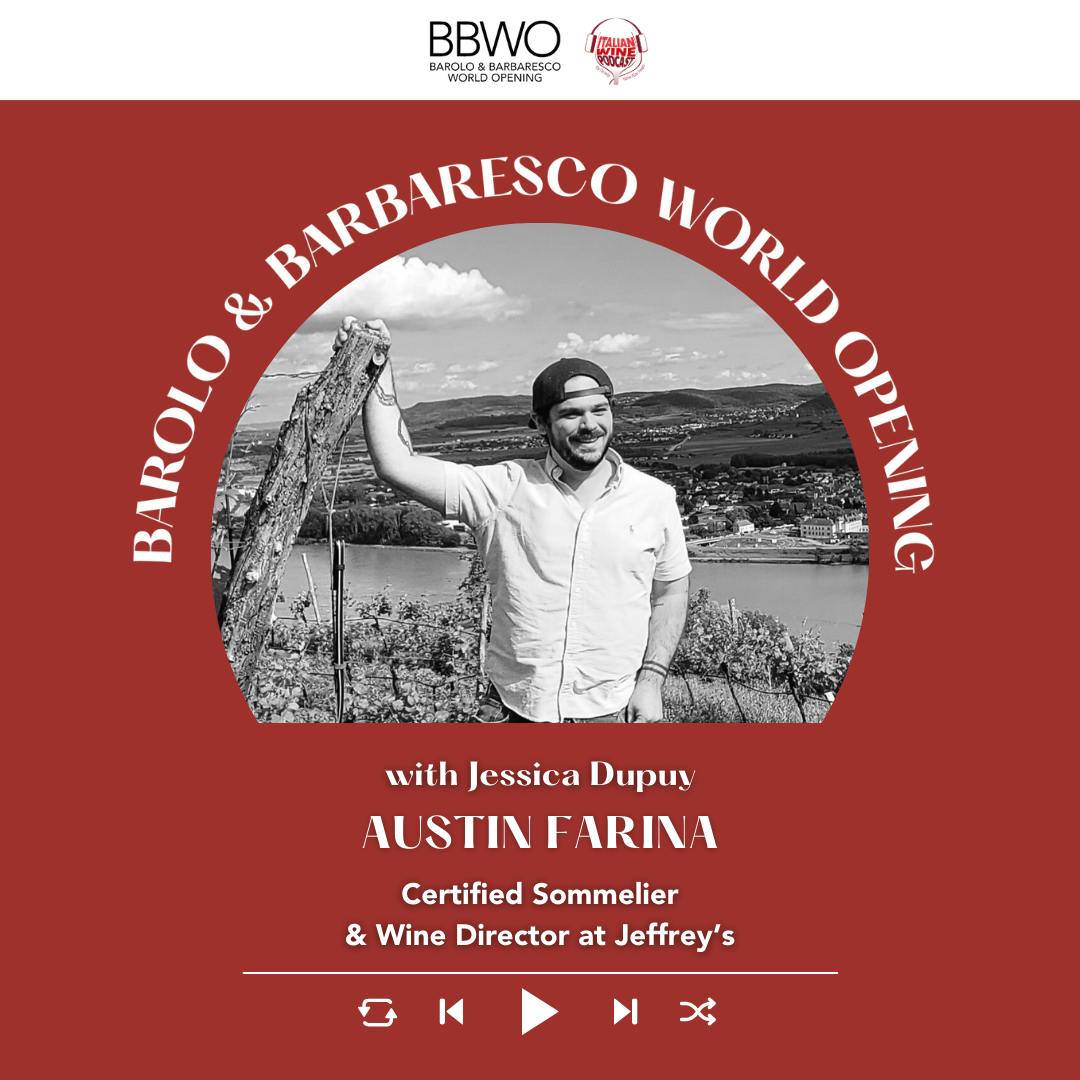
Ep. 2285 Jessica Dupuy interviews Austin Farina | Barolo Barbaresco World Opening
Barolo Barbaresco World Opening
Episode Summary
Content Analysis Key Themes and Main Ideas 1. The rising interest in Barolo and Barbaresco wines in the United States, particularly as alternatives to Burgundy. 2. The characteristics of the Nebbiolo grape and its terroir-driven expression in Piedmont. 3. The evolution of winemaking styles in Barolo and Barbaresco (traditional, modern, and ""post-modern""). 4. The vibrant and growing wine community in Austin, Texas, and its broader role in the Texas wine market. 5. The importance of wine education for both hospitality staff and consumers. 6. The cultural significance of food and wine pairing, especially in Piedmontese cuisine. 7. The upcoming Barolo & Barbaresco World Opening (BBWO) 2025 event and its significance for trade professionals. Summary In this episode, guest host Jessica Duppuis interviews Austin Karina, Assistant Wine Director for MML Hospitality, about Barolo and Barbaresco wines in anticipation of the Barolo & Barbaresco World Opening (BBWO) 2025 event in Austin, Texas. Karina shares her background, the growth of Italian wine interest in Austin, and the collaborative nature of the Texas wine community. She details MML Hospitality's commitment to wine education for its staff, enabling them to speak knowledgeably about the regions. The conversation delves into the unique qualities of the Nebbiolo grape, its terroir-transparency, and the historical and current winemaking approaches in Barolo and Barbaresco, including the concept of ""post-modernism"" and the increasing role of women in winemaking. Karina highlights that the perceived differences between Barolo and Barbaresco have significantly narrowed. She also emphasizes the integral role of wine with food, particularly in Piedmontese culture. Finally, Karina discusses how trade professionals navigate large-scale tasting events like BBWO, balancing the discovery of new producers with strengthening existing relationships, and notes the current string of exceptional and accessible vintages from Piedmont. Takeaways - Barolo and Barbaresco (Nebbiolo) are gaining popularity as alternatives to Burgundy in the US market. - The Austin, Texas wine scene is dynamic, collaborative, and shows a strong affinity for Italian wines. - Wine education is a continuous and emphasized process within MML Hospitality, equipping staff with deep knowledge. - The distinction between Barolo and Barbaresco has become less pronounced over time due to advancements in winemaking. - Nebbiolo is an inherently terroir-transparent grape, deeply connected to its specific region and climate. - Modern Barolo/Barbaresco winemaking is evolving towards a ""post-modern"" approach, integrating beneficial new techniques (like cleanliness) while retaining traditional elements. - Many next-generation leaders in Barolo and Barbaresco are women, contributing to continued excellence. - Recent vintages (2016-2021) of Barolo and Barbaresco are noted for being exceptional and enjoyable in their youth. - Large trade events like BBWO are crucial for discovering new wines and fostering industry relationships. Notable Quotes - ""We're seeing such a good increase in interest in Barolo and Barberesco, specifically single cruise, as people are looking for alternatives to Burgundy, frankly."
About This Episode
The Barolo and Barbara single cruise have seen a strong increase in interest, with a guest host for a special series on the Barolo and BarBaresco World Open 2020. They discuss the community in Austin, Texas and its vibrancy and community in Houston. They also talk about the demand and demand for Italian wine in the Austin area, as well as the success of Barolo and Barbara in attracting new customers to their menu. They emphasize the importance of education and tasting class, and the transition from traditional Italian wine to traditional Barolo and Barbara. They also discuss the "lessen of cleanliness" and "lessen of traditional" movement, and the importance of navigating experiences to avoid disappointment. They also discuss the success of their own wine program and the potential for new vintages.
Transcript
Jeffries is a worldwide list or worldwide programming. So our focus on Italy and specifically PM Monday is growing. At Jefferies as we're responding to what we're getting us for, you know, like, we're it's hard keep these things on the shelf sometimes, to be honest. Like, I I hate to say that way, but, like, we're seeing such a good increase in interest in Barolo and Barbara, specifically single cruise, as people are looking for alternatives to Burgundy, frankly. Right. Especially in Austin. Hey, y'all. I'm Jessica Duppuis. Guest host for a special series on the Barolo and BarBaresco World Opening twenty twenty five presented by Landmarks. This fourth edition of BBWO will showcase the latest releases of twenty twenty one Barolo and twenty twenty two Barbarresco wines from Piedmont, and takes place in Austin, Texas on March twenty fifth. Join me in the heart of Texas as we delve into the experiences and insights about the terroir of the Longay region and its star grape variety, Nebulaola. We'll talk to Smalliers and retailers from the key markets of Austin, Dallas, Houston, and beyond about the alluring wines of the barolo and barbaresco regions. If you enjoy the show, please subscribe and rate our show wherever you rate your podcasts. Note, this series is funded by the European Union. View and opinions expressed are however those of the podcast participants only and do not necessarily reflect those of the European Union or of the granting authority. Neither the European Union nor the granting authority can be held responsible for them. Alright. So Austin Karina, welcome to Italian White Podcast. I'm so glad we were able to sit together and talk a little bit about Barolo and Barbara. Yeah. Thank you so much for having me. This is one of my favorite regions, and I'm so excited to talk about Yes. I do. So just so everybody knows, we are at Jefferies, which is a fine dining establishment here in Austin, Texas. One of my favorite places to come for special occasions. I think I was here for my anniversary recently. And so maybe you could tell us a little bit about first yourself, and then we'll talk about Jefferies and kind of the MML group of restaurants. But where are you from, Austin? And how did you get into wine? Yeah. Absolutely. So, yeah, we are here in Jefferies, which is amazing restaurant. We're celebrating our fiftieth anniversary of this year as well. Really? Yeah. Nineteen seventy five to twenty twenty five. Wow. And so, yeah, it's a really exciting time to be here. I have been down here in in Texas for six years now. We originally grew up in Virginia. My dad is Italian from, was born in Milan. So I grew up first generation in Virginia. So my side of the family really drew me into the wine business. They weren't involved in wine, but always had an affinity for it. Always had a love for it. My grandfather specifically had a love of collecting things that didn't really need to be collected. And giving them way too much time in the cellar. Oh, no. So you got to learn about oxidation quickly? Oh, we I got to learn to know what George Buff tasted like in the eighties. Oh, it looks so weird. I think. But It is also, had a huge, love for Virrolo and Barbara, specifically, of course. Yeah. And so I moved down here about six years ago. I'm now the assistant wine director for MML Hospital Hospitality. So we operate quite a few restaurants now. Mostly here in Austin, a hotel in New Orleans, now post in Houston, as well as a few small smattering of things up in Aspen and a new one, Clark's poster bar in Montecito. Montecito. It's Santa Barbara area. Yes. Yeah. And, you know, I'm originally from Austin, and I have to say, like, the MML properties have kind of been, like, a fixture in my life since childhood. So Jeffrey's being a perfect example. Like, like, like I mentioned special occasions, birthdays, prom, I think, a long time ago. So it's really cool to kinda see that you've come from not from Texas, but have found your way to this place and have made really an impact particularly in the Sommelier community in Austin. I wonder if you could talk a little bit about the community here, and maybe Texas in general, just in terms of, like, the vibrancy of such a great community that helps each other out to kind of further education and wine and some kind of career trajectory, if you will. Yeah. Absolutely. Texas is such a big and diverse state, which is so exciting. It's I mean, it's bigger than France. So we have very different communities in the different parts of Texas, which I think is super unique Austin, the community is small, but really tight knit. Everybody is really helpful to each other. It was really impactful, and everyone really kinda lifts each other up. And if you have a question, there's always somebody who has been there before and is ready to answer it. Also spent some time in Houston, which I've that we've talked about before, is I think the most exciting place in the country to drink wine right now. Hundred percent. Yeah, an incredible community, an incredible market to work. It's a really, really fun time. And then, of course, Dallas, San Antonio, West Texas. They all have their own personalities too. Austin is a really fun place to be. It's really dynamic place to be. Still one of the the fastest growing cities in the country. Still one of the most fastest growing cities amongst kind of the the new emerging wine drinking millennials now. As they start to to shift into drinking a little bit more wine, and we start to see a few other people kind of coming up behind them. But but yeah, it's a really exciting it's a really exciting place to be here right now. Yeah. That's super cool. I wonder, actually, if you could talk a little bit about What you see in terms of Austin community compared to Houston community when it comes to wine? Like, what what is Houston wine seem like compared to Austin and what have you seen is there a stronger desire for French or Italian or, you know, things like that? Yeah. I would say Houston there's so is such a big city and such a diversity that there's an affinity for just about everything and there's a place for just about everything. There. In Austin, I was surprised by the strength of the desire for Italian wine amongst general consumers. Oh, really? Okay. I've been pleasantly surprised by that. When I first moved back from Houston, I was overseeing it, almost a hundred percent Italian list at Sam's. Still oversee that kind of a more of a director away to the team there, which on the ground, which has really taken the reins and run with it. They've done an incredible job. Barolo and barbaresco are two of the main features of the menu there, of course, but it spans at We North south as well as some France, some other Mediterranean islands smattered in there as well, and some domestic stuff too for good measure. Yes. But, gotta get to some Texas for that to go on the list. I love it. But it's a fun place. And I, like I said, I think Austin has a lot more demand and a lot more affinity for Italian wine, and I think that speaks to kind of the or more than I expected. I wouldn't say more than Houston. Okay. More people there. They got a speed they got a speed on population. By a lot. But I think it's speaks to the Austin kind of market's desire to, like, try new things and have new experiences, especially when it comes to food and wine as a unit. It's a really adventurous market. So hot or newer trendier things tend to tend to take hold and then in Austin and then spread, I think, elsewhere. Austin has that kind of cool factor, that x factor that kind of makes it outweigh even larger cities in the nearby area, like San Antonio, for example. Exactly. Much bigger city. Yeah. Austin is the Austin's the one that people pay attention to. It has that x factor. And so it's a Yeah. It's a it's a cool it's a good place to be for that reason. Yeah. Absolutely. I'm curious, you know, talked about how, like, there seems to be this great love. And of course, you know, Sammy is Italian being an Italian restaurant. Right? They're gonna obviously ask about Italian wines, but it it's interesting to me just looking at that list in particular, the depth that you're able to bring for Barolo, Barbara. And has that kind of been exciting in helping to build that list in terms of, like, okay. Here's what I'm seeing people want, and here's what we need to make sure we can offer. When you approach that kind of a list, are are you looking for breadth of producer, depth of vintage, or how do you approach a list, like, like, at Sam's? And maybe even compared to Jefferies because I know it's quite a bit different and still offers a lot of Italian wine as well. Yeah. Absolutely. That's a great question. So Jefferies is a worldwide list or worldwide programming. So our focus on Italy and specifically PM Monday is growing. At Jefferies as we're responding to what we're getting asked for, you know, like, we're it's harder to these things on the shelf sometimes, to be honest. Like, I I hate to say that way, but, like, we're seeing such a good increase in interest in Barolo and Barbara, specifically single cruise, as people are looking for alternatives to Burgundy, frankly. Right. Especially in Austin. I I can't speak to if Houston's seeing the same thing right now, but I so if I say it probably are, it's probably not just an Austin Houston thing. Yeah. Yeah. Yeah. Yeah. But So, yeah, we are at Jefferies, the list is smaller of Pemonteisse wines because the overarching programming is bigger. Whereas at Samis, it's more of a microscope. The server and it reflects in the servers there too at Jefferies. We have incredibly knowledgeable sommeliers, and they're on the floor every night. It Amy's the servers can tell you the difference between La Mora and Casiglione Foletto. Pretty awesome. They can talk to you about trace over snape. Like, it's it's an incredible thing that they've been able to build as, like, they're able to go from a big bird's eye view. Like Jeffrey has into a little bit more narrowed focus. Over at Sam's. Bliss there is still big. It's still about five hundred wines, but again, mostly Italian and the biggest focus is Piamonte. And so Jefferies, it's more about, okay, we're seeing this trend popping up at Sam's and people being excited about it. How do we expand our offerings here, make sure we're getting a good stylistic diversity in Piamonte, make sure we're capturing those entry tier folks who have, you know, maybe never heard of Long in a b o o. Maybe they can graduate from there to a barolo or barbaresco, then they can start to explore single cruise, then they can keep going from there, but it's all about taking that first step in that first journey. So how do we make sure that a small in a smaller list, we still hit all those steps of that journey? Exactly. Yeah. No. That's a really good way to look at it. I think that's really helpful. Tell me about your kind of personal experiences with two regions, Barillo and Barbara. Have you had a chance to ever go? Or Yeah. So I have been a handful of times to Barillo and Barbara the area red around the longue and Alba and Austy. And so it's an incredible place. It's one of my favorite places in the world. Oh. It's one of my favorite cuisines in the world as well. I think Barrola and Barbara Esco, and the cuisine of Piamonte, specifically the cuisine of the longue and the cuisine of Monterato are so unique and kind of capture this really beautiful synchronicity between the French love of food and ingredients and, like, putting the highest, yeah, putting the highest importance on just good quality ingredients and technique and the Italian ideas that were similar, but maybe a little bit more driven from heart and soul and just feel of it. Love it. That's a great yeah. They really just come together. Yeah. It comes together like that. Yeah. It's such an incredible place. And so, yeah, we have a really incredible love and respect for Piamonte, both at Samis and Jeffries, but it doesn't just go to the wines. It's the cuisine, it's the culture, it's the people, it's the art, it's everything that kind of comes from it. Going to Barolo and Barbara, handful of times has been you know, a mountaintop journey for me for sure. And I go hope to continue to be able to do it. The towns are incredible. The winding streets, the wine, of course, the fog, actually being able to see it roll through, being able to look down the valley from the Cruise Corona and see all the way down to Sarah Alanga to Alba and some of the single vineyards, single crews kind of sticking out from the ridgeline. It's an incredible place and I highly, highly, highly encourage anyone to go. It's super tourist friendly. It's really easy to get around. There's a lot of cycling if you're into cycling. I know a lot of folks here in Central Texas are. It's an incredible place to do a cycling trip. Yeah. It's a wonderful. I love you. I love the role of Nebraska. If we're if we're pushing things for people to do, I also think it amazing to go ahead and take advantage of the truffle dog hunting if you're in there in at the right season, you know, because, like, to have an expert guide and show you how these dogs are trained to go and find, like, things deep in the dirt is pretty fascinating. Yeah. And I didn't know this, but, like, I knew about, you know, there's trouble hunting in, like, France, but they tend to use pigs, whereas in Pimonte, especially, there's a there's a particular breed of dog. It is specifically trained to do the truffle hunting. And, you know, for anyone who's not had fresh shavings of a white truffle on tairine I mean, I know we're supposed to be talking about the wine. But we'll get to that. No kidding. But it's pretty amazing with you know, Naviolo. Right? So Absolutely. So whether that's from Barbara or Barolo, maybe talk to me a little about what is it to you with the Naviolo grape that is so that captures something that's beyond. It's I love the conversation circling around food and wine here because that's what it is. Right? And I think that's what we need to kind of refocus a little bit in America is, like, having a meal in Piamonte without wine is, like, having a meal without a fork. Like, you just say you don't. It's something you wouldn't do. Yeah. And in America, we are still kind of figuring that out, I think. And so I I maybe that's our next pair of brain scheme is to convince everyone that the wine is part of dinner. It seems like an obvious, but maybe you and I are in the the industry that yeah. So Nebula was specifically really incredible grape variety, really to our war transparent long rowing season, which I love in wines always. I always seek out vintages where, you know, the growing season was a little cooler, a little longer, a little bit more even, because it for me, I feel that it gives the grades the opportunity to develop complexity of flavors without their alcohol shooting through the roof or their acidity falling off. Right? So Neviola's already kind of built for that inherently, which is part of the reason why it hasn't really propagated around the rest of the world the way that Cabernet sauvignon or Hina noir has. It's so it's indigenous to this place and it's molded itself to this place, specifically. Yeah. And so it's so uniquely. It needs such specific climactic conditions through the season. That, you know, just like truffles, you really can't do it elsewhere. It just doesn't work in that way. Very few. There's some some exceptions where Nebula has gotten out there and done really well. But again, their places where it's very specifically has a very long availability of their season. Right. Tell me what you expect between Barbaresco and baro we don't have to drill too deep into, like, specific, I mean, unless you want to. But, like, what do you expect from Barbaresco? What do you expect from Barbaresco when you're drinking those wines and and kind of where do they shine in their own way. Yeah. So I think this is such a fun topic because it addresses what I think is probably the biggest misconception in Piamonte today. Wonderful. Is that there's not that much of a difference between barbaresco and Barolo unless you're tasting them side by side and you are a really adept at tasting wine. Yeah. The vast majority of people, consumers who have heard of barolo and barbaresco and understand that there's a difference between the two would think that barbaresco is lighter. Okay. Because historically and I'm talking fifty years ago plus, that was the case. Right? But as winemaking has improved, as farming has improved, as appointments being changing a bit, for both of the regions, the the bar has drastically narrowed. Okay. Or the gap is drastically narrowed, I should say. And so at the wines and the quality, the kind of richness in body, the aromatic structures, there's almost an indistinguishable difference between the two. Now I think we can definitely drill down to individual sights and individual cruise. Like I said, Nebula Noel, kind of like Pina noir or Norello Moskaleise or Granache can be sometimes it's a really terroir transparent grape. And so I think that's where for me, you see a lot. I would say there's a lot more difference between La Mora in Saralanga, then there is between a barolo that's regionally appelated and blended from a few different parcels or a barbaresco that's regionally appelated and blended from a few different parcels. Yeah. No. That's a really good way to say it. Let's talk on two levels here because I think that it's important to mention the depth of education that you guys really, kind of promote here through ML. You guys do regular weekly, I think, classes For staff, that can include everyone from your floor, sommeliers to dishwashers. Right? Like, if you wanna learn about wine, you can come and show up at these things. How do you approach the education angle for your staff to be able to explain Barolo and Barbara as you said, like, at Sammy's, everyone can talk about it, with great knowledge. So how do you go about doing that? Yeah. So it's it's a lot of constant gentle pressure. Okay. It's a lot of kind of pushing a little bit every day. Right? Yeah. You know, if you come over, come out and hit somebody over the head with questions that they don't even know what the words mean, then you're not really gonna get a good response from them in terms of learning and pushing themselves. But we do put a lot of emphasis on education, a lot of emphasis on tasting. Well, and again, with those weekly classes and others, it's a lot pushing somebody a little bit further every time and pushing a little bit more towards the direction you want them to move it to. And so, yeah, we do a lot of, a lot of education here. We feature producers from around the world and focus on different import books, different domestic producers, great varieties, kind of regional themes. We did a really great class alpine wines last year. It was really fun. Nice. Kind of focusing on those alpine and sub alpine regions around the world. So some high altitude nebelo will included in that conversation, which was fun. Balselina? Yeah. We got introduced to Balselina that day. Nobody else drives the Nebula out like they do. So it's an interesting. It's an interesting flavor profile. Yeah. But it works for them. And so the region of barolo and barbaresco, while they're not necessarily alpine wines, they do see that influence of the cooler climate, the longer season, and those things as well. But having the emphasis for our staff being on education about these regions and about the micro regions within them, the villages, and the crews really kind of drives the narrative then I think that infects other places and other regions. Because you can see that same effect of, you know, it's concept of terroir, right? Right. Yeah. In action, and you can see that same effect in burgundy. You can see the same effect in Tria. You can see that same effect starting to emerge in Germany and in other parts of the wine world as well, and Barboresco really jumped on it pretty quickly, and realized that their terroir transparent grape variety is that can do really well when you look at them on an even more micro level. Okay. Okay. That's super helpful. How does that translate to the guest? You know, when you're let's let's say Cammies, for instance, where it's an Italian driven menu, You probably have I mean, this is the case for all guests. It's like sometimes you just order what you know. So, you know, it's like, oh, I love Barolo or I love Barbararesco. I'm gonna stick stick in my little safe place with these producers that I know kind of, what's the approach on expanding their horizons and, giving them something to discover? Yeah. Absolutely. So I all these questions today. So, So I a lot of when we talk about it, Sammy, specifically, end of Jeffries too, but specifically, Sammy's when it refers to Italian one is the kind of transition that Italian wine has had since, like, the seventies and eighties into now. Yeah. And kind of from a historical context. So starting with like the staunch traditionalist winemakers and the folks who have kind of maintained that kind of staunch traditionalism into the quote modernism of using some more French techniques using French various, shorter fermentations, more aggressive extraction, all of these things. And what is that profile, flavor profile, and the folks that are still, using those techniques? Some have pulled back a bit. Some have continued to stay exactly where they are. And, you know, where does that add more diversity into how we write the list? Where does it add more diversity into how we talk about it to guests and make recommendations? If you typically drink napa Cabernet, and your friend told you to get you should try Barolo, you know, it's helpful for me to know that you typically drink napa cabernet so that I can steer you towards somebody who also uses Barriq and who uses commercial. There's not a right or wrong way. They're just totally different flavor profiles, and we wanna make sure that they're, you know, from a service perspective that so people get what they want. Yeah. And now I think the most interesting part of Barolo is the what I've kind of been calling the end, Barbara Esco, and calling kind of post modernism. Tell me. Yeah. How would you define that actually? Because that's a really So these are folks who are utilizing the technology and the, kind of, some of the beneficial parts of the, kind of, modernism movement, but pulling back to large Botte, pulling back to longer macerations, kind of pulling back some of the things that made Barolo, Barolo, but then keeping some of the things that made barolo into something that you don't need to wait thirty years to be able to truly enjoy or at least the perception of it. Right? And I think it's similar honestly to what happened to Burgundy back in seventies and eighties. Burgundy people forget was also something that you had to wait quite some time to be able to really enjoy a grown crew. And in that time, we saw a lot of kind of quote modernizing right around the same time as Barolo and Barbara did. And you started to see wines that were a lot more plush and a lot more open in their youth and a lot more ready to enjoy. And I think that's Barolo is re and barbaresco are really starting to emerge from that same era into things that I can drink a twenty twenty or a twenty twenty one barolo. And get immediate pleasure out of it. I don't need to wait so long. And so they took some of these good things from this kind of modernism movement and then hold peeled back the stuff that they didn't want anymore. Yeah. Yeah. Yeah. No. That makes sense. And the and the best part of it. Yes. It's all being led by women. I love this too. Yeah. Yeah. Not all. But a but a lot of the greatest houses of Barolo and barbaresco are being taken over by the daughters of the founders or the daughters of the people who took the, the ownership of from just making grapes to making wine and kinda founded the label into these things. So there's a ton of that. I would spend way too long listing specific people, but but it's they're I think the wines have never been better. Yeah. I mean, that transition to the next gen, you know, is all always an interesting thing to see. And I think you're right. You do see a lot more women wanting to kind of really dig into the and take on a family tradition in this way. It's something, you know, something I heard the other day, and I I I feel like it's appropriate to quote who it was from just because it it was something I'd never heard of when it comes to the Barolo barbaresco region and the the discussion of traditional versus modern. Right? Like, we should probably just move away from that in general because it creates so much tension, but heard this from Giuseppe Vaira, who was talking about how you also have to think about that those two factions also had other things going on that we don't think about. So, like, the issue of cleanliness really came alongside with the whole modernist movement because they were using new barrels not old barrels that had probably been used so many times. Right? And they were using new things that were just by virtue of the fact that it was new going to be clean. Right? And something he said that struck me is that really like, running water did not make it to Pemonte until the seventies, early eighties. Certainly not into the sellers. Exactly. Cause they were underground. And it was like, you had wells and you had to pump the water too. And, like, like, if you already had to fill your kitchen sink to clean dishes and bathe and everything else. Like, were you really gonna pump that much water to get down to your cellar to clean everything? And so that was such a huge revelation to me because it's not necessarily about being tent of the winemaking. It was a byproduct of what resources were or were not. And so this idea of, like you said, people are kinda going back to our traditionalist ways in terms of larger vessels but with more modern advanced techniques because we have water pressure heat from the water. You know, all of these things Better understanding of microbes. Like Yeah. Yeah. Yeah. So I mean, he used the term, like, clean traditionalist. And I really liked that idea because it's these are the parts that We hear buzzwords about these things, but I think there's so much more that we have to consider. And it was really helpful to me to understand that better. Yeah. Absolutely. Yeah. And it is such an interesting phenomena I experienced it. During a trip to Barbara and Barolo in the same day, we went from the seller of a very well known kind of arguably the founder of modernism in Barolo and and largely in Italy, which is a very, like, pristine, shiny, elegant thing. Yeah. An amazing in that right, and then to one of the most sought after traditionalist winemakers right after Yeah. And saw the damn seller and saw the the mountains of, you know, iconic bottles displayed amongst the Boti and, like, you know, to see those two so starkly contrasted in, you know, within an hour of each other Yeah. Was such a unique thing. But I think, yeah, many of these wineries, whether they kind of went into the more of the modernist route or whether they stuck into the more of the traditionalist route, These families are now coming back towards the center in both ways, most, most people and are taking some of those better things like we were talking about, the cleanliness, temperature controls in some instances, winemaking advancements that came with, the quote, modernist movement, But then I went, wait, you know, did we lose something when we Right. You know, or or what do we wanna keep from our kind of history and our tradition in terms of, you know, what makes Barolo, Barolo, what makes Barbara Esco, Barbara Esco, you know, making sure we don't lose those things in the pursuit of a style. Right. Right. Right. And, you know, to kinda, like, sum all of that up, I think this is what inspires me about what we do in wine is, like, you're able to take all of that experience, see those two different contrasts in one day And then you have to boil that down and present that to a guest as you're as they're asking you what bottle of wine that they should drink that night. Yeah. And to me, that's the beauty of the exchange, right, of what we're doing. Right. The biggest question that I ask, yes, especially at Sam's, and especially when you're looking at Barillo and Marberezco, is are you searching for something that's more driven by elegance or more driven by power? And those two things are not mutually exclusive. At all. It's just which one is winning a little bit more. And there are and there are answers. There are a handful of wineries in the world where those things are both equally matched and both equally turned all the way up. Yeah. And those things are some of the, you know, those wineries are some of the best examples of each of their, prospective regions. But generally, let's say most of the most wines fall into one or the other is gonna win win out a little bit. Right? Yeah. So it's more steering towards okay. Someone drinking classically Napa Cabernet or Bordeaux and wants to try Barolo. Right. You know, where am I gonna take that person versus somebody who typically drinks burgundy and riesling and Aetna and things like that and and taking them into into barola. Where am I gonna end up with both of those different clients? And I think that's kind of the unique thing for barolo and barbaresco is that you do have both because of this history because of this trajectory, because of this kind of split between traditional and modern and and the kind of convergence of it. And because of the the kind of unique aspect and the unique characteristic of the Nebula grape. Right. We talked about it a little bit with food pairing, but it's such a unique thing to be able to have something that has really high tannin, in really high acid. Mhmm. At the same time, it's drying your mouth out with the tannin. It's replenishing the water with acid. Yeah. It's making you want more with that. And also to eat, so much so that you oftentimes don't notice the alcohol that also happens to be a little bit elevated, but that's okay. Yeah. All the things all the way up. Exactly. Everything's turned to eleven. Alright. So I have one last question for you, and that's just, you know, We're sitting here today to talk about Barrello Barbarresco and kind of like anticipation of the BBWO. So Barrello Barbarresco World Open. And I'm just curious, you know, for someone like you who's in charge of multiple different wine programs, And you're you have an opportunity. Obviously, you've been able to travel to the regions, but then at in a situation like this, you have an opportunity to see a hundred and fifty producers in one place. How do you go about navigating an experience like that as someone from the trade? What are you most looking to to do out of something like this? Are you trying to discover something new? Are you trying to make relationships with people you already have? Yeah. It's it's it's a both and for sure because we have a lot of interest in Barolla and barbaresco both from the trade level as well as the consumer level right now. Yeah. I tell folks all the time, you know, when I'm kinda moving them from one part of the world into something from Piamonte, for their dinner, you know, this is the best time to discover Erolo and Barbarresco. For all the reasons we just discussed, you don't need to wait forever for it to be ready in your cellar. The wines are increasingly, you know, delicious upon release every year after years. We also are going through a string of really incredible vintages, which shows no signs of slowing down. That's awesome. Yep. Some really incredible vintages that are some even you can still find some sixteens in teens in the market still occasionally. Eightteens are so delicious and ready to go right now. Ninens are amazing. Twenties are being released right now. Are incredible and ready to go right out of the gate. Like, these ones are are really spectacular. And especially if you're looking for terroir transparent grapes, you probably also like things like burgundy and things like riesling and things that are, you know, that are catching on already or have caught on already. And maybe you're looking for what's the next thing I can go to that's a little bit different still gives me that pleasureability of, like, oh, this single vineyard is different and unique and fun. Right. And gives me a really delicious flavor profile that can hit all the things that I was already looking for. I just didn't know why Yeah. To find here. Yeah. Yeah. Yeah. That makes sense. So within the, context of events itself, we're always looking for who's here for an event that is either excited about getting into the United States, if they're not already, excited about getting into Texas, if they're not already, with Texas. Of course, we have the advantage of of a few massive ports. So we do have a lot of kind of smaller independent folks who are able to find their way in via connecting with other smaller independent folks who are here. Which is a great boon for our market here specifically. But beyond that, I think it's so important to develop to continually build and develop relationships with folks that you already have, especially, because you never know what the you know, what shifts are gonna happen, you never know what position you might find yourself in, or where you might find yourself, you know, fits geographically, and you might need to lean on somebody, a relationship you have with somebody that you didn't know you needed So it's a balance of all of it. Absolutely. Absolutely. So, like, I'm so excited to connect with people that I've met before and some other, you know, some of my my favorites as well as to meet, you know, new friends and people. We're doing a small breakout session and tasting at Jefferies here during the, walled open, I think on February fifth. Yes. As well as a few other events happening around town. It'll be a lot of fun. Yeah. It'll be great. Well, Austin, it's always great. To sit down with you. I feel like you're really good at packing all sorts of amazing information into a short amount of time. Thank you. And you're so good at editing. Well, you know, it's a good team. It's a good team, miss. But thank you so much for taking this time. I know you're super busy right now, and I look forward to seeing you definitely at the master class. I will be there. And then also, the big event in March. Yeah. It's gonna be incredible. Alright. Looking forward to it. Thanks so much. Thank you. Thanks for listening to this special series on the Barolo and BarBaresco World opening twenty twenty five. If you enjoyed the show, please subscribe. And rate us wherever you listen to your podcasts. Special note, this series is funded by the European Union. Use and opinions expressed are however those of the podcast participants only, and do not necessarily reflect those of the European Union? Or of the granting authority. Neither the European Union nor the granting authority can be held responsible for them.
Episode Details
Keywords
Related Episodes

Ep. 2787 Prosecco Superiore by Dr Susan H. Gordon | Book Club with Richard Hough
Episode 2787

Ep. 2784 The Other Side of Valpolicella: Volcanic Soils & Sparkling Wines with Francesca Marcato of Talestri Winery | Wine, Food & Travel with Marc Millon
Episode 2784

Ep. 2780 The Bridge between the Past and the Future of Wine with Serena Costanzo from Palmento Costanzo on Etna | Clubhouse Ambassadors' Corner
Episode 2780

Ep. 2773 Trento DOC: one of Italy’s finest sparkling wines with Alessandra Caroni of Maso Martis | Wine, Food & Travel with Marc Millon
Episode 2773

Ep. 2749 The Many Faces of Etna: Climate, Contrade and the Art of Volcano Winemaking with Federico Graziani | Wine, Food & Travel with Marc Millon
Episode 2749

Ep. 2744 Ep 25: Pantelleria, Salina e il fascino del vino insulare | Pellegrinaggio Enoico con Attilio Scienza
Episode 2744