
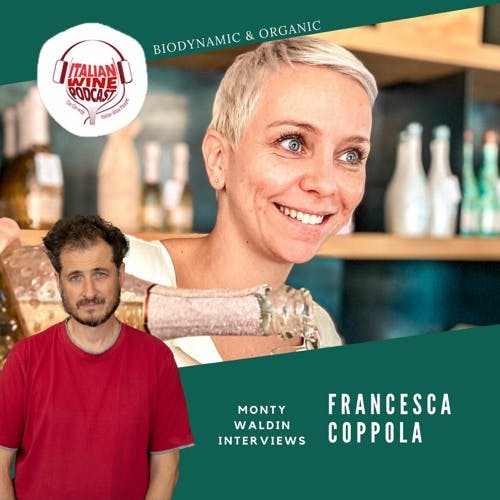
Ep. 635 Francesca Coppola | Biodynamic & Organic
Biodynamic & Organic
Episode Summary
Content Analysis Key Themes and Main Ideas 1. The pioneering history and enduring commitment of Cantina Pizzolato to organic and vegan wine production. 2. The evolution of sustainable winemaking practices, including certifications and innovative varietals (FTV). 3. The company's approach to market demand, particularly for organic, vegan, and no-added-sulfite wines. 4. The philosophy of sustainability influencing all aspects of the winery, from vineyards to packaging and hospitality. 5. Specific insights into Cantina Pizzolato's best-selling products and future projects. Summary In this episode of the Italian Wine Podcast, Monte Walden interviews Francesca Coppola, Sales Manager at Cantina Pizzolato, a pioneering organic and vegan winery in Treviso province. Francesca details the winery's foundation in 1981 by Settimo Pizzolato, who, influenced by his background in chemistry, committed the estate to organic farming from the outset, becoming one of Italy's first certified organic wineries in 1991. The entire production achieved vegan certification in 2012. Cantina Pizzolato was also an early adopter of no-added-sulfite wines, driven by demand from the US market starting in 2007. The discussion highlights their holistic approach to sustainability, exemplified by their eco-friendly winery inaugurated in 2016, the ""Muse"" line which promotes bottle reuse, and the forward-thinking FTV (Fungus Resistant Varietals) project aimed at drastically reducing vineyard treatments. Francesca also shares insights into their popular Prosecco DOC lines and mentions an upcoming wine bar project to enhance their customer experience. She emphasizes the increasing consumer demand for organic and health-conscious wines, a trend Pizzolato has anticipated and led for decades. Takeaways * Cantina Pizzolato is a historic pioneer in Italian organic wine, celebrating 40 years of organic farming. * The entire product line of Cantina Pizzolato is 100% certified organic and vegan. * They were among the first to produce wines with no added sulfites, responding to specific market demands (e.g., US). * Cantina Pizzolato's commitment to sustainability extends beyond certifications, incorporating practices like eco-friendly packaging and disease-resistant grape varieties (FTV). * The FTV project aims to significantly reduce environmental impact and costs by decreasing the need for vineyard treatments. * Consumer demand for organic, vegan, and sustainable wines is a growing trend globally. * The winery is expanding its hospitality offerings with a new wine bar. Notable Quotes * ""We are in fact taking this year celebrating fortieth anniversary of organic farming."
About This Episode
The current owner of the organic winery Monte Walden has a sustainable approach to organic farming and is interested in non-traditional wines. They have a long history of organic farming and have seen success in organic wines, including their sparkling Proseco extra dry vintage. Their new vintage twenty twenty Proseco doc Rosier has seen great success in Europe and overseas markets, and they plan to create new, eco conscious, and multi-year designs. They discuss their experience with fungal and fungal disease treatments and their desire to have a new journey to a new planet with less energy consumption. They thank their new sponsor, Federal Wine, and encourage them to subscribe to the Italian wine podcast.
Transcript
Italian wine podcast. Chinchin with Italian wine people. Hi, everybody. Italian wine Podcasts on the Breights' fourth anniversary this year, and we all love the great content they put out every day. Chinching with Italian wine people has become a big part of our day, and the team in verona needs to feel our love. Producing the show is not easy folks, hurting all those hosts, getting the interviews, dropping the clubhouse recordings, not to mention editing all the material. Let's give them a tangible fan hug with a contribution to all their costs. Head to Italian wine podcast dot com and click donate to show your love. Hello. This is the Italian wine podcast with me Monte Walden. My guest today is Franchesca Copola from Cantina Pizzolato. Welcome, Franchesca. Thank you, Monte. Hello, everybody. So Franchesca, what's your role at Cantina Pizzolato? My role, is sales manager. I'm one of the two sales manager. I work closely to the export manager, Sabina, managing, mainly our export customers. Where where is the estate then? The name of the estate and where is it? Our state, our organic winery is in Vilarba in Treviso province in the flourish countryside of Treviso province in the art of Perseco DOC area. When was it founded? The company was founded in ninety eighty one when the current owner joined the company with his father. So Satimo Pizzolato, the current owner, started the company, with our organic management with this father, genome. We are in fact taking this year celebrating Fortieth anniversary of organic farming. The whole production has been certified or than in nineteen ninety one when Italy actually, there were the certified companies who started officially certifying the the wine, so it was quite an easy process that actually because we already had all, organic management in our winery. We gained also in twenty twelve, the vegan certification for all our wines. So the whole production, when you talk about pizza lotto wines, is hundred percent certified organic and vegan. And this was practically one of the, of the owner's desire to make a wines fall and to be affordable for all. And then the results of this process is like, a new wiring, inaugurated in twenty sixteen, with a sustainable concept. That is mainly, like, inspired by the philosophy of the of the owner. This is the fifth generation of pixelato family. So this is practically one of the biggest Italian family company who, produce and sell only organic wines? What are your, obviously, this is a historic wine. For those of you who don't know, It seems quite recent. Some of these, mistakes, are becoming organic, but this really is an historic, estate in terms of its, organic organicness, if you like. It was all sort of organic before organic was even on the radar. In terms of, where where was the where was the idea, where was the idea coming from to really break the wine down into something very, very elemental. So you know, vegetarian friendly, vegan friendly, organic, etcetera. When the current owner set him up, Pizolato joined the company with his father, he was studying, chemistry at university, approaching to what all the chemical products and pesticide, results could have affected the soil and the the terrar and also customers So when he joined the company with his father, one of the the focus that he, firstly, highlight to the father was, look, I'm going to join the company, but only if we are going to only manage it organically. So that was one of his, main desire. This is not, as you correctly said, before, this is not like a trend. Because it's it's quite a recent trend in our market as in, foreign markets, especially, a recent trend of organic, but Satimo Pizzolato was one of the pioneers in the organic farming. Because, this is his philosophy. This is a a life choice that he desired, like, very strong, strongly for the whole winery management. From the vineyards to the final bottle. And this is his philosophy, then you can see it in our sustainable winery. You also make, from two thousand and seven the company started making wines without sulfites. And the idea of wines with no added sulfites is seems quite a recent one. But again, this estate was a was one of the pioneers of of working that way. Why did they, why did the family decide to make a no sulfite wine, no added sulfite wine. We we started in two thousand seven, due to the US market. As you may know, the in in US organic wine could be declared a wine with a certain, quantity of sulfites. So under, ten parts per million, that was, a specific request from that market in which we we approached actually our wines since nineteen ninety four. So we were already there with our with other wines. But then it started the the strong desire also to go beyond. And and that was mainly, through that market in which we started with a cabinet, with our added sulfites, And then we implemented the line following the great success that from the beginning, the carbonate, had in the US market, and then we spread it also in other markets. The whole line now is covered by the carbonet without a sulfide than a merlot, no ad sulfides, a red blend, merlot, and carbonet. And then a prosecco, a sparkling prosecco, DOC brute, no added sulfides. All of them are still, exported to the United States and We are also seeing an increasing interest in the no supply also from the customers of other markets and of our national markets too. Mhmm. Yeah. America was kind of ahead of other countries in in eliminating, delineating, I should say, organic wines and organic wines that didn't contain any added sulfides. And obviously, this company has been very ahead of the game by by looking at looking at that and and developing the wines that would fit that particular niche. So again, again, there's a state, the Pilato is very much, you know, this idea of, organics being a little bit sleepy. But this estate has always been ahead of the game. And what other what other ranges have you got that, successful range you got. Mhmm. We, one of the, like, the best sellers in our range is our sparkling DOC Proseco extra dry. Discover, also, like, a a full a sparkling prosecco DOC line, that also combines, like, a sparkling prosecco DOC brute, and the new release, the sparkling prosecco DOC rosette. So, the sparkling, do you see extra dry, the Proseco extra dry, has been for several years, the best sellers in the Swedish market. So we reached up more than two millions of photos only in that market. And it is now, like, seeing a great success all over Europe, and also, overseas. And the last one, the the new release, the prosecco doc, Rosier, do you see Rosier, which, we have released since last November, vintage twenty nineteen. And then we approached to the new vintage twenty twenty from the beginning of this year is is actually seeing a great success too. This is one of the, the most successful of of this year. Being a prosseco and also following the rosette trend of several markets, especially abroad. Let me also add, among all the best sellers like a sparkling rosier of our line called muse that we have launched in twenty nineteen. Muse is a double concept muse as muse inspirational art and beauty, but also muse as multi use. So the the concept behind this line was to give a second life to the bottle once the consumer has the chance to, enjoy the content. So you can see it is like a very precious and exclusive glass with kind of diamonds all around. And the idea is, as our philosophy is to be sustainable, three sixty degrees. So not on not only because of the organic certifications, but also as a daily commitment also in our packaging. The the muse line embrace this kind of commitment. So the idea is to not waste the bottle after after drinking the wine, but giving a second chance as a bottle of water or a flower vase or like a candle. So just to to express also with these choices, our philosophy. Hey, guys. This is a brief intermission to give a shout out to our new sponsor, Federal Wine. The largest wine store in Italy since nineteen twenty. We are delighted to have them on board and thank them for their generous support and our new t shirts. Find out more on Italian wine podcast dot com. Now back to the show. Just a quick note on them sparkling wine champagne, for example, is statistically effectively the least, the least organic wine regions statistically of all the great wine regions of the world. And, just seeing the trend that are going on in the prosecco arena is there seem to be more and more organic or even biodynamic sparkling wines. Is that is that sort of trend that you're very well tuned into as a company? Yes. I can confirm you that the trend of organic also in in the Italian Viticulture is, is really increasing in the last in the last years. This is basically a customer request. So we are seeing more and more, as cautious, and eco conscious consumers that are asking for, like, more organic wines, more no sulfites added wines, So this is something that the market is asking for, and we are, actually strong now of our long term experience in this sense. We have forty years of experience in the organic farming this year. We are celebrating it with, a great proud. Let me say. And also not keeping, at the stage that we have reached during these forty years. But still looking at the future with, a lots of project in this sense to go beyond the organic. At two minutes just to talk, to you about our TV project. A TV is the German acronym, for, like, fungus resistant varietals. And these varietals, we started this, this research and project in twenty sixteen. This is bringing us to have several new, varieties that allows us to decrease the number of treatments in the vineyards. In in our organic farming, management, we are allowed to use offering copper in our determined quantities per hectare per year. We wanted, especially in some sensitive spaces in villages close to our area to plant these resistant varietals. We started in twenty sixteen, and we planted the first plants in twenty seventeen. We had nearly four actors, and we reached out in twenty twenty, sixteen actors. So this is this is actually what we are really believing in, as the future of organic. These these varietals are crossing between American varietals and european varietals. The first ones are very strong in in struggling the main diseases of the wine. While European varietals, diabetes, Vineifera, are very are carrying a lot of interesting characteristics or analytic characteristics that are preserved in these new varitos. The idea is to have a new experience That's why we choose for these wines that we have that currently are, fermented in bottle white one, Anchestra method, a pet nut called and I will later on, explain to you the, the meaning of these strange names. Then we have the, which is the, a bad nod a rosette pet nut, fermented in bottle. Then we have, white white steel wine called Waca, and then Kontiki, which is a a red blend, no added sulfites. If I, explain to you the, and tell you the name of the varietals, maybe for the majority of our, of the people who are listening to us. It doesn't mean anything. Also, the the fantasy name that we have chosen, but the project behind is that we approach into a a new journey a journey into a new planet in which we need to, taste this kind of wines in a different way. So with new, a new concept with new characteristics, like, with new, it's a new experience. And that's why we call we used to, we we choose these kind of names, as like a journey. So we start with a wakai, which means journey in the Asian etymologies, through the means of transport, which is the Kontiki, a raft used by a tour on its expedition, from South America to Indonesia. To go to the final destination of the pet nut, the white pet nut. And then the free shout of the crew once we arrived into the planet, in the PV planet is So this is a long, a long journey that is going to change. Let me say because we we just started. We started five years ago, so there's a lot of things to discover. So this is, our journey to go beyond the organic. How much of a of a difference does it make in terms of the cost of farming, a hectaro vineyards between normal grape varieties in, like, no cabernet or chardonnay, and the disease resistant crossings that you have? I will not go deeply into the real costs, but let me say that from our experience, the the resistant varietals are giving us, great results from the beginning in terms of in terms of resistant to the main, fungal diseases. That means also decrease the number of treatments. As I told you before, And that means also decreasing the times in which the truck turning to go into the vineyards to treat and to maintain the vineyards. That means from, like, final results. And decreasing costs and decreasing, environmentally impact in this sense as well. Yeah. Soil compaction. Soil compaction is a big issue in, in all types of Viticulture, not just organic Viticulture, but, you know, by not having to use the tractor so much, you're making a very, very big saving and you're, yours helping your vineyard as well. I think these varieties, that often have odd names, these inter into specific hybrids is their technical term. But for me, they're very much part of the future of wine because, we can't carry on burning fossil fuels for luxury, products like wine, and wine is a luxury product. We need to find ways of of getting into the vineyard less often, and more decisively and more economically accepted with economic benefits and and environmental benefits. So you're very much ahead of the game, I think. Have you got a particular wine that you'd like that is from an interspecific, crossing or hybrid? What are your favorite wines? Just give us some of the names of the grapes and then what they taste of. Let me say that the favorite one for me is now the the last released is the ora is, a pet nut made from Prior grape. Hundred percent of Prior. It has, eye catching pink color. It's super amazing color. That's why we we we started using Prior only for the red wines. For, for the Kentucky, for example, but then we saw the gray potential also from a color point of view, and this is amazingly pink. And it has, like, kind of a tropical characteristics so you can, like, perceive some tropical fruits on the nose than, pomegranate. So it's very, easy drinking. Is, refreshing. And just thinking about this hot summer. We are just approaching here in Italy. This is the perfect super for any operative in this summer season. Okay. So, what's the next project you have lined up for Christina Pilato? So there's an upcoming, new opening here in Pizzaato. One of the the the main project is, a new wine bar that we are building close to the winery inside the the state. And this is going to complete an already good hospitality offer that we are, already giving to to visitors and to our customers. So, ideally, when the when the winery has been built, the idea was, like, to be more transparent to the customers who are searching for, this year, producers, and faces behind the glass they're tasting. And in this sense, combined to the already existing winery visits and guided tastings and vineyards, picnics that we are offering. We will now, complete this hospitality offer with a wine bar to give, an incredible customer wine experience, hundred percent sustainable to join our wines close to our our sustainable vineyards. So this is like a upcoming, project that is going to take place next autumn. So let me invite you all to visit the winery and then to join the the new wine bar when it's going to be be ready and to leave, hundred percent organic wine experience in Pizalato. But do you get lots of winemakers contacting you about, how you've gone about your, obviously, your history, but, you know, step by step, the organics, and then, the disease resistant varieties. You must get a lot of inquiries from people. Yes. We have, especially, in in the last years, So what we are seeing is that there's more conscious consumers, who are, more, like, healthy conscious in this sense while choosing food and wine, and what we saw, especially in the last year, after the pandemic affected the whole world, people are more and more sensitive in this sense. And are more careful also of what they are choosing. So they are asking more and more to see, how we behave daily, how we manage our winery, and who are the people behind the portals, And this is an increasing, request we are having actually. Yeah. Yeah. It's interesting that wineries with a story to tell that is, an authentic story and has common sense behind it in terms of making better quality wine using less or lower inputs. It's a pretty hard, thing to to criticize. And, obviously, you're gonna be on the, I think, on the right side of history, and you've been doing it for, for many, many years as a as a winery. If anybody hasn't heard of this winery, you should really get to know it because it's been an absolute path finder, in the international, organic and biodynamic arena, for many, many years, and, just keeping it simple. And working using lots of common sense. Franchesca Koffler, thank you very much for, giving us a little window into the world of the cantina pizzolato, as an outstanding estate. And we wish you and everybody involved with the estate continued success. Thank you, Monte. Thank you for the opportunity to to talk about our organic winery. And we will wait for you as soon as possible here in our sustainable estate. That's right, Koehn. Take care. Listen to the Italian wine podcast wherever you get your podcasts. We're on SoundCloud, Apple Podcasts, Spotify, MLIFM, and more. Don't forget to subscribe and rate the show. If you enjoy listening, please consider donating through Italian wine podcast dot com. Any amount helps cover equipment, production, and public citation costs. Until next time.
Episode Details
Related Episodes

Ep. 2789 ColleMassari: a long-term vision rooted in Montecucco with Giuseppe Di Gioia | On The Road With Stevie Kim
Episode 2789

Ep. 2788 Ep. 14: Austria and Hungary | Study Smart for your WSET Level 3
Episode 2788

Ep. 2785 From Volunteer to Speaker at TEXSOM with Samantha Cole Johnson | TEXSOM 2026
Episode 2785
Ep. 2766 Inside the U.S. Non-Alcoholic Wine Market: What Wineries Need to Know with Jill Sites | Masterclass US Wine Market
Episode 2766
Ep. 2761 Winemaking and Consulting Across Sicily with Alessandro Serughetti | Wine, Food & Travel with Marc Millon
Episode 2761

Ep. 2759 Part 2 – The VIA Educational Program & Italian Wine | Heart-to-Heart Conversation with Sarah Looper
Episode 2759