
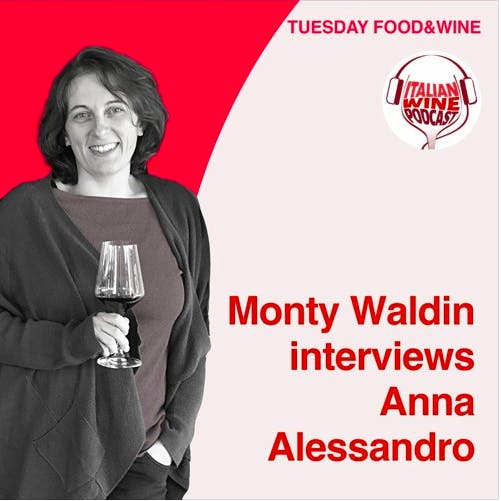
Ep. 655 Anna Alessandro | Biodynamic & Organic
Biodynamic & Organic
Episode Summary
Content Analysis Key Themes and Main Ideas 1. The history and generational evolution of Alessandro di Camporeale winery in Sicily. 2. The unique terroir and microclimate of Camporeale in the Belice Valley, Sicily. 3. The cultivation of both indigenous Sicilian grape varieties (Catarratto, Grillo, Nero d'Avola) and international varieties (Syrah, Sauvignon Blanc). 4. Sicily's diverse winemaking landscape, referred to as a ""continent"" due to varied terroirs. 5. Detailed discussions of specific wines produced by the winery, including red, white, sparkling, and late harvest, along with their characteristics and food pairings. 6. The importance of understanding Sicilian cuisine and traditional dishes as companions to its wines. Summary In this episode of the Italian Wine Podcast, host Monte Gordon interviews Anna Alessandro, co-owner of the family-owned winery Alessandro di Camporeale. Anna shares her family's rich history, detailing their transition from grape growers for generations to winemakers in 2000, and how the current generation continues the legacy. She describes the unique terroir of Camporeale in the Belice Valley, highlighting its hilly terrain, equidistant positioning from the sea, and a beneficial microclimate characterized by constant winds and significant diurnal temperature shifts. The discussion covers the winery's approach to grape cultivation, embracing both traditional Sicilian varieties like Catarratto, Grillo, and Nero d'Avola, and successful international grapes such as Syrah and Sauvignon Blanc. Anna emphasizes Sicily's diverse winemaking identity, likening it to a ""continent"" due to its varied altitudes, soils, and microclimates. She provides in-depth descriptions of their wines, including the versatile Catarratto (still, cru, and traditional method sparkling), the elegant Grillo, the ""Donnata"" Nero d'Avola, their flagship Syrah wines (Kaìd and M.M.L. cru), a French-style Sauvignon Blanc, and a unique late harvest Syrah. For each wine, Anna offers detailed tasting notes and suggests traditional Sicilian food pairings, from pasta with sea urchins to rich dishes like 'falzomagro' and aged cheeses, underscoring the deep connection between Sicilian wine and cuisine. Takeaways * Alessandro di Camporeale is a multi-generational family winery in Sicily, evolving from grape growers to winemakers since the late 1990s. * The winery is situated in Camporeale, within the Belice Valley (Palermo province), benefiting from a unique microclimate with significant diurnal temperature shifts and constant wind exposure. * Sicily is considered a ""continent"" in winemaking due to its vast and diverse terroirs, encompassing coasts, hills, mountains, and volcanoes. * The winery cultivates both indigenous Sicilian grapes (Catarratto, Grillo, Nero d'Avola) and international varieties (Syrah, Sauvignon Blanc), achieving distinct expressions. * Catarratto, once primarily used for bulk wine or Marsala, is now recognized for its potential in producing high-quality still, cru, and traditional method sparkling wines. * Alessandro di Camporeale produces a traditional method sparkling wine from Catarratto and a unique late harvest Syrah made by pinching stems to slowly dry grapes on the vine. * Food pairings are integral to the wines, with Anna Alessandro offering specific Sicilian dish recommendations for each wine. * The winery highlights the importance of single vineyards and believes in the long-term aging potential of its wines, particularly the Syrah cru. Notable Quotes * ""This is a family company. Alessandro company is a family company. We are great growers for for generation."
About This Episode
The speakers discuss their success in Italian wine production and their success with hairdresser Anna Aleisandro. They also discuss their success with a specific hairdresser's name and their success with a hairdresser's name. They explain their production methods and their approach to classico, including using grapes from the same wineyard of Cartarato, Vessano, and the third one from the same wineyard of Cartarato. They also mention their success with a hairdresser's name and their success with a hairdresser's name.
Transcript
Italian wine podcast. Chinchin with Italian wine people. Hi, everybody. Italian wine podcast on the Breights its fourth anniversary this year. And we all love the great content they put out every day. Chinching with Italian wine people has become a big part of our day, and the team in verona needs to feel our love. Producing the show is not easy folks, hurting all those hosts, getting the interviews, dropping the clubhouse recordings, Not to mention editing all the material. Let's give them a tangible fan hug with a contribution to all their costs. Head to Italian wine podcast dot com and click donate to show your love. Hello. This is the Italian wine podcast. My name is Monte Gordon. My guest today. Is Anna Aleisandro, who is a co owner of the family owned winery called Aleisandro Dicampo Breali. So I'm gonna ask Anna, can you tell us a little bit about your family history? Yes. This is a family company. A legendary company is a family company. We are great growers for for generation. My great grandfather was a great for great grower. My grandfather And then at the end of the nineties, my father and my two uncles, they, had the dream to have their own, seller. So we started to build the seller. And now the company is run by myself and my two cousins, both named Benadetu, because Benadetu was my grandfather name. One is the winemaker, and the other one is the marketing manager. Okay. So what was what was your father's name and what was your paternal grandfather's name? Just so we're clear. Well, my father's name is Rosalino, and my uncle's name is, Antonino and Natale. And there is a repetition in name because my grandfather was Benadetto, such as my cousins, and my great grandfather was Antonino, such as my, uncle. Perfect. Okay. So your family started in the early nineteen hundreds. Yes. Okay. And how did that actually start? Was it just wine then? Or were you were there other were there other crops like animals, sheep, cheese? No. The main the main culture was the Viticulture and also some, you know, green, wet, and also some fruit trees. But the main business was the the the grape growing. But in the past, we used to sell the our grapes to other companies. And when my grandfather passed away at the end of the eighties, as I told you, the three brothers, they had the dream to produce wine with, their own grapes, but they, started to make a very important process of renewing of the farmer because, you know, in season in the past, the production was focused more on quantity, than on quality. So little by little, they start to make the extirpation of the old vineyard. And they started to plan a new one with a different training system. Now we only have the sperrier training system with a spark cordon for the red varieties and the y grapes. They introduced it, new international varieties such as the Sierra. We choose for the production of our first wine and also, Sumignon Blanc. Side by side to the indigenous wine, like, Cartarato, Grillo, and, we finished to build the the salary in nineteen ninety nine. And we started in two thousand with our first vintage. So, great grower for for generation, but we are pretty young winemakers since, two thousand. Okay. So tell us about the actual terroir that you're you're in. You're in Camporeale. Yes. Which is in the Perman province, and you're in the Belicee Valley. What is what is Valley. What is the valley then? Is it, is it Rocky? Is it, Sandy? Well, we are. First of all, let me say an important thing about this, this area where we are because, yes, Camperale is in the palermo district that we are very close to the Japanese and, agriculture districts. And, one of the main feature of our territory is that we are equidistant from sea on three sites. North, palermo direction, South, Shopka, in the Agrigento area, and West trapani. So we have a very good wind exposure. But at the same time, we are surrounded by because we are on a hilly area. We are on the hill. So on a medium altitude of five, four hundred and fifty meters above sea level, but we are surrounded by higher hills that defend us from the humidity and from the, cold that comes from the sea. So we have a very good microclimate with, constant wind exposure. With the temperatures not so high, like, on the coast, and with a very, good range of temperature between night and day, which is very important. For two reasons. First of all, because, helps the fixing of the aromatic features of the grapes. And it also gives, acidity to the grapes, which means, acidity freshness, elegance, and also a long live perspective for the wines. I mean, how long has wine growing been been in in your area? Is it a recent thing or is it does it go back to prehistory. Very growing is one of the oldest activity in this era when I was a child, everything was we were surrounded by grapes side by side with, olive trees and some other culture. This is a very, vocation area for Viticulture, and we are, within three different doc appellation, the DOC, Sicily, the biggest one in the island, the DOC Murielle, and the DOC, Alcamore. We currently have, the world production as a DOC, Sicily. But we are starting to produce some DOC Marielle wines starting from the two thousand and nineteen vintage. Okay. So Monriale, what what does that name derive from? Well, Marriale comes from Yes. Morale comes from the the small city of, Murale, which is, located very close to Palamo, and which is very famous for the amazing Norman Dom. And, you know, the church of Morales was one of the richest one in, in Italy, in the past. So the property of the the church of Morale was very, very big. So the USC Morale area is a pretty, is a pretty wide. It's a, an amazing territory featured by this, Hilly landscape, very, very, but cut with the, for Viticulture. And, we choose the name, Monroe, but without the votes m m r l for our crew of Sierra. We started to produce on two thousand and sixteen. Yeah. Montreal means, like, the campus, you know, the the field work worthy of a king. Yes. Yes. It's, like, onte real. Yes. It's like Camporetta. Yes. Tell us about the, is it is it important to talk about the the value? What is the value? The value was the whole, the court we have, in our small town of Campriale because, you know, Camriale was founded by the Greek around the six century before priced. And then during the Arabic domination, it became an important world village Then we have the, just speaking, and, there was, a very rich colony of just waiting, we built, this amazing with the two different court And, as a coincidentally is where my family, my father and also one of my two uncles live. We live in the Bayou of Camfir al. So let's talk about the, the wines. So let's start with the whites. So you make a Cartarato, and it's called Benide. Is that did I say that right? Yes. Benidekatarato is the first white wine. We produced it back in two thousand and five. Is not the that the is not the one and only Cartarato wine. Vanessa stands for means blessed and was my, grandfather name and also my cousin's name. So he's tribute to to the family. And, Benadocatarato is a blend of grapes from three different vineyards of Colorado with different age altitude and exposition to the sun. And, is the white wine we're producing more in, larger quantity is very fresh with a deep Mediterranean and an impact with, you know, some see throughs and fruity notes, some spicy, some white flower smell, with a very good acidity and with a bit of mineral. Colorado is probably one of the most representative grave of this area, but until twenty five years ago was almost completely unknown out of Sicily because in the past was only use it to produce bulk wines or for the, production of marsala, wine, you know, the forty five wine made with producing in the Marcella, in the Marcella city. And then we finally understood the big potential of this grape, a grape, which, is three different biotype because we have the most cultivated all over the island, which is also the more, the more, the more, resistant, then we have luchido, shiny, and extra luchido, which is the less cultivated because it's very delicate. And, in the last ten years, we focus it a lot on this grape on Cartarato. So on two thousand and fifteen, we started with the production of, crew from the oldest and highest, Vineer, the Cartarato, which is an extra look, an extra shiny, Katarato Vineyard, and the wine is named in the, Vigna Limranova. And on twenty sixteen, we also choose this grape for the production of our first, sparkling wine. I met to the classical. We, we released after thirty six months, of aging, surly, and, about six months of bottle aging after the the gorgement. Hey, guys. This is a brief intermission to give a shout out to our new sponsor, Federal Wine. The largest wine store in Italy since nineteen twenty. We are delighted to have them on board and thank them for their generous support and our new t shirts. Find out more on Italian wine podcast dot com. Now back to the show. It was interesting when you were talking about the Cartarato built beforehand where you said you had it, that particular great variety in, or family great writers. A different altitude. So that I assume allows you a lot of flexibility in terms of how rich you want the wine to be or acidity, etcetera. Yes. Yes. For sure. We as we as we are on, on the heels, and we have, vineyards on located on different health tools. There is a great flexibility of results from one vineyard to the other. And, in a, wider perspective, probably this is one of the most fascinating things of wine men in Sicily. Because when we talk of, a sicilian wine, for example, a sicilian wine made from, an indigenous grape, such a we always have to consider the, the area, the, the, the, the, the territory where this wine, come from because, Sicily is, a very big region, but in winemaking, we consider as a continent because, you know, we have, hundreds of kilometers of coast. We have hills. We have mountains. We have We have a volcano. We have the the Mount Tetna. So there are so many, different features from, micro territory to the other one that wines of Sicily are are like a a mosaic, Calabrio's topic, because, there are so many different feature from one place to another. Okay. Let's talk about, is it it's a narrow dabbler? Is it called woman? Is that correct? Nero Dabbala is, well, Nero Dabbala means black from Ebola, and the name of our Nero Dabbala is a Donna tab, but it's not Donna. Like, woman is Dawn. You know, in Sicily, we used to call Dawn, the important guy in the family, like, the important guy in the community also, like, the priest or the padrino, let's talk about Dombito Corlione, which is probably the most famous don all over the world. And, Nata stands for Natale. Natale is a Christmas. Is my, my uncle's name, and my uncle Natalia is the manager, the the field manager. So, all our employed in the field, both for joke about also for respect. They used to call him Donata, and we choose this funny nickname for our narrow double. Perfect. And what would you drink that with? If you were having a meal or something? What would you what would you match that with? The Nero Dabbala. Well, Nero Dabbala is perfect to be paired with, some meat dish For example, for a barbecue. But our narrow doublea is very fresh with a very good acidity, some spicy, is not featured by the over mature fluid, almost jammy, which is you know, this feature are common to be fine in many. So a very, very interesting pairing for is, tuna fish, greenland tuna fish. I love it very much. Really? Would I mean, would that be freshly cooked or would it be, cold? Probably with both. Alrighty. So next question, do you make a grillo? Tell us about the grillo. We consider grillo as the the the song of a catalacto because for many years, Grillo was considered was considered like all the indigenous sicilian grade, but now it's finally demonstrated that Grillo is, a crossing, hybridation between Qatar and muscat or Zibbo. And it was created for giving more aromaticity to the Marcella, to the Marcella wine. Grillo is, usually featured by, deep tropical impact. But here, in comparative, the altitude we are and with the kind of soil we we have, we are able to obtain a very, very fresh and elegant grillo with some white flowers smell that in some way can remind the the sauvignon blanc and with a very good minerality at the at the taste. So it's very elegant, very fresh, and is the perfect companion in my opinion for, pasta with the sea urchins, which is one of my favorite dish. Really? Excellent. Okay. What's the next wine we can talk about? You make a wine called. I don't know if I've got this right. It's m l l Yes. It's Demorales, the crew of, Sarah. We started to produce, on two thousand and six. We started our adventure in winemaking with, Sierra Grape, which is the most planted international variety, in Sicily, especially in the Maria area. And Sierra found here a very good condition for its grown and use a very excellent results. The first, Sierra wine we produced was, Kaid, which is still probably the the the flagship wine of our company, but started from two thousand and fifteen, we, focus it on single vineyard wine because we, deeply, we were deeply convinced of the impotence of the of the vineyard, the single vineyard, the the the grape came from. So we started this work with the Cartarato vineyardanova. And on two thousand and sixteen, we, started to make the separate bottling of wine obtained by the oldest Sierra Vineer planted about, thirty years ago. And we have these, limited production because, they are only four thousand and four hundred bottles per year. So very, small production. Of this wine, which, ages for fifteen months in French Oak, to no, and, another here in bottle, at least to an ear in bottle before the releasing, which is very rich and complex with, spicy notes with, red black fruit, it's like, cherries and also, very rich and intense combination of cloves, lequeries, tobacco, and chocolate. And we are still releasing the first vintage. I am very curious to, know the evolution of this wine to know how it will be in the, in the next ten, twelve years. We are very we we we deeply trust in this wine. We we believe it can have a very good evolutionary bottle. Tell us about the, one of the dishes that you recommend on your website for the sira or for the sira wines is, it's called a falzomagro. What's that? Falzomagro. Well, falzomagro is, the Italian name, which means folds thin, in Cecilien dialect, we used to call, and, is, is a, very big, filled it with, cheese, with bread crumbs, with ham, with the bioledex, then the recipe can change from a family to to another. This is another very funny things in Sicily. Everything changes from a place to another, from a family to another. And we used to, cook for a couple of hours into the tomato sauce. So it's a very rich dish. We used to prepare for the traditionally. We used to prepare for the, Christmas eve dinner. Okay. Just to go just to switch back to a white wine, you make a souvenir called, Kaid, and that's about three hundred and thirty meters above sea level on clay and sandy soil. How does is that a very pungent sovignon or is it a very kind of, a kind of a a less aggressively aromatic style of sovignon? Is a sovignon more, in my opinion, more French style that, North Italy, so is a very elegant and not very, not very aggressive. We bet on, Sonia Blanc on, two thousand and four, we decided to plant this, this grape in the the most, sandy part of the of this state with, exposition to North Northwest. And we are very surprised of of the result because, it's a very, very volatile. Yes. It has some Mediterranean feature, but, it doesn't seem, sicilian wine, but, Nordic, a French, a very, very recognizable and very, very varietal. And what would you eat that with? What sicilian dish would you have it with, like, an antipasto or a a main course? With a with a, the onion blanc? Well, wow. Very good pairing for, the Subignon Blanc. It can be some pasta with, you know, and with fennel and, fish because the aromaticity of the of the fennel pairs very, very well with the with the green aromas of a Sunian Blanc is, appearing. I love very much. You make a late a late harvest wine as well? We we have, a late harvest of syrup. You know, we used to harvest normally syrup on around September fifteen. For the production of this wine, we used to leave the grapes on the vine for thirty days more, but we make a very special process because we used to pinch the stem, the link, the gray to the vine with, you know, electrician pinches just to crush without cutting it. So we stop the lymphatic circle and the the grapes start to dry very slowly, but there remains exposed to the to the the the the range of temperature between night and day, to the wind, to the sun during the morning. So we have a a very full concentration of aromas. And when we, when we finally pick the the grapes in the second of September, sometimes also in October. They are almost completely dry. They look like raisins, you know. So they are very rich in sugar. And when the the fermentation, the alcoholic fermentation starts to preserve some residual sugar. We used to stop the fermentation with cold temperature after about seven days. So we have a balancing between household content and the sugar, the residual sugar. And then we make a very, very big aging in, in viral and a few months of aging in bottle. And what we have is a wine with a beautiful, deep ruby red color, very, rich and concentrated with, great intensity on the nose. And but the most surprising official is probably the the taste because it's, sweet, but is not too much sweet. It is not jamming. It has a very good acidity which balances this weakness. So it's, very fresh, and, is a perfect companion for, typical, Cecilian desserts like, Camoli or Casata, which are both with Rikota Kreme, but I love very much with some good cheese, like, aged pecorino cheese, but also with goat cheese. Good cheese. Nice. Okay. Okay. Final wine. You make a traditional method, sparkling wine, Metro classico, from this is from, well, which which grapes is is that made from? Our method of classico is made from Katarato, extra luchido, graves, from the same vineyard of Cartarato, Vinearano. But this vineyard, which is the oldest, was planted in nineteen eighty nine. And also the highest one is divided into, two different parts. The one, on the top of the heels, of the hill in which we have a faster, maturation. And the other one on the on the bottom when the the grapes, wipes more slowly. So we have more, activity and less sure content. So we use the part from the upper side for the Kataratoveny and the, the the grapes from the, bottom. Part from the from the met of the class. We make, aging surly for three years, thirty six months. And, after the the version went, we we make the aging for about six months before the releasing. And, is, is a limited production also about four thousand bottles per year. We currently are working with the the second vintage the twenty seventeen. And, it was, it has a very good success. It's a win. We released, during the the the pandemic period and was the first sparkling wine for our company. So we were very treated. We, have many doubts about the this wine, but everybody love this wine, is, very, is very complex with the, nose, with a spicy, notes of, saffron, nutmeg, some white pepper. Then, yes, we have the bread, the past three. The bread crumbs notes due to the, the, the agents who are leaked. With a very, persistent and subtle per large, perfect to pair with many issues of, you know, crochet like, a shrimp, for, lobster, very good for this kind of dishes. Nice, sir, nice way. That's a very nice way to end with a sparkling wine and the taste in your in your brain anyway, have some lovely food. I just wanna say thanks very much, Jenna. Alejandro, from Alessandro di Campo real. Thanks for going into such detail about the terawatts that you you have and the great varieties you have and the and the wines that you make. Also, the food, suggestions you've, given us as well, have been pretty spectacular. If I could get on a plane and go to Sicily right now, I would. I will wait for you. Yeah. Thank you so much. Thanks, Monte. It was a pleasure to be here with you. Yeah. Me too. Thank you so much. Brilliant. Really nice interview. Listen to the Italian wine podcast wherever you get your podcasts. We're on SoundCloud, Apple Podcasts, Spotify, email ifm, and more. Don't forget to subscribe and rate the show. If you enjoy listening, please consider donate dating through Italian wine podcast dot com. Any amount helps cover equipment, production, and publication costs. Until next time.
Episode Details
Related Episodes

Ep. 2789 ColleMassari: a long-term vision rooted in Montecucco with Giuseppe Di Gioia | On The Road With Stevie Kim
Episode 2789

Ep. 2788 Ep. 14: Austria and Hungary | Study Smart for your WSET Level 3
Episode 2788

Ep. 2785 From Volunteer to Speaker at TEXSOM with Samantha Cole Johnson | TEXSOM 2026
Episode 2785
Ep. 2766 Inside the U.S. Non-Alcoholic Wine Market: What Wineries Need to Know with Jill Sites | Masterclass US Wine Market
Episode 2766
Ep. 2761 Winemaking and Consulting Across Sicily with Alessandro Serughetti | Wine, Food & Travel with Marc Millon
Episode 2761

Ep. 2759 Part 2 – The VIA Educational Program & Italian Wine | Heart-to-Heart Conversation with Sarah Looper
Episode 2759