
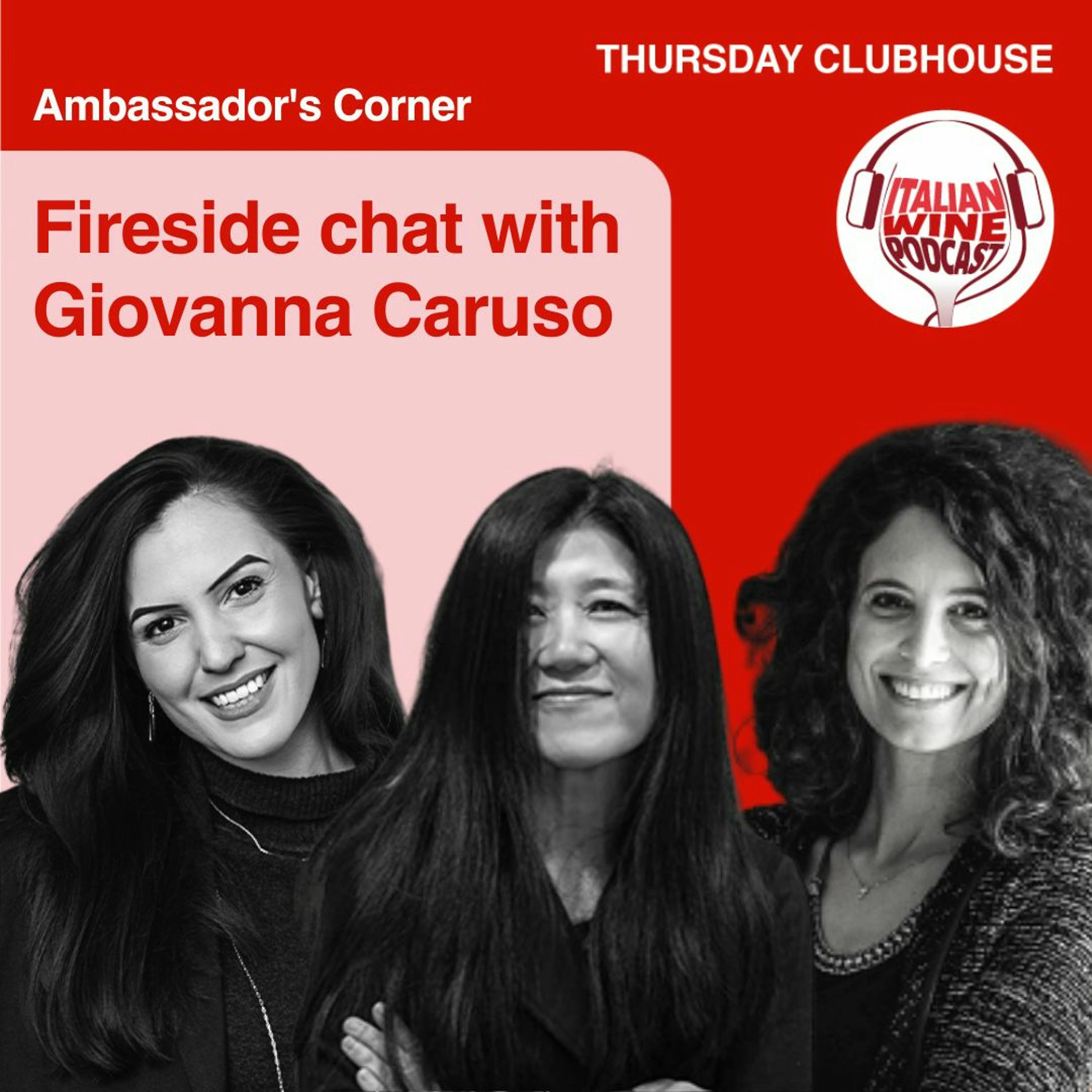
Ep. 1291 Renée Sferrazza Inerviews Giovanna Caruso | Clubhouse Ambassadorìs Corner
Clubhouse Ambassadorìs Corner
Episode Summary
Content Analysis Key Themes and Main Ideas 1. The Evolution and Impact of Sicilian Wine: Focus on indigenous varietals, tradition, and the unique terroir of western Sicily (Marsala region). 2. The Role of Women in the Wine Industry: Giovanna Caruso's journey as a woman in wine and her involvement with ""Donna del Vino."
About This Episode
The speakers discuss their interest in working with winery owners and learning about other wines. They also talk about their background in law school and their love for history and tradition. They express excitement about their plans to transition to sustainability and hope to see their work with Speaker 1 soon. They also discuss their partnership with a community organization called Vericona and their plans to create a label and visual for their brand. They express their commitment to sustainability and hope to see their work with Speaker 1 soon.
Transcript
By now, you've all heard of Italian wine Unplugged two point o. The latest book published by Mamma jumbo shrimp. It's more than just another wine book. Fully updated second edition was inspired by students of the Vin Italy International Academy and painstakingly reviewed and revised by an expert panel of certified Italian wine ambassadors from across the globe. The book also includes an addition by professor Atilio Shenza. Italy's leading vine geneticist. The benchmark producers feature is a particularly important aspect of this revised edition. The selection makes it easier for our readers to get their hands on a bottle of wine that truly represents a particular grape or region to pick up a copy, just head to Amazon dot com, or visit us at mama jumbo shrimp dot com. Welcome to this special Italian wine podcast broadcast. This episode is a recording off Clubhouse, the popular drop in audio chat. This clubhouse session was taken from the wine business club and Italian wine club. Listen in as wine lovers and experts alike engage in some great conversation on a range of topics in wine. If you enjoy listening, please consider donating through Italian wine podcast dot com. Any amount helps cover equipment, production, and publication costs. And remember to subscribe and rate our show wherever you tune in. Alright. Welcome to Ambassador's Corner. My name is Joy Livingston. I am standing in for Stevie Kim. Who is currently traveling yet again. She is in Wales. I think today. She has been doing the, Van Italy International Academy, roadshow, I believe. And she's out there with Cynthia and a bunch of others. So she's, she's there. And and so I'm doing it tonight. So I hope that's fine. Tonight, we have Renee Speranza talking to Joanna Caruso. So we do this clubhouse ambassadors corner every Thursday. It is going to be moving to a different day soon. I believe either Tuesdays or Fridays. I'll let, like, explain that later. But, it is normally on Thursdays at this time, and it is replayed on the Italian wine podcast. So definitely tune in for that. We have a a much larger following on the podcast. Unfortunately, Clubhouse after the, you know, the dreaded scourge, it has, it has basically not been as popular. But that's fine. It's actually a wonderful recording medium, and so we're we're continuing with this. And actually, like I just told me today is the eightieth episode of Clubhouse which is really, really, really huge. And I know Stevie is super excited because Clubhouse is really popular, on the podcast. It is actually, I believe, the most popular show. So that's awesome. So let's let's get to it. So we have Renee. How you doing Renee? Hey there. I'm doing great. It's a wonderful twelve PM here in Toronto, Canada. So I'm joining you guys from an afternoon type of view. And I'm excited to be chatting with Giovanni today. I'm a deep fan of sicilian wines. For those of you that don't know me, although I could see in the audience, there are some people that do know me, which is a lovely thing to see. My name is Renee Sparata. I go by wine by Renee online. I am a certified sommelier, wine writer, wine communicator, wine TV show, post, and more. Basically, the nutshell version of it is, I talk about wine for a living. You beat me to the to the punch. I was gonna I was gonna introduce you, but you did a a much much better job than I would have. So that's fantastic. And so you also write for the wine effect and for the distillery District magazine and Holler Online magazine as well. Yeah. I rank for about six different publications. Oh, wow. Okay. So that keeps you pretty busy as well. Yeah. It's a you're also a brand consultant for for who are who are you, a brand consultant? So the work that I do in wine is kind of all intertwined together. All of it is under the umbrella of presenting wines to consumers in a way that is very easy, unpretentious, really fun. At the core of everything, wine is a livation that is a a drink that can lead to a wonderful time. And why not learn about some of it in the process? So with the publications that I write for, including the distillery District magazine, my column in there called the wine effect, holler, monarch dot wine, I also write for the waterfront magazine, addicted magazine, and I'm doing work for foodism as well here in Canada. You can find me on, three different TV channels for city lines, CHCH, and breakfast television here in Canada as well. And then my social media account, wine by Renee on Instagram, which is one of the largest wine focused accounts in all of Canada. The whole idea with it, and that's where the brand consulting comes in, is that I work with either wineries, agencies, and wines of regions to tell people about all the wonderful wines that are out there and hopefully, quote, unquote, influence them to grab a bottle and try it themselves. Awesome. Okay. So Toronto, I just gonna can I just I miss Toronto? I used to live in Toronto for so many years. It's been I I miss it dearly. A random question though. Do you work with the LCBO as well? Or do you is that completely separate from, like, your wine work? Fun thing about the LCBO is that as long as you're in Ontario and working in wine, you're always working with the LCBO. I also do work directly with them. Actually tomorrow morning, I have a TV segment coming up with wines and a a conversation about low sugar wines that they have, put forward for me. Awesome. Okay. Well, I'm gonna I'm gonna let you go ahead. There's two questions I have to ask you before I let you go ahead and and do your own thing. I was just, gonna ask you how you why you you selected Joanna Caruso as your producer of choice. If you could tell us a little bit about your your thought process there. Amazing. So, Chow giovanna, we're gonna get into our conversation shortly. But here, the reason why I chose you is I was looking around for a great producer to chat to specifically from Sicily, and I really wanted to speak with another fellow woman in wine. I always love the conversations that we have. And the reason why Sicily is coming up is because I love sicilian wines. They're my top favorite area of the world to keep going back to again and again and again. So that's why I am always drinking sicilian wines and wanted to talk about this today. And I had tried your wines previously from your wine importer that's here in Toronto in Ontario called Azeroo. While I know you guys have a lot of wines there, I've only tried the Nero Davala and the organic hotoratto, but There's more for me to try for sure. Yes. Yes. Thank you, Renette. And thank you, everybody, for having me and for choosing me. Mhmm. I'm super I'm super excited about this chat. And, yeah, we are in now CBO, with Azuro. And, yeah, at the moment, we have two of our organic wines. One is the Cartarato, and the other one is the Norodala. But I'm quite sure that, I mean, we have, a bright future, in front of us. So I'm, I'm quite excited to improve our our present in LCBO as well. Super. Okay. And Renee, I was also gonna ask you, the question, what do you hope the audience will take away from the conversation, like, on a on a geekier level? Is there is there anything that you specifically wanted, to impart on the people that listen to the show that, you know, they'll take away from it and be like, oh, okay. Yeah. So on a wide geeks level, this Kiraso and, Minimi are a really interesting winery across the board, especially because we're moving into this massive second generation, which I think is really quite interesting to look at at a winery. It's a place and time for wineries. If the family members are not moving forward, then You never know what's going to happen in which direction it's going to go in. So I'm curious to learn about that. The other thing is outside of Nero Davala and Casarato, this is a winery that makes some amazing wines across the board including from, other grapes across Sicily that you might not see as much. So that's something that I am very, very keen to talk about today. Specifically, I know you guys are making from Zibobo and you also have some other really, really beautiful wines as well and sparkling, even though I don't get to try them over here in Canada. But I wanna look at it from that perspective. And seeing where Giovanni and her sister are taking it, the winery itself as the years go on, because I've heard some really interesting things coming through the grapevine. Yes. Yes. Absolutely. Yes. And thank you again, for this opportunity. It's always nice to chat with women like you, girls. So, yeah, I'm sure, I'm I'm sure it's going to be a really nice chat together, tonight. Alright, guys. Well, without further ado, oh, by the way, Renee, that was a really nice pun. You know, through the grapevine. I'm gonna let you I'm gonna stop talking now, and I'm gonna let you guys, go ahead and and do your thing. And I will talk to you guys at the end. Thanks, Joy. Alright, Giovanni. Let's, you know what, let's kick this off a little bit because I, like, I kind of hinted at before. I really wanna understand, like, how you got into wine. I it's a question I always ask people whenever I do interviews. I know your family makes wine. But I can see that you've had a really interesting life all on your own before you got to it. So what inspired you to work in the family business, and to get into wine. Okay. How? So that's a nice question. Yeah. It's true. Actually, I I have a law degree, and I'm a qualified lawyer. So But I grew up in the in the countryside with my grandfather. And I have always had a passion for the history and for the tradition of my family. So in the in the countryside, I learned from a early age to appreciate the land and the hard work in the vineyards. For example, I remember when I when I was a child, when my grandfather used to bring us, in the in the vineyards, And we we were with all the farmers and they used to explain how how they they picked, the grape hop and how how was everything. And we used to eat altogether. And for me, yeah, it it was not like a hard job, like, hitting us, but it was like a party. So we we we had lunch together, and we drink, drank together and was was really, really nice for me. So, being a lawyer, of course, has helped me in various areas, but in the hand, I decided to fully dedicate myself to the family business. I knew that my true calling was to share my family's passion and history with the world. That's why I decided to focus on export and becoming an an ambassador for sizzling the world. However, being a lawyer has helped me a lot with the export sales, with international contracts, and and everything concerning the legal part of the winery, especially because our focus in is export. So we export the most amount of our product. So, I mean, yes, I have not a properly degrees from from the, from the technological or from the winemaking part. But, yeah, I'm it's always useful. To be honest, I'm on the same path as you. I have an entire degree at something that I think I'm not using. My degree is an environmental policy, but like yourself, you know, there's a lot of crossover in these degrees, especially in why. Yeah. Absolutely. Absolutely. I agree. No. It's amazing. So I I love that aspect of it and how you get to use all of your skills as a human being into into what you're doing and into the export of it. So since you guys, Since the winery itself exports a lot, I just wanna give people in our audience today a sense of where the winery is. Could you just, like, tell us where, Curazo and Minini is in Sicily? Yeah. We are in in Sicily. Yeah. Yeah. So, beautiful highland in the middle of the Mediterranean Sea. We are in extreme, western side of Sicily on a seaside. It's a really, really beautiful land, kissed by the sun and by the sea. It's a really windy area. So our, our grapes are, especially in the whites are really, fresh and salty tanks today to to the winds that can bring into the vineyards, the saltiness from the sea. So it's a really, really, particular area. Also, because our vineyards are now are on a hill area. We are around four hundred meters above this eleven. So that's a really, really nice area. And is, I think, that is a part of Sicily that, need to be discovered. Because, today, I mean, for sure, Sicily is now famous, for the Aetna area. It's, I'm sure that the volcano is one of the this is a super amazing but there is also another part of TCD that need to be discovered. And we are part of this side of the island. So Yeah. You guys are on you guys are on the far, western side of the island. And from what I know, you guys are basically sitting in the area of Marcela. Yes. Yes. I I forgot to mention the city, actually. Yeah. We are we are in Marcela, Trapani province, of Marcela. It's also him to produce the Marcella delique coron as you know. So, yeah, we are from Marcella then. Yeah. So if anyone's trying to figure out where that is and you're putting it in your head, just think beautiful sunshine, and they are not that far of a drive away from Palermo it's still gonna take you a little bit, but you can get the stuff any pretty quickly from there. And it's a beautiful, beautiful place. I haven't been there in years, but it's gorgeous. So let you talked a little bit about the terroir of the the area. You're very, very, seaside influenced as well. So how are the soils and everything in where the vineyards are? Let's let's dive into the terroir. A little bit. Yeah. The terrarium is really, spatial because it's, it's, like, clay. Yes, Sandy. But it's also because, it's also rare because in the past, was the bed of birth. So it's really, really, rich in mineral. So we have, for example, all the round of stones that we call Kuti. So, they are really, important because that these big round stones, have the, important rule of keeping the warm of the so of the some some during the day to release it during the night. So it's a really, really special soy. This is kind of similar to the galette soil that would be in shutting off to pop those large stones play a really big role. Yes. Yes. Absolutely. And and we and we call this kind of cookie in cecillium, this this kind of, of, stones in cecillium, cookie. Amazing. Everyone, new wine term, cookie. There you go. Not the less. Gotta switch that language out. That's lovely. So from that, I'm expecting, and I know I've tried a couple of the wines, but if you wanna imagine what you're gonna be trying in the glass, I'd say Your wines your white wines are gonna be nice and fresh, very textural, have some heat elements to them, which will be really fun. And those it's great for red wines too, especially, having that wonderful aging process on the vines as the grapes are growing with that type of soil to create very complex wines, especially in a hot region like Sicily where you want not everything to be so hot all at once per wine making. Yes. Yes. Absolutely. I I can confirm comparing to also, no. You you you know, there is a stereotypes about the Cisionian wines that they, can be, like, really heavy to to drink Yeah. That's not true. I we, thanks to the, this kind of soil and thanks to the winds, thanks to this kind of, temperature wind. We have really fresh And with good acidity also thanks to the altitude of our vineyards, wines, both, white and red. So really, really easy to drink, with really good minerality as well. So let's now that we've talked about a little bit about the terroir, I wanna dive into the history of the winery just a little bit because you got you got some people along the way before it's come to, you and your sister. Can you tell us a little bit about the history of the winery? Yes. Sure. The cruzaminini wineries was, established at the end of nineties with a desire to complete the entire production chain by block by bottling the fruit of the hard work done done in the vineyards. That's why we decided to found the Curusa Minini together with the Minini family, expert in trade focusing on the quality of a Helbity culture. We focus a lot on an indigenous grape varietals, fully aware that they had nothing to invite to the other famous international ones. That's why our bottles are almost a single varietals we put the monovarital. We have the, green law. We have, and many, many others. I'm quite proud to say that today, the winery is present in in about four countries around the world, and our wines are appreciated by many, wine enthusiasts. However, I have to say that all we are today is only the result of what what we that has been in the past. I would not be here to tell myself without the work, carried out by my grandfather and then my father, of course. It's in fact, it's only thanks to them that my sister and I hire while we hire, and thanks to their passion and dedication that they had managed to, convey to us that we can taste our territory and talk about this wonderful land that attracts one lover from over the world. Today, in in addition to me and my sister, there is also my husband, Andrea, who joined us, And he looks after the marketing, part now, you know, the PR, area section of the winery. And he's, he's a, guy from Kemonte. And he decided to, turn upside down his life and decide to move to Sicily for law at the beginning. And then he he was fully involved in the winery And, yeah, now he's he's with us as well. That's amazing. Pick up your stuff. Move down to Sicily, you know, it's basically summer year round. I have some family members in the area near you and sometimes they try to tell me they have winter there, but I don't believe them seeing as where I'm sitting at the current moment. But I love that story. So it goes from your grandfather to your father. So your grandfather, I believe his name was Nino, and then you move into Stephanol, your father. Yes. And that he partners with Mario. Yes. Absolutely. And they have you and Rosana, and now your husband. Yes. Yes. Yes. Yes. So it's a totally a family business now. Oh, that's absolutely amazing. So I wanted to ask, like, when when did you when did you start really working in the white? Like, what year? Do you remember how many years ago that was? Yeah. I immediately after my, degrees, I I started as a lawyer. So at the beginning, I was, like, kind of legal consultant. The one and then I switched totally. Right after. Yeah. And, yeah, it was, like, eight years ago. Oh, fabulous. Yes. And the reason why I wanted to ask is because I know that you're also part of, Donna Delavino, the women in wine association in Italy, which is lovely. If if I lived there, I would be part of it, hopefully. So how how do you bring that aspect of working with that association into the winery itself? No. I I'm you know, I am, being part of this kind of association is is quite important for me, because, you know, don't know, all for, for all the people that don't don't speak Italian, the women of wine. As you can easily guess from the name, units, boom, old women, producer, Sumolia, one merchant, journalist in the one sector. All are driven by a passion for their work and team up to make their voice heard in a word that has been relegated to a man present. For years. All only in our recent years had agreed when professionals emerge like you. And, it's increasingly exciting because at the hand, I think that, wine is a is is a woman. So, for me, it's, quite important that today, my sister and I are part of, this big family of, women. I mean, is, quite essential. That's absolutely amazing. I'm I'm so happy to hear that. Yeah. Can we hear me now? Perfect. Sorry about that. Yes. So that's absolutely amazing. And I I think the same. I I think it's really quite interesting to be in this age of wine specifically. As a fellow woman and wife. There's a lot that we can do to bring people up, and I think working with these organizations are absolutely amazing. I think you know when something interesting is happening, especially in industry, If you look to the women that are into it, are in it and ask them who they've met in it. So I've met all of my, idols that I once would would read about and read their work and all all these amazing women. Now I've gotten to meet them. And, you know, when you're looking at an industry and you get to do that, that's great. But it also says we need more women at the top because I want to be able to, like, idolize and look at people and try to meet others. Which is great. So I love that you guys are working towards that and being part of, Donna Delavino. Yes. Yeah. Italian wine podcast, brought to you by mama jumbo shrimp. I we we have we have the same, way of, see the things. I mean, yeah, we women today has a really and and essential rule they are, they are part of a big, family that is the wine word. And, I mean, they are, one of the most important part, I guess. No. For sure. And we're seeing everyone, more women, more and more just like yourself and your sister coming up and seeing four of the faces. Speaking of yourself and your sister, I've noticed that there is a key look at sustainability with, Curasso and Minini and Minini. Was that something that you and your sister put into focus and and what is that sustainability that you're focusing on? Yeah. Our focus on our sustainability started a few years ago, when we understood the importance of preserving the environment for future of our planet and our business as well. So we truly believe it's all our cycle. What you give to natural will be returned. So following this belief, today, we are committed to using clean energy searches during the one production processes. Like, for example, the solar panel else and working with the NGOs to promote the, social sustainability. For this reason, we started on collaboration, few months ago, actually. With a well known Italian designer, the name is Jerluca Kanizo, who leads a team of artists affected by down syndrome. Those guys have a fantastic and unique sensibility, and a further trip to Sicily. They came up with our pure, a clear idea of what our identity is. The way they created everything takes into consideration, small details. They learn here, turning our identity into labels and visuals announcing the link with our land and nature and culture. Because for us, you know, sustainability is not just about our expecting the environment, but also embracing the diversity because everyone can make their own personal contribution. I can say that today, many other companies, especially those with a new generation think like us, and we are very, very happy about it. Our hope is that the this way of thinking can be extended to everyone because environmental and social respect is a duty I think before being our our right. No. That's amazing. I love that you guys are working with NGO. So this this organization that you've worked with with the artists that, are affected by Down syndrome. What is the name of the organization? The name of the organization is, in English, I can translate to his family name, actually. It's actually funny. I'm laughing already because I know what it means. It's like, mosquitoes laboratory. But, yeah, I mean, Yeah. And they are they are quite nice guys, and we are really, really happy to work with them also because we always, had to to learn something for them. They have a really unique sensibility. And, yeah, I I I'm quite proud that, we are, to say that we are, very, very happy with the results. And we are And these are for sorry to interrupt you. These are for the labels on the organic, the, bio mics. Yeah. And I mean, we we are we are working to launch this restyling, this year. And and the restyling is, is involving all of our portfolio wines. But the organic that you know, I think is a step by step process. You know, I mean, we have customer all around the world, so we have to be careful also. So I think that the organic will be launched, next year. Now, so this year, we we will, launch the, part of this restyling. So also to taste the market, to taste also our, our customers all around the world. And then, the organic that you know will be, changed from next year. Wow. That's amazing. I'm so happy you can't to hear about that. Just diving into sustainability a little bit more. So focusing on sustainability outside of the, more so in the vineyard for this part, I see that we got social sustainability covered so far. I'd love to hear more a little bit more about the sustainability that's going on in the vineyard and what kind of practices are really being used out in this area of Sicily that you can you can go with. Because I know the areas kind of great for organic production and some sustainable production. Yes. Absolutely. Yes. You, you had to imagine that the Sicily holds the, around the eighty nine percent of the total organic product area of Italian beauty culture. So all Italian beauty culture, so follow it by Pulia, which stands at sixteen. CCidor Ghanibidity culture, area represent the almost the thirty one percent of all sustainability culture. So what makes Sicily a sustainable high land by nature is the Mediterranean climate, which has not be particularly affected by the climate change. We are now focused on sustainability and preserving the plans for the future. We truly believe it's important to preserve the environment for future generation and to ensure the continuity of our business. And I said before, it's all cycle. What you take must be given back. In the countryside, for example, we use the waste from the grape harvests, to improve the the texture of the soil. And with, for example, regard the labels, they are made with a high percentage of recycled paper. Or, for example, we use a lighter glass bottles. Today, we are, I think the we are responsible for our tomorrow, the tomorrow of our children, and this that's very, very important to us. For this reason, from this year, we are also certified officially, with the Qualitas. Which is one of the highest authorities worldwide. So it's a really, really, important organization, which give us a unique approach to the sustainability in the one history. Industry. So, and and that's built on the social, environmental and economic pillars. And, yeah, I am and I think that can, it can be a guarantee also for the consumers. So thanks to the technical, culture, and political resources, a political intent to pull the best consolidated in the in the laboratory is in order to launch a global Italian model of sustainable quality. Also, thanks to these apparatus, standards, we can adopt an internal accessibility management system and prepare an annual sustainability report, assuring the ongoing improvement of our sustainability standards for clients and and for everybody. So I think that, that can be a guarantee for for all the people, for the people that work with us, for the people who drink our wines, so from the people, with, that are around us. See, I always think that my degree is never gonna come in handy, but then I remember that everybody's going more environmentally friendly and my degree is an environmental policy. So I absolutely love to hear that the wineries are doing this and that you and your sister, I have really started to put in that additional work into the winery. That's one of my favorite things to hear. And as we know, this environmental push is full across the board. So it's socially And it's from the vineyard all the way down to the people themselves. It's amazing to hear that Sicily covers so much organic and biodynamic and all that type of, sorry, organic and environmental friendly production. Moving into this, like, now you guys are in a new generation with the winery. So I I see everything that you're doing. Is is there one, like, area of focus that you really want people to know more about in the winery? Because I've been hearing a lot about Peticorne lately. Yes. People haven't been drinking it that much in the past. I know. How is it going with that grape? That's something I'm really curious about. Yeah. I'm, I'm really happy to ask about Vericona because it's I'm quite proud about this grape. So, yeah, I And it's such a unique grape. It is a very, very, very unique grape. Okay. Before we get into it, would you mind giving everybody in the audience just like a sense of what Peticona case. Right? Yeah. Yeah. Yeah. Okay. I I do a small introduction. So I, strongly believe in in the engineers and, and in in, territorial, I strongly I strongly believe in the revival of those varietals that maybe is lovely be lost in favor of the more widely known and easy drinkable wines. And that's the and that's the sample of the pericona. Which is an extremely interesting red grape varietal. Four years set aside in favor or more, well known, grape, like, for example. So when you think Sicily, you immediately think to narrow down. Think that in Sicily, I give you just two numbers. There are only three hundred hectares of Perricona and eighteen thousand hectares of So, Perricone is a a really ancient grape varietal from Perricone. You also make the Maricone, the Maricone, And it's a typical from the province of Japanese in extreme western, Sicily. Most hectares, were, were destroyed over the centuries in favor of a easy to grow and sell grape varieties like Lenerudavola. But I feel, quite lucky today because my grandfather decided to keep five hectares of it and this allow us to carry out studies and experiments both in the vineyards and the winery. And today to bottle a really exceptional product, fermented only steel. Which has a surprising evolution, reflected to evolve for a few years. I, today, is one of our best seller all all over the world. We, we have customer, which appreciate every corner from Japan, to, to to China or in Canada as well like you, or, is one of our best seller in USA as well. So I I'm really, really proud about this varietal, and I'm quite happy that many, people, many one loggers all around the world are just not are really, interested to know more about spatial grape, typical, an ancient grape, and not just, the most well known ones. No. It's true. And Peticorne is is really, really quite unique. I got a chance to try a bunch of Parecona from across Sicily last year with a trip that I actually did with the, Italian Wine Academy for their Gita trip. It's a beautiful, very dark colored wine. You're getting lots of, like, almost blackberry and plum and earthy notes. Very almost fruit cakey. Lots of herbaceous notes and pine, which is the most interesting thing about pine, lots of pine notes, which I thought was cool. It just tannins themselves tend to be a little bit chewier. It's almost like a like a wildness to it, and it's fairly juicy. So seeing it done in oak versus seeing it done in stainless deal. You can imagine everyone that's listening to us today. How different the wine can come out, especially with that style of tasting notes, and it tends to be quite full in body the stainless steel version is my favorite one. I determined that after trying for me to. Yeah. Yeah. Me too. If I had to be honest, yeah. I I because I I really love this game. So I prefer to drink the pure perricorn without any other, no, information, you know, from from from the external parts. So I prefer to drink the pure perricornant Also, I think that one of the most amazing thing about Percona's devolution in bottle. So since, if you if you have, for example, for a a new vintage Percona, yeah, explosion of, red fruit. If you have an added pericorna, it's like a super spicy wine, full of lequeries. It's also really nice because you can drink pericona. We, while eating, for example, fish. One of my best pairing is with tuna, is amazing. So I suggest if you didn't try yet. I suggest you despairing. Tuna and Pericones, wow, is a bond. So, yeah, I I definitely can say that this is one of my most favorite grape. No. It's really unique. Everybody, go out when you get a chance. If you're filling up your wine cellar in the near future, pick up some quetzalayan mae and get some pretty funny from them and get yourself some tuna. Click it any way you want. Preferably not casserole style. Just regular tuna and go at it. This is a beautiful, really interesting wine, and the evolution in the bottle. That's where the wine geeky stuff really comes in. If you're trying to get a sense of how much this evolution would be, when I first tried some really unique and and very youthful petacone, it from the jump from that to being more aged. It's kind of like having a beaujolais, and then jump to a crew. It changes completely, and it's really quite nice to see that. If you're looking on the Oak Age side, which you guys don't do, think more along the lines of how deep and in tense you can get with something like a. But at the same time, that fresh style, that's where it's at. So Yeah. Thinking of the other wines that you have outside of What are what else are you seeing from the native grape varietals that are coming up? Because you make a lot. You have some really interesting stuff. You can have this very unique wine. I can see the, tagos with Grillo. Grillo is wine. I have been dying for it to become more and more available because it's gold. It's like gold in a bottle. Yeah. Absolutely. Absolutely. Yeah. I mean, Grillo is our really, typical from this side of the high land. And, yeah, it's, one of the most famous, actually, it's one of the most famous white grape from from this side. It's a really, special product is really ancient, like the Perricorn because, you know, the, they'll, grillo make also the Marcela. So it's a really, really ancient. And you know that grillo is the sun of the Cartarato and Zimbabwebo. So it's a, their their parents is, is a result of these two fantastic grapes. So has the, amidst the complexity of the Cartarato, but as is like the perfume of the DB, so it's really an extreme, interesting, grape. So, yeah, we have a Grilo, into version in our portfolio. We have Grilo as organic green loaves. So the dry version, but we have also the green lo late harvest. It's a a super nice product, because being a a late harvest, We don't have sugar, but this weakness comes from, that we, pick the grape hub, one one month later than usual. And, yeah, we we don't have any alcohol. Is a is a super nice wine that can be paired with, cheese board or with, as a dessert wine as well. And is, is an explosion of, almonds of apricot, honey, is a is a really an amazing wine. That is awesome. I love Grilo. So so so much. I need more of it to be around in all styles, even the Oakage version I love. Before I get into my next question, I just wanna remind everybody in the audience that there is a little chat box at the bottom of your screens. If you have any questions as our one hour long conversation will be ending soon. If you have any questions for either Giovanni or myself, During this time, please put them in the chat and the wonderful team will help out with that and, ask your questions as well. I wanted to ask you, seeing as we mentioned Marcella quite a bit, Are you seeing more people drink Marcela lately? Is that, like, being ordered more? Because I'm here for these very unique to region wines. Marcela is one of them. Are we seeing more of it coming out? Yeah. I, I think that Marcella is, is a wine with a really long history and tradition in Sicily is a really ancient wine that's back to the Roman times just to give you just few information about the history of Marcella. It it was born at the end of, one thousand and six hundred, when the merchant booth house decided to send some barrels of Marcella wine to England, to England, but to prevent the wine from, the the the deteriorating. He had a good dose of of household of brandy. So from that moment, the myth was born, and Marcela has become over the years one of the most successful fortified wines. Marcela, yeah, now is, it enjoy, a little fun today. Everyone should keep a couple of bottle of this fortified wine in the cellar. And of course, I'm not talking about the wine to make Beena. Is, it's Don't use the good Marcella for those. Use use use the basic bench Marcella. Absolutely. I step in there. Absolutely. I agree. So, to be honest, it's not a very easy to approach. So it's not a soft or a vinyl wine. But if you if you give it a chance, you will be you will find a masterpiece behind. It's splendid in the in the dramatic complexity. But above all, Marcella wine is not a simple sweet wine. Of course, there are sweet Marcella wines, but also dry and semi dry. So let's say that it's it's not a dessert wine. It would be uh-uh colosalmon scents. It has today become again a great wine, rich, complex, and full of emotion, an excellent wine, capable of surprising both when tasting alone, as well as match too many food. Is, for, for the people who, don't know, Marcela is quite similar to port in Portugal or, they spend sharing. Unlike the two, however, Marcela has, unfortunately, been gradually relegated to a cooking wine, as mentioned before, which has certainly, led to a downgrade as a lower, tier wine. This was a mistake, certainly made primarily by the cecilium themselves. I think that now it's up to the new generation, like, has to carry different ways of living and doing things. Perhaps even, seeping a good Marcela along with a nice cheese board. Yeah. And I have to ask So you're Marcella. You have the superior, the superior audio reserve. That one, I can see it doesn't have as much sugar as I was expecting. I haven't checked. But yeah. I yeah. It's the yeah. Deborah's I, as I mentioned before, there are, many different kind of Marcela. So we are not, like, winery, that produce, many kind of Marcela. And we have just one one, one, one Marcella. This is a superhero, and is a dry Marcella. The Marcella can can be defined as a dry if it has less than forty grams per liter of, sugar. So, yeah, we have this Marcella, which is made by, Cartarato, Enrillo. So it's, the typical, the classic Marcela. And, you know, seeing as it's it's a really beautiful style, it almost and and because it's on the drier side, we're looking at something that's more along the lines as if you were thinking of pairing the notes that would be coming from, like, a brandy type of vibe more than we would be getting from a port. So just for all y'all out there, this would be something that I would be pairing with some really fun cured meat dishes. I want a little bit of salt in there, get that sappidity going. Yeah. And also something like I would love this with, honestly, I'm just gonna say it like a fried fish sandwich. Would be amazing with, like, a little bit of fun fella on the side. I could be fancy and dirty at the same time. Yeah. Absolutely. Absolutely. I I personally, love cheeses. So, one of my one of my best pairing is with blue cheese. That is amazing. Oh, that sounds so good. That is delicious. Also, if you guys wanna let us know your favorite ways to have Marcela, let us know in the chat as well. We're we're coming up to the last little bit of time here. So, you know, I I also, Giovanni, I don't know if you have any questions for me, but I have one more question for you, and you're more than welcome to organize to ask me a question too if you'd like. But I wanna know where you see the winery going in the future. I know you're you're making the labels that are gonna kind of rebrand everything and make stuff under the full line. We see a lot more native great varieties. Like, what are you really excited about getting, Curacao and Miami started for the next couple of years down the line. I mean, no. For us, I I I can say that our, commitment today is to proceed to in in this way of sustainability, in in all of on on north part of our, job. I I so I I see in the next future, is is is a long way. So it's a we are converting of our, of our vineyards in organic. So it's not a thing that you're doing one day. So I I see that in in in the next future, we are still working on it. And, there is always a space to improve ourselves to to, to do, the maximum we can do. So I I I can easily say that we will keep we will continue to do that. And, yeah, and and I hope that we can do even, more and more, our best in the next future, of course. That is awesome. I'm excited to see what you guys do, and I really hope more of your wines tell Azaru, which is your agency here in Ontario for all of my Ontario stuff. Yeah. The the the holy the holy question that I I have to to ask you is why you didn't come to Sicily yet? I've been to Sicily so many times. Yeah. But but but why, you know, my worry. We are we are way too for you in in in the future. I mean, I hope to see you soon in person. I will happily come the next time I am there. And when a classic Italian boost, don't be into coming back. I love it. I love it. So I will be back in Sicily soon enough, and I will definitely come out for a visit. I have your contact, and I will make sure that I do so. Joy. I I hear you coming back into the conversation with us. How are you doing, I'm doing this? Hi. That was awesome. That was that was great. And, honestly, you guys are yeah. No. It was very, it was nice to hear you guys sort of have that connection. It was cool. And by the way, I have never been to Sicily. I just heard that I You've been on that field here. So You'll enjoy now. Of course. All of Seriously. I've always wanted to go. Everybody keeps telling me how amazing the food is, and the wine, and the weather, and the people. So it's gonna happen soon. No. Okay. So, sorry. I think I got you necessarily too. That's a basic. Yeah. Absolutely. You are you are all welcome girls. We can we can set everything to to welcome you here and drink good wine and, of course, eat, some cannoli together and, and some Aranchine as well. Yay. That sounds amazing. So, I am going to say because normally what happens is, sometimes not normally, sometimes there's people that have questions, but they don't, or they're too shy to ask. And it usually happens after it's been released from, on Italian wine podcast. So, if there are any questions, I'll put it out there now. Please email me at info at italia wine podcast dot com, or you can always text Leika. And, she will forward it to me, and I'll forward it to either Renee or Giovanni, to answer your questions about the winery or anything else. And, that that is, the end of tonight. There will be another clubhouse next week, I believe, but not on Thursday. But we don't I I believe it's Tuesday. Like, I think that you are trying to organize a different day because of your classes. Oh, joy. The the next clubhouse is going to be, next next week. It's on February, some, some timing that week. So I'm still organizing with Noelle. It's actually She's here in the audience kind of well. So she'll be interviewing Joy Cool, from LaViliana. So that will be the next. And, yeah, thanks. Thanks, everyone for listening. Thank you so much. Thank you. Thank you. Thank you, guys. It was such a pleasure to to meet and reach out with you as well. Thanks so much for having us. Stay warm, Renee, over in Toronto. Today. It's all it's only like zero, so I'll be fine. But have a wonderful evening of Ruwan. You too. Bye, guys. Bye. Listen to the Italian wine podcast wherever you get your podcasts. We're on SoundCloud, Apple Podcasts, Spotify, EmailIFM, and more. Don't forget to subscribe and rate the show. If you enjoy listening, please consider donating through Italian wine podcast dot com. Any amount helps cover equipment, production, and publication costs. Until next time, teaching.
