
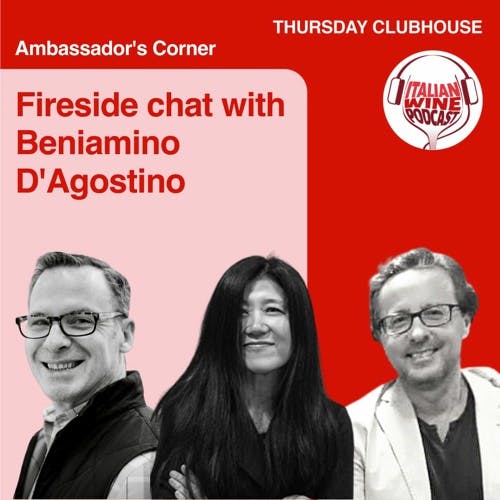
Ep. 1016 Hugh Preece Interviews Beniamino D’Agostino | Clubhouse Ambassador's Corner
Clubhouse Ambassadors’ Corner
Episode Summary
Content Analysis Key Themes and Main Ideas 1. The unique terroir and ancient winemaking heritage of Gravina, an inland, high-altitude region in Pulia. 2. The historical significance and revival of the Gravina DOC, Pulia's first white wine appellation. 3. Bothromani winery's production of distinctive white wines from native Greek varietals (Greco, Fiano) and reds, particularly the potential of Uva di Troia. 4. Beniamino d'Agostino's personal journey from lawyer to winemaker and his commitment to sustainability. 5. The challenges and importance of promoting sustainable practices and consumer support in the wine industry. Summary In this episode of the Italian Wine Podcast, recorded from Clubhouse, Stevie Kim hosts Hugh Priest, who interviews Beniamino d'Agostino, owner of Bothromani winery. Beniamino shares his unique story of transitioning from a lawyer to a winemaker, saving a local cooperative in Gravina, Pulia, in 1991. He elaborates on Gravina's distinct inland terroir, characterized by high altitude, Tufo (limestone) soil, and significant day-night temperature variations, which contribute to the elegance, minerality, and saltiness of his white wines, primarily from ancient Greek varietals like Greco and Fiano. The discussion also highlights the Gravina DOC as Pulia's pioneering white wine appellation. Beniamino champions Uva di Troia (Nero di Troia) as ""the next big thing"" from Pulia, explaining how cultivating it at altitude yields distinctive, elegant red wines. A significant portion of the interview is dedicated to Bothromani's comprehensive sustainability initiatives, including organic certification, forest planting for CO2 compensation, and renewable energy usage, underscoring the financial challenges and the critical need for consumer support. Beniamino concludes by discussing his favorite wines, the Gravina Bianco and Rosé de Lulu, and their ideal food pairings, alongside a humorous mention of the Gravina bridge's appearance in a James Bond film. Takeaways - Bothromani winery is located in Gravina, an inland and high-altitude region of Pulia, offering a unique microclimate and Tufo (limestone) soil that imparts minerality and saltiness to its wines. - Beniamino d'Agostino, a former lawyer, founded Bothromani by saving a local cooperative, making it a first-generation family winery with a deep connection to the land's ancient heritage (over 3000 years of agriculture). - Gravina DOC is historically significant as Pulia's first white wine appellation, with its origins tracing back to the 8th-9th century BC. - The winery utilizes native white Greek varietals (Greco, Fiano, Falangina) and red grapes like Aglianico and Uva di Troia; the latter is particularly highlighted for its potential when grown at higher altitudes. - Bothromani maintains a strong commitment to sustainability, being 100% organic and vegan certified, planting forests to offset carbon emissions, and relying on renewable energy sources. - Beniamino emphasizes the need for actual consumer support for sustainable wines, as the financial investment required for such practices is substantial and often not recuperated through sales premiums. - His favorite wines include Gravina Bianco (for its historical significance and character) and Rosé de Lulu (made from Nero di Troia, prized for its unique structure and pairing with spicy Asian cuisine). - The Gravina area boasts a famous bridge, featured in the James Bond movie ""No Time to Die,"" showcasing the region's scenic beauty. Notable Quotes - ""We are, literally a first generation winery."
About This Episode
The Italian wine club is hosting a club session and creating a sister channel called mama jumbo shrimp. They have created a podcast and Facebook group, as well as a Facebook group called mama jumbo shrimp. Speakers discuss their success in the Italian wine industry, including their own success with their own wines and their own branded wines. They also talk about their success with their own vines and their love for their own varieties. They mention their sustainability program and partnerships with the Italian wine podcast, as well as their partnership with the London brand. They encourage viewers to donate through their website.
Transcript
Welcome to this special Italian wine podcast broadcast. This episode is a recording off Clubhouse, the popular drop in audio chat. This club session was taken from the wine business club and Italian wine club. Listen in as wine lovers and experts alike engage in some great conversation on a range of topics in wine. If you enjoy listening, please consider donating through italian wine podcast dot com. Any amount helps cover equipment, production, and publication costs. And remember to subscribe and rate our show wherever you tune in. Okay. Hello, everyone. My name is TV Kim, and this is the Italian wine club on. Clubhouse. Welcome everybody. Chara Gatsi. Cha, you, Chris. Chal Ben Yamino. Charles Stevie. How are you? Alrighty. Are you guys ready to rock and roll? Absolutely. Yes. Okay. So for the folks, I think everyone knows what this is all about. This is called the Ambassador Kona on on Club House, and we have this Italian wine club going since a couple of years, I guess. Now, actually, yeah, a couple of years, maybe eighteen months or so. And, it has been hugely successful because every Thursday, six PM central European time, we have one of our ambassadors at large from Vineetalia International Academy. And on few exceptions are friend ambassadors, Italian wine ambassadors. They choose their favorite wine produce, Italian wine produce, of course, And they do kind of the deep dive fireside style with their favorite wine producer. And today, we have Hugh Perez, who has chosen Beniamino. That goes Dino. Let me just sit quickly. Say hello to Laika. Of course, she's a our clubhouse manager. Cha laika. Chow, Steve. What's up? Where are you? All good. Usually, you're, like, on a train. You always have bad WiFi. Are you okay? Are you at home? Yeah. Yeah. I'm home. I have to say that we started the ambassadors corner in July eighth, and now Oh my god. It's almost our anniversary. Exactly. And every every week, rigorously, we have been producing a show. So I know he he used to have a have a room of your own. Right? I did. Yes. I did. Whatever happened to that. Everything started to open up again, and I had to get back to work. You see, we we believe in consistency, consistency, we still work, but, we really think this is a fantastic platform to have our ambassadors interview their producers. And we do, of course, replay it on the Italian wine podcast, by the way, for those who of you who are unaware, we have, become number one wine podcast, not in America, not in Italy, in the world as of May. So we're very, very excited about that. And, of course, the Ambassador's corner is one of the favorites. So congratulations to everybody, and thank I'd love to thank all the mod squad, including the Via community at large. So please don't forget to subscribe. Wherever you get your pots, it's Italian wine podcast. And I started a sister channel. It's called mama jumbo shrimp. Yeah. Don't ask. It's that's the YouTube channel. So check that out and please subscribe Grod. Hi, Joy. Child Joy. Joy is our, Italian wine podcast producer. She's working. We're driving her crazy today. Actually, Friday is her usually crazy day. Joy. I'm here. Hi. Yes. She's right next door to me, by the way. And do you want to say anything to our audience? I certainly do, everybody. This is super important, and I'm I'm super invested into this. So I would really appreciate it. And so would everybody who works at IWP Could you guys on July the first to the thirty first if you have a few seconds, go on to the Italian wine podcast, and there will be a link from July first onwards. Where you can go and vote. It will only take a second. We are basically running in the running for a war, the best podcast listening platform through pod the podcast awards, the people's choice. And, of course, me being Uber, competitive. I'm, like, super into this. I would love it if everybody went and so voted. Just just do it. July the first. After that, go onto the podcast, click the link, and boat, and and that would be awesome. I'm sure. I mean, I think, like, and everyone at the, the social media team, we'll have the information out there for you. So, you know, it's a small ask. We do do, do this every single damn day. I'm driving everyone crazy. We do have a daily show now since the pandemic. So I and and the numbers are showing. So I know there are lots of you out there in May, we had three hundred and thirty thousand listens just on SoundCloud. So I know there are many of you out there. So if you are listening to this and you listen to Italian wine podcast, please follow the instruction and vote for Italian wine podcast. Okay. On with the show. That's it. That's enough self promo. For the moment. Let's get on with the show. So, of course, you priest is our friend and our Italian wine ambassadors For, where where do you actually live here in New Jersey? I do. I live in New Jersey, long branch, the Jersey Shore. Right. Oh, well, you have the beach and stuff. That's why you're so, like, relaxed. Yes. That's why I'm so chill. And of course, he is an entrepreneur. He owns several restaurants, and, he does some educational, stuff with Italian wine. And he is a truly an Italian wine ambassador. So and you know lots and lots and tons of Italian wine producers. Why did you choose Benjaminino, d'agostino, for our call today? Well, I, you know, Benny, Benny and I have known each other for a while, but it wasn't, I didn't really meet Benny until after I had, sampled some of his wines, and some of his, white wines, which are absolutely incredible. From his region of Pulia. And I thought that, you know, what they're doing down there, I'd like everyone else to to hear about the projects they're working on and their sustainability program. And you know, I think in another life or a past life, Benny and I were, brothers at one point. Oh, I see. Is that the is that the avatar you have? That is. Yes. Yeah. I love I love Hugh because every time there's a call, he has a different avatar. It it's it's it's truly a labor of love and unclove house. I I think Ben Yamino has has one too, one of you. Yes. Well, that's, here at the restaurant in Princeton. Oh, so that's one of one you have a big chair in at, at your restaurant? Yes. So I I make all the Uh-huh. I see. I still take a picture with me in that big chair. Oh, that's nice. That's a great idea. I I still have to make it out there. Alrighty. So what are our learning objectives from Benaminos call today? Well, I wanna I want, everybody to obviously I'm sure they're familiar with Pulia, but I'm, focusing on the inland side of Pulia. Where is he located exactly? He is located around the town of Gravina, which is, Straight west of Barri, on the border of, basilicata. Uh-huh. And are you serving, his wines at your restaurants? I do. I serve his primitivo by the glass. And Oh, so you have a by the glass program. Yeah. I do. And I also have, four or three of his bottles, other bottles, that I serve by the bottle. Okay. And what is kinda the best selling, I guess, wine? I I guess the by the glass. Right? Yes. By the glass is, by far. It's the primativo. So, you know, it it helps bridge that, knowledge, for my staff to teach people that Primativo is Zinfandel. So Right. And it sells like wildfire. Okay. So they do make that connectivity from Permitivo to Zinfandel? They do, actually. And and actually, you know, the the response out of it is, like, wow, I've never had Zinfandel like this before. This is incredible. Right. Okay. What about the piano and Grecho? How how do you make them more familiar to to your, to your customers? Well, it's, all hand cells. So it's it's, you know, proper education. Education of the staff. Usually when somebody's looking for a bottle, a recommendation, you know, the the staff will try to get what they're what they're looking for in a in a bottle, and they'll gravitate toward They have an easy drinking, wine, which we'll talk about called Ultra. And then we also have a higher, higher premium, label, called Gabina, which is incredible. Okay. Very good. Listen. So for everybody who's listening, to today, but also a replayed on the podcast, Hugh priest did another call with Ariano Kpinki way back. And it is one of our most popular, episodes. So go check that out. We have a playlist of the Ambassador Kona on Italian wine podcast. So check that out. We had Ariana and, of course, amongst the iconic woman of Italian wine, Adwynethly, with Feradore, with, in Chiza de la roqueta, with, of course, Antinori, and alegrini, and Caraboski. So it was a fantastic, session. And we also have that on replay as well on Italian wine podcast. The recording, isn't so great. But if you are interested, you should check that out as well. I think it's in like four different series, four four part series. So I'm going to pass the mic, to you, Hugh, now I will now shut up. And come back towards the end to see if there are any questions from the audience. Take it away, Hugh. Thank you, Steve. Appreciate it. Always, your support in allowing me to do stuff like this. Hello, everybody, in the community and everyone else who's out there. Today's guest, I'd like to introduce, is, a winery from Pulia, And, as many of you know, about Pulia, I'm just gonna bore you with some general detail of, its location, which is in the southeastern part of Italy. If you're looking at the map, it's the heel of the boot. It's the easternmost, point, region in Italy. And, its landscape is a little peculiar compared to, the rest of the Italian regions, where over fifty percent of it is plains, and only two percent of it mountains. So, and it's very hot down there. Very dry and not much rain. So, As we move forward, I'm gonna first introduce my guest and my, brother from the past is, Benny Aminostino. How are you, my friend? You. So please do, to to be here. Thanks for your kind words, obviously. I'm sure that we was brothers, strictly connected because, in Italian, we say two words are, called, and, is, related when two people since, the first moment that they met, immediately have a fantastic, you know, feeling a fantastic connection. And this is what was, what happened with you since the first moment. Thanks, also to Stevie, for this opportunity. I, you know, as a wine producer in Pulia, and, selling my wines in the United States, since nineteen ninety seven, I was following you since, I think the early days of your career, and I'm so thankful to you, for all the the the the the things that you do for the promotion of Italian wines in your country. Hello? Yeah. Hello, sir. Okay. So thank you, Benny. I appreciate those kind words. And I appreciate your time, making time out of out of this busy day of yours. You know, first, you know, I would like, maybe you could tell us where your winery is located. I kinda gave a general vicinity, but, tell us a little more about the history of your winery, and the location. Absolutely. Absolutely. We are, literally a first generation winery because, it started as in September nineteen ninety one. But the story of the winery is, very, very old and long and strictly connected with the heritage of this area. We are in a small town called Grabina Inpul. Yeah? Is a forty two thousand inhabitant city located in, exactly the middle of, the hill of the boat that is Pollia, but not on the sea in Ireland. We are only six miles far from the border with Vasiliqata. We are in a very different, I can say, area, because now luckily, a lot of people from all over the world and from United States know very well, Julia, because it's, renowned, as a touristic, and food and wine, place to be after the usual Tuscany and Piedmont and Veneto, in Italy. But, thinking about us, we are quite different because we are in the island. We are, in about, forty five hundred to six hundred meters on sea level, and this is so unusual for, Pulia in South Italy. Is a very hilly area that in some parts, especially during the spring, when all its green, reminds, tuscany, you know, the the county shire. We are something like that. We have no influence by the sea because we are seventy miles far from the Adriatic sea on the east side and seventy miles far from the Union sea on south side. Botiagonia started in nineteen ninety one for, I can say an accident because at that time I was a lawyer. The president of the local cooperative founded in nineteen fifty one was a close friend of my father, They are having a huge economic problems. They are very close to bankruptcy and, ask my father to call me that I was a business lawyer in order to try to find some investor to save the winery. After a few months studying the papers, I have realized that I know very, very few things about the heritage and the history of my land. I understand and learned that my land has a very noble and ancient history. You think that the first traces of developed agriculture in this area are dated more than three thousand years ago. Eight, ninth century before Christ. And I have learned that that was at the time, and and still we are now a bit of the probably the most, important at the time white wine appellation called Gravina after the name of the town as usual in Saudi when the wine is made, blending two different grapes, and you cannot give the name of the grape to the wine. And at the moment, I literally fall in love with the winery, with the story, with the heritage, and decided to stop being a lawyer, starting, to be a winemaker. Excellent. Great history. I love it. I love it. I love it. So tell me what makes that region a little different, when it comes to the soil? Can you, you know, Pulia is generally rich in iron. It's you have the taro rosa soil. Tell us about your soil, in particular. Yeah. Just, you can imagine this. Having an operation Only white in South of Italy is something like that is nonsense because, Puga, Sisley, Vasilicata are really well known for, obviously, their red wines. The reason is the perfect combination of, soil and altitude. The soil is, a white stone tender soft stone, is a limestone called the twofold. The altitude I said to you, and the other characteristic is a big difference in terms of temperature between day and night, especially, during the summer when it's the decisive moment of the maturation of the grapes. Every year, even during those day that is very, very hot, today here is one hundred degrees Fahrenheit. It's about, I think, something like forty two. During the night, the temperature rise down to the halt. And this is absolutely helpful, helpful for the elegance, the finance, the minerality, and the acidity of the wines. We have a very, very small part of for tile you know, terroir. And then the roots of the vineyards go directly into this, stone called the Tufo. Tufo is absolutely car sick. And when we have rain, The rain immediately goes deep in the underground in the in the underground rivers and the the the vineyards to survive and find the nutrition have to match a perfect symbiosis with humidity that remains in these stones. Another spectacular interaction is, between the roots of the vineyards and this stone is that During the prehistoric cage, this area of Puna was completely covered by the Mediterranean Sea, and this stones that are like sponge are really, really full of salt. And this saltiness is the best case that you find in our white wines. This is true. This is what drew me to, to your good Avina was, incredible. So, you know, you mentioned rain. You know, pull you up is very dry and it's, in, in, generally speaking. You know, do you get much rain in your location and, and being in higher, higher altitude? Thanks, God. We are really, really in a in a in a hidden hidden, wonderful place to grow correctly, the vineyards. You think that, in difference of many other areas. At the moment, this is the less affected area of Italy from the climate changes. We do not have any big anticipation of the harvest in cause of the rise of the temperature. And we still continue to have good rain during the winter. Just two weeks ago, we had a a week of rain, despite there is one of the hottest of July, hottest due ever on the history. And also in January and February, we have some, snow. And this this helps a lot because the reservoir keeps for a long time, the water after, the, the snow. Excellent. So, you know, when we talk about grabbing a you had mentioned it's a town, but it's also a DOC. Can you, tell us a little more about this DOC? I I know it was founded in nineteen eighty three. What was the importance of, of creating this DOC? Sure. Is an operation, the industrial importance, first of all, is because, it it was, and it is the first white wine appellation of Pulia. And in Pulia, obviously, probably eighty five percent of the production is based on red and now a little bit more of Rosay wine. That because this wine has a great, great, great story. I said before, you think that the first traces of the production of this wine are dated the eighth, ninth century before Christ. There is a huge necropolis in the area of Grabinna on the Port Romano Hill from where we have taken the name of the winery because sorry. This is, you know, a little parenthesis. When we have saved the the property from the bankruptcy, strange but true, the people from Raven wasn't looking to my family in a good way. They was thinking that we are we was stolen, a public property, transforming the cooperative from public company to private company. And for this reason, we decided at that moment not to give as as usual, the the name of the family to the winery, but the name of Bothromani. Bothromanio in Latin is a a blend of two words. Bothroos in Latin means, bunch, you know, the bunch of the grape. And mano means big. Big bounce because this hill, the boss, the mano hill was a fantastic fantastic place where to grow, the vineyards. You think, how NICE is, a microclimate of this hill that in two thousand and ten, fifteen minutes of very, very hard hail completely destroyed eleven hectares of our state. Our agronomy say that, there isn't any possibility to recover that vineyards. Then after two years, only two years, the vineyard was up again completely, perfectly functional because this terroir is absolutely fantastic for, the grapes. And I see, do you think that the first traces of the commerce of this white wine are dated during the Roman empire. Gravina is based on exactly in the middle of one of the most important Roman highway, we call it, the VIP that from the southeast, the port of Brindisi, the most important commerce port with man agree, Greta during the Roman Empire, the the goods go through Mana Grachea to Gravina, the Naples and Rome, and there are traces of the selling and commerce of this wine that that at that time was called Verdega de Gravina, even during, the the the Roman empire. So let's let's move into your white native grapes, that you're growing there. Tell us tell us about, how Greco and and fiano, made their journey into, into Polia into your region? The secret is very simple. Once again, sorry to be repetitive, but, the secret is, the microclimate is the terroir. In this part of Pulia, grapes like Greco, like Piano, like Falangina, like Malvasia, and you know you, that is quite the same grape that you find back in Campania. Especially in the Avelino area, the Gregory two four area, here we have the perfect condition, climate condition to have not haiti white wines, very elegant, very mineral, very salty, very food friendly. Here, it's very easy to grow and very easy to transform the grape in a juice in a wine that, go on the palette of the final customers giving to him exactly the same sensation that he finds if he came here in Pollia on our elves and smells our spontaneous herbs and try our simply but authentic food. That pairs wonderfully with those not in grapes. Excellent. And we'll get into food, at the end of this. And what what you, what's your parent with some of your wine. Oh, the characteristics of your whites, and in particular, the the fiano and and the Greco, is there a marker we should be looking for when we're ch tasting your wines? Oh, yes. For sure. I think that, especially if you I I I tell you, this, this is a story. This is a nice story, many years ago, a journalist. I don't wanna say the name for obvious reason. Nutsa Castaldo, at the time, he was, the vice president of Wybo, my national importer, United States, send some samples of Gravina Bianco to this famous journalist who ever tasted. And the journalist said to Don't, so please know I'm bored of this eighty white wines that are coming from South Opunya. This was happening in nineteen ninety eight. You you have to understand this. Notio, that is was a a a fantastic guy. The guy's a close close friend of mine decided to be a little trick. That week, this, journalist, have, a blind tasting of white wines from, freely, in a famous restaurant in the in in Manhattan in the center of New York, he, gives some money to a waiter and add one bottle of Gravinah, obviously folded to this tasting. And at the end of this tasting, the number thirteen, I still remember of the sample, had an eighty nine points from this journalist. At the moment, Nuncio revealed the trick to this journalist that is a friend. And the journalist said to Nuncio, okay. I was wrong. I'm a journalist. I have to taste everything and do not have any, you know, idea before tasting the wine. Probably this is the best way for me to show to you which is a characteristic. Our wines are like, the northern more most of northern Italian wines, But for me, white wines, but for me with a little bit more hint of character that is given by the minerality and the saltiness. I do, detect you know, the piercing, minerality when I'm drinking that wine, and it's just, you know, incredibly refreshing and elegant, which, made me fall in love with it. So, thank you. What, what other native whites are you growing and, that you can tell us about? I do know you grow Chardonnay there as well. About the Chardonnay, yes. But we are we have only two actors of this grape. And we sell many locally. We train it in organic way. The reason is that we have bite this, vineyard from an old firm of, the local cooperative. And, it was, a unique, vineyard because it's the only chardonnay that I know that is planted and trained as a pergola, is a tendon is our traditional way to grow. And for this reason, we have decided to keep. But even if you taste the chardonnay that is the only international grade that we have here, immediately, you can find, once again, the characteristic that you find in the grave. And it's difficult to find in other chardonnay from France or from New Zealand or from, you know, Napavale. Once again, is not powerful in our call. It's not fitted to going Oak, and it has a real, real nice, finesse, elegance, agility, and minerality. Excellent. And any other whites, are you you're growing Falangina, I believe? Yes. Yes. We grow falangina. Falangina, for me, is one of the most versatile white grapes, is a typical white grape from Campania but, Falangina have found that the perfect carar in the central northern part of Foria is produced, usually, also in the northern part, nearby Portia, is a for me is, is a wine that, is, you know, the perfect, summer white wine. It's a wine that you can drink hugely with absolutely not thinking to have it anything. Maybe enjoying an oyster by the sea, chatting with your friends, on a on a, on a, an afternoon, summer afternoon. Yeah. We call that porch pounding wine. Wine is just Yeah. Yeah. Excellent. I love it. So, these wines, were traditionally from or native from, Compania, but they they've been in your region for hundreds of years. And I believe they were they were brought by, King Frederick the second of the twelfth century. So They do have a long tradition in that area. You know, so they've they've, adapted and have created their own personalities to say, pull in personality, which is, which is incredible. The the minerality and, you know, and the freshness of these wines. So, are all your wines, trained on the Tandoni, or do you train them on, different different structures? First of all, you just to, be a little bit more specific. No. All these grapes are coming from Greece in my area. Not from Campania. Oh. Are imported from Greece, Greco, Fianu, Falangina, and Malvasia. They was imported in this area at the same age when they was imported and planted in Campania. And the period of adapting is, like, three thousand years ago. About the reds, Primitivo is more recent, is about one one hundred one thousand two hundred imported from Benedict in monks, and also the multiple channel that we have in our area was imported here. Also, the Alianico, as other red, was imported imported directly from, from Greece. Understood. Thank you, for that time because, sorry. I said thank you. I, you know, I was mistaken on that, and I appreciate the, the history lesson. And and, yeah, the the I have realized now that we have never talked about this, my my my bra. We have talked a lot about the characteristic of the wine, but I never never chatted with you about the origin. Of ninety percent of the grapes that are here. So Is my I'm I'm the guilty. No. No. No. I should be asking those questions as an ambassador. So I appreciate that. So, I mean, we've So you started to talk about your reds. So let's get more involved with your reds, your ionico, and, what bio type of ionico is it that you're using in your vineyards? Is exactly the same biotype of Alyanigudal Bultore. As I said to you before, we are only six miles far from the border with Vasili Carta. And from my highest vineyard, I see the volcano. Obviously, the characteristic of our Alyanico that we use, blending in our top red wine that is called Pierre de LaVigna in honor of the right hand man of the, emperor, Freda, the second of Slavia, are quite different because are not grown on volcanic soil as, the the the bolt. Right? But the biotype is exactly the same of, basilicata, great. Excellent. And your Uber, Detroit, I I tasted that for the first time, the last time you were here, and I immediately had to buy cases of it because it was incredible. Tell us tell us a little bit about that, that variety. And, you know, it's it's actually as I taste people on it, it's very popular amongst my amongst my guests. So I'm interested on seeing if you've had seen growth in that in that particular variety and how you see it in the future. Okay. Is the wine that I used to drink at home is my house wine. The reason is, for me, is the next big thing from pulling. Big thing from pulling. If we we will we bill able, obviously, with help of people like you, like Stevie, to promote it. Because, nearly, Troy, for the international market is still an obscure rate. Nobody knows about it. But for me, the characteristic of the wine are really, really outstanding. All the people like you that taste it for the first time, they rebuy the wine. The reason is that this grape, the origin of this grape are probably from somewhere in southeastern Europe. The legend says that, it came from the legendary CT of Troy transported from, refugees of that were arrived in Polia, founded a small town called Troy called the Troy and planted this rape there about three thousand years ago. These are the legends. What is true that this grape was imported in Pollia from some from refugees that was coming probably somewhere nearby Turkey. They have planted this grape, unfortunately, in the wrongest place of Pulia at the time on the Tableier de la de la Pulia. That is the flattest part of Pulia, very rich in water. This grade when it has a lot of water and stay on flat area, gives huge tons director. And for this reason, this wine for centuries was sold only as a bulk wine to blend it with other white red wines in cause of its natural level tenants. Only recently, not more than thirty years, few wineries in Polia, like us, with tried something different. We have planted it in altitude. We have reduced drastically deals director, and the result is a wine with absolutely unique and distinctive personality. I prefer They're Victoria when it's unoaked because it has natural noble tenants, medium body, very long on palak. Wonderful. It knows with, ends of cherries, violets, and it works absolutely perfectly with wide range of food from meat, pasta, pizza, and also with fish. For example, one of my favorite pairing of nerdy, is with the the grilled salmon. I tell you the first time that I sold this wine in United States was only two hundred cases of twelve. I have to push on my importer the mythical Leonardo Locacio to buying this this wine, if I did only because it's a very, very close friend of mine, it do not believe a lot in this wine. We have sold the two hundred cases of the wine to only one restaurant in the village in New York City in two weeks. And the reason is that the people that have taste This wine paired with, it was a Roman restaurant, paired with Italian pasta, truly Italian pasta, immediately, wanna re buy and re taste it. Incredible. The tendons are high but get refined and and, You know, it's a beautiful, beautiful wine in the glass. So what is your position on sustainability with the winery? This is, what we are talking a lot, all over all over the world, but few people are doing, something really different. In two thousand and four, when my daughter was born is the, you know, it's very simple and very truthfully. Only at that moment, I have realized that I have to do something to preserve the environment for the future generation. We have started, the organic training methods in our winery. We have reached a hundred percent of the surface. Forty five actors in two thousand and eight. And since that moment, we are organic and vegan certified with with Echea that is one of the most strict control authorities of all Europe. But it's not only that. From that moment, we have changed completely in our mind, on everything. We have started planting out actor of new forest every year. Now we manage a thirty hectares forest that compensate ten times the c o two emission that the winery put in the atmosphere. And I'm not talking only about the winery, the tractors, my car, but in the calculation is included also the travel that we do all around the world every year in exception of the last two pandemic years. We have, in two thousand and twenty one, build a solar panel power, central on the rooftop of the winery that it was ninety percent of the energy that we need. And the other ten percent is produced by two small windmills that we have in the fields. And in two thousand and, sixteen, we have completed this process of sustainability program, using ninety percent of recycled glass for our bottle, recycled paper for our boxes, and recycled papers for our labels. That must have been very difficult to achieve and very expensive, to get to that point. Is your philosophy on sustainability? Is it, a movement in the region, or is it, just a discussion? What are you, what are you saying from other producers? We have a big problem. The producers like me and like all the others have to invest in gay. We are, you know, not, nonprofit organization. The problem is this, All the people around the word are sensitive to this argument. All the producers are sensitive to these arguments, but at the moment, mostly of, final customers, and inverters don't wanna buy more to preserve the environment and save the planet. And this is the reason why not many wineries can afford a sustainable program to go in this way because it's expensive and there is no way at this moment to not only gain money, not to recover the major quantity of money that we use investing in this process. It's definitely a long term investment, to see the return on it. But it's definitely a necessary one for our for our world. Yes. Yes. I agree. I agree. You, but was, I'm a little bit upset because there are a lot of people that, only talk about, the environment maybe having a meal or buying a sorry for it to be a little bit polemic, but, you know, I was a lawyer. My real nature sometimes goes out and like, oh, you know, I became a little bit green when something like this, happens. I think that, also the final customer have stopped to stop to talk only about, sustainable wines, natural wines, and all this tank and giving their support, real support to the winery that go in that way. Only in that way, we can add more people that follow us. Agreed. Agreed. It's gotta be a movement from from all points. So as we're coming to the end of, my questions here, I I wanted to ask you, and I know it's like asking, you know, what your favorite child is. Which is not good. But, what are what wine are you is your favorite and you're most proud of? I have to say too. Because, you know that there is a wine that is sold mainly in the United States that is called Rosse de lulu, hundred percent from never Detroit grapes dedicated to my daughter, lulu, because, the day that I was in this vineyard is a single vineyard per se that is quite rare also. I was, buying this vineyard in the moment that my wife made me a phone call and said to me that, she was pregnant. And at that time, it was four years that we was trying to have a child. And, also, I'm proud because this Jose de la rue is a really, really, really unique, Rosier wine because it has the color of the provence on Rosier, Rosier, but the structure of a southern Italian Aapulien Rosay. The second one, obviously, is the Gravina Bianca because we have saved, this operation, historical operation from the disappearing. We are proudly the only one producer of this operation in the world. And also, because, for me, is, I don't wanna be not modest, but for me, at the moment, is the indigenous is the white wine from indigenous grape from puglia that is the best white wine that show best than the other, the real characteristic of white wine southern Italian. In the world. If you haven't tasted either one of those wines, they are incredible. And, you need to go out and get some or go and visit Benny and and Pulia. So you picked two wines. So what are you eating with both these wines? Oh, okay. With gravina Doc is, what we call it, the Apolian sushi. That is have have nothing in common with sushi, only that is raw fish. We have fantastic mussels, fantastic, oysters here. We have the a shrimp called the Roseto de gallipoli, that is a violet, you know, shrimp that has really, really a unique flavor. You know, you every time often we have talked about it, I love the way that you in United States cook your own fish or admiral fish. But also, you know, that, the fish that came from the the Mediterranean Sea in case of the most, concentration of the salt, is more savory than any fish that you can find from the ocean in your country. And, this combination of salt, saltiness in the raw fish and saltiness and minerality in the back taste of the Grabina bianco is something to die for. With the Rosidilulu is, fantastic to say that my favorite, absolutely favorite pairing is with the Asian spicy foods. If you taste this rosé, with sushi, for example, with a little bit of wasabi, or, spicy shrimps, typical from, you know, tandoori cuisine, you can have a great, great food and wine experience. Yeah. It's definitely it's incredible with a with Thai food. Yeah. Yeah. I agree. With Thai food, because in cause of the combination of the tenants of the narrow destroyer, the acidity of the wine, the minerality, you ever, you know, a little bit of this thai food, and the wine is able to clean completely your palate. And your palate is asking for more food and then back for more wine. It's a real treat for sure. So, you know, that's pretty much it for my questions, but I know there's probably some questions from the audience. But before we do that, let's talk about, the famous bridge in Gravina, and the most recent movie, it was it was in because it was a fantastic movie. I loved it. And I think it was Daniel Craig's last last time he was gonna be, double o seven. Oh, it's incredible. We was a little bit, you know, unlucky because this movie was blocked for two years in cause of the pandemic and was played between Grabinna and Matera exactly, between the beginning and the end, sorry, the beginning of the pandemic, and what is incredible. That is the bridge from where mister Craig, mister zero zero seven James Bond jumps down to avoid to be killed is exactly underneath the window of my mother's bedroom. Because my parents, they are so lucky, lived in, three hundred years old palace overlooking the gorge of Gravena. Please, if you can go on internet and find the trailer of no time to die. And the, the the all the the the scenes of the per the trailer are played exactly under the window. Of my mother's bedroom. I think I saw your mom drinking a glass of the lulu, in that trailer. For sure. Looking at the the blonde ears of, you know, the the the lady that is with, with, James DuPont, and someone say that that actress looks so similar to my daughter, Lulu. That that's a great compliment. I'm sure you're I've never met your daughter, but, I'm sure, you know, you being the father. She's the wonderful, wonderful young lady. Absolutely. Absolutely. She has just turned eighteen. And I'm so proud of of her. Is there anything else you wanna let out to the crowd, or is there anyone out there that wants to ask a question? No. I I don't wanna I don't wanna be boring for for anyone. I'm I'm at disposal to any question. You know, as a lawyer, I have the tendency to to to talk a little bit too much. Just leave that to me. I'll be the boring part, Benny. No. No. My brother, no. Absolutely not. So anybody out there? You wanna talk a little more about the DOC? So what wines can you produce in the DOC besides white? No. No. There is actually, we are allowed to produce also, rose, red, sparkling and dessert wine. But, in respect of the tradition, we have still maintained only the historical Grabina Bianco in two versions, as you know, because we have the Grabina Bianco, and we have the single vineyard special selection that I know that is one of your favorite white wines that is the Pajol Bosco. Pajol Bosco is, it means literally translated place in the forest. We have give this name to the wine because, it came from a tree actors, single vineyard located in the middle of the biggest preserved area of Central Pollia, a forest called And, what is, fantastic is this vineyard that we have is the only vineyard of all our properties that is not on limestone. But is on portal pebble stones, plant. We made the selection of the single l t branches, then the second selection of the single truths on, selection tables. Six months on lease and, one year of finding between stainless steel and, bottle before the release. Someone has called this wine the Appulian Chablis. I agree a little bit because this is probably the only white Appulian white that is fitted to develop very, very well in time. Agreed agreed. So we're gonna hand the room over back over to Stevie Kim. Thank you, Stevie, for giving us this opportunity. Okay. There you go. There's the pause button. Thank you so much, Steve. Listen. Fantastic. Benjamino, and Hugh, the the Blue Brothers, the soulmates, from Julia to Princeton. Excellent discussion going there. There's no more time actually for questions. But how do we get to, what is the nearest, closest airport? For to get to your winery if someone wants to visit. Yeah. The closest airport is body. It's very easy to yeah. It's very easy easy to reach because, there are two or three flights daily from Rome and Milan to Body. If you arrive from any part of United States, you arrive mostly from the East Coast, is from, New York to to Rome. And we have, you have forty five minutes slides to body. And then there are only thirty minutes from very airport to my winery. Okay. Okay. That's very good to know. And just, an overview. How much how many labels do you have in terms of how many wines do you produce? Actually, we produce in total ten different wines. Okay. Six one. And your signature wine is gravina. Is that correct? The signature wines for the white wines is gravina. And, the most selling, wine from reds, international is our premeeting goal. But also we sell successfully. Our top red wine, it is called Pierre Galavin. Is, the first vintage was in nineteen ninety one, and it it is a blend of, alianne equals sixty percent and multiple channel forty percent. Okay. So that's it. Incredible. Yeah. I'm going to close-up the room. I know that your handle is Bothromani in Yeah. I I suppose both in, Instagram and Twitter. And, of course, mister fermented Boss himself, Hugh priest. Like, did you want to come back and let us know who the next, the the lineup of the next guest? Yeah. We're still working on for the next week, but then we have one confirmed from Chiro who's actually here in this oh, he's here in the room. Is going to be interviewing Salvatore Avalo Avalone of Villia Matilda on July twenty five. Okay. Excellent. Okay, everybody. See you next time. Cheldon yummy. What's again? Here we go. Listen to the Italian wine podcast. Wherever you get your pot podcasts. We're on SoundCloud, Apple Podcasts, Spotify, Himalaya FM, and more. Don't forget to subscribe and rate the show. If you enjoy listening, please consider donating through alliantwine podcast dot com. Any amount helps cover equipment, production, and publication costs. Until next time. Hi, guys. I'm Joy Livingston, and I am the producer of the Italian wine podcast. Thank you for listening. We are the only wine podcast that has been doing a daily show since the pandemic began. This is a labor of love and we are committed to bringing you free content every day. Of course, this takes time and effort not to mention the cost of equipment, production, and editing. We would be grateful for your donations, suggestions, requests, and ideas. For more information on how to get in touch, go to Italian wine pot cast dot com.
Episode Details
Keywords
Related Episodes

Ep. 2787 Prosecco Superiore by Dr Susan H. Gordon | Book Club with Richard Hough
Episode 2787

Ep. 2784 The Other Side of Valpolicella: Volcanic Soils & Sparkling Wines with Francesca Marcato of Talestri Winery | Wine, Food & Travel with Marc Millon
Episode 2784

Ep. 2780 The Bridge between the Past and the Future of Wine with Serena Costanzo from Palmento Costanzo on Etna | Clubhouse Ambassadors' Corner
Episode 2780

Ep. 2773 Trento DOC: one of Italy’s finest sparkling wines with Alessandra Caroni of Maso Martis | Wine, Food & Travel with Marc Millon
Episode 2773

Ep. 2749 The Many Faces of Etna: Climate, Contrade and the Art of Volcano Winemaking with Federico Graziani | Wine, Food & Travel with Marc Millon
Episode 2749

Ep. 2744 Ep 25: Pantelleria, Salina e il fascino del vino insulare | Pellegrinaggio Enoico con Attilio Scienza
Episode 2744