
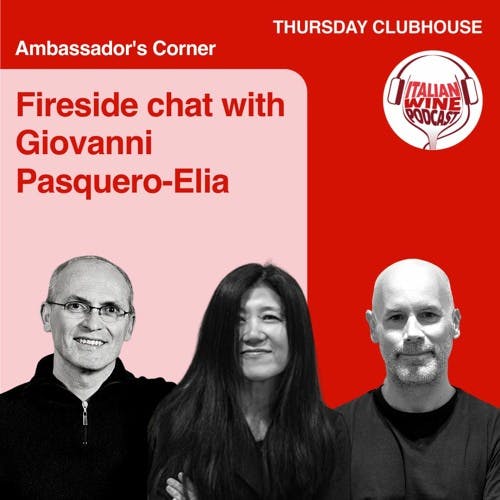
Ep. 1096 Matt Paice Interviews Giovanni Pesquero-Elia | Clubhouse Ambassador's Corner
Clubhouse Ambassadors’ Corner
Episode Summary
Content Analysis Key Themes and Main Ideas 1. Paitin Winery: History, Family Legacy, and Winemaking Philosophy. 2. The Importance of Terroir and Specificity within Barbaresco (e.g., ""Sori""). 3. Nebbiolo Clones and their Influence on Wine Character (Lampia, Michet, Rosé). 4. Paitin's Adaptations to Climate Change in Viticulture. 5. Market Expansion and International Reach for Piedmontese Wines. 6. Collaboration and Community Building among Winemakers. Summary This episode of the Italian Wine Podcast features an interview with Giovanni Pescuera Elya and his son Luca from the historic Paitin winery in Barbaresco, Italy. Paitin, established in 1796, details its long family legacy and winemaking philosophy, emphasizing elegance in their Nebbiolo wines. Giovanni explains their shift towards longer maceration and away from rotary fermenters to achieve desired quality. The discussion highlights the critical role of terroir, specifically their ""Sori"" vineyards, and the distinct contributions of Nebbiolo clones like Lampia, Michet, and Rosé. Luca addresses the urgent challenge of climate change, outlining Paitin's proactive mitigation strategies, including specialized canopy management and reflective sprays. The winery's successful market presence in the US and emerging opportunities in Asia and Northern Europe are also discussed, alongside the importance of community and collaboration among Piedmontese winemakers, influenced by figures like Luigi Veronelli. Takeaways - Paitin is a historic Barbaresco winery, with family winemaking dating back to 1796. - The winery prioritizes elegance in its Nebbiolo wines, achieved through techniques like long maceration and careful extraction. - The concept of ""Sori"" (sunny, steep, poor soil) is fundamental to their terroir-driven approach in Barbaresco. - Nebbiolo clones (Lampia, Michet, Rosé) offer distinct characteristics, with Rosé contributing elegance despite lesser structure. - Paitin is actively implementing various strategies to combat climate change, including canopy management and the use of mineral powder sprays. - The US is Paitin's primary market, with significant growth potential identified in Asia (Japan, Singapore, Hong Kong, China) and Northern Europe. - Collaboration and community among Piedmontese winemakers are essential for collective representation and research. - Journalist Luigi Veronelli played a significant role in promoting quality Italian wine and food in the 1970s. Notable Quotes - ""The negative things are probably easier to remember."" (Giovanni on recalling bad vintages) - ""If I need to speak about the future, probably the most urgent thing is, is how we need to take down the climate. To preserve the quality we always had in our wines."" (Luca) - ""The biolo is a pretty vigorous plant. If we choose, a soil, with, a lot of nitrogen... it has too much vegetation."" (Giovanni) - ""Sorry, it means it's the it's the sunny spot... south to west, and and the normally steep... poor soil is much better than, than the rich soil and the biolo doesn't like rich soil."" (Giovanni on the meaning of ""Sori"") - ""We try to stimulate the community, and we hope that as a community of Alba, we will be able to stimulate some research from our local institutions."" (Luca) Related Topics or Follow-up Questions 1. What are the specific long-term projections for Nebbiolo viticulture in Piedmont given ongoing climate change? 2. How do Paitin's climate change mitigation strategies compare to those of other leading Barbaresco or Barolo producers? 3. What are the challenges and opportunities for premium Italian wine producers when entering new, diverse markets like China and India? 4. Can the unique characteristics of Nebbiolo clones be further optimized through targeted research and clonal selection, especially in a changing climate? 5. How has the definition and understanding of ""terroir"" evolved in Barbaresco, and what ongoing role do traditional terms like ""Sori"" play in today's wine discourse? 6. What specific research initiatives are currently being pursued by the ""community of Alba"" (as mentioned by Luca) to support local viticulture?
About This Episode
The Italian wine podcast hosts discuss the upcoming edition of the Italian wine to wine business forum, which will be in-person and recorded. They promote a clubhouse session for ambassadors to ask their favorite producers and make contacts with them. Speakers discuss their past experiences with Barbara and Navio, including their work with an ologist and their belief in trusting family. They also discuss the importance of creating a vision for the generation and trusting family culture. The success of the US wine industry in America and UK, as well as the importance of reducing energy and preserving the quality of wines is also discussed. The speakers emphasize the importance of creating a climate action to address climate issues and promoting small farmers and political communities.
Transcript
Welcome to the Italian wine podcast. This episode has been brought to you by the wine to wine business forum twenty twenty two. This year, we'll mark the ninth edition of the forum to be held on November seventh and eighth of twenty twenty two in Verona Italy. This year will be an exclusively in person edition. The main theme of the event will be all around wine communication. Tickets are on sale now. So for more information, please visit us at wine to wine dot net. Welcome to this special Italian wine podcast broadcast. This episode is a recording off Clubhouse, the popular drop in audio chat. This clubhouse session was taken from the wine business club and Italian wine club. Listen in as wine lovers and experts alike engage in some great conversation on a range of topics in wine. If you enjoy listening, please consider donating through italian wine podcast dot com. Any amount helps cover equipment, production, and publication costs. And remember to subscribe and rate our show wherever you tune in. Hey there everybody. Welcome to Club House Ambassadors Corner. My name is Joy Limmxton. I'm standing in for Stevie Kim. She normally does these, but she's still getting back from Compania. So, doing this for this evening. And, so, yeah, Clubhouse. We do this, every Thursday at six PM. And this is a great opportunity for ambassadors of leaving it to the international academy to end wine lovers, of course, to get to know their favorite producer and, you know, make contacts and basically ask the questions that they they've always wanted to ask their favorite producer. We do replay this on the Italian wine podcast. So this will be on there in the next couple weeks or so. And, that so that people who are not in the same time zone can catch it or for whatever reason. So it's it's actually really popular on the Italian wine podcast. So, yeah, that's great. So for today, we have Giovanni Pescuera Elya, being interviewed by Matt PACE. And if I have butchered anybody's name, I really apologize. Matt, are you there? I certainly am. Yeah. It's quite hard to get my name wrong. It's good. And I I detect a a British accent. Where are you right now? I'm in London, where it's raining very? Ah, okay. I wish it would rain here. It hasn't rained in in a long time. So So I will, I will go ahead and, give you a quick, introduction, and then I'll I'll I'll turn you over. I'll let you do your thing, and and you can go ahead and introduce Giovanni from the Paitin winery. So, sir, you're the operations director of Enotteca Daluca. Independent group of three Italian restaurant and wine bars in central London. And, you're also, a wine ambassador and also have you have your w set three level three. Is there anything else you would like to to tell me about yourself before I before I hand you over? Well, that's my bio. That kind of pre pretty much covers it. You've got me in two sentences there. That's That's very, very British. Very good. They're good. Get on the important person who's the who's the genius winemaker. Fantastic. I love it. So, Giovanni, are you there? Yes. I'm here. Okay. Perfect. Okay. So, actually, you know, before I I go, I just wanted to ask a couple things that Stevie always likes me to ask, which is Matt, what, what are the learning objectives that we should expect from this interview? And how did you discover the wines of pi pi team? Sure. So learning objectives, I would say, I can answer both questions at the same time. So why why Python and what are the learning objectives? You know, Barbaraco is famous for its varied soils. And all the different sites. It's harder to understand than Barolo, where, you know, there's many, many, the villages and the sub zones, relatively easy to get your head round, whereas I would say, Barbara is harder. Because there's so much more variety. And that is one of Python's strengths, I think. And I hope to talk to Giovanni about this is how they have pioneered the use of single vineyard and understanding what each different plot does and what kind of different Babaresco that makes. So that's one of the reasons for wanting to interview Giovanni. How did I discover them? I think I first tasted pie tin wine if I'm not wrong at Nebula de, which is a fantastic event in London that happens happened twice or three times, put on by the journalist water speller. And so if you're ever in London, if you're in the UK, you must go because it's an amazing amazing event. And then In April of this year, I went to Grandilanga, in Torino, which is an event organized by the consortciardi tutoral on Babaresco and Doliani. And, you know, same thing. So big tasting, mostly not biolo, but also, some Doctorchetto and Barbera, and I met Luca, Giovanni's son, at that event, and tasted some of the twenty nineteens. We know which everyone is saying is, gonna be a pretty stellar vintage for Barbara and Barolo, and was just super, super impressed. And then I happened to get invited to a lunch with Luca in London two months later. So Yeah. It's, I've just ordered myself a case of the, twenty nineteen Sorry Pitein, which isn't even in London yet. So, yeah, I'm a fan. I'm a fan of Pitein wines. Awesome. That that that actually does sound really great. If I'm ever in London, I know exactly where I'm gonna go. So go ahead to you guys. I will come back at the end, and, we may have a couple questions or not, depends on the time And, until then, I will I will, mute myself. Go ahead. Okay. Perfect. Thank you very much. Giovanni Chow. Come as day. Chiao, Matt. I'm fine. Thanks. We just started the harvest, last week, everything looks nice. We hope that now the weather continue, like, I guess now it's cooling down at night. So and, the grapes are looking very nice. So we crossing fingers for this this vintage. Fantastic. And how have you how much longer will you be picking for? So this since this was, warm summer, we are starting. So just start with a nasal dulcreto, but, we continue with Barbara and Navio. I think, at the end of the month, everything will be done. Okay. Amazing. So I wanted to kind of first of all, you know, put the estate into perspective. It's a very historic estate, isn't it? One of my team. One of the oldest. Tell us, a bit about the history, how long I know there is, I think, different families have come together over the over the centuries. Tell us tell us please about the the history. Yeah. So a short, short history. We, We are in this this occasional scene, so now, seventeen ninety six. The, the family purchased, the first part of the, this state, just after the French Evolution, you know, before the Napoleon came, so in a couple of a couple of things later, Napoleon arrived in the area. We still have a document with the Napoleon stamp when we purchased the second, the section of the winery. And, we had, for, for many years, not only venues, like, it was it was a classic, classic farmer with also some hazelnuts, some peaches, and also some some animals, when, we we kept the the cows and oxys until nineteen seventy. To to work in, in the vineyard before the first director. First director came, in nineteen seventy. I remember, and I was born in nineteen fifty nine, so I I remember my parents, working with, with the animals with, was a really tough time that so then the family, they continue, making, making wine, other things. And then, my great grandfather in, eighteen nineties, Elia Giuseppe decided to focus mostly in in one making, and he he started to make the the first labels. We have no information about labels before before him. Then some, he started to export also to London first because it's causing, had a restaurant in London in the early, twentieth century before world war one. Reading. Yeah. He moved there as, to be a waiter, then he married the owner of the, the the restaurants. So, and, they they opened also later, the family in another restaurant in New York. The my, my granddaughter, father started to to New York, probably one of the first of the did that period. Then, continue after world two, after world one, during world war two was a complex situation because my great grandfather and my grandfather both died. So during the war was really complex. So my father took, to started to work with, with the family, in, nineteen forty eight, and, and, restarted the, the the business, not restart, but it continued improved a little bit. The business was down for, for, like, ten years. I came about forty years ago. Around four years ago, working with my father. I also have a younger brother, Sylvano, which is, also an ologist like me, but is mostly the winemaker now. We are sharing the the the different think so. And and it's mostly him in in, in the cellar. So sorry. You must have been about twenty then when you started working in the winery. Is that right? Yep. Mhmm. Yep. And but I I started to work to to participate with the fermentation in a very difficult years in early seventies when, the weather was not cooperating. So I remember seventy two, seventy three tragic, the, okay, seventy four, but other years. So, seventy was very complex. So it was a time when a lot of people were, thinking to change business and not continue to make green wine. Then, unfortunately, the weather, became, and, much better for us. And, so then, Luca. Sorry. To me. It's interesting to me listening to winemakers talk about vintages. You're talking about a vintage fifty two years ago as if it was yesterday. You still the pain. The pain of nineteen thirties. Yeah. The negative things are probably easier to remember. I don't know. But so, and Luca, he he, he joined us in two thousand six was lucky because it started with a the great vintage. And so, our history, so we are in more than, two thousand two hundred years, you know, in, so making windy things, but, that the, recently has told us that the results, must be achieved slowly. So we have to make a a bigger force and, you have to wait, wait. And it's important to have, greater family spirit and family culture, to continue. And but I I think the most important thing is we have to have a vision. The family of a vision, if our family has managed over time to transmit the same vision, the dedication of through the generation. It's still our our engine today until the the new generation at the reception, obviously. But this is not Tell me, so, yeah, tell me a bit about how that vision works because one of the things that strikes me is you you have you make, you know, relatively of quite a few wines. Mhmm. Tell tell me kind of what they'll tell the tell the listeners, you know, what what is that philosophy? Yeah. It was, believing in the third war and, what we we were doing. A lot of farmers was just, you know, even our business, just, cultivate the the the vineyards, you know, the things just to survive five, and not to making something, to, to have a a real project, and that my also my ancestor, my grand grandfather, they they had a project, a real project about to do something special, related to the, to the third wire. So it's important to to trust, in the territory. And a lot of people didn't in the past. So which, this is what's the advantage probably we had. We we always we remain very small. We never have, big production, but, the the idea was always there to, to make something to create something. How many hectares do you have? Actually, we have around twenty hectares. Okay. Right. Which is, is not too much, but this is, it's a lot of work. Sure. When I mean, how did your great grandfather, you know, understand? How did he do you think he came to understand the terroir differences? Because I I imagine that a lot of our understanding is quite modern. About soil types and the influence and and that kind of thing. But how do you know how he came to kind of that view of terroir? He he he started to travel. He he was a lawyer. He was not farmer. But, especially when he he move, he's he went to visit, his crossing in London. He realized that, was not, was possible to make something something different, something, something better. And and the potential of the of the re it's tough to understand a little bit the potential of the region, probably not hundred percent, but I think that, that, trip going through France, going up to to London. It was the the the time when he realized it was possible to do something something more important. And did he did he go to any there's a few, quite a few Piamante, say winemakers who went to burgundy and kind of opened their eyes a bit. Is that what happened to him? Do you think? Was there a burgundy? No. No. I I I think it didn't visit the the the the French wine region, bourgogne, but he realized it was an interesting market, for for wine bottles, not only in big in Demision and what that we like it was the market, at the timing also in in the region. Got it. I see. And then, l talking about your the wines that you make, you know, you have an Arnese, a fraser, Dolceto. Uh-huh. The ones that I'm particularly interested in today are the, the Nebula based wines. So you've got tell tell us what the what the wines are that you make, please, to to tell us about them. So about all all the wines we are making, or the Naviolos? Just sorry. Just the Nebulaos, please. Nebula. Okay. Well, we have, Naviolos mostly planted in Nava here where we, in Sarabuela, then, the recent acquisition, Vazorina Fazette plus in in Alba. We have, where I live in a property in Alba where we make them Bureau, Alba, and I'm gonna be all. Our focus obviously is mostly mostly bad water ice cream. As you know, we, we work for a long time and more than a hundred years only in Sarboiler with a single, single vineyard. And, more more recently, after Luca came on board, we, we acquired First Basarine and then and Fazette, but it's very recent, eighteen, two thousand and eighteen, two thousand nineteen. And, but we were able since we work with, one vineyard, old Sabuela. It's it's a big vineyard, but, with some difference, but, you know, it's, same hill. The the difference is not not very big. We learn how to, diversify. So to recognize the small difference in, in, in, so, the this, our our Saraguela. So the Suripay team is the the central part, the oldest, property which always give us, much more, I mean, quality. So much, so more important wine, with big, bigger engine potential. And, sir, well, are different plots around. Also, we purchased later in the last eight years. So, so with, this, so working with the same, or as the same So it was, was interesting to, approach other other area, like, like, Brazarina, for that, which are, special Basarina is not far from here, but it's, very different, very distant soil. Fazette is some way similar to here, but, you know, it is, the question of microclimate here, not only in the soil. We could, we can talk about terroir, normal in general. What are so tell us what's the the soils you've got in Sarabuella and the soils that you've got in Bazarene, what are they? Mhmm. So, Bazarene, you know, in this, this area, the hills were originated by the the erosion in millions of years, when, after the, when the the, the soil came up from, from the ocean. And, you can find much, closer to to the river, to the Tannaro river, more longy soil with, we call a limo. And then, moving away from the soil, more clay, and then more sand where we are much, away from from, from the, the, the, the, the, the, the, in case of Bazarin, Bazarin is much more sandy. Much more sandy soil. It has in our vineyards, faces mostly south, but as a, big, large valley in front, so it never gets too hot. And, but the soil is much more sandy than Sarabala and also Fazette, Fazette, and, Pazette is next to Azili. So very similar soil. But it's also very similar to, the Sarabala. But the situation is different because the the the the climate is, you know, may aggravated by the, the river, and as less variation of temperature, so as, gets warm and gets cool much faster because it's in, we can get a lot of wind from, from the ocean, in, in, in Sarabuil. So even the soil are similar with the, the effects are, so the results are quite, quite different. So, you know, so I remember being taught that a high diurnal range will give you more, perfume in the wine. Mhmm. Hi. Sorry. Is that fair to say in Sarabona? Sorry. I I did say it again. When you have high temperature range between day and night, that might give you a more perfumed, more aromatic wine? Yes. In general, yes. So, Sababello, we have this situation in general, but also Even, Baseline, which is not, we it is not such a big, big, wide, temperature difference. It's, that has nice, nice flavors, but a little less, less structure. Yeah. And that will be the sand as well. This you get less structured. Naviolo requires less structure when it's on sand compared to when it's Yeah. Normally, with more sandy soil, especially in in Alba, we have, a new vineyard planted at the the top of the hill, which is very sandy. And and so this lighter. We also mix, some, Lampia and, and Rosier. So it's, it's very interesting with the it has a lot of sand, but are the sand, called Sabilidiana, so the sand we you can find in castillanifa late to to the part, the first part of Montford. And, but, normally, Sam's gifts, especially in Royalero, the scent of Royalero gives, so less tannins, makes less tannins in the wine, and, nice flavors, maybe the wine cannot leave very, very long, especially with a rose sand, but, with the different flavors. And that's because the the, the white the the vine is getting less nutrient from the sand because if the sand drains the the the vines aren't quite as strong as they would be if they were on clay. Yes. Yeah. Mhmm. Got it. Okay. Great. It just talking about your new vineyards. You've got Fassette. You mentioned and Bazarin, are you going to are you intending to do single vineyards of those in the future, or are you gonna just blend them into the, your, we we don't make a, a blend, barbaresco blend. So Yeah. So we have all single vineyards. So, Azarim Fazette, will be, in the future, we also will have, in some years, we just replaying the the the start day, re vineyard, and, also another, but, it will be a question of some, some more years, but all single vineyard. We are, all the, from, the great we have from the young vines, are going all in I'm gonna be on. We don't make, just, a barbaresco without, with the nuts and single vineyard. Are you enjoying this podcast? Don't forget to visit our YouTube channel, mama jumbo shrimp. For fascinating videos covering Stevie Kim and her travels across Italy and beyond, meeting winemakers, eating local food, and taking in the scenery. Now, back to the show. How many years do you wait, before, you know, how many how old does the vine have to be before? Normally, normally, ten years. It it depends, different source, but normally, the first ten years we make, only only longer than the owner. Got it. Got it. Got it. Tell us, can you tell us a bit about what what do you want your wines to do with in the glass, in the bottle? How do you want your wines to be? How do you think your wines are best appreciated, you know, what what style of because one of the reasons why I loved Nebula so much is because of all the different expressions it has and the different types of Nebula you can get What what do you aim for and what your quality that you want to achieve? Mhmm. So, right, now, in in in the years, actually, this idea changed in the late, especially talking about the the nineties when, we we were, flirting with the new new wave of the the the, the new Nebula's made with the short maceration and, this thing. So in the that period, we, it was we I can say my fault. I was looking for a little more extraction in in in the wine back back in the nineties, like, thirty years ago. You've done you bought yourself a rotary fermenter, right, I believe. Yes. Uh-huh. Yep. We purchased all the experimenter in ninety seven. And and we used for, like, thirteen years, sir, probably, sir. The idea was, to to have more extraction, but we realized, in a short time, that, with the ferment, it shows some respiration and a high temperature and, and the rotation. We had the much stronger, authentic, extraction, especially in the hot fintages. In hot fintages, sir, the the wine became we're supposed to have, why it's easier to drink, but was not to because we have more extraction. We we never made the super new, vinification as some, especially in Barolo area, some producer made with, like, four days of maceration with Naviolo, and then, with a thirty five cells, use of, implementation. So in this case, you, you cannot get a lot of tennis, but the the wine was, I mean, little too soft. In, after the the three years, sir, we started to make a little longer maturation in rotary fermenters, and then with a lower temperature. But, the the technical extraction span again, especially in the hot warm vintages was was still still quite high. We changed, we decide not to use anymore. The rotary fermenters, so also we introduce some small French barrels, like five hundred liters for also for Barbara Esco. Just a small percent, in, like, ninety nine, two thousand, thousand and one. In two thousand and ten, we started to cooperate with the the, a winemaker called Dante Scaglione. Mhmm, Antesaglione was a a classmate when I I made the wine wine school. It was the for many years, the Bruno jacuzza winemaker, and he suggested us to not to use anymore, the rotary fermenters, even with the new system, with long maceration, cool temperature. And, so we have From two thousand and ten, we have the new, a little change, so back to the, the past. Now the focus is so in the glass to have a very gal very elegant point with, a nice way verse, then, you know, Nebula is not, is a wine that can change in six months. Sometimes it's not good as it was before, then it becomes better. You know, it's up and down some, like, some pinot noirs or some others. Somewhat, we we want to have the focus in most of the elegance of the wine. So we we don't care anymore about, the extractions, and also the color. With the long maceration, we we are losing some color, but the color is more stable, and the elegance is much better than before. So the ma our maceration now is long, like, four weeks, for for Debbie Zerva, sometimes it's even, eight weeks. Very with the submerged cap, like, my my father did, in in the top vintages in the past. So we what we want to have, and also especially Luca. Luca is a fanatic. It's, borgon fanatic, and so he likes it. So it's easy to be in Borgon fanatic, but, he likes it. The the they have real elegance in the in the wine. So the to you, the secret of making an elegant Nebula is having the what would you say? The top, factor for determining the elegance is is it right. The the median, the combat medium four week, maceration, you'd say? Yeah. Yeah. The maceration, it I also, but, yeah, the first, before the the the verification to have the the right, terroir. And you you must be in the good condition with microclimates and, and, and so it otherwise, you can, you can make all the efforts, and, it's hard hard to make it. It ends. So the longer maceration out, to to reduce the quantity of tannies because the harsh tannies are going normally are going to to reduce in the longer maceration. And, more distraction from from the skins, So this situation, you know, you know, we are lucky in the last, like, like, twenty five years because the skin is in very good condition. Going back to the the the terrible years when I started, when we had problem with the thin skin, attack by arthritis. In this case, it's, it's impossible to think about lung maceration. It's, extremely important to have the perfect skin, like, like, most of the cases to make, to make the long observation. And, it's possible to get, more elegance, not always, it's important to have the right, right, or wire, and also the right, clone the right variety. So we we have a blend. We we have, Jose in every vineyard, different percent. Rosets, the variety gives much more flavors and much more elegance to the wines. Unfortunately, doesn't have a lot of structure, making a hundred percent Jose, the wine will be too too thin. And, maybe it doesn't age very long. But, Rosay is very, very important to have, the, the real elegance in the in in the diolo. We I don't know if you know a producer called Orlando Abrigo, but he makes that wine. Yes. I've just I've just listed It's c n one eleven. C n one eleven. C n one eleven. C n two. Yes. Yes. Yes. We did something for the nerds in the audience. This is a wine named after the clone of Nebula Rosay. So you can go and order to see and one eleven yourself and make your own. We just planted two new vineyards this year, and one is a fifty percent of, one one one. And in in Arrow, we play when we make the R and A's, we replaying to the vineyard, hundred percent with, one one one, Santon, did you? Sure. I mean, I think technically, it's now if you ask some scientists they would say it's actually a different variety. It's not Nebula. It's a different grape called Nebula Rosay. I don't suppose that makes a difference to you because you're growing it, but I've I've read that it's seen a scene that's thought to be a different variety. It's, so, you know, the tree variety is lumpia, Mccaton, Rosiette, lumpia Mccatas, very similar. So different, a little bit different vegetation, and, also the the grapes, it's, it's different shape. Rosay is very different because as the leaves are different. And also when it's ripe, it looks like pinot gris. It doesn't doesn't look ripe. You have to turn around the the the the fruit to understand if it's ripe or not, especially the people don't know about Rosay. I remember sometime in the past when we had some pickers, were not specialized about the mural. They didn't didn't pick. They left Rose in the vineyard because they didn't know it was was was ripe. Wow. It's funny. Yeah. It's a it's strange. As the vegetation, you can easily recognize the rosse even before it's, change the color. Is is quite a little different. But now we have a lot of selection of, also, about lumpia and, and me cat, to choose, with the more flavors, a little more color. Some, mortality. It's, I think it's always important to mix, different loans. In the case of, the this one in Roera, we we decide to plant only this variety because we want to make, this, so hundred percent gentle wounded ship from from where it, but it takes another three, three, four years before to work. What would you say? Just you've you've talked about, Naviorel Rosay, but Lampierre and Mick we get. If I remember rightly, Lampia is thought to be more high quality. Have I got that right? So Lampia has normally the bigger, bigger bunch, it's, the fruit is a little bigger. And, and Mccat is much, much smaller with thicker skin. In general, the classic old, Mccat, much more tannic. So to make an hundred percent Mccat is not really drinkable, maybe all because it would be tough, very tangic, much little more color, a lot of concentration, but not, not the best. We, now there are some, clones from Lanca. They're they're very nice. They also The problem, Macat was, the, inconsistency of the production. Some years was, making, make normal production. And next year, only twenty five percent. It was, some variety with not not reliable, so very complex. Got it. Got it. Got it. Talking about, you know, your your site. I noticed you've got, you know, you've got this word, sorry, on, you know, in the name of your wines, which is something that I just I recently learned has a very it's a PM Monte's dialect. Yes. Yeah. Exactly. Yes. Yeah. And it means it's the it's the sunny spot. Is that right? Yeah. It's the sunniest part. So normally, south to west, and and the normally steep. When, even when the exposure is, is, is a good exposure, but is not the steep is not considered free. Must be steep and, so, south, south to west. The, disclosure, which is much warmer than for and a steep is normally poor soil. Poor soil is much better than, than the rich soil and the bill doesn't like rich soil. So, like, many other gray varieties to make interesting wine. And the biolo is a pretty vigorous plant. If we choose, a soil, with, a lot of nitrogen, like, eastern exposure, sometimes the northern exposure is not much of the the quantity of sun that can get the plant, especially now with each of his warmer, but it has too much vegetation. And normally, this soil, especially in the northern exposure, it also too much humidity. Maybe it was good to zero in two thousand and three, two thousand and five or seventeen. But in general, it's, is negative because the plants give, make too much vegetation and doesn't focus in, in the fruits. And so sorry. We, my father introduced on the label put sorry, by Tina back in the seventies, that was a as a suggestion of an important journalist of the the that period. Call luigi Veronelli. Yes. It was a fashion. I now there's I've met a couple of winemakers who attribute their success to Mhmm. Veronelli. I was in, Trentino in April at, you know, Poyais and Poyaisandri. Yes. Uh-huh. Yeah. And this it his visit and his write up in nineteen seventy three was to Poyaisandri was the turning point. No. No. It was, it was an important person. It was the first to introduce, wine, food intellivision in the seventies, before no nobody else did even, you know, we are food food wine is very important, Italy, but we we never had before in television seriously. So, no, before we had somebody was not, it was just, for jokes. He was a real professional, we g, and we are everybody, we call Geno. And, was a very good, great journalist, sometime, even hard to understand from Italians, I was writing in Italian, but very sophisticated the words, and, that was, was fantastic. Gina, and, when, or, when it was here back in back in the seventies suggested my, my father to put on on the label, the the the name of the vineyard, which is the sorry. Piting is the the old name of is the nickname of the fam, the family is not our, last name. And Brico, another word we use is related to the top, the highest point, on the of the of the area. Yeah. We are in Brico Yeah. Brico, you see quite a lot for about Yeah. I don't think the top of the hill, right, where the story is. I also read the story is the spot that where the snow melts first. Yeah. The first. Yeah. Yes. Normally, yes. Now there's no way is, not much. It's melted melting very, very, very fancy everywhere, I feel that we don't have much anymore. Yeah. But normally, there is a way where that there's no melt first, is as a good sign. Got it. Got it. Got it. One thing that, you mentioned in, you know, I read in your biography was, that that when you went to America. Mhmm. And because it it's noticeable, like, looking online how much, you know, how many American imported right about your wines or how much coverage you get in America. I know there's lots of Italians and and Ven Italy themselves are Yeah. Always fascinated by, you know, Italian winemakers being successful in America. How how would you say you'd it seems to me you're successful in America. How how have you done it? You know, how does it work for you? Yeah. Yeah. So, the the adventuring United States started in the late, early seventies. We, we met, one, important one agent at that time called, Thomas Abruzini, present to this guy, he was a visionary man. He was a, the the vice president of Banffi Group sort of, the big, comp American company, but it was mostly in charge of, the buying, you know, on premel. So it was going to the different Chateau. It was a was a super expert of Bordeaux, especially also in Bordeaux, but and he since, the the parents were Italians, he didn't understand why the Italian wines, with the big, big possibility. It didn't have a lot of success in the United States. And it started in the site to open his own business as an agent, but before it traveled through Italy, for a couple of years, just, moving in different, regions and pasting the wines, and making a lot of notes to understand about the the Italian territory. So we we met this guy, back in the late seventies, in, it came one day at the winery. He was, trying to put together some, producers, to have the same label. Everyone with the his own wine and depend with the name, but to, to have one label to, to make a a promotion easy easy. The promotion of the the small producer, but it didn't work, So, when we started to ship something to the States, and, my my first trip to the US was in nineteen eighty four, and I realized, how weak was the presence of the the Italian. The Italian wines in the United States, so it was also probably also related to the the lousy quality of most of the Italian restaurants at that time, and, a lot a lot of bad bad wine from the big big wineries, some and then it was a for us, it was a a big chain because we started to, make some, so selling some markets, and then open in different markets, then we we continue, by ourselves because it changed a little bit of the strategy. And then we started to work with Marco de Gracia in the nineties. Mark was, another visionary guy starting in the eighties, to it was very important for the, Piamonte, Piamont, wines. During, during Marco de Grasse, we analyzed the distribution. Now Even we are very small, we have twenty one distributors in the u in in US. So, they're covering, right, thirty, more than thirty states. So it's even it must be even too much. Here. This is and it is still, it's important for, for us, US, it's, it's our main market. The the second market is, UK. Great. Good. I'm glad to hear that. And now in fact, I think your son, Luca, has, just managed to join. He was, I believe he was Luca was traveling, but now he's here. Hey, Luca. Hi. Hi, everyone. How's it going? It's okay. Same as we're talking about kind of international and, you know, new markets and all the rest of it. Maybe we could talk to you now a bit about, the future for posting. We've had to Okay. Good. It can be quite it can be quite a long a long question, a long answer. It's speaking about the future. But, I would say that, if I need to speak about the future, probably the most urgent thing is, is how we need to take down the climate. To preserve the quality we always had in our wines. And so this is for me, the most urgent part of, of our objective, as a consequence, This year has been quite a great testing year for, we will see in, after the fermentation are finished. If our efforts has been, worth, I think that we try to approach we haven't removed, for example, almost any leaves from, from all the ground from all the plants to avoid any wound and, evaporation of water. So this was a way to keep the plant preserving all the water they had. We manage the canopy in a different way, without taking out some branches that normally were preventing the humidity to move away from the plant. With the move to solar. We fragmented the site to avoid the sort of operation. And then many other things, also spray, kind of, powder mixed mixed with water to reflect ten, fifteen percent of the radiation of the sun. So those are some some of many other experiments with fungus, and, that we are experiment and I'll get to do our experimenting in the vineyards to preserve the elegance in the class that always distinguish Balbaresco. And so I think this is the most challenging and, find your part of, of our activity today. Tell me about tell me about the spray. You're not talking about copper sulfate. You're talking about a spray that just is just to reflect sunlight. See, as I said, it's just a soil. It's a powder of soil, mineral powder, that was used in the past for, constructions too. It essentially is very, very white, and, he goes on the plant. He's rate, even once it's, is enough away if you have, like, a heatwave coming. And, hey, there's a bit of reflection. Normally, it is considered ten, fifteen percent. And it's just water on soil. Nothing, after three, four reins. Probably, we will be washed away. But this is a good way to reduce the amount of radiation limit limiting the photosynthesis and also, prolonging a little bit, the ripening. Of the other drugs. Okay. And do you think, you know, so your approach to kind of to combat climate change is that gonna be focused on this kind of canopy management you know, that and and the frame, that's the kind of a headline. What what else might you do? What how else are you thinking about, you know, how to respond to future empathy? That's for sure. So another way that takes will would take little bit more longer would be, like, selection, maybe of newer clothes that are able to take a better, the climate. We already did, since, I think my family always had quite attention to for the rootstock. And, when I joined the one, it also had, like, a little bit more, attention on on the roostocks selection. So essentially, we're able now to have a roostocks. They are kind of very pastry based. So very resistant to dry weather. And, it's those are all elements, and also a lot of research will be needed from, some more complex, institutes for, for better nebulo, also for the future. But, this is something that is outside of our potential, and, we rely on, on, on, the community. So we try to stimulate the community, and we hope that as a community of Alberto, we will be able to stimulate some research from our local institutions. Do you work with the university of Torino or who do you work with for your kind of technical advice? What do you talk to? Yes. For sure there is, like, a close connection with the University of Torino, some professor of, the University of Terina is a branch in Alba. It's very easy to communicate. And then, most of the research on the cons is also done by the Roschetto company, who is the one that makes most of the small plans for, the North Italian Viticulture. Oh, yeah. I think I've, I think that yes. I think I've seen them and they'll sell you a clone. What, and then talking about outside of climate change, kind of new markets, where else do you see the what what what markets are embracing, Babaresco, Naviano internationally. So internationally, we are seeing, a much more demand also from the Asian market. And Japan has always been a quite established market, and we worked with Japan. I think, since it was a key, I always heard about the shipping line to Japan, and my father can confirm that. But, now we have, like, many more Kazproma, Singapore, Hongland China, many different areas that are asking for, for, having the opportunity to test the wine and to see and to check also the reaction from the market. And the few reaction we had, were extremely great. And market now is a little bit more it came now to be solid. It's that an Northern European market that maybe, ten, fifteen years ago was almost not existing, and instead became very important for a Fortenabial area. Also because it was very easy to travel to our area. So we had, like, a very strong influx of, of Northern European, people coming and visiting. They loved the area and so forth. It was easy. Than to to buy and get passionate with the wine. Yeah. Amazing. Cool. Probably final question. You mentioned that you, you know, you you work in the community in Babaresco. Who are the other producers in Barolla, Babaresco and perhaps Barolo as well? Who else do you admire? Do you kind of compare notes with? Who else are you kind of, hero producers or your neighbors? So for hero producers, we we have, we have made it to admire. I think that each one has, works with, I I I admire people that are able to, make out of their soil one very unique expression in Varesco. I would say that I'm incorporating very well with, for example, Ricardo Sabrina from Luca from Bruno vodka from, those are friends in which we often meet, the four of us plus some of the Gabrielle Cortesa from, you know, the Gabrielle located from Giuseppe Cortesa. So many people that essentially we we often find each other together. We discuss or exchange some information. And we also create, like, a little commune political community, let's say, to show the power of the small farmers and to have, like, more, awesome representation in, when we're speaking with bigger institution or a political, let's say, authorities, having a voice of the farmer that has been, much more influential in the in the decision. Yes. Of course. Yes. If I think about some of those other producers you mentioned, they I suppose there's a a common theme would be, elegant. You know, I tasted the Cortezi ones with Gabriela. Early this year, and it's they have the same, you know, some the same elegance and poise as your wines. That's super interesting. Thank you very much. Great. Joy, I think we might be drawing to an end unless you've got any more or leica, if you're there, if you've got any more questions. Hello? Can you hear me? Yes. I can. That was a great interview. And, I'm wondering if we have any questions. But if anybody thinks of a question that they would like to ask at any point after this, they're always welcome to email me at info at italian wine podcast dot com. And I can forward it to, anybody who, who spoke today. And, Luca, it's nice to meet you as well. My pleasure. Alright. So, Without further ado. Actually, Leika, do you know if there are any do we have any more club houses coming up before I before I sign out? Yes. Actually, we have a lot of club houses ongoing, like, or still, like, preparing for it. But then doc the confirmed one we have is going to be on September twelfth on Monday next week at six PM. It's going to be Robert Maggie, interviewing Madica Maggie, and they're not related. That's what told me for sure. So she's from Cantina La Marquesa in Poria. So see you next week then. Until next week. And thank you, Giovanni. Thank you, Luca. That was really fun. I I love to listen to that. That was great. Thank you so much, guys. Thank you very much. You're very welcome. If, if people can get hoe anyone listening can get hold of the barbaresco Sourie Piting twenty nineteen, it's that's my big bet for something that's gonna age in an incredible way. I feel like the case I've bought has been an amazing investment, and I'm gonna have to wait ten years to find out just how amazing it is. But, bravo, Giovanni, and Luca. Thank you so much for doing this. Thank thanks everybody. It was great. Thanks. Thanks, everybody. Thanks, everybody. That's awesome. Thank you. We hope you enjoyed today's episode brought to you by the wine to wine business forum twenty twenty two. This year, we'll mark the ninth edition of the forum to be held on November seventh and eighth twenty twenty two in verona Italy. Remember, tickets are on sale now. So for more information, please visit us at wine to wine dot net. Hi, guys. I'm Joy Livingston, and I am the producer of the Italian wine podcast. Thank you for listening. We are the only wine podcast that has been doing a daily show since the pandemic began. This is a labor of love and we are committed to bringing you free content every day. Of course, this takes time and effort not to mention the cost of equipment, production, and editing. We would be grateful for your donations, suggestions, requests, and ideas. For more information on how to get in touch, go to Italian wine podcast dot com.
Episode Details
Keywords
Related Episodes

Ep. 2787 Prosecco Superiore by Dr Susan H. Gordon | Book Club with Richard Hough
Episode 2787

Ep. 2784 The Other Side of Valpolicella: Volcanic Soils & Sparkling Wines with Francesca Marcato of Talestri Winery | Wine, Food & Travel with Marc Millon
Episode 2784

Ep. 2780 The Bridge between the Past and the Future of Wine with Serena Costanzo from Palmento Costanzo on Etna | Clubhouse Ambassadors' Corner
Episode 2780

Ep. 2773 Trento DOC: one of Italy’s finest sparkling wines with Alessandra Caroni of Maso Martis | Wine, Food & Travel with Marc Millon
Episode 2773

Ep. 2749 The Many Faces of Etna: Climate, Contrade and the Art of Volcano Winemaking with Federico Graziani | Wine, Food & Travel with Marc Millon
Episode 2749

Ep. 2744 Ep 25: Pantelleria, Salina e il fascino del vino insulare | Pellegrinaggio Enoico con Attilio Scienza
Episode 2744