
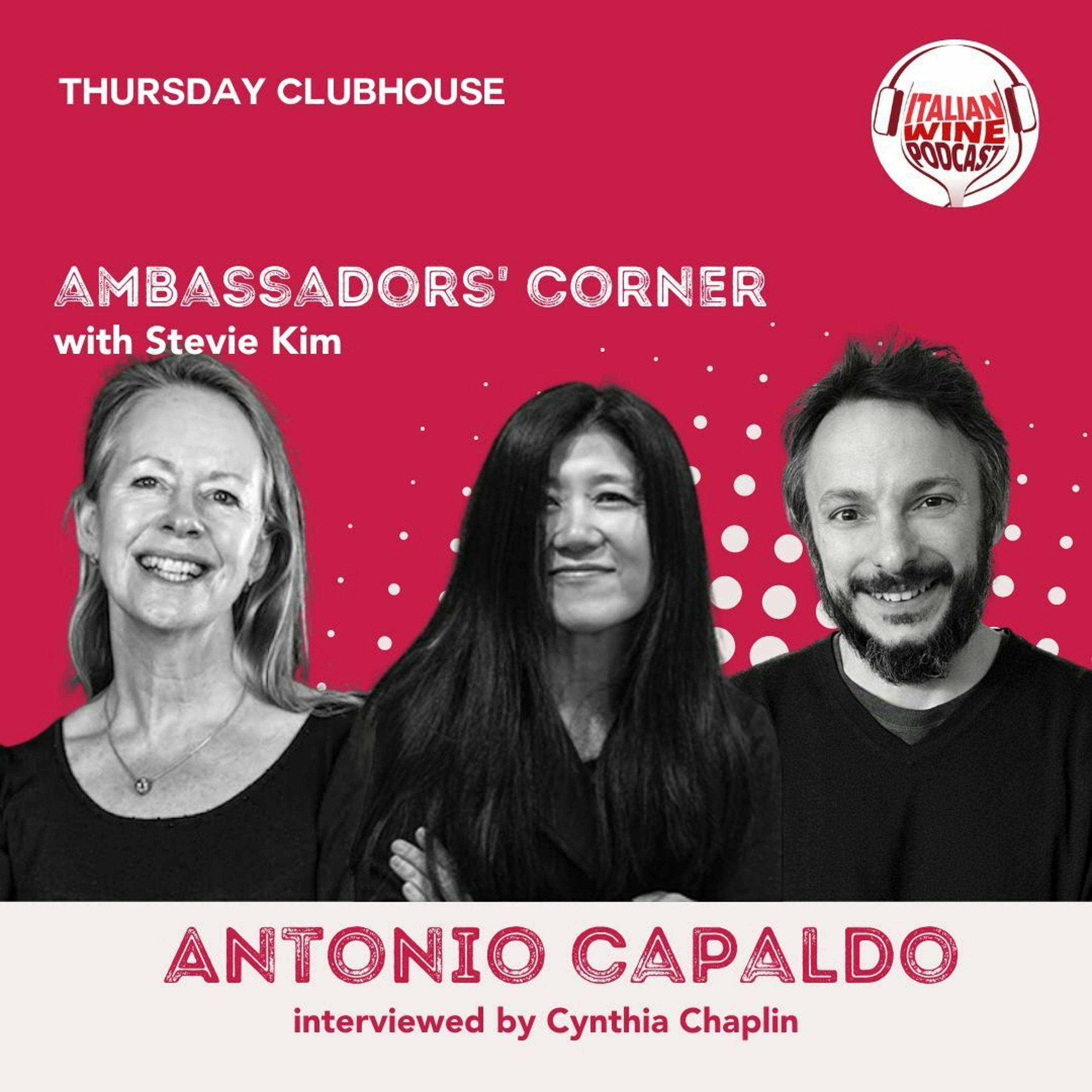
Ep 1447 Cynthia Chaplin Interviews Antonio Capaldo | Clubhouse Ambassador's Corner
Clubhouse Ambassadors’ Corner
Episode Summary
Content Analysis Key Themes and Main Ideas 1. The critical importance and ongoing preservation of ""old vines"" in viticulture. 2. Antonio Capaldo's leadership at Fuedi di San Gregorio and their pioneering efforts in old vine research and conservation. 3. The unique viticultural characteristics and challenges of the Irpinia region in Campania, Italy. 4. The application of ancient viticultural techniques (e.g., Taneckia, gentle pruning) to enhance vine longevity and resilience, particularly against climate change. 5. The intersection of tradition, heritage, and contemporary business practices in the wine industry. 6. The role of art, community, and long-term vision in winemaking and winery philosophy. Summary This special Italian Wine Podcast episode, a recording from Clubhouse, features an interview with Antonio Capaldo, chairman of Fuedi di San Gregorio winery. Interviewed by Cynthia Chaplin, Capaldo delves into his passion and the winery's extensive project centered on preserving and understanding old vines, some of which are ungrafted and up to 180 years old. He highlights that these ancient vines represent a unique heritage and are a ""gateway to the future,"" especially in tackling climate change. Capaldo discusses the complex challenges associated with old vines, including low yields, high production costs, and the lack of a legal definition for ""old."" Fuedi di San Gregorio addresses these by financially supporting small local farmers, implementing respectful pruning techniques, and researching genetic material from old vines to ensure future resilience. He also touches upon the distinct characteristics of the Irpinia region, the significance of indigenous grape varieties like Aglianico, Greco, and Fiano, and the winery's broader philosophy, which integrates art, long-term vision, and community engagement to promote their wines and region. Takeaways - Old vines, particularly ungrafted, pre-phylloxera ones, are a valuable and unique heritage in the wine world. - Preserving old vines is challenging due to factors like low yields, high costs, and a lack of official legal or industry definitions for ""old vine."
About This Episode
The Italian wine club is hosting a Zoom meeting to discuss the importance of old vines and their impact on the industry. The winery wants to investigate the diversity of biotypes used in their wine culture and is interested in the focus on old vines to address climate crisis. The winery is working to define old vines and create a community for them, and they are exploring the potential of bringing out the future generations. They also discuss the importance of learning from mistakes and rebuilding from them.
Transcript
Hey, guys. Check out Italian wine unplugged two point o brought to you by Mama jumbo shrimp, a fully updated second edition, reviewed and revised by an expert panel of certified Italian wine ambassadors from across the globe. The book also includes an addition by professoria Atilushienza. Italy's leading vine geneticist. To pick up a copy today, just head to Amazon dot com or visit us at mama jumbo shrimp dot com. Welcome to this special Italian wine podcast broadcast. This episode is a recording off Clubhouse, the popular drop in audio chat. This clubhouse session was taken from the wine business club and Italian wine club. Listen in as wine lovers and experts alike engage in some great conversation on a range of topics in wine. If you enjoy listening, please consider donating through Italia wine podcast dot com. Any amount helps cover equipment, production, and publication costs, and remember to subscribe and rate our show wherever you tune in. Welcome everybody to, Clubhouse Ambassador's Corner. We are, here. Once again, it is a Thursday afternoon, five thirty. It's a little bit earlier than we normally do it, but we change the time just to make it easier for everyone. Tonight, we have, Antonio Capalo being interviewed by our very own Cynthia Chaplin, and Cynthia's here with me in the booth. Hi, Joy. Hi. Alright. So, let me just, you know, we we normally do this a bit differently. So I'm going to just, give a little bit of a a background on Cynthia, before I bring in Antonio. And, Cynthia was born in the USA. I think it was Ohio. Right? Absolutely. Okay. It's a bit cheating because I I I spend most of my time with you. So You know more than the average person. I do. So this is gonna be hard to stick to a to a script here. But, she moved to Europe and in nineteen ninety, she lived in Spain, Belgium, England, and, of course, Italy. I think you were in Rome. And, she she's a qualified sommelier with fondazione Italiana Sommelier, a Vine Italy international Italian wine ambassador, professor of Italian wine and culture, and a certified w set educator. And she's worked with embassies, corporations, and private clients creating and presenting tastings, events, team building sessions, seminars, and in-depth courses. And Cynthia has also expanded her communication within the sector as a wine writer, translator, a judge at international wine and sake competitions, and she now works here with us. And she's the host of voices on the Italian White Podcast. And you do so many things. I'm not really sure where to begin here, but think that covers most of it. I think you've covered it. Yeah. So, yeah, normally, clubhouse the way this goes. And I know you know, you know, we do an hour of discussion and you are going to tell me now why you chose Antonio Capo. I chose Antonio because, I've I've been a great fan of few to design Gregory for many, many years. But it wasn't until recently, that I was part of an old vines conference that was held at Fuyutti, and I became really captivated with Antonio's passion for the subject and his determination to make old vines into a defined term just like bio and organic and things like that have become in recent years. And the old vines in Futed to Sangregor's vineyards are up to one hundred and eighty years old and standing in those vineyards was the most magical and humbling experience. So I just felt like it was important for all our listeners to hear about old vines and why they're special. Okay. Awesome. And, so I guess my question, I was gonna ask, you know, if you had met him already, you know, but you have, obviously. So what kind of learning objectives do you want people to take away from this conversation? Well, as I said, I'd I'd really like people to understand why old vines are so important. They're ungrafted. They are unaffected by phylloxera, but they also face all kinds of challenges. They they don't have a legal definition for the term of old, climate change, is their enemy. They have very low yields, and so that makes them very expensive for producers to justify. They have to be hand pruned and hand trained and hand harvested and it's expensive and time consuming and very difficult. And many growers would rather rip them up than replant them. So Antonio was explaining to me how he's battling that. And I think it's important for people to understand how special and unique these vines are. Okay. Cool. Actually, I find old vines very interesting, so this is this is gonna be good. I'd be before I bring on Antonio, I should also mention before we go any further, there is the one hundredth episode of Clubhouse coming up. It's gonna be a bit of a celebration because there's a lot of episodes. Leica, can you jump in here and let everybody know what Hi. So before the clubhouse, we're going to have a Zoom, meetup that's going to be on July twelve at six PM. So everybody would drink together and have a soon call with us and the team. And, it's like a premier for tomorrow. So for the next days, one hundred episode, which is, gonna be at July thirteen, five thirty PM, Matt or when we'll be interviewing Kiara Baskis. Okay. Well, that sounds good. So I'm going to bring on Antonio. Are you there? Of course, I am Hi. For having me. No. Thank you for coming. I'm going to mute myself or rather I will just not speak. And, let, Cynthia do her thing. Chao Antonio, thanks for joining us today. Thank you for having me today. Well, let me just share with everybody a little bit about you. You've been the chairman of Feoydie Desan Gregorio since two thousand and nine. And you graduated with honors in economics and worked at LaZard in Paris from nineteen ninety nine to two thousand and three. You completed your studies with a master of science in management and international finance at London School of Economics and a PhD in Banking and Finance. And in two thousand and four, you worked for McKinsey, where you became a partner. But in two thousand and nine, at the Young Young Age of thirty two, you took over the helm of the family business, and that's where the Magic Start Yeah. Or that's where the dark side ends. I mean, we could also say. I mean, that's it. But it's not the the usual bio for someone who works in the wine industry? No. For sure. And I I think, knowing you as I do now, you definitely made the right choice to leave, leave what you were doing before and and start doing what you're doing now, which is running food into Sanagorio. So, let's let's start talking about these old vines. I've been looking forward to this conversation all week. So, you know, we we all know FAy, and we love your wines, and we refer to them often as benchmark wines representing the native grapes and the wine styles from your region, Campania. But you've be you've got this important new project on your hands now related to the old vines in your vineyards and the old vines in European, in general, they need to be saved. They're centuries old, pre phylloxera vines, and they've survived into the modern day. And you told me that they constitute a unique heritage, but also a gateway to the future. So when did you get interested in focusing on old vines? The the winery was, I would say, always interested in this focus because we could, mostly on a Viticulture's standpoint, we could leverage such a diversity of different biotypes ungrafted. And this was something that, first of all, our ground, Mr. Pierpaulo Sierra always wanted to investigate. So even before I joined, the winery started between two thousand and three and two thousand and ten, a study with the University of Milan and Naples actually to analyze all the different bio types that were selected from this, in particular, from this unique vineyard that you visited with me, that is called that is made of over four hundred different pre philosophy plans. Personally, I when I joined, I think the biggest thing I had to learn when I moved from finance to to to the wine business, actually, was the value of time in general. Time in finances perceived mostly as a cost. In our world of wine and vines, time is a value. And for me, this was Probably the most important lesson I learned when I visited this vineyard was that this vineyard, this heritage, this history represented an incredible value for us. When I understood also that all vines could help us in tackling, climate change consequences on agriculture than I was immediately in. So we continued studying what we started before. And I would say that since I joined the winery. We continued focusing on this quite extensively. Well, I I know that it's not been easy for you. You were explaining to me how, so many of the parcels of old vines in our in our pena are owned by you know, several family members, and a lot of them have been sort of let to go, and they haven't been cared for, looked after for a while. And I know that supporting these small farmers financially and helping them preserve and protect old vines is something really important to you and part of the future that you described as well. So can you just explain to us why these farmers need your help and, and what you're doing to support them? Since a couple of data, first of all, I mean, first thing is that in over a century, the surface cultivated in the opinion was reduced by half. So it's one of the few regions in the world where we have less vine that is, by the way, good region for winemaking, where we have fewer, you know, a a smaller a much smaller surface than we used to have at the beginning of the twentieth century. This is because the Viticulture is quite complex. It's complex because the varietal are not easy because the slopes are very significant that soviet culture cannot be made mechanical. It needs to be manual. It's difficult because the yields are very limited for a number of reasons, the soils, the varietal and also the inclination. So And because the property is very fragmented, we never had the big, large surfaces like in Tuscany because we didn't we never had the noble families, but historically, our area was property of the church and then was split in different, pharmacist states, and each farmer within this small estate could, grow not only the vines, but also only trees, fruit trees, etcetera. So there is a structural element that supports this situation on it, such a small parcel, where you have different, different cultivations, is more and more complicated to, to be kept in an economic and sustainable way. So when we arrived, in two thousand and nine with Pia Paulo, we decided to launch a program for for these farmers because actually the other thing that is important to know is that they take care of their parcels much better than what we could do as owner So in in these fifteen years, we had to purchase some of their of their lens because the kids didn't wanna do the same job, but we tried as much as possible to keep them there because they knew their mistake by heart. They knew exactly buying by what buying what they needed to do So what we did concretely was to make, to keep, rental contracts, but to give them, total protection against them, against the climate, climate situation. So, basically, they are paid whatever happens to the production. Secondly, we support them financially to all the possible investment that they may need to keep the estate. And third, we give them a warranty that if they wanna sell, they're gonna sell to to a a predetermined price, but we want to keep that as long as possible. So that's basically the program that then we, completed in twenty sixteen where the all the new contracts came in place. And I think it was successful because over the past seven, eight years. We didn't have so many, dropping out as we had or because they thought it was an economical to continue managing. And for us, the incredible diversity of leukemia is not just having three wonderful varietals, one close to the other of having such a diversity of soils or age of vines, all the things we all know. But it's an incredible, potential diversity of experiences in so many farmers, the real ones that in Europe, we are almost not used to see anymore. It's it's for us an incredible possibility, of knowledge. Yeah. Absolutely. I I it's amazing to see when when we were there how diverse every single parcel is. I I know some of the existing vines I visited with you just a few weeks ago, you know, as we have said, they're ungrafted, and they're up to a hundred and eighty years old in some places. How have these vines survived so long? And and what are you and your team doing to preserve them into the future? What what varieties are growing in these old, old vineyards? That that's a very good question. This raises a lot of very good additional questions. So in the first, I mean, answer easy answer is which varieties means mostly ayanico growing on the sandy soil, on the sandy ash, volcanic ash of Taurazi, where the philosopher could not attack in, in particular, at the beginning of the twentieth century. So mostly in the Ayaniquo area, but we also have some old vines in the Vienna area. Now the second question is how they survived? Actually, the lesson we're learning from this is that, actually, they can't thrive if the man doesn't make a disaster. So, I mean, there's a, the the pruning system, which is basically what Pier Paulo here teaches with this It's a it's a system that now is used almost everywhere internationally. It's a system where the pruning is much more respectful of the life of the buying rather than on the productivity of a single given here of, of production of the vine. So, basically, there was a change of focus in the way we prune the vine, and this is something we are doing everywhere. But also, this type of old cultivation methods, in particular, mostly pergola, tall or small pergola. They proved to be more resilient to extreme climatic, events that was more resilient when it's it's very hot in the summer. It's much more resilient when it's very cold in the winter. It's much more resilient. Also, when it, we get the freeze at the beginning of the of the spring that usually is the very detrimental to the, to the production. So there, there are and there are many many technical reasons for that that we can speculate about. But we are doing a project now in particular on the Greekko Dutifel, where we are trying to understand what's the best cultivation technique to handle the effects of climate change. And, we are it's been going on for, like, five or six years. And we are discovering a very simple thing that, actually, the most effective ways of, of ending this is using the old techniques, February, or Teniquia, because the grape is more protective, be more protected in particular to the exposure of the sun. And I still remember a farmer that told me, well, we presented his work. He told me Antonia, we could have told you this for free without having to do a five years, study with the university. So there is a lot, most of the things that explain the way this vine survived has to do with the experience of the man that worked on them and protecting them rather than just trying to maximize the productivity. Let let's talk about this for a second because I it it is so important. I know And I think Taneckia is probably a term that not a lot of people have ever heard before. So can you just explain what Taneckia is and why it works as well as it does? But first, it works well in our area and of course, it doesn't work well everywhere. But these ancient systems, such, such in PUia, you have the AlberL or another small tree that works better in certain conditions. These old systems that are not mature, that you cannot use any machine to harvest that that that are probably a tough road to handle because you cannot really, you cannot really work, easily on the, on the buying ladder. You have to, you have to go down on your knees, or you have to go up on ladders. These systems, they are not particularly economical, but they are they prove to be better. I mean, Tunisia is a system that is pretty similar to the pergola. So the the the volume grows high, mostly at two meters, so we are not going at three meters such as There are also examples of the pergolite three meters, but an average ten inches between one hundred and fifty and two meters. And then the vine spreads in different direction. It can be it can create a ray. So going in five different or six different direction. And then you have such a similar to a labyrinth, you know, the the the vineyard at the end, when you walk in this, you almost have the perception of it being in the middle of a labyrinth, or it can go just on the four direction north south east west, and then it creates a nice square where you have vines all around. In all these different systems, there are two effects. The first one is that the grape is protected by the leaves in particular in the summer. And the second is that the grape is also a little bit higher. It's kept a little bit higher from the ground, and this is particularly interesting for varietals such as Greco and Gallianico that are very delicate. And they risk, in particular, the days prior to the harvest, when the grape is, almost mature, the risk of the skin gets, perishes, and then you lose everything. So the fact that they are protected from the humidity coming up from the soil plays a crucial role in protecting the grade at the end of the cycle. Okay. I just wanna touch back again too about the pruning because, I remember Pierre Paulo telling us that, some of the most damaging things to to fines is drastic pruning. So I know you're doing your pruning differently. Can you just explain a little bit how the pruning is done there to maintain these fines? Yeah. The drastic pruning. I mean, what do you call it is trusting. I mean, there are two things that are bad for, Evine actually not doing any pruning at all for a long time, or do a drastic pruning approach to aggressive pruning approach. What we do, of course, we prune every year, but we also prune in a more respectful and gentle way. This has a lot to do with what I was saying before. The more you protect the previous year wood that has been formed by the plant, the more it allows the plant to continue developing on this on this on this wood, they're not starting back again from the start. So drastic pruning, what do you call this drastic pruning means that at the end of each harvest, when you prune at the beginning of the new, you know, the new season, you want the divine to redo the old cycle from the star, from zero. This tends to be very intense for this, for divine. And this is why most of the regions You have to replant everything after fifteen, twenty, twenty five years. This is also a way in most cases to have a higher yield, but then it's detrimental to the life cycle of the vine. What it does what we do in terms of pruning that now is done in many, many regions, the regions that are more attentive to quality that are more attentive to long term, are more attentive to sustainability. There are areas where you still have a lot of just improving happening. What we do is that actually every year we cut around the existing, the existing, boot, and we allow the plant to continue growing on that progress. Simply. This is also a way it could seem romantic, but actually it is proven. This is also a way that the the divine keeps track of what happened the previous vintage, the the vintage before that and the vintage before that one. So that's why, in particular, in the oldest vines of Torelzy, we have a very good resilience from a good to a bed here, divine and divine adapts pretty well, reduce automatically the yield. So it it carries less fruit when it's a difficult here or it gets less less water. We don't need to intervene. The old vines are the only ones where we don't do anything actually during the cycle, except for the pruning. We don't need to take our leaves. We don't need to to do green harvest. We don't need to do anything. And that has a lot to do with the fact that the vine keeps memory and to allow the vine to keep memory, you you shouldn't count it every year to the bone. Well, it's it's just like the old farmers, the vine, the old vines know what they're doing. They don't they don't need your help, sir. Absolutely. Well, you told me that one of the biggest problems surrounding the concept of old vines is that there is no existing legislation or even vocabulary to really discuss these vines properly. What what do you think needs to happen to get the message out about old vines and their importance and sort of legally define them? I think this is, this is, particularly I mean, this is a missed opportunity. I don't think it's dangerous for the old bank moment, but I think it's a missed opportunity because I think that there is a lot going on in different areas of, of, wines, not organic, sustainable. There are many things that people care about, not biodynamic. And I think that all biometiculture is extremely interesting. It could be extremely appealing in terms of storytelling to the consumer because it puts together quality, long term sustainability, and in adherence to the roots that is pretty pretty, relevant, and also is a distinguishing factor between, you know, the areas that are originally suitable for making great wines, and the areas that are more newcomer, more, you know, they are more playing a, a forces role in the way making arena. So I think there is a missed opportunity. If we don't do something about it, I know it's very complicated. The thing we were discussing together is that there are no standards, and it's not easy to set the standard because, you you have two extremes. One is that you go for, you really, really the old, old vines. So you go over a century, you go to the vines that are before the philosopher because they keep an heritage that, it's actually before the, that the fact that everything was replying to put in American food. So they are grafted vines. So you go with the definition that is very specific. Then the other extreme is that you you you you pay a tribute to everyone Arabic culture that doesn't replace the it's is vines after thirty years. So you say over thirty years, it's original vibe because you're doing something to protect them rather than, you know, turn them, turn them down after a site, a normal cycle, of, of, of a life for a time. And between these two extremes, we need to do something to communicate this properly. And today, if you have a two, you know, it brought it, it brought the definition. So everything above thirty years is all mine. I think you risk of doing something a bit confusing, like everybody can call itself a you can call himself an old vehicle culture. It may be the definition is not particularly distinctive, also for the experts. If you go which is where I would prefer personally, but because I'm a living in parties. And, of course, because of the area I come from, when you go for all these vines and you go more from the pre philosophy and definitions over a century, Then you need to make sure that you still consider also the merit of people that work in the vines that are much more much younger in a way to make them become older. So I think there is a lot to do in terms of communication. There is the producers are not able to, together. And I I say that to myself as well because I'm producing several wines that come from all wines. We are not able to communicate this properly. We are more looking into saying, I'm the the oldest vines, compare it to the others rather than say, okay. There is a movement. There is a lot of knowledge shared. It's all by conferences. An example, Cynthia, but there are many other areas where experts are putting their forces together to, you know, to really bring this knowledge out. We should do this together, and we should try to regulate this to the wine connoisseur because I'm sure that the people would be curious and eager to know and taste those wines. Absolutely. I think there's a huge audience for old vines and the wines that they make. They're they're so unique and they're so interesting and I I know you're working with Professor Sienza and University of Milan to use the geni the genetic material that are generated from your old vines to grow new vines that will carry the same DNA and the same characteristics when you replant. So Can you just explain how that's working and the results you've had with your new vines that you have grown from the genetic material from the old vines? Yeah. I mean, results, I have some to share, but, there is Of course, it's in Viticulture. Everything needs more time. Italian wine podcast brought to you by mama jumbo shrimp. First of all, let's, let's, I tell you what we did, and this, as I told you started already in two thousand and three, they did an individual analysis of each of these old, biotypes. And then we could select by planting them, in new vineyards, we could select five or six of them that will prove to be more qualitative because we also work in big Professor Mario the University of Naples, doing examples of, doing, you know, analysis of the grapes that were produced by each biotypes in five, six year different vintages. So to either an average that could make sense. Five or six prototypes we're selecting being the more interesting in terms of quality in terms of yield in terms of resilience to diseases in a six vintages time frame. And then we planted them in, in our new Vignettes. There is an incredible advantage of having different biotypes rather than a clone. This is, you can see it in the Vignettes immediately when there is a disease, when there is a, when there is a, there's a shortage of water, there's there is a reaction that is differentiated within each line. And this is good because it gives a way of, you know, minimizing or diversifying the risk of losing everything or getting an impact of the diseases that is bigger to have this variety allows you to, to diversify your, your, your risk. On average so far, but there are well- there's, we just need a few rvests so we don't have conclusive data. As I told you, on average, we have high heels and better quality of the grapes measured by all analysis, possible analysis, coming from those vines rather than the ones that we planted before from selected clones. So there is a lot going on, but we are definitely planting everywhere now these old biotypes. And I think this day, this variety of of genetic options, is key. To that to our future. It is also the reason why you're saying that these all binds are the gateway to our future when you you quoted that at the beginning of this talk. Which which varietals are you working with most? Are you touched on Alianico and Greco. Which of the varietals are you doing this work with? Mostly Alianico on this. Yeah. Mostly Alianico, we do something also on piano, but we don't have same genetic material on Greco and, even Fiano compared to compare it to Ayanco. Greco is also the viticulture is squim or complicated. They were buried. There are fewer examples of vines that survived so long. So we are trying to do the same progressively on on Greco, but, but the focus on our work is on mechanical. Well, I'm I'm gonna drag you over to the Greco side because, even though I've always loved the beautiful Alianca wines that you make, the Taurazis, Cerrico, Cerrico, Dalaray, I I love them. But when I was at Feruri with you, I fell in love with your wine Galetoleto, which is a Gregory du two for wine, that you're producing at Tunuta Capaldo, pretty near the twelfth century Galeto Abi that was destroyed by the earthquake in nineteen eighty. And I was happy and lucky to be sitting with Professor Shanssen and Pierre Paulo talking about this And they said the vines are about thirty years old. So, you know, as you said, some people would say they qualify as old, but they're actually pretty young in terms of Feudu Desangrigorio. But you said this wine was born the way you like to work. With your feet firmly on the ground and your eyes staring at the generations to come. And I know that the wines are made in a combo of Tanno and the beautiful amphora that I saw with you in the in the cellar. Do you see the future generations working in these careful and timeless ways? You know, Greco is a difficult grape. Do you see this project going forward? I think so. I think we have a, honestly, we our area is famous for all three indigenous Verizon. It's probably mostly Ayanyiko. But I think on the contrary, we have an incredible potential on the white wines, Seattle, and particularly Greg. I think, that this potential has to do with the fact that there are not there are very few areas where you have all the perfect conditions for making great white wines in the world compared to how many areas you have to make a great red. So I think there is a more distinctiveness in your opinion for the for the whites. And in particular, I'm in love with Greco because Greco being such a neutral varietal by itself vacuulates the incredible richness of the soil he grows on, and in particular, on the sulfurio's minds, you know, where the Gallito vineyard is located. It grows over one of the largest sufferers mine mine. So, legally, so that's the wine has specific characteristics coming from that. Having said that, I think that the future generation will continue to do that because there is no shortcut in what we do. And I think the curiosity of the international while Wallace is growing and is encouraging this kind of sacrifices. It was more complicated for people before us actually than for people who would follow us. They are they have to be in audience of consumers that is much bigger. And an enormous number of ways of communicating this passion, considering also what we are doing now. So there are potential to talk to everyone, everybody in the world that make every experience, known worldwide. So I think there are many new, there are many opportunities to give value to such a sacrifice. So I'm very confident that future generations will be as patient and as, timeless, you know, as you said, as oriented to long term than, the previous generation were. I certainly hope so because the wines really show the love when you're tasting them. They're they're very special wines. So it it's it's funny though because you you also said that, you know, yourpina is not the first place people think of when they talk about Italian wine. So, you know, how how are you going to get more people on side with, your opinion as as a hotspot for Italian wine, you know, of really high quality? What's the marketing and education like for the area. How are you getting the message out about quality and the level of work and attention and care and study that's going on in your opinion right now? I think there are two, let's let's answer with two different parts. No? There is one thing that we're very that is inertial. They were lucky about it. There is an inertial, increasing interest in the international one lovers to get to know unusual territories unexpected varietals. And we are in unusual south. We are holding the mountains with approximately two hundred days of rain with this incredible soil. So there is an increasing, willingness to discover. There is an increasing curiosity. And we also give in terms of hospitality and everything, the possibility to come and visit us, but there is an inertial movement that is helping us. Then, so that's a positive thing. And I would say we're we are there for nothing, and we will benefit from this. There is So I think the it's the best moment for bringing out in the world. Stories like indigenous varieties, stories like, you know, traditional farming, old vines, all the things that actually are part of our heritage. There is a second part where we do something, and we we we always have to do more, I believe. That the results that there is one, bringing out minds, one is that represent such a complexity. And you know about our FELD's two d project, this collection of the small single vineyards that we do mostly for educational. And every year, we do twelve different single vineyards, where we put in a in about a little bit the dive the by divert the diversity and the complexity of our different the parts. That's not some of them. Maybe the large consumer is not ready to drink four different records from the same producer, but the people that are really into wine, they're ready to drink it and talk about it. So also we can what we are doing is bringing out wines mostly for educational reason, but they actually represent the complex diversity once again, no short count. The second thing we can do is that we need to work to create knowledge about it. So we work to create gonna be ready in a couple probably in a couple of months. We worked on creating an encyclopedia about European, where every town of every appletian is descriptive in terms of soils, in terms of inclination, terms of the most interesting vineyards there. And it's not just done for fairly decentralized wines, but all the wines of the of the area. And that's gonna be available in two months. We have been working on that for five years with local journalists with a massive effort and disconnected with the Faudis two d project. Third is the is the class are the classic things now traveling around the world with the bottoms, and also being ready to welcome, with the top notch of hospitality with something we invested heavily on because I think that even if you are in an unexpected place, even if you are in a rural area, you wanna have the people visiting this and experiencing and having a wonderful time in seeing the winery visiting the vineyards pays the wine. So also this is something we are working strongly, and we will continue working on the next on the next steps. That sounds fantastic. And having, been there and seen what you've created for hospitality, I can definitely recommend that everyone should go and and take a look and spend some time with you. It's absolutely beautiful and and stunning, and really a showcase for the wines and the vines and the grapes and everything, that you're accomplishing in your opinion. And I know that you've also got, a cornerstone of what you do at Fuyuti is the belief that a bottle of wine and a work of art share the same creative process. How is that affecting the wines you're creating? You you do a lot with with different art, different artists. What's what's going on with those projects? I mean, I think the the there is a common trading yarn that is for many winemakers. But there is a common tradition between art, wine, design, that is beauty, research of beauty, research of long long lasting beauty. Long lasting is not is quite important. As an attribute to this beauty. We started our talk today with the concept of time. Now I told you the time was one of the things that was more difficult different from my previous experience in the world of wine. I think time is also what makes with me, but brings together wine and art, for instance, because when you do the wine, I I'm not saying you're an artist because we don't wanna be pretentious that much, but I think you're doing something starting from your past heritage and experience such as an artist's task with this creation, you're doing today, but you're doing for the generations to come because you are out as such similarly to the wines. We'll be enjoyed for a long time of to that. This relationship, for me, is important. This relationship is important not just for communicating the wine, but also to encourage the people that work within the vineyard, the the winery to think of themselves as people that are protecting an heritage by bringing in the contemporary time. This has been always our approach to to have a contemporary approach to our heritage, which doesn't mean for getting our parts in the country, and I'll allow a discussion about all binds in a way supports that. But to try to communicate that in contemporary word to the contemporary and the present consumer of today, with the communication that is not dusty, with the communication that appeals to the same value with the contamination of, of other reams of creativity such as art, such as design. And the art is also one of the cornerstones of our community program because There are there is no possibility for an individual winery or an individual producer to be successful without creating a stronger community around it because people, when they come and visit, just to make a very simple example, in terms of hospitality, they need to find an overall system around the winery that is receptive to that. So art is at the center of our benefit B corp program. So we invite artists to do, to do artistic pieces in the winery. And then we ask them to do bottles that then we sold for free for local foundations. So art for us is also a vehicle to, you know, to not only to make the winery more beautiful but also to make the community more tight and more, careful of what we have in our hands. That is indeed quite exceptional. And I think you've you've hit hit right at the core of it. Everyone feels invested in what you're doing. Which is so important with a project on this sort of scale. So when we were together, we also talked about how much Massey Mavinielli meant to you as a mentor and a collaborator and a friend, and he meant so much that you put a quote from a fax he sent you on the gate of the winery, and it says fundamental for success in work, vision, courage, determination. He who does not possess them deserves to fail. This is this is pretty stern stuff to have on the gate of your winery. So What does this philosophy mean to you in your everyday work? How are you inspired by Masimo's quote and and driving forward all of these many, many projects you've got going? Yeah. Massimo for those who who don't know him was one of the most important Italian designers of all time, Sandy worked on our corporate identity, graphic identity on the creation of our labels and everything for with us. They passed away in two thousand seventeen, but it worked for us for, fifteen years, basically, from two thousand and two to two thousand seventeen. Now, the the the quote that we put in the entrance of the of the winery was actually coming from a fax that sent me. And it was not a com compliment. It was actually a reprimanded. So he brought me this because he thought that I was lacking vision, courage, and determination to drive, to, to drive this company towards this success and sustainability survival, you know, because I I may, I was taking a decision that you did not agree with. And I think for me, then, of course, I changed in my mind. The the the the thing about it because the fax was pretty strong. And the idea of putting this there is first of all, you can do mistakes. We did many, many mistakes in our world. But first of all, in our lives, sorry, but first of all, you need to be ready to recognize that and change your mind. And second, you need to be able to, regenerate from your mistakes. So in case you in this in this specific case, I stopped before making a mistake because I got good advice. But in case you do a mistake which happens all the time, then you need to be ready, you know, to stop that, and then regenerate from this mistake and find the right path. So, for us, for me, this quote is represent very well the spirit of this winery that is a you know, is is a contemporary winery in a in an area of incredible heritage is a winery that always try different ways of expressing itself, not just in the classic, ways that wind us. And it's a winery that is happy and proud to share his history also when when it's made of mistakes. Well, I think it's a great quote, and and I know how much he meant you, and I'm sure that, he's very proud of the fact that you are following his very stern words of wisdom to the letter. It's it's incredible what you're accomplishing and so many things on your plate. I didn't know about the encyclopedia of Epinia, which sounds like an amazing project. I just wanna thank you so so much for coming on today and explaining all of this about the old vines and everything else that's happening at Veeyudy, especially the the Greco and how you're sort of taking the old vines project and the replanting out and spinning it out into the world and and getting this moving. So thank you so much for your time. I'm gonna turn this to joy to see if there's any questions from people who aren't listening. So bear with me for a second. Hi. That was really interesting. I don't see any questions. Leica, do we have any questions? Yes. I see a question from Paul Balonia. So he's asking what age of a vine in your opinion would constitute old vines? Oh, and he said, answer. Thank you. It would be nice if every region tracked its oldest vine. So that's what he said in the chat. Yes. We answer to that. Is there a project where all the regions of Italy might be looking into old vines in each place? Do you know? No. There is none at the moment. Well, that's something we should be. Angelo, our Italian wine ambassador also said excellent interview. So, yeah, it's very bad, everybody. I think I only have one one question to ask. Because I know that there's also old vine projects in Chile and in Australia. Do you happen to have any, contact with other regions that have old vines, to talk about the best way to manage them or anything like that? We we we had some context in the past. But it's we are part of this OldBine conference. And this association now that started a three, four years ago, is helping to bring people together to talk about these issues. So I think that in the past, this happened only, you know, celled array early, I would say. Now it's becoming more and more structured because there are associations that are in particular, the online conference, but I'm sure there will be others in the future that bring together people experiencing, the relationship with Old Barnes. So now a more and more structured way this is happening. Okay. Well, Antonio, thank you so much. And, of course, thank you so much, Cynthia, who is Thank you. Yeah. No. This is really, really exciting. And I appreciate you both spending the time to come on here and, talk about old vines and what the work that you're doing. And, this is going to be airing on the Italian One podcast soon, of course. And, I should probably do the the thing. Hold on. Okay. There we go. Alright, Leika. I think you've already mentioned the next club house, which will be the one hundredth anniversary. Am I correct? No. That's on that one hundred clubhouse is going to be on July thirteen. So the next one is, next week on June nine, June twenty nine. So at five thirty PM, our original, our regular slot. It's gonna be Kevin Divicente, and he will be interviewing Paulo Montioni of Montioni winery from Montefalco. Okay. Well, fantastic. I guess I'm gonna close the room now. I hope everybody has a wonderful evening. Thank you again for joining us on Clubhouse, and we'll talk to you all soon. Bye everybody. Bye everybody. Hi. Thank you. Listen to the Italian wine podcast wherever you get your podcasts. We're on SoundCloud, Apple Podcasts, Spotify, HimalIFM, and more. Don't forget to subscribe and rate the show. If you enjoy listening, please consider donating through Italianline podcast dot com. Any amount helps cover equipment, and publication costs. Until next time.
Episode Details
Keywords
Related Episodes

Ep. 2787 Prosecco Superiore by Dr Susan H. Gordon | Book Club with Richard Hough
Episode 2787

Ep. 2784 The Other Side of Valpolicella: Volcanic Soils & Sparkling Wines with Francesca Marcato of Talestri Winery | Wine, Food & Travel with Marc Millon
Episode 2784

Ep. 2780 The Bridge between the Past and the Future of Wine with Serena Costanzo from Palmento Costanzo on Etna | Clubhouse Ambassadors' Corner
Episode 2780

Ep. 2773 Trento DOC: one of Italy’s finest sparkling wines with Alessandra Caroni of Maso Martis | Wine, Food & Travel with Marc Millon
Episode 2773

Ep. 2749 The Many Faces of Etna: Climate, Contrade and the Art of Volcano Winemaking with Federico Graziani | Wine, Food & Travel with Marc Millon
Episode 2749

Ep. 2744 Ep 25: Pantelleria, Salina e il fascino del vino insulare | Pellegrinaggio Enoico con Attilio Scienza
Episode 2744