
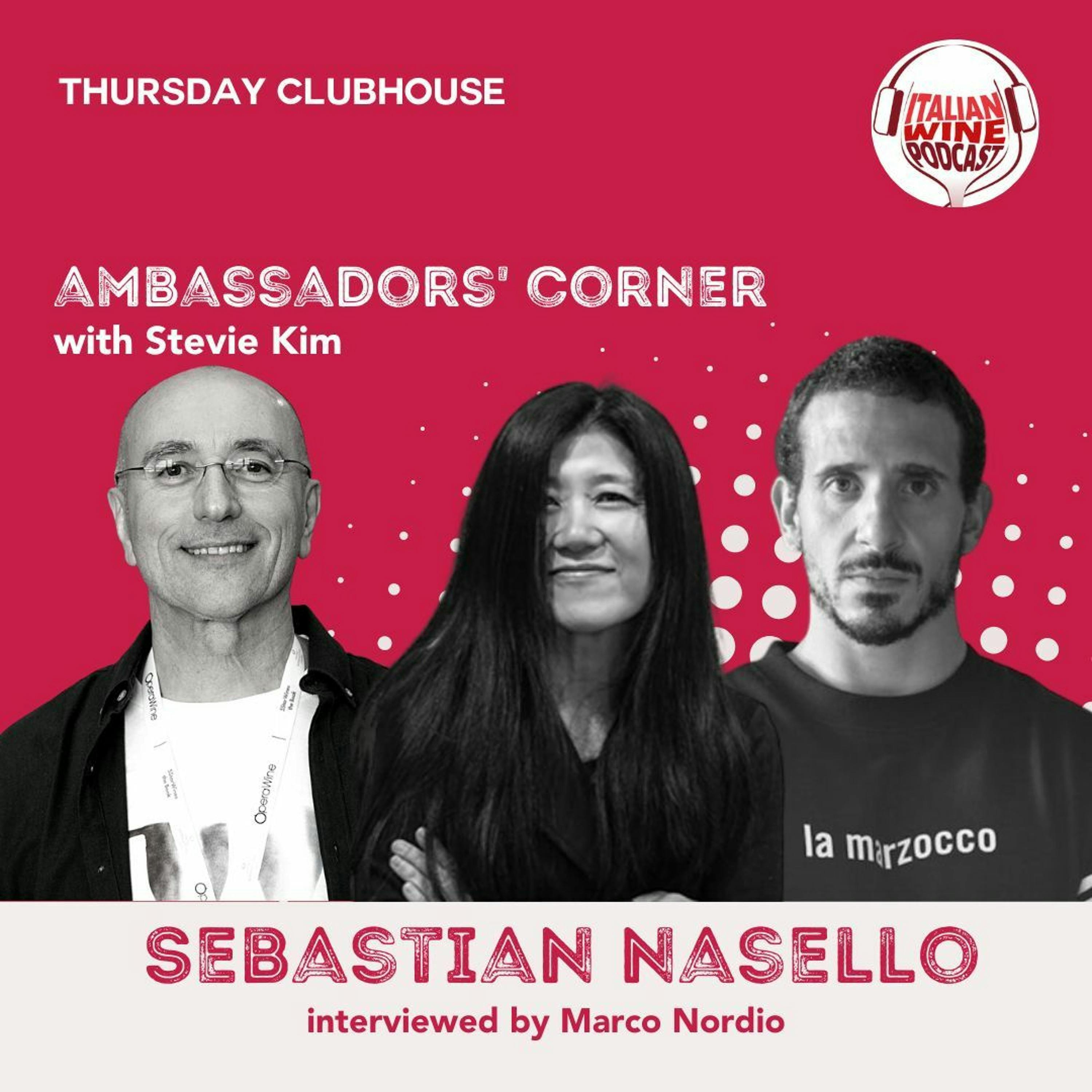
Ep. 1466 Marco Nordio Interviews Sebastian Nasello | Clubhouse Ambassador's Corner
Clubhouse Ambassadors’ Corner
Episode Summary
Content Analysis Key Themes and Main Ideas 1. The journey and philosophy of Sebastian Nasello, an innovative young winemaker at Podere Le Ripi. 2. The unique characteristics and expression of Sangiovese across different Tuscan terroirs. 3. The balance between innovation and tradition in Montalcino winemaking and business practices. 4. The importance of mentorship and empowering young talent in the wine industry. 5. Podere Le Ripi's holistic approach to farming, including biodynamic practices and animal integration. 6. The role of culture, heritage, and personal connection in wine communication and consumption. 7. The evolution of aged Sangiovese wines and their sensory profiles. Summary This episode features an insightful conversation between Marco Nordio and Sebastian Nasello, a young, award-winning winemaker from Montalcino's Podere Le Ripi. Sebastian shares his journey into winemaking, highlighting the role of curiosity, patience, and crucial mentorship, particularly from Podere Le Ripi's visionary owner, Francesco Illy. He delves into his winemaking philosophy, emphasizing the expression of terroir through Sangiovese, which he describes as a chameleon grape that deeply reflects its specific ""sense of place."" The discussion covers the unique soil compositions of Montalcino, compared to other Tuscan regions, and introduces Sebastian's experimental high-altitude Sangiovese project in Amiata. Podere Le Ripi's innovative approach extends beyond winemaking to business, incorporating HR departments and robust hospitality programs, including a new wine bar, Vineria Aperta. Sebastian also discusses the evolution of aged Sangiovese and advocates for communicating the cultural and historical richness of Italian wine rather than solely focusing on technical details. The interview concludes with a look at the winery's biodynamic practices, including the integration of farm animals, and Francesco Illy's pivotal role in fostering a collaborative, team-driven environment. Takeaways - Sebastian Nasello is a pioneering, young winemaker at Podere Le Ripi, known for his innovative approach and commitment to continuous learning. - Podere Le Ripi employs a holistic, biodynamic farming philosophy, viewing the winery as a complete ecosystem. - Sangiovese is highly valued for its ability to express the unique characteristics of its specific terroir, rather than having a dominant intrinsic flavor profile. - Innovation at Podere Le Ripi embraces business aspects like HR and hospitality, in addition to winemaking techniques like whole cluster fermentation experiments. - Mentorship and fostering young talent are crucial for the development of Italy's wine industry. - Aged Sangiovese wines develop complex, evolving profiles, sometimes exhibiting unique ""oceanic"" or savory notes. - Effective wine communication should prioritize sharing cultural heritage and the human story behind the wine over technical specifications. - Francesco Illy, the owner, is a visionary leader who empowers his team, fostering a sense of ownership and collective success. - The winery has launched ""Vineria Aperta,"" a wine bar offering a diverse selection of wines, encouraging broader wine education and appreciation. Notable Quotes - ""Winemaker, it's a job that needs lots of patience and curiosity because, in my personal opinion, is a handless journey of, learning."
About This Episode
The hosts of the Italian One podcast thank their guests for their contributions and discuss the lack of wine production and the importance of innovation in the industry. They emphasize the importance of finding a balance between sensitivity and knowledge in the industry and finding a unique personal experience. They also discuss their approach to winemaking, including creating a wine with a strong personality and a third war to enhance the freshness of the wine. They emphasize the importance of tasting and finding a unique personal experience, and their interest in creating wines from animals and their interest in creating wines from humans. They also discuss their approach to the current production and their plans to evolve the entry-level wine into more contemporary elements. They emphasize the importance of communication and sharing points of differentiation for their customers and emphasize the success of their wine program. They also discuss their interest in creating wines from different places and their interest in creating wines from animals and their interest in creating wines from humans.
Transcript
Since twenty seventeen, the Italian One podcast has exploded and expects to hit six million listens by the end of July twenty twenty three. We're celebrating this success by recognizing those who have shared the journey with us and giving them the opportunity to contribute to the on the success of the shows. By buying a paper copy of the Italian wine unplugged two point o or making a donation to help the ongoing running costs, members of the international Italian wine community will be given the chance to nominate future guests and even enter a price draw to have lunch with Stevie Kim and Professor Atigioshenza. To find out more, visit us at Italian wine podcast dot com. Welcome to this special Italian wine podcast broadcast. This episode is a recording off clubhouse, the popular drop in audio chat. This clubhouse session was taken from the wine Business Club and Italian wine club. Listen in as wine lovers and experts alike engage in some great conversation on a range of topics in wine. If you enjoy listening, please consider donating through Italian wine podcast dot com. Any amount of help cover equipment, production, and publication costs. And remember to subscribe and rate our show wherever you tune in. So here we are. It is a Thursday morning, and it is raining cats and dogs, or I think it may have stopped by now, but let's Okay. For once it's not raining here in New Zealand. Hello, everybody, and welcome to Clubhouse Ambassador Corner. I am here today with, moderator Marco Nordio, who is in New Zealand, and our guest today is Sebastian Naselo. And I'm going to let, Marco do the intro for Sebastian, but, I'm I'm here today on a rainy morning because, I guess, in New Zealand, what What time is it in New Zealand right now? Zealand is eight PM. I just had dinner after dinner. Perfect time. Wow. Okay. Okay. Alright. So, yeah, I'm here in place of Stevie Kim because she is off on her travels. For the mama jumbo shrimp channel and for the Italian One podcast and for, yeah, many many different interviews that she's she's doing at the moment. So I'm here. And, Clubhouse is incredibly pop well, the actual platform seems to have crashed, but, we put everything on the it's replayed on the Italian wine podcast. And so this is being recorded, and I will let everybody know when that, when that comes out. We have a one hundredth, episode clubhouse coming up soon. It is going to be actually like that. You know a lot more about this. Help me out here. When's that happening? Hey, Joy. Oh, yes. The clubhouse for one hundred episode is going to be next week on July thirteen at, yeah, five thirty PM. And, it's going to move to be with, Matt Erwin interviewing Kiara Bosquez. So we're really looking forward to that. Fantastic. Okay. So let's get into this episode today. So I'm gonna introduce you, Marco. You're born in Kyoca Venencia, and you trained as an economist at Bocconi University, m o n. And after spending ten years working in finance in Italy and overseeing, in Italy, you you you flew overseas and went to New Zealand, on a yacht. Oh my god. I know exactly who you are because I read your story on on your website. And I was like, oh my god. This man is so interesting. Okay. So you landed after three years. And you studied wine science at the Auckland University, and you planted a small vineyard with, Nebula, and Pino Grijo, and you reached, four barrel production of Nebula, and then you turn to importing. And, yeah, you have, you import a large portfolio of Italian wines, probably the largest in New Zealand, and, is your star Montalcino producer. Yes. Yes. Sorry. I knew that I recognized you, but I was like, no, because there's so many or there's so many people, right? And and I was like, oh, and then I just I saw this just now, and I'm like, oh, Wow. Okay. I do. This story of you going across the ocean. And I think I saw your wife was there too. You guys went together. And what's it like being on the ocean for three years? Well, you realize that, wine is in short supply. So you run out of wine quite quickly also because you, you give away some to friends, who are the boats. Yeah. So wine is something which is all in short supply. And I all I always wonder, you know, there are obviously big tanks for water. I'm about to wind up turning a water tank into a wine tank. That would be a very, very good idea for yachts, you know, because Oh my god. Wine seems to be always in short supply. But you've never did that though. Right? Because I feel like that's that's a genius idea. No. I didn't do it yet. Maybe it's my next project. Fantastic. Alright. So, I will ask you, why exactly did you choose Sebastian Nacello? For your interview today. Yes. There are several reasons. Well, the first reason that is quite obvious. I think I love the wines that Sebastian is making. And, you know, first of all, Bruno is one of my favorite denominations in Italy. But there is something about the Sebastian wines that they have, this kinda, I I kind of drew inspiration from some, some of some of our critics defined as exotic, like, savory, exotic spices, but to set the podera Laripe, brunellas and sangiovese apart. Also, you know, Sebastian is the is is the definition of innovation. I think it's it's a young, innovative, and this is what Italy badly needs. And, I think it's a good, example for young people in Italy to draw inspiration from. He's a master of San Jose. He won a prize because of that, the famous gamble prize. And, I think it's it's it's a very good, it's very good example of what, what, what kind of, innovation you can, even in Italy, but there's quite conservative. Even in Italy, you can, you can you can you you can have the. Yeah. That's awesome. I I okay. So inspirational. So what what is it you want the, the nerdier crowd, in the community and anybody listening to take from this conversation. Yeah. So, basically, everyone knows that Montalchino produced some of the best wines in Italy, but, what I would like, Sebastian to, spend few words about is, what what in what the innovative style you can make, even in mental children, even in a quite traditional denomination. And, apart from wines that can age very well, as we all know, But the the kind of a feature in a way that becomes so distinctive that you can, have a recognizing and becomes like a a trait, a signature. I think Sebastian wines have a kind of a signature that that the drinkers and tastes can easily recognize. Great. Okay. Well, then without further ado, let let's see here. Are you are you there Sebastian? Have we lost Sebastian? Hold on. Hi. Yeah. You're here. Alright. Great. Okay. I'm gonna I'm gonna mute myself, and then I'll come back at the end if there are any questions. And, go ahead, Marco. Yeah, Charles Sebastian on. Trial. I'm very glad that that you actually can talk in this podcast, and you can explain because you really deserve, this this space. I I just do a very brief introduction, you you want this, as I mentioned, this premium, gumbelli, as a best winemaker under thirty five years old, and the gumbelli, as we all know, is is is the hero of San Duvez. So, gumbel, you you you you basically continue the tradition of this Gambelli, innovative winemaker. And you have a lot of projects that we're gonna talk, and you you're gonna talk about this. Yeah. And, first of all, I would like to ask you one question. The first question to start with, how did you become a winemaker? And, did you always want to do this job, Sebastian? First of all, thank you for this opportunity, and, Let's see. I'm, I love to say that, after twelve years, I, I remember very well when I arrived in Puerto Rico was a kind of intern. And now, Let's say, with the team, and we run the whole operation with over thirty people. And, let's say, but we are still commit with the same mindset and patient and curiosity, of twelve years ago. Winemaker, it's a job that, like, most of the job in the world, it's it needs lots of patience and curiosity because, in my personal opinion, is a handless journey of, learning. And, let's see. It's I I I became a winemaker, I think, thanks to my curiosity, because, from when I was very young, I was very in love with, with farming and with, with the landscape. And and also with this particular business where the, let's say, you have to find a perfect balance between, the sensitivity for the nature, but also the the knowledge of the man. Because, by the way, we we deal with the with ecosystem, we deal with plants, but We also need to be, aware and, skills about, transforming the grape in wine that is, is something coming from the human. And, and this is a beautiful game, that for me, can represent a way to feel free to have a kind of personal, expression way to express our self. And, I feel very lucky because, I think being in the wine industry day and especially Maggie Wine. It's a it's a good, great opportunities. A beautiful job is, is something that really inspire, our, our mind and our brain to, to grow. It's so this is a job, but you will certainly recommend to young Italian and to pursue a career. They can give you a lot of satisfaction as it. And I always think that young people maybe they don't know how to start how to how did you start initially? What was the first step? And how what would you recommend to young Italian? What was he the first step to take? Yeah. I had the team. I'm not coming from a family, in the wine industry, and, I I started, with a with a farming and after with a university winemaking. And, I know very well, the young Italian condition because, my team is based in young people. Average is around twenty eight, thirty years old, and most of the guys are they are with us for long for for long time. They're high, very young. And they are, in some way, incubate, grow inside the company in the, in order to them, make them very, very love and commit with, with our mission. I think, of course, spend is very important to, be, let's say, take take part of the university program and all the study program. But for for what I saw, the most successful young people in the wine industry today, are people that really invest, be more than just their time in the university in in this world, but maybe they spend also time traveling among the wine regions, taking part of wine event, taking part of a a Tasty wine group, And, it's a it's it require this word require, curiosity and also, the the willing to to to know more, to talk with more people, to do networking And, and it's not, extremely easy for for Italian and young people because, you see, I also needed mentorship. And mentorship is something in Italy very weak and not very common, but, very typical of many other country in the world. But I think, for, for my personal experience, without having the opportunity to to meet and, and join couple of mentor that really changed my life, I will be not here today. And when I talk about mentorship, I don't I don't wanna say people that, say, master that are there to say you what you have to do or how or when, but more people that can inspire you can can can inspire you to to do more question to yourself. To, let's say, to to be more open, you know. And, talking about Gambelli has been for me very important, for example, for my personal story, I arrived in Montaschino with a mindset with a knowledge, be more academic that is great because I know the science behind winemaking, but I in Montalcino, thanks to Franchesca, for example, that has been is one of my mentor I have been exposed to wine, like, the wine of Camelli, like, soldera, like, Poggio D'Soto. That really opened my, my mind to more sensitivity to more to to things that, are not explainable through the books or through the, through the study. But in the, I would say, in the university, I mean, in the university, but You start to dive inside yourself inside the wine industry to understand, if there is something more that we have to know. Yes. It's very important what you say. And just for the audience, I say that when you mention Francesco. You are referring to Franchesco Ile. Yeah. That is the the owner of the founder of the Podero Lipi. It is another example of a innovative entrepreneur and, you know, wine, a a passion efficient wine lover that started from scratch together with you, something, that now becoming so, so successful. There's a a a question, but it's more curiosity. Sabasio. What other jobs would you have considered in your life if you were not to become a winemaker? That's a that's a hard question. I think, Now I am thirty six, and, I'm, I'm still struggling to know better myself, but I understood that, what is very important for me is, freedom, and, freedom, for me, it's, it's the opportunity to, express myself in what I do to also take decisions, to do mistake, and understand why And, and this is why I think I if I if I have to think something else, then why making a I would go for something in the kitchen or something where you you can you can talk about yourself through the services or through the experience or through the products that we are crafting. You you craft it. Yeah. It is important that, you know, because, what you're saying is, basically, wine for you is like cooking. It's like creating something. And this is what is your is in your philosophy. And this is what I wanna expand upon. What is do you have a a particular idea of, what kind of, philosophy for you? What, what is your inspiration in winemaking? Do you have any any model that you regard as such, and, what kind of achievement do you wanna, you wanna reach? Yeah. I I have to say that, let's say, through the years, I evolve a lot, my taste, and my also my philosophy in winemaking, and especially tasting more wine, especially traveling more around the world. And, nowadays, I can say that the wine that take more take I'd say they impressed me more, are wine with a strong personality coming from, the third war, the place where they are coming from or also the personality of the white maker or the vintage. This is why I like wine, with, mainly, terrace driving, with, with lots of shadows and, and, and flavors typical of maybe a specific vineyard or a specific region. And, the real pleasure that I I have tasting the wine or making the wine is the the beauty of, appreciated the the the uniqueness of every bottle, every vineyard, every vintage. And, yeah, for me talking about San Jose, I really like this, this skill of this grape able to be a kind of camellion or a kind of mirror of the place because Sanjay Vis himself doesn't taste very much. It's a it's a grape, that takes a lot like a sponge from the place where is where where is growing. The vineyards. And, and this is why, let's say, it's it, for me, it's an opportunity working with Sanjay, because it's I'm not we we we have a grape that really really photography, a specific place. And, and this is the, I'd say, the wine you need to drink most. Monu variety very high personality, third war, very low intervention in the seller, and, mainly made by hand craftsmanship. Yeah. Oh, very good. I think now we we we take a step back, Sebastian, if we can, and the you talk about the current production. You talk a bit more about what is what is what the current production. And they also, a little bit about, bit of a curiosity here. The story behind the distinctive labels, the bottle labels for podrilla repeat. Yeah. Podrilla repeat. It's a project started in the ninety seven. By Francisco that, decide to move in Tuscany and, step by step, do some wine. In two thousand eleven, we decided together to, to, let's say, start a new a new cycle. And, finally, make this place blossom. And now we have, thirty four hectares, of vineyards, plus, an olive oil production, honey production, and also animals and garden. And, our, our path, our journey is a journey where we go back to the, to the beginning because in some way, we are transforming our place in a farmhouse where vineyards, of course, are the core business, but we try to pay attention to everything, to the wall frame, to the wall cycle of farming around the farmhouse. Like it was hundred years ago in Italy for before the transformation of farmhouse in one yearies. And, yeah, and we we make wine in different places of Montalcino farming, following the biodynamic philosophy. And, yeah, we mainly do wine, especially in the last year. We we try to evolve a lot the the entry level wine, being more in the idea to, enhance the freshness of Sanjuvisit through the fermentation with the stems through different method. On top of this, young wine, we have the classic brunello and Roso de Montalcino that are defined, not by the process, but by the veneers. This means that we mainly produce single veneer. Brunello are three. Total. And, and are vineyards where we discover particular soils and condition in order to have a wine that ferment separated and also age separated. And, we will have to show the, let's say, the single personality of this plus. And, yeah, this is, the idea behind the wine behind the the labels, we have several particular labels. Franchesco has a background of, kind of artist. He did many photography. He did many. He he wrote some book, and he always been very sensitive to the beauty of art and nature. And this is how we we end with, with the label of today. And, where three of them are, a very intimate, mantra and, and also words with the aim to inspire young people to to to do something we love with curiosity with, some of foolish and, this is what we have today on the labels. Yes. It's this distinctive names. I I would invite the audience to explore the tables because they are really, in tune. They are really super for the kind of wines as a stressing the point of innovation and the and the respect for the environment as you are saying. In the environment of Montecino, it's not, very common, very common winery because for the way of how we do business, we can say because, first of all, it's a community business. We have lots of young people. And, they we don't have seasonals. And, and also the idea to work in the vineyards in the in the farm, like, not just with culture, but be more large and, work with, without consultant, and, where there's a inspiration to, to grow a kind of little ecosystem. This is, this is very typical of us, and, I think is also some some vision that I I talk and I grow from the initial vision of Franchesco. And, yeah, we I don't think we make wine, Bernelo, untraditional because the way, Marco, you know, you've been in the cellar. We we work with a big cask. We do wild fermentation. It's the wine is very loyal to the tradition of Montalcino wine, but at the same time, we can do innovation in many different way. For example, what we did that has been very let's see. I can say pretty new for the area. We introduced EHR in our business that for for any kind of business is something normal, but for farming, it's it's totally new. And, and now we have an HR department in the winery. We introduce a very well made program of hospitality that's for Tuscany. Now it's is quite, established, but ten, twelve years ago was totally new. And, and also, for example, we we did some some innovation, now working with Sangiovese in a different way with the stamps with carbonic maceration. Those are not, let's say, innovation that we do to change Bernelo. And we don't make we don't wanna make innovation in the products but mainly in the whole vision of the business, in the whole, evolution of the company. Also, because, let's say, tradition is something very, important for us but, tradition is is dynamic. It's not something that really stuck, but we and this is why we can do innovation in many different way, not just thinking that the products are the wine himself, but we have an environment that is changing. We have a market, as you know, that is changing a lot. We have, we have the customers, the wine lovers that are changing the the media, and we have to stay open and, stay in some way dynamic and, able to, take all the input that we got from the environment from the market for the consumer. It is certainly a dynamic, environment. I wanna ask you, Sebastian, about, how you see the difference of this Sanjay, this beautiful grape, as you say, reflecting the sense of place or terroir. I don't wanna use the French word, a sense of place, ideally. So now you have a visit Montalcino. You have a Kianti classical in Tuscany, and you have a no bill at the multiple the multiple channel. And then you have this new area that you are particularly interested in, how each of this area has a different, personality in the how how do they create a different version of the SanJvez in your opinion. Yeah. SanJvez, it's our, I will say, San Jeviso is the way for us to read the territory And each of the area that you name is characterized by different microclimate, as you know, for sure, and also different soils. The two area that, I know better, of course, montalcino and the Amiatamontin that is totally new as an outsider. And, Montalcino, for what I know, compared with, Chianti or Montalciano, other task and my regions, is be more dominated by clay. Clay is is something that we we name a lot in the wine industry, but, we should be, aware that they're a female. Clay is a big family. There are so many kind of clay. The clay of Bordeaux is not a clay of Tuscan. And, I I I had this book, a few months ago, wrote by Pedro Parla, and the name is Terlar footprint. And it's a crazy, beautiful book, probably the best I ever read in the wine industry from the about wine and terwar and soils, where you really get deeper in the idea of how the clay can be different. And, of course, in consequence, all the different, compound of the soil, limestones, sand, or sealed, And, for Montalchino, I think we have a very particular clay that, mainly, originated by the ocean sedimentation with a different kind of limestone compared with Kianti, for example, And this soil that, of course, has a huge vulnerability inside the territory because we go or we have also alluvial soil. We have also more rocky soil, but a big part of the soil on the hill of Montalcino are Marl, mix of clay and limestone. And, this soy really gives to the San Giovanni of Montalcino the touch of Senator of layered mouth feeling, deep mouth feeling that is typical of the wine of Montalcino. And it's, and this is so beautiful because at the end, Sanjuviza can takes all this, input from the, from the environment and translate in different wine just by himself. And, it's like I always say that, the DNA of San Jose, it's is not so strong because at the end, you don't feel if when it is the grape sangiovese, you don't feel that the, specific, flavors recognizable for this variety like could be for cabernet or a specific, spiciness or, tannin, but it's more the wall. You taste the wall that is very influenced by the location. And, just to add two words about the Emyatha, it's the very close mountains of Montalcino, growing up to thousand seven hundred meters. And, with a friend of mine, three years ago, we decided to take, take, take this journey to discover a new terroir. We gamble on the idea to grow San Jose with, be higher altitude and on a different soil because we still have us ocean sedimentation soil, but with with a different clay and with a different limestone. And there now we are growing six, six sectors of San Jose grape, in a totally different terroir that, it's a kind of white page that we are trying to interpret and the study in order to deliver a different San Jose. And, and is the real beauty of my job. Let's say, having, having a journey where for sure we know that we're gonna learn a lot. Italian wine podcast, part of the Mono jumbo shrimp family. Yes. No. Totally. I will be very curious to try these new wines from Montaniata, from high altitude vineyards. And, hopefully, we're gonna we're gonna we're gonna add the two hour portfolio here in New Zealand soon. I wanna ask you a related question regarding different size, but this time, in the, montalcino, area, the domination, you know, it's quite a large area for Montecino, and there are different, different size different aspects. Your vineyards are located in Castalmo, the labate, and then the Cherokeelyssa is more on the southwest. Yeah. Yeah. Yeah. How important is the different size? For example, now Northern size seems to and do you think there is a it'll make sense for Montalcino to sub divide the same way MGA in the same way the Kianti and Barolo is going. It's, it's big, but it's not too big for me. Because we are talking about one hill, mainly one hill, not, multiple hills or valet, like, for example, Kianti. And, this is why we recognize for macro dispositions, and, having a hill that starts around hundred meters above the sea level and reaching six hundred meters. We have a different altitude And, and this is a a kind of condition where we determine a different microclimate. On on top of this, we have, of course, different soils. Because the sedimentation happened in different way in the core bring of the altitude, and also the erosion did some, mix up of the different soils. For me, growing vineyards in two different, macro area of Montalcino, and mainly the southeast and the southwest. I really love the idea to keep them separated and underline the differences of these two different locations. Taking advantage of the beauty of San Jose is able to do this. We don't have any classification of the soil. I can see how's the wine consumer? I love I I'm a wine consumer, but I'm also a wine nerd, and this is probably, a point of view bit, bit personal, but as a wine nerd, I love to drink wine, where I can really go deep in the provenance, means even in the single plot. In the, like, I can do, for example, in, Pamonte, where I can drink, MGA, single vineyard, and I can dive in the map to watching where how is this position, where is the video, who is the neighbor. And this is something that for me, is very, really, feed myself, my, my curiosity. This is why I love one day. I I I wish one day from Montalcino the same opportunity. For now, we don't have it. It's not something easy because, require lots of study of the territory by high professional people like geologists, like, but we, we are also lucky to have one grape, only and is the right grape because it's the grape where that underline these, differences. This is why yeah. When I have a guest in Montalcino or when I talk with someone about about Borello, I always talk about different soils, his positions, climate conditions because I think it's what make our our job, impossible to copy or repeat around the world. Yes. I think, Sebastian, we need to invite, Mass Nagetti to come to Potatino and spend, a few weeks to meet all the territory. He produced these beautiful books, but he he made that for barolo and for candy classic or beautiful beautiful book. Okay. So if you want to introduce ready for that. I I wanted to to ask you, Sebastian. You, you mentioned this class, the whole class of fermentation. As a method that that you want to probably to increase or use more and more. What what kind of, the interest? What does this interest come from? What do you see it cannot be? Yeah. The, let's say, the traditional way to make wine in Tuscany, it's, distaining the grape means, fermenting all of the skins and the juice without stamps, without any particular phase of carbonic mitts from a tissue with wall bounce. And, I, a few years ago, I started to travel more in French. And this is, one of the good things of COVID because I had been more time. And, and I, and I was also asking myself, because of the climate, because of the risk to have a lack of acidity in our wine, every year more hot, every year more dry. And, I started the first experimentation, processing some sangiovese without removing the stems, and just fermenting, the wall bounce inside the tank. In order to understand if it could be helpful to manage the, hot climate. And, we end making some, some new COVID that will arrive in the market from September, that are not Bernelo, but are new SanJovese coming from veneers that, in our opinion, are more suitable to work with the stems. And, let's say, it's something that we are studying. I think is an opportunity. I just came from, a visit in burgundy where we had also the huge opportunity to visit, Roman equity. And, when we ask, why they use the stamps, beside the tradition to use the stamps, they where the villain answer, the stamps will, supply a kind of, energy and vibrancy. And, is not really, really about the freshness, but it's more about the, the the the the the mouth feeling of something more more more vibrant. And, that we really they it told us we really want in our wine. This is why I think, makes sense to understand if San Giovanni take some advantage working with the stems. And, especially for the third one that we have in higher altitude in Bacanale, on the Amyata, it's also very, suitable for the kind of chemistry that we have in our grape, for the kind of ripening of the grape, And, for the kind of personality of the kind of sangiovese growing over six hundred meters. This is why we are, we are keep going. There, we also do hand only one hundred percent word cluster. And the wine is, of course, different from Montalcino. I always say if in Montalcino, you can really, dive inside the texture of the wine because the texture made by many lyer, many limestone, sensational feeling, and, and, and, Mediterranean, and, Mediterranean, in the San Juviso Montalchino on I mean, I thought just five kilometers, but in a totally different environment, I enjoy this kind of raw energy and be more masculine and, with a tanning that are not charming, but a bit more, straight, but lean with, with a not too much instruction or with not too much. Let's see the wine as a totally different shape. Yes. Well, I'm very curious to to taste the the result of this, innovation. So let's see. Let's see what happens. I wanna ask you now Sebastian about, the aging of wines because not many people are lucky enough to taste the, and age the sangiovese. You need to, you need to afford this wines. And I and not also, no many wineries keep a library why because, again, it's a very expensive, strategy to have. But can you describe, you know, of course, you you have, you had the chance to try aged wines? Can you describe how the age we find, even, like, ten, fifteen, twenty, thirty. I don't know how long it. But how how does the wine change in European and Sebastian? Alright. We have, We have some old vintage, vintages. I, talking about, we let's see. Our old wine, are influenced mainly not only because of the longer aging, but also because at the beginning, you know, we had young veneers, we had I I was young, full of mistakes. And, let's see. We had wine that are not made with the same awareness and, ripening of today. This is why the probably some vintage is limited in the in, in potential of lasting, literally because, the condition were not right to make a wine for twenty years aging. Because the vineyards were young. The seller was full of new borrowers because we started from scratch. And also the team was not like today. I, I, my personal taste, about Bernelo. It's I I'm not the kind of, drinker that wants to drink Bernelo, merely refine or old, but I also like the energy of a Bernelo between five and eight years old. Especially in the last two, ten years where the climate made our San Juviso been more ready. And this doesn't translate necessarily in a wine with lower potential of lasting. And, but I also experienced, as a wine consumer, Bernelo, from maybe some producer, some vintage, and some vineyard able to offer amazing experience. In my personal opinion, wine, with aging must evolve. When you when I try a wine that didn't change one little, shadow in twenty years and still taste, totally, like, when it was made. For me, that's not real, really, doesn't pay pay back me enough. I want to feel the aging in some way. Doesn't I don't wanna feel a tired wine, but I want to feel something that go behind the, the, the personality of the young wine or the, and this is why when I had some of the biggest experience with sangiovese with old vintage for me, they bring me in the flavors of the ocean means I taste in the sangiovese, the touch of, you know, when you go to the fisherman or maybe you go to the port and there is that kind of smell of salty water. That's the kind of profile that made me more in law with San Jose. It's not common. Doesn't happen every year, neither for the same producer. And but it really delivery, amazing experience. Sometimes, let's say, also in Nebula. I had the same experience. And, or you can have a sense of it. Is it a three day years delivering more sweetness, not because it became sweet, only because the tercirrhization, the evolution of the smells and the tannins go more in a, in a, in a direction of being more sweet feeling and are two different, street. And, we know that every one day we do one day, we take one of the two. We it's unpredictable, which of the two. But, it this is this is my personal experience with experience with Sandra Is it? Yeah. I I came a person. I came in touch with, with you and Poderla Rippi in twenty fifteen. Through our common friend, Alejandro, that is a professional photographer. And we we should we should both thank him because thanks to him, actually, we are here doing this. Yes. Yeah. There's there's a little bit of story. They are a very nice story, but the twenty because, when when we met first time, I was, an experienced totally inexperienced about, I I would say all sales and market. And, it's you had to deal with a, a young guy that didn't know literally anything about how we sell wine around the world. And you better I remember when I was sending by email, my order, or by or over the phone, I say, but who's the white maker? If you, you were answering the phone, you were answering sending me, but you were doing everything. So I said, this is a one man band. So it was really early, early stages. But this I I mentioned this because I still have my seller my small cellar. I have a twenty eleven Bruno, lupus here and I have it. I keep it as a special wine for when my son will be ready to drink this. So I'll I will share my experience with you eventually. Yes. Eleven is a good vintage. I like it. Oh, very good. Very good. Yes. And, yeah, I wanted to ask you also, you know, part of the job of an importer is also to educate, communicate, communicate a zone, communicate, a, a winery, communicate, fill out your fill out. I kind of feel, sometime, we are a lot of responsibility because all your job, what you describe then it's up to me to communicate it to my customers, to our cattle, our common customer. We have in New Zealand. I want you to ask if you are in front of an audience and you don't have much time. You have less than an hour what we have here. But you need to communicate just a few points. What would be the most important points to communicate to an average audience? Average knowledge of audience about multi tune about your wines in particular? Yeah. Allahah. I normally, especially when I'm short in time, do not speak about why. That's something that we experience that it it it works because it's most of the wine communication is based in what you can feel in the glass, what you can, how you describe the wine. I see those are important things. Very technical, but are not, for me, the things that inspire people to drink more or more often, especially a wine region. This is why I I spend more normally spend more time talking about our heritage or our culture or our, environment. Not not necessarily necessary about the benefits. You know, people don't don't really care about how many months I keep the centuries and the battles. This is something that comes later. For people that want to go in the details. But I think for, some audience, in the other side of the ocean, never been in Montalcino, in front of wines from everywhere because maybe they can experience every day a wine from a different corner in the world. What we can we can do to, to to do our best, do our best, is just share our culture our heritage and make them be more friendly with, with, with the Italian idea of winemaking. And, and after the wine must speak for himself, in, in the glass. Let's see. Yeah. And it's not important that the, the guest, we go out of the room saying, brunello taste cherry. For me is important that they go home with, a little seed of our culture. No? And it's maybe the culture of how Muntalcino became what is today in the last forty years from stretch or why San Giovanni is so, special. This is, for me, what is really important when we talk about, education. Yes. Oh, I think it's a very precious advice. Thank you for that, Sebastian. I think it's very, very true what you say there. Sebastian, I want you to make a final, like, a comment, in the time we have, about, Franchesco. I think it is, it is, is a character, but it's quite important in the winery as well. He's the owner. And, just to describe this person, how you your relationship with him, how he influenced the wise. Yeah. I'm very thankful to Franchesca because it's a he onboard me super young, and it was crazy enough to made me the driver, the main driver of the company. And, it has been my mentor, has been my boss, has and now he's also my partner because, let's say, give me the opportunity to be part of Podlee Rippimi and Alejandro that is the agronomist. And this is, I think, one of the secret of Podlee Rippi because at the end, we have people that work, for, not for a company, but for themselves, for something that they feel very personal, and is not working for someone else. And, Franchesco always been very sensitive, very curious, very it's a character sometimes beth, in Italy, we say lunatico. I don't know. But, let's say it's sensitive to the moon. We can move. Exactly. Yeah. And, but at the end, he has been, a visionary he's a visionary man because Yeah. And I'm not talking about how many we make wine because that's literally the smallest innovation. The big one has been, the idea to develop the business in the way of we do today, the idea to be, trustful with young people and, to make them able to understand, try also do mistake and and and and and change again. This is something that I think in the environment of, entrepreneurs Italian entrepreneurs, especially in the wine. It's very hard to find. And, Francisco today is not it doesn't come to the repeat to, decide when it's time to bother the wine or when it's time to harvest. It's more than ten years that this is totally in the hands of the team. And, it comes to the repeat to, to, to feel the, the energy, to to, maybe, to share some, some vision, some inspiration, to be a mentor. And, but there are farmers. There are seller master. There are, logistic manager. There are hospitality manager that they really work for Padeleripe like their own company. This is the the very unique things of Padeleripe. I think so. It's like a cooperative where each one that feels like he owns a little bit. And they Yeah. They really do it, for for for for the good, the the cooperative. I had to say that one of the most successful testing around since my I started this, important business is I did a live tasting where Francesco Yili was live on the screen, in a restaurant, in a restaurant here in Auckland, and the people were tasting the wines and, food matching, and it was I describe your wines. And he led such an impression on the other people. There's still people talk about him, but because this is what you were saying before. Wine is about the person. It's about the human side of wine. Yeah. History, more than the technical side, because it is about memories, about memories. Yeah. I see. Yes. Absolutely. I think we are towards the end of our interest, unless you wanna add something, Sebastian. I I think we took a bit of everything. I want just can say for everyone want to visit Montalcino, potato. Let's say we are more than happy to to welcome you in the in the winery. We also launched a brand new wine bar with kitchen, with wine from everywhere. And, it's a new project that looks like a wine Starbucks. You go there for multiple reasons, and you end drinking wine from everywhere. When when is it gonna start? It's it's already started three four months ago. It's a little wine temple, because it's a place for wine net and therefore the spread spread wine culture. His name is Vineria Aperta. Vineria Aperta. I'll be there as soon as I can. Hello? Can you hear me? Yes. Hi. Yes. We can. Okay. So I was just listening. I was you just actually answered the question. I was gonna ask you Sebastian. I was gonna ask you if, you you had a lot of visitors and if, you know, if you had sort of a tourism thing going on, and you do a wine bar. So do you do you you said it's only been open a few months. Have you had many people come and visit? Or Yeah. Uh-uh. About putting it in a repeat, we always did say wine hospitality with our rooms, but with wine experiences. And, we develop a lot this, this department, and, we, we have a lot, lots of visitors. I will say, let's say, big numbers, all made to, let's say, make, in a in a kind of educational way. On top of this wine program, wine hospitality program, we meet with some friends and also Franchesco. We launched Vineria Perta just three kilometers from the winery. And, that's totally different because it's a one spot spin off with, over a thousand five hundred labels, three somms in the room. A very easy local food, but a huge content of wine from everywhere from Spain, from America, from best stuff, old great stuff from French, all the new stuff, but also the very classical next to the greatest Bruno. And this is, I think, a huge opportunity for for the Bruno himself to show, next to amazing burgundy or, I don't know, amazing, Spanish wine. And, and this is a place that we need to feed the wine curiosity of people like us. No. I I think that's great. It's also really different. I haven't I mean, I'm sure that you know, but I haven't heard of that. So I mean, that's that's really cool that you have wines from different places because then they can make the comparison. So that's amazing. And I I actually have another random question. This is absolutely completely different. I noticed that your, your winery has a cow, twelve sheep, two donkeys and five goats. Yeah. Now you have more? Yeah. Because they we don't have a bird control. That's exactly what I was gonna ask. How do you I mean, I I understand that it's part of the biodynamic process. It's really great. But how do you how do you care for all of these animals? Like, what do they What do they do? That that's the real hard worker because, making wine and a competitive with, taking care of animals is nothing. And I learned on my skins. And, yeah, we had a few pack of animals in two thousand eighteen has another step in the direction of, far mouse, model and biodynamic philosophy. The pack is keep growing, and that we don't produce any milk or meat for now. We use them to do part of the compost that we knew that that we need that, I would say, around twenty percent because, with our vineyards, we will need much more. And it's just, you know, when, in your daily routine, you do something, small, but that keep growing day by day very slowly. This is the same. Yes. We we don't wanna be breeders, but we want to be farmers. And, thanks god with Bernelo de Montalcino, with our company, we can invest bit of time, energy, human resource, also in things that, probably are not profitable, like having those animals there, but they enrich the the world picture. They they pay back in different way. Okay. And the and this is the the journey. Yeah. I know. I think that's that was real. I I read that. I was like, oh, I wonder how that works. So thank you. Yeah. Well, it is, the end of the hour. And I think, Sebastian Marco Thank you so much for your time. And, have a wonderful day. Thank you. It's been a pleasure. Our pleasure. Great. Yes. Take care. Thank you. Thank you. Listen to the Italian wine podcast wherever you get your podcasts. We're on SoundCloud, Apple Podcasts, Spotify, HimalIFM, and more. Don't forget to subscribe and rate the show. If you enjoy listening, please consider donating through Italian wine podcast dot com. Any amount helps cover equipment, and publication costs. Until next time.
Episode Details
Related Episodes

Ep. 2789 ColleMassari: a long-term vision rooted in Montecucco with Giuseppe Di Gioia | On The Road With Stevie Kim
Episode 2789

Ep. 2788 Ep. 14: Austria and Hungary | Study Smart for your WSET Level 3
Episode 2788

Ep. 2785 From Volunteer to Speaker at TEXSOM with Samantha Cole Johnson | TEXSOM 2026
Episode 2785
Ep. 2766 Inside the U.S. Non-Alcoholic Wine Market: What Wineries Need to Know with Jill Sites | Masterclass US Wine Market
Episode 2766
Ep. 2761 Winemaking and Consulting Across Sicily with Alessandro Serughetti | Wine, Food & Travel with Marc Millon
Episode 2761

Ep. 2759 Part 2 – The VIA Educational Program & Italian Wine | Heart-to-Heart Conversation with Sarah Looper
Episode 2759