
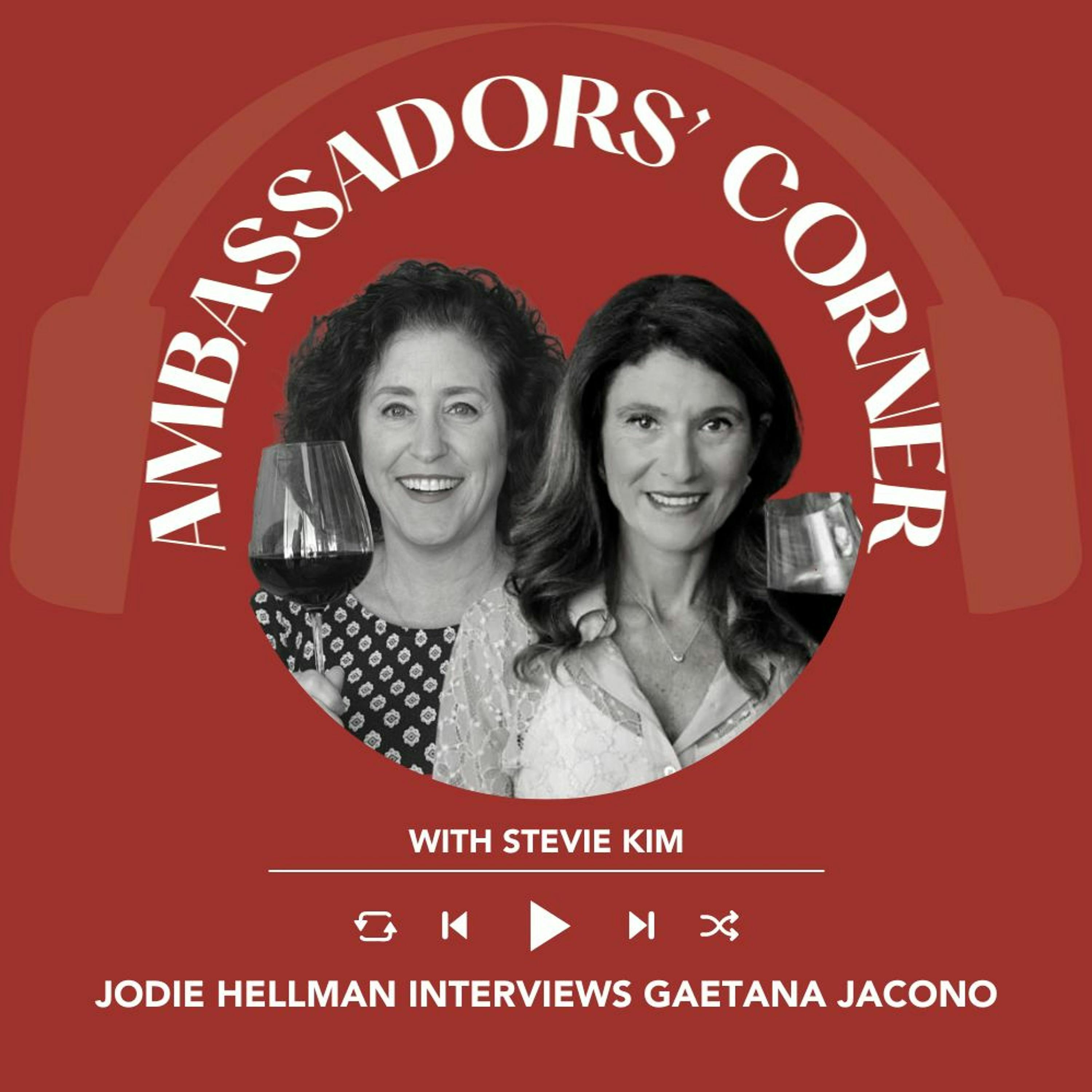
Ep. 1547 Jodie Hellman Interviews Gaetana Jacono | Clubhouse Ambassadors’ Corner
Clubhouse Ambassadors’ Corner
Episode Summary
Content Analysis Key Themes and Main Ideas 1. The philosophy of ""continuity"" in winemaking, blending tradition with innovation. 2. The influence of a pharmaceutical background on a pragmatic approach to winemaking. 3. Organic farming practices and the ""seven soils for seven wines"" concept at Valle de la Carta. 4. Detailed discussion and unique characteristics of Frapato and Cerasuolo di Vittoria wines. 5. Adapting to climate change through innovation, technology, and vineyard management. 6. The dynamics of export markets and the significance of storytelling in wine promotion. 7. The growing role and resilience of women in the wine industry. Summary This episode of the Italian Wine Podcast features an interview with Gatana Yacono, a sixth-generation winemaker and owner of Valle de la Carta in Sicily. Gatana shares her family's rich history, emphasizing their commitment to ""continuity"" – a philosophy that harmonizes tradition with modern innovation, a perspective she attributes partly to her pharmaceutical background. She details the winery's organic certification and their unique approach to viticulture, focusing on seven distinct soil types that yield specific characteristics in their wines. A significant portion of the discussion is dedicated to Frapato, highlighting its versatility and unique profile, and Cerasuolo di Vittoria, Sicily's only DOCG, particularly their single-vineyard ""Yiri Dairi"" which boasts significant aging potential. Gatana also addresses the pressing issue of climate change, explaining how Valle de la Carta employs sensors and careful vineyard management to adapt. She discusses their primary export market in the US and future expansion plans, concluding with reflections on the increasing prominence of women in the wine industry and the importance of engaging storytelling. Takeaways * Valle de la Carta operates with a philosophy of ""continuity,"" integrating ancient traditions with modern winemaking innovations. * Gatana Yacono's background in pharmaceutical science has influenced her structured and innovative approach to winemaking. * The winery is organically certified and leverages its diverse terroir through a ""seven soils for seven wines"" project. * Frapato is presented as a distinctive, light-bodied red wine, often enjoyed chilled, with significant complexity. * Cerasuolo di Vittoria is Sicily's only DOCG, a blend of Frapato and Nero d'Avola, with Valle de la Carta producing an age-worthy single-vineyard bottling (""Yiri Dairi""). * Valle de la Carta uses technology like vineyard sensors and meticulous pruning to mitigate the effects of climate change. * The US is a key export market for Valle de la Carta, with plans to expand into European and Canadian markets. * Women are increasingly visible and influential across various roles within the global wine industry. * Storytelling is considered a crucial element in promoting wines and connecting with consumers. Notable Quotes * ""Continuity for me is, means to take on the duty to maintain quality, excellent, refuting compromise, don't follow the fashion, and respect tradition and preserve the territory with sustainable technologies, and create a value for these native wines to project in the future."
About This Episode
Speaker 2 introduces a wine podcast episode where guests can nominate a guest and win lunch. Speakers discuss their work at a wine and food restaurant where they help entrepreneurs learn about Barolo and Barbara, and their desire to create sustainable technology and community. They also discuss their experience with organic certification and their plans to expand their production. Speakers discuss their unique characteristics, including their seven different soil and varying degrees of minerality, and explain their unique characteristics, including their experience with organic certification and their desire to showcase their wines in the US. They also mention their love for the Arva region and their desire to showcase their wines in the US.
Transcript
Since two thousand and seventeen, the Italian wine podcast has exploded. Recently hitting six million listens support us by buying a copy of Italian wine unplugged two point o or making a small donation. In return, we'll give you the chance to nominate a guest and even win lunch with Steve Kim and Professor Atilio Shenza. Find out more at Italian One podcast dot com. Welcome to this special Italian wine podcast broadcast. This episode is a recording off Clubhouse, the popular drop in audio chat. This clubhouse session was taken from the wine club and Italian wine club. Listen in as wine lovers and experts alike engage in some great conversation on a range of topics in wine. If you enjoy listening, please consider donating through Italian wine podcast dot com. Any amount helps cover equipment, production, and publication costs. And remember to subscribe and rate our show wherever you tune in. So we're going to welcome Jody. Hey Jody. Hey Jody. You gotta unmute. Yes. Hello, Steve. I couldn't I couldn't see the tiny little button. Yeah. I know. Right? They make us or lives a little bit more difficult nowadays. How are you? What have you been up, Jevy and senior in a while? I know. I actually, have a hello to you from Kiara Soldati. I saw her yesterday here in Las Vegas. I haven't seen her in a while either. Yeah. Well, she's in the US. But she says hello, and, you know, I have been just working and trying to stay cool. It's very, very hot out here in Las Vegas this summer. And, you know, just sipping away at, Italian wines. So, you know, we had the huge, as you know, the heat wave in Europe. But as of Monday, even Sunday, things cooled down, and now it's quite It's quite nice actually in Italy now. So you should you should hop over. So this is what we call the Ambassador Kona where one of our Italian wine ambassadors at Lodge, they get to interview their favorite producer. But before that, Jodi, so what are you doing now in terms of work? So I am working for a an importer that's based out of Chicago. What's the name? And I Michael Corso selections. And I'm moonlighting on the side at a restaurant here in Las Vegas called Feraro's Okay. Which just won the gambaro Roso award for best Italian wine lists this past year. And so I've been working over there to stay fresh. And, you know, I get to taste a lot of Italian wines that way too, which is fantastic. Oh, great. So you're now both working for the Lacocoso and also you're working for this restaurant? Yes. Okay. And what are you doing at the restaurant? I am helping them with their wine program actually. Okay. And how many how big is their wine list? It's about twelve hundred selections. Holy crap. Yeah. And how significant are Italian wines? How significant? It's ninety percent of the list. There's a three page vertical of Gaia. There's, another three pages of La Espa. There is, you know, the wine list is almost seventy pages. Yeah. I guess you're just doing for the wine. Yeah. Yeah. I'm pretty much there just for the wine, but the food is fantastic as well. And it's a lovely family. It's actually a a locally owned restaurant. It's not like a big celebrity chef, like a lot of the casinos have Right. In town. So who have you seen lately from the via community? Who have I see? Actually, I saw Paul bologna. He came to yeah. He came from that part of town. Is he? No. He's from not far away, but he came to visit to see a concert here in town. So we were able to get together and have some lunch and have some wine. And I've I've seen a few winemakers kind of stroll through the restaurant. It's a it's a must stop for any winemaker that comes into or winery owner that comes into Las Vegas. They have to come by and Cgino Feraro. And so that's been great. I'm helping them with some education as well. Actually, when I finish today, I'm gonna be going over there and helping the staff learn a little bit about Barolo and Barbara. That sounds good. So listen, let's let's get into today's interview. Tell us why, of course, we I know Gaitanya. Chao Gaitanya. I see she has her party hat, so she's new to the, clubhouse. Why did she chao come inside? Benny, Benning, the middle of the harvest. Oh, how's that going? It's very good that the white grapes are inside the the cellar. So we are more relaxed now. Okay. So we are respecting for the reds. Okay. Great. So, Jody, tell us why you have access to all of these producers Why did you choose Kaitanya Yacono? You know, I recently saw a little post that you had done, with her. I had listened to Mark's interview, and I found that, like, the seven lands for seven wines project very interesting. Great. And I just really was kind of drawn to her energy and her passion. And I also really like furopato. And I kinda love furopato. I mean, that's not too much. And, you know, the fact that she makes three different wines with the grape. I kinda wanted to focus on that a little bit. It's one of those things that, for me, I think of it as the high smile quotient, you know, when you take a sip, you immediately, it immediately brings a smile to your face. It's one of those. I didn't know that type of quotient existed, but The smile quotient. Yeah. To take a sip of something, and it just immediately makes you smile. Yeah. I love it. And so, what he should be expecting from you in terms of learning objectives today? I really hope that people come away remembering to think outside of the box, you know, when they're deciding on something that they wanna drink. I think that's the purpose of us being ambassadors. People have a general idea of what they know pinot grigio when you say the grape. They may even know Nebula or Barolo barbaresco. They know Kianti. And I really think it's important for us as ambassadors to highlight these other native grapes and other regions as well. So Okay. And hope that people come away thinking differently. Hey, I'm very much looking forward to your call with Gotcha. Speaking of the five things about this swine, actually the kid started that at the office during the pandemic. And then I had never been part of it, you know, because I didn't want to just like endorse one wine or one winery. And then as I got to traveling and I had some downtime, you know, all started with Alecio Planeda, actually. I was at his winery and the video team, they were, you know, the crew, they were getting ready to all the set. I mean, it takes some time. So I started doing that and it's I don't know what you think but I have a great time. I have a lot of the outtakes too and it's just hilarious because, you know, you know, I'm pretty bossy and I shove this thing in their face. They don't know what to do at first. But I think it's kind of a fun way to also learn about directly from the producers, just the essential things in a way. So I hope you liked it. I guess at least you it gave you a high smile quotient Yes. So that's good. So I'm going to leave you now. I mute my mic. I just want to remind all of, listeners. Thank you very much for doing that, by the way. All of our recordings are replayed on Italian wine podcast. We we do have a fairly large audience. The Ambassador Kona episodes are one of the top listens every single time. So thank you for that and thank you for also the entire community out there hosting these shows. And thank you, Jody, for joining us today. So I'll be off. I'll mute myself, then we'll come back towards the end. Okay? Alright. Thank you, Stevy. Okay. Ciao. Hello, everyone. Hello, Gatana. I am hoping that, you can start off by telling us, a little bit, about the winery and a quick history of your family and how you began making wines there. Hi. Hi, Jodi. And, thank you for for inviting me in this, discussion, and thanks to other house members that's listened to me. My winery is, Valle de La Carta is located in, the province of ragusa in a small area called Acate. And, my family is, involved in wine business from six generations. I am the sixth generation, and we started our business in, nineteen centuries, living, the wine, in little boroughs to France. And, that was, a very, very, my family, makes a great job for the area of Lagusa in terms of a knowledge of the Cera swallow and the Victoria and especially Frapato. So I can say that Frapato is no secret for us. And, we are, and this tradition was maintaining, and, despite it to my degrees, in a pharmaceutical, I decided to come back inside the winery and inside the the, the value of these two minds that we will, so the winery is, quite traditional, but with my brain that it's so, creative, great for, innovation. And, so it's a classical wine with a modern style. Well, I'm glad you brought up the pharmaceutical your pharmaceutical background because I was interested in, wondering if, your original path of studying pharmaceutical science and your background there, if that has, any influence on the philosophy of the wines that you produce. Of course, yes, I can say that, in, in general, the, studying, studying, to obtain the the the degrees is, give, give us, a pragmatism, and, give us, the idea to to have an organization for your life, to make a result. And, you, habits, to resolve problems, to schedule things, so but, and, of course, it was more easy for me to understand, about, the sugar that changing alcohol, what is the malic acid, but by the way, I can say that's all the people that study analogies, or agronomics can understand this. So that that's, I considered very important as my first studied, that was completely classical. And this this mix between classical and scientific helps me to create, to have to have a balance, looking in the past, looking in the Greek culture, Roman culture about the wines. And in the meantime, to have the brain with the entrepreneur, so a brain that wants to schedule the things. But, I can say that, this mix, the culture inside me, about my study gives to be the perfect idea of the philosophy that I want to have in Valle de la carte that I can include in one unique world that's he's the continuity. Continue for me is, means to take on the duty to maintain quality, excellent, refuting compromise, don't follow the fashion, and, respect tradition and, preserve the territory with, sustainable, technologies, and, and, and, and, create a value for these native wines to project in the future. For for me, the philosophy of my winery, I think it was born of this, my, of course, because my family works in the wines, from sixth generation. But, my my my head, understood that, innovation is fast, and could appear in contradiction with the tradition, but it's not true for me. So, Balda dela Carta shows how innovation is possible in tradition. Actually, innovation is a significant part of tradition. So we have to see the past, and, to bring inside the house, and we celebrate the present. And, this is philosophy that's, to a low house, the high quality of aloe de la carte wine. It we have a deep and solid roots, and the herbs day by day throw compost, you know, constant analogical research and sustainable technology. So this balance between the innovation and tradition was the the main philosophy that I want to have in Valle de la carte and I want to, give to the other people that follow me and test and appreciate my wines. It sounds like it's equal parts history, equal, and science, and passion. Yeah. Yes. Yes. So a little bit of everything mixed together. So you're you are you use the past to look to the future? Yes. Correct. This is not an also, he wants that this, especially the the Nativa wines and the territory of the southeast where I'm located, keep value and goes to the future. So I always think that wine is culture and has to be brought into the future with the noreth and interruption. So I work on this. I work and for years. We we are our our wines. Our stories, our wine, and I don't care for trends that that, for the excellence of Nancy, the testers of my soil resulting in, excellent wine. So I'm ready to work for years, and if that means the best balance of time, test, and density of single level, well, so about the property itself, what are the total hectares of the property and how much of it is under divine? Oh, yes. We are we are located in the, the province of ragusa. And, the vineyard has around the sixty five actors, organic certified, but my family, cultivate in, organic way path before the, the certification. Now we are also certificated. And, we, we have, we produce at least at the moment around, two hundred and fifty thousand of doctors. And, and, of course, we don't, we have a very selected, in terms of a field for actors. And, of course, you know, that's if you are organic. Sometimes, the quantity could be, less if depend of the artist, but the quality is, is, is, is very good. But, so we are a medium size of wineries, I think. And, all the vineyards are located in a round of Valle de la carte winery that it's in the center of this, this place that is, really wonderful, a rich of biodiversity we live in paradise with the birds, and we are also in orange, in orange trees, trees, instead of close to the the vineyards that is beautiful. It's organic too. And a lot of the aromatic herbs, and the trees. It's quite a little, corner, like the paradise where the where the vineyards of Valle de la carte are located. Well, you're you're painting a beautiful picture. I definitely would love to come and see it. So you answered actually one of my questions about how much wine is actually produced, but do you have the ability to grow your production? And if yes, how much more, and when would you like to expand? At the moment, we produce, because we have a seven soil that we speak later, maybe, in wines, but, that each one come from each soil. But, what I have seen, what I want to continue to do is working on the prepato. I can say because I'm not a baby now that we produce the best carpet in Sicily. And this is, the one, in what I want to continue to work because we we really have a a specialty identity and characteristic, very strong of different patterns. So my we live in three different Tarno and the high plateau of the, bidini, high plateau bidini Suprano. So I have seen that's, we produce our flabaso in one contrada. But now I'm studying, how does the plateau, how our vibrato is also in, other soils, but the other zone, other different altitude, different windy area. So my deal in the future, is to increase a little bit to the numbers of the battle, but not so much. I I think in sixty five actors, and, keeping the the of excellent, we cannot grow so much. But the wine that, I definitely choose for for grow is the yltrappatto. The yltrappatto. Okay. Well, before we start focusing just on Ferpato. You mentioned the, the seven lands or the seven soils of seven wines. So could you maybe explain the story behind this focus? Of course. This was a a story because, it was a very interesting story because, I worked with my father for many years when I I I decided to enter in the winery. My father works in the vineyard, and I work in the winery. And, I I I started to travel around the world to promote my wines to speak about his story the family and the value of this wine. And I understood that, all my wines, in general, was, immediately recognized in blin testing. And I I I started my my brain started to think, why I'm so distinctive. And I saw my father that to replant, the vineyard, ex the great, exactly in that, in location, a very exciting specific, a sudden soil, and I understood with his support that the project is born out of fifty years of field experimentation before it was only empirical and then became analytical. And So we we understood the right soil, the master characteristic for each vineyard, giving a a unique expression to each one. So, for example, the yellow soil that is for, our Grillo, Zagra Grillo, is, some de Clayley, and the the area is very windy, and the one's Grillo has a great minerality and, and the Sabory. So we discovered to have a seven different soil, completely different. And my father and his grandfather and then generation, they always, plans the the vine, exactly in that specific soil. And that was the reason. I had so much identity in the wine. Excellent. So now, with all of the different wines you produce, you actually produce three wines with Ferpatto. The eel Fropato is the, hundred percent Faropato, and then two Charaswolo de vittoria, wines as well. And one is a, crew wine that you're at, that you're at. Could you talk a little bit about each one of these wines and what makes them unique? Oh, yes. Ferpato, as I told you before, is is the love of my family. So we is a wine, a unique, is a very ancient wine in Sicily, especially in the area of ragusa. The name of the Frapato could be Frapato, Frapato de Victoria, and, this was always a precious, in quantity. It's very important to understand that, there is a big difference between Fravato Victoria Doc made only in Raghuza, Victoria, and Akate, and Frapato doc, Sichilia doc, made everywhere in Sicily. The production area, and everywhere are fundamental for this specifically, we produce our fabric in a black soil with white stone. And there is a is a is a is a clay we produce it in the com in business, and the sole is lack relatively relatively compact with the wine stores. The sole structure makes it possible for roots to oxygenate freely, extending down deep into the ground. That was a characteristic, very important for to understand that the characteristic of the fracato, if Zapato was, is an explosion is a light red wine. It's an explosion of blackberry strawberry in the nose. And, a lot of spices in the mouth, like, sage, and licorice, and also a flower, bi net flower. So at the beginning of my life in the wine business was not easy to promote because, it was unusual for Sicily. And, but we have a story that, Frapato is is great to serve the shield is, and, I'm sicilian and the combination of red wine and fish is, is not new for us. And, and that's come back, back memories, from the past and go to the future because now many red wine, we serve it, serve it with the shield, and use it with the fish. But for housing, sicilian, especially in the area of ragusa. Frapato with the fish was something that come from the past that was normally for us. It's a is a wine, a fresco, and Boston, And, of course, I can say that, put it very contemporary because varietal and not very muscular, preparato place, on finance. Not on power. It's a fantastic, it's a drinking, it's a light, silky ton, mints, and, tangy acidity. So it's, of course, is, is a wine that, I can say that, is a wine of the past. The, he represents the ancient story of this part of Sicily, but in the meantime, the Zapato is for more than present because why it's one of future is perfect with the healthy food, every every people wants to have a glass of wine for lunch, but, every people, people doesn't want to have, strong lunch, but, easy lunch, healthy, and Fekato is perfect for fish, for like lunch. So it's more than wine with a a very long story in, in the back. And then the difference between the three different wines that you make, can you talk about each one of those wines? Oh, this, that, that's, that's, that's, that's the wine that we have, because Now, it's a Prapato under present. So il Frapato, Frapato, Victoria doc. Then, the ancient story of Frapato coming also because, it's became one of the two great so, inside the cerceto de vittoria, that's d o c g, that's today is the only d o c g in Sicily, in all the sicily. And, the Fropto and Nero Dable are the other grapes is Nairudabola. So the Sarasolo Ditori is made, from, fifty-fifty of Nero and Fepato, until the seventy narrow and for, thirty Repato. But our, blend is sixty, narrow and forty Freppato because, of course, in nineteen seventy three, one of the Cera swallow became, doc at the beginning. Nero Dabela was an introduction because, was in, was put inside to give structure to the wine. Because, one time when my family send the wine to France, the Chera solo de Victoria was made only from Frapato grape. At the nineteen seventy three, they decided that with the narrow double inside, the chest wall became a medium body, but the structure and the body was, it's narrow double that gives. And the nose, the floral nose was from Freppato. And it's in two thousand and, and five, the, doc became a docG, and, today, it remains the only DOCG in order to sicily, but we can produce also the classical and not. And the mentioned classical means that you have to keep the wine inside the winery for minimum eighteen months. So I I understand that the public today, can understand it differently. You can, you can produce such as a soloviditoria DOCG and you can release in the market after eight, month after the address. If you want to produce classical mention, you have, you, you have located, you are you are you must be located, in the original area where the Chera swallow was born. And you have to keep the wine eighteen months from the harvest. So there are two different, Chera swallow in the market. But, I can say, Jodi, with honestly, that the Cerrasolo de Victoria is not so famous like Frappato. And so it's sometimes it's difficult to do the perception of the difference between classical and non classical. And, another thing that's, we can say that the Charasolo name, sometimes people getting confused with, Roselle from Agruzzo. And, because we have the same name in common. So the Charasolo, Valle de la carte, BDN. It our Charasolo class c code that we produce in the contrada bidini, and BDN is the nickname of the contrada bidini. And the for this wine, we use, only to know for, and, Frpato remains in, in, in tank before to put in battle and then, refining for minimum six months. But in twenty thirteen, I asked to a famous wine consultant from Pimonte to come in the winery to follow me, to became, the best producer of Repato, and also to to, to start the project, for the, crew of Sarasolo Debitoria. Because I was, I was assured that the Sarasolo Debitoria can be a wine for long aging. And we started a project many years ago. And from a single vineyards, we could use a Sharasolodiditoria. That's, iri Dairi is the name that I found in the last account of the divine comedy from Dante inside the paradise because, I told I tell you a funny story. Every summer, I read a book very boring. Only one that was, a book that I read in the school, like, paradise of dance, promises pozial is something that is very boring. Any in that period that I'm starting, I'm looking for the name of this, this new wine, the crew, Charasolo, Vitoria. And in the last account of the paradise, Dante, see the trinity like, a, like, a sun, and, like, and one circle goes over the other circle, giving a sun. So I thought that the circle of the narrow dawla goes over the circle of the Prapato, giving the sun, that is the Charasolo of the Victoria. And that funny story was the name of the Crew Yiri Dairi of the Charasolo the Victoria, crew is wine, that we can keep, for a long time. He has the characteristic to, to, to, to be, longer, gin wine. In, Fracato remains in tonneau. Nero davela remains in tonno. We use it only to know for our wines, not barrique. And, is, is a wine a very food friendly. You can pair with a lot of food, the spices, food. It's it's a great wine. We need only a little promotion despite the Freppato that run cerracellogitoria Walk. Well, the story of of that wine I think would really, is really wonderful. And, you know, for for us, in selling wines or working as a sommelier, you know, one of the things that I find it helps to promote the wines is the story and that is such a great story about about that crew wine. The so the biggest difference between the two then is it is coming from the single vineyard and then both grapes are done in Tanno, where, just to be clear, where the other chair is solo, the Farpato is in tank, and, the narrow d'avalas in Tanno. Yes. Okay. Fantastic. Yep. Thank you for clarifying. I am really excited about trying that wine. What is the oldest, of the, era to era that you've, you've had, like, how long do you and what's the aging potential do you believe? I, I have battles from, two thousand two thousand and two, nine, nineteen ninety eight, but that's, battles was before they're arriving, of Carlos, the wine consultant. So the first vintage that we have together is a two thousand thirteen. And, we can say that, because of the bottle that we have inside, we can give us fifteen years without any problem at too long, long age. And despite that the the wines that the the bottles that I have, it's, was made, less, less better we can say than the hand, the the pressure center of Carlos, Vasquez. But because if we work, we work so much, on the single vineyards in DiFrappato. We work in the Nernadabola. We work with, on different in Defrappato. I don't know. That is something very difficult for Desrappato that normally, it's, Fravato remains in town. It's difficult to work in Fravato into law. But it's a really, giver has a great satisfaction. And and how much of that wine do you produce? Oh, but for the Erie, it's around four thousand bottles. So no more than this. Chetera swallow Bdn is quite, fifty thousand pattos, and for pattos, quite, seventy, eighty thousand pattos. And and what do you think the the long term, like, the aging potential of the Erie is is I think ten years, twenty years. I think around, ten, fifteen years, that's because we have, an experienced, but not so big because, the first battery that I have in for example, nineteen ninety eight, hate, are still in form, more rustic, less elegant, but perfect. So, we can expect from ten, fifteen years because of the Farpato side. Excellent. So, and speaking of Ferpato, for for me, personally, when I'm first introducing a grape that may be unfamiliar to the average wine drinker like a frapato. I try to find a reference to a wine or a varietal that they may already be familiar with. So, and I know that it's noted that the origins of Repopto are from San Giovanni. I I think of something like a a crew beaujolais or a game It's kind of what I've had the most success with in trying to give someone a starting place or a comfort level when introducing the wine to them. Do you think that's a fair, like, basic comparison, or would you compare it to something different? If you were trying to explain it to someone that's has no idea what Farato is. You're right because, sometimes it's very important that the perception that people are as from the wine. And so at the beginning of the story, the, Gamet and and also, sometimes, also pinot noir, is a good comparison from Zapato. And at the beginning of the story of of the same of the vibrato is what's not the idea to the comparison, especially for the test, and especially for the aging of the wine, especially because the Freppato has a great, red color, but light. So the, the, I I think that, when, people discover Sicily in wines, and understand that that's inside the Sicily, there are a different area like Aetna that became so famous, like ragusa, for Charasolo and Fepato. Fepato started to work, alone, and, take an identity. But, of course, at the beginning, and I personally thinks that, the, and the pinot noir is, wines that we can, compose a lot of different parts. A little bit of a scale, can I say? A little bit of a scammer, but, because I tested the scammer this summer, and, is the the but Farpato is more complacent more complacent in the months. Of this gaba. But for example, the color is a similar and the perception of people about this type of wine is so fresh and that you can serve the chilled. They can you drink in for aperitiv, during the summer, or or pairing with the fish, it's super similar. So for me, Ferpato has a more complexity, especially in the mouth, but, I, I can say that, could be, a quiet cooperation. Thank you. Yeah, especially the, the idea of the chill as well on the wine, I think, is something that connects them together as well, because we've I think of, Bojoulet being really nice with a slight little chill on it as well. So, so Sicily, has literally and figuratively been on fire this year. You've had, fires throughout the island and record high temperatures. So how has this affected your vineyard management, and the harvest that's going on right now and how do you see it affecting the production of the wine for this vintage? Italian wine podcast brought to you by mama jumbo shrimp. Hi, Jodi. I can say that this, not for the artist, the artist, the actor for people that, that wants to to arrive in Sicily was a a dramatically, somewhere. Before we have the problems of the airport, of Catania, and people doesn't come and didn't come. So, Sicily, in the few years, in the last ten years, became a very, popular place, to visit because it's, it's beautiful in the diversity of the area of the wine, the food, the people, the style, So this summer was, disaster for that, but disaster. But, and, but in terms of, change of our climate, we can I I can say with, clearly, so that's, I don't worry? I I'm not worried about the water. For example, because my father has he was a perfect construction of lake. We have a two lake in, in the vineyards. So we have no problem over water. What I can say, that's, so it's I'm not worried for the Hariditi, and, I did not worry before the hot. But what I can say, that's, we have to understand how his, the great, more resistant, in this, climate change. And for example, we have seen, that the Guillo is much more delicate. Fracato is very wide. Despite that trapato is delicate, wine. The grapes is very strong. It's very wide. So, in terms of others, also because we are organic, we can say that we expected for the white, we have seen, a little bit less quantity, but a good quality. But what I can, I want to study in the future is, to pay much more attention in prune because, the prune is very important? We have to take care of the grape, with the not, not cover, much leaf. So clean and clearly. We take care of very much the cultivation during the winter and and spring. And the prune the prune in winter and the prune in spring will be very important because we are, we have to be careful. So the hot harvest, it's not a problem for CCD because we had, sometimes, in some others, very big heart. So, not worried for that. But, of course, we have to see very well which grapes will be great will be good for the climate changing. And of course, also the time of the harvest will be very important, in the future. So we have to think our wineries, vineyards, especially in respect of what is uh-uh happening in the world. And, this is the time that, when you are inside the climate change and all the world now is inside the climate change, you have to use the innovation, sustainable technology to understand, to understand before the events, before that's happening. For example, I'm starting with a start up, to put the sensor inside the Venus to understand if the Venus needs water or not or to and, another for example to understand if, there are condition of a humidity or something that can, can, can give some, illness, some peron hospital, some like that. So I think this is the moment to use your brain to study with an innovation culture in, sustainable technology to understand the the vineyards and what's happening before that happens? So you're using innovation to, protect the the, the wine rather than change the wine or to change the final product? Yes. I I I protect. I use the sensor that I can I can put in the ground that give me, the alarm too much water, too less water, or the condition, for example, you can see, you you can use the sensor that give you an idea of the weather in the next month? So you take care. So we don't do nothing, but we take care. We have, we have to open the highs. This is the only before. So this is the only, things that we can do, especially if you cultivate in an organic certified. So you have to prepare yourself to see that what is possible to happen and, of course, to be to put attention, which grapes will be better in will be more resistant. Well, I think that's great. And, the idea, like you said, you're still combining looking at the past and looking towards the future for the wine. And, speaking of that, so for you, what are the most important export markets that you have? And is there a country that you're not currently selling your wines in that you would like to maybe see the wines being sold? We do have an international audience. So it would be a great opportunity maybe to, see if there's someone out in the universe that would be maybe interested in your wines. Oh, thank you, Johnny, for the opportunity. It's a it was a when I started to work in my wines, and I started to travel around the world, and it was in nineteen ninety nine. So it's a like, a history for me now. And, I understood that my seven wines, are brilliant for elegance, but not for powerful. And in this time, the market, the Europe market, and also Italy, but the Europe market, expected from Sicily wine's very deep color memory, the strong testing. And, my wines were elegant, freshness, and, velvet. So I had a great problem at the beginning of my work to explain that the soils, the area gives the tip this type of wines. And, in nineteen ninety nine, I decide to go in US thinking that, US, are able to, unders to, to drink the wine all over the world. And also, the culture gives you the possibility if you produce an excellent wise to look to you and to give a success. So I can say that the US market became my first market and I thank the people of the US that gave this success especially for Frapato and Charazuolo. After many years, I decided to, introduce the wine, Valle de la carte in the Europe market because, of course the condition and the test of the consumer is completely changed. That now people are, are very, take care of the, the, the diversity of the different area. And also, the food is changed, and my wine is good for, Europe also. But, of course, I was a little bit in late. So I can say that, US is my first market, and the Europe is, not so efficient for Valle de la carte because, especially, I was alone and, I cannot go everywhere, but I now I am a very well supported in, US, and the next, deal will be to, to introduce the, or Valle delacate wines in a Europe market, and in, Norwegian, Scandinavian, that are good market for the wines, Valle de la carte. Do you have plans to visit the US, or when was the last time you came to the US to showcase your wines? Yes. I'm coming because, I I live on the eleventh of September to grow in Boston for the harvest, for the Arva, the portfolio testing with my importers. And, I will spend three days of work. That's I love this because it's as you see, I I speak a lot. And this is my my, and I love to, to speak, about, the wines, the story of family because I think the mass value is the storytelling. And then I will go to Atlanta to the market of Georgia, for three or four days. So, and So I I will come also in Chicago. I hope very, very soon. Excellent. Well, for everybody that's out there, they know that you're coming. So, hopefully, they will, know to look for you, in the the next few weeks. So and then I was curious if you have any wine making heroes, that inspire you either from Italy or from other countries that you want to maybe emulate or just that you, are really passionate about, personally? I can say honestly that's in Italy, my region of reference is Pemon And, that was the reason that I wanted the wine consultant that come from Pemonte, and also because I believe, and I'm sure that's, I'll and the Charasolo as something in common with, Doctor. Barbaresco. And, Piamonte for me is, is a great region for, to represent the the wine in Italy. So I look at for Pemonte in general. Donna, I have, some, some, I love to see the I love the one where he said that are women inside, for I can I can do many example, Elizabeth Feradore for Terral Dego, or the the the the girls of the Antinoid that have the big deal, to follow what is father makes that that made, that was great? So in general, I can say that the women in the one business, has found that the value and the maximum expression look at us. We are three women today that we are speaking about. So the wine, gives to the female, maybe it's it's perfect marriage in terms of, and women are, everywhere in, they are one making, they are analogist that they work in communication. So women and wine are perfect. And maybe also the resilience of the women that is, is very important. So I I look at all the wineries where women, and, I looked to, I looked always to see someone better than me. That is the one that's my parents, let me look up in your highs, and look, who is better than you, follow? Well, it sounds like Farpato is your baby Yes. It is. So, you take care of it like it was your child. So, you nurture it like a mother. It's, it's it's really lovely. You mentioned a few places. We have a lot of ambassadors in Canada. Do you have your wines available in Canada too? Yes. So we have, the wines, available in Toronto, and a little bit in Quebec in, in, in, in, in, in, in Ontario, in Ontario, in Ontario, in Quebec, in British Columbia, we are starting now. And, so the the Ontario could market a quite difficult, but Quebec, it's a little bit more difficult. But, We have the wines in Canada for many years. Well, we only have a few minutes left. If anyone, that's here, that, is listening, finds themselves in Sicily and wants to visit Valle de la. What is the best way for them to make arrangements to come? To come see you. Oh, we have in the website a very good, offers in experience, because, we have two different offers, the classical testing with the, the sommelier and the wines, and also I create a place inside the court of the old ancient structure that's called the house of pairing, where we have a chef that's dedicated, the house of pairing, is dedicated to our excellent. And the chef cooker, the the food, pairing, for each wine. And, this is, from four to two other people. Then we have a tracking in the vineyards, and, I and the and in the website, we have a lot of experience that you you can book and reserve, and it's a beautiful experience to come in Valle de la carte. And now, I'm I'm sorry. I'm, I'm opening, the rest, the rest, the the bedroom to receive also the guests, and, because it's a very paradise. So I that people remain for one, two nights. Well, I I look forward to an opportunity myself to come and visit you on your property someday soon. Is there any place in the world that you haven't visited yet that produces wine that you would like to maybe go visit yourself? Unfortunately, many places, I was in Argentina. I was in South Africa, but I missed Australia. I was in Bordeaux, but I did it, in, in, burgundy. So I, I'm, I'm too much concentrated in the value of Prapato and, I, I travel a lot, but of course, I I wish to continue my, my travel around, Australia is a place where I want to go. And, I know course, there are a lot of places, and this is the, I think, the wonderful world of the wines, that it's so big in terms of knowledge that you can learn. I agree. That's, that is why I, I'm here for to soak up all of the knowledge, for sure. And, I'm wondering if anyone has any questions. I think we're kind of close to the end of our time. So is there a good time? Yeah. Listen, I have to you guys, thank you for so so much for this wonderful. As you can see, Gaitanya's incredibly full of energy. You she's like, one of those, like, Duracell Bunny, you can't make her stop. Wonderful story. She has so much to tell. But listen, I have to close-up the room because I have to go into another meeting. You guys took the entire time, which was excellent. I loved it. And I hope people can come and visit you, that wonderful space that you've opened, and that is that is it. It's a wrap. I will see you next time. Cheddar Gatsi. Swah! Snah! Snah! Listen to the Italian wine podcast where you get your podcasts. We're on SoundCloud, Apple Podcasts, Spotify, email, ISM, and more. Don't forget to subscribe and rate the show. If you enjoy listening, please consider donating italian wine podcast dot com. Any amount helps cover equipment, production, and publication costs. Until next time. Chichi.
Episode Details
Related Episodes

Ep. 2789 ColleMassari: a long-term vision rooted in Montecucco with Giuseppe Di Gioia | On The Road With Stevie Kim
Episode 2789

Ep. 2788 Ep. 14: Austria and Hungary | Study Smart for your WSET Level 3
Episode 2788

Ep. 2785 From Volunteer to Speaker at TEXSOM with Samantha Cole Johnson | TEXSOM 2026
Episode 2785
Ep. 2766 Inside the U.S. Non-Alcoholic Wine Market: What Wineries Need to Know with Jill Sites | Masterclass US Wine Market
Episode 2766
Ep. 2761 Winemaking and Consulting Across Sicily with Alessandro Serughetti | Wine, Food & Travel with Marc Millon
Episode 2761

Ep. 2759 Part 2 – The VIA Educational Program & Italian Wine | Heart-to-Heart Conversation with Sarah Looper
Episode 2759