
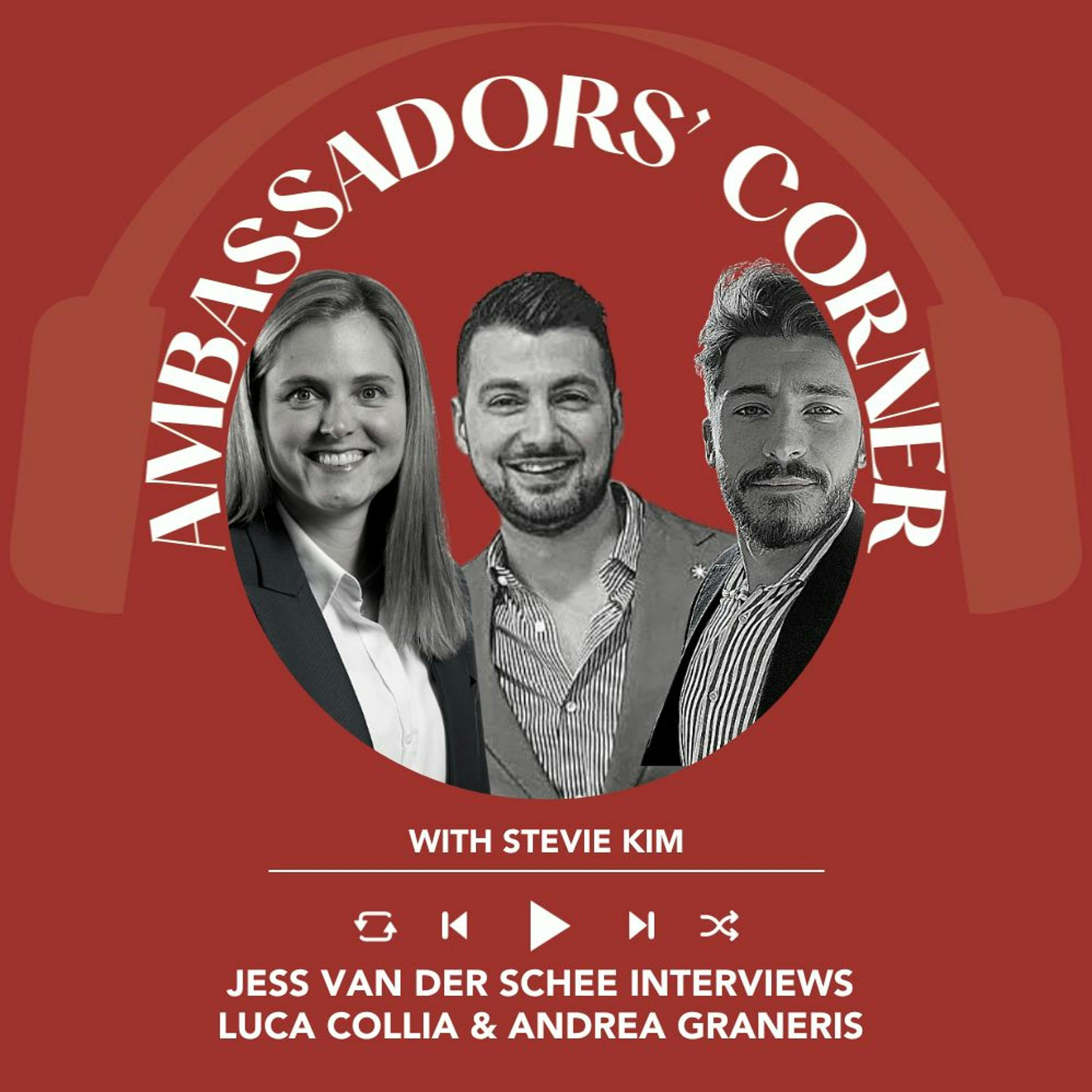
Ep. 1597 Jess Van Der Schee Interviews Borgogno & Carranco | Clubhouse Ambassadors’ Corner
Clubhouse Ambassadors’ Corner
Episode Summary
Content Analysis Key Themes and Main Ideas 1. The career transition from corporate law to the wine industry, exemplified by Jessica Vander Shee. 2. The historical significance and evolving winemaking philosophy of Borgogno in Piemonte. 3. The unique terroir and distinctive winemaking practices of Carranco on Mount Etna. 4. The exploration of new and revived grape varieties, such as Timarasso in Piemonte. 5. Strategic business developments in the wine industry, including global distribution via La Place de Bordeaux. 6. The crucial role of wine tourism and on-site hospitality for wineries. 7. The impact of climate change on viticulture and the future of Italian wine production. Summary This special Italian Wine Podcast broadcast, recorded live on Clubhouse, features an interview with Jessica Vander Shee, a WSET-certified educator and Italian Wine Ambassador. Jessica shares her unconventional journey from a corporate M&A lawyer in London, Shanghai, and Zurich to a passionate wine professional, highlighting her decision to pursue wine education after realizing it was ""way more fun than lawyering."" She introduces her favorite Italian producers, Borgogno from Piemonte and Carranco from Mount Etna, and explains their recent collaboration under the ""hundred Vini"" group. The discussion delves into Borgogno's winemaking philosophy, emphasizing its blend of tradition (concrete fermentation, large Slavonian oak barrels) and modern approaches to reduce oxidation and refine tannins, aiming for wines that are both age-worthy and approachable. Andrea, representing Borgogno, highlights their significant investment in Timarasso, an indigenous variety from Dertona, which they see as Piemonte's ""white Barolo"" due to its complexity and aging potential. He also details their strategic decision to sell select, limited-edition wines through La Place de Bordeaux to expand their global reach to new accounts. Luca, representing Carranco, elaborates on why Borgogno chose to invest in Etna, citing its unique volcanic terroir and strategic importance in the Italian wine landscape. He contrasts Carranco's winemaking approach, which uses less maceration and less oak than Borgogno, to produce elegant, softer Nerello Mascalese reds and a fresh Carricante white. A highlight of the conversation is the famed ""No Name"" Barolo, a wine born from a bureaucratic challenge in 2008 that was ingeniously transformed into a successful protest label. Both Luca and Andrea stress the increasing importance of wine tourism, with both wineries actively developing on-site hospitality. They also candidly discuss the significant challenges posed by climate change, such as rising temperatures and water scarcity, and their potential long-term effects on Italian wine. The interview concludes with a fun segment on food and wine pairings, including personal favorites and tricky combinations like spicy food. Takeaways * Jessica Vander Shee's career transition exemplifies a growing trend of professionals seeking passion-driven careers in wine. * Borgogno maintains its traditional Barolo practices while embracing modern adaptations for broader appeal and investing in obscure indigenous varieties like Timarasso. * The partnership between Borgogno and Carranco showcases a strategic move by established wineries to diversify their portfolio and explore unique Italian terroirs like Etna. * The ""No Name"" wine story is a powerful example of turning a bureaucratic obstacle into a successful brand and marketing tool. * Wineries are increasingly recognizing and investing in wine tourism and direct-to-consumer experiences as vital components of their business model. * Climate change, specifically rising temperatures and water scarcity, is a major concern for Italian viticulture, impacting ripeness and acidity. * Innovative distribution channels like La Place de Bordeaux are being leveraged by Italian wineries to expand their global market reach. Notable Quotes * ""This is way more fun than lawyering, so I changed careers."" - Jessica Vander Shee * ""we want consumers to drink the barolo, old, but also the current vintage because, we love, this wine, in all these different phases."" - Andrea * ""Etna... it's a very unique terroa. There is nothing like this in the world, actually."" - Luca * ""this is not a problem. This is an opportunity."" - Andrea referring to the ""No Name"" wine * ""From two thousand and one, almost all vintages are good enough to make a a great reserve. And this is only thanks to the global warming."" - Andrea * ""the one once you put the one in your your mouth, it's still fresh. It's still alive. It's still giving you huge, expression of our terroa."" - Andrea on tasting old vintages Related Topics or Follow-up Questions 1. How are other Piemonte producers adapting Nebbiolo winemaking to contemporary tastes while preserving tradition? 2. What are the broader market trends for indigenous Italian white grape varieties like Timarasso, and which others show similar promise? 3. Beyond La Place de Bordeaux, what other innovative distribution or marketing channels are Italian wineries exploring? 4. What specific sustainable viticulture practices are being implemented by Italian wineries to mitigate the effects of climate change? 5. How is the growing interest in wine tourism influencing infrastructure development and local economies in less-known wine regions of Italy? 6. What are the long-term consumer trends for ""protest"" or ""concept"" wines like ""No Name,"" and how do they impact brand perception? 7. How do Italian wineries manage water resources in the face of increasing drought conditions, especially in non-irrigated regions?
About This Episode
The speakers discuss their experience with their own wines and their plans for future business. They also discuss their approach to wine making, including using less maturation and more creative techniques. They also mention their plans for future business and their plans for future wines. They also discuss their love for their wine and their plans for future business. They also mention their love for their wine and their plans for future business.
Transcript
Since two thousand and seventeen, the Italian wine podcast has exploded. Recently hitting six million listens support us by buying a copy of Italian wine unplugged two point o or making a small donation. In return, we'll give you the chance to nominate a guest and even win lunch with Steve Kim and Professor Atilio Shenza. Find out more at Italian One podcast dot com. Welcome to this special Italian wine podcast broadcast. This episode is a recording off Clubhouse, the popular drop in audio chat. This clubhouse session was taken from the wine business club and Italian wine club. Listen in as wine lovers and experts alike engage in some great conversation on a range of topics in wine. If you enjoy listening, please consider donating through Italian wine podcast dot com. Any amount helps cover equipment, production, and publication costs. And remember to subscribe and rate our show wherever you tune in. Hello, everybody. Welcome to another series of clubhouse ambassadors corner. So for today, we don't have a lot of people in the room right now, but remember that this conversation is recorded, and we put it up on our Italian wine podcast every Thursday at eight AM Italian time zone. So right now, we've got our guest from the Via community. We have Jessica Vander Shee. Hi, Jessica. Hello. How are you? All good. All good. So I will be first introducing you, and then I'll ask you a couple of questions. Okay? So, Jess is, WST certified educator. She is a WST diploma holder and winner of the loose style Sherry trophy for her top performance in the fortified wine module of the WST diploma. She coordinates the Bernard Massard wine Academy, a WST app affiliated with Luxembourg largest private winery, Bernard Massard, where she teaches LAS City classes and master classes. So Jess is an Italian wine ambassador for Vineetale International, She helps source Italian wines for Bernard Massard's portfolio of international wines and judge the five star wines competition in two thousand twenty three. She's also a Balicella wine specialist and a French wines collar with the wine scholar guilt, a top score in twenty twenty as one of the few people to score one hundred percent of on the FWS exam. Wow. That's that's amazing. Congratulations. Prior to working in wine, Jess was a corporate M and A lawyer and worked in London, Shanghai, and Zurich. So, yes, I've been I've been wanting to ask you this. So you are you are an American. Right? Why are you based in Switzerland? Sorry. I'm an American, but I lived in London for a very long time, like sixteen years. And now I'm based in Luxembourg. So I've moved around. Oh, okay. So why did you suddenly turn into wine from, corporate lawyer? That's a good question. I started taking WSTT classes in London a long time ago back in twenty twelve to learn about how to order wines on wine lists because sometimes as a lawyer, I'd be out with clients and I'd have to order wines for dinner, and I just would be terrified. So I got in WSET, and then I just kept going, and I loved it. And I thought this is way more fun than lawyering, so I changed careers. Okay. So you've got bitten by. They say getting bitten by the wine box. So they like that. Exactly. That's right. Oh, wow. That's it. That's a really nice story. So before we begin, I would like to ask you, why did you select bourgogneo and Carranco as your favorite producers? I love wines from Piamonte and Mount Aetna. It's one of my favorite regions, and both of these wineries produce very delicious wines that show a sense of place, and I think they're quite iconic wineries for their respective regions. What are the learning objectives that we should be expecting from this interview? We should learn a deeper understanding of the history of Gorolo because bourgogneo is one of the wineries that played a fundamental role in the history. And we'll also learn about processes and reasons that led bourgogne to invest in a new and unique territory like Mount Aetna, and we'll also discuss the points of connection between two regions that are very geographically distant, but also so close. Okay. So I know that you will be interviewing two people for today's clubhouse interview. So one is from bourgogne and one is from Caranko. So before I ask you more about it, tell me how did you discover their wines? So I was tasked with expanding my company Italian wine portfolio, and I was looking for an Aetna wine that wasn't already imported into Luxembourg. I was actually on my way back from Cecilia dot Gita last year, and I had three hours at Rome Airport. So I sat at Italy as one does eating pasta and trying the wines by the glass. And I had a glass at the Carranco at Narosa, and I loved it. So I emailed Carranco, and then they passed my details on to the hundred Vini team. And then I was very thrilled to find out that Bagonia was also looking for Luxembourg partner. So we, import both the states into Luxembourg. Okay. So just to clarify, for the audience. So we've got Luca and Andrea. So Luca is for bourgogne. Works in bourgogne. And Andrea is Carranco. Am I right? They're part of the hundred Vini Group. I think we'll talk about that a bit later, but they both work on the different states through hundred Vini. Okay. Okay. I see. Alright. So I'm going to meet myself right now, and I'll give you the floor. Good luck. Thank you. So today, we are lucky to have two different speakers as that we mentioned, one from Vogonio, one from Caranko. So first, I will introduce Luca Kalia. He is forty years old, born and raised in Calabrio and Southern Italy right in front of Sicily. Since he's been eighteen years old, he's traveled around the world studying, working in exploring different cultures. After some experiences abroad in Bulgaria, Estonia, Argentina, and the United States, he came back to Italy where he located in Kimonte and currently lives there. He's been working in the wine spirits industry for fourteen years. And since twenty nineteen, he's been in charge of the export business development for a hundred Vini, which has a great portfolio of Italian wines. He has a big passion for soccer playing since childhood. And although he's already visited more than fifty nations, he loves traveling and introducing Italian wines and their biodiversity to people all over the world. Andrea Granneris is thirty years old, a younger, younger one born and raised in Piamonte, a few kilometers from the longue. In twenty twelve, he started to work at Italy, which is one of my favorite places. Covering different roles for both food and wine aspects of the Italy business. After two years at Italy in Italy, he moved to Chicago, to take care of the wine business development of the growing number of stores in the USA. At the beginning of twenty twenty, he decided to keep following his big passion for wine moving to a hundred Vini as brand ambassador of Borgonio and his expert manager of the group. He recently achieved his WSTT level three qualification, and he's also launched a fine and a rare wine business called Inohance. His greatest passions are traveling wine and dogs. Welcome. So I'm going to ask a few questions to Luca and Andrea. As we are fortunate to have two guests today, can you please provide a short summary of Romeo and Coranco and explain the relationship between the two wineries? So, I guess the first question was about, what's linked, Yes. Thank you. So, bourgogneo, so Carranco was born from the meeting between, bourgogneo and Sonatore. So in a way, a combination of, each history and experience, bourgogne, which is the oldest binary in the barolo municipality, an iconic producer of Lange and Barolo. Wailetore in a way is, originally, from Castillo and this is, of course, one of the few remaining native producer, from the Aetna. In two thousand eighteen, these two binaries decided to join forces, giving birth to Carvanka, which is in a way, this new project on the Aetna slopes. Thank you. That's really interesting. So we'll talk a little bit more about Morocco and a few questions. But first, let's talk about bourgogne. I had the great pleasure of visiting bourgogneo last winter, and I had a tour. And your team mentioned that bourgogneo is traditional, but with an eye on modern styles. Because you want your wines consumed all over the world. Could you please talk about how you do nebbiolo winemaking in this process? Because I assume, I love how the wines are fruity. Like, there's not too much oxidation and the tendons are relatively fine grains. So it's traditional, but it's also not too know, it's not too heavy. The tendons are quite nice. Yeah. So I would say that, the change of, not only bourgogne has changed, quite consistently in the last years. Bourgogne has always been a very traditional producers starting from, seventeen sixty one. Still today, we consider ourselves traditional producer because we work with concrete for the fermentation, spontaneous fermentation. We work with medium to long macerations, and we work with the big Slavonian oak barrels mainly. But in the last years, especially with the new owners, the farinetti family took care of, the winery starting from two thousand eight, We also saw the introduction of, a more, modern style, which doesn't means, working with barrick or auto accelerators, but simply maybe lower in the temperatures or fermentation slightly shorter in the duration of the maceration in order to have wines, which at the same time could be, enjoyable, but at the same time with the the capacity with potential to age for a very, very long time. This is important because sometimes, especially the barolo as a wine, is the wine that people consider, the wine for special event, for Christmas, for birthday, It's the wine with the dust on the bottle, but this is not true anymore. Actually, everything is changing, not just bourgogne, but many producer, I'm trying to produce wines, which are more elegant, more fine more fruit forward in a way in a more burgundy style. And we think that this is, the future of this operation, and we want consumers to drink the barolo, old, but also the current vintage because, we love, this wine, in all these different phases. Me too. Thank you. That's interesting. One of my favorite grapes is Timarasso, which I love the wines that you make from Timarasso. So how did you get involved in cultivating this variety? So tomorrow is probably one of our biggest, project right now. We are investing a lot on this variety, and we are proud to be, the first barolo producer. Who started to invest in this variety. Everything started actually in two thousand and twelve because in two thousand and twelve, we were looking for the white barolo. And that's why we decided to plant, a couple tors of riesling, and we started to make our longer riesling, the very first white wine, in our history. But a few years later, we understood that we couldn't make a a white barolo working with, an international variety like the riesling. That's why keep looking around, back in two thousand and fifteen, we met Valtermasa that, as you know, Jessica is, the father of the team or us, the most important producer. And in a way, the person will save this variety from the station back in the nineteen eighty seven. And when we met Walter, we immediately understood the the potential of this variety, and we decided to to invest in Timorazo. Chase in three act actors back in two thousand and fifteen. And last year, we bought additional four actors. So right now, we have reached a total of seven actors. But the production is still a quite small because, Tim Moraso is not a really easy variety to work with. Very sensitive to diseases, very low impactor. And these are probably the reason why this variety was so close to the extinction. But all the characteristics which are into this variety, so the complexity, the aging potential, really make made us understood how important it could be, for Pemonte, and that's why we are investing so much on this variety. To give you an example to explain also to the listener Oh, we consider this variety. We try sometimes to compare Italy to another very famous wine country, which is France. And we and when we do that, we can say that the touscany in a way is bordeaux. So if we look at touscany, we have these big binaries as well as there are big chateau in in Bordeaux. But also, of course, the approach to the wines is similar, you know, Bordeaux varieties, of course, in Bordeaux, but also in Tuscany, especially in the Bulgaria area. And instead, if we look at France for Pemonte, we can say that Pemonte is burgundy. And if, our Nebula is their pinot noir, today, we have our chardonnay, and it's called timores. The name of the appalachian, he said, it's Dertona, which is the Roman name of the city of Tortona. So there is a very interesting equation when we talk when we try to compare Barolo and Dertona because we can say that stay at Barolo, just like so stay at Dertona. That's a great story. I love it. And I I think you recently released a single vineyard T Mobile. Is that correct? It's a recent vintage? It is correct. We released for the first time, the Vintas two thousand and nineteen of Scalda Pulche. Because in the call, we are in. We are doing almost the same thing we did, more than fifty years ago in this area. So we are now selecting the single vineyards. We have released Scalda Pulch again, winter twenty nineteen last year. We're going to release a new single vineyard, the, probably next year called Valbona. And, but the aim today is to release on the market the first Deltona Riserva. The idea in the future is gonna be to have just like we are doing on the Barolo reserve, but also a library collection of bat vintages of Dertona reserve. Because, again, for us, it's our white barolo. While that will be great to take do a comparative tasting in a few years of the different vintages. Yeah. Absolutely. Absolutely. Wow. Delicious wines. Another question, I see that bourgogneo has recently started selling wines through Bordeaux laplace. I was wondering if you could explain what your reasons are for selling through laplace. And how is it going so far? So, yes. A couple of years ago, we were reached by a courtea from, from laplace. Which was looking for a great producer to to introduce to to La Place de bordeaux. We were not, the first one as you know, but, we noticed that, the interest from laplace towards Pemonte is growing with a few new binaries being introduced in laplace recently. We talked along about, what to do with this request. Of course, we were honored because, you know, places for sure the temple of, fine, and red wine, and we were on or about it. But at the same time, you know, that during the past years, we, invested a lot of time and energy and energies to build our relations with our importers all around the world. We started to to to to talk with our importer. And altogether, we understood that these could have been a very good opportunity for all of us, not just for bourgogne. And so we decided to create two new wines to be released on La Plus in a in very, very limited quantities. So we release two different cases, cases of three wines made of, barolo canubi reserve and barolo lister reserve. So the first single vineyards reserve. Ever released by bourgogne on the market. I would say that's, so far we are doing pretty well. We we are very happy. We receive a lot of compliments from, from everybody. And, we had the opportunity also to reach those, a few places that maybe were not yet covered by our importers. So altogether, we think, that, we, we will keep working with the laplace and the little by little, we will, give the opportunity to everybody to to taste our wines all around the world. So that's fascinating. So you so a plus gives you a bigger reach. That's interesting. So what market has it gone into that's new for you? More than new markets, I would say, like, new accounts, new places because, you know, at the end when you work with one importer, this importer, has let's say one thousand accounts and, it can grow to one thousand and two hundred, or it can have less accounts. But at the end, it's always reached those certain number of accounts. Having the possibility of working with LaPlus, give us the opportunities also to reach other accounts because, of course, the wines are no more only distributed through our importers, but also through a few other partners. But I want to stress the points that since the release was made on old vintages, the availability is very low. We're talking about, about a thousand of bottles released on the market. So very, very little quantities. But, again, I get a great opportunity to let everybody taste our wines. Wow. That's very exciting. Thank you. We're very welcome. Now, Kate, to switch over to Corona for a few questions. Yeah. Yeah. And give the word to to do Come. Hey, Luca. Hey, Jess. How you doing? Good. How are you? Good. Good. It's a fantastic day in the in the Lang area. We are here to weather with the Andrea today. Cool. It's very, very rainy in Luxembourg. So hope you're having a nicer day. I bet. So Caranko, so you talked about the collaboration. Yeah. But what drew you to this particular site on Aetna? You know, bourgogne being, like, Andrea said that the, most ancient, the one area you have in the land area is always looking for new opportunities, new, areas to, to grow. And, for us easily, Aetna, especially represents an, let estimate the word, a new word a strategic area, where a lot of very important wineries from Italy are investing. Just think about the Gaia some years ago. And also the Aetna wines are, between, among the most important, categories of the Italian wine, that are growing more than the others. So this is, for sure, very important and crucial for a winery like Borgonio to be there with, a new winery. With Carolina in this, in this case. But, to be honest, there there is also a romantic part because, when we talk about Aetna, it's really a magic place. You know, it's a very unique terroa. There is nothing like this in the world, actually. It's a very fertile volcanic soil, that, allow you to grow very fastly, your plants, and also, you know, being on the North parts, the most important parts, Karanco is able to, to be on between, five hundred and seven hundred meters by the sea level. This is very, very important when you make, example. We are located in Castillo and Desigilia. And there, we have also huge, the range of, temperature during night and day, you know, so the the difference is huge between the night and day. And also, you know, you're very close to the militariancy, you know, and it's, maybe the most fertile place in Europe, for sure, between the most important place in the world for fertility of the plants. So This is really a a unique place because even because you have a steel volcano erupting. So all the ash you get from the eruptions, going to, continue recycle or new minerals at least on the surface of the of the land. So it's really, really, unique place to make wine. And that's why, bourgogne wanted to know, to have a space there and to invest there some years ago. It's been already seven years for us. Let's, finish this, this topic is saying that, you know, it's really a place for a beautiful, elegant wines, prestigious area to be, So for us, it was very, very important to invest, on the Edna slopes. Yeah. They are very beautiful, elegant wines. We love them here in Luxembourg too. Question about wine making. So How is the wine making different? Let's take the Roso, like the Norella Mescalesi different from, Naviola. So an Aetna versus Piamonte. Have you had any surprises? Have you had to adapt your practices? Oh, for for sure. Sure. I mean, it's a completely different for for the antenna, we try to use less maturation. So to have, let's say, softer kind of tenants, and the extraction also is in this ways, more delicate. In any sense, when we talk about bourgogne, of course, like Osundra said before, we have long administration. You know, we want to extract more from Dimobiello. We consider it, the, a little bit like, the pinot noir from Italy. Let's say, let's put it in this way. So a very elegant, thin in a good way, wine. Which also have beneficial by the altitude, like I told you before. So, here, we we want a little bit, more elegance and less maturation. Let's put it in this way instead when we talk about we we have, a little bit more motivation, a little bit more extraction. The tenants are more important even because we want the one to live forever. And also, when we talk about the differences, also the the oak, for sure, in a, in a, when we make Carranco wines, there is less use of oak. Sure. We never use Barrick, but always big oaks But, when we produce in Sicily, we, let's say we do less time into the Oak than compared to bourgogne, so to the Lananga area. Interesting. So that leads me out of my next question is that you make three different Aetna rosso wines, and I'm wondering if you could explain a bit about the different wine making approaches to the three. Sure. Sure. So for sure we we do the classic Aetna rosso. So this is, fermented and, concrete, with, control temperature, without any maceration in this case. So and then, it it this takes twelve months. One year in, biggest Labono. This is more or less the way we do it. In this way, we have a fresh kind of wine, very enjoyable from the first sip. For sure you can, age it, but, it's also, good to drink it, even, during the the year of, the way making. Then we have the Aetna, Roso, which is the single vineyard that we selected, once we arrived on the Edna slopes. And this is also, with a, control temperature into the concrete. But then it does twenty five days, more or less, it depends on the vintage, of course, of a technique, which is typical from, piedmont, actually. It's called Submergent Cup, Capelos Omerso. So to extract, a little bit, more from, the grapes. And, and, let's say, I have a, also, a twenty percent of all cluster technique for this wine. So in a kind of French style, way to to make it. And then, to finish twelve months, a little bit, like, the first one in, biggest Lavonia, Oak. And then to finish, we have the RV. It's it's a kind of protest. Let's say, I mean, if it is not, specifically, it's a RV means, sir, but just for us, because it's not legally a reserva, And, fifty percent of it, of the Nerelomasklese is, in temperature, which is control in the concrete. And then the the other fifty percent is all plaster technique. After two months, those two wines are blend it together into concrete, and they stay, again, between twelve to eighteen months in, biggest Labonne, you know. It depends, of course, from the vintage, because sometimes you have a hot vintage, so you want to keep it a little bit less. And so on. So this is, more or less the difference between the three, that we make us threats. Wine to wine business forum. Everything you need to get ahead in the world of wine, Supercise your business network. Share business ideas with the biggest voices in the industry. Join us in Verona on November thirteen to fourteen twenty twenty three. Tickets available now at point wine dot net. That's interesting. And I got to try out the three with you. Yeah. And I I did taste more structure in the RV. Definitely. Yeah. For sure. For sure. It's more structure. It's the one we want to, to have it, for for many, many years. Heard, Andre, I was talking about Temorazo, which is, you know, a long potential wine, two agents, the same here with the RV, but also for the crew. We have more frustration, focus on the first one. We'd use number one. But in general, we have a lot of aspiration to extract more and to have a long life for these wines. So what was the the first vintage of the RV? Have you have you had some years on it to taste? Yeah. Two thousand nineteen, we started, we released it last year, actually. So, you know, when we once we got to own the Aetna, we started to experiment, with everything, with the single vineyards, with the RV. So, we started to release, some years ago, let's say, six years ago, the Aetna also, and not Bianco, and then with the time last year, we released, for the first time, both two thousand nineteen, the crew, the Nuta Carranco, and the RV. Cool. I think I tried the twenty nineteen, actually. Yeah. Yeah. The the first one for sure. And, you know, it's a very small production, when we talk about this two, what, dust two wines, the crew would be two thousand bottles production and the RV, even less. So, you know, it's a really less than an actor dedicated to, this, this two wines. Wow. Less than one hectare. Wow. Yeah. Rare. Very rare. That's very cool. So as, Vorgonio is pretty much a hundred percent certified organic or almost a hundred percent. Are you going to be looking for organic certification on Quranco as well? You can match on it because, we already started the deep process. So we hope to have a very soon, certified wines, you know, that in Italy, it takes you three years to get this certification. So we started and we hope from, next year we do release some, vintages, which are already organic certified. Unless, say, it's not easy, because, it's it's not just in seasonally everywhere, actually. It's becoming very warm and, hotter than, used to be for sure. So you have to be very careful because, when you have, an organic, path into the vineyards. And when you, when you start to do everything natural, let's say, you have to be completely, a hundred percent, in control of the vineyards. So it's spend more time into the vineyards to hope not to have a, hailstorm of whatever the weather is giving us in the last, month's years. So but for sure, we are already enjoying this path and, for sure we're gonna have a very soon some organic certified wines by Carranco. Very cool. And I was a question about Native East, because you mentioned that bourgogneo fermentson indigenous East. Do you do that with Carranco as well, or will you be moving to that? Yeah. We do the same, and we select everything by our vineyards, for sure. This is the way, differentity likes to work on, on the, on, his wines. And this is already something we do. And, you know, even because, in this way, and the goal, the natural way you work on the wines, the spontaneous fragmentation, the the demonstration we, we, we, we, we like to do. You announce that that Tara is talk about before, you know, this is a very unique place. You mentioned that, when all Europe was completely more than one hundred years ago, completely full of Velocera, and all the vineyards were destroyed, On the Aetna, we didn't have any philosopher because, you know, was tall, and we, between five hundred and seven hundred meters, but also because it was an island. So it's really a special place. It became, unesquared, since two thousand thirteen for even for the complex connection between, the the terroir and people that live there, you know, they will kind of wear damage almost, let's say, a god, you know, it's already there is some metaphysics school, a relationship between people and, the terroa. So in this way, we want to respect, hundred percent terroa, even in the way of making style. That's great. I like that philosophy. Another interesting, thing I noticed when I did the tour at bourgogneo, and also from looking at Caranko's Instagram and web pages that you both have hotels at the properties. So how important is that tourism angle? I know you have this beautiful townhouse next Borgonio with an amazing library collection. It's one of the coolest places I've ever been, and I'm wondering, I know, how does that, how important is that in use in your business? Well, you know, this is super important because, we can talk a lot about the wines, about how we make make them about the tarah, but it's very important for people for our partners, for our clients to come and touch with their parents to see with their eyes, because this is this make the difference. So for us, it's super super important. For for bourgogne, I'll pay you a little secret. We are, building, let's say, a boutique hotel that, still in into the process, but they will be, in for for the next year. So we are very excited about that. We'll be very small and, for just for members. And in Carranco, we already have, actually, Palmento, which is, was the place where they used to make the wines when there is also the seller. But at the same time, you have, like, a a little house, let's say. And now we, transform it in, bed and breakfast more or less, with a swimming pool, you know, with a tennis field. We have, also there are seven apartments, more or less rooms, apartments, call it as you prefer. There are hybrids. But this is super, super important because, you know, again, people they want to see, they want to touch with their hands, they want to discover, they want to get into the the winemaking process. And this is very important because just, ten meters by the seller you have, the place where you're sleeping. So how does one become a member of the bourgogneo boutique hotel? I cannot tell you this right now because it's a secret. I hope that, andre Fernandez doesn't listen to this, but, because it is really it's really something that we're gonna exploit in the next, months or years. But, we will let you know, for sure, and just I we did a tasting, I think, in that room, and it was it was honestly super cool. It's That's that's possible going. Yeah. It's, let's say they shareable place where you can go to drink even older vintages there. We have even something that we are not able to sell because we don't have enough wine. I'm thinking about nineteen, nineteen thirty seven, nineteen forty seven, and so on vintages of Barolo reserva, because we sell from nineteen sixty one to twenty sixteen that just released, but, to have even older vintages is kind of difficult. So just for the members, it's it will be possible to drink those wines there. Wow. Have you tried any vintages that old? Have you been able to taste those? Andre and I, we are very lucky people as persons because, just today, we tasted, for example, nineteen eighty two with some, with our partner from Germany. But in general, yes, we are able even to drink sixty one thirty seven forty seven. So we are very lucky people again. How do they taste? Like, how does the thirty seven? Was there still some freshness in it? What what was your They're very impressive, actually. They're very surprising because, you would imagine something very mature, actually, the color, for sure, is changed completely, as well as the nose, but the one once you put the one in your your mouth, it's still fresh. It's still alive. It's still giving you huge, expression of our terroa, this personality with this integrated tenants. Of course, they're not, tenants like, for the twenty sixteen reserva, but still, you have beautiful, beautiful integrated tenants and, also good acidity, actually. At the same time, I think it will it will be interesting, to see how in the future these new vintages of Barolo will, develop. Because, you know, the temperatures as everybody knows are changing. And this is quite clear when when we look at the wines. For example, if we look at, at the past, like, in the nineties, more or less we had three grade vintage is now sixty one, sixty four, sixty seven. If we look at the seventies, again, three grade vintage is seventy one, seventy four, seventy eight. A little by little, going closer to our days, like in the eighties, eighty two, eighty five, eighty eight, eighty nine. In the nineties, even more great vintages, ninety than ninety five, ninety six, and so on. From two thousand and one, almost all vintages are good enough to make a a great reserve. And this is only thanks to the global warming. So right now, we can say that from a certain point of view, we are lucky because it it's easier than in the past because we always reach the ripeness. But the future sure it's quite uncertain. No. Because when you reach the peak, when you reach the maximum, I mean, the risk is that the temperatures will be too hot, and we won't be able anymore to end all the acidities. So quite challenging in future. In front of us. That's very interesting. So we'll have to wait and see, I suppose. Yeah. Yeah. There's there's no much we can do, but, this is the magic of wine. No. You, you have to wait. There's no other option. Even if you pay If you don't wait, if you don't wait, you cannot get your answer. So, Andrea and Luca, if you had to pick one wine from Egypt Pagonio and Carranco, which is your favorite and why? So very, very tough, to be honest. I start with Carranco. And when we talk about Carranco, to me, the my favorite wine is the regular, right now. So because I think that at the end, even if probably from a overall quality point of view, the contrada Carranco or the ARVu or could be better, let's say. But I guess that it's quite difficult to find the that quality, like, on the regular retinaro. So, at that price point. So in terms of quality and pricing, I think, is a a really, really great wine. When we talk about bourgogne, is that excluding the Dertona, which we we spoke about a lot. I would say that my favorite wine is our single vineyard list because just, you know, that we own today is six different single vineyards. We have Kanubi, Kanubi Saloren. So for and recently, this is something that every most of people don't know yet. We also purchase, less than an actor of And, of course, you know, can you be in a ways to dream? No? Everybody knows the single vineyard, the crazy, expensive, and so on. But the most unique and the most historical for bourgogne is least list is also a doable because it's only owned by us and another producer. And is unique because, you know, that in the last years, in the last thirty, twenty years. A lot of producer decided to cut all the forest, all the trees around the area to plant more nebbiolo nebbiolo. Of course, today is not possible anymore. But, all these, changes in the environment change also, the ability of these trees to lower the temperatures. List, in fact, grows in between two forest, two woods. One of them is called the wood of truffle. And thanks to this, we have, like, the crossing, the vineyards from a side to the other, lowering the average temperature that we have during the year by two to three degrees less. Thanks to these, we have a better polyphenol concentration in the skin of the grapes, which are thicker, again, richer in polyphenolis. And thanks to this, we can reach very, very long maceration. We can reach sometimes forty, forty five, sometimes sixty days of, of macerations. And this is the secret of, of this wine. And, of course, also of the reserve, because our Marolo reserve, is made sixty percent using a single vineyard list. That's fascinating. So you you're in the global warming discussion. You actually you do have some land that is more resilient in a sense because of the forests. That's interesting. Yeah. For sure the forest is helping us, then another big discussion in the future, I guess, is gonna be about, the exposures, you know, because everybody was looking, in the past for the best south, south facing hills, but, when the temperatures keep, increasing this much, the risk of being too well exposed to Saudi is, is behind the corner. No. So can you be, for example, which is perfectly? Well, let's pause during the warmest days, reach very crazy temperatures. But I will say that the biggest challenge today is not just the temper or not just the temperatures. But also the lack of water because you know that here we cannot irrigate. We have to work with the the water coming from the sky. But when you have to face Vintages like twenty twenty two, so you have twenty of months without water, the risk of losing, the job, of a life. It's, it's behind the corner. Luca, I give you, the phone for Yeah. Lucas speaking now. Can you hear me just? Yes. Your favorite wines. Alright. Sure. When we talk about South, you know that I'm very sensitive because I was born in front of, like you said, before, in front of the Aetna was born in Calabrio. So when I when I'm in my village in Calabrio, going to visit my mother during summertime, I always see from my house, the Aetna. So it's very, very nice for me to talk about, Karangon general. But, if I have to pick up just one wine, I will say the white, Karacante, so that it's not Bianco from, Carranco, because, it's really made by alchemy. Imagine that you are in southern Italy. And if you taste it, a blind tasting, you would think about north of Italy, or maybe if you think about South, you can think about your opinion and company, you know. Why is so special? Why? So different from all the other wines from Southern Italy as a white. Because there's a beautiful elegance. This elegance is given by, this alkaline soil that we spoke before, but also by the old altitude you know, the altitude is crucial for this wine. So to have a wide, which such an elegance from that area is really, really interesting. And, something that we'll discover in the next year, it will be the fact that, there is a debate in Italy, respect to the fact that if you can age the Caricante for so many years. I had the lack to pay some old vintages like ten years ago, ten years, and they are perfect. They are very, very nice. So in, in the Karankaranko, seller, we make the at the the percent without any oak, just expressing the the acidity, the elegance. So we hope, and I hope that in the future, I will love the pleasure and, to share also with you just and the other guys that are listening, a beautiful, which for me is really a special, special wine. Instead, when we talk about, Vorgonio, I have a personal story to tell you. My favorite one will be always no name because, I started to work for bourgogne around five years ago. And, at that time, I knew very well, bourgogne, but I didn't know about the no name. And the no name is my favorite wine. So one day, I went, to visit my brother in Bologna, and, had to buy a, a wine to celebrate something we were celebrating together. I had a big budget. I went on a shelf And I saw this, this label and on. There was a non aim etiquette that he protests a label of protests, but I didn't know anything. And so I I choose it from the shelf without knowing that after a couple of years, I was enjoying the winery and, selling this wine. So for me, it's really, really, beautiful, personal story, but also the wine is a beautiful wine. You know, it's a very successful story. It's a beautiful wine that we Let's say we present, we introduce to all our, clients in the world, like a baby bottle, you know, it's a story of resilience, but also of, really intelligence and changing difficulties in a a good opportunity, I would say. I also love that wine. Could you just explain to the other listeners the story of why it's called no name and how it should be? Sure. Sure. Sure. So in two thousand eight, the Farinity family bought the winery after some generation of a, bourgogne family in Boschka's family. And when, they bought the winery andreferneti was twenty years old, he was studying at the Enerological school in Alba, And, of course, the most important thing in his life, at that time, it was to release his first barolo. And it was a thousand five inch of, of course, to be released after three years. So being a small boutique winery, we are not able to bottle, in one day, the big, Snavoni Oak we own in our cellar. You saw some pot damages. Sometimes we can bottle eighteen thousand bottles, but we what we do usually is to divide in two tanks and to do it in two days. Nine thousand bottles one day and the rest in the the the second day. When you do like this, you have to present two samples to the commission that in Italy gives you the, docG appolation for Barolo. So that's with what we did that here. So we send the first sample. They taste it. It was perfect, and they gave us the usage manipulation. Then they they they taste the second, bottle and they say, you know, this is not typical. So it will it's gonna be declassified from Barolo to La Guelo. At that time, you know, it was a huge financial problem for someone that just bought the most ancient winery in, in Barolo, the tone all the vineyards act to Barolo in Barolo village. So Andrea was, twenty years old, very stubborn. And they went to his father and said, we have a problem. I have nine thousand bottles of bottle of bottles, but I cannot call them like this. And it's a problem, you know. And the father, you know, after a couple of drinks, wines, they said, you know, this is not a problem. This is an opportunity. Let's call it no name, label of protest, it gets all the bureaucracy we have in Italy because we like to be farmers, to make wines, not to make papers. In Italy, there is too much, bureaucracy, even if traveling that much. We are seeing that, this is something that is common in all the countries. But for somebody that wants to make high quality wines, it's really a nightmare, sometimes. In that, in that case, was, human mistake, but actually was a huge success for us because, from that year, every year now we do classify on purpose, part of our production of Barolo, to just to not gonna be allowed to call it no name. And, I must say it's, it's becoming a brand into the brand, the no name. Yeah. It's a wonderful story, and it's it's a and I love how you turn it around. And it's also a delicious wine. It's one of my favorites. And it's it's a good the price is good, you know, for the Yes. I was surprised. You're buying about all of it for a good price, let's say. Yes. Indeed. So I think there might be some extra questions here. Should I hand back to the podcast team, Micah? Do you wanna open the floor? Hello. So, hi guys. So I just have to say that we've got a comment from Pablo before he left. He said it was a great chat and congrats everyone in Jess. And he has to go. So so for those who are listening in, if you have any questions, you can raise your hand, and I will put you up on stage. Okay. So no questions for now. So if you wanna ask along the way just to write us here in the room chat, and then I might probably be read it, or you can send your questions at info at Italianmy podcast dot com. I'll bring back the floor to you just because there are no questions. Okay. So we have a few more minutes, and we have, well, I think we have nine more minutes. So we can talk about food and wine pairing because that's always fun. Do you guys have favorite food and wines for your favorite wines? You know that our job is to to travel, and to visit different countries, and quite often, when someone asks, your perfect pairing, every producer starts speaking about the local food because, you know, usually, the wines from a place match perfectly with the food from the same place. But in recent years, we we wanted to start thinking in another way, you know, because we're selling our wine all around the world, and we needed the to to find other food pairing. So, for example, for, for the Aetna, also, something that's I like to do, because of the very smooth and soft tenants, especially during summer, which is, of course, not the typical period for drinking red wine. So I also like to chill it a little bit. Drinking the as an aperitivo, but also with some salad vegetables, for sure, with, some seafood. So it's it's very, very good pairing because I think that's, the salinity, that's that is into the wine, can really match well, maybe seafood, especially with the gal as well. So this is one of the pairing that I would suggest for, for the Aetna also to give let's say, an alternative to the classic, red wine pairing. While talking about list, of course, list that needs, something flavored, let's say, with an important flavor, is a wine with very strong characters. So, of course, game, meet, maybe local from Pemonte, but not only, last week. I went two weeks ago. I was in Japan. We tried Lisa with, an amazing Wagyu. It was just perfect now because you have the fattiness given given by this this kind of meat, which is balanced by these, tennis, very, very interesting. And then of course, barolo. And I have to say because, the truffle season is starting, match perfectly with the white truffle, especially. So it's a pairing that nobody should miss. That sounds delicious. Now what is the worst pairing you've had on your travels? Because I know you eat it with local foods. Is there anything that has gone with the barolo that's been really awful? So after Korea, I visit after Japan visited Korea. And, I mean, Korea is, they have super spicy food. And, as you know, as wine educator, when you have a spiciness, It's pretty tough to match, to match the wines with the with this kind of food quite often. Even if you have strong flavors in the wine, the risk is to have, your palate completely covered by is a hot, spicy sensation. So we'll say that I don't have a specific pairing that they really ate, but something that is quite challenging when I find it is is too much. Any kind of wine with, with spicy food. For me too, the tendons become more pronounced with spicy food. So it's like Yeah. Yeah. Challenge. Interesting. Luca, Luca speaking, so for the white, for the Karekante from Carranco. For sure, I'm a big, big fan of a pasta with Vongoleic clamps, especially when they're coming from the meats, the Iranian Sea because they're very salty. So they match, they match very well with the sovereigness of, the elegance of the Caracante. But since you were speaking about spicy food, I think this is a great wine to pair with spicy food, because, it's refreshing your mouth. So after having this spicy, taste in your in your pallet to have a little bit of this refreshing, good acidity wine. It's, it's a perfect pair. So Thai food, that would be a great, matching my point of view. Speaking about the no name, so about Piamonte, I'm very classic on this, and I like a lot, and you're a lot to the plane, which is a typical dish from this area, especially like I said, if you have the white truffle on, and this is, the season starting now. So we are willing to to eat a little bit of those very soon. Yeah, and, for sure, I always think that, and Nebula goes also well on its own. You know, it's such an elegant wine that, when I want to treat myself, maybe with my girlfriend on the on the couch Friday, night. You know, after a long week, we just get a a bottle of, the name of Barolo, whatever. And, we have dark chocolate with us. That's it. You know, very simple. It's a really nice pair. That sounds delicious. I'm getting hungry for dinner. Well, thank you very much. I don't have any more questions, and that was really interesting. Thank you for your time. Thank you very much, Jess. Thank you. Yes. So we are done. And so thank you so much guys for being here. For next week, we are still working on the next clubhouse Ambassador's corner, but we will let you know on our channels on our Instagram and our Facebook, Twitter, So there you have it. Thanks, guys. Thank you very much. Thank you. Thank you. Bye bye. Bye bye. Listen to the Italian wine podcast wherever you get your podcasts. We're on SoundCloud, Apple Podcasts, Spotify, HimalIFM, and more. Don't forget to subscribe and rate the show. If you enjoy listening, please consider donating through Italianline podcast dot com. Any amount helps cover equipment, production, and publication costs. Until next time.
Episode Details
Related Episodes

Ep. 2789 ColleMassari: a long-term vision rooted in Montecucco with Giuseppe Di Gioia | On The Road With Stevie Kim
Episode 2789

Ep. 2788 Ep. 14: Austria and Hungary | Study Smart for your WSET Level 3
Episode 2788

Ep. 2785 From Volunteer to Speaker at TEXSOM with Samantha Cole Johnson | TEXSOM 2026
Episode 2785
Ep. 2766 Inside the U.S. Non-Alcoholic Wine Market: What Wineries Need to Know with Jill Sites | Masterclass US Wine Market
Episode 2766
Ep. 2761 Winemaking and Consulting Across Sicily with Alessandro Serughetti | Wine, Food & Travel with Marc Millon
Episode 2761

Ep. 2759 Part 2 – The VIA Educational Program & Italian Wine | Heart-to-Heart Conversation with Sarah Looper
Episode 2759