
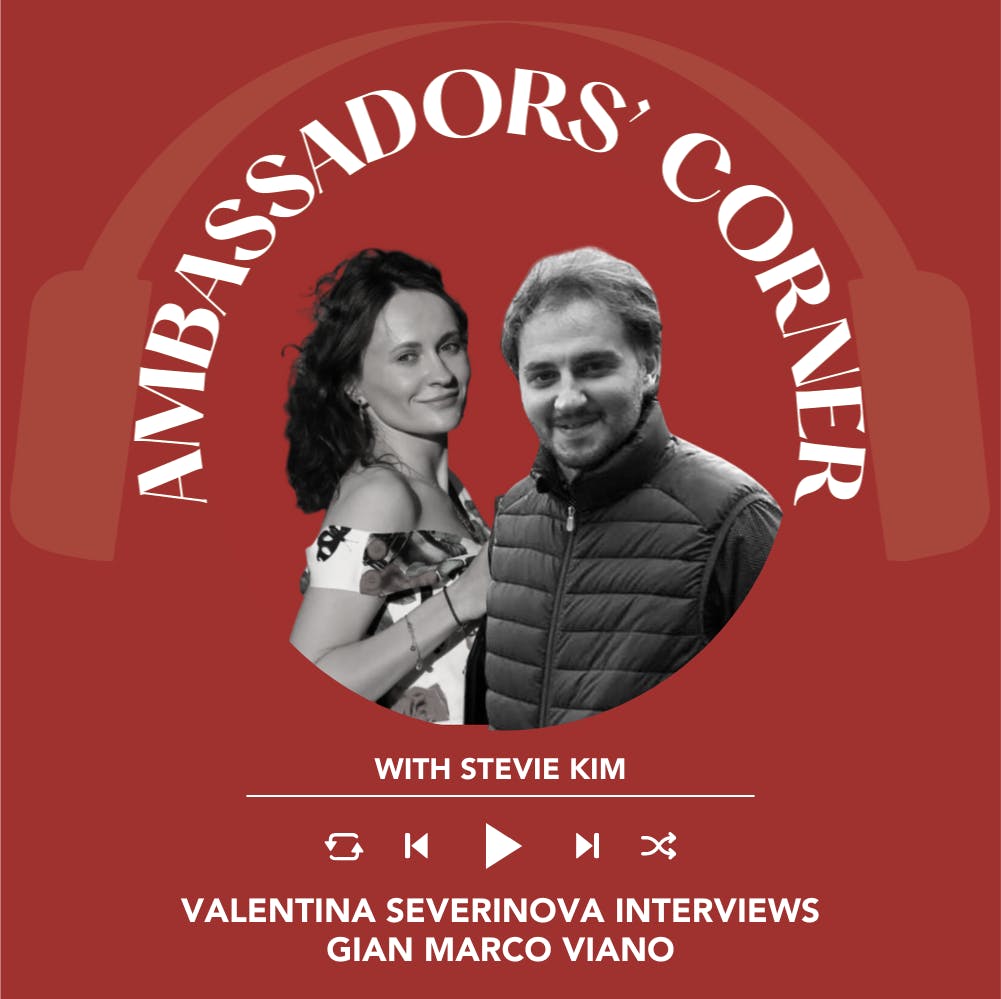
Ep. 1779 Valentina Severinova Interviews Gian Marco Viano | Clubhouse Ambassadors’ Corner
Clubhouse Ambassadors’ Corner
Episode Summary
Content Analysis Key Themes and Main Ideas 1. The unique characteristics and terroir of the Carema and Canevese wine regions in Northern Piedmont. 2. Gian Marco Viano's journey as a young, artisanal winemaker and his philosophy. 3. The distinct expression of Nebbiolo in Carema compared to other Piedmontese regions. 4. The significance of the pergola training system in Carema viticulture, especially in the context of climate change. 5. The role and importance of the young producers' association, ""Vignaiole Carema and Canevese."
About This Episode
During a wine podcast episode, Speaker 3 and Speaker 4 discuss the wine industry and the importance of finding small, family-friendly businesses to be influencers. They also talk about the difference between the French and Italian wine markets and the importance of managing a small, family-friendly business. They discuss the benefits of the Karema and the need for constant improvement to maintain health and well-being. They also discuss the challenges of finding the right recipe for a specific style of wine and the excitement of the Italian wine industry. They emphasize the importance of preserving their environment and increasing their production capacity to maintain profitability. They also mention their desire to increase production capacity and discuss their plans to increase production and maintain their production in a sustainable way.
Transcript
The Italian wine podcast is the community driven platform for Italian winegeeks around the world. Support the show by donating at italian wine podcast dot com. Donate five or more Euros, and we'll send you a copy of our latest book, my Italian Great Geek journal. Absolutely free. To get your free copy of my Italian GreatGeek journal, click support us at italian wine podcast dot com, or wherever you get your pots. Welcome to this special Italian wine podcast broadcast. This episode is a recording off clubhouse, the popular drop in audio chat. This clubhouse session was taken from the wine business club and Italian wine club. Listen in as wine lovers and experts alike engage in some great conversation on a range of topics in wine. If you enjoy listening, please consider donating through Italian wine podcast dot com. Any amount helps cover equipment, production, and publication costs. And remember to subscribe and rate our show wherever you tune in. Yes. Welcome, everyone in this episode of Club House Ambassador Corner. And so today, we have Valentina. So she's back, and welcome Valentina. Today, she will be introducing John Marco Viano of So before we begin, I would like to tell the audience about Valentina. So Valentina Severinova, hi, Valentina. How are you? Hi, like. I'm okay. Thank you. Thanks for this session. Of course. So we were actually classmates back in Arvilla in Verona. How was it for you? I think, that Avir is the most detailed course about, Italian and the wine. And, first time, I did it. It was two thousand twenty one. I did not, started too much. Actually, I was not prepared for this course, but I was happy to be back in Italy because it was, the country I don't, very much. That's why I, was with you, like, classmates, and after I did my first attempt, I did the second time and, in two thousand twenty two and, passed and happy to be part of our community because I think it's excellent community to be, like, bridged between, ambassadors, and, producers, very useful connection if you work as a client educator or a wine buyer. And you need to find new producers, from, not very famous, wine regions, especially. Absolutely. I totally agree with you on that. Actually, I also wanted to say that Synthia is here. So she is our project manager for Via. And I wanted to tell the audience that we are actually having the in New York on March forty six. And so, yeah, so it's open. And so if anyone wants to join and subscribe for the course. It's at the natalie dot com. That's just a plug in. But, anyway, let me continue to introduce you. Three years ago, you decided to dive into wine and you started your own tasting club. So that's really amazing. And then you're now teaching Italian wine at Sommelier Schools and work as a buyer for distributors and helps with the portfolio. So now Valentina is a wine journalist and a blogger promoting Italian wines in the Russian market. So Tell us why did you select John Marco Viano today as your favorite producer? Okay. Why I choose? Because, you know, when the wine is such a substance that there is always, something new to discover. And if you work with wine for a long time, as a family, a buyer, whatever, you have to taste a lot of wines as a part of your job, and, your palate develops and, changed. Very often it changed towards subtle or very elegant and gastronomic wise. For me, it's like that. And, anyone in lava is fascinated by nebela, and, its ability to translate the terror. And we would like to see as a consumer's, different expression of this variety. And for me, the wine from John Markoviano is one of the most stunning fine people I have ever tasted. That's one thing because it's a different PM amount. And moreover, we are used to the fact that Barrola and BarBaresque produces are usually, like, grand, great grandfathers. And which is handled down from generation to generation. And, however, John Markoviana is a very unproduced say even younger than me, with a young winery representing the heroic which he called the region of, Karima. And together with other young people, they call themselves, he's, dedicating his life to the development of a unique wine region and to the restoration of this, Appalachian with the abandoned terraces that we are almost, forgotten. And that's very exciting. I think. Okay. So I'm actually excited. Will will you talk about the wine you tasted? Is it a nebbiolo wine you first tasted with John Marco? How did you discover the wines of I teach it in Moscow. And here, we're not discussing politics, but it's for commercial things. You know, that the Russian wine market is quite developed in wine and also growing a bit in Italian and wine scene, but even now, And, currently, Karima has seven producers and, one cooperative. And the only wine from Karima that I tasted few years ago was a comparative wine. But it was very memorable. Wine of good quality, not like other styles of, nebela. And, also in our market, we have a growing number of distributors and demand them there are not only large ones, but also small ones, who are looking for diamonds among the famous and not so famous regions like Karima. That's how I discovered new wine from Karim, and now I market. And it was Zendaya, Greekumala Erocha produced by John Markoviano, This one was imported by a small distributor called Alavolea. And last spring, I was, invited to the event called, Revain, organized by John Mcoviano, and Adayana produces from the association, joining Vigna Yoleca NAVizani. And I was fortunate to taste all the wines of twenty four young winers producing, Karaima, Kanveza, and, Ervalucha. That's incredible. Actually, we also have a podcast segment called next generation. So I would like to get in touch with you, John Marco, for, you know, to feature also the young producers from Karema, Kanavecie, and Ervalucha. So before we dive into the discussion, since it's a geeky discussion, so tell us what are the learning objectives that you should be expecting from this interview? Coming back to America, Van Italy International Academy, the ultimate Italian wine qualification will be held in New York City from four to six March twenty twenty four. Have you got what it takes to become the next Italian wine ambassador? Find out at Ven Italy I come? We'll discuss how small young producers can be influencers and attract young audience to the wine. We'll also talk about the difference in terror between the of Karema and Alto P monitor. In spite of the fact, that Karema belongs to Kanavessa formally, not and not Alto P. Monta, we discussed the difference also between Antonybelo La Canaueza, and, that's from the styles of white wines, from Erbaocha. Okay. Perfect. So now I'm going to mute myself, and I hope Steve will arrive. So now the floor is yours, Valentina. First of all, I'd like to say thank you to John Marco Eviana to participate in this interview and, would like to introduce, John Markoviana to the audience. John Markoviana born in nineteen eighty six in a host and raised in Everea is a man the first caroma produces part of this new generation of Canalese Van makers. Previously, formally in start and not start restaurants in Italy. In two thousand fourteen, he began his new adventures, winemaker, becoming one of the protagonists of this hidden era that is extremely suited to wind production. Ciao, John Marco. How are you today? Thank you for that introduction. And, I will try to do my best with English. Thanks for the opportunity to have our conversation with you and, with your, collaborators. Cool. Before we start the discussion, I am curious about one thing. We know that you have always worked in the wine industry, but How did you come up with the idea of your own wine who inspired you? Yes. Before, being a winemaker, as I said, as you said, used to be a similar, yeah, especially the restaurants. Around seven years. And, at some point of, of my life, I decided to to split a little bit because I was tired of, the the timing and the hours of work, on the on the restaurant industry, especially the business part of the industry. I saw, I tried to to split us even if, staying in another white, word. That is my frustration. And, so I tried to work in a winery. I was in a personal room of a winery that is located in Barolo, which is called the Vaira. And, in that experience, working in the winery, looking around. I was very fortunate about the the work in the business. The work in the wineries. And so I decided to try to manage a little bit of those to my to my to my town, to my native town, which is, Iraya, which is going to kilometers far from, karimas. And I start, this adventure. We found a great, school basis. But, just allowing me, asking a lot of producer on, And, let me, by myself, through some, some booths, or, some experience of all people that are working here in the videos from a lot of times. The idea was trying to managing Avina, but I I stopped to decide. And, I I decide to, to do this this work because I I I I discovered that was, my my very, big passion. It really sounds very cool and exciting also gives, provide some hope to others to produce wine as a family, sir, to produce wine. Yeah. And why did you choose Karima Canvasa and not other neighboring vineyards? Was it the call of your motherland are other reasons? Well, yes. First of all, of course, the Karema, as I said before, is very gross to my hometown. I saw was not allowed to choose, something around, my my city, you know, then another interesting reason, for sure, is the cost of the VR here. You need to consider that here, ten years ago, a lot of people decide to abandon it, and there was not a generation exchange, and so the cost of the bill was not in some way. Also, the work was to know some people that, maybe old people that, was not more able to manage Vignard. And then, just ask, can I please, manage your Vignard? And they said, okay. Just let me a couple of bottles. The end of the year, and that's why. So that was the, at the time, the the the situation. I saw even, a a people like me, like me, that, I know coming from winery family, and I I'm not coming from, a bridge or, you know, a family that can, spend for money for to to buy vineyards. What was very easy to to start and to, begin this, this adventure. So there there is a reason, of, native, as in native area, but also a reason of, in terms of economic cost, that allow me to to stop here on the this business. Great. And now a little bit study questions. We know that nebela is, the great terror translator. And speaking about the terror, what are the distinctive features of a wine from Nebula and Nebula canales. How do the wines differ from other al to be monitor? And how can Karema and nebula can never be recognized in a blind tasting? Well, we are, in the very northern part of the head months. It goes with the Alcavalay Reinbord. So at the bottom of the big, very close to Montebiano and Montarosa and so on. So there is a a very particular, microclimate in this area. Of course, when we think about Mediolo, we think about longer, which is a completely different, climate. And, especially the soil that is very different. So here, do it with this, the this big, glacier that was here, a million years ago. With, a series of frost and defrost, create this valley, and brings a broad brings a lot of, stones from the big and a lot of sand. So we have we are, we have, a very sandy soil, in some terraces or more destructive of sand that gives, to the winds, I would say a very elegant and and and thin, character. So you you don't need to imagine the tennis of a barolo, of a barolo, that are, of course, very, important. But here, you have you have, more of a acidity. They update it next to her, much more, delicate in some way. And so this is, the big, characteristic, I would say, from, the lung area to here. Also, the pHs of the soil are, much, much lower, the city, higher. So pressure wise, normally, we have, one degree less of alcohol and one point more of acidity. And if the business, like, is, our main character issues, As you said, on top of your mind, there is this, white region that, begin here in Tarima since, close, bulk, again, man, and there's, like, some way of work when they know, because every Vignac, So every little, town, like, both, Arizona, or Amazon as a it's a proper characteristics. In the here, in this area, the marine soil, the the gas, the original soil, gives a lot of, I could say mineral touch with the wire. There is a lot of iron in our, was sanding our soil. And so you can recognize, uh, orama, with this, very mineral, very we have a browser. We have, let's do it. It's always, a very delicate line. And, you don't need to look at the power when we when we where you taste the, Karema or a cannabis in the Biola. Karema is in the cannabis area because the region is called the Kareza, but it's like, a little village of, twenty two hectares in total. Wipe the Kanabasa in much, it's much more larger, and these are around forty villages, in total. Okay. And, one more, like, geeky question about, pergola. Almost all caramavinias are under pergola training system and, like, planted on terraces that's high altitude and can be cultivated mechanically. And we know that, VITiculture here is a very labor intensive and, like, time consuming process. But as far as I know, there is also a research that pergola helps, to reduce not only the impact of extreme climatic conditions like global warming, but many producers in Italy are going back to pergola because it requires also less labor. There is no canopy management, no shooting and, position in low leaf removal. Like, with vertical shoot position. Does it does it really make, sense? And does pergola help you working in the vineyard? And do you think that now more and more wine producers are going back to hold and traditional winemaking practices. Yeah. This, very interesting questions because, what, the the characteristics that, I was told you before, out of are, made also by this, of people are, training system that we are, especially, you know, the Italy. Also, for example, there is paragona Veronese in the in the day at all. And, you know, there are areas of the, ultimate, alternative culture and insights. Because, yes, the the the climate changing, of course, I is challenging. And, the paragola, I think that helps, to live, I mean, it's it's like a protection, from the sun because the clusters are below the the bits every every time. I saw, normally, this freshness is is also preserved by, this protection by the sun that preserved Alamas, the fruitiness, and also, it's to preserve the city. So, it's definitely an old, tradition, an old, which includes your system. But, that is very modern. Very modern. Today, this morning, I had I had here, at, at, at, at, at, at, at, at, at, at, at, at, at, at, at, at, at, at, at, at, at, at, at, at, at, at, at, at, at, at, at, at, at, at, at, at, at, at, at, at, at, at, at, at, at, at, at, at, at, at, at, at, at, at, at, at, at, for sure, paragola, even in counties, because, I want to understand if, is something that can help me. You know, in, a lot of areas in this moment, to have, a win less than fourteen hours of alcohol. It's very difficult. Due to the climate changing, the dryness of the soils and so on. Then b can be something to try to discover, of course, every soil, every, area of different characteristics and maybe, not everywhere. The paragola can be okay, also because, even, each varieties that can be better or or not. But, you said about the the time, in some way, for sure during the green, moments of July, June, the Taghala gives less, work because we don't have, this work of, shooting, car But, for sure, we need to remove, beliefs. Absolutely, we need to do great harvest. We need to do a lot of things because below the paragola. We need to have always, a good variation, some, some, that's the entry, anyway, who don't create too much humidity. Because otherwise, then, we start a lot of, diseases, like, one mother and so on. So there is that work, maybe during the from May, July, less than, Agoyo, for example. Yeah. Lavinia in Karima is like, a spectacular view with pergola and very memorable and recognizable, I think. And so you are working with, two varieties, and, and what is your favorite grape to work in the vineyard? And is it your favorite one to work in the cellar as well? Difficult question, because it's asking, what's your favorite zone? The the first one, the second one, the third one, on it might help me somewhere, you know, for sure, the DNA of the Balucha helps a lot, the figurine. So the it makes a lot of this, a lot of green so, maybe confederate with Nebula is more work, more work to maintain the, you know, healthy and, good condition. Well, then the viola, there there is more, the equilibrium, not the equilibrium, of, figurine and so on. Also in the cell are, are both interesting because, with the I make just, classic, and all those with wine, but doing to the higher CT, and the VAC, which is low and so on, you can do everything you want, you can do very good, medical, classical, very good procedure. And, also, with the three wise, also, wage. I personally making those also, orange wine, you can make, you can enjoy your elite work, in the vineyard with the menibiola of course, for us is, is something special. Because we are very lucky to to be here to pour me out of the road here, you know, before the corner of the head month to work. Rather, there is the Nebula, which is actually, I think, one of the, I don't know, four or five, most important, the grace of the world. And so it's always, interesting to work in the vineyard with, Gabrielos in the in the cellar. It's pretty amazing. For example, old rastards or, not disturbing the grades, just the extensive egg, aging, but also you can work very long, aging in wood. So, you can do plenty of of things, with these two these two drives. Yeah. And you talk already about the balocha that this variety, you know, provides. So all styles of wine, from, excellent sparkling to Pacita. And, you mentioned your experiment with macerated, and do we see potential for the variety in this particular style? This is a very good question, very difficult because orange wine, is something very ancient as a region. But even here, any kind of, is but just, finished these six years ago, the white one was made with, skin contact, you know, because, I was, not, a selection selected this. So the the East that provided the from the the skins that were, were very important to bring with the wires. At a certain point, it's been a kind of of, orange wise, correlated with natural wise, with few years of, good, orange wine, and not for good, wise in this particular side due to the volatility. And, other, things that are, in my opinion, are not, proactive. Now, there is the, point that I think, it's very difficult to find out that, over the line. Thanks to the experience. Thanks to the in Italy, especially to the three way experience. So, many great producer that is a way to explain to everybody, what was the right way to produce orange wine. It's a wine that's dividing the customers. So there are the very, person by, orange wine and the people that, really doesn't like orange wines. So there is a little corner of, the market that, lost this kind of, wise, and the others that really are more in the plastic, white wise. So my opinion is that would be, interesting to, follow, the traditional style of wine, but without, producing many, many bottles. So I think it would it will be, a little, discovery of your portfolio once. This is my opinion. Okay. And what about your title one? Your title one is called Monte Malletto Carama soli rocha, and it has an interesting label as well as, your avatar on WhatsApp. Depicting a famous Italian figure. Can you tell us more about it? Basically, that is, a portrait made by, so, you know, artist and there's a portrait of Marisol Dottie. Marisol Dottie has been here in Italy with, by the name of the very first, journalist, we're talking about, wine talking about the gastronomic world in some way. And he was, very low with Karaima. And so I decided to put this little portrait, in the label. And then, the portrait reminds also my, my father, my father, and, they, I think, then two thousand fifteen, that has been my first, harvest. I saw that there was this kind of a combination of things that is fire to me to to put this portrait in the label. Great. And, John Mark, or tell us three reasons why why conosis, who normally drink Barriquez should try, caramel lines. I told you, the beginning of the interview. If you're looking to Anadiola, a little fresher, with less, alcohol that maybe even easier to finish the bottle, you know, sometimes, depending by the style, now the style, the, also in Marlboro, Paris, for the trend is to give a little more lightness to the wine because, sometimes, it's difficult for us to finish a bottle because the thing is the power message, it's useless. So right here, the wine's a little more, fresher. And so even easier to create grass. That, doesn't mean that are less complex, sir, but having different, kind of complexity, different characteristics. And so, so this also also is interesting to discover, the Nipiolo that's coming from, the areas. No. We have also been there, even over there, there are many new york producers that are, stop producing great stuff in the zone. And that for me is fantastic. I was different characteristics of, from Karema. So this may be a little more in the fruitiness, style, but I'm very good, good products. So I will suggest, to everybody to test, to test, the wise from a cookie monitor to have, another view, of the bill from Pierre. And, you are now a president of cessation, who are they? And, you have also a very cool event. I was happy to participate, and it's then dedicated to Do we plan to continue with this presentation? Yeah. Is, an association, bought in the two thousand and twenty. Why why? Because, I just said before, many, many young producers start to to try, you know, to experiment, to to stop the summit base for the wine business, because the opportunity to stop. But many of us didn't have the, basis law of, analogies, agriculture. Sometimes it's difficult to buy the press, the press, graves or, sometimes, So, with this group for some time, sir, we, give us, in each other, no, some machinery that we need, in the media or in the seller. We, we share informations. We share, something that we discover, some experiments. We try a lot of wiser together. From, other areas, but also, we do blind testing with, with of our our wines to see at what point we are, and to do some, competition but it has the competition, good competition, between assets to to ground, not to ground. And, in this area, it's never been, a fire, a fire of, of wine from this area. And so, we decided to create this event. I would just order a rewind, that this the most important event of from of, cannabis and karma wise. Normally, we do this in, in hate. That is a good moment for us. Where we do the opportunities to to everybody to try more or less all the the wines from Canada and and so we are very happy. We're every every year, we have a lot of, incredible people that are coming from, from us, to us. And so, we definitely want to continue. This year, with the eleventh and twelfth, May. And, also, in this case, we we want to improve, and we want to move forward with, our best, in the in the sixth. And I saw that, our Italian wine bible, professor. I tell you, Shanks, are also attended. You know, last last last year. But in the, last year, we have, material. So people that really are, an opportunity for us to grown, we are very proud and very happy to to have this, personality here in Calabas. It's really great. So, John Marco, you are young, and, your friends, also, young producers. How would you describe the target audience for your wines and what, should be done to promote wines to a young audience? Does being a young winemaker help you to sell your wine somehow? Well, first of all, all of us, I would say, are, more than younger that, for me, yes, he is, like, he's, important, but not so important, you know, because, you know, there are three four, that maybe are, sixty, seventy that are younger than, twenty is not because it's the it's the brain. It's the man it's the mentality that have to be younger. Our characteristic, I would say, it's, more than younger, but there are these. We are all the people that, are, follow, the vineyard from the beginning, from the little plant that's planting. That's to the harvest. And then from the harvest to the to the bottle, and then we we need to to take about the labels and and also the commercial staff, trying to We have also, with the healthy economic situation. And so this I think is, the characteristic that every artisans have, you know, in, in every business and this is, what we are. No. We don't, I don't know. We we we can buy some grades. Well, we cannot buy more than the sixty percent of grades that we make. We don't buy, wines that are already made. We want really to follow all these all the little stuff that, are are and it's starting from the the little plant to the bottle and so this, this is important. Of course, be young as always, interested for, involved session. It's on because you can, give a a fresh, some fresh ideas, some new interesting points of view, but, the most important piece is that there is another personality that that everyone of us have. And how do you see, in the future? For me, it's great. And for me, for our reporters, you need to consider here the quantity are not allowed. So we don't, producing many, many bottles, but all the bottles that we're producing are normally sold before, bottles of the wires, not. And so this is a good point to to start, you know, because, I think another another important thing, sir, as we we told before, is the climate changing that, at the moment, I think a lot, so we really need needed to go higher in terms of elevation, in the vineyard because even here, will be the problem of the climate changing. We have a big problem here that is the water, that we need to to challenge in the future. But I think that, the area is developing a lot. In term of quality of wise, in term of production, in term of people that are starting in business with, passion and bringing some new ideas. And I think, that the market, the big quarters, and so on. We follow-up, who follow us in this, in this, Jordan. And, John Mark, or do you plan three weeks pant, your Vignettes, in the future, because, you know, in Karema, great territory, unique, and every every producer is very small. Tiny. And, only twenty two hectares, as you mentioned, and, what about, your perspectives? What do you see? Well, yes, a little bit. I have, one one, you know, one extra nine hours at the moment, and I'm producing around the seven, thousand bottles. I think, I will, go home up to plus the sixteen thousand bottles. But, no more, for me, it's important to preserve, as as we said before, these are seasonal, these are artisanal ability. And I think that, being a deal on, means also, dual step by step. And, I have, short face that, allow you to to manage everything from the beginning to the to the finish. And so this is my goal. I don't want to be, yep, you know, I don't want to have to connect us and produce I think, one hundred thousand bottles. I I really don't care about it. Even because, before the work, after the work, there is a a life, and, I want to present also little traffic, prime by any month, and I want to go to the stadium to see it. But you said, my my football team, but I saw This is my my reality. No. This is my my god. So why? Yeah. Just ask this question because, your guy in Russia is almost finished, and I think that you give a allocation to distribute. So we need more allocations. Oh, I I will increase. Like, for example, Karim, and I always two thousand bottles, and I also have to four or five thousand bottles in, in we have, so two thousand twenty three that has been just, economists, the the the past year. It will be already around the three thousand bottles. So, slowly, slowly, I will increase, but, I just said before, I don't want to be a big producer according in terms of quantitative for sure. Yeah. John Mark, that's all from my side. What, in question, all questions from my side. I think we have a good, interview about different, PM and style. And thank you for joining us. And I give floor to Stevy. She usually has also questions. Thank you. Hey. Thank you very much. I'm sorry to, come on board. So late because we had some technical issues at the office today. I guess I do see the notes from backstage, but so John Mark, I'm sure you have discussed most of these topics. But can you just give me a brief, like, Review. You said you make seven thousand bottles. You produce seven thousand bottles? Yes. In total? At the moment. Yes. And how many labels? On four labels, there is a white. One is the, make it so long. That is Darbalucia made, in wood. And, the other one is the genesis that is on orange, white may do. Again, with Darbalucia, Mhmm. And then I have, the cannabis in the viola. That is our, Russian fluid in the viola from, selection of gravesa, village goes to to Karima, but already, out from the DOC of Karima. And then the Karima solar option, which is how I blend of, different vineyards in, in Karima. In Samir, like, two thousand eight, eighteen, and, probably, two thousand twenty two, I will I will I'm producing also, single vigner, the wine from Karema that is from, my first, vineyard that, I I took in the two thousand and fifteen, which is called the la costa. That, is made, pressing the grapes, without the stem, the the guys, so it's one hundred percent, with Spencer, and, is another, again, as another personality character, compared with the seller of Charles. You know, John Marker, we've never met, but I'm so fascinated by your philosophy of, I would say, wine production, but also just life in general. You had just mentioned, I came at the end tail end of the discussion, and you said you have no intention of becoming a much larger wine producer. Is that correct? Yes. I want to maintain, an artisan. So I will try to do this. Of course, never know in the life because in the life, you can have some opportunity that, maybe you can change your mind, but in this moment, in this moment, my my goal, is, of course, to increase the production because now, it's not enough. But it's not enough also, to invest, or invest in the cell or invest in other things. So, you know, I hear, we we were told before, about the Germany, and here, we, we are twenty four wineries. And I think, twenty of the of those twenty four are, are just, you know, let me is providing with this work, you know, because every every every other one as another job, or are working in other wineries. Right. And so we need every every everybody. We need to increase the production to maintain, economically. The the winer is not I suppose that was my question leading to, like, how is it sustainable for you to make so, like, such small production? I don't know the organization of your wine company So I guess that was it. You know, I was kind of struggling trying to understand your business model, if you will. How many people work in your company? So you're you're pretty much a one man show. But, yeah, it's just me. Right. I I have one extra last. So I don't have connectors, but in, for example, Google, and Chuck always made for him. The car image made all with terraces that the most of the terraces are I know. I saw the pictures. I mean, it is heroic Viticulture. Right? Ah, yeah. So You must be super fit. Human. Yeah. Super for informa. Yeah. Yeah. Yeah. Yeah. But we also we love wine and we love most food, and here, we have good food, but also, right, you know, calorics food system. So, John Marco, listen. I think it's it's fascinating story. It's it's, I think, fairly unique. And, hopefully, a good luck to you. Hopefully, we can come and visit. Your one man show will give you a little bit of advanced notice. But we would love to come and see you sometime. Yes. Yes. I'm, as I said before, I'm, I know, just just me, of course, in this, this way, you know, I am, as I said before, I'm, many other wineries, if, great guys that are making great. Yeah. Okay. I think, there is a big, a great future for this area also because this guy at the moment doesn't have experience but year by year, are improving the quality of the wines, the the quality of, also, the communication. And so, it's a kind of white paper, and we are, right now, you know, right now, our, our story. And this is very, very stimulating for, every of us, you know. And the label on your wine, that gentleman, who is that? The illustration of the man on your label. With the hat? It's marisol marisol Doctor. Ah, okay. It's marisol Dante. Yeah. You know? Okay. So you dedicated this wine to him? See, yes. This in this corporate, he reminds also of of my with my father. So my father meet my father, that the the learned fifteen, that was the one, my first three interns. I saw this combination of, of being the Marisol dotty also because Marisol dotty was very, very, very low, Karaima. So this combination of, of that of things, this perimeter, the site to use this, for operator that is made by an entrepreneur, this, for the, Spanish's contribution. Yes. So I just want to invite all of our listeners to check out also your Instagram. It's very skinny, but it's, Montema underscore Karima. And Mikayla Morris, who is also our Italian wine expert from Vineutal International Academy. She reviewed your wines for Decanta. And we have the, like, very, very important wines. You know, your and you're squeezed in between Beyond DeSanti and funtecanales. So you're you're a small guy, but you are quiet in in in good company, let's say. Yes, ma'am. John Marker, let us know how we can help you and, you know, spread the gospel about your wine if we can help you with that. That's what it's all about. Valentina. Is it our Italian and wine ambassador, of course? And that's what we want to do. And thank you so much for bringing John Marco to us today. And I think that's a wrap. Like, do you wanna come on and tell us what's going on next? Okay. So next week is just going to be one club house on Thursday. So that's Thank you very much. It's going to be Russ Lorber. He will be interviewing Nikolettaala from Aldaria from Sardinia. Thank you very much. Thanks, everybody, and hope to thank you for joining us today, John Marco. Chavalentina. I hope to see you soon. Listen to the Italian wine podcast wherever you get your podcast. We're on SoundCloud, Apple Podcasts, Spotify, email ifm, and more. Don't forget to subscribe and rate the show. If you enjoy listening, please consider donating through Italianline podcast dot com. Any amount helps cover equipment, and publication costs. Until next time.
Episode Details
Related Episodes

Ep. 2789 ColleMassari: a long-term vision rooted in Montecucco with Giuseppe Di Gioia | On The Road With Stevie Kim
Episode 2789

Ep. 2788 Ep. 14: Austria and Hungary | Study Smart for your WSET Level 3
Episode 2788

Ep. 2785 From Volunteer to Speaker at TEXSOM with Samantha Cole Johnson | TEXSOM 2026
Episode 2785
Ep. 2766 Inside the U.S. Non-Alcoholic Wine Market: What Wineries Need to Know with Jill Sites | Masterclass US Wine Market
Episode 2766
Ep. 2761 Winemaking and Consulting Across Sicily with Alessandro Serughetti | Wine, Food & Travel with Marc Millon
Episode 2761

Ep. 2759 Part 2 – The VIA Educational Program & Italian Wine | Heart-to-Heart Conversation with Sarah Looper
Episode 2759