
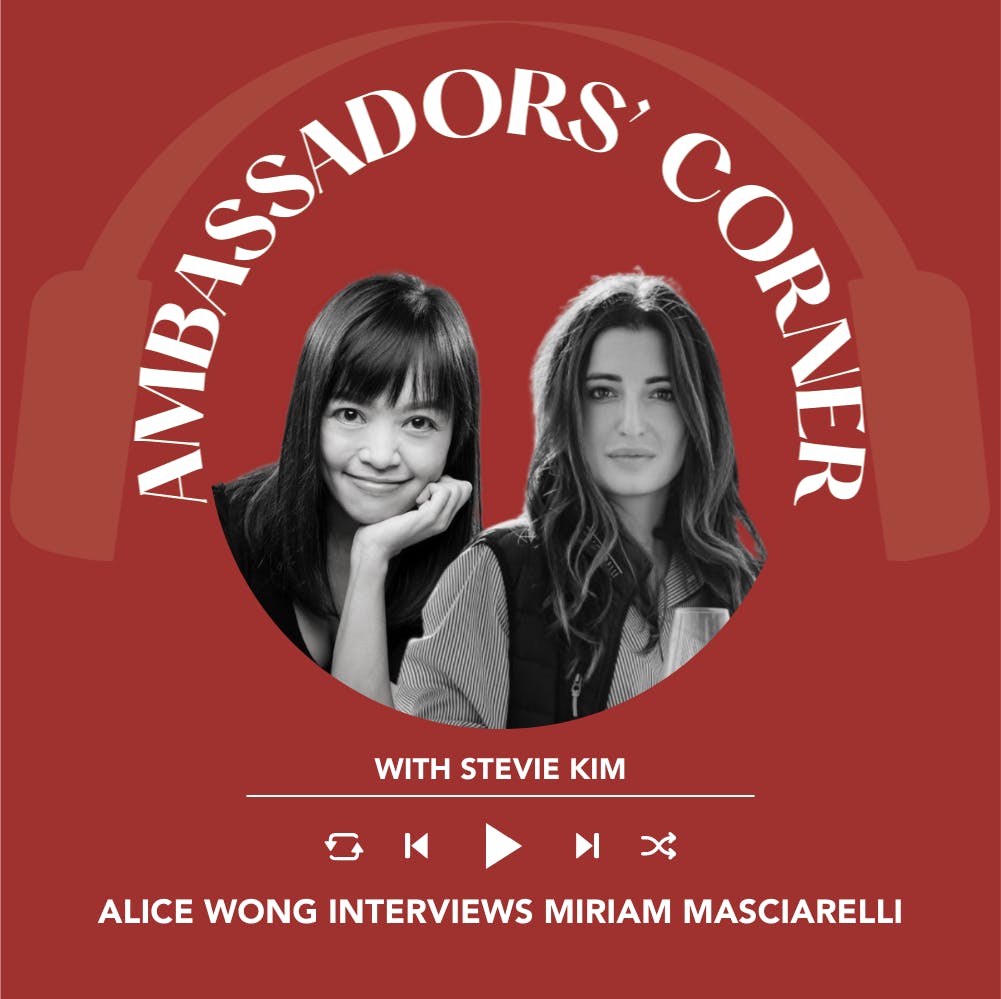
Ep. 1801 Alice Wong Interviews Miriam Masciarelli | Clubhouse Ambassadors’ Corner
Clubhouse Ambassadors’ Corner
Episode Summary
Content Analysis Key Themes and Main Ideas 1. The unique characteristics and winemaking of Abruzzo white wines (Trebiano, Pecorino, Cococciola) and rosé (Cerasuolo). 2. The historical evolution and current market positioning of Abruzzo wines. 3. The role and increasing visibility of women in the Italian wine industry, exemplified by Miriam and Marina Machiarelli. 4. Machiarelli winery's commitment to sustainability and biodiverse winemaking practices. 5. The importance of wine tourism and hospitality (Castello di Semivicoli) in promoting Italian wine regions. 6. The consumption patterns and preferences of female wine drinkers. Summary This episode of the Italian Wine Podcast features a Clubhouse session where Alice, an Italian Wine Ambassador from Hong Kong, interviews Miriam Machiarelli, Brand Manager of the Machiarelli winery in Abruzzo. Alice introduces Miriam, a third-generation leader of the family business, whose father Gianni Machiarelli was a pioneer in Abruzzo. The discussion delves into technical aspects of Machiarelli's wines, specifically their Trebiano d'Abruzzo (Marina Cvetic line, known for its longevity and single-vineyard origin, aged in French oak) and their Cerasuolo d'Abruzzo (a unique rosé, described as the ""fifth color,"" challenging to produce but highly versatile for pairing). Miriam explains how Abruzzo, though historically significant, is still ""a treasure to discover"" internationally, but is gaining recognition thanks to collective efforts by producers. A significant portion of the conversation focuses on the evolving role of women in the wine industry. Miriam shares her mother Marina's challenging journey taking over the winery after her father's unexpected passing, highlighting the societal perceptions and progress made since then. She notes that female wine consumers tend to be more curious, open-minded, and less prejudiced when exploring new wines. Miriam also discusses the winery's commitment to sustainability, including biodynamic and organic practices, and their unique location amidst national parks with rich biodiversity. She touches upon their hospitality venture, Castello di Semivicoli, as a means to invite visitors to experience Abruzzo. The interview concludes with Miriam revealing future projects, including new vineyards in the Gran Sasso National Park, emphasizing respect for nature and historical preservation. Takeaways - Machiarelli winery produces distinctive Abruzzo wines, including a long-aging Trebiano and a versatile Cerasuolo. - Cerasuolo d'Abruzzo is considered a unique rosé (""fifth color"") with a cherry hue, best served chilled, suitable for year-round consumption. - Abruzzo is a growing wine region, still gaining international recognition, offering diverse terroirs and native grape varieties. - Machiarelli practices extensive sustainability, including organic/biodynamic approaches and biodiversity preservation. - The role of women in the Italian wine industry has significantly advanced, with more professional women in prominent roles. - Miriam's mother, Marina Machiarelli, is a ""superwoman"" who successfully led the winery after her husband's death. - Female wine consumers are generally more curious, open-minded, and less prejudiced when exploring different wines and regions. - Machiarelli offers hospitality at Castello di Semivicoli, integrating wine tourism with cultural and historical experiences. - The winery is expanding with new vineyards in unique high-altitude locations, emphasizing respect for natural and historical landscapes. Notable Quotes - ""The word Cera Zuolo comes from Ceraza, that means cherry, actually. And the color of the this kind of Rosay is cherry. It's totally different from other typical Rosay of thin palette, Rosace. Personally, I used to call the only red you can that you have to serve very chill, very cool, like, ten degrees."
About This Episode
During a Clubhouse event, guests discuss their favorite Italian wines and learnings from the event. The brand manager, Miriam Messiramelli, gives an introduction to her experience with winemaking and her interest in learning about the role of women in the wine industry. Speakers discuss the importance of winning wines in the past decade and the evolution of the role of women in the industry. They also discuss the use of ice cube and the importance of learning about Italian wines and investing in them. The speakers emphasize the importance of women in the wine industry and the challenges of women in the wine industry. They also discuss the importance of winemaker and sustainability in winning wines and emphasize the importance of winemaker in giving wine to people.
Transcript
The Italian wine podcast is the community driven platform for Italian winegeeks around the world. Support the show by donating at italian wine podcast dot com. Donate five or more Euros, and we'll send you a copy of our latest book, my Italian Great Geek journal. Absolutely free. To get your free copy of my Italian GreatGeek journal, click support us at italian wine podcast dot com, or wherever you get your pots. Welcome to this special Italian wine podcast broadcast. This episode is a recording off Clubhouse, the popular drop in audio chat. This clubhouse session was taken from the wine business club and Italian wine club. Listen in as wine lovers and experts alike engage in some great conversation on a range of topics in wine. If you enjoy listening, please consider donating through Italian wine podcast dot com. Any amount helps cover equipment, production, and publication costs. And remember to subscribe and rate our show wherever you tune in. Okay. So thank you so much. I am together with Alice and Miriam, and it's a pleasure to have you both here on Clubhouse Ambassador's Corner. So before we begin our session, I wanted to introduce Alice. She's actually one of my favorite ambassadors ever because so she's always very, very happy whenever I see her on wine to wine and the event. So I'm so happy to have you here, Alice. How are you doing? I'm doing very good here. Hello, like, thanks for having me. Yeah. It's, almost lunar new year here in in Asia. So we're getting the holiday mood here, but, good to have this interview before we, close down for the holidays. Of course. Thanks. Thanks for being, awake. I mean, I'm sure that it's late back there in Hong Kong. So first, Alice is a physical therapist by the day and a wine educator by night. Her love for Italian wine started in the early two thousands when she lived in New York. The passion continued to grow when she relocated to Hong Kong and she was proud to be one of the first batch of graduates from the enhanced edition of the Vine Italy Italian wine investor program in twenty eighteen. Ever since then, Alice has been working closely with the Italian consulate and also the Italian trade agency in Hong Kong to promote Italian wines. She has also represented several wine consortia in Italy such as the Alto Adige wine consortium and the consortium for the protection of ugly wines on professional training and consumer education. To honor her contribution in promoting Italian wines, Alice was the winner of twenty twenty Hong Kong Living Influencer award. But congratulations on that one. So for today, you have selected Miriam as your favorite producer. So why did you select her as your favorite producer? I met, Miriam long time ago in twenty sixteen in Hong Kong And, when her importer in Hong Kong here, Watson's wine arranged a dinner for her winery. And back then, in twenty sixteen, I wasn't, an Italian wine ambassador yet. I was just a wine lover. I studied W set diploma. And then, Abuso was a fairly new region to me. So I was very excited about the region, the wines, and the winery, and I was definitely impressed, at that night. And, ever since then, I I saw Miriam over the years, different events, whether it's with Hong Kong or whether it's infinitely and wine to wine if we've been in touch. And, it's just something that I think we have a very special relationship, and especially like the Treviano, the Russo. And, I just wanted more people to know about their wines in Asia. Tell me, since we're all very geeky here in this room, as we have our Italian wine ambassadors. So, oh, hi, Alan. Hi, Ellen, Kevin, Elena, Cynthia, and Andrea. So thanks thanks a lot for being here. So I wanted to, ask what are the learning objectives that we should be expecting from this interview? You're correct. I do have several geeky questions to ask Miriam, about winemaking. So one of the first questions I have would be to talk about the special white wines and Rosay from a brussel. I hope she can answer some of these questions specific to the wines they produce at their winery. And also in general, like I said before, outside of Italy, especially in Asia, not a lot of people understand wines from a Brazil. So I'd like to learn about her view, in terms of the position of the wines of her region compared to the rest of Italy to the outside world. Thirdly, I'd like to also know as women, how she feels about the role of women in the wine industry now compared to ten, fifteen years ago. I think we have made a lot of progress. And I think she has been, taking over that role for for a good number of years now. So it's good to, listen to, Miriam and tell have her tell us, how things have evolved in the last decade. And finally, I know her winery, Masie Raley, has a various strong emphasis on sustainability. So I'd just like to get some information from her on that. Okay. Yes. I I actually like how you grouped, categorized everything together. And so I am looking forward for a very detailed and Taro, interview. So, I leave the floor to you. I'm going to meet myself. And, yeah, that's it. Alright. Thank you, Leika. So I will start with, giving a short introduction of Miriam Messiramelli. Miriam is the brand manager of the Machirelli winery. She's a third generation of the of the family of the winery history. Her father was the late Gianni Machirelli, and her mother is a Marina Satish, As a child, she traveled frequently with her parents, her father and the grandfather, to, conduct business activities all over Europe. She learned a lot about logistics and connections. Every step of winemaking, she was quite involved in since she was a child. I'm sure a lot of investors in this room know about the story of her family. When Miriam was eighteen years old, unfortunately, her father, Jayani passed away, it was unexpected. And, she Miriam and her mother at that time stepped up to really help a lot with the family's business. At that time, Miriam first was studying in the university in Rome. After her graduation in Rome, she went to New York and work in marketing and also for a wine imported company handling more the side of the industry specializing in PR communication in the wine and beverage business. And after a few years, she eventually moved back to, Italy and, help with the family's business, with the wine production. Recently, she has made a significant contribution in defining the role of Montepa Chiana, the Russo, with the, Vila Gamma resurface, that was since two thousand twelve Vintage. And, and today, Miriam works full time for the family business as a brand manager. And I'm focusing on the promotion, sponsorship, and the, special events around the world. Miriam, again, thanks for accepting my invitation to be interviewed today. So I have a few questions, like I said before, to start with, let's start with some geeky questions about wire making. I know that in your portfolio, the Machirelli production, there are several product lines including the, Gianni Macharelli, Marina Fatic and the Villa Gamma. And the first white one I've tried from your production was actually the Trebiano from the, marina Svetish line. And I really, really liked it. On the other hand, the, Vila Gama, line is not so easy to find in the market. And I noticed that in that line, the Vila Gama, Abruso Bianco is not actually, hundred percent made from, Treviana Debrussell. It was made as a blend, amongst, several white grape varieties. Do you know what's more about that wine and what what was the dis decision behind to make that wine as a blend instead of a hundred percent variety wine? Hi, everyone. Hi, Alice. Thank you for the invitation, and thank you especially for select me for your favorite, one. You're in Abruzzo. I'm very kind. Yes. So about Villa Jema Bianco, It's a blend of three native grapes from a brusso. Mostly it's Trebiano. Second is pecorino is another native grape from Brus, and then a little percentage of cocoa chola. The one of the most historical wine that we have, one of the first wine that my father produced. It's not easy to find because it's a more local market. It's very, we sell mostly in Italy. Actually, it's the the the the wine that we play more because, we did this kind of, blend every year, change the percentage. And, we try to balance the wine with the for example, with the Trebiano, we want to give the balance of the wine with the the pecorino for example, the structure and Coca Cola, a little bit of freshness on the wine. So I think it's an expression of of brutes of wine with these full habanative grapes. I'll talk to any grapes, vines of a brusso. Trebiano, still, need a little bit of, nose better now because Montecannon, internationally is more known, but Treviano still, it's a little bit high. I think it's one of the best, white grapes that we have in Italy actually. First of all, because if the longevity of the wine is incredible, even at the the structure in a rooftop is planted, more than seventy five percent of multiple chan in general. So rebiano should be knows more in the future. We will see, of course, even the market now is moving more into the white wine for, many reason. So we see what happened. Very interesting. So your, Treviano Brousseau from Marina's Fatic Schlein is made in, French Oak. How about this wine? So Treviano, marina Zweta, which is a reserve a wine. It's a single vineyard. It's a crew. The vineyard is, close to the winery. The winery is, in province of Katy, and the feet of the Maiella, mountain close to an, national park is, the top of the hill. So we had the vineyard. It's about the forty years old. And this is three hundred fifty meters above the level of the sea. So a little bit high. The curious thinks about this vineyard. The vineyard is in the mountain, in Manila mountain that we have in Abruzzo. And there is a reader through the vineyards. That is full of crap. So the crab with the the river of the the mountain. So it's a beautiful vineyard with a beautiful terrace. The biodiversity, I'm mostly, I think it's all our vineyards that we have the biodiversity around the vineyards that we are full of, everything like the different you cannot see just vineyards. There are type of culture, our three olive trees. We produce olive oil too because we have, for the Venus School of Holly Cre. So it's a very beautiful vineyard and this is a one year new French break. It's a very small production. Can you tell us about how small we're talking about since I can never find it? Because it depends of always depends of the vintage. Never the same, number of bottles, but it's around fifteen, thousand, fifteen, eighteen thousand bottles. Okay. And in terms of aging potential for these two wines, I know it's, a very rough generalization, but, in terms of the time to reach its peak, how long do you think that will take? So for, marina Sverte, I think, it's a very like, Martha wine. So I opened the other day three liters of a ninety seven, and this was incredible. The last seven. Wow. Yes. Very long attention. So I think the oldest vintage that I try is ninety four? Ninety four. Yes. And the deposit was incredible too. Lovely. I wish I could, get to try some when I come to Italy in April. Yes. But, always it during the Vin Italy, we try to bring some, really old vintage bottle of Trebiano marina or Villa de Marasso. So if you are, yeah, immediately, pass by. Will be. Definitely will. And whoever is listening in in this room now, remember, I've been doing it till April, stop by and taste in ninety ninety seven or open to each. I can't promise, I guess we can't promise which vintage, but very interesting. Thank you. Thank you for the offer. Now to the other, iconic wine style, pretty unique to, Brazole is the Chorus model. I think overall, I have this question because, Italian Rosay has always been in my view. Under appreciated. Again, maybe I was up Italy, but Chorusolo, the Russo is such a distinctive product and it has its own, obviously, dedicated denomination, in the DOC system. And, again, you have several Chorus Wallowing in your portfolio as well. Can you tell us a little bit more about, the differences between them? So the difference between them, there are just actually the vineyard. For for example, Villa Gemma Charazuolo comes from a single vineyard always in San Martino, where is the the the winery. I think Charazuolo is the wine of the future because even if the common sense is a rose wine, but I used to call the fifth color. You know, this is white, red, rose, orange, and then there is Charazualo. Because it's, something different than Rosier, The word Cera Zuolo comes from Ceraza, that means cherry, actually. And the color of the the this kind of Rosay is, cherry. It's totally different from other typical Rosay of thin palette, Rosace. Personally, I used to call the only red. You can that you have to serve very chill, very cool, like, ten degrees. Also, it's very difficult while making wine because, you have to pick the right day to pick the grapes during the the the harvest because Charazuolo should be fresh, but also with structure. So you have to find the right day. If you pick, too early, you are going to lose the structure of the the the the wine. And if you are going to, pick up late, you're going to lose the freshness of the Charazuolo, the the the Rosier that okay. Give the freshness of the wine. So it's a, actually, it's a nightmare during the harvest, to pick the right day of the the Charazola wine. But this is, very unique. Also, it's very flexible because you can pair with, actually, with everything. Everything, with all the, meat, hand seafood, especially with tomato, all the the spicy food also. It's not, Arze wine that you, drink just in the summer, but I think in January, in fact, all the year, it's a wine that you can it's, I think, together with the champagne. It's, the one, one of the most flexible wine. Champagne in Charazwala that you can, a drink, all day, lunch, dinner, breakfast, all the every every month, all these old seasons, and, all kind of food. Right? You gave me the permission to drink in breakfast. Thank you. Can I can I tell you a story? Yeah. So Charazuolo was born many, many years ago, from the farmers. Was the wines of the farmers because they used to drink during the morning while they are working. So they cannot drink, of course, multiple channel. It's a little bit too too strong for the morning and the the field, you know, with the hot climate too. So they put this, the Charazwala. It's, fresh and that they they used to, like, for, for example, my grand grandfather used to feel under the the river close to the the the the fields and the working lines. So it was it was perfect for breakfast for the farmers at the time. Great story. Alright. I think I think for Chorus swallow, if if there's a blind tasting game just by looking at the color among Rosays, it stands out. So it's relatively easy to tell by the appearance. And the this the deeper color is is it the nature of Mona Bouciado, made Rosay wine or it's also from the the way the maturation was done? No. Also, the muesaturation, and muesaturation, like, for us, is minimum twelve hours, like, with the cold maturation on four four degrees. So the color is closed because that also. Okay. And I just have to ask this question. It was actually something new to me, this summer when I was in New York, I was served a French Rosay wine. And my friends insist on adding ice cubes to my wine. And I said, no, no, no, no, it can't be done. But later on, I learned that it was actually a really common practice, not just in the US, but also in certain parts of France as well. So, what what is your view on this in term in terms of adding ice cube to your Chiras swallow? I'm not used to put ice cube, but if you want, I I always and also, Vivi Kim told me. Why is it a joy? So, yeah, we would would be we have to I think, civic Kim is right. We have to change even the communication of the wine, you know, because, I think it's, not not to give the wine very serious, old classical, a little bit snobbish. So it's freedom. If you want to put the highs during day of forty degrees in New York, put highs. And who I am to give to those, told you to tell you, no. You're a bad person because you put the highs in the glass. Like, life is joy and also wine is more appreciable when it's, sharing with, with people. So that's the key. Oh, I love the, the open minded view, and, that honestly really reflects your family's philosophy. I always look into Macharelli as the it's a symbol of, more than winemaking. And, certainly, your statement just now, aligns with the vision of the story of your winery. We are more than because we are open minded. We are no prejudice. Very, very open. Like, we are trying to study always, research always, trying, like, personally, I'm trying all the wines with all different fill out, Sophie. They are different wine from what from the the wines that I produce. So that's our philosophy. It's, no, no prejudice. Always to be curious. Yeah. And I think that's important. Not only in terms of winemaking, so that you will keep on trying different methods to show a different to show what you think is best for the wine. But I think with that mindset, it's also very important when you introduce your wines to the export market. You don't have a very strict stereotype for your products. You are open to let people from different parts of the world enjoy your wine and the ways they think works best for the for their world. Italian wine podcast. Brought to you by mama jumbo shrimp. So with that, let me jump on to my second group of questions done with those geeky questions for now. In terms of a brussel wine, the position of your wines in Abursault, the position of Abursault wines in Italy. I know your your brand managers, so you travel around the world to to tell the world about your winery. What is the main thing that you see with all these years of going overseas? The biggest selling point to differentiate wines from a brussels compared to the rest of Italy. So I see a little bit of, change in the last past, ten years. So, Abusso, now it's still a treasure to discover. It's not well, no, like, Tuscany or PMant. But in ten years, we we did a very good effort to explain, like, me personally, I, when my father died, and I, I was studying and working together. And I was, the first trip was in New York. I remember I was now I am, thirty four. So at the time I was eighteen. And, remember the people used to have me, oh, where is Abrutso? It's in Tuscany. So I think now you find the the the the the the people, they ask me where is Abrutso? But I I find also the people they have been to Abrutso. So they know a group. So they know multiple channel, Tarviano. So I think, we all the wine producers did a very good job. We want to increase more, actually, of course, to educate. Thanks to you. And yeah, all the wine indicator that may explain, all the people, even the new region, like, even if it's a old region for wine, but new region to discover. So I think it's so your, your job is very, very important. For every one producer. And but I brought some now is one of these on on the wild, all of the wild lists of the the the work. Deal, we have to prove more because there is a lot of small, small wineries that might be sold in a local market. So it should be very more international, so to discover even because that region is made, not by two producers, three producers, but a big region, a wide region, is made by few wine producers, more than thirty, more than, forty. So it's, with the, with the expression of quality, of course. So I think that we are going in the right way. Yes. And I also remember in terms of the wine markets, I recall, actually, maybe I got it as a gift, but I do get a a very old back vintage of Willow back vintage wine from a friend And I believe he got it from a secondary market. I think he got it from a wine auction. And so that's my other question as well. For people who actually do understand Italian wines, in terms of investments, I mean, obviously, most people know that Gaia and Sazekaya, and in terms of, wines from Brazil, the first name that people will think about is Valentini and then Emilio Pepi, what do you see wines from, Machirelli down the road, in the fine wine markets? We have we cover all the the the kind of money pocket, actually. So we have, fine wine, and we also have wine from every day. For example, with the we have, La bossa di Janis about nine hundred bottles just because it's, to know It's a barrel of, seven hundred liters, with Villa Jamarosso. Johnny was my father was one of the first, producers that go outside of Bruso, and held the story of the Bruso, and is fine all over the one. It was one of the first, and it was a revolutionary man because he changed completely omitted to make, wine, in his family, but especially in Abu too. We need more of this binder, more than more more valentini, more Pebbe, more Macharelli, whereas there is other wineries too. Alright. Before I move on to my next question, actually, there is a question from the audience. We have a question from Anna. Hi, Anna. Her question is back into the first section about, the Waime team part. Do you practice organic winemaking? Part of we are sustainable three hundred sixty degrees, not just the vineyards, but also the winery. But also we do like a mix of biodynamic and the organic For example, before that we plant a vineyard, we plant on, one year of four leaf clover, the sunflowers, and then we plant vineyards. We don't use chemical products. Also, if you also these, but we plant the vineyard where there is no streets, no houses. In the middle of the forest too. So if you see with your eyes, you can see the what what is very natural vineyard. Also, we have, vineyards in National Park So it's so you cannot touch everything. And does that practice also apply to your other products such as the olive oil production as well? Yes. One more question, Otis, side of it, since you're you're you're the brand manager of the company. Castello De Zanafi calling, if I pronounce it correctly, Yes. It's a castle. It's a palace. Right? And you mainly utilize that for hospitality. Is that right? Yes. It is. It's a castle of, sixteenth century, close to the winery. It's a beautiful place. It's a one on the top of the hill surrounded by vineyards with eleven rooms. We'd, actually, answered olive meal of the seventeenth century. Also, we have, a small winery of the castle of, with the barrels of eighteenth century, but it's, it's open to the public also, we opened in two thousand and nine after, restoration of ten years of, conservative restoration. So all the materials are original except for the furniture that is very, very mother and design, family designer, but we organized show a cooking cookie lesson. We organized so many events. Even if you can find many art piece, we organized art residence, every year with the different artists that live there and, leave us installation. Also, we do wine tasting, picnic, convenient, a lot of party, and also it's a, of course, place to, restore, like, your energy because it's very peaceful place. It's, in the middle between the sea and the mountain. So it's, twenty minutes driving to this year, twenty minutes driving to the mountain. So it's a special spot. Very interesting. I asked because, some wineries, like yours, have a very elaborate hospitality center. And I'm really welcome visitors to understand the story, and the products of the winery. And I also know their wineries almost have, like, a closed door policy that you cannot get through the door. They don't wanna deal with consumers. They just focus on making the wine, and that's what they do. So in terms of wine tourism, what is your view in terms of that on promoting your brand and making helping people understand the overall machinery experience? So I think when my father bought this castle, because if you see my winery is in the mountain, in the middle of nowhere, there is more wild animals that people really honest, like, my around my house, that is actually the name is Villa Gemma. So it was the first, winery. So my father used to make, wine in his home at the beginning, and then we came a little bit bigger, and we moved in front of the house in the garden. So until three months ago, I had a wild beer, a wild a wild pig. Okay. So sometimes when you go outside the one where you can see, oh, my house where we are in the same place, or you see wolf. Also, dear egos that you are you are walking and you have egos on your head because we are close to a national park. Then there is, a brusso is one, I think, one of the greenest region that we have in Italy. It's not famous for industries or, it's famous for, agriculture. It's famous for, winemaking for, restaurants. We have a few very good restaurants. Also, three star Michelin, one star two seven. So it's a spamos for the Anogastronomy work. There is more than wild animals that people, and that, it's beautiful because even even beers, like, we have a lot of beers, that walking in in the in your garden sometimes. And it's beautiful because all the children born with the respect of the wild animals. So there is like this cois coexistence of the two worlds. No? Like, I respect you. I don't wanna bother you. Like, the same way. So we we never feel endangered. I have just problem with the, the white pig that, I'm go go they are going to eat all my, very good grapes every year. So that's the only problem that we have. Very interesting. For my information, the last time I went to a a winery in Napa, and I also stay on premise, the wine the winemaker invited me to stay there for a few days. And I was told, every so often they will also have wild boars on the premise. And then they would tell me, oh, tonight we're gonna hunt for the wild boars. So please stay in your room because if we see one, we will shoot it I wanna make sure you're not around when we shouldn't. So and then if if we end up catching one, the next day, we'll have a big feast. So I was just curious, is that what you will also do in your winery? No. Okay. So I'm against the hunting. I'm I'm honest. But, you know, it works like this. So there is a the the the region give some days that you can like the the the region give to you the authorization. We have to have the authorization before for the hunting because we have a lot of wolves because the the the our village, instead of called the the the hunters, they put the wolf to eat the the wife pick. But now the problem is, two wolf, and now we have fifteen wolf. So, it's a repubilation of not the people after a lot of animals. More more wolves than people. Yeah. And we have a lot of travel also. Like, like, in the last October, I found in the vineyard. The one of the my my vineyard, very old vineyard, the, white truffle also. Really? Well, you know, I didn't know they have white troubles there too. Yes. And this way, you can find it actually, especially in the the very old vineyards. I see. I see. Very interesting. No. Babruta is full of travel. Nobody say because they want to keep the secret. A school of truffle. It's a truffle region. I keep thinking umbria was the one people always, talk about when they talk about black truffle. I haven't heard too much about truffles in Brazil, but thanks for sharing. Good to know. I think we're on a pretty good schedule here. So I'm moving along. One of the things I think, it's very important for us to know is in your view, the role of women in wine, and the changes you've seen in the last decade. I think nowadays, women are getting more and more recognition in the wine industry. Your mother took over fifteen years ago, a few years later, you joined as well. So I think both you and your mother Marina have really seen, the changes in the last ten, fifteen years. Could you share with us more what you think the industry have accomplished in the last decade to allow women to be more successful? So I think let me tell you, honestly, I see all these thirty years of, wine world out change. Because when I was child, I was always, with my parents because I had no vacation. So I was the wine. Like, my first in Italy was at ten years old, washing your sunglasses, and cutting the bread and the salami, ham, and then I was, all the the the award, the wine award, I was in all the restaurants. We were all the the the tasting. And I tell you I'm going to tell you that now changed completely because more than ten years ago, all the women was, on the backstage, was difficult to find, a woman, family, or, like a cover of, a woman, white maker, I still like my grandmother, used to say, I have other two siblings. My sister, and then my brother is, fifteen. The result is a teenager. And my grandmother used to say, finally, we have a machete boy. Finally, the the winery keep going. Oh, finally, So it's, the old generation, even my grandmother, even the women think about little death, you know, it was torture. Even when my father passed away, I remember all the people in the wine world said, oh, Marina, with the three children. So it's not going she's going to fail because she's a a woman. She has a three, children. And so it's not she's not a journey. So she's always compared high heat with the people compare, others. So because I think everyone is unique. So, but now I think, everything changed. There is a lot of very good professional women in wine for all all the areas. I think they should get in better and better, but I think, respect to all the ten years ago, we do, very good jobs, very good effort. Definitely. I I I always wonder how your mother did it because I think at that time, in two thousand eight, your your brother was how old was he at that time? Seven months. Seven months. Yes. So so it is very difficult. I mean, forget about taking over a business, just being a mother of three by itself is a full time job. And on top of that, she has to to take over the entire business. Is it a family support that she got that helped her overcome all these obstacles? What was the main thing that really helped her to achieve what she had? She's, Oh, she's a superwoman. No. She's a superwoman. Of course. She's a superwoman, but she's, a creation of Serbian. So the, her family was not in Italy. So there was the family of my father that helped, but I think she she did everything alone. So she is very, very a superwoman. Can I can I can I can't? I remember it was really difficult. Now if I see what what she did in this year, in these fifteen years, that everything actually changed, better and better. And, if I see fifteen years, the other months, actually, sometimes we see each other and said we did a lot of things. Changed a lot of things, and we did a lot of things. I remember at the time it was really, really difficult. Like, a woman, not, so Italians in the wine world. So it was very masculine at the time, but everything is Twenty twelve. Yeah. No. I think thanks to people like women like her and other pioneers that really helped to shape the women, the role of women today. Is your sister also in the wine trade? She's twenty three. So she's still young, but she's, starting a university, but she now a little bit, come with me and, we will see. And and when I come to Eviniti in, April, your brother will be the one slicing breath in the salami for us. Stick at the time it was, because at the time it was, we were, very small. We are family, like, a very, like, we were, like, a five I think, five people in the winery. So it's we're a big family. Let's go to Veroonau. There will be a big family. Now we became a little bit bigger. So, I wasn't joking. I was if I were we withdrew the older sisters. I did it when I was ten, so it's now your turn. No excuse. Alright. Now, I have one more question regarding women. It was has something to do with my own presentation at one to one, last November. Because, when people talk about women in wine, most of the focus went on to the, supply side, either the winemaker, all the brand manager, or all the CEO of a large company, there are very few discussion about female drinkers in general. Or if there is a discussion about female one lovers, usually, for my research, usually talk about the problems of that that brought on by female wine drinkers such as the health issues that bring along with it. For my research, I I found that, women's drinkers is a really overlooked demographic, in the market, especially in Asia. Most female, and and I wanna see if you agree. They have, in general, a more sensitive palate. There are also more they may not be big drinkers in terms of volume, but they are because they are willing to pay more attention to what they're drinking. A lot of times in Asia, they are the ones who actually more willing to spend on expensive wines. So, regarding female drinkers, just from your point of view, do you notice, first of all, their consumption pattern? Any differences, between women and men? And also, in general, what your observations are of, men versus female consumers? So I think what I see, especially during the wine dinner, the wine tasting, the the the female, they have no prejudice about wine. And they are more curious. They want to try different wines, different region, they want you to always, listen all the story behind the bottle, the territory behind the bottle. So, Dave, I think they they have less prejudice. They are more open minded, I think, about the the the those wines. Okay. That's very very important to know. Again, a second part of the question, do you know this that's to apply to different continents that you've been to, whether it is within Europe, in US, or in Asia. Do you find that similar pattern across the board? Yeah. They are in general. They are more open minded. They are not very, oh, I drink just this region. I I just trained this. Oh, they are very, very open minded. They are very curious, and they they are more open minded about trying new wines without any judgment before they try. Alright. Thank you. I think we have one question from the audience, but I just want to ask one more question. Recently, I noticed that, on social media, a good number of, Italian winemakers get to meet with the pope, including your mother marina, So could you tell us more about that meeting? Tell us more about, what was happening in that event and any interesting thing to share? So she was lucky, to be there. She was really, really lucky to be there. But I never I hope that next year I will invite me also to go to the pope. And, no, but I love pope Francis. He said that the wine is a gift of god, but, the winemaker has to give the wine the the the the sense of, it's a point of joy, you know, the the the source of joy of the wine. So it's a, responsibility of winemaker for this gift that, that god, give to us. Also, speak about sustainability also, especially the ethic of the the workers in the wine world. My mother was really excited, like, really happy. She sent me all the pictures. And, and we we we we were so happy for her. Oh, it's very, very, very special. Very exciting. Okay. From the audience, Alan Paul has a question. From your website, I read that, you have also vinyas in the coordinate have among the module that are also DOCG denomination, yet you do not make a DOCG run. Is that because the grapes there is used as part of the final plan, or it is a pure marketing decision? Hi, Helen. So, no. No marketing, no blending. It's a single vineyard of in a contravera. It's the name of the village that we make, like, a one one wine called Escra. It's one hundred percent multiple channel that came from this, single vineyard. I think there's actually a decision of Marina. They don't like something about their limitation of the consortium. So I think she decided to choose the CLGG of the Colina Romane. When in terms of the wine, Do you see a big difference between, the different tower which you, you have regarding on the bridge panel? Because we do not get, to have this one in our market. Yes. So I, I know that it's a little bit far, but I suggest you, I invite you in a brutal to see the stories of a brutal because it's different between province to province, but it's also different kilometers by kilometers. So village to village. So it's a there is a huge kilometers. Also, it's not a flex territory. It's full of hills. We are between the Apilini, the mountains, and the sea. There is a huge biodiversity in terms of also the agriculture, not just, with grapes. It's a multiple channel from the south of part of a group. So are different from the north from province of Panama, even the the multiple channel from Pescara. Well, it it's different. So they change. But I can tell you the change also because I have more than three hundred actors in all the four provinces, actually. So we can produce multiple channel in very different phases because the multiple channel, as you said, like We have in Teramo. It's totally different from the untable channel that we have in Katy, in term of soil, in term of also in the climate, in term of altitude. We are waiting for you, Alanina Brookso. Next time. No. I think I need, one year to cover three hundred headaches. Yeah. Yeah. Hopefully, hopefully, Alan will also come to, in Italy in April. So at least, we'll we'll get to try your back vintage in at your booth until next year when he gets to your winery. Okay. We are waiting for you in Italy. I think we will let's just move on to our final questions before we get cut off. What's next? Do you have any projects coming up? Any interesting things you have lined up for the next three to five years for the winery? A lot of projects a lot of ideas, a lot of things. So now I have, vineyard, in, in another national park, Grand Sasso, in province of Laquilla. The village is called Opena. This fifteen hectares, is on the in the middle of this mountain. It's one of the biggest mountain, Grand Paso that we have in the center of Italy, and, the Penini mountains. The vineyard is about six hundred six hundred fifty meters above the delivery of the sea. And the beautiful of this vineyard, there is a old ancient village of twelfth Century in the middle of the vineyards. We received the authorization of the mini are very culturally because it's, under protection because it's one of the, oldest side that we have in Italy. You restore this church, made by stone from the mountain. So it's made by stone and soil. So it's something very unique. There's church and other houses. Like, of course, it's a village abandoned of the medieval age. As a winemaker, we have to respect not just the nature, but also the beauty of the landscape or the territory. You know? Something about we're speaking about the architecture of the landscape to preserve the beauty of what what would you have, around it. No? No. I think it's back on the sustainability topic. We were talking about earlier, how to respect the environment. I think given the the size of your of your state is even more important. Yes, but we are, like, even pope Francis today, you are responsible for everything. So we we got this word very serious. Good. Very good. Thank you very much for being interviewed on Clubhouse today. I'll see you in April. But hopefully, in the near future, you will visit Hong Kong again. We'll miss you here. I hope because of Conte, one of my favorite city. So Yeah. I think, in October, we'll be there. Oh, lovely. Thank you. Can't wait to, help you back. Turn it over to Aleika. Thank you so much, guys. I am really enjoying listening to the conversation, especially when you talk about your mom, Miriam, so that's really inspiring. Thank you so much guys. Goodbye. Thank you. Listen to the Italian wine podcast wherever you get your podcasts. We're on SoundCloud, Apple Podcasts, Spotify, Email ISM, and more. Don't forget to subscribe and rate the show. If you enjoy listening, please consider donating through Italianline podcast dot com. Any amount helps cover equipment, production, and publication costs. Until next time.
Episode Details
Keywords
Related Episodes

Ep. 2787 Prosecco Superiore by Dr Susan H. Gordon | Book Club with Richard Hough
Episode 2787

Ep. 2784 The Other Side of Valpolicella: Volcanic Soils & Sparkling Wines with Francesca Marcato of Talestri Winery | Wine, Food & Travel with Marc Millon
Episode 2784

Ep. 2780 The Bridge between the Past and the Future of Wine with Serena Costanzo from Palmento Costanzo on Etna | Clubhouse Ambassadors' Corner
Episode 2780

Ep. 2773 Trento DOC: one of Italy’s finest sparkling wines with Alessandra Caroni of Maso Martis | Wine, Food & Travel with Marc Millon
Episode 2773

Ep. 2749 The Many Faces of Etna: Climate, Contrade and the Art of Volcano Winemaking with Federico Graziani | Wine, Food & Travel with Marc Millon
Episode 2749

Ep. 2744 Ep 25: Pantelleria, Salina e il fascino del vino insulare | Pellegrinaggio Enoico con Attilio Scienza
Episode 2744