
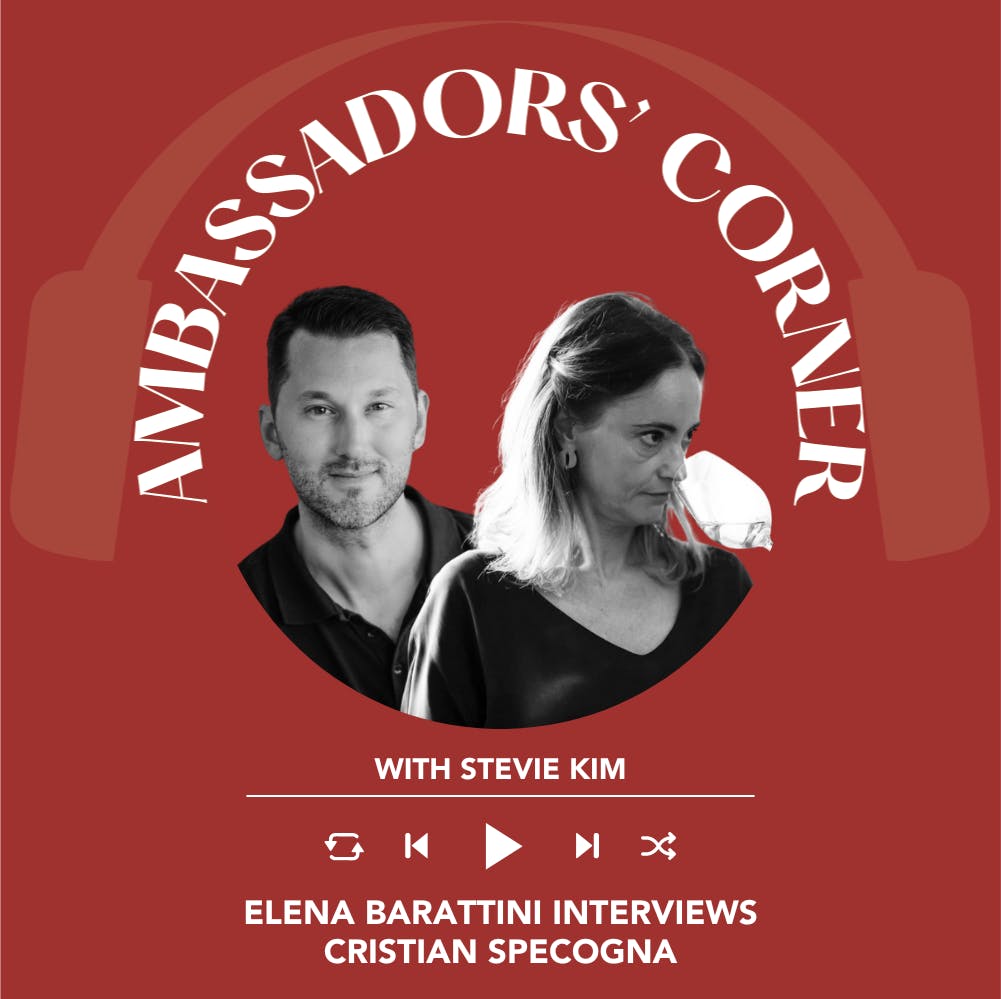
Ep. 1854 Elena Barattini interviews Cristian Specogna | Clubhouse Ambassadors’ Corner
Clubhouse Ambassadors’ Corner
Episode Summary
Content Analysis Key Themes and Main Ideas 1. The legacy and evolution of Christian Speconia's family winery in Friuli Venezia Giulia. 2. The unique terroir of Friuli, specifically the Colli Orientali, including its climate, topography, and “ponca” soil. 3. The philosophy and implementation of organic, biodynamic viticulture, and permaculture at Speconia winery. 4. The profound impact of climate change on viticulture in Friuli and adaptation strategies. 5. The historical significance and unique characteristics of Pinot Grigio Ramato, particularly the Speconia approach. Summary This episode of the Italian Wine Podcast features host Mark Millen, introducing Elena Barretini, an Italian wine ambassador, who then interviews Christian Speconia, a renowned third-generation winemaker from Friuli. Christian shares the fascinating history of his winery, detailing how his grandfather, Leonardo, established the estate in 1963, and how his father, Graziano, further specialized it in wine production. He passionately describes the unique “paradise” that is the Friuli Colli Orientali, emphasizing the critical roles of its mountainous protection, Adriatic influence, unique ventilation, and diverse ""ponca"" soil in shaping their wines. A significant portion of the discussion focuses on Speconia's commitment to organic and biodynamic viticulture, highlighting their efforts to restore ecosystem balance, plant diverse trees, and produce honey to foster biodiversity. Christian elaborates on the meticulous data collection and ""sartorial"" approach to vineyard management, adapting to the challenges of climate change, such as rising temperatures and extreme weather events. He shares how these changes necessitate new approaches, including utilizing north-facing slopes and selecting specific rootstocks. The interview also delves into Speconia's unique nursery project, preserving rare and endangered local biotypes. Finally, Christian discusses his winery’s range, particularly focusing on the iconic Pinot Grigio Ramato. He explains why this traditional, skin-contact method, though sometimes misunderstood, perfectly expresses the identity of the grape and the land, offering incredible complexity and aging potential. He recounts his family's unwavering belief in this style even when it was unfashionable, detailing its red vinification process and emphasizing the critical role of perfect grape ripeness for successful maceration. He concludes by expressing his dream to continue promoting the quality and identity of Friuli wines globally. Takeaways * Christian Speconia represents the third generation of winemakers at his family's estate in Friuli. * The Friuli Colli Orientali boasts a unique pedoclimatic environment, characterized by mountainous protection, sea influence, bore wind, and mineral-rich ""ponca"" soil. * Speconia winery practices holistic organic and biodynamic viticulture, focusing on ecosystem balance, biodiversity, and soil health. * Climate change has significantly altered grape growing in Friuli, leading to increased average temperatures and extreme weather, necessitating adaptive vineyard management. * The Speconia winery has a unique nursery preserving endangered local grape biotypes through massal selection. * Pinot Grigio Ramato, made with skin contact, is a traditional Friuli wine with historical roots and significant aging potential, often defying modern expectations of white wine. * The family commitment to Pinot Grigio Ramato persevered through periods when skin-contact wines were not commercially favored. Notable Quotes * ""My dream is to let express the identity and the elegance of the fuel and wines. And to search for a balance in our agriculture practices that can improve the health and the quality of the land that, surround our vineyards."
About This Episode
During a clubhouse session, speakers discuss their love for Italian wine and their desire to share their vision with the audience. They also talk about their past experiences with wine winery and their desire to create a balance in agriculture practices to improve the health and quality of their wine. They emphasize the importance of ventilation, organic farming, and diversity in the wine industry to achieve a better experience. They also discuss their philosophy on organic farming, sustainability, and creating a balance in agriculture practices to improve the health and quality of their wine. They also talk about their plans to preserve their land and the importance of diversity in wines and their desire to create a balance in agriculture practices to enhance their identity and winery.
Transcript
The Italian wine podcast is the community driven platform for Italian winegeeks around the world. Support the show by donating at italian wine podcast dot com. Donate five or more Euros, and we'll send you a copy of our latest book, my Italian Great Geek journal. Absolutely free. To get your free copy of my Italian GreatGeek journal, click support us at italian wine podcast dot com, or wherever you get your pots. Welcome to this special Italian wine podcast broadcast. This episode is a recording off Clubhouse, the popular drop in audio chat. This clubhouse session was taken from the wine business club and it Italian wine club. Listen in as wine lovers and experts alike engage in some great conversation on a range of topics in wine. If you enjoy listening, please consider donating through Italian wine podcast dot com. Any amount helps cover equipment, production, and publication costs. And remember to subscribe and rate our show wherever you tune in. Hi, everyone. Welcome to another episode of Clubhouse Ambassador's Corner. Today, we have Elena Barretini, and it's her first time to do Clubhouse. So welcome, Elena. How are you doing? Hello. Hi. I'm very well. Yourself? Yeah. I'm good. I'm good. But where are you right now? I'm in London. Okay. So before I turn over the floor to you, I would like to introduce you first to our audience. So, yes, welcome, everyone. We have Georgia. We also have you, hi, you, hi, Marina, Violetta, Elena Roberto. How are you, Elena and Andrea? So thank you so much for coming. Remember that this clubhouse is, being recorded, and we will put this up probably in the next two weeks. So Elena here, she is our Italian wine ambassador, and she actually became one of the best students and awarded by, Franco Zeliani Award. Tell us more about this via journey. Actually, we just finished our via New York. Tell us about how was it for you, and especially your experience because now I'm reading your bio and you started enjoying being a wine educator throughout your career path. So tell me more about that. Well, I kind of work in in different, fields of the wine industry, since I've moved to London in twenty eleven. But then, really, as I was studying my WCT diploma, I study also the, educator program, and I really enjoy, so I I wanted to build a career in the one education. And during lockdown, I actually applied for the EMW, but unfortunately I didn't get in. And then I kind of reset my mind on, what to do moving forward. And, I really wanted to start specializing in Italian wine, And so when I got to, learn about the the via program, I was really, really excited. And, I might say is is one of the best things that I've done in my life. I really recommend it to, you know, fellows, colleagues, particularly if someone want to, you know, really deep dive into Italian wine. And, yeah, I I really look forward to maybe one day apply for the expert. Yeah. That would be great. I'm rooting for you for sure. So for this first club house you've ever done, why did you select Christian Piconia as your favorite producer? Well, first of all, Christian is a wonderful person. And that is really important to highlight. But there are many reasons. Well, first is is a really incredible talented younger one maker just to highlight some of these, recent achievements It's been listed amongst the fifty best young winemakers in the world by the American Food and Drink Magazine. It's been recognized as one of the forty and the forty one industry leaders by fortune, awarded the title of the best Italian winemaker of twenty twenty three by the Italian Association of Innovway's election, but also the winery is future amongst the fifty best wineries in Italy on the magazine food and wine and also recognized as one of the best, one of the hundred Italian excellences, by Forbes in twenty twenty three. So a lot. But at what struck me the most about Christian is is so passionate about his land and his wines, also very sensitive to contemporary issues such as climate change, sustainability, So I thought it would have been very, very interesting to to share all these, his vision, with the audience, but also I really love for you live, and it said Julia wise, but probably I'm not the only one No. I think Amelia Marina is in love with it too. Yes. Okay. Okay. So tell us when did you first try the wines of Christian? And how did you discover the wines of Asandia Agricola Esponya? It was long time ago. I was already in London. It was twenty twelve, and I used to work for Fort and Amazing in their, wine shop. And, Forton Amazon used to stock her, his wines. I think they still do. The very first wine that I tried was the pinot grillo Ramarto, and for me, it was a revelation, really. Probably Kristin will tell us about the wine later on. And then, a couple of years ago, I went to frijuli, and I visit a Kristin' was winery. I met him. And, yeah, it was just like a a crescendo of enthusiasm for his lines. That's so beautiful since, you know, our listeners are ambassadors and they're they get very geeky on this part. So tell us the learning objectives that we should expect from this interview. Well, first of all, I would really like to, you know, share the knowledge and, know more about the the freely caller entirely because pecona is in the in the beating. Heard of of the ERC, but also I really like to know more about Christian vision for the future, particularly linked with this, the sustainable Viticulture's organic approach and all these very important, subject that, I'm sure, are very, very interesting for, for all of us. Okay. So I am going to mute myself, and later on, I will be back if there are any questions from the audience. Okay? Thank you. Hello, Christian. How are you? Hello, Helena. Ciao. Ciao. So nice to hear from you. Thank you so much for, you know, accepting this invitation and, you know, sparing sometimes with us because I know it's you you're very busy, you're always so kind. So thank you so much. Now thanks to you, and most of all, thanks for the wonderful introduction. I hope to be at the level of the expectation now. Of course, you will. Of course, you well, first of all, just to introduce a bit, Christian. So Christian is represented the third generation of winemakers of the Sequonia family. He was born probably not very far from this state, in, Rosatsu, and, is running the the the entire business now with this brother little brother. Right? No. It's bigger than me. Bigger brother. Oh, yes. Yes. Yes. Okay. Six years older. And so It got so very young. Yeah. Yeah. So the state undervines is twenty five hectares or farm organically. As we said, is it is in the middle of the Caliorentale in friuli. But I think it would be much more interesting if our audience could hear from your own voice, the whole story. So how your grandfather arrived to, these plays and, you know, everything happened since the sixties and until you you took over, with the business. So go ahead. I go. Well, like you said very well, everything started with, my grandfather, leonardo, Speconia, that, in the nineteen sixty three, after some years, in Switzerland as an immigrant, because, you know, Helena, after the second world war, our region, Frulio, Vanessa, suffered a lot, you know, the poverty and, wasn't an easy situation. Also, because we were, close to the border line with yugoslavia, and thing like this. And so many, many people went abroad It's Switzerland in Belgium, in Argentina, and Australia. And my father, a grandfather, did it the same. He went for five years in Switzerland. To try to to to to find some money for, for the family. And, after five years, he comes back in the region in Frulli Vanessa, and for the first time, he passed through the heels of Roca Bernardo in Colonelo, and he totally felt in love with the beauty and the history of, this disorder. And so he decided to invest his savings by buying a small plot of land in this area in the heart of the truly vineyard. And, everything started. You know, initially, the the company was focused on a dairy a little bit of serial cultivation and wine production, most of all for, self consumption, consumption, and, subsistence for the family. But here after here, thanks to the commitment of my father, Graciano, the company began to improve the techniques of buying other management and, winemaking, and so specializing the estate mainly on the wine production. We have to say that this was a very typical situation for all the family in, our zone in that period because, you know, in the beginning, a lot of winery born, like, farms to have something to eat. Of course. And, today, we are at the third generation with me and my brother, Mikhail, and we could see about twenty five hectares of vineyard. And we produce more or less, one hundred and twenty thousand bottles each year. Which we sell in forty countries, around the world. And so, you know, Helena, all my life, turn around this, story, this history, You have to know that, when I was a child, I, companion my grandfather and father to the vineyard with their, daily work routine. And so we can say that basically, I started to work in the vineyard when I was really young. So it's not habitually to walk in the media. Absolutely. Absolutely. Absolutely. Calling to walk by in the meeting. That's true. You know, in the beginning, it was for me, like, a game, because, just stay outside, with the family that was all the day involved in the company's work. And, seeing the dispassion in the highs of my father and grandfather that, led them a day after day to try to improve more and more, began to give me the interest to be part of this adventure. And for that, the entry into the daily business was for me very natural. Continues. Italian wine podcast brought to you by mama jumbo shrimp. And, year after year, then, you know, after completing my studies in Viticulture and technology, I decided also to go out of the winery for some, period to understand what there was outside in the world. And so I made some experiences and study trips in, the most important Italian and French wine growing regions. And, you know, Elena, each of this occasion, every major will get into into the Vineyard vineyard of other zones. Every meeting with the other white makers allowed me to hear informations that helped me to discovery more and more the word of wine in its beautiful complexity. And most of all, at the same time, increasing me the passion for this work. And so I just really decide to go on and to try to do my best to give my contribution at, the adventure of my family and the word of wine of the friuli. Well, this is beautiful. It sounds that you couldn't do differently. So that that's very nice because, it it gives you also, an idea of of your passion, which is, really interesting. Infectious, I will say. It's my line. Fell and I saw it, to put inside of the bottle, what is my dream and what is my way of thinking about the wine. It's something that give me such an energy and such a joy because, you know, it feels like a a freedom of expression, and this is something that I love so much to share with the people. Yes. It's it's beautiful. It's beautiful. Of course, your passion is is, really in men's, but also you have the, you know, you have the fortune to really be in a place where, there are, there's a matrix of magic interaction with the climate, topography, soil. So can you tell us a bit more about, you know, where West Waconia is located and how everything really contributes to to the making of these special wines You say a beautiful thing. And, you have to imagine that every time that I started a, tour of the winery of the pinion with the people, I always say this is a paradise for the vine and for the life. To let you understand how much I believe in the potential of this zone and how much is beautiful. To let understand to the people, our winery is located on the hills of Roca Bernardo in Cornodoro Zapo that is really in the heart of the Fuely Wyeland. And, it's close to the border line with Slovakia. So we are in the north eastern part of Italy, just one hour far away from Venice. And, to give an idea to the people, this region, has been used for Viticulture since, the Romans times because it's got some ideal, vine growing condition with unique and exceptional climate, and pedoclimatic characteristic for making quality wise. There are three macro characteristics that are very specific of this, area. First of all, the lucky that in less than seventy kilometers, with pests from two thousand meters to the water of the seaside. In fact, our hills are located in the middle between the Karnick and Julian Helps, which protect the vines from, the cold wind of Northern Europe. And at south, the Abriatic seaside that, you know, guarantee, constant influence of, milder hagers. And this is really unique, for the quality of the wines because, thanks to this, for this, proximity between mountains and sea. We have the lucky to enjoy important, temperature excursion between day and night. And this is such a fundamental condition for the aromatic quality of the wines, and that at the same time for the maintenance of the seed it in the grapes, you know. Another important value sure is the ventilation. The famous, bore wind from Northeast, that it's a fresh and dry wind, very strong in the winter period, but, incredibly, fantastic for us during the summer. And the whole team because, you know, for me to create a a drier climate with lower humidity, less humidity, and that at the same time, amplifying the temperature excursion. Okay. And, but most of all, the, the greatest thing of this ventilation is that, thanks to this dryer situation, we have a lower risk of diseases. On the grapes and lower risk of cryptogammic diversities. And so we can really wait for a longer time on the plant, letting the grapes to obtain such a beautiful maturation. And this is one of the key to obtain a great balance in the wine for me. And the third, fundamental macro characteristic of this area, it's sure the soil. Cool. The pomka, the famous pomka of, call you and call yourientalia, you know? You have to imagine that, in ancient times, we are speaking about, fifty to thirty five million years ago, the fuel and plane was submersed under the seaside. And the costs were just situated before the current, Julian, helps. And this was great because thanks to this situation, under this, hold the lagoon during the million of of fears, there was a slow sedimentation process of the minerals coming from the erosion of the halps rocks from the water of the seaside and from the shells of the different, fishes that, lived in those water. And this process create a kind of soil that from a geological point of view, we call flish. What is the flish? The flish is, a kind of soil with different, substrate, of Marl, the fitter limestone clay, very rich in minerals and micro element, and sandstone that are a calcified sand. That permit also a good drainage of the water. And so this this, mix of soil, it's so fantastic for to obtain quality grapes thanks to this, richness and micro element and also for, like I told you, the good capacity of, a nice drainage of the water. So putting all together, we understand why we have the lucky to drink well in our zone. Well, That's that it it it needs a little more than that. I'm afraid. It needs you. Not bad. But, yeah, it's it's really you know, I still have a piece of pankaj in my in my bag and I use it when I teach my students, so I'll freely win a session again. But, it's it's breaking. So I have to come back at the and collect a more pound guy. We will waiting for you. Oh, that would be fantastic. But, yeah, they will that is really great because you really explain well all the interaction of this natural factor. Now as I would say in my educator clothes, let's move to the human factor, you know, how spaconia interact with this and Christian, particularly with this fantastic, environment. So first of all, what what would you say is your philosophy as a wine producer? Very nice question. And, you know, I I think that, my philosophy and my dream is to let express the identity and the elegance of the fuel and wines. And to search for a balance in our agriculture practices that can improve the health and the quality of the land that, surround our vineyards. This is really my goal when I you know, every day start, a new day. And in my mind, this is the idea that I want to transfer in my wines and in my place and in my way of work. Yeah. So So I I guess that this is very much linked with the decision of becoming organic. Right? Because Exactly. Because if you want to if you want the the land to to to speak, you really need to respect the land. Right? You know, Elena. My one of my most important goals is, really to be able not only to keep the land that we cultivate as intact as possible. But to try to help it, to obtain again a great balance, biodiversity, totality, evidence of the environment so that it can best face also the years ahead and the climate change of the last years. That's very, very interesting. Can you tell us about more how how these organic approach and, the sustainability approach is implemented, in in your everyday operation, basically. I know that you don't only have vines. You have Exactly. A lot of other things going on. Can you tell us a little bit about the farm and the, you know, the plants and everything? Absolutely. Absolutely. My dream is really to, recreate an ecosystem at three and sixty degrees. And so this is why in the last years, we restart to plant also other kind of plant, like olive trees, cherry trees, you know, that, first of all, also has got a very important rule for the protection of our hills. Because, you know, the ponca has got a lot of erosion. It's very sensible to the erosion. And so to plant other kind of trees, in our zone with the root system of these trees, help to stabilize the hills lobes of our area, and so to preserve the quality of this, this land. And like you say very well, we also, and started several behaviors for the production of honey, of course, but, most of all, also, because the the bees has got such a fundamental, role, you know, for the balance of the system and for the quality of the biodiversity. Because thanks to them, we have, the lucky to have a better quality of the flower richness around us. And, you know, in my mind, if there is a word that I always search is balance and everything. And to obtain the balance in my vineyard, I need the balance of the ecosystem around my vineyard. And it's the motive that, really, let me understand how much was fundamental to to start in the organic and biodynamic, pharmac and also the permaculture. That is something that, I admire so much. But to arrive, to make a great quality and the great culture with this kind of, practice, you know, It's not so easy. Mhmm. And in fact, in the last year, I've been reading so much, you know, to to try to learn every day something new. I have visited so many wine growers that are for front of these practices. To be able to understand everything better and better and that at the same time to, make a great work. I started, study of the components, that's, of the ecosystem that surrounded our plan. By analyzing, you know, the characteristic of the climate, of the soil, the fauna. Because nowadays, the more we want to work naturally, the more we need to be able to understand the details and, nuances that surround us because we are facing a completely different climate than in the past. And to get to this, you know, Elena, we have started the study of, all the possible information that we have around us. And so, you know, temperatures, light, hours, rainfall, the agronomical characteristic of our plants, So to give you an idea every year for every vineyard, we, count the number of bunches per plant and the average weight of the bunches, the weight of the berries, all that analytics, characteristic, because this is the only way to create an identity card for my vineyard of my plants, and so after to understand how to work for every vineyard, what to do in every vineyard and in what moment. You know, if we have to say time or something in the past, usually, all the words in, all the surface were always the same. The treatment, the nutrition for the soil and things like this. Nowadays, instead, we are really making work like, how to say, sartorial work on every single square meter. To understand really how to help the plants and, our land to arrive to a balance that permit, to work in organic and biodynamic obtaining, also great result in the quality of, the fluid. And second thing, you know, Elena, we are all the day inside of our vineyard. Yeah. And so in the past, when, we used, chemical treatment, things like this. We started to show to see that, the soil changes, the color of the soil changes, the the life inside of the vineyard was always lower. And so we understand that it's not just a question of making wine, but it's a question to try to preserve my land and the life of this plan for the future. And, this is something that you have also, you know, to really believe in what you are doing, and not only because now it's fashion able, of course, speaking about sustainability of organic, because, you know, it's a moment of the history where it's nice speak about this. It's something that we believe, first of all, for our family, for our zone, and for the dream to let's do our child, something better than today. Absolutely. Absolutely. But also, I think, is is the, you know, the direct benefit of what you're doing and what, you know, many growers are doing with this is literally, as you said at the beginning, the the results in the glass of wine because that that glass of wine really speaks about the land rather than Exactly. And you know what, Elena? Also, we are looking to an incredible capacity of the plant to be more able to, face the difficulties of the, you know, last vintages that sometimes are very extreme in the condition of the temperatures of the rainfall and to have a soil and a plant with, this balance with this richness of, the biodiversity. Absolutely, it's a key of quality that is sure, and we fill this in the grape in the glass that we will that we drink after, and in the capacity of the wine to have a great evolution in the time. That's very good. Yeah. Very good. So talking about climate change, we were having a a little conversation earlier about the the average temperature above a certain, range in the last, what, sixty years. That increased dramatically. And you were saying to me about, the the fact that between the sixteen now, the the the the average the the the number of the days that the temperature above thirty or forty. I don't remember the degree. Thirty. Yes. Thirty is like, five times more, Helena. To give an idea to the people, in our zone, in the sixties, like you say, very well, the number of days that go above thirty degrees Celsius in a year were no more than ten, twelve. Nowadays, we are speaking about at least fifty, fifty five. But in some vintages, like, for example, twenty twenty two, we arrive to sixty eight. So if you work during all over the summer, the temperature is always above thirty degrees. Just when it, rain, you know, it go down. And so I have what happened at, due to this thing? Of course, we have to rethink to to some, the reality of our way to make wine to critique the plant. For an example, you know, in the past, the north facing slopes were used only for serial cultivation and, orchard and things like this, hip, apple cultivation, you know, cherry. Nowadays, instead, those zone are among the most desire in the south after areas, to maintain a good acidity in the grapes and to have a great, aromatic freshness. And this is an example, but, another one could be, you know, another way to manage the soil works and the pruning And at the same time, make new choice on the rootstocks and biotypes of plant. So it's a phase of the history where, we, our work, need absolutely from us agree to capacity to understand these details, this changing, and, of course, to react, helping the plant to, to go on in a better way. You know, in the past, the problem in our zone was to reach a full ripening of the grapes. Today, instead, we must be careful not to go over right, because to have too much alcohol and lower acidity. And so for that, I told you before, how much is important for, me to understand every single detail of every single square matter of my yield to prevent problem and to go in the best direction possible. Wow. That's, that's very interesting. So the the this not facing, a slope's, thing is is, I mean, in fuel, as a region, there are actually an increasing appeal and price of this lesser of, you know, these were lesser slopes, twenty seven years ago. And probably nobody wanted to buy them to not to buy a vine a vineyard, but, Did did you notice already an increasing of prices and, more demands of the of these lesser, north facing slopes in the in the Absolutely. Absolutely, Elena. And, also, for example, higher zones that in the past were too much cold, you know, for the I got it too. Exactly. Exactly. And so, absolutely, the zones that were very, very good in the past, and nowadays are not so good for every kind of variety Yeah. Or to say well, in the past, you know, the south faces on the higer zone of the hiller were used for the white wines. Nowadays, of course, if we do a new vineyard in the zone, sure, we will have a, plant red varietals and the white wines in other zone. And so there is a change in this way of, decisions. Then, of course, you know, I don't know. We can't, move our heels in a in other zones. So, and so for that, our kind of decision that can help. Like I told you before, some kind of biotypes inside of the same variety of grapes, that has got a little bit, slower maturation, change the root stock in proportion with the past. And so these things help, however, to find a good balance. Freeually, I have to say, luckily until today suffer a little bit less than other zone is, change of the climate. But, of course, it's sure that, from the two thousand and three, Until today, the direction is, in a hot test season, more extremely event on the rain, because just to to make an example, in twenty twenty two, We have the hottest, being in touch of the last century in a free or even at Georgia. Change practice from, March, April until September. We had Every month should increase more of medium temperature than in the past. Mhmm. Instead, at the the opposite, the twenty twenty three was very, very cold and rainy in the beginning of the season. In April and May. And in fact, this was a difficulty for, you know, try to maintain the sanity of the grapes, of the plant. But after close, very, very hot in September and October. So the direction is to go to warmer and out test the situation, but with extreme situation, depending from the season. Yes. And the only way to contrast this is really to help the soil, most of all, to find a good balance because this, you know, Elena, in the past, we only look almost to the plants. But all the winemaker look to the plans to what we can see up there. Nowadays, probably, the most important focus is to make on the soil the quality of the microbiological life of soy, the quality of the biodiversity of the soil because we see that, it helps a lot to prevent problem from, this extremization of, situation. Yeah. That's right. Definitely. You you you talk about, biotypes and this, kind of trigger another question. I I read on your website that you have a nursery where you grow different clones that facing, extinction? Yes, sir. Exactly. Very interesting. Can you tell us a bit more how about this project end? If if you had already some results that you've actually could use to implement in your winery. Absolutely. We have this as more nursery that to give you an idea, it's a specific being yet dedicated to this where we grow clones and bio type of variety that are facing the danger of extinction using boots. I think the translation is with boots Yeah. That's correct. Collected from the oldest vineyard of our region. Oh, wow. And, this system, you know, allow us to study and to continue growing varieties, which would, became a distant memory. Because, you know, in the recent years, most of the works of the nurseries all over the world was focused only on certain type of varieties and bio type. Instead, in our opinion, A vineyard needs a great richness of diversity within the same type of grade because, this hello to get more balance in the different vintages and at the same time can, enhance the identity of a place and the winery. Just to give you an idea, inside the some varieties, like, for example, speaking about typical grape of our zone, red post called, Frulano, There are more than ten, twelve bio types that, you know, grew in different zone of the region with a different characteristic of the microclimate. And so in the centuries, let's show small, but important difference, in the characteristic of the leaves, in the characteristic of the bunch. And, you know, I think that to have more diversity in the vineyard, help to have a great identity on the wild. So you you do your muscle selection from the panel? Yes. In Q word, it's like a muscle selection, we can say that, in this vineyard, for us, it's more something to study. Yep. But, we we have, usually, all the new plans that we create, we produced with muscle selection from our, oldest vineyard. And, that's for us. It's fundamental, Helena. First of all, because, you know, we are speaking about materials that has got the lucky to update themselves in, a lot of, a lot of years, almost century sometimes. And so we see that when we plant a small, vine obtain it, with this way of production. There is such a better reaction from the beginning. And, and most of all, you know, in the past, the farmers hasn't got so many technologies and, help to to, up juice some mistake in the work of in the vineyard and in the cellar. And so they have really to look to the best kind of, biotite, best kind of grapes. And so sure there, there are some, hold kind of variety that, also has got an incredible history for this motive because they reflect the decisions and the idea of making wine in our zone in the history. Yeah. That's very important. Also, because otherwise, if if he wasn't for this work that you do in this vineyard, the these these, old bio types will be completely lost. Yes. Probably this is gonna be beneficial for not not for your a stake only at some point probably faster than the line. I hope so. So now let let's go in the winery. You know, we we we've been around the hills. Let's go in the winery because what I would like to know from you is, of course, you you have a a range of different wines, all, I think, except one there is a blend with my law. All your wines are based on, native, grape varieties from the, the Colliorentale. So, what, what do you think this is a tough question because it's, like, deciding who who is your favorite child. Right? So first, if you wanna talk about the range a little, and then if you, would like to tell us, what do you think is the one that best represents the call you're entirely n y. This is, not easy, hands work. It's like you said. Also, because, you know, that in our zones, there are so many varieties, and it depend, you know, from, from the history of our hills that in one century change it three different nationalities because until the first world war, we were under Austrian and Hungarian Empire. And then, between the two world wars, you know, there was this borderline between, Italy, and, yugoslavia. And so it's an incredible history in our zone. And, how would you say very well? My production is, principally focused on the varieties like, Frulana, like Rybola Jolla, Malazilla, a force called Picolita. But, for me, one of my wines that, represent very well, Our zone and our tradition is the pinot grigio Ramato. Even if pinot grigio is an international variety, in our zone, it finds, you know, this traditional unification so characteristic that for me, even if we can say that it's massive, it's sure one of the most typical, wine of our heels. Sure. The pinot gris or tomato, I, as well. So Yeah. Well, this is, this will be my next question because, as I mentioned at the very beginning, this is the one that's made me discover, Spekonia, twelve years ago. And, particularly zero is is a legend. I mean, I had the the the the pleasure to try some vintages from the nineties when I was, when I visited you and is is quite it's quite astonishing. How do you do that? Nice question. You're also this. How do you make a fenugreek? Just so special in the age worth it? Sixty years of experience in this traditional unification with the skin contact and most of all, the passion for this wine, Helena. Because, you know, many people still today see to the pinot grigio, like, you know, a variety of, second class. Yes. Quality, not so important. Instead, the for us, pinot grigio, when it's planted in the right areas, and you understand how to best manage it from an agronomical and, analogical point of view. Well, it can give the bird to a incredible wine with such a great complexity and capacity of evolution over the time And this is why my grandfather from the really first big touch always believed in this type of pinot grillo. I mean, Ramato. And, believe me that there were some period where, this kind of wine wasn't sufficient label. Like today, you know, because in the end of eighties, nineties, and beginning of two thousand was the period of the white paper wine. Very clean, very with a lot of filtration, very yellow light. And, instead, our family always believe in this way of unification of the pinot grigio, because, We were really convinced that, contact with the skin could help this variety to better express its identity and the link with the place where it grows. And my our dream is always this to put in a bottle, the, relations relationship between the variety and the land and the zone. And so for us, in the pinot grigio, sure the the skin contact unification is the one that give more this identity. Also, because we have to think that, Pinogrillo, it's a wide. Yes. But, still today maintain several points in common with the grape from, which, it originates the pinot noir because, you know, that's the pinot grisio is a mutation of the pinot noir. Plus, sometimes, we're keeping that, Pinogrillo is the redest of the white or the whitest of the red. Yeah. Because, it can show really, truly fascinating, aromatic complexity, and most of all, authentic, finance in this version. And, it this that make the difference because thanks to the extraction of the tannic component from skin and the seeds during the maceration, you know, the potential of the shelf life in the bottle can became very important. Mhmm. And, if you remember, like you say, we opened it together some, vintages of the nineties that were still so fresh. Oh, there. Absolutely. One week ago, I opened a bottle of my grandfather of the nineteen eighty two. So forty two is a hold of wine. And, and I was still so incredible young. The color was so nice to see because this Ramato tonality was postparticine. Some of the vehicles. Floricant. Floricant. And, and most of all, what was incredible for me was that, you know, in that period, my grandfather, don't think to create a wine for a long evolution. No. Sometimes if they drink the wine directly from the barrel and nothing ruins the bottle. Okay. But just just to clarify, how the the vineification work. So you you pick the grapes, of course, probably, by hand, and you you you crush them and you macerate the juice with the skin, and the fermentation starts with the skin. Right? Exactly, Eleanor. And so it's a red unification. Our family produced two kind of pinot grigio. One is a fresher version where usually usually we use the grapes of the younger vineyard and the one in the lower part of the hill. And, in that wine, usually, we make three, four days of skin contact. Okay. So after the harvest of the grapes, we just crash a little bit. And, we let the entire grape, also with the stem in contact with the the the mast. And, in the fresh one, we let the skin until the beginning of the fermentation. When the fermentation start, you know, with the carbon dioxide, the skin go up to create the Uh-huh. Cap, and, we take out, from, the bath. Instead, in there is serve, you know, Gridio, we make a very long skin contact because, we arrive to two, three months of skin contact until the end of the malolatic fermentation. I see. Also because this, Serva born from the oldest vineyard of Figaridio, of our hill that was planted in the sixties. And so, you know, this kind of plant has got such a great balance that helped to obtain a very, very, very good maturation of the tenino components. And this is fundamental to make, ver, vinification like this. Because if you have some grapes with, not a perfect ripeness, or with just one two two percent of, you know, disease on the grapes that result with the maceration, it's a disaster because, the color, obtained a bad tonality like maroon oxidized. And the test became very, you know, technique, very, bitter, amaro. And so, for that, to arrive to obtain a good result in this kind of unification, the first fundamental thing is to find perfect ripeness, perfect quality of the grapes, and then to be able to understand exactly the perfect moment of harvest and how long to let the skin in contact with the mask. Because there isn't, mathematically formal. You have to be able every season to understand stand the the the vintage, the quality of the grapes and then to make the right decision. You know that, in the period of the night is, when, this kind of wine was not so, well known abroad because, Just a few word. In the past, in the end of the nineteenth century beginning of the twenty, the pinot grigio was always made like this with skin contact, because we have to imagine that one hundred years ago, the climate was completely different from today, much cooler. And so usually the harvest was always very late. Also for this kind of variety in October, at the end of October, And so, you know, the temperatures were very low also in the cellar because there weren't, technology of conditization or things like this. And so what the farmer saw? They saw that, to help to obtain a good, fermentation until the end, a period of contact with the skin, help a lot. Because Also, because, you know, in the skin, there are a lot of nutrients that help the Easter, the microorganism, to make a good quality of fermentation. And this was fundamental also because, at the opposite, if they don't finish the fermentation. Usually, with the spring, the new fermentation could be also with a setting bacterium and things like this, and so with, bad quality after of the ones. The second thing was also that, you know, the problem of the wines of the period was that they haven't got such a great structure. They don't have so much alcohol, and so the wine, go in oxidation very fast. Also from this point of view, was very important the maceration because help to obtain, some tannino component that protect from the oxidation. Yeah. It's toxic. And so to help the wine in the evolution. And the third thing was, that, in that period of the history, the technology in the cellar was really a archive. And so you don't have a press machine like today and things like this. And so the work was made all by hand. It was so, difficult, so strong to make this kind of work. And the people, the farmer, so that with a little bit of skin contact, with the master, the the skin became softer. And so it was easier to press by hand and to obtain a little bit more wine because we don't have to forget that in that periods of the history, the wine, wasn't so much emotional, like today, was more food for the people and to have something to to drink. In the sixties, this kind of tradition was almost a disappear. I mean, the skin contact because like I told you before, you need absolutely perfect grapes with perfect maturation. And in that period of the history, the idea for a lot of, companies was to make more quantitative than quality. And so the result was always, very bad. And for this, they started to producing white. And in that, period, you know, only the big company can go abroad to let discovery the wines. And so the people abroad discovered the pinot grigio only in the white version, not in the Ramato style. And in fact, my grandf my father and grandfather, a lot of time, told to me how the first, during the first, presentation of this wine abroad, a lot of people said, what is this? You put a red inside. It's not been a great job. Here's the oxidate. And so we understand stood how much was important to make culture to let understand to the people what is the pinot grisja. And so for that, we started to make a lot of testing inside of the vineyard showing the color of the grapes to the people and most of all, showing to the people how the pinot grigio can obtain a great identity. Thanks to this. Well, that's that's very interesting. The the the history of this wine as well, because as you rightly said, you know, perhaps it's not the most indigenous, great variety of friuli, but definitely there's a strong link with the land, and they sorry of these of these area. But thank you so much because you I I learned so much from this. I think I have a a last question to ask, and we'll be suddenly we have to wrap it up. I'd like to stay here for hours with you, but, the very last question is, what is your short and long term goals what are your short and long term goals as a grower and winemaker in, two minutes. But, well, I tell you the truth. My dream is to continue on the path that, the path undertaken in the best possible way and, to help make the world more aware of the great quality of our wines, of friuli wines. And so I really want to put all myself to, dedicate my future to, like, discovery to the world. What is free only, what we can do over here, and to let's show that we are, only in the beginning, because for me, free only, you know, thirty, forty years ago was, very, very important zone in Italy. Of course, still today, but in that period, if you go in all the restaurants, you always find the biggest part of the white wines, from friuli. Then there was a period where also due to the climate change, you know, it wasn't so he's in the beginning, to find the the right way for, everyone because, the white wines became a little bit more strong with Tiger Halcol. Today, instead, I think our region is, going into, great period. Thanks to the new generations and thanks to the capacity to, understanding the better way with a lot of study, the potential of our zone. And so here it is my dream to give my contribute in this. Well, your dream is fantastic, but, also, I think that Freeman, Vanessa, is a great, great, ambassador in you, and we believe so. Thank you. Thank you so much. Christine for your time. I'm just waiting for, like, to connect again and if there are question from the audience perhaps. Hello. Hi. Hi. Thanks. Thanks a lot for the conversation. And you're a really good storyteller question. I and listening through your conversation. It's very thorough. So thank you so much for having the time, and also, Elena, for introducing Christian to us. So, before I wrap up, I wanna say that the next clubhouse is going to be next week on Tuesday. So we'll have Joan Harnish, and she will be interviewing Elizabeth Foratori. So that's it. And thanks a lot. Goodbye, everyone. Ciao. Ciao to thank you, Langa. Thank you, Kristian. Bye bye. Listen to the Italian wine podcast wherever you get your podcasts. We're on SoundCloud, Apple Podcasts, Spotify, EmailIFM, and more. Don't forget to subscribe and rate the show. If you enjoy listening, please consider donating through Italian wine podcast dot com. Any amount helps cover equipment, production, and publication costs. Until next time, teaching.
Episode Details
Related Episodes

Ep. 2789 ColleMassari: a long-term vision rooted in Montecucco with Giuseppe Di Gioia | On The Road With Stevie Kim
Episode 2789

Ep. 2788 Ep. 14: Austria and Hungary | Study Smart for your WSET Level 3
Episode 2788

Ep. 2785 From Volunteer to Speaker at TEXSOM with Samantha Cole Johnson | TEXSOM 2026
Episode 2785
Ep. 2766 Inside the U.S. Non-Alcoholic Wine Market: What Wineries Need to Know with Jill Sites | Masterclass US Wine Market
Episode 2766
Ep. 2761 Winemaking and Consulting Across Sicily with Alessandro Serughetti | Wine, Food & Travel with Marc Millon
Episode 2761

Ep. 2759 Part 2 – The VIA Educational Program & Italian Wine | Heart-to-Heart Conversation with Sarah Looper
Episode 2759