
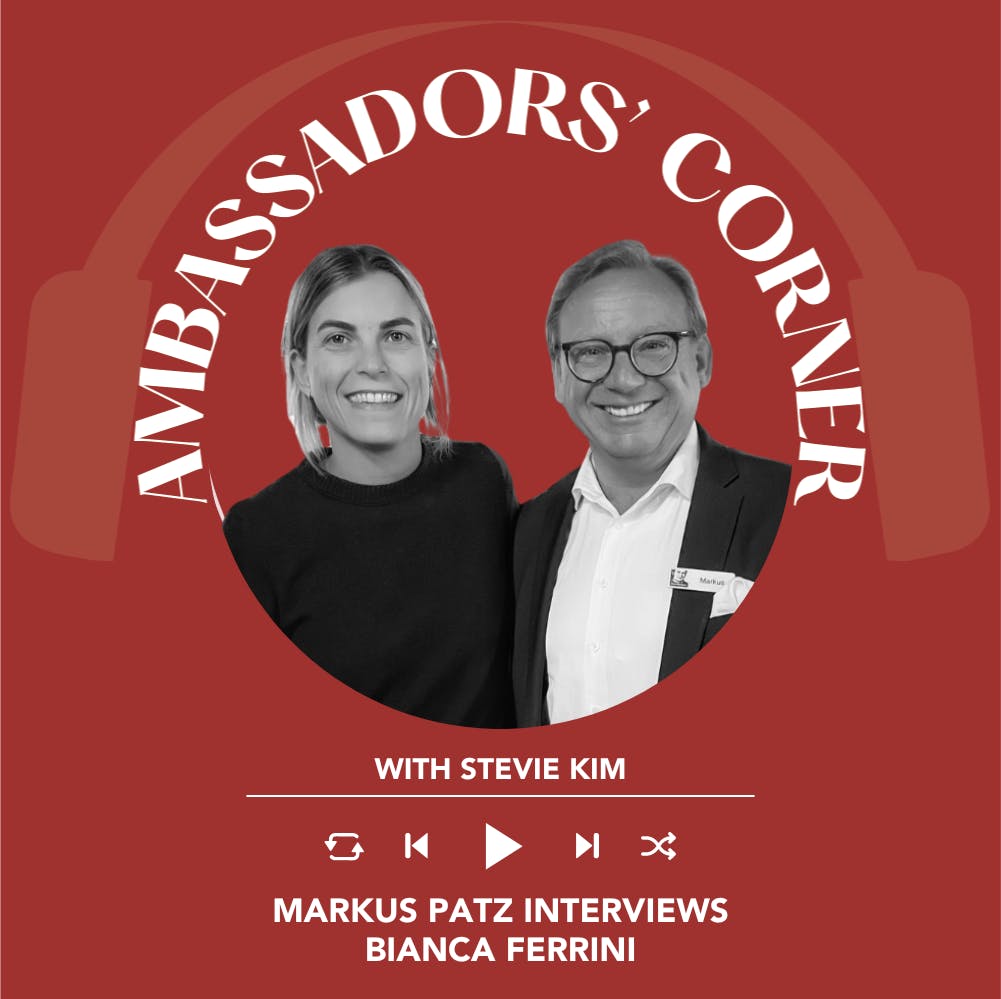
Ep. 2089 Markus Patz interviews Bianca Ferrini | Clubhouse Ambassadors’ Corner
Clubhouse Ambassadors’ Corner
Episode Summary
Content Analysis Key Themes and Main Ideas 1. The unique characteristics and challenges of cultivating Sangiovese in Tuscany, specifically Montalcino. 2. The philosophy and practices of Gioto winery in Montalcino, emphasizing elegance, organic production, and vineyard-first approach. 3. The expansion and challenges of winemaking on Mount Etna, focusing on indigenous grapes like Nerello Mascalese and Carricante, old vines, and volcanic terroir. 4. Bianca Ferrini's personal journey, passion for winemaking, and role as a female leader in the industry, including balancing tradition and innovation. 5. The impact of climate change on viticulture and adaptation strategies employed by winemakers. Summary This Italian Wine Podcast episode features an interview with Bianca Ferrini, a young winemaker at Gioto winery in Montalcino, Tuscany, and for their expanding project on Mount Etna, Sicily. Bianca discusses her family's legacy, particularly her famous father Carlo Ferrini, and their shared dedication to Sangiovese, which she describes as representative of Tuscany yet challenging to manage. She highlights Gioto's commitment to ""elegance, elegance, elegance"" through organic practices, meticulous vineyard work, and innovative aging methods like ""Corchio Pesto"" vessels. The conversation then shifts to their Etna venture, detailing the unique conditions of high-altitude volcanic vineyards, the ancient Nerello Mascalese and Carricante vines, and the challenges of working in such a wild environment. Bianca also touches on the crucial importance of adapting to climate change, emphasizing sustainable practices and biodiversity. Towards the end, she offers invaluable advice for aspiring young winemakers, particularly women, advocating for study, experience, and unwavering passion for the craft. Takeaways - Sangiovese is a core grape for Gioto, deeply representing Tuscany but requiring careful management due to its terroir-specific expressions. - Gioto winery's philosophy is centered on ""elegance,"" achieved through a strong focus on organic vineyard practices and balanced winemaking in the cellar. - The winery utilizes non-traditional aging vessels like ""Corchio Pesto"" (similar to concrete but allowing more micro-oxygenation) alongside traditional oak. - The Ferrini family has expanded their winemaking efforts to Mount Etna, cultivating old, untrellised vines of Nerello Mascalese and Carricante at high altitudes on volcanic soil. - Climate change adaptation, including specific vineyard management techniques, is a significant and ongoing challenge addressed by the winery. - Bianca Ferrini is a strong advocate and role model for women in the wine industry, emphasizing the importance of education, experience, and passion. - Sustainability and biodiversity are key long-term goals for the Ferrini family's winemaking projects. - Gioto wines are gaining international recognition, now being represented in markets like Australia. Notable Quotes - ""Because it's a beautiful grape because they represent Tuscany."" (on Sangiovese) - ""My father everyday say to me, we have free goals, elegance, elegance, elegance."
About This Episode
Speaker 1 and Speaker 2 discuss the Italian wine industry and their passion for learning about it. They talk about their interest in learning about the industry and their first experience with a wine club called Club House Ace. They also discuss their passion for small berries and their belief in protecting their diversity. They talk about their approach to creating wines and their interest in forest management and the importance of balancing activity, extractor, and long finish. They also discuss their plans to visit a vintage wines and their plans to grow their team with younger guys. They express their passion for the Australian wine industry and their desire to increase their team with younger guys.
Transcript
You obviously share his passion for sangiovese. Yeah. What is it actually that attracts you so much to that grape, Ohio? Because it's a beautiful grape because they represent us can hear. You you can be also a challenge because, you have to manage the sangiovese grapes. And also, it's very interesting because change by to a war from, to a war to another. For example, it's very different from county classical to Montecino, to the cost, other type of, so it's a beautiful, but it's a very different, example. So it's interesting. Yep. Who wants to be the next Italian wine ambassador? Join an exclusive Network of four hundred Italian wine ambassadors across forty eight countries. Vin Italy International Academy is coming to Chicago on October nineteen to twenty first. And while Mati Kazakhstan from November sixteenth to eighteenth, Don't miss out. Register now at vinegary dot com. Welcome to this special Italian wine podcast broadcast. This app is episode is a recording off clubhouse, the popular drop in audio chat. This clubhouse session was taken from the wine business club and Italian wine club. Listen in as wine lovers and experts alike engage in some great conversation on a range of topics in wine. If you enjoy listening, please consider donating through Italian wine podcast dot com. Any amount helps cover equipment, production, and publication costs. And remember to subscribe and rate our show wherever you tune in. Hello, everyone. Welcome to another installment of Club House Ambassador Corner. Today, we will have, Marcus all the way from Australia interviewing Bianca from, I guess, you're in US right now, Bianca. Right? Bascale. Hi. You're in Montecino. Okay. We're around the world. Definitely. Okay. This is fun. So, my name is like, Caparas, and I am the producer of Italian wine podcast, and I am so happy and honored to be part of this conversation together with Marcus and Bianca. Marcus, it's an honor to introduce you. And I have had, chance to meet Marcus before in the, Jita Scholastica back in Tarmina. And Yes. That's what. Yes. That's right. Yeah. And we had a great time. It was very fun. I had the opportunity to get to know you as well. And now I'm reading your bio and I see, a I'll just go ahead and read your bio. I might miss out on something. So meet Marcus, he's a mechanical engineer turned wine professional who twenty years ago driven by his deep love for wine and adventure made the bold decision to relocate to Australia originally from Germany, Marcus proudly embraces his multicultural heritage and calls Australia home. And Marcus is an international wine merchant, an international wine ambassador, of course, certified WEST educator, certified semia Italian and French wine scholar, wine judge panelist writer speakers. Wow. There's a lot of under your belt. That's amazing, Marcus. And then even an event host, that's pretty interesting. So what events do you host aside from, I guess, wine tasting supposedly? I'm I'm running virtually weekly wine events, I call them edutainment. So it's, yeah. So these are one or two hour wine classes of different subjects, different wine regions, different wine styles. Designed for wine lovers for consumers that really wanna learn more about wine, but the way I'm doing it is, engaging, making it fun so it's the perfect combination of education and entertainment. Yes. And then that's what, that's actually where you got your credit from the nickname of mister Schoman. Exactly. I suppose you are. I agree. I agree with this. Then, Marcus dedication to the wine industry extends beyond his professional achievements. He volunteers as mentor for the Australian wine industry program where he inspires his ports the next generation of wine professionals with his infectious enthusiasm charm, I would say, an unwavering commitment. Marco's pass is a true ambassador of the world of wine. Okay. So for today, actually, I guess this is your first clubhouse, Marcus. Right? Yes. That's right. Yeah. Okay. What a fabulous one to have Bianca on the shelf? Yeah. Hey. Let me let me just have a Hey. Hey. Hey. Here. Why did you select Yanka Ferini as your favorite producer? The Yanka left, a huge impression on May when Bianca came for I don't know whether it was actually your first time visiting Australia, Bianca, but Yes. Yeah. So you came to Sydney to Australia in September last year, and this was for me the first time to actually learn very much about your portfolio at Gioto. And I could really see that passion in you for the winery and also the passion you virtually inherited from your father. And, that was to me, where there is a passion there. All the secrets, the expertise, a mission, a challenge. There is so much, actually to learn from the virus from your dad and especially from you, that I said my first choice, Bianca Ferini. Thank you so much. Oh, you're welcome. Thank you. How did you discover the wives of Jodu Wainer? I don't know whether you ever heard of Vinicelli. But, it was actually it. Yeah. It was to, I don't know, join me in Italy and, also through a tasting at the international wine academy, and also including that trip to Mount Edna and to Sicily last year, But then, especially, and that's with more depth to it, when Bianca came for her visit, to introduce to us to Theodore Wands here in Sydney in Australia last year. So I'm just actually also curious. When was the first time you tried the wines of Bianca? Was it also during the Vineetale event? Or Exactly. Exactly. Exactly. Exactly. Yeah. It would be obviously get you it. And I still I mean, I have to admit I opened a bottle of Gioto La Quinta tonight. So that's standing here on my my desk right next to me. And Please correct me, Bayanka, but I think you produce maybe only sixteen thousand bottles of that wine. Yes. Like, thirteen thousand of fluffy thya. No. No. Well, it here, that one bottle is currently standing next to me. That's the vintage twenty twenty. It could be in danger. Exactly. So and that's to me the thing. I mean, we're here in Australia. We're eighteen thousand kilometers away from from Italy and, shorter wines haven't been introduce, to Australia, not that long ago, you were more mostly focused obviously on America, speeding on other markets. And but now you're here, and we are loving it. Thank you. Yeah. A very nice opportunity as well to also, to have this clubhouse, also coming from you, Marcus, that, you could actually introduce more to more audience, especially from Australia about the wines of Jodah winery. So Yeah. Absolutely. Our last question is, what are the learning objectives that we should be expecting from this interview? After all, I think it's just to learn how to love and appreciate Italian wines and the whole history behind it. And it's in that case when I'm going and when we'll be Anca and I talking through Georgo Vans. I think it's the whole story of, the Ferini family from the inspiration over the achievements to their aspirations, whatever is coming ahead. That's incredible. I really look forward to your interview. So for now, I'm going to meet myself and turn over the floor to you, Marcus. Thank you very much. For giving me the word. And thank you very much for having me on these podcasts. And thank you very much Bianca for taking your time and being here. Yeah. Now I could switch a biography of you. But I think Bianca, if you don't mind, if you could just tell us a bit more about yourself, like where you're born, are you at a two tuscan where you have lived. I know that you lived for a while in the States in the US. And then interestingly to me, for someone who's so connected to the land, You were a professional water polo player. Yeah. Yes. I'm from from Florence from I truly tuscanga girl. And, I live in the city, but also I travel a lot around the countryside in Tuscany. We are, full of feel and, beautiful nature. And, yes, I played waterfall for twenty years almost in the major series. So I travel a lot. Okay. And, also, this helped me to, build the team. Also, now, that time work in Georgia. So are you, with the other, my girl mates, so it's so important for me to work in a team. Yeah. So, I mean, if I go a little bit back, I mean, your father is there is no denying. He is one of the most famous and possibly one of the Italian legends in winemaking. And, so there was some big winemaking consultant in the nineteen eighties and nineteen nineties, and fulfilled his dream of making own wines and buying his own vineyards around two thousand and two. And that's now in Montagino and I can't even say you're following your dad in his footsteps that would be totally wrong because your dad and you you're actually walking alongside each other. You're working together. What was your first or that what's your first memory of working with your dad? When did it start and how did it evolve? From the beginning for me, it's, an inspiration to to to understand him and, stay with him. So from the beginning of my life, I live in Flores about also going in the countryside, I am going in the vineyard and see what he, he did he already and he also is doing now because, he worked for many important wineries in Italy from the north to the south and but his first lover was sangiovese. So when he found this place in Montecino, he fell in love and decided to start his home project after many hours, working for others, very important, on earth. Finally, he he realized his dream to start his project. They were, and, and make his wine. So we here we are. He found this place in two thousand. Yes. And, he planted his clone of Sanjay, so it's, a very long project because he started nineties. And find these, clones. And, he keep for himself, and in two thousand, he planted in this, free Hector in Montecino. Now we reach seven hectares. Yes. The maximum production. You obviously share his passion for. Yeah. What is it actually that attracts you so much to that grape variety? Because it's It's a beautiful grapes, because they represent Tuscany. You think Tuscany, you feel you feel Sanjay, but it's, can be also a challenger. Because, has, you had to manage, the sangiovese grapes. And also, it's very interesting because the change by Torwar, from Touwar to another, for example, it's very different from anticarcico to Montecino, to the cost or in the other, type of soil. So, it's a beautiful, everybody are beautiful, but it's a very different, example. So it's interesting. Yeah. So, but you chose virtually, the low vigor bio types of such a busy. Yep. Okay. So you're really focusing on the of the tiny berries of those Yes. Herbs that really bring out the aromas and the flavors of the concentration of the one. Yes. So we are focusing on that. And, to reach that, that, yes, you have to work a lot in the vineyard. For us, the main point is the vineyard from the beginning, So, we built the seller only in twenty twenty. At the beginning, we are focused only on the vineyard, and, we are all stood by other airline there. The the vineyard is located in the southern part or possibly south western part of, Montecino. Is that right? But somewhere a bit near close to Santangelo in color? Yes. It's right. The southeast side, is a very good area. It's a street between Santander or the white street between Santander and Colle and Castenor Delabaster where there is, Davacia, the church. And is, between three and four hundred meter. And this side is very good because take, the sun of the morning and not the sun of the afternoon that is dangerous. And also in the first part of the street, we are we have all around the forest. So it's very important for us to forest for the by the by your diversity. Keep us, a good humidity and, protect us from the frost. And there is this change of aroma or with the terrarium that are very interesting. You got how many different, clowns do you do you have? Eight. It's quite a good range. But, the vineyard itself is, relatively small for a winery. Yes. Now we reach, the maximum. We arrive at seven Ekder, only Sanjay, great. And, we start from three Ekder. Where we have a our brunello plots. We have four plots in the story part that's now twenty years. Yep. And then we produce another wine that is called Aquinta. That is the one that you heard me. Yes. Yes. And, it's, also, it's a hundred percent. It's going out after two years. So, it's a younger version of our Bernelo. Yeah. I mean, I've got some a few bottles of your brunello here as well, but it's too early too early to open. Yeah. So really appreciate the quality of the wine. Yeah. Our goal is that against all our wines. And so to reach that that point, you you have to start from the vineyard. The and so the elegance is also in the environment. But, also, we want to work in the clean cella. It's, it's important to reach a balance between the activity, the extractor, and long finish. So we have to be cleaner with the the great balance. Yes. Because the wine has to be drinking. So if you put with, in a on the table with your friend, you have to finish the bottle, because you, like it and you, it's very brick bottle for us. It's important. Yeah. I mean, I can only encourage to all listeners, following us here to also have a look on your website. So, that's pordero dot it. There is a beautiful I think it's only two or four minutes, a short video, but it just shows the beauty of where your vineyard is located and what what you're doing. So I can just suggest to everyone, go on the website, have a look for their beautiful, video. Before I wanna go more into the wines, what does Jaudo actually stands for. I mean, I don't find a b of Bianca. I don't find an f for Ferini. Not even, the CEO of your father Carlos. So what does, Jaudo mean? Yes. My father, I prefer to stay in the corner, and he don't want to appear so much. So, then in Georgia, Danyisha, my grandparents, they for any of my father. So GIO is the mix of the initial g GIO, stay for Joana, my grandma, and they are for, donatello, my grandfather. My father came from a poor family, so they they did a lot of sacrifice for, the studies for the university of my father. So he want to put the this name, the owner. I mean, that's a really wonderful touching tribute to your grandparents. Yeah. That's good. Where where are your grandparents actually from? My grandma, she was from, the North Italy. And my, my grandfather is from Tuscany. Yes. Ah, so there's home, home to you. Yeah. That's some Yeah. Yeah. Yeah. Yeah. The philosophy of your house. I mean, when I've got coming back to your website, there is the one slogan that writes over there that says at the heart of everything is the search for elegance. Yeah. What does that mean? Yes. For us, my father everyday say to me, we have free goals, elegance, elegance, elegance. So, yes, we start from the vineyard, we follow this also in the cellar. We're in the first phase that we have to be clean. We will we are organic. So, for us, it's, the first point to be organic. And sustainable. And then, we have to be very simple. We do simple things. We work very well in the vineyard and and the seller. We we can we we work very simple because, you can only damage what you did in the vineyard. So when I arrived the grape, you have to, keep them and, very simple way to arrive to reach the best quality. Yeah. I think, from what I remember, especially during your presentation last year here in Sydney, your quality is absolutely uncompromised. So there is you just search for the best way making virtually tending to the grapes and then making it into perfect wines. Yeah. We are not the and then most, perfect, wines, but we search every year to reach the quality. Starting from the vineyard. We're organic. We are going from the beginning in the vineyard. And, when we build to the cellar, now we reach also, they're organic, also the cellar. And, we, you, we don't want to use a lot of, machine in the first place. When I ride the grapevine in the cellar, and, we work by gravity. We only used to do some, the mustache. And, then, we work with the temporary two indigenous seas. Then, we put in the hook, for Bernelo and Guila Fola Quinta. We work also with them for us. So we use a, different type of materials, and also concrete. For the before bottling, it's very important to balance the wine before putting in the bottle. And it's also a very important evolution in the bottle. We keep the wine one year and the bottle before going on the market. Okay. And how long do you match here the brunello? Is that two and a half years in Oak? Yeah. In Ocke, we use a principally French Ocke, but we we work with, Stockeinger from Oscar. And, yes, we keep separate each plot, the four plots that we have, and we do a little blend year after year. And we do the final blend in the concrete before bottling. Yeah. Stay nine months in concrete and then one year in the bottom. So, yes, it's a longer way to to to receive this. Yeah. I mean, it's some of the longest Asian terms anyway. Yeah. So, and as the little little Pinello, you got La Quinta. Yeah. Which interestingly to me, you don't use the Appalachian of Roso de Montalcino. Yeah. But you also don't use Santantemo, DOC. If you you really integrate in toscana IGT, why is that? Because for us, Tuscana GT is, any it's important. And, you can, taste it with a lot of different, gray. Varieties, but also important wine, like, super tuscan wine. So it's it's also a way to, understand, but maybe the quality of, this wine. For us, the rosolimontachino is important, appelation, but the beginning, he can't be also so muchachino. Now we can put on, rosolimontachino. But, now it's, known, a little bit, La Quinta. So we prefer to continue, like, this is, we write only SanJovese on the label. So it's a hundred percent Sanjuvese. Yep. Yep. And we yes. So we, like, to be an adjective. Okay. Okay. What does, La Quinto stand for? I mean, obviously, something fifth. Yeah. Yeah. So it's an Italian the fifth, the the translation. And, very simple because we are very simple. So we have four plots in the historical part for Bruno that we call for, one, two, three, four. So in the younger part, we have, these other plots. So we called five. So, the grade from come from this plot, and we call the fixture for, in the meetings that camera from that plot. That is the number five. Okay. Yeah. That makes that makes sense. I mean, and now that I have the, obviously, the wine just, quite next to me, one thing that impressed me last year already, and looking at it now is the color of the wine. It's, I mean, all we know that Sanchez is a bit moody when it comes to the color regimen. How do you work the color with this surgery? It's important to work. We are between the first that, our best, in the Monteaccino will because we prefer to keep a good activity. Also, we work, with the end of fermentation with the temperature. So it's important, this, this control of temperature is also very important for the color. And, we stay, twenty days. And then, we, we go out from the tank. So if they could, they could, days for us, the good time. And, yes, there is a good distraction and not too much. Yeah. So Yeah. Yeah. No. It's, absolutely stunning. I also, learned about your I'm far away. Yes. So actually here. And when I heard the word for the first time, Cochio pesto. It's obviously not a pasta dish. It's, so it was, I mean, pasta pesto is my one of my favorite dishes for four times, but, what what is it? Is, a material, similar to concrete, but it's more, it's great for micro oxygenation. It's more there is more micro oxygenation as better they concrete. So there is a we use only for the aging and not for the fermentation. And, it's, very good because you, you keep a good through it on inside that. And for us. So, for a wine that is going out after three years. For us, it's so important to have, also, a good through it and not too much. Okay. So what does actually that Ocho peso, the vessel due to the wine. Is it a bit of a natural finding or even cleaning process? Or, it obviously doesn't impart much extra flavor like Oak or two, and you don't want that. It's very good because there is this, excisionation. So there is a transpiration of oxygen. And, give, a letter to the wine, this fluid that in Oka is a little bit closer. Okay. Interesting. Interesting. And with the yeah. And we in the last year, we arrived at fifty percent of culture based on fifty percent of Okka. And we find that is the good balance between them. And if they want the other, then, yes, some often concrete, and then in both. I mean, it's really I mean, you say it in your slogan, you wanna work search it for elegance. I mean, this La Quinta is very, very elegant. It's you open the bottle. It's just when they are all at, it's, such a clean, clear one. The the aromas on the narrow circle. I mean, It's almost I don't wanna even drink it. I just wanna smell it. So it's, it's really, yeah, congratulations. You're you're doing a great job. By the way, I'd also just notice on the back label it actually doesn't stage giotto by Carlo Ferini. It states clearly Bianca Ferrin. Yes. Now, yeah, in the last year for fourteen is, Bianca Fervini. Ah, here we go. And, and also from next year on in the second project that we didn't talk her yet, but on Aetna, also changes to the owners and and we're gonna become the anchor. Wonderful. Wonderful. Congratulations. That's, that sounds exciting. Yeah, so, Mount Edna, here is a keyword. Now, Did you fall in love with Sicily or your dad or you're both together and started this project? Yes. My father works in Sicily from thirty years, so with many important realities. Okay. And, fully love, in general with Sicily, then it started also to work, on Montecma, and we love completely with with it, and, in year after year, we both, very small plots. And we reach now eight plots, but we in total, we have a two and a factor. And we are on the north side, very high. We are a one thousand meter between eight hundred and one thousand. And, we are close to Pacific Shari. Yeah. And the process got, yeah, in the sixteen, within Redden and in Moscow. And then we find also the white grape with the with the red one before because before they plant everything together, the farmer. So we find this, Calicante grape, and we start the project of, also the white. Very small production. We have very old vines. It's amazing over there. They had, between fifty and eighty years old. And so each one produce a very little, few bunch of grape. And, it's so amazing over there because you can find in each in each parcel, these very old vines, then you find also olive trees, fruity trees, and this, small house made by volcanic rocks. So it's, amazing. In Tuscany, you actually also could use olive oil. Do you do Yeah. That in Sicily as well? Yes. But, for ourselves only, Sicily, because we have a few, few olive trees. So it's, it's impossible. Yes. Okay. Okay. Yeah. I mean, your fascination of your dad and your passion also for Yeah. Does that stem from the the fact that Nerello Maskaleesi is actually a cause of Sanjio Vese and Montonega? Yeah. It can be. Relationship. Okay. I kinda have a relation. Yes. Because The, it's also very challenged to manage because it has a very hard turn turnings too. So you have, to manage it, and find a good balance. Yeah. So you started that project in two thousand sixteen. Yeah. And I mean, the elevation is pretty high. And, the wine is actually simply called Alberemeidi Giro de Mescalese. So it's not called Aetna Roso. So is it actually outside for limits? Yes. Right. Because at the end of this case, we can check we can write it, if we decide to do two wines. But, our philosophy is to do one label for each type of wine. So, also, in Montecino, for Bruno, we can do, Brunello, vintage, a brunello selection, but in our brunello, we have, all these free type because we have a very tiny production. The same on Aetna, we can do an Aetna, you see in the IGT Terna. And, I explained because we have a part of, we are in four different contrada. On Aetna, we have a decontrada that is very little area. And, we are, inside with, free of them, but with Ramanted where we are principally, Ramanta is is divided by this line that is, that an agency that will reach eight hundred. So we have, part of, our production is above this, eight hundred meters, this border. So we reach, one thousand. And, for this reason, we will write a g t, let's see. Yeah. I mean Aetna is really I mean, to me, it was an eye of not traveling to Sicily at Mount Edna last year. And, It's many of us, they become an Italian wine ambassador and prepare yourself. You learn all the theory about Italy. And, it the first time. I said, I mean, isn't that honestly I mean, it's the whole vineyard area is obviously only eighty kilometers from the south over the east to the north or vice versa. And I said in those eighty kilometers, they have one hundred twenty contrawattas. Yeah. That sounded to me absolutely. I said, oh, Jesus. But when you then travel there and you see it with your own eyes, it's it's, yeah, I mean, it makes sense and it's so amazing how, every few meters virtually even the botanics completely change. I mean, you can have barren land. There is nothing but just a bit of soil and sand and stones. No bushes, no trees, no nothing. And then you have in Milo, obviously, there's really plush green vignettes, and then you have these really almost antique looking northern vignettes where you see all these Arberello's, you know, those low bush trained, Nerello Maschalese ground, yeah, almost wide in the middle of a lava field. Yes. They're so amazing over there. Yes, the first time that, you are visiting Aetna, you, I mean, like, I don't know, an, amazing environment because you see this very old vines that are like sculptor, and then you will see this lava, black lava. You work on it, and it's so amazing. And then you see also the fee from their So it's, you stay without words. Yeah. Are you actually currently affected by, Edna Smood or from spine? Do you have lots of? On that side, on the north side, doesn't arrive. Or on the south side, on the side of Catania. Yes. The gourds of the winds are with you Yeah. Blowing it all to the south. Yeah. Yeah. I've seen a few, pictures, also from the Milo area. They're really covered in in ash And it's And, yes. Yeah. Okay. Well, well, but good for you. Oh, yeah. Because I thought it was very beautiful to see the the direction from from Aetna. When, in the night, you see this red lava. It's so beautiful. Yeah. Yes. I mean, we were there in end of October, November last year. Yeah. And and we virtually just left the island two days later, and it started had a little outbreak again. So, yeah, so we missed it. That's yeah. But it's Next time. So, and then, I mean, we have, you virtually work with only only, exclamation, ma'am, three great providers. So that's Santiobese and Nirello. And then, Karicante. Yeah. Karicante is the last project is, from twenty twenty. So, we are the third, the vintage now. And there's very thin introduction. We produce four thousand bottle on it. And we work only with, still, stay on the list six months and one year on the bottle. So you feel a lot better tomorrow. So, on, on Karicante grade first or on Aetna. And, for us, it's a very important goal to feel the terrain both for the area. Both on a Montechina in the in Montechino. Oh, wow. Yeah. And both okay. And we work only with the indigenous grape. Yes. And because, Yes. Yes. Yes. They they are content. They are both local grades that you can find only on Aetna, not also another part of Sesame. So it's very interesting. I mean, the winemaking, techniques, obviously, the whole winemaking tools and processes some for Nerello and Caricancha will be different. Are there two really different gray varieties to change two inconvenience? Yes. Different. Yes. But you, yes, you work the same way in the land because they are together. So when you work only by hand, you don't use a tractor on it now because, it's, every he said, like, a wild bush. So, you work only by hand, and then you have to work a lot. It's very hard. But, so beautiful there. And also, it's very important to keep and protect these very old profilocks are vines. Oh. It's a an heritage that you have to protect. It's a history of, the bitty culture. Yeah. So did those wines survive from or weren't affected by filoxo because of the elevation of the the, actually, the lava, the soil? It's a mix between all of them, is, which was, this, with vines because, we choose that area because these vines are so important for us, for all the, the artistry. We, and it's also for this reason that we didn't see we we didn't think it's, at an agency or not because it's so beautiful, that, vineyard that, we say that we have to protect them. We want to be part of the BC story. Yeah. Do you propagate your your wines? I mean, they're all obviously ours, which, you know, if one of them maybe passes. Yeah. Yes. But it's not so simple. So we we try. But, yes, we had to manage them and work with them, but then, yes, then you, it's not so simple. So it's, it's a more important also to have a summer, protection of them and not to create a new propaganda from them. You work with them. Yeah. In January, so whether we're talking about some Monticino and, you know, like, in Sanju Vizewine or Norello and Caricante. How do you actually I mean, there's lots of innovative wine making, coming along. And, the Cortio pesto for instance is one of the, one making tools you've got. How do you manage to actually balance that innovation with obviously very traditional winemaking practices Yes. The challenge now is, the the the climate weather is changing. So, in the last year, and the hot time freezer, they are temperature. And, then the rain, there is a rainy season, but it's very, short time. You have this, this lot of millimeters of rain, very short times. So the innovation we start also from the vineyard because we we work in the land not so deep. So, it's better for them to reach, the range. Yep. And, and then, you keep this, leaf, to protect and cover the grape during the heat and the summer, increase also. They are multitude of, the vines from the soil to protect them from date. So it's not, in innovation, but, for us, it's changing a little bit of, the, the growing system in the vineyard because, we had to adapt to this changing. And also in the fella, yes, we we use new material, but, yes, we try to keep a very simple, also with this new material, because we like our tools to enjoy and, so we like to try different material and see what, can be. But, yes, in the cellar, it's very simple. Now we we will we will post the wine globe that is this, this glass, container or tank. Okay. Very small. So, yeah, so we for this harvest, we try out a bit. But, yes, it is simple in the cellar. The important is, to manage the vineyard now with this change climate change. And, we think that, with the very good area that, laidicate for, when making, it's hard, but, I think also that the vines adapt to this climate change. But we help them to adapt to this climate change. And, we work on the best way possible. So we are organic, and we're increasing also sustainability. So, one goal is to build also the seller, and now it's, we are just organic in the cellar. We are sustainable because, the cellar is, half underground. So it's, inside the environment. We also built, we grow a big garden. So we have a lot of bees, and we like biodiversity. So in the future, I see this, I see, sustainability that is the main goal that we reach here three years. So the way the biodiversity is what you're really supporting and, trying to, extend lots of work. Lots of work. Yes. Lots of work. And then, will be busy. Yes. A lot, and, I love to stay, part of, the years, in the vineyard and support the guys and, work also with them. Yeah. So because so we are very small, state. And then we divide by Monteaccino and, Etma. And then I love also to travel and explain all over the world, what we are and what we are doing inside. And some and I hope that then, one day, they will come to see our reality. Also you, Microsoft. Yeah. I mean, speaking of traveling, so, you came, last year for the first term to Australia. And, I mean, with the number of production, the number of bottles you produce, and Australia, yes, we sorry to say, but the Australians, we love our booze. We love our wines. And not just our vans. So it's especially Italian wines coming into Australia. What made it so interesting for you to come to Australia and bring your wines to our continent rather than, let's say, to other markets in Europe. For me, every time that I travel in you, in a new place, it's is amazing. I'm so happy because I can explain to, in a world that is very different from our world, what we are doing and, what we're searching to express and the wines, and when you tell me that, you find also the elegance for me is the maximum achievement that we can reach because, it's, we work a lot very hard to, and when you some people say that love the wines or that they feel the expression of the for or I say to the the best way. We do. We do. Yeah. Are you I mean, as much as we love you to come every two weeks to Australia to promote your ones, Are you represented in Australia? Do you have an ambassador for Judo in Australia? We work. Yes. In Australia. Yeah. One of our markets, and we work with Alankton now. And, yes, we have also a guy that, represent us, that yashpepe, and, jesper. Yes. Yes. Yeah. Oh, that's great. Great. Got the right person to promote Judah in Australia. But are your future plans. I went somewhere that maybe your dad, you are kind of, also interested in My father, yes, love that area. Oh, here we go. That we finish on the hour. Oh, okay. We focus on that area that we have. Okay. In the future, yes, we want to to increase the the quality. Yes. Because we want every year to increase the quality. The quantity is, is over. We are reaching the maximum. And, We work. We want to, yes, to increase every year, and also to work in the vineyard, yeah, after you are better. We want to increase our team with younger guys, that have a lot of pressure because as far as it's important, we continue to do the maximum possible for for Jordan. Wonderful. That sounds really exciting. We're coming slowly, to the end of our podcast. It's amazing how quickly fifty minutes can already, pass by. So one almost final question for me to you, your father, and you, you have a very close relationship, and you're really working together. So it's not that your dad would hand over something to you, you share the passion you share that mission and every challenge you do. But if you would I don't know whether, you know, but I'm here in Australia, an advocate and huge supporter of, the Australian women in wine. And, and that's obviously in Italy, there have also the similar organization course the Donator Vino. Are you a member there? Or not yet. Not yet. But it's, you know, we're we're here in Australia. We we we we just noticed when, you go to the wine universities and schools. The the six is a pretty party, fifty fifty. And as soon as you enter the workforce, the whole thing changes. So, So for female winemakers, younger winemakers, maybe now twenty, twenty five days. We really have from, you know, ambitions to enter the wine industry. What advice would you give them to find their spot in the wine industry? Beautiful quest. Yeah. No. It's, it's, you had to study because of the first topic, you had to study a lot, but, you have, you can like me to do, some experience abroad and understand, very well what you want to do. Because, yes, you had to, at the beginning, I think it's not easy to work, together with, lots of men. But, now I think it's, quite normal to find a lot of women and signed the, being at the, I was in the cellar, and it's also beautiful because there are something that is better maybe to do, demands, something better than women. Like, also, the hand that when you are pruning, and they said that I prune better than some man because, you are more, you feel better and, are more on the details, maybe on this, and the demand is better on other fields. So, you have to do study, do experience, and then enjoy it. Because it's the main thing is to enjoy in on, your work to keep, going on because, it's a beautiful world, I think, and, and also for women, you have a lot of, challenge and achievement that you reach, I think. Yeah. Absolutely. I mean, you're really a role model for so many young people out there. And I'm not just to women also for the men, the way you're really managing that, your winery cooperation with your dad is just, absolutely beautiful. The final question is you got very interesting wine labels in different colors. What do they stand for? No. We have to thank also the the man, behind that is, Aldos Agat, that is a close friend of my father, and it's from Milan, representing the man, is our great, variety. So I Montaccino. We have the man that is Sanjuvizem, and the disciple is the the logistic word. So for La Quinta, the man is is inside decipher. And so I represent that Sanjuvizem part of, the GT, toscan assistance. So it's one of this grape that can be together with Merlo. So he's one inside this, grape word. For, Bernelo, he, the man hold the the cycle that for us, the, San Giovanni hold the analogisti code of Montecino because Montecino is represented by San Giovanni. And on that now, we have the view of Aetna from the top with the free fire mouth. And we have also the little man on the north side where we are. And there's, me. Wonderful. Wonderful. Well, Bianca, we're virtually at the end of our session. And, thank you so much. Thank you for your time for this really great chat with it have. And, before I'm now, tending to the first glass of mine tonight, the real glass of. Right? Just before midnight our time. And, now thank you so much. And, I hope, to come back to Italy next year. And if in the meantime you are coming here to Sydney, please, you know who to call? Yeah. Yes. Thank you so much, Mark. No. Thank you. Thank you. Yeah. And then I would like to hand back over to Leika. Hey. Hi, everyone. Thank you so much, Isabelle. It's a wonderful, wonderful conversation. I really like the fact that you covered different subjects to actually explore, the winery and the family of Bianca Feremy. So this is so beautiful. And, yeah, it's really a perfect time right now to drink digital art wines. So that's it for today. And ciao. Listen to the Italian wine podcast wherever you get your podcasts. We're on SoundCloud, Apple podcasts, specify in IFM and more. Don't forget to subscribe and rate the show. If you enjoy listening, please consider donating through Italian wine podcast dot com. Any amount helps cover equipment, production, and publication costs. Until next time, Cheaching.
Episode Details
Related Episodes

Ep. 2789 ColleMassari: a long-term vision rooted in Montecucco with Giuseppe Di Gioia | On The Road With Stevie Kim
Episode 2789

Ep. 2788 Ep. 14: Austria and Hungary | Study Smart for your WSET Level 3
Episode 2788

Ep. 2785 From Volunteer to Speaker at TEXSOM with Samantha Cole Johnson | TEXSOM 2026
Episode 2785
Ep. 2766 Inside the U.S. Non-Alcoholic Wine Market: What Wineries Need to Know with Jill Sites | Masterclass US Wine Market
Episode 2766
Ep. 2761 Winemaking and Consulting Across Sicily with Alessandro Serughetti | Wine, Food & Travel with Marc Millon
Episode 2761

Ep. 2759 Part 2 – The VIA Educational Program & Italian Wine | Heart-to-Heart Conversation with Sarah Looper
Episode 2759