
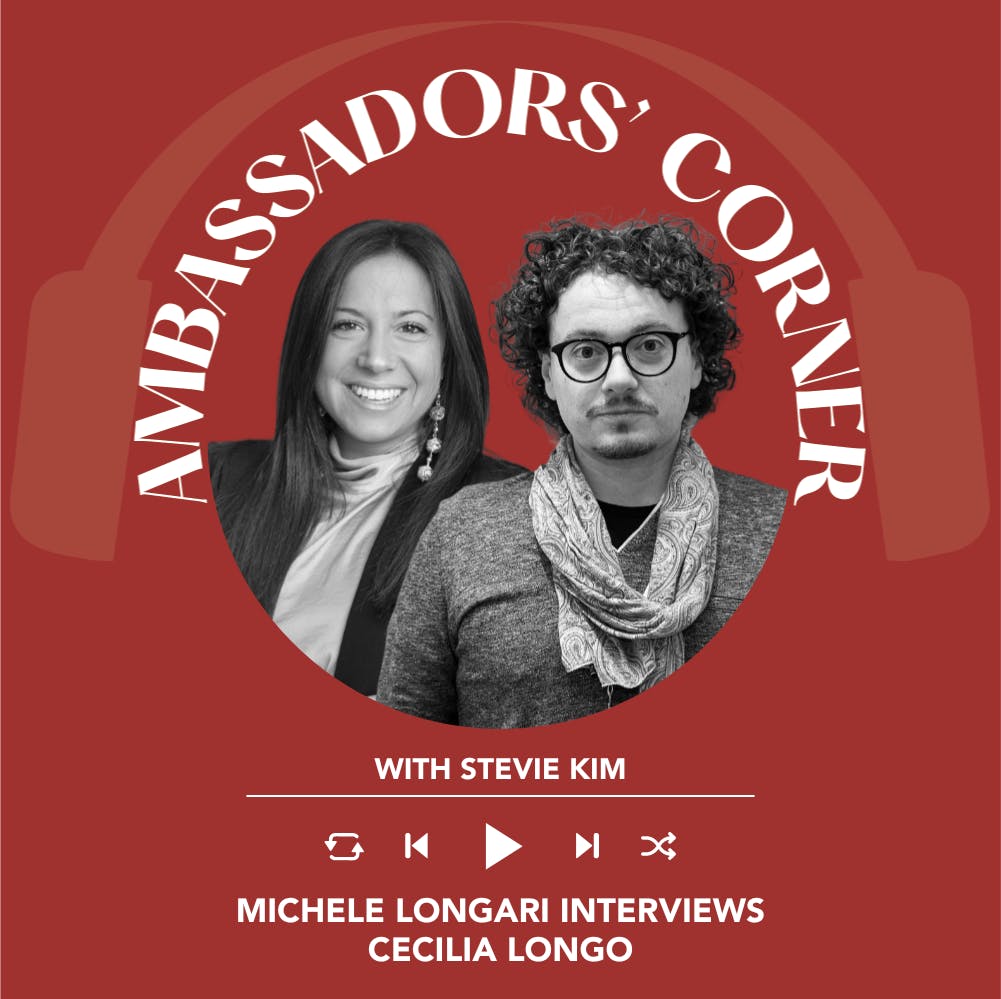
Ep. 2105 Michele Longari interviews Cecilia Longo | Clubhouse Ambassadors’ Corner
Clubhouse Ambassadors’ Corner
Episode Summary
Content Analysis Key Themes and Main Ideas 1. The evolution and diversification of a multi-generational family business in the Italian food and wine industry (Longo 1961). 2. The unique business model encompassing corporate gifting, a retail wine shop, and international wine export. 3. The paramount importance of personal relationships and ""soft skills"" in the wine business, particularly for producers and distributors. 4. Strategies and strict criteria for selecting Italian wine producers for export, focusing on authenticity, terroir representation, and family ownership. 5. The logistical and competitive advantages of a ""groupage service"" for international wine distribution. 6. Current trends in Italian wine consumption and export, including the rise of sparkling wines and interest in niche, lesser-known denominations. 7. The effectiveness of direct events and hospitality (""incoming activity"") as a marketing channel for wine. Summary This episode of the Italian Wine Podcast features Carla Arvagnolo and Mikaela Longari interviewing Checilia Longari, the third-generation representative of Longo 1961. Checilia provides an insightful overview of her family's diversified business, which began in 1961 producing wine, evolved to include a prestigious wine shop, became a leading corporate gifting company in the 1980s, and later ventured into international wine export in 2006. Both Checilia and Mikaela emphasize the crucial role of human interaction and personal relationships in the wine industry, contrasting it with Mikaela's previous career in computer engineering. Checilia explains the complex process behind their corporate gifting business, highlighting the meticulous selection of products that convey values and stories. For their wine export portfolio, she outlines strict criteria, prioritizing family-owned wineries that authentically represent their terroir and respect the land, regardless of size. The company specializes in medium-high quality wines and offers a valuable ""groupage service"" that consolidates orders from multiple Italian wineries for international importers, providing significant logistical and cost benefits. The conversation also touches on market trends, noting the enduring popularity of sparkling wines and a growing global interest in Italy's diverse, less-known wine denominations. Checilia concludes by advocating for ""incoming activity"" (events and hospitality) as the most effective marketing strategy, as it allows direct engagement and conveys the rich stories behind the wine products. Takeaways * Longo 1961 has successfully transitioned from traditional wine production to a multi-faceted business model, adapting to market changes over generations. * Developing strong personal relationships is a core competency and a significant differentiator in the wine industry. * Corporate gifting in Italy is a sophisticated sector that requires deep product knowledge, logistical expertise, and a focus on conveying value and brand identity. * Longo 1961's export strategy prioritizes authentic, family-owned wineries that embody their regional terroir, often focusing on niche or lesser-known Italian denominations. * The ""groupage service"" offers substantial advantages for small to medium international importers by streamlining logistics and customs for diverse Italian wine selections. * Sparkling wines remain a top-selling category, reflecting a trend towards wine as a ""celebration"" product. * Direct events and hospitality are considered the most effective marketing method for premium wines, enabling immersive experiences and storytelling. Notable Quotes * ""The most important difference in the wine industry is the fact that, in addition to having obviously a good level of preparation and education in wine, it's also incredibly important, your ability to, create and develop, personal relationships."
About This Episode
Speaker 2 introduces a podcast on the wine industry and discusses Speaker 3's career switch from computer engineering to wine and food. Speaker 3 explains their interest in the business model and discusses their desire to create a showroom for their own products. They emphasize the importance of privacy and strict criteria for organic orutive certification for their company's products. They discuss their approach to selecting and exporting wineries and their focus on medium and high quality products. They also discuss their interest in the Italian wine industry and their use of social media and press events to promote it.
Transcript
I actually don't know how my father and his brothers ended up understanding that there was space, in this industry, but, I think, this business began together with our wine shop. In the eighties, probably they note is that, they were becoming a point of reference for companies looking to create Christmas gifts. Also, the eighties was a period of significant industrial development in Italy. So many companies had a lot of budget to invest in a high quality gift basket. So probably they understood this, and they adopted the the business to that. Welcome to this special Italian wine podcast by podcast. This episode is a recording off Clubhouse, the popular drop in audio chat. This clubhouse session was taken from the wine business club and Italian wine club. Listen in as wine lovers and experts alike engage in some great a conversation on a range of topics in wine. If you enjoy listening, please consider donating through Italian wine podcast dot com. Any amount helps cover equipment, production, and publication costs. And remember to scribe and rate our show wherever you tune in. Hello, everyone, and welcome to another episode of the Ambassador's corner. My name is Carla Arvagnolo, and today we have Mikaela Longari. And Chichia longo here with us. So welcome, everyone. Hi. Thank you. Thank you. So one fun fact about Mikele is that he started his career in computer engineering. But he's always had a deep and rooted passion for wine and food to the point that he decided to start a professional so many diploma. The more he got involved in wine, the less he wanted to deal with computers and coding, So that's when he decided to fully dedicate himself to wine. After moving to the UK and obtaining several wine certifications, he's now purchasing director at High wines. Did I pronounce it correctly? Hey. Yes. Hey. I have one interesting question for you because like your story, your career switch could be an inspiration to many people, especially like younger listeners, or even experienced professionals, So how was it for you to first approach the wine industry as a professional coming from such a different environment? I think that probably the main differ, the most important difference I found between the two different industries is the fact that, obviously, in both jobs, you need a lot of, education and to be prepared because, you cannot, just be unprepared in in both matters. But I think the the most important difference in, the wine industry is the fact that, in addition to having obviously a good level of preparation and education in wine, it's also incredibly important, your ability to, create and develop, personal relationships. Because, in particular, for the, basically, the producer we are importing as a as a company, which are all a small, a familiar convenience. Yes, it is important that you are preparing in terms of, wine tasting and wine marketing and all these kind of things. But most importantly, it's very important that you are able to create a relationship with the producer. So I think that this is something that you cannot, learn from, from books. So when I was in computer engineering, I always felt that something was missing personally because, you know, we are all different, but personally, I felt that something was missing in my job in terms of, human interaction because I was, most of the time alone in front of a screen and, maybe talking to customers just over the phone. I really missed something. And, I think that I found what I was missing in wine because, yes, as I mentioned, in addition to all the work we need to do on a daily basis. It's also very important that, you have, the so called soft skills, to know how to deal with people and how to create and develop personal relationships with the producers. I totally agree with you, and I'm very much glad that you found what you were looking for basically in in the wine industry. So you mentioned, of course, that relationship and human interaction is extremely important in and why. So I'm very much curious to know why did you select, Tachina Nongo as your favorite producer? How did you get to meet her? Yeah. So, first of all, I think, I need to clarify that longo nineteen sixty one is not actually a wine producer, but yet a company that, has been involved with the food and wine industry for more than sixty years. I decided to have this conversation with Checilia, because they currently manage a white portfolio of Italian wine producer, and that they represent them on export markets all over the world. So told that, this conversation with Chachilla could give our listener clearer and more detailed view of, how Italian wine is actually marketed and approached by people all around the globe. The way in which I I actually met Cecilia was, a pure coincidence, to be honest. It happened during the last week, Italy, twenty twenty four. And, during this edition, I was invited to an evening event organized by a small consortium of young white makers I bet the person responsible for PR and press during this event. And after we had, a chat, she told me that her boyfriend worked for a company acting as, export agents for many Italian producers. A company that actually turned out to be longer nineteen sixty one. So I was very much intrigued by their business model. So finally, I managed to arrange a very quick last minute meeting with Cecilia before the exhibition ended. But then we had another couple of online meetings afterwards because I think that what they are doing is incredibly incredibly interesting. It's it's funny to get to to learn how you got to to meet this company and to Tilia. So for today, what are the learning objectives that we should expect from this interview? Yeah. Sorry. Going back to what I said in the beginning regarding the wine industry, if you think about it, the way I met Chacharya is something that happens quite often in the wine industry. And the only reason why I was able to meet Chacharya is because, during an event, I started to have a conversation with a person that that person, led me to, longer nineteen sixty one. So what I said in the beginning that, this is something that is very important in the wine industry for people that want to approach a job like this. I really meant it because, if, you know, during this event, I just, you know, was on my own in a corner very sad without talking to other people, I wouldn't have be able to have the opportunity to actually meet, chessilia and to know something more about, their company. So it's, it's this kind of situation are open more often than that we think and why. In terms of learning objective for today, I think that, this time, we will be focusing less on the production side of wine and more on the commercial side logistics and marketing. In fact, I think that sometimes, people tend to forget that once the wine has been bottle, there is still a lot of work to be done by many different key players before the wine is actually able to reach the glass and the final destination. So the interview with Checilia, hopefully, we'll give our listeners a clear idea of what happens behind the scene from the moment the wine is put in the bottle until the moment is, in the glass. You have a lot to say. So I'm gonna leave you the room to introduce Tachea, actually, and have fun. Let's learn more about this. That's perfect. Thank you, Tachea. How are you? Ciao, Vakele. I'm good. And you? Yeah. I'm very good. Thanks for accepting my invite to come here today. I think it's going to be very interesting for our listener to, learn something more about yourself and, obviously, your company. Just, before we start our interview, let me just, give to our listener a very quick, introduction about, yourself. So Chacheeda was born in nineteen ninety five. So she's very, very young, but actually she joined the family business when she was just over eighteen years old. So at the same time, she's young, but she also has this period, which is a combination that, you know, normally doesn't happen very often. She had the love at first sight, the relationship immediately with the word of, the dining table. So food and wine. And obviously, in Italy, we all have this kind of, yeah. The longer company, we need to say that is, more than just the business because actually it embodies, family values, culture, and the respect. And also, it's a story of different generations succeeding one another, and, a continued evolution over time. Chechilia at this very moment is, overseeing the product selection, marketing, and international market development for over forty wineries in the thirty countries all around the world. So, Chichilia, I gave a very brief introduction about, yourself and, your company. But obviously, there is much more, to say. Can you please, introduce to our listener longo nineteen sixty one. Can you tell us, where are you? Why are you? What do you do on a daily basis? And, because I think this can be very interesting for our listeners. For sure. So I'm the one who needs to thank you because I'm super fighting of of being here because I'm a very big fan of these format interviews of the wine business, and I'm I always follow Italian and podcast. So I'm super excited. You said everything already about me, but I will try to give you a a panoramic vision of what I do. I am, as you said, a twenty nine years old woman, and I live in the province of Milan. Nowadays, I represented the third generation of my family company, which has been established in nineteen sixty one, in fact, by my grandfather. And my grandfather came from the South of Italy and used to produce wine in large volumes and probably lower quality typical of the sixties and that period. Then in the eighties, my father and his brothers recognized the need for change. So they first opened the wine shop in Leiano. And at the same time, they explored, I would say unconventional sales channel, which is the one of the corporate gift. So today, In fact, we are the leading company in Italy in this field. To give you some numbers, we create over four hundred thousand gift boxes or we can call them Pampers every year. And we create them with the products selected food and wine products, and we make them for companies looking to make gifts to their customers or to their employees maybe. So this is our main business. And then additionally, in two thousand and six, we began focusing on wine export, and now we export products from, over forty wineries to thirty countries worldwide. And to end this introduction, let me tell you what I do. So as you said before, I primarily handle the product selection together with my father. I follow all the marketing aspects, and then I also coordinate the export business. Oh, that's great. And, this is what I found, immediately interesting about your company is the the gift giving, the corporate gift giving side of the business because, you know, it's something that, until, you don't think about it, you just take for granted. But then, obviously, as soon as you start, to think about exactly all, the complex side of it from selecting the products to managing, the logistics, the commercial part, marketing. It's, it's something that is, very complicated. And talking about this side of your business. I wanted to ask you, Cecilia, how did everything start exactly? So what was the reason to start the the the corporate gift is gifting side of the business? And, if there was like a gap in the market or if it was just an opportunity, business opportunity, and, most importantly, I wanted to ask you, because I think it's, you know, something not easy to do. How do you make sure every year that, your selection are always, at the same times competitive in terms of price, but also up to date in terms of, trends and what people are looking for. Yeah. And you can see it loud actually is a very complex, field, very complex industry. And, I actually don't know how my father and his brothers ended up understanding that there was space in this industry, but, I I think, this business began together with our wine shop. We have this wine shop in, in Laniana, which is in the province of Milan. And, it has also been awarded as the best wine shop in Italy. So it's a little corner, but something with a good history. And, in the eighties, Probably they noticed that that, they were becoming a point of reference for companies looking to create Christmas gifts. So people enter in the wine shop and then they understood that they had the knowledge to make a good gift. So also the eighties was a period of significant industrial development in Italy. So many companies had a lot of budgets to invest in high quality gift baskets for their customers. So probably they understood this and they adopted as a business to that. But, as you said, this is a very difficult business because, create a gets that requires three menus, the flexibilities, and big infrastructures, whereas, because the boxes are always larger with the big volumes. So, also, it's important to service because companies want them to be beautifully designed, customized, featuring their logo, fill it with the casing and always luckily always more and more ethical products, that's, could represent their brand. So, again, since we are not producer of a fine wine or food, our role is to trust form that kind of product into a memorable gift. And, this means understanding for us where it comes from how it's made and try to highlight these values and make it a gift. So we put all the efforts to educate our clients and we always, often speaks to people who are not into in industry because they are probably people from multinational corporations, or banks or insurances companies or tech firms. And they are not used to speak about wine or food as we do. So every time we try to educate them, we try to make this a real gift and try to let them understand what's the value behind each product that we select. And that's how we try to proceed and, and to tell people, that our selection is trying to be up to date as you asked. Yeah. It's, I mean, it's incredible again. I remember when, when I started to talk to you about this and immediately, you know, I misunderstood how difficult it must be, because obviously we're not talking about, you know, average corporate gifts. We're talking about selection that, you know, even, inogastronomic enthusiasts, like, us will be very happy to receive. It's not that kind of, average said basket. So it's, it's incredible how obviously everything started because I think it was, a very, very good idea to target this kind of, market. And, and also it's, it's amazing to hear how difficult it is to keep things under control and to manage all the different tasks. But yet, after sixty years, you're still, you know, making, an excellent job in this kind of business unit. Thank you. Moving to the other side of your company, so the wine shop, the end of take. I think this is, also something brief for a company like yours as it gives you, the opportunity to get, consistent feedback and the inputs directly from, wine consumers. And, we had the opportunity to discuss about this during one of our meetings. And explain that also we, as a company, hey, wise, we have a shop that actually is the tip of the iceberg, probably, and, is incredibly, incredibly important because it give us the opportunity to talk to the people that are actually the final destination in the wine industry. So the people that are actually putting their hand in the pocket to buy wine, and I think this is something, you know, I think the opportunity to have a shop and to talk to people and to see what people are looking for is something that, gives you you and also a company like you an incredible, advantage. So I wanted to ask you from the specific view of your wine shop. What are the, best selling wines at the moment? And, I also wanted to ask you, if, you notice any trends, and shifts, tova specific styles of wine during the past eight to ten years. It's a very good question. And, when I speak about our wine shop, I'm very proud, mama, because I love the last location that we choose in two thousand and twenty. And because our wine shop, we need to say the blend of tradition and modernity is very stylish but also practical because, everything is studied, and we choose many different parts from shops around the world that we liked, and we've tried to put it in in this location. It's a a complicated location where we moved in twenty twenty. Because, it's made of nine big windows. So unlike many wine shops that are narrow, dark, lightning with the old people serving you our white shop is the opposite. Yeah. I know I know what you mean. I know what you mean. It's feature of, getting nine large windows that allow people who pass by to see our product and also clearly from the outside. So to encourage people to enter and feel comfortable, we display wines below fifteen euros in the showcase. Our store manager are young Somier, very knowledgeable people, and they are seen as a consultant. To what their customers in choices. And as a one shop of Provines, probably the our customer's preferences might be a little different from, those that everybody reason the statistics, or in magazines. What I see from the numbers, and when I stay there in the one shop with twelve people, I see that the best selling wines are always the sparkling wines. So for, in our case, prosecco, Francacorta, or maybe champagne. And I don't know if this preference, is partly due to our role as key player in the gift business. Yeah. Yeah. But, probably, it's also because in general, there is a trend in consumptions towards the sparkling wines, because I see I see them as a moment of celebration, this sparkling wine. So probably as the wine is no more food product as it used to be in the sixties, or in the past. Now has become an element of celebration. No. It has to be on the table of people when they want to celebrate something good and probably the sparkling wines, are clearly symbol of, festivity and joy. Yes. Is something that, I think is happening, everywhere. And, I think you, you, you made a very good point. So wine used to be something to be consumed only with food at the dining table. Well, obviously, now the uses of wines are, are changing constantly because our society is changing constantly. And, I think it's very interesting to also see all the efforts that you made in order to make sure that, your wine shop was at the same time, obviously, an additional business unit for your business, but most importantly, a showroom for, all the wines that are in your, portfolio. I think that this is this is something that is great. And, I think the the people around you and your customers are very lucky because, obviously, it's not easy to find a white shop with that, level of details in the selection and also with that level of, knowledgeable staff there to support you, which is something that, it's, it's very, very important. I think you made it very clear that your company's, focus isn't just about buying and the reselling food and wine produce. Basically, this is like, how the vast majority of distributors actually, deal with this part of the business. It's clear that, you show a full commitment to communicate and share with your clients, the values, the history, and the tradition of your supplier. So, basically, you are creating value, within your portfolio by adding more to it, so not just by buying a resounding. Can you tell us why you decided to go down this road, which is clearly more challenging and complicated compared to the traditional way of, distributing food and wine products And, do you think this is something that actually creates, more value within the endogastronomic industry? I'm confident that this is the case, actually. So, our job because beyond the merely selling foods like in a supermarket. So we are in the business of gifting. And when it comes to gift, every item must be carefully selected and represent also a value probably, you know, when you when you need to think to a gift, this is very important. All you always think of what the other people would like to to receive. And in fact, our role is crucial, and I wouldn't say that understanding our customers values and needs, and reflecting them by choosing a particular food or wine product. So this is the most difficult part, but it's also the most important. And Of course, then there must be all the efficiency part of services, logistics, and so on. But what we try to do is to make this product communicate itself. So we try to make also a box become a way to communicate, a message to our receivers to our customer. So it's not only a container. It's not only a place where we put food or wine at the box but it itself it becomes a a place where it communicates something. Yeah. It's actually I think that this part of your activity is actually, inspiring because you know, as I mentioned before, there will be a much easier way to do what you are doing. But then, obviously, that's, a road that, is not creating any kind of value during, this chain. And I think that, you know, my job is obviously on the other side of the market because obviously you are exporting. I am importing, but at the end of the day, I see that, the most important part of our job is not the the purchasing beat. So when actually we select a new producer or when we buy the wine, is actually making sure that we are creating value throughout the chain and to make sure that actually we, as the basically importers, are actually adding something more to this chain. And, I think this is something that, a lot of companies are finding very difficult to understand, but Obviously, the wine market and the wine industry have changed in the past twenty years. And, they're all of, people acting as distributors or, importers or exporters. Is now much more than what it used to be. And I think we have, a great, responsibility on making sure that actually the producer we represent are actually also proud of what we are doing with direct products. And, to see you're talking about this part of your business activity, which probably we could call, like, a customer's education, maybe something like that. I don't know. But Definitely. I know that that you are organizing an important event called, Longo, kiosco, which will be held at the in September in a few days actually. Can you tell us a bit more about this event when and why did you first organize it? And what kind of format are you following for this, longer kiosk? I'm very excited in these days, and we are all very busy because, we are organizing in fact this big event happening the next Tuesday in Milan. And for this special occasion, we are transforming an entire museum, as you said, into a big showcase of food and wine products. And it's not an annual event because for us, it requires months and months of preparation. And, our business is not a create event, but our business is, is, something else. So, we'll be very big. And in this poetic frame, our food and wine producers partners, would represent their products, and they will try to highlight the air production process. So everybody will be showcasing their products and tell our customer how they produce it and show them practically actually. So we have invited the the key buyers from, the major Italian companies to experience first send the stories and and the craftsmanship behind the the items that we put in our gift box. And as we said before, our customers are not people from the wine industry, wine, or food industry, but they are people coming from other completely different companies. So it's always a big to be. And, these events will also have big speakers from the wine and food parts and who will try again to educate our customers and try to show them how big is for us the work of choosing one by one the producers of food or wine products. Yeah. And, I think, again, in particular, for the fact that, as you mentioned, we are not dealing with people in the food and wine industry, but people that, do a completely different jobs. I think what you're doing in this kind of event, is exactly what gives you the opportunity also to improve your selection and to make sure that your customers are asking more and more from you because I think that, incorporate gifts if, you don't show customers that actually you are different from, everybody else. And, actually, your selection is, something a step forward, then probably they will start just, to ask for, like, discounts or better prices, but, as long as, obviously, you can show your customer that, you are giving them the opportunity to create, these corporate gifts that are basically a piece of work, you know, a very, a very important gift, and something that, is different from anything else. Then is is actually where you are also able to create even more value for the people that are buying the corporate is from you, but most importantly for the people receiving the gift. So I think this is something that an activity that I think it's, incredibly, incredibly important. And, I hope that our listeners can actually understand the amount of work that, is behind, something that sometimes maybe we take for granted like a corporate gift. If you wanted to do it, in this way, the amount of work behind the scene is just incredible. Chicilia, although I found our conversations so far very, very interesting and inspiring, as I mentioned. At the end of the day, this post is called the Italian white postcard. So I guess We need to go back, to talking about a while. So also our listener can have a better understanding of, your wide portfolio. Before you said that, basically, you, are currently managing forty Italian wine producer on more than thirty export markets on the globe. Can you tell us a bit more about, your catalog? Which regions are you covering? And what are the since you basically are responsible for, the product selection, what are the specific criteria you follow? You and your team follow when, you are looking for new wineries to be added, onto your portfolio? So the the before I start with this, thank you again for make a a clear point of what we do in the the gift business because, it's not easy to explain people what we do every time. It's struggling. Think and thank you for understanding. No. Of course. I understand that because, as I mentioned at the beginning, it's something that people just, take for granted. And, I think that to some extent, doing a corporate gift giving, as I mentioned before, in an average way, is not that difficult. What I think is incredibly difficult is to do cooperative giving like you do because basically you are creating like, selections that require a lot of knowledge and a lot of, different things. So I just wanted to point out what you're doing is, it's something that, requires a lot a lot a lot of work. It's true. So going back to, as you said, to the one five We began handling the export of selected wineries eighteen years ago in two thousand and six, and our primary customers are traditional importers who then distribute their products in their respective countries. So by purchasing from us, they can access it to a range of wineries and benefit from our groupage service, which also love them to fulfill their hoarders with a single purchase but then covering various Italian denomination. And over the years, our portfolio has evolved as it always happened. Even if some wineries has been part of our selection since the beginning, our criteria for selecting the wineries are easy, but very strict. We search mainly for those that control the entire production process, which are preferably family owned. And most important is, that they authentically represent their terroir. Yeah. Maybe with nating native grapes better, but what's important is that comes out the region where it comes from and the terroir. Yeah. The size of the winery is less important. But typically, we work with wineries that are producing between one hundred and maximum five hundred thousand bottles. I would say around this range. What matters the most is the philosophy behind the winery. While we do not specifically require for organic or biodynamic certification, for us, it's very important that they respect the land and that they enhance it. Yeah. Nonetheless, it's important that they are precise in the service because exporting is a serious business, and we ensure that to all our partners uphold these standards because the expert is very serious. While about the portfolio, we can say that we represent all the major Italian wine regions. And, even if a winery is not listed in our catalog, our experience and the work that my parents at the previous generation in the company has been doing, this really allow us allow us to connect with any kind of winery and also provide any kind of denomination they might be looking for. Yeah. It's very interesting because, when you you were mentioning the criteria, you follow when, obviously, you need to update your portfolio as we discussed, during one of our meetings. So I think it's incredibly similar to what we do as a company. Hey, wise. And, I think it's exactly the same. And in fact, it's, the way in which, you can actually make sure that, not only you are, importing or exporting, Italian wise, but, that you are also able to, as you mentioned, actually, think you, you, you, you said it very well. To represent their region, their tradition, their history. And, the only way to do that, is, to deal with, wineries and producer that, can actually show a focus on, yes, indigenous varieties, but most importantly, on, the traditional styles of wine, done in that region. And, this is obviously very important for, like, a podcast like Italian white podcast because, this postcard is listed by people all around the world. And, we need to remember that, not everyone is so lucky to have the opportunity to visit Italy because, we have a listener that are all over the world in the US, Indonesia. And, for many people, they just hear about, Italian, Italian wine virtually because, it's a very expensive trip, and, it's not something that is accessible to everyone. And this is something that is true also here in the UK. On a daily basis, I have, customers that come to me and, they love Italy, they love Italian wines, and that they haven't had the opportunity yet to go to Italy for many different reasons. So I think that the opportunity we have with our job representing Italian wine is, to give to these people also an idea of, what Italian wine is about. And what the Italian wine and food culture is about. And, the only way to do that is, exactly, to follow what you describe as very strict, criteria, very strict rules. So, you made, very clear that, what is your approach when it comes to selecting and exporting your producers? Can you tell us, at the moment, what are the best performing regions in your portfolio and, the best performing markets? In terms of best performing markets, my question is, is a double question because I would like to know both in terms of, total annual say, so, like, the biggest markets for Italian wide, but also if you have any, let's say, niche market, so market that, have a very small values, maybe, but, very good in terms of, sales per capita. Sure. Actually, for for me, is, is a question that, as an answer in a niche because, as per our one shop, which we are where we are in a in a province part, of, its groups of a country of a of a city. Here, we operate in a another niche because, for example, in our export company, we don't sell a single bottle of prosecco, but not for a choice, but because, you don't refer too long ago when you're looking for a prosecco, not because we are not able to search for it. But because you you search for price, when you need the prosecco and big volumes, you don't need the groupage service or you don't need someone who tell you that this is better for a reason or or another. We focus on medium high quality products, and they are not the everyday wine or the high volume wine. So they they, you know, the la casa, you know? Yeah. We specialize in rare and prestigious label such as if I need to to tell you names that probably everybody in the board know are Mascarello or, in Montebertsina wines, they're or I have many different premium wines in our portfolio. And, these are important names that contribute, of course, significantly to our revenue, but since the availability is limited, in terms of bottos, the turnover is high in terms of value, but, not necessary in volume. So as you said, it's very interesting because, if we we need to to watch the numbers, I tell you that, our stronger market nowadays is is Canada. But, again, for us, is a niche, and we we do a different role. We, of course, work with the monopoly, but, not for the big tenders of, everyday wine. We work for these kind of high, medium, high products. And, we have markets, which could be more weird because for us, is in very important Puerto Rico. We have an important customers that from us. He buys more than fifteen different wineries, or, the Cayman Island or Malaysia. They are all important customers, but both in terms of volume, but I'd say volume in a different way probably from another wine area because it never leaves the container from our warehouse. It leaves a a mix of five to ten different palettes with the inside maybe fifteen different wineries. So it's an unusual markets, probably sometimes, and, we also reflect unusual use in terms of consumptions, because if I if I need to to watch the numbers, for consumption task and E and P ed monitor are still the top performing regions for us, but before I mention to you some Ynas which are, themselves, big names. Yeah. It's clear that, obviously, for the very specific, business model of your company, you are approaching the export markets from a different side compared to the vast majority of, export agents. And, I think what gives, a lot of value for, importers in terms of what you do is, as you mentioned before, your groupage service. And, I just wanted to spend a few words about this because maybe not all, the listeners know what it means exactly, group of service. Basically, when may you export or import wine, from a country that it's outside the, European Union, the customs and, the fixed costs regarding customs in particular, are quite high. And, this is something that, I've seen, myself, because obviously when I moved to the UK, the UK was still part of, the European Union, and then, the UK left the European Union. So before, the UK left, so when the UK was still in the the European Union, it was a very important, like me, to organize a groupage of producers on, my own, because basically, you didn't need to provide that level of detail in the export documents, and, the export documentation wasn't, so expensive. So, basically, if I wanted to, have, as you mentioned before, five pilots from, ten different producers, some type. Well, not like that, but what I was organizing was more maybe two pilots and four different producers, one single collection point, and then I was importing the one in the UK. Obviously, after the UK left, this is something that, It's still possible, but it's like incredibly difficult and expensive to do. So this is where companies like Longo come in help for, importers, obviously looking for, niche wines, and niche population rather than volumes because then longo is representing all the forty different producers. And this means that that if an imported wines from longo, they can actually place an order for, different wine producers all over Italy, but they will have only one invoice and one documents for the customs declaration, which basically gives, a huge competitive advantage. And the other important bit is obviously that, there is only one point of collection. So it's not like, that you need to go and follow all the different producer, but all the wise are in the same place. They live in one place with one invoice and one custom documentation. And, this is, what is the, in this part of the industry, referred as a, group of service. And this is something that Longo is offering, and it has, an incredible value for, small and medium importers all around the the world. So it doesn't surprise me that actually your best markets are very small markets like Portoric or Cayman Island these places because, for that kind of small importers, basically, you are giving them a unique opportunity to have, an incredible range of Italian wines in a very convenient way. Exactly. So Bravo, you are hired than if you want to be connected. It's, it's great. It's great what you are doing. And, I would like to ask you now the same question I asked you before regarding your, Innoteca customers, which obviously are a B2C customers. And, now I wanted to ask you directly the same question about your B2B export clients. What are the best selling Italian wines abroad at the moment? And, have you noticed any trends or, changes in a specific styles of wine since two thousand and six when you started exporting the wineries on your portfolio? So as before I I told you that's probably our main business of the gifting is affecting the consumptions inside the the wine shop. I think that also here, our model, is affecting the the statistics of the export because, what I see is that as I said before, if I need to see the numbers, tasks and impediments are the regions that are top performing for us. And we don't even sell a bottle of prosecco. And what what we see if I need to think about the trends is an increasing interest in the lesser known denominations probably because of our model. As I said, that you don't search for long. If you need to add a multiple channel de la Casa, but you search for long. If you want, probably, Valdosta wine, high cadmante wine. I know about the lena or probably those kind of denominations that are not for the ones that you would stock up for in your browser, but they are for sure, the most representative, if we need to think, of Italy diverse a great pride is, so is a is a statistic that is different is difficult to analyze. Yeah. No. I think that, what you're saying is consistent to what we see every day. And, I think you're right. So part of this is due to the fact that people that want to work with your company. They are not looking for, like, wise that are easy to find. But I think I'm also noticing on a day to day basis that, Italian wine is growing incredibly, all around the world, thanks to the smaller denomination, and, the almost unknown aggressive varieties. Because, obviously, we need to, think about the fact that the white market probably is reaching a saturation point in terms of, the most important population and the most important varieties because, They are, available basically everywhere. So we are reaching a point where, in particular, the export markets are starting to look for something different. And, when you start looking for something different, Italy, It's, in terms of wine production is, a very good starting point because, as we know Italy, in terms of, number of indigenous grape varieties and denomination and styles of wine, it's, basically unique in the world because, the diversity in terms of, soil composition and micro climates, the variety of styles from, as you mentioned before, let's think about, a white wine from, validosta, and, the wise, from Pulia or Sisini. Although we are in the same country, the diversity between the the two styles is incredible. So Italian wine, I think, is becoming all around the world. A starting point for, importers and distributors that, are looking for, something different for their customers. And, with Italian wise, you know, that actually you can find from validosta to Calabria in Sicily, you can find a variety of, very top quality wines, in styles that, are able to please a lot of customers because that's what, at least they find out every day in my day to day experience. Finally, I have one, actually, two last questions for you before, I leave the room to Karla. So, a couple of questions that, I always like to ask to all the people I'm interviewing. So since two thousand and six, Cecilia, you have given high relevance to international market for Italian wine. And, I just wanted to ask you, from your direct experience, what are the three most important words or objective to be used when communicating and promoting, Italian wine abroad. Good question. I think we have been speaking about it for the past last hour. And But, in my case, and for the wineries that represent, which, to me, for my personal opinion, embody the true essence of what Italian wine words should continue to be I would probably use, e three, the rhetorical expression and, variety. As we said, the great variety and native great varieties. It's it's a very good point. And, I think that, history and variety are also two of my favorite was when, I had to describe Italian wine because it's, obviously, the history that there is behind every single wine and the variety of styles is just, something incredible. And now, Cecilia, before I leave the room to Carla, the last question. So pay attention. I give you three different options. Web and social media PR and press events and hospitality. So I just gave you three different marketing channels that are actually very popular, in the wine industry nowadays. Consider that, you were giving, enough resources both in terms of, time and money to be invested on this channel, but you had to pick only one of these marketing channels. What channel would you pick and why would you pick that specific one? This is very tricky. It's especially for, and as if, of, of the social, like, but probably if I need to consider an unlimited budget, I have no doubt that, the most effective solution is the incoming activity. So events and hospitality. In fact, the the event we're going to take and next Tuesday is, is the practical explanation of this because actually you can show people what you do and you can explain them why you do it in that way, and for sure is the best solution to promote yourself. Yeah. It's, I agree. And, I need to tell you that so far, everyone has given me the same, but I think that, obviously, the incoming, it's, a very expensive marketing activity. It's a very expensive marketing activity because, obviously, it's not just that you need to allocate time and work, but also you need infrastructure. But, considering, yes, a limited budget, everyone so far has given me the same answer. So incoming is the best way, and I totally agree because, in particular for this kind of, wines and products, the best way to communicate them and to share their value is, by sharing this kind of experience with the the customer. So I am done with the interview. Thank you very much, Echilia. Now I leave the room to Carla because I think there is, probably a question for you. Yeah. Thanks to you, Vikele. It's been a pleasure. This was actually very interesting. I know you've touched already, on the markets you work with, but we do have a very specific question. Do you and your company work with the central Asia market? Yes. I need to to make a difference between the wine business and the Pampers business. Actually, we work in Asia with the wine export and we cover all the different countries. I would say with little numbers as I said before because we represent little wineries, but, we cover all the different countries. But with the hand person that is a a a different thing because when you go into the gift business, you need to consider which are the consumptions in the country of reference. So in fact, for, this branch of our company, we haven't been able yet to understand how to export this kind of business because, in Italy, we are super stronger. We know perfectly which are the use and consumptions in the country. But if you go to Asia, Of course, there will be other moment of the year when you need to celebrate something and the other products that you would consider to to celebrate. So we what we would like to find is a partner on the other countries that can help us to identify that. We bring our knowledge in terms of logistics, in terms of boxes, in terms of customization of it, services, and so on. And they help us understand which are the products and the way it goes on the market. Amazing. Thank you so much for this interesting answer. So I think this is a rep, but I really wanna thank you, Micah, and Chutilla for this conversation. I think it's been extremely interesting. Because you've touched on such a variety of topics spacing from logistics and portfolio selection to the entree and market demand. So, again, thank you so much. I hope you had fun, and we look forward to our next conversation. Thank you. Thank you very much. Talk to the Italian wine podcast wherever you get your podcasts. We're on SoundCloud, Apple Podcast spotify, Himalaya FM, and more. Don't forget to subscribe and rate the show. If you enjoy listening, please consider donating through Italian wine podcast dot com. Any amount helps cover equipment, production, and publication costs. Until next time.
Episode Details
Related Episodes

Ep. 2789 ColleMassari: a long-term vision rooted in Montecucco with Giuseppe Di Gioia | On The Road With Stevie Kim
Episode 2789

Ep. 2788 Ep. 14: Austria and Hungary | Study Smart for your WSET Level 3
Episode 2788

Ep. 2785 From Volunteer to Speaker at TEXSOM with Samantha Cole Johnson | TEXSOM 2026
Episode 2785
Ep. 2766 Inside the U.S. Non-Alcoholic Wine Market: What Wineries Need to Know with Jill Sites | Masterclass US Wine Market
Episode 2766
Ep. 2761 Winemaking and Consulting Across Sicily with Alessandro Serughetti | Wine, Food & Travel with Marc Millon
Episode 2761

Ep. 2759 Part 2 – The VIA Educational Program & Italian Wine | Heart-to-Heart Conversation with Sarah Looper
Episode 2759