
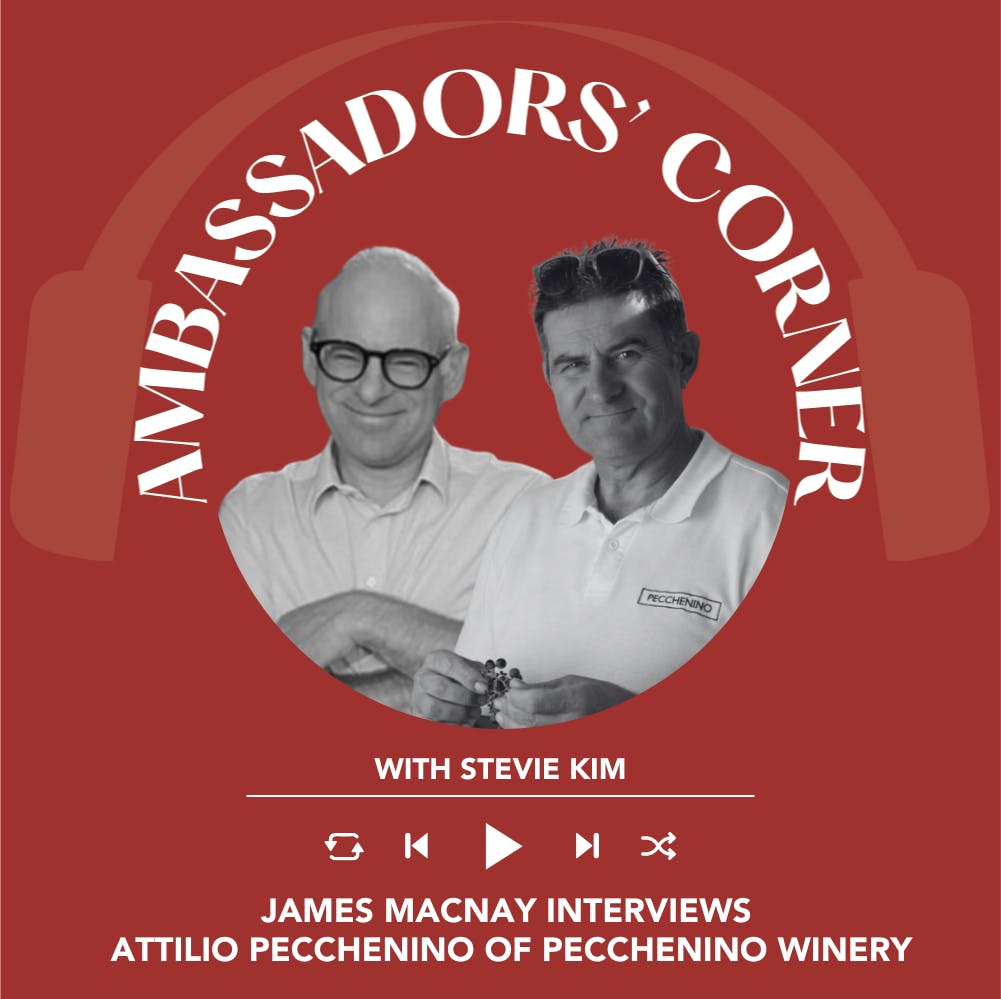
Ep. 2230 James MacNay Interviews Attilio Pecchenino | Clubhouse Ambassadors’ Corner
Clubhouse Ambassadors’ Corner
Episode Summary
Content Analysis Key Themes and Main Ideas 1. The history and evolution of Piccanino Estate, a fourth-generation family winery in Doliani. 2. The characteristics, challenges, and unique winemaking techniques for Dolcetto grapes in the Doliani DOCG. 3. High-altitude winemaking and the production of Alta Langa DOCG sparkling wines, including comparisons to other sparkling wines. 4. Innovation in sustainable viticulture and pest control through collaboration with universities. 5. The integration of wine tourism, including a B&B, e-biking tours, and truffle hunting, into the winery's operations. 6. The significant increase in Barolo vineyard land value. 7. The importance of passion for the land and winemaking as a core philosophy. Summary In this Clubhouse session of the Italian Wine Podcast, host Carla Raviano welcomes James McNae, who interviews Atilio Piccanino of Piccanino Estate in Doliani. James, who runs a wine travel business in Piedmont, discusses his personal journey to Italy and his passion for Val d'Aosta and Piedmont wines, particularly Piccanino's. Atilio shares the history of his fourth-generation family winery, located in the UNESCO-recognized Doliani region. He elaborates on the Dolcetto grape, highlighting its delicate nature and the specific winemaking techniques (like controlled oxygenation during fermentation) required to produce high-quality Doliani DOCG, which has achieved a high status comparable to Barolo. The conversation also shifts to their Alta Langa DOCG production from high-altitude vineyards in Bosolásco, emphasizing its distinct mineral profile and aging potential compared to wines like Prosecco. Atilio details his pioneering work in non-intrusive pest control, developed through long-term collaborations with Italian universities, which has become a reference point for sustainable viticulture. Furthermore, Atilio discusses their extensive wine tourism offerings, including their beautifully restored B&B, multi-day e-biking tours through the Langhe, and even truffle hunting experiences on their property. He touches upon the challenges of climate change and the rapid appreciation of Barolo vineyard land. Atilio concludes by stressing that ""passion"" is the most crucial message and driving force behind their work in winemaking and hospitality. Takeaways * Piccanino Estate is a historic, fourth-generation family winery located in the UNESCO-designated Doliani area. * Dolcetto, in the Doliani DOCG, is a challenging but rewarding grape requiring specific winemaking techniques, such as targeted oxygenation during fermentation. * The status of Doliani DOCG has risen significantly, becoming comparable in quality level to Barolo. * Alta Langa DOCG sparkling wines from Piccanino are produced at high altitudes, offering distinct minerality and long aging potential, setting them apart from other sparkling wines like Prosecco. * Atilio Piccanino is a leader in sustainable viticulture, employing non-chemical pest control methods developed through extensive university collaborations. * Wine tourism is a significant and growing aspect of Piccanino Estate, offering diverse experiences like e-biking tours and licensed truffle hunting. * Barolo vineyard land values have seen an almost tenfold increase in the last 15 years, presenting both opportunities and challenges for the region. * ""Passion"" is the cornerstone of Piccanino Estate's philosophy, guiding their dedication to the land, winemaking, and hospitality. * Climate change is an ongoing challenge influencing viticultural practices in the region. Notable Quotes * ""Doliani is in Salt Hera from the land horizon that, in, in nineteen ninety four, was, the vineyard Landes came from UNESCO."
About This Episode
The speakers discuss their experiences with winemaking in the Italian region and the success of their own wines. They also talk about the challenges and benefits of high pressure winemaking, the excitement surrounding the new vintage, and the importance of the taste and ageability of Dol Dol pricings. They also discuss their involvement with universities and private companies, their approach to pest control, and their efforts to create sustainable tourism projects. They also mention their desire to bring their experience to the market and encourage listeners to subscribe and rate their show.
Transcript
Doyani is in Salt, hera, from the land horizon that, in, in nineteen ninety four, was, the vineyard Landes came from Onescore. In recent years, you've been involved in a new sustainable tourism projects, an e biking project. And what what's the name of the organization? Yes. The brand is, a long, incoming, a bike, and wines. Usually, we don't, drink and, bike, but, before we we go, we bike and, and when we come back, we we're drinking some some glass of wine because during the tour is is a little bit as difficult. Welcome to the special club house session of the Italian wine podcast. Listen in as members of the Italian wine community engage in fascinating conversations about contemporary wine topics. If you enjoyed the show, please consider donating through Italian White podcast dot com, and remember to subscribe and rate the Italian wine podcast wherever you get your pods. Hello, and welcome to Club House, the Ambassador's Corner. My name is Kararaviano, and today I'm pleased to welcome James Mcnae, and his guest atilo Piccanino from Piccanino State. Welcome, everybody. Hi, Carla. How are you doing? Great. Very much looking forward to hearing your conversation with Atelio today. But first, I wanna introduce you our host for this episode. So James is originally from Southeast England where Cuculo cheese monger and Enoteca, which he still partially owns, is located. But James nowadays is currently based in Pemonte's Western Alps. Where he runs Macne, travel, and wine with his wife, Chincia. Here, they operate self guided walking holidays and small wine tours. So, James, I have two questions for you. One is I wonder how come this big change in your life? Because, like, from Southeast England to Western Alms, I wanna know how that happened and why. And my other question is, where did you lead your first ever wine tour? Okay. So to answer your first question, I first lived in Italy to the city of Lasencia. This is going back quite a few years now, but I I really fell in love with the country, and especially the northwest of the country. Ligoria Valeda Oscar Piamonte, won the clock forward quite a few years, and ginsier and I met while we were walking tour guides. That was a a job. We actually met in an Oxford College romantically enough. And, Chincia, although she was born and raised in Valid Oster and fields Valdoskana, her family is from Iemonte. So when we decided that it was the time to move back to Italy, which we always wanted to do. He wanted it was the obvious place, for us to come. Specifically, Dorre Eliche, which isn't about Eliche. And in wine terms, that's within the Pinero laser DOC, and that's where all of Chintzy's family is originally from. Bear in mind, we also have a he was ten at the time. Now he's thirteen. Some to look after as well. So we have family help, lots of family around to help with after him while we're away on trips or, or back in England for this job. Second part of your question. The first ever tour was well, it was our self guided trip in Validation, which was the first trip for we designed, and that is called heart of the Italian Alps. And it was, a group of three. So they were customers from our shop, keen walkers, wine lovers, and they took the plunge and and were our very first guests and that is an unaccompanied Drift, so they were just there. The the three of them with our logistical support with us having designed the the itinerary books everything for them. Got it. It's kinda surprising to me, and I'm very excited to hear that your first tour was in Valedaosta, because I feel like in some way, it's still such an underrated and under the rather region. I don't know if you agree. Yeah. I I really do. It's a it's a wonderful region, both for its natural beauty wonderful people, if anyone's been skiing in Italy, then there's a good chance that they will have skied in the valedosta. If they've done any mountain walking, then likewise, but in terms of winemaking, there really are some superb wineries, winemakers, and really wonderful wines in the region that don't get enough exposure. And I guess a lot of that is to do simply with the the volumes that they can produce. There's so little space in the valid Oscar that you can actually make wine, Groveite, that the production is almost by definition very limited. A lot of that is consumed within the region by the locals and by tourists. So you really don't find that much outside the boundaries of the region. Yeah. Totally. I totally agree with you. But today, bringing it back to today's focus and to today's guest, we're talking pitman. Am I correct? We sure are. I'm glad. So moving on to introducing your guests, how did you discover about Pecanino wines? So, Artidio's wines, the Pecanino wines were one of our first labels on our shelves in the Enorteca in East Sussex, we were introduced to the pecanina wines by the Van importer, and they've been a permanent feature on our shelves ever since. Why did you decide also to invite Tatilio? But I tell you, is, has become a good friend over the years. The wine's exceptionally good, really superb, really interesting wines as well. So he he he does make, barolo, farbera, but really the the private place goes to Dolceto, and also to Alta Langa as well. And over the years, at the Pet Penino winery, there is a beautiful B and B with five rooms, and I've taken lots of guests over the years to stay there. And it's a magical enchanting place. My guests have wonderful experiences, and, Octillo is at the heart of it all, the winemaking the hospitality, and he's a, an important member of of the Dolly community as well. We can definitely feel your passion for this one or in this producer. So one last question before passing the mic to you. What are the learning objectives that we should expect from this interview? We're gonna learn quite a lot of background about Doliani itself, the place. The the area, about Dolcshedo, the grape, which, for me, doesn't get enough exposure compared to the Nebula. That all. What techniques winemakers working with Dolcshedo employ to achieve high quality Tilia can tell us about the challenges and benefits of high altitude winemaking, and we'll also go into particular detail about the wines of Halte Landa, DOCG. Tilia works closely with universities and private companies to manage vineyard pests in modern, sustainable, non intrusive ways. He can give us the lowdown on the latest pests. Some of which have appeared, become problematical only in recent years. And the latest technology one can employ in combating them without recourse to chemical intervention. We'll talk about climate change a little bit and how that is affecting winemaking here and in Alta Langa. And we'll also have a discussion about Artilio's B and B and, wine tourism in in general because Athelia is very connected, especially in the cycling side of of wine tourism. Everything sounds great. Lots of questions, lots of topics to touch on. So I'm now muting myself, and the room is yours. Thank you very much, Carla. So, Athelio, hello? Hello? I'm sitting here in Athelio's kitchen. The sun is going down on the hill behind this, behind Dahliali rather. It's a a beautiful idyllic scene. And, should first mention that Athelia is not the only person involved in the athelia winery. It's important to mention his brother Orlando, who doesn't really speak in English. I don't think does he. And, Athelia's niece's Liza Gaia and Sophia, and they're all very much involved in the winemaking in the vineyard in the cantina, and also on the hospitality side. So looking after the B and B, so it's very much a a family affair. So, Adelio, introduce your wine retailers. How many hectares do you have? Where are vineyards? And how many bottles do you make? Yes. At first, I give a thanks, to James and Jeania for this, possibly to introduce our, Renee that the location is in Doylianee. Doylianee is in South Hera from the lung duration that, in nineteen ninety four was, the Vineyard Landes came from UNESCO that, is one of the best, I think, one of the best, beautiful place, in the in the north of Italy and also in Italy and it during the war, I think. That is, exclusive, particular, that we can, we can see the mountains. Then we can see the vineyards so that we can see some forest, and, is a balance of the, the nature that, is, very, very personality also is a place that, we have a more ecosystem in inside here. In in this, in this part of, of the origin. Then, for us, it is the fourth generation at this moment that, from, from the, the winery that, He was, born in, we have the history in the beginning of, nineteen century. Then, at this moment, we are me and my brother that, we take a car from everything. At this moment, we have forty hectares that was located in Doyani, the more quantity of entering Doyani than on Forto da alba, and also a little bit higher on the top of the hill. Bochelasco is the name of the community there. The climate is changing, but also James, speaker before. Then, at this moment, we also try to put some white vines a little bit higher. Then we have the our Viner is four hundred fifty meters, then the Boscholásco is higher. You make, Altaanga, and you make Doliani, and you make Parolo, and you make you have a reasoning as well, I think. Yes. It's the new experiment. We had, the first, Vintech was in nineteen eight, eighteen. And, at first, was, a spell incremental also for the family whites. Then, now we also became more famous and, this moment, we made around six thousand the bottle from the last three inch. That is, twenty twenty freight. The first was eighteen, and, is especially wide so that we can, drink, also after many, so that, we have a more flavor more, Interocarbor, and, will be better in next year. So we don't know how many because it's a new experiment. Yeah. For this one. Good luck for that. It's delicious. I can tell you that for sure. You grew up, Adilio, in the town of Doyani. Didn't hear this. That's correct. So what was it like growing up here? And how the things changed? I'm sure beyond what I could imagine, how have you found things changed over, over the years and the decades? And then about, Dolcshedo? No. I mean, really about, life in Doria. Oh, yes. Is there a lot more tourism? Is it a more wealth? Is it a richer, a richer place? Yes. Is, our passion. I think that, we have, high passion for for business form, from the vineery also when making and also for, from B and B, for everything, for for the the outdoor activities for everything. Every day, every day we introduce some something to give them more, more, experience, to all people, all, our guests and our a customer for a for one customer. Cool. Then, in Indiana, we only changed, a lot of things in the last, fifteen years. But, I remember when we were, the the child, then we we started, and, then there was the first vintage for us, around nineteen eighty six. And then, in that, times, many, many people make a double check, So we have, more people, that work every day for the this kind of, grape. It it was more popular. It was more popular because it was a wine that we drink daily. More easy. Then me and my brother and the other one maker in the last twenty years, we invested the for the one making from the technical individuals. Everything has changed in the last twenty years. So if if we go back twenty years, where there is many wineries, private wineries as there are now. So it seems to me that there are lots of wineries in Guoyan, you know, but I don't think that was always the case private winery is making our own labels. Is that right? In that time, many, many private, one maker we had here. In that private, for the race, They just so great. They didn't make wine and make wine because, was, vintage when the weather was better, the wind was better. Then the weather was not, perfect. The wines are not good and the family drink before, summer because it was not, the the wine that we can eat longer. We study from this kind of grave that is, that is dedicated, grapes, and that delicate wine is, very difficult to go on the wines during the year, and it is very difficult to also under one making the seller that, It's very, very complicated. It's more easy to make, maybe all. It's more easy to make a barolo also. It's a wine that we can compare from the pinot arm. It's similar, more similar. But it changed many, many things. It changed in last, twenty years. Also, also, with this experimentation, we had the DOCG Doliani. Is that two thousand and seven? Two thousand and seven was the first, Vintaj in that became, became, from DOC, became DOCG. And, became a better and also the minister of agriculture, filed this line. We have the the tastings for this one, this kind of wines and the they gave it that the OCG was a high level. It's the same level of the barolo at this moment. Right. And, we also changed the the one making because, in the time, we choose that the we, we, have, different, one making from the all the vines and the new vines. And we make two different wines at this moment. Doliani docg for the youngest vines and Doliani docg's for the all just, videos. Yep. And the wine is completely different. Yeah. Because the wines are closer and they're all go deeper. And, we took the similarity of the terviola device became different. MB is a dolce. But, now it's called Doliani, the OceG superior, but, we can drink after, fifteen years. We have, exceptional result from this. Yeah. We tried the two thousand and three twenty thirteen. It was, wasn't it? It was wonderful. Yeah. It was superb. So I I'm interested to learn more about working with Dolcep or the grape. So you said it's more difficult to work with than nebbiolo, for example, and more delicate. Do you mean that it's more susceptible to pests, or is it more susceptible to the weather? Can you say a few words about, the difficulties of working with Dorchecto? He's, more delicate. Is more delicate, in the vineyards, that, if we compare the the work, when the vines are growing up during the year in June, in July, We have the leaves that, for example, the leaves for the Dorjeta are more soft. And the leaves, if we have the data with, windy day, we have to pass again because the Dorjeta is soft. Are softer leaves. And then the nebbiolo is, a strong, then he passed one time and is enough. We don't have any problem for all the year. The corona nut is the the first because the Dorietta is more sensible. Then during the one making, Dorietta is, more delicate, but we start doing the fermentation days that we need a more oxygenation. We understood during the experimentation because we study, we make some machine ourselves to add the oxygenation, we're pumping over on the tanks during the fermentation because without this, the the Dorceto became more cooked. Don't we lost some smell, fantastic smell if we don't use these, methods. Pumping over during the fermentation. So that's machinery. The machine itself is your own machine. Yeah. But, this is the machine that, we change it totally the result about smell and the fresh And because, before, sometimes, we make, some wines that are a little bit cooked, not a fantastic flavor. So no fresh and delicate them all. Yes. And on our surface, we need, we need the fresh there's now, the the perfume, the the the easy perfume, not, not as foam, not, not cooked. This is very important, you know, for the version. Does that technique have any effect on the pageability of the wine as well? Does it have a positive effect on the ageability of the wine? Fantastic for the oldest vines for the oldest vines we divide the best veneers, the best EAS also, not not every year is possible to make a Doliani super rare that we can leave, fifteen years, in a battle. But we advise also the one making the age, because, the simple wines, age in the steels tanks, then, the oldest, vines, the best, the best weinster, we Asia in the cask of wood. Yeah. Yeah. Wonderful. So if I'm thinking about Dolcshedo, I can either be thinking about the premium end of the market like but I can also be thinking of the wines of Kladasana, the cooperative, which are simpler, fresher. And I like both. We have both in our cellar, and we have both in our shop. I I really like the wines of Kladasana. Make you horribly answered the question, but is there anything you'd like to add to explain how you make a wine that is a dolcecto that is different? Why is a pecanino dolcecto different to a klabasana dolcecto? A stylistically or in the flavor in the over electric quality? Yes. We talk about that Goccietto have more personality. And that sometimes every vignas that are closed closed Venus and make a different one. Also, also from, our lines. The Venus, Sierraium, and Brecobothi, for example, that are Doliani Shukariore and Bolofa, are not far The vineyards are closed, but the whites is completely different. But one, is located in, Salt West, and the other is, southeast. And we have, ten meters of different. But, the wines from the different, that is, more and more different if we have, the, we would taste the wine from the co Carativa cantina Cercciare, because we have many, many producer. And, the wines usually is the same because, we use, the Venus that came from the big hero. And, at least for this, that, we are more personalized is is normal. And, for the bigger copper chamber, it's more difficult to make, sometimes, the dual language barrier. Because, if we take the gray so that it came in the big in the big era, sometimes it's more difficult. In the best years, is better. Yep. Yep. Not is not the same. Yep. Yeah. Okay. Enough Toceto. Should we move on to Alta Langa, and, ginsular and I enjoyed a bottle of maybe not a whole pop in the last night, but we did enjoy a few glasses of, taking, you know, Alta Langa. So your vineyards are in Bosolásco. Can you describe to us where Bosolásco is compared to Doljani and what the growing conditions are like compared to the growing conditions of Doljani? Then, the first experimentation, about, starting wine, we had the indolian also. We start, twenty ten vintage that we make the two free years of sparkling that, we used white grapes from Doyan. And, we have, the bottle also here that was a two thousand ten vintage, the first but, is a special wines, is fantastic wines after fifteen years. That is is very, very good wines. But we know in, two thousand thirteen, was the first vintage that was, very, very hot. Mhmm. And then that we had to find some place, a little bit higher because, our Vanias are for under the for fifty meters and was a little bit, warm temperature here. And then we decided to go up the seven hundred meters, direction to to the salt Alba is a little bit in the north for PMont and the legal direction to the south direction to the sea. Legal. Yeah. Boschka is in the Alps League between PMont, PMont, and, legality. And this is fantastic place is not far from liguria because, his, line hair is, around fifty thousand kilometer. And this is, special wind from the seed that we kept there is, especially temperature because there's a little bit, cold. Then we have a different soil, more mineral, more, and this soil, but, is different from our region because it's, is, more yellow. But more sandy is not heavy because the sand had the problem because, for example, it's not only the positive evolution. I got you. For example, we have a a little bit steep, Venus, and we have the problem for the airbrush on every. Yeah. Now are not normal rain, but we have a big rain in ten minutes to disrupt everything. And we have to work to put up, again, the soil. Very difficult because it is very steep. But the wines, are completely different. More mineral, also the riesling, we taste the riesling, and then we, we understood what is the it mean. And the sparkling, we make a wines that, we don't know, be because we don't, we don't have a long experience, but, I things that we can drink after fifteen, twenty years for the packaging is not a is is a is a fantastic result from this, this era. It's the first sparkling. Alta Arang is not a long experience, a long story about this point, but at this moment, is more popular, became more popular. Because, because in PM, we only had this starting, but, the quality is very higher because, the quantity for actors for rectory is very low for the the the quantity upgrade and the quality is fantastic. Yeah. It is. I agree. So you you have two Kuber w at the moment. Yes. Sarah Yes. And the echo name? Yes. Say that is which vintage? Which year? Yes. So at at this moment, we have a twenty twenty, the in touch. Mhmm. And the echo is twenty twenty nineteen. In twenty nineteen. So they're both. Yes. Yes. They're quite different, which is a reflection of two different harvests. I think two different Completely different. Nineteen is a little bit, sweet, but when we make wine, we didn't add sugar, but was the the vintage that was like this, and we have to make a lot of wines that is a call is the new one at this moment. Because, for seven years, we make, the pad Jose and not, the breed. Right? At this moment, we are too positive. Both are fantastic, but, the the fruit is more easy. The the the fruit is more easy, and the pad Jose is more mineral that, should be a wine that we can drink, after many years. Yeah. For a long time. Yeah. Usually, we have a comparison like this. Yeah. How do you make your outer land ones in the seven? I mean, in the cantina, how do you make them? Your production. Our our production at this moment is, twenty five thousand dollars at this time last week. And so you don't bottle in the salad video. We both of them in the sale, but, we have a negotiation from the other company. Yes. For this second boarding. Yes. Yep. I'd like to talk now about something that I've always found fascinating to to hear you talk about, which is your work with universities and private companies. I I believe it's very forward thinking work, and it's just an amount of experimentation I get. In the AMbit of pest control. So this is not intrusive pest control. Are you organic certified or not? We have, the SQL NLP that is the discipline area of the minister of agriculture around that that we reduce insecticides from the last fifteen years. Yeah. Tell us a little bit about, first of all, what kind of pests you have and how the situation with pests has changed in recent years because it seems to me that every year you have a new invasive species that you need to deal with in a different way. Is that correct? I remember then I was sold in my era here. Tuliani and also Barolo and also the Barolo era. I remember that, we used the EZicopter Ford Prime Davinias, well, around nineteen seventy. In, sixty years, in this era, it changed all. The philosophy of the farmer changed the culture, it changed. And, for us, we start immediately when we continue to work from the family, from our our family. And then we start immediately to reduce during service hiring. Doing the this prime, doing the the work into the into the videos. Then, immediately, we started to have a experimentation we have the different methods, that, we we didn't find in the PMant, but, we found in a Tarantinalto Avish, that is enough based off Italy. I I found that there are more culture in this, sense here because, I think that, the producer, the the one maker there, and also the normal people are more sensibility for this. They have, they are two university, and, I start, to the work, we'll be with them with our cooperation with, this university, at first in the nineteen and ninety seven in two thousand or around two thousand vintage. And the, here after here, Vintech after Vintech, we introduced some new methods that we import from there, from, from the twenty one to Avidgen. But, the first year that, was, very important for me, was in two thousand seven. Where I use the, several months to defense the, insects that, it mean, Martin disruption that, we defense the great, we route in thirty five. At first, we use, deferments from, Tientino, but, during the experimentation, we study in here, deferments from PMont. Because we have two different insects that, we have here and not in Trentinalton. But at this moment, in, PMont, we have, around four thousand hectares that use these methods. I remember at first, in two thousand, nobody understood these methods. Not body. I'm sure because, when we try from the material disruption, from the insects, we wait six, seven years, because we have we had to have the result official result. Then we give it to other, producer. The result. Mhmm. But, we work with the university, not alone. Mhmm. They can, you know, at this moment, to work with three different, university and the result are officer. Mhmm. And it's for this, that we also introduced our, experimentations from the, another key sector that we found in, in this era with the trap, by the traps. And then fifteen years ago, we we did And then the the climate is changing, and we have to go and, the climate is changing. This is the the big problem that wasn't we don't didn't ever before, but now we have to defense. Yeah. But in the first the first, important things is, we vowed in certain science. Yeah. Yeah. Without the curriculum. Yeah. So does the universities refer to you as a case study. So your your point of reference for them. So it's been a slow process, but very important piece of work that you've done with the university. Yep. It's very important that, at this moment, our our result are used, many, many technical from, astronomy from, from all all, Italy. They are looking to, to find, also, to understand more things about this. But, in Italy, we are, two producers that use this, in this method, taking in or in area, and, the other is in TransUnion. Two thirty. Okay. With this experimentation, but is official. Many, many for user use some other, methods, but are not official, and that is not important for their shows. Yeah. Yeah. Yeah. Great. We did have a a question that in a little while ago. So the question was from one of the, and it is do you use wild yeast for your fermentation? Yes. The we usually use the the weather is good. We use original, our list. Right. But, sometimes, the weather is difficult to trail that last, for example, last year was, very difficult, but, we work, every day, and we took care from the vineyards every day. And, we save ninety eight percent of grapes, but, I know some producer in this era that lost fifty percent. Yeah. Yeah. It was very difficult. Disaster. Yeah. Disaster. But, the experience, the the passion, I think it's a passion because we work at Saturday Sunday out of there. And do we save every Yeah. Sure. Twenty four was difficult, but we have good wives. Yes. Yeah. Important thing in the end, isn't it? Okay. Just to quickly touch quickly on your baron of vignettes. So they're in, Busier. Yes. Is that right? Yes. And you and you have a winery, a cantina in New York. There's a remarkable statistic that you told me that I think when you bought your Vineyard in Barolo, they cost whatever they cost. And now how much is a hectare in in Malo? That, very, very difficult at this moment to buy some smaller venias, the summer small era. Because, for example, in, in Busyia, we bought the the Venus in two thousand nine, and, we we spend, Friander, the thousand euro. Correct. Correct. Correct. Mhmm. And, I think, sir, in this moment, is, three million. Wow. That's just It's incredible that, in fifteen years, it changed. Or It's almost ten times multiplier. It's incredible. It changed three million euros ahead. No. It's not possible. And the the at this moment, it's is a bit, big problem because, some other company business, case here to buy, sometime here. Mhmm. But they make, different insurers or close everything. But, if you just But, by, by the the the Venus here To make wine. To make wine. Oh, okay. So, so why do they do that to But, to to diversify or as an investment investment. Okay. Yeah. Sure. This is a big problem. Then we, at first, in two thousand and four, we started to make payroll, but we rent the Venus for three, four years. Then we bought this, Venus team like, course, demand for them in most protected alba town, then we invested little by little, because one was not possible to buy immediately home. And, little by little, also we bought, a small house where at this moment, we have the small seller to maybe the Barolo there and also repeat a little by little because it was not possible. At this moment, we we have five actors in the Barolo in Mount Fort Lauderdale. But all the vignas are not, Barolo, but, Alta, at this moment, we are the documents for the Barolo and the Alfries, Lamolo, but we'll be Barolo. If you're working towards, you're working to have to have a document about there, wise, we make, nebbiolo there that, is, very different from the nebbiolo that we make, here, that in Doliani, but we have eight hundred meters. It's not so it's not far. Yeah. But the result is completely different. Yeah. Yeah. But also the name of y'all are from Miami is very good. Yeah. Let's talk a bit about, like, the premises now. You have a a beautiful farmhouse. I can't, quite express how gorgeous it really is. That is a five bedroom b and b. But I've seen photos of that building before you started working on it, and it was, a ruling, really? Wasn't it? Tell us when you started that job and, and a little bit about the process, how it happened, and problems you had along the way. Yes, sir. It was, a big investment, in that time was nineteen ninety six, then it was Arwin. It was, an old house, that, was, building one thousand seven hundred for around around the DC years, but, the houses stay many, many years, that nobody took care and the sum of, some parts, fall down. But, where we are right at the I mean, my daughter, we start immediately for the renovation, and then we use the all, all, and all the materials. All of all of them, the original materials. And, and at this moment, the house is, is the same that was, before in, in in the original, house. Fantastic because it's very the top of the hill, and it's very beautiful view. We have all all around, we have the mountains, And, we have a fantastic location because we are, one other kilometer from the sea. And when we stay from us, and we can go, you know, on one day to the sea, then we have a one hundred kilometer from Dorino, And do we have Alba? We have, long, UNESCO, landscape, in this region, that is very, very easy to go everywhere in this part. Continuing on the question of tourism. In recent years, you've been involved in a new sustainable tourism project, an e biking project. So what what's the name of the organization? Yes, sir. The brand is, a lung incoming, a bike and wines. Usually, we don't drink and, bike, but, before we we go, with a bike and, And when we come back, we we're doing some some glass of wine because during the tour is is a little bit difficult, sir, and, is better. But we have many, many trails. We have the steps around the here, direction to to Bosco, that we have Davinias, or direction to to Barolo or to Alba. Because in with the e bike, electric bike, we can go in, Barolo in a twenty minutes. We understand, and we can we can offer, to the guest many, many activities from, the tracking also, not only by at all, also tracking but with the Ebike is better because the bicycle guide and, we can go all around, for two, three days, and we don't pass in the same trade. Mhmm. And you also can do multi day trips. Kind of all the Yes. Yes. It's impossible to go. We started from, Alba and, in three days, we arrived in the, legal area here, then we passed, in the modern times, and the beautiful view of all the trails are fantastic experience. Yeah. Yeah. Yeah. Once in a lifetime experience, I'd love to do that. I I I will put my name down one of these days. So as you know, we're involved in wine tourism. We have wine tourism business, and we're particularly interested in walking and cycling. Is that one of the big directions that's wine tourism in the language and the outer language, is that one of the directions it's it's moving in? Do you see any other themes developing in tourism in this area? For one side, is, fantastic, is very difficult things from the other side. It's a little bit dangerous because, some more tourism in the small harris became, a little bit difficult things. Logistically. Logistics. We have a number of people, the number of vehicles, for this, at this moment. But, we have the possibility to go on the other side, for example, or in Alta, for example, that is the more natural. That we have the the the small vineyards a little bit. The Arizona, we have a different, we have the the roots. We can go inside the roots. We can go to catch a truffle. We can go from different, and fun passing experience. Mhmm. Yep. I have one special memory from last year. We had a group staying with Teconino. Artillo's friend came. Your friend came he he's a truffle hunter, so he brought his dogs and, and did a wonderful presentation in your cellar, and then took us into the woods because on your farm, on your you have, I don't know how you describe it. You you're licensed for Crussel hunting. Probably, you have trees that are well, you explain it, Anthony. Yes. We have a office other tree, isn't that, we have the document of from the Regina P monitor. Then all the truffle men can go everywhere, everywhere, but, they paid, the license, and, they paid some, some money to me from every three years. Yeah. And so if you're a truffle hunter Yes. You you pay for your license. Yes. And you can but, a truffle hunter can access your property, and they can go. But, last year, they found many truffle in September, and in the end of October, not too much. Not too much in the price, sir, go up. Yeah. And, we in the Christmas time that we don't find nothing. Yeah. Yeah. And the price will go higher. Well, my my happy memory is, sitting on your, your garden area with the sun up over the mountains, We had successfully found some white truffles with the dogs. The weather was perfect. Juncio, my wife has made one of her legendary picnics, and, you, Cecilia, got and batutarifasone who had a kilo of batutarifasone for the guests, and nobody wanted it. So it was just you and me with this wonderful shaved truffle enjoying Chincea's picnic. You brought out a bottle of your two thousand and eight Barolo and your twenty thirteen Brecobothi doghani Sutteliore. It was just the perfect day. It was, it was wonderful. And I I I have a very vivid memory of that. So thank you for for for hosting us on all my occasions. Yes. I'm very happy because, this is the, the fantastic opportunity to introduce our our clients, but, our experience. Because, Chinciana and James, I think they they are fantastic and big passion from the job and the, and they're all pissed. Sometimes it's also all pissed because they they stay to us, all the they state from with the guest for, all the day, and it is not easy to find some other, travel agency that do like this because it's very important. And they also they give the service all together, we we we think so that we can give a different experience. I'm sure because for the guest, also, the people told me that a fantastic feedback. Our customers are are very, very happy. So let's just circle back to the beginning, to the wine, which, of course, is is what this is all about. And, I wanna thank you as well for all the wine. We've always sold your peoples in our shop, and it's, extremely high quality and, I always really, really enjoy it, and I wouldn't come anywhere else for, for Dolga. So thank you very much, Artilio. Well, thank you, James Zagini. And thank you for all of you, and, we wait you for the guest to Casa Pepinino on the techinino Vinal. We look forward to our next trip. Thank you very much. Does anyone have any questions? I think we still got, three or four minutes to go. I have a question if you don't mind. Yeah. It's good. It's like jumping in. I'm taking the chance. Just because as you mentioned earlier, Alta Lankaa doesn't have a long history, but I love Altaalanga wine. So my question for you is I noticed that many people associate immediately sparkling wines, like, with prosecco or, like, Champagne, like, they don't actually, like, read the label. They're just assume it's, like, prosecco automatically. So maybe my question for you is, how would you explain Alta Langa wines to a wine office? That is a root question. Is another kind of wine? Because, the winners of Alta Langa are teeth are, in the top of the hill are more windy. The soil is completely different from the Baldo Bialan, for example, era. But, the first thing that is the quantity of grape, that we picked in in the Bosco are twenty five percent from the, for Seco Hera. And, our Alta Langa from also other producer will be better terroir than also show that we compare of a financial quarter, for example, is the same. Because, take, altogether with the terroir and the place and everything. We don't taste only wines, like, for that period, we have a good prosecco But sometimes all the here, all the bins are the same, but, Alta Langa, that we can, toll that before, for example, the echo, the nineteen, and the twenty, was different, but the Venus is the same. And the two different here and the two different wines is for this that that we are used the the quantity of grapes and the wine is completely different. The spartan, the bubble is very, very thin, like, if we compare the champagne, and it is very long taste because, the persistance aromatic shiitai and pancita, is longer that we compile of the donation priority of the barolo is very long. Ten second, fifteen second is incredible result from, from this kind of, wide. It's completely different, completely different. Okay. So we got one question from Kevin. Great question, actually. What is the most important message you'd like the fortunate ambassadors of your winery to convey when presenting in the market? What's your single message when you're, in the market? Passion. Pashing. Yes. I think that, pastoring is our life. Yeah. I think that, at this time, that, the longest change became more famous. Sometimes, some someone making, sometimes, think that, oh, I can, sell everything. And the goal to in these differences, that you will go to to Alla Place, but, only the family that have the passion, I think, stay on the land, and, we continue this. Because, when the the hera became more famous, sometimes, we, we lose the that is one that thinks that is very, very important to keep in the parts. And to transmit, when we tasted the wine, when we were on the trailer, then we go off the truffle wood every day is like this. Every time it's like this. It's very important. That's sometimes when you taste some wine also with the fantastic company, but sometimes with the big company, they don't transmit the wine. Don't transmit this, passion. This AI for me is very important. Great. So everyone needs to get down to the nearest end of data and ask, packing inner wines Tuliani Altaanga, Barolo, etcetera. And I think that's a wrap. It's, we've gone one minute over. And thank you everyone for listening. It's been really good fun. Thanks again, Natilio. Bye for most both. Thank you very much, sir, to everybody. Yes. I think this is a wrap. Thank you again to a Tido and James. Hopefully, we're gonna meet you soon in person. Maybe I've been Italy. Who knows? But for now, it's the wrap. So thank you everybody. Listen to the Italian wine podcast wherever you get your podcasts. We're on SoundCloud, Apple Podcasts, Spotify, email ifm, and more. Don't forget to subscribe and rate the show If you enjoy listening, please consider donating through Italian wine podcast dot com. Any amount helps cover equipment, production, and publication costs. Until next time, chi qin.
Episode Details
Related Episodes

Ep. 2789 ColleMassari: a long-term vision rooted in Montecucco with Giuseppe Di Gioia | On The Road With Stevie Kim
Episode 2789

Ep. 2788 Ep. 14: Austria and Hungary | Study Smart for your WSET Level 3
Episode 2788

Ep. 2785 From Volunteer to Speaker at TEXSOM with Samantha Cole Johnson | TEXSOM 2026
Episode 2785
Ep. 2766 Inside the U.S. Non-Alcoholic Wine Market: What Wineries Need to Know with Jill Sites | Masterclass US Wine Market
Episode 2766
Ep. 2761 Winemaking and Consulting Across Sicily with Alessandro Serughetti | Wine, Food & Travel with Marc Millon
Episode 2761
Ep. 2759 Part 2 – The VIA Educational Program & Italian Wine | Heart-to-Heart Conversation with Sarah Looper
Episode 2759