
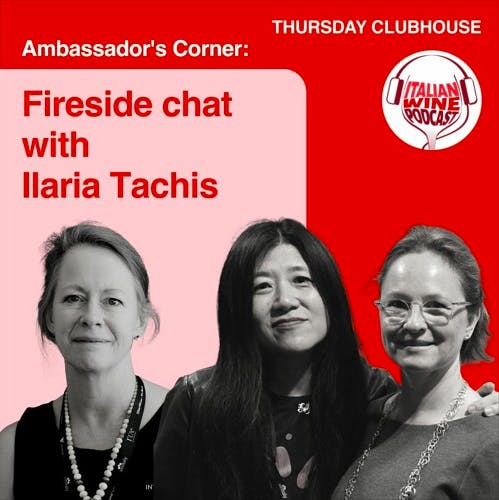
Ep. 662 Cynthia Chaplin Interviews Ilaria Tachis | Clubhouse Ambassadors Corner
Clubhouse Ambassadors Corner
Episode Summary
Content Analysis Key Themes and Main Ideas 1. The legacy and influence of legendary Italian winemaker Giacomo Tachis through his daughter, Ilaria Takis. 2. Ilaria Takis's personal journey in winemaking and her unique approach at Podere La Villa. 3. The development and characteristics of Ilaria's two flagship wines: Pargolo (Sangiovese/Merlot) and Jakamo (100% Merlot). 4. The importance of family, tradition, and an ""artisan"" philosophy in Italian winemaking. 5. Challenges and future prospects for Podere La Villa, including a new winery, new wine projects, and international market expansion. Summary This episode of the Italian Wine Podcast, part of the Ambassador's Corner series hosted by Cynthia Chaplin, features an interview with Ilaria Takis, daughter of the iconic Italian winemaker Giacomo Tachis. Ilaria discusses her personal path into winemaking, which began later in life after studying English literature, and how she inherited her father's passion and mentorship. She shares the story of Podere La Villa, the vineyard she started with her father and husband, Raffaele, and details her two main wines: Pargolo, a Sangiovese and Merlot blend named after her first son, and Jakamo, a 100% Merlot dedicated to her late father. The conversation delves into the strong family bond that underpins her work, emphasizing the crucial role of her husband and the hopes for her sons to continue the legacy. Ilaria also reveals plans for a new boutique winery set to open in Spring 2022, her intentions to produce a rosé and a high-quality Vin Santo, and her successful expansion into Asian markets (Japan, China, South Korea) and the US, despite her self-professed humility. Takeaways * Ilaria Takis is forging her own path in winemaking while honoring the legacy of her renowned father, Giacomo Tachis. * Her estate, Podere La Villa, located in San Casiano Valdipaza, produces two acclaimed wines: Pargolo (Sangiovese/Merlot Chianti Classico) and Jakamo (100% Merlot). * The Jakamo wine, a tribute to her father, has received high recognition (90 points from Wine Advocate and 5 Grappe from Vibenda). * Ilaria and her team are building a new, small-scale winery at Podere La Villa, expected to be completed in Spring 2022, alongside an organic vegetable garden. * Future wine projects include a rosé and a high-quality Vin Santo, following Giacomo Tachis's original formula. * The winery maintains an ""Artigiana Del Vino"" (wine artisan) philosophy, focusing on quality over large volumes. * Podere La Villa has successfully entered international markets, particularly in Japan, China, South Korea, and the United States. * Ilaria's husband, Raffaele, plays a vital role in the vineyard and winemaking operations, and there's hope for their sons to be involved in the future. * The property also offers hospitality with a vacation rental. Notable Quotes * ""I feel that my father is in my heart every day as well as my mother, and I have the strong feeling that his spirit is very close to me..."" - Ilaria Takis * ""I think it's really important that people know that Giacomo's daughter is creating new wines, not just carrying on the legend that he created, but starting her own future and her family's future as well."" - Cynthia Chaplin * ""I was fascinated by all these incredibly eccentric people I could meet through wine. And I was also fascinated by the history of each winery by the culture, by different, background they all Italian wineries have."" - Ilaria Takis * ""The beauty of Italy is this great wealth of unique native grape varieties."" - Unattributed (likely Ilaria from a previous thought process, but not in this transcription) * ""...we mean to produce no more than thirty thousand bottles of excellent wine."" - Ilaria Takis * ""You're too humble. If I might add, you know, we have to work on that."" - Stevie Kim to Ilaria * ""I think that, we are more Artigiana Delvino wine artisans and artisans need to be discovered."" - Ilaria Takis Related Topics or Follow-up Questions 1. What specific challenges and opportunities does Ilaria anticipate with the opening of her new boutique winery in Spring 2022? 2. How does Ilaria plan to market her wines more broadly given her self-described ""humble"" approach, and what role will digital platforms play? 3. What are the unique characteristics of the Sangiovese and Merlot grapes grown in San Casiano Valdipaza that contribute to the distinct flavor profile of her Pargolo and Jakamo wines? 4. Can Ilaria elaborate more on ""Jacamo's formula"" for Vin Santo, and how does she envision her version contributing to the revival of high-quality Vin Santo in Tuscany? 5. What are the long-term goals for Podere La Villa regarding sustainability and organic practices, especially with the new vegetable garden and olive groves?
About This Episode
The Italian wine club is hosting a clubhouse session on Italian wine podcasts and introduces new guest, Cynthia, who is part of their agenda. They discuss the success of their own wine, Pargolo, and the importance of social media. They also discuss the success of their own wine, SwamO, and their plans to expand their business in Asia. They discuss the Italian wine industry and their plans to build a wine cellar and plant a vegetable garden. They also discuss their plans to make their wine in another facility and give advice on planting a vegetable garden.
Transcript
Welcome to this special Italian wine podcast broadcast. This episode is a recording off clubhouse, the popular drop in audio chat. This clubhouse session was taken from the wine business club and Italian wine club. Listen in as wine lovers and experts alike engage in some great conversation on a range of topics in wine. If you enjoy listening, please consider donating through Italian wine podcast dot com. Any amount helps cover equipment, production, and publication costs. And remember to subscribe and rate our show wherever you tune in. Hi, everybody. Italian wine podcast celebrates its fourth anniversary this year, and we all love the great content they put out every day. Changing with Italian wine people has become a big part of our day, and the team in Verona needs to feel our love. Producing the show is not easy folks, hurting all those hosts, getting the interviews, dropping the clubhouse recordings, not to mention editing all the material. Let's give them a tangible fan hug when a contribution to all their costs, head to Italian wine podcast dot com, and click donate to show your love. Hey. My name is Stevie Kim, and welcome to Italian wine club. Today's call is what I believe to be our ninth installment of the Ambassador Scauna. Actually, our first our first of the series kickoff was with our current moderator, Cynthia Chaplin, And she's back. So since then, Armott squat, that's what I'd like to call all over ambassadors, Ommott squat, of Ambassador has interviewed Alberto Tasca, Elena Fucci, that wonderful interview from Shaolin, Rocco Tuscani, Roberto Dimeo, Stefano Carla, to name a few. In fact, I think we just dropped today Paul Balonia session with Masiano Brambilla today. On Italian wine podcast. So check that out if you missed that call. For those who are new in the audience, Ambassador's Corner is where Italian wine ambassadors like Cynthia and many others get a chance to nominate and interview their favorite Italian wine producers on Clubhouse. Don't forget to pig me, like, or joy if you like to nominate and interview your personal favorite Italian wine producers. As always, a quick shout out to like our backstage clubhouse manager, enjoy our Italian wine, podcast producer. So before we get on to today's show, as always, I need to remind you in the audience, and the panelists that this room indeed will be recorded and maybe played on the Italian wine podcast that we'd like to repurpose content because I think they are really can be interesting for others who are not present today. If you can give a thumbs up to the Italian wine podcast and radar podcast, wherever you get your we'd really appreciate that. And if you like to make a small donation, we love you even more. Let me now start, the show by saying a few words about Cynthia, your host Ambassador for today. Before we get to Cynthia, I just like to, you know, I I don't know. I don't see Lynn today, but I'd like to say something about Lynn because a lot of you have been asking about him. I know some of you are sad. Lan has left our group after five years. Believe me, it's no small miracle. He's lasted five years. He's thoroughly enjoying his retirement, as you can see from his social media, from from us, mostly from me, from in if anyone wants to hit him up. Obviously, he'll continue to be part of our community, and I personally like to thank him for all he has done for us and our group. Including driving me crazy. Grazia grazia Lance. So getting back to Cynthia, Lan's gone and now Cynthia has joined us. She's sitting right next to me in the Italian wine podcast booth. She clearly hasn't a clue what she's in for, but now she's still in her honeymoon, I believe, face. So we're glad to welcome her. Welcome, Cynthia. Thanks for having me, Stevy. She's our Neo Italian wine ambassador and will be part of the Via team with Yacopo and Rebecca. In short, you will be seeing a lot of her. So You know, I like to do two things before I hand the mic over and get on with my drink here. I met a little mix with Karucci and Malvasia puntinata. And Cynthia was like, I didn't come all the way here to drink Malvasia puntinata. That's another story. So what I what I always love to do with my, moderator is that I like to ask them one, why they've chosen this particular, producer in today, of course, is Ilaria Takis. The last time I've I saw her was in Admittedly. We did this iconic tasting in honor, of course, of her father, Jakima Takis. Wonderful. Wonderful. Wonderful. Wonderful. One of the more memorable tastings I've had in my wine career. And then the other thing, of course, because we like to make it a little bit educational, what the learning objectives are. So let's get to first why you've selected Iliya Takas as your interviewee today. So I selected Iliaria because I met her in a totally different way than Stevie did. I met Iliya just a very brief time after Jacquamo had passed away, in two thousand and sixteen, and she was doing a tasting of wines that she was making in the vineyard she created with her father. They did a vertical there. And after the tasting, which was incredible, of San Giovanni and Merlo Blend. She was left on her own while all of the dignitaries shall we say of of the evening chatted with others. And so I just sauntered up to her and said that her wines had really touched me and I was a great fan of her father, and I was sorry for her loss, and we got chatting. And we've become friends over the years. She kindly invited me to her vineyard and to her Agra Theresaismo. We've had some wonderful, evenings together, I've had the opportunity to meet her husband and her children and help her with her website. And I am very proud of everything she's accomplished since Chacamo died. I find her wines really come pelling with a great story. I fell in love with her pargolo, which we'll talk about later. And I think it's really important that people know that Giacomo's daughter is creating new wines, not just carrying on the legend that he created, but starting her own future and her family's future as well. Okay. Great. And what about the learning objectives? What are the learning objectives of today? Well, my objective really is to let people know that Ilaria Takis is out there making wine. Ilaria herself is a very humble person. She doesn't play off the history of her father at all, She is, a person who's very dedicated to what she's doing, not only in her vineyard, but in her garden, and as a mother, and as a wife. So I think it's important that people understand that Jakima's daughter is making wine in her own way her words to me when I first met her were she had taken everything she learned at his knee with, Sanjay and Cabernet blends, and she decided to make Sanjay and Merlo blends because they're more feminine. And I fell in love with that idea. Her wines are wonderful, and I think people need to know they're out there. Okay. Fantastic. Listen, just before I hand over the mic to you, I just want to remind her audience that next week, we have Hugh Prease interviewing Adiana Okeypinti. And we have whole loads of, program, which I will publish. I was a little bit busy going to Slovakia, which is actually, you know, Slovakia is actually a lot closer than you think because it's I crossed the border between Colio and, Colio equivalent to Colio, and Slovakia is called Verda, about ten times the past, few days. And, it was fascinating. I was a little, enthralled by my trick there. So I was a little bit busy. And, of course, at the office, but now I think, you know, we're going to go back to our full schedule of clubhouse. And we have everything lined up until, actually the fourteenth of October. I see like a two. So she's going to give me the, okay, fourteenth of October. She confirms So we have a lot already confirmed, and we will be looking forward to that. If you are interested, let me just remind you that you should hit up LICO or myself or Joy, on Italian wine podcast, and we will take your nomination into consideration. Okay, Cynthia. Take it away. Thanks, Stevy. Well, it is truly a pleasure for me to be here tonight and talking to Ilaria Takis, the daughter of Jacobotakis, the legendary winemaker, but more importantly to me personally is that Ilaria is a dear friend with a fascinating story and a wonderful, big, gigantic heart. So I'm very grateful that she accepted this invitation. Social media is not Alaria's favorite thing, so we're very blessed to have her with us this evening. She's coming to us from Sardinia. We'll talk about why she's there at the moment because normally she is buried in her household life, at Porterey La Villa in Tuscany. So I just want to say thank you to Eilaria and welcome her to Clubhouse. She joined it today, just so she could be here with us tonight. Hi, Eilaria. It's a great pleasure. I just want to let everyone who's listening know a little bit about your background, if you'll let me. Alaria always lets me do these things. I drag her kicking and screaming into social media and into websites that she doesn't want to have. So she's used to me telling her that she needs to do things that are more modern, but her background is in English literature, not in wine. So she she decided to go into wine quite late. She wasn't one of these winery children who, who stayed in wine for all of their life. She came into it later. And the the vineyard that she runs now called podrilla is one that she started with her father, Jacamo. So it it's really great fun for me to have you here and to be able to tell our listeners your story. I've been longing to do this as you know, Elyaria. I tease you all the time. About how how humble and how how generous you are with your time for me. So thank you so much for coming this evening. So I'm gonna just say that Elaria is in Sardinia, not on vacation because Elaria never takes a vacation. She's always very, very busy as as a mother and as, a winemaker with a quite a big, piece of land where she grows her tomatoes according to the cycles of the moon She really hangs on to the tradition of her mother, and and her father, both of whom were really important people in her lives. She was very close to both of them. So she's in Sardinia today, tenuta Asinara, who are honoring Jakamotakis by naming a street after them. So I just wanna ask, Iilaria, you and I talk about this a lot how it's been for you, since your your Babo died, in two thousand and sixteen, it's been a very big mantle for you to carry, a big responsibility, a big, legend to, to take on board, not what you like. I know you don't like the spotlight. So how has it been for the past five years. I feel that my father is in my heart every day as well as my mother, and I have the strong feeling that his spirit is very close to me and that and to my family and that many of the events we came across in the last years were there because he put them on our way. And many of the decisions we took, we took them with his approval. I really have this, strong feeling in my heart, and I also think that you'd be very happy about what we are doing in this way, I carry his mantle. I think that's exactly right. You've had so much, outside pressure in the past few years, a beautiful book written about Giacomo, so many other things, so many memorials and it's it's not easy to go through those moments, and you've carried it all with good grace and good humor and and really elegantly. So I'm so proud of you. And Thank you. It makes me smile that you're in Sardinia today to to be there for the street being named after Jacamo, because I know how much he loved Sardinia. Oh, Sardania was his second home. And today, I told the children, this is another gift from Nono Jaccamo. He wanted us to come to Sardinia again, I think. He loved, this, region. He loved the culture of Sardinia. He loved the wines. He loved the people. He was more Sardenian than Pemonteza despite his birth. Was in Piedmont, to place in Piedmont. But I think, his heart was in Tuscany, of course, and second place was Sardinia. I think that's really true. I'm very proud to be here. I'm very happy. I'm so glad. I think you're right. I know he's smiling down on you and the boys on on Sardinia today. Exactly. Exactly. And, we are going to tenuta Asinada tomorrow, because they are going to inaugurate, this street, heading to the winery in the name of my father. I didn't know much about this winery, until a few months ago when they contacted me, but I came to know that this was one or the last, consultations of my father, when he came to Sardinia and, the owners of this winery, at the very beginning, we are not winemakers or wine producers, but they where Alebatore, they, they had, I think sheep and, and other animals, and Azini from Azinara, so, Dancase, But my father, suggested that they could make wine because their soil was so located to winemaking. And since then, they started, and now they're very successful. And I'm looking forward to meeting them. I'm so glad to hear this. I anything that honors Jacquamo and that includes you always makes me happy. I'm I'm just gonna ask you quickly because we were talking about this morning and it's so fascinating about the wine that they're aging under the sea. Yes. I don't know much about it, but I read that, on the program that they are going to there will be a helicopter and they are going to, leave some, wine or grapes. I don't know, under, under water. Forty or fifty meters underwater. And we will also have the honor of tasting the wine that will be picked from the water, and that was aging for a few years. I think, and for the first time we are going to taste it together. So I'm very thrilled about it. So this is a great event. I I I think Bobbo must be laughing to to watch this. Yes. He he I think it's interesting from an archaeological point of view because I think that, people are going back to make wine like the Greeks made so many centuries ago, and my ma my father was always so excited about it. No. It's true. She loved archaeology, loved the whole history. And he always said that wine comes up from Greece and, even more east than Greece from Asia. So I think we are going back to the roots. I think that's great. And and he probably would have passed my Italian wine Ambassador exam in a much better, and more stylish way than I did knowing all of that history. But I'm I'm gonna ask you now about the vineyard that you created with Giacomo. It's called Podare La Vila in San Casiano Valdipaza, that you started, I believe. I think I remember you telling me two thousand and four with your husband Rafaelle and Giacomo. We well, I moved to this house in two thousand, which is a a typical Tuscan farmer house in the nearby of my parents' house. I moved, to this house in two thousand, and we had an old vineyard, only one active vineyard. Which, we gave to a neighbor who who had a little farm, a little winery, but we were not interested at that time in making wine. Then in two thousand and four, my father and guy, we decided to re plan the vineyard because it was too old and needed some renovation. And that's how it all started, and in two thousand and seven, we had our first harvest, which coincided with the birth of my first son Ricardo. And for this reason, we decided to make our own wine by the name of Pargolo, which is a tender expression to mean baby in the Italian language. The wine at Canti Classic was successful and we decided to continue this way. So that was our first step. This was the wine that I fell in love with when I met you. Yes. Exactly. For people who've never tried this wine, it's It's a sangiovese. It's a chianti classico, but Iilaria commissioned, an illustrator to make the label, which is a beautiful black and white, almost a a pen and ink pencil drawing of a helium balloon, but the balloon is all made of grapes, and it the basket has a stork. It's as if it's the baby that was arriving in your family, but also this new vineyard was also a baby. It's a wonderful, coming together of the the label, the land, the story, the vineyard, and the wine. This wine makes me very happy every time I presented the story is really beautiful. Yes. Thank you very much. It's true. There is a story behind this label, which was designed by a dear friend of mine, Anna Beliker, an incredible artist from Germany who lives in Tuscany, and she also designed my second label, Jacamo, but we are talking about it later. Going back to my, to my wine estate in two thousand and thirteen, we purchased some more actors because our neighbor one of our neighbors, decided to sell some of his vineyards, and we, took that chance to extend our vineyards, with the help of Alessandro Chilay, who is our current technologist and one of the dear friends and pupils of my father. Without Alejandro, we would never have taken this step. For for those of you who are listening who who don't know, Alejandro, July, as Elaria said, was one of Jacquamo's students. He is also the analogist at Castellare di Castellina, very famous Chianti Glassico, but he he's much more than just someone you work with, isn't he? He's much more like a brother. Exactly. He's more like a brother, like, yes. He's part of the family now. And we don't, move one single berry without asking him what we have to do. We we trust him one hundred percent, and he's a great, great man. And I'm very happy that he recovered because last year, he had, COVID and was very, very bad. He was in the hospital for various weeks and months. And now he's much, much better. And thank god. He's helping us again. And I saw him a few days ago, My husband was supposed to come with me to Sardinia, but Alessandro came to taste our merlot, and he said, no, no, Rafael. You are not going to Sardino. Stay here and harvest. The the grapes is ready to be harvested right now. We don't have to lose one day because this is the right point of maturation. We have to pick at the very peak of maturation at the very best to obtain the very best and the excellent wine. We hope we hope we hope to obtain And Alejandro has these piercing blue eyes. When he tells you you have to do something, you have to do it right now. You can't ignore him. Exactly. He's very bossy. He's very bossy. He's very bossy. He's very bossy. He's very bossy. He's very bossy. He's very bossy. He's very bossy. He's very bossy. But in a good way. So tell me about Pargolo. Tell me how the blend came because I know you had a lot to do with deciding what that blend was gonna be. Yes. At the at the very beginning, we had one single vineyard and that was, only sangiovese for eighty percent and the twenty percent of Merlo. So we put in the Pargolo Land only SanJerveze and Merlo. And, we we are understood, by the first vintages, which were two thousand and eight, twenty ten, that, this blend was a really good formula for us. The wine was incredibly, drinkable, fresh, with a lot of fruit and a lot of, plum in it, mini rolled. It was really a wine we liked. And that's why we decided to continue in that direction And for a few years, we made Pargolo using eighty percent of Sanjuveza and twenty percent Mirlo. Pargolo is Pargolo is the easiest class ago to, present and to discuss and to teach. I use this wine all the time when I'm doing tastings because it tells a story that's so honest and genuine. It really speaks of the land in San Casiano, It's it is a wonderful, wonderful blend. And what Iliaria is not saying because she never does, is that it was awarded ninety points, by the wine advocate. Well, you I'm sorry to interrupt you, she Cynthia, but I think there is a little mistake. Pargo was given, eighty eight points and Jakumo, ninety points by one spectator. Oh, I'm sorry. The other way round. My mistake. But anyway, I love Pargolo, and we always have very high scores also on Vibenda, with both with Pargolo and with, Jacamo. Everybody loves Pargolo. All our, customers come back and come back to us and us us to ship them Pargolo. Also, the private customers, it's incredibly it's incredibly loved this wine. I have to say that the area where we grow, Sanjay and Melo in Saint Kashano is a very special area because it's not the heart of the Kianti classical. It's not, Diana or Radha. We are only two hundreds and, two hundred three hundred meters above sea level. So we are a bit lower, in comparison to the other, communes of of of Canti classical. So we have a very, early maturation of the grids. But the, all our chianti classicals in this in the area of San Casiano have a particular taste. They are very drinkable, even if they are young. And, they have very rounded turnings and their fragrant, and they have a lot of mature fruit, which is what is really loved by most consumers at County classical. It's it's a beautiful beautiful vineyard, land rolling downhill which is really carefully cared for by Rafael Eilaria's husband. The the second wine that Eilaria makes besides Depargalo is Jakamo, obviously named for her father, which is one hundred percent Merlo. Is that right? One hundred percentoux and, we started to produce Jakumo, in two thousand and fourteen, which, if you remember, was a very bad year, bad vintage for many, many wineries and many regions. And, for this reason, in two thousand and fourteen, we decided to sell the whole, the all, all our grapes, especially Sanjay, but when we came to harvest the merlot, I found it was incredibly good. I loved it. I I I had the vision that this merlot could turn into a very, very good wine. And so I was harvesting. I was in the field, and I I told Rafael, I think we should not sell this Milo. And we called Castello de rampola where we made wine in the very beginning. And, we asked them if they had, a vet empty for us where we could, ferment, Merlo. And that's yes, there is. So straight we we took the grade straight away to Pansano. And a few years later, we discovered that this Merlo had turned into an incredibly, good excellent, really top. And, when we tasted it, the Alessandro, we were at the Castello de Ramona on a very nice and sunny, September morning, and we decided that this wine, we we both thought this wine would have been loved by my father, and we decided to name it to name it after him. And I think the same, illustrator did the label. Is that correct? It's a beautiful, drawing of Jakamou on the label. Yes. Exactly. And it ex exa it exalts his eyes, his nose, and his mouth. Which are where he's, Medi de Laavoro, how do you say his tools? Exactly. His his signature, his signature. His signature. Exactly. Exactly. And that that is the wine that, has received five grapple from Vibenda and the ninety points from from wine advocate. Yes. It's a wine with, it's a wine which ages in a a new barista for almost twenty four months. And, when you open, when you uncote a bottle of Jakumo, you have the sensation that you are in Tuscany despite, the international variety, which is Metlow. But Merlo, in our vineyards, have a very, very specific, characteristics, which you don't find in other regions or in other in other soils. And, it has this incredible centore, scent of vanilla chocolate, ripe cherry, plum. It has this persistent, aftertaste and finale. How do we say in Italian? And, and these solid tannins and a great organoleptic balance, which helped the wine have a long life ahead. This is best news to hear. That it's aging. Please correct me if I say something wrong in English because it's true that I studied English literature, but, the technical language when I go to to speak about wine, sometimes it's wrong. So you correct me if I'm wrong, please. Well, your English is better than my Italian. We we have, discussed this many times in the past, so I'm never going to correct you. The the the fun of this, because of where I'm sitting today in Verona with Stevie, in the Italian wine podcast booth, is that Iilaria came into the wine world because she was working at Vinitally just as something she didn't really want to do and she got fascinated there. Exactly. I I followed my father to me me, in Italy for many, many years since I was eighteen, maybe, yeah, nineteen. And I started by helping Marquise Gonzalez, Gonzaga, from Tinuca Saliano and a Castello de Rampola to rinse the glasses and to serve the glass to their customers, and that's how it all started. But I was fascinated by all these incredibly eccentric people I could meet through wine. And I was also fascinated by the history of each winery by the culture, by different, background they all Italian wineries have. It's something which is unique. You don't find in other parts of the world. Wherever you go in Italy, is each winery which state has it has been interesting to tell you about. And now before COVID, but I hope also after COVID, you've been taking your wines to Asia. So spreading the Italian wine joy and these Italian wine stories to another continent Yes. I think I have a link to Asia, and, Timmy will will be happy to hear that. And, our first importer was, Japanese important. It's still my best, important, one of my best friend. And, I traveled to Japan a couple of times and, the importers, came to visit us, and we have a great relationship, and I distribute a one in Tokyo, Ozaka, and also, the other, famous historical, Tokyo Ozaka, and the other one, it doesn't come to my mind. Anyway, it's a very famous, Japanese, town city. Maybe Kyoto? Kyoto. Exactly. Sorry. Kyoto. And, I I fell in love with Japan and with their culture, and our ambassador is lives in Rome. She's called Nika Hitakani. And she represents our wine importer, in Italy. So we're always in connection. And a few months ago, we started to ship a wine. We began to ship a wine to China to inner Mongolia. I'm I'm so happy about this. Start. And next month, we have an order ready for South Korea. So I I have a feeling that Asia will be very much in our life in the future. I'm really glad to hear this, and I'm glad to hear that you're leading the charge of Tuscan wines and Italian wines to Asia, to Korea, to China, and Japan, This is a big and very important market for all of the Italian wines these days. Exactly. Exactly. We also have a small importer in New York, and New York is a very important and fundamental area for, marketing our wine. And we also have, some connections and links in, the United Kingdom which I really love and and Germany, of course, and a little bit in Switzerland. I think your father would be very proud of everything that you've done in just such a short time with this vineyard. I also know you've got some really exciting projects happening there. You were saying that you used to make the wine, a Caselo, but not for very long. What's happening now? Yes. We found we decided that Cassello de Danpola was a little bit too far away from us and, and so we, decided to look for a wine cellar to, to construct or to rebuild, or and we, by chance, came across a beautiful, tinaya, which is an old name for meaning seller in the Tuscan tradition. And, we purchased an old Tania from, a ninety five years old lady called Maria Pannerai, and she was wife, the, but she was a widow, of course, after so many years, of Mr. Panirai, the man who invented, the first, diving watches during second World War, and Panirai is a very important brand for watches, Italy, of course. And she owned some vineyards and estates in the San Casiano area. And she decided to put them on sale because she didn't have any, sons and daughters, and she wanted to to get rid of them. And the last part, of, her properties, which was to sell was this tinaya. And she was very happy to sell it to me, and we are rebuilding it. It's, the tinaya, the container, the seller of a node Renaissance's Villa, maybe two kilometers from our weird, so very close. We hope to inaugurate it, in spring two thousand and twenty two. It's a big project. It's not a big winery. It's a small one, or it's just right for, our size. We have seven active vineyards, and we mean to produce no more than thirty thousand bottles of excellent wine. I'm really looking forward to coming and and raising a glass with you when you open the doors to that winery when it's finally finished. I know you've been waiting such a long time and and COVID, the pandemic stopped your work for a while, so it's good to know that it's up and going again. Yes. And we also had a lot of problems with a commune because this is an historic historical area. So we have a lot of strict rules before you do any changes, you have to ask for permissions. And you you know something about Italian bureaucracy. So Well, the the last thing I'm gonna ask you before I open it up to questions from our listeners is, about your your family and your hopes for the future. You have such a beautiful family with your two sons who are so charming and so talented. And I'm wondering if you think that either of them will follow you into the vineyard, keep keep Jacobo's legend going, stay with their father, Raphaelle, who's a a wonderful rock for you. Oh, he's he's without him, I wouldn't have done nothing. I'm sure. And, he's there. He's harvesting. He he's facing all the big problems with winemaking and transportation and cultivating the land. It would be very difficult without him. So we are real careful because we, not only we are in love, and we have to have two beautiful children, but we also share the same interests and the same love for our land. And I think also Rafael is a lot more funny than you are, Lara. I think he brings laughter into your life. Oh, yes. He is. He he is. He the last thing he told me today is that his tire was off, while while he was taking the the grapes to the seller and, and I said, oh, no, I'm so sorry. What happened to you? Don't worry. He said, I will come also by swimming, but I will come. That's that's the Raffella I know and love. He's he's the perfect. He's he has a big sense of humor and sometimes I miss that so he compensates. Good. Good. So what about these boys, Ricardo and Nikolo? What do you think? Are they coming in your vineyard with you? They always come to the vineyard with me and Raf, especially with Raf, more than with me, because the babo is, you know, he's the example to follow. But, both my parents, and Cynthia have always respected my interests and passions. And I think I will do the same with my boys. They love our little estate and projects. They like wine very much. It, even if they're very young, but they love wine and they love good food. So I hope that whether they decide to do to do what to do in the future, the one world will still be part of the life. And, Alvisi, who is Rafael as a son, and my stepson, he's studying agricultural in, Sami Kalia Ladiger in Trentino, and he's becoming passionate with our estate. Alviso is my stepson and Ricardo Nicola, my two sons, and they adore him. So I think that the three of them can do great things in the future. Even if they can choose to have another work on the site. I don't know, but I think they are very much in London. They have big roots in this estate. The this is Elaria's real heart and soul is her life as a mother and a wife. So I expected no less out of that answer, and it makes me smile. So I'm I'm I'm really happy to hear that things are going well for you. I know COVID was a difficult difficult time for for you and for so many of us, So it's it's really nice to know that you are gonna have a little bit of time celebrating your father in Sardinia that Rafael will get there and you have the boys with you, and I'm really looking forward to coming to, raise a glass with you to inaugurate the new winery. So at this point. Oh, you will we will be part of the team for sure. Thank you. At this point, I'll turn it over to Stevie so we can, ask our listeners if they have some questions for you. Thank you. Oh my god. I it's been so, so, so long. I can't believe it. Listen, I have a question. So how many how many labels do you have? You only have two labels. Is that correct? At the moment, we have two labels. And what is classical and and the Jakama. But as soon as we have, the wine facility ready for us, we in we mean to produce every server. A rosette, a rosette, a rosette for the summer and a vincento because we planted, a little parcel of our vineyards with vincento grapes. And we mean to make vincento, following Jacamo's formula. You remember that maybe I don't know if you know, but many years ago, I was maybe fifteen, sixteen years old. He wrote a book about Vincent. And, it's very disappointing to see that in Tuscany, many wineries don't make Vincanto anymore, or they don't make a good one. So with Alessando, we decided to make, a little quantity of Vincanto but of the best quality. And for this reason, we planted the santa grapes, last June. And what what is the volume of the productions? How many bottles do you produce of these two? We need, my potential Yeah. Our potential is thirty thousand bottles. Thirty thousand bottles. Thirty thousand bottles. And and The moment we produce only ten thousand because we don't have a fast one facility ready for us, and we have to make the wine in another facility. So you can basically drink all the wine in the family. At least my family, I think we can take care of that. And what and where do people like, first of all, what is the price point of your wine? Okay. If you go to a restaurant or to a wine, let's say to a wine shop, And I can tell you our, our, Vindita Director of prices, which is more or less the prices of wine shops. The Pargolo is sixteen euro one six. It's just one six. Yes. And the part and the jacqueam is thirty euro, three. Oh my goodness. It's just gonna I mean, I let me just buy them all. I mean, ten thousand bottles. My shop, an online shop. At the moment, we have only ten thousand bottles. But from next year, we mean to make much more thirty thousand. Mhmm. And maybe if we have a demand, we are going to raise a little bit the prizes. But I want to be humble at the beginning. You know, I I I don't want to be to show off just because I am Jacquamotakis too. You know, I think you have the other I think you have the other problem, to be quite honest, Deladia. You're too humble. If I might add, you know, we have to work on that. Listen, where can people find you? Like, I I kinda have a bone to pick about you because it's very, very difficult to find you and your wife. Like about us. I know, honey, but, like, I mean, if you have any ambition to, like, you know, make your wine or grow, you're right. You're right. You're right. You're right. You know, but I think that, we are more Artigiana Delvino wine artisans and artisans need to be discovered. It's more fun for people. It's an extra value. People leave it like an adventure and, Well, discovery is one thing, but being in hiding is an completely a different story. Right? Anyway, I gave you my website. Okay. What is your website? Yes. W w w. Tratino. How do you say Tratino? Oh my goodness. First of all, you have to get rid of the dash, the Tratino. That's a very bad website. It's not good for algorithm. Yeah. You're right. You're right. I will take this into into a high Yeah. Let's take off the dash. I let me give you some free free advice. Okay. Okay. Okay. And then the the normal one, not the under underliner, the normal one. Tatino la tatino villa does IT. Oh my goodness. Okay. We're gonna we're we're I'm going to have to come down and, you know, give you some free advice. Where are you located exactly? We are in San Casiano Valdeza. Okay. And do you have her hospitality? Yes. We have we have, a rental house, a vacation rental, which is always busy. We Now you tell me. It's September. I can't do vacation now. So you have a, so you have some hospitality. Yes. Yes. Yes. How many rooms have you got? We have, an apartment, accommodating six people. Mhmm. It's very nice. We have a large pool overlooking the vineyards, which is very beautiful. We have a fantastic view. Cynthia can con can confirm that. I can confirm that, and I'm I am also sitting here laughing because I have spent five years trying to boss Iliaria into getting social media. Now I hear Stevie do it really well. Steve is much more bossy than me. So I'm so happy. But we we now I have, a collaborator Barbara who is helping me. And in two, we can do many more things, and I have already seen it in the summer. We had a lot of work. So and she will take care of that. Well, let's do that. Let's make a deal. I'm you give me, Barbara's phone number, and I'm going to be reaching out to her to get to get some things done. Okay? Okay. Okay. One morning, you can reach her. She's in the office. Okay. Great. Listen, it's been so nice to hear your voice again, and I hope to see you very, very soon. Hopefully, Edvinitely, or we'll come and find you, maybe with the Chitascolastica, with our with our Via community. We'd love to see you what you are all about and, of course, taste your wines together. Can I say another few words? Sure. Of course. Absolutely. So what I wanted to to tell you is that in spring, we will have this new wine cellar, which will be a sort of wine boutique It's really, really a little jewel. And in front of a cellar, we will have a beautiful vegetable garden and, garden with olive trees, organic vegetables, and, all aromatic herbs, and it will be possible to be this beautiful garden as well, which will be, taken care and cultivated by some very high professional people. So I invite you to visit the winery and the garden starting from spring two thousand and two and twenty two. Fantastic. I will count on that. In the meantime, I think we'll have Andrei or our Italian wine Ambassador, same class as Cynthia. I I believe he has a question for you. Okay. Chandra. Hello. Hello. Nice to meet you, Andrea. Oh, wow. Anyhow, you just mentioned it as a question. You just mentioned it that you're planting some variety for your incentives. So I'll probably be speaking about white variety. Exactly. Exactly. But, speaking about what is your opinion about of your different nature? Yes. It's made it's made with red grapes. Exactly. I I want to go through it because, my my father was one of the creator of Ocudepinice and I tasted some some excellent Ocudepinice at Avinuneisse. Many, many years ago. And, we mean also to, take into consideration to make ocular d pernietta, but at the moment, we planted the white varieties, which were selected, by Alessandra, July, considering, what he's my father told him about Minsanto. So we have Trebiano, Malvasia, and epitit, and a little bit of, Gevurzramini, I think. Hello? Oh. Andrey? Yeah. No. I'm here. Yeah. Thanks for your answer, but I'm just, who would like to to to ask your opinion about this type of, Vincent. Is it, how to say more traditional. It will be a very traditional example with a little touch of Jakamu. So inside this, blend, you will we will have also some, varieties, a little bit of varieties which are not tuscan, and we will age the wine for four years minimum in small caratelli. And we will only make, small bottles of two fifty milliliters. So it will be very, a very high, let's see, high level, Vincent. Okay. Thank you. You're welcome. Great. I am going to close-up the room now, and I don't know if you have an, importer in France, but I see Fannie. Fannie, I think you should check her wine out. If you haven't already. And that is for now. Next week, don't forget to join us. We're going back to the eight PM slot with of course, our fermented boss. He is Hugh priest, one of our favorite ambassadors at lodge with Ariani Okeypinti. And that's it for today. Day. Listen to the Italian wine podcast wherever you get your podcasts. We're on SoundCloud, Apple podcasts, Spotify, email ifm, and more. Don't forget to subscribe and rate the show. If you enjoy listening, please consider donating through Italian wine podcast dot com. Any amount helps cover equipment, and publication costs. Until next time.
Episode Details
Related Episodes

Ep. 2789 ColleMassari: a long-term vision rooted in Montecucco with Giuseppe Di Gioia | On The Road With Stevie Kim
Episode 2789

Ep. 2788 Ep. 14: Austria and Hungary | Study Smart for your WSET Level 3
Episode 2788

Ep. 2785 From Volunteer to Speaker at TEXSOM with Samantha Cole Johnson | TEXSOM 2026
Episode 2785
Ep. 2766 Inside the U.S. Non-Alcoholic Wine Market: What Wineries Need to Know with Jill Sites | Masterclass US Wine Market
Episode 2766
Ep. 2761 Winemaking and Consulting Across Sicily with Alessandro Serughetti | Wine, Food & Travel with Marc Millon
Episode 2761

Ep. 2759 Part 2 – The VIA Educational Program & Italian Wine | Heart-to-Heart Conversation with Sarah Looper
Episode 2759