
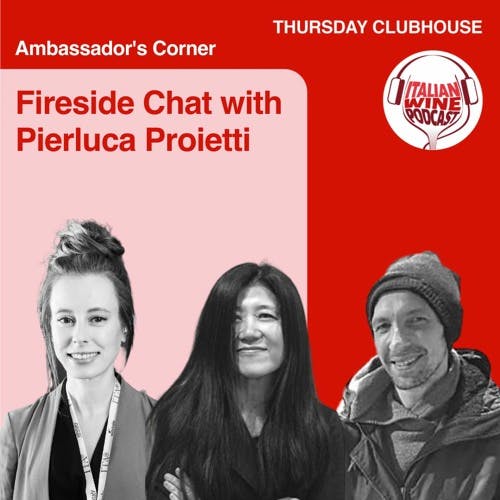
Ep. 826 Ashlee Howell Interviews Pierluca Proietti | Clubhouse Ambassador's Corner
Clubhouse Ambassadors’ Corner
Episode Summary
Content Analysis Key Themes and Main Ideas 1. The history and unique winemaking philosophy of Abia Nova winery in Lazio, Italy. 2. Pierluca Priyetti Avaya Nova's personal journey, influences, and dedication to traditional yet innovative viticulture. 3. The specific characteristics and challenges of volcanic soils in Lazio and their impact on native grape varieties like Chezzanese and Pasadena. 4. Abia Nova's strategies and adaptations in response to climate change in the vineyard and winery. 5. The integration of holistic agricultural practices, including animal husbandry, into viticulture. 6. The philosophy of producing wines that transmit values and stories, rather than conforming to trends. Summary This Italian Wine Podcast episode, recorded live on Clubhouse, features an interview with Pierluca Priyetti Avaya Nova, co-owner of Abia Nova winery in Lazio. Ashley Howell interviews Pierluca, who shares his deep connection to winemaking, stemming from his childhood involvement in his father's vineyards in the 1980s. He details Abia Nova's evolution, from early experiments with natural farming and fermentation methods in a social cellar alongside his cousin (2005-2009) to establishing their own project in 2013, focused on ""right wines"" with no additives. The discussion highlights the unique characteristics and challenges of Lazio's volcanic soils, particularly for native grapes like Chezzanese and Pasadena, and their potential for aging. Pierluca explains how Abia Nova adapts to climate change through meticulous soil management (green manure, bio-fertilizers) and careful plant care, aiming for balanced wines despite rising temperatures. He outlines future plans, including exploring new, high-altitude planting locations, further developing expressive white wines from Pasadena, and integrating animals like chickens and sheep into their vineyards for a more holistic approach to agriculture. Pierluca also discusses their olive oil project, producing single-cru oils with a similar philosophy of respecting terroir and tradition. He emphasizes Abia Nova's commitment to producing wines that convey values and narratives, valuing genuine consumer opinions over fleeting market trends. Takeaways * Abia Nova winery in Lazio practices a blended approach of traditional and natural farming, emphasizing minimal intervention and no additives. * Pierluca Priyetti Avaya Nova's winemaking philosophy is deeply rooted in personal history and influenced by pivotal moments and mentors. * Lazio's volcanic soils present specific challenges (e.g., pH, acidity) and opportunities for the aging potential of native Chezzanese and Pasadena grapes. * Abia Nova actively addresses climate change by focusing on soil health, adjusted pruning, and supporting plant resilience through natural methods. * The winery plans to expand plantings to higher-altitude, non-volcanic sites and further develop expressive white wines from Pasadena, potentially with skin contact. * A key future direction for Abia Nova's viticulture involves integrating animals (e.g., chickens, sheep) into the vineyards for a more harmonious and traditional agricultural ecosystem. * Pierluca respects consumer opinions but disregards passing wine trends, believing wine should transmit values and stories beyond being an alcoholic beverage. * Abia Nova also applies its ""cru"" concept and traditional, experimental approach to its olive oil production. * Historically, Andrea Franketti selected plants from Abia Nova's San Giovanni vineyard for his own Chezzanese plantings in Sicily. Notable Quotes * (Ashley Howell on Pierluca) ""He is such an interesting gentleman. He's, like, one of those special individuals that you rarely get the opportunity to cross paths with. Yeah. He's talented. He's dedicated. And he has the biggest heart."
About This Episode
During a podcast, various speakers discuss the importance of taterwines and the use of animals as a tool to understand the complexity of wine. They also discuss their plans to create new wines with a small creative base and their use of animals as a tool to understand the complexity of wine. They also mention their small vision for their own wine and their approach to taterwines. They encourage viewers to subscribe to their podcasts and donate through Italian wine podcast dot com.
Transcript
Welcome to this special Italian wine podcast broadcast. This episode is a recording off clubhouse, the popular drop in audio chat. This clubhouse session was taken from the wine business club and Italian wine club. Listen in as wine lovers and experts alike engage in some great conversation on a range of topics in wine. If you enjoy listening, please consider donating through Italian podcast dot com. Any amount helps cover equipment, production, and publication costs. And remember to subscribe and rate our show wherever you tune in. So welcome to Clubhouse, Ambassador's Corner. My name is Joy Livingston, and I'm staying for Stevie Kim, who is in Tuscany. She's on her way back, but the internet is a bit spotty. So I'm just stepping in for today. Today, we have, Pieriluca Priyetti Avaya Nova, who will be interviewed by Ashley Howell. Ashley, are you there? Good morning or good evening. I'm here. Wonderful. Nice to nice to hear your voice. Likewise Joy. So before we before I I'm just gonna give you a quick intro. I'm I was gonna before we start, I just wanted to, talk about the show. This is the thirty first show that we've done for the Ambassador's corner. It's been super popular. Every single one has been re replayed on the podcast, the Italian wine podcast, and it does really, really well because I'm sure you've heard TV say a bunch of times that, you know, Clubhouse has sort of waned in popularity after the, the pandemic sort of has been getting better. And but when we put put it on the podcast, it gets amazing listens And so it's also great because people who can't tune in in this time can listen to it whenever they like, which is wonderful all over the world. So it's for, you know, via community members. It's for Italian wine lovers. It's for pretty much everyone who is interested in wine because this is a really interesting way to get people together from all parts of the world and talk about talk about wine. So Ashley is going to be introducing she will introduce Pierluca, but I'm just gonna quickly introduce Ashley. She is from Vancouver, and she's, she's been doing many things. She's been in many roles in wine, in the wine trade over the past ten years. She's been a Somelier, to a consultant, to a buyer. She holds w set qualification, French, and Italian wine scholar certifications, and is evidently international academy, Italian wine Ambassador. That's actually where I I first met you. And after spending half of twenty nineteen in Italy, fully submerged in the culture, the vineyards, the language, the wine, the way life, she returned to Vancouver to share the best kept secret amongst Italy's highest quality niche producer. So I actually I what I did not know that you had returned to Vancouver. You're also, before I I I start talking to you, you're a freelance writer, and, you know, you've done a lot of, you know, you're always looking to travel and and just cover new wines. Actually, I thought you were still in Italy. I did not realize that you had returned to Vancouver. How how was your your time? Oh, it was amazing. But I've been kinda going back and forth whenever COVID doesn't get in my way. So that might be why you didn't think I came back because as soon as I come back, I'd be gone again. I I just recall before you left, you were, you know, we were talking and you were, you were, you know, trying to get organized and everything, and it was it was, yeah. I'm glad that you actually did it in the end and I knew that you had, but I thought you were still here. So how are how are things, otherwise No. Things are great. With COVID this past couple months, business has been a little bit slow, but restrictions were just lifted last week. So things are looking really good. From this weekend up until end of March. When I leave to come back to Italy, I have over forty tasting events and meetings, so I'll be really busy. Wow. That's a lot. Well, I'm I hope that, I hope we'll see each other when you get here before I I hand you over to to Pierluca, I wanted to just ask you, you know, because, of course, we we wanna know what educational value we're gonna get from from this this meeting. So tell us why you selected your favorite producer. It was really hard trying to decide which producer to select because I respect and I love so many, and especially all of my suppliers, I have that kind of relationship with, but this past November finally getting to meet Pierluca and Daniellele and Barbara of a Bienova experience was just one of the best ones I've ever had, with any winery, not even my anyone that I work with. So I definitely wanted to choose him. I wanted his story to get out. He is such an interesting gentleman. He's, like, one of those special individuals that you rarely get the opportunity to cross paths with. Yeah. He's talented. He's dedicated. And he has the biggest heart. I always learned so much from him, both in our Zoom calls and in person. And his wines have a be an over really speak for themselves. They have poise. They have flare. They're authentic. And his his project and his wines and his way of farming and living really became a place that my heart, like, resides with. Like, even when I first met him, he drove to my exit to meet me in Anyani. I had driven from Verona all the way to Peddio, and it was really late. It was two AM, and he even drove home to get me a cup so I could have T. B. For bed. So, I think that really speaks for the type of person that he is. Wow. That's that's pretty that's pretty nice. That's awesome. As far as, learning objectives, go ahead. I mean, I really hope that the audience becomes enlightened and informed and a little bit more curious about what's going on in lazio because I feel like sometimes that area gets overlooked. And, yeah, like, his his way of doing farming, like, the art of doing nothing is really interesting, and it will kinda leave you, like, stripped of your path, preconceived understandings of, you know, what it really needs to be working in harmony with nature. Cool. And and what, so how did you, you know, how did you discover the wines of, Abyanova? Like, when did you first taste them and say, wow, this is really great. I wanna go there. You know, my discovery of them was, completely unexpected and very much by chance. I was first contacted by them on Instagram, in late twenty twenty. And I was just in the early stages of my importing business So all my palettes were still on the way. I wasn't really looking to expand or grow when I hadn't even sold anything yet. And I've always loved Chase and AZ and been so curious about it because what's available on my market is pretty low. There's only one bottle and it's not anything exciting. And then when I spoke to them and I got to learn what they were doing with their Fukua method and biodynamic based raw wines, I couldn't say no to a case of samples. I was so curious. And I I instantly fell in love with them. I couldn't say no. And that's kind of how it started. Great. Okay. Well, I'm looking forward to hearing this, this interview. Pierre. Are you there? Hi, everyone. I'm here. Hi. Good afternoon to everyone. Good afternoon. So I'm gonna I'm gonna hand you over here to Ashley. And at the end, there there may not be time for questions, depending on how long this goes because we typically like to close the room after about an hour. And, Yeah. Until then. Ashley, take it away. Thanks, Joy. Chowuka. How are you? Thank you so much for being here today. Thank you. For most of the audience, you probably, no perluca, as one of the owners of Abia Nova. He also works with his cousin Daniele, and they work with this fabulous woman named Barbara. But he's got quite an interesting past. Pierluca kinda started out as an agricultural entrepreneur. And he's worked for many different research centers and companies, throughout Italy, and later on developing commercial strategies for farms and wineries. He also teaches and in Parelle's worked for the professorship of history of science in Rome's university, Lasapenza and has worked for the Italian and Cyclopedic Institute. But today, he deals mainly with the Viticulture Management of the family winery Abia Nova. So I'm gonna start off with my first question for Pierluca. Just to kinda get everyone familiar with what's going on with the Bia Nova. So can you share with us the history of your winery through to the evolution of today? Okay. Hi, everyone. Usually is a little bit complex because, as you said, I started and then I was, you know, in in a in a university in studying history of science at the same time from the early eighties, my father, started this hobby of buying all vineyards and video, those are planted in new vineyards. So I was involved as, you know, a weekend hobby in, agriculture until the early eighties. I was six years old when I planted with my father, my first video. But then when I started philosophy and his or your science, at the same time, I used to I used to work more and more in a repository with my father and he was so fascinated by, new movement of the biological of the culture. And I'm talking about the blade eighties. And The same time, my cousin started his degree in winemaking and Enology in Pardon. We talk about a lot of times of stop making wines but we just wanted to focus on different kind of agriculture that we could do in other places. We did a lot of courses, so natural agriculture, people coming through, fighting on agriculture, in the 90s and the first year between two thousand and two thousand and two thousand and five. After his degree, my cousin come back in Pigo and started as a director of the social seller, the country planner that we have in our town. This was the beginning of our history because he has he had a lot of bets of different materials to do a lot of experiments from different crews that that time we yet had in our in our company. I'm talking about two thousand and five. So So I'm talking about the year years between two thousand and five and two thousand and nine. We, me and my cousin did, a lot of experiments into the social seller that where my cousin was the director. Different kind of fermentations, double fermentations. We we tried on one hand to respect the tradition at the same time to do new things with our wine grapes. And, you know, we cultivated traditional wine grapes from lots, such as Anese and Pasadena. And we didn't have so much literature, about them. So we need to explore new phases of those wine grapes in a small time with the fermentations include in different kind of woods and steel in concrete and salmon and then in jar in glass. And this was the period that we use to to wait until opening our new project, our project. We spent about five years, six year And in two thousand and thirteen, after two years, between two thousand and eleven, two thousand and thirteen, I left BU to join an experience in Tenglala Drinor with Andrea Franketti. Then I came back and we started at Vienna. At that time, we we had all the crews, not so much as today. Now we have about seven crews and we are improving other small vineyards and small parcels. And at the same time, we realize that we have the right experience to to, you know, to manage different kind of natural fermentation. The period that we spend in the social seller was to be more confident with, making right wines. I use this word, right, right wines, correct wines, linear wines, making different kind of natural agriculture and new vineyards. And at the same time, to ferment grapes and age the wines with no ads. And that's all that's all from, you know, as a stronghold. So, an history, a straight history of Abianola. We started in two thousand and thirteen, but we started before in nineteen eighty one when we were a child. We were a child. Thank you so much, Pierluca. I just wanna recommend a book just to the audience really quickly. If anyone wants to read a bit more, on the method that Pierluca really kind of has based a lot of his agricultural practices off of. It's called the one star revolution, and it's He actually, Pierre Luca recommended it to me, and it's just a fantastic book, and it really opens up your eyes to so many things. So Pierre Luca, I know you started with your dad, like, as a child in the vineyard, but when did you really discover that you know, your your calling in life was to be in line that this is what you wanted to do. I've yeah. Probably there were two times in my life. The first time was in nineteen ninety seven when, a small producer from a small town near video, brought me a bottle of Chezzanese of ninety eighty one. Until the time I thought that Chezzanese could not be a wine for long aging. And for some point of view, this is what I think right now. But sometimes you could find beautiful gems. And I mean, with beautiful gems, I mean, beautiful, small parcels. Which could give you really long age and why. At the same time, the other the other, yeah, the other important things to discover that my life was cool to be in wine is was when I in two thousand and two, I met Alezandro Masetti. I was involved in wine. I was I had all my degrees with by the social soon italia as a as a taster. But reading for the first time his guide in two thousand and two was a kind of urethra for me. Because he wrote in a different way about wine, and using words that could express something more than a straight description of the flavors. And when I met him, I found that something could be done also in this place. As I said, I was a taster. I taste a lot of beautiful wines from all over Italy, from France, I was really enthusiastic about, you know, the great name that we have in Italy, but I didn't think the time that me in that small and common place with this kind of wine rates could could do, you know, good wines, fine wines. Yeah, I remember this two times just two times I discovered that. I could be involved in wine. Thank you, Priluka. Now I kinda have a question that ties into the my next question I had planned to ask you. But you were talking about how, you know, you weren't really thinking that Chase and AZ could be a great to age for a long time, but with, you know, really special, you know, individualistic parcels of land, that can produce special wines, this can happen. Now I know with the small different, single vineyards that you work with, you do have a different variety of soil types. Now is there some that you think are better than others and have longer potential for aging. I know they're also very different, but what is your take on that? Well, Chasanese, yeah, I need a little a little a little hack about Chasanese and Pasadena and about the soil. General soil that we have. We are on a volcanic soil. In this kind of soil, the fruits to be eaten are really good. But when you have to face yourself with fruits, that had to be has to be fermented. They have to be fermented. Sorry. Now there's a problem because the pH and acidity in a volcanic soil you know, dense too much, in particular before fifteen days, twenty days before harvesting. And when you compare your wines on a volcanic soil. With the Greek wines, all over the world, you see that you need acidity, you need strong tendons sometimes. And at the same time, you need low pH Well, I and this is good for long aging. So we tried to all over the year to do something into the soil in a natural way just to give all those wine grapes that we have the strength to be aged and not so sweet because another objective of the wines from a volcanic soil is that the flavors in the mouth, is something too much sweet. At the same time, when you work with Parcels, so when you work when you work with Cruise, you realize that even if you are in a general volcanic soil, not every place is similar to the other. And we started in nineteen ninety five And we started in two thousand and five, as I said before, to ferment grapes from old vineyards from all over the town, Opillo. And in five years, we realized that in some places, when in particular, there are more rocks into the soil with the volcanic clay that we have. The wines could have more chances to be, you know, similar to the grid wines of the word that we know, big potential of aging And at the same time, sweetness, which is not sweet, sweetness with, which is, you know, to be soft kind of softness in the mouth with the violet flavors all around your nose. And this was the skeleton of our point of view on the age chosenese. And, no, of the eight chardonnese. And that's why we used to ferment badly called the parcels and all the parcels we have have more or less potential to be aged. Consider that also we used to pick some other small parcels into the prues that we have because we you know, we realized that in every single person, we have some plans more, you know, more yeah. There were better for this idea of cruise as a long age, Gisonese or Pasadena. At the same time, the oldest wine grapes that we have So the ones that were planted here in the Roman during the Roman period and the medieval ages, they also have a big potential, but only when they are blended into the classic bottle of Chasanilla del pio or Pasadena and other foods in art. And we realized that the picture of the old vineyards that we have and all the old vineyards that are in pio are a kind of picture of the best one you can do from these places. So the right percentage of plants into the vineyards is is the right percentage of the wine into a bottle. Usually eighty five, eighty percent of the main wine grapes. So Cesar, Pasadena, and the rest of the other ancient oldest wine grapes that helps that helps, sorry, the, Cesar, Pasadena to be great in a aging point of view. Thank you, Priluca. Now I know you mostly work with Chezonese de fillet, but you do have a little bit of Chezonese in Australia on your parcel single vineyard Burlame crew. That you use to make your rose. Now maybe can you talk a little bit about the types of wines that come from a sandy soil rather than the rest being all volcanic based. And are you considering on planting more chasanese in Australia. It's not really seen very much, and it's very much kind of like a lightly resurrected grape. Oh, yeah. Verlame. Verlame crew, I planted Balami crew, crew in two thousand and two, for this reason. Because, dispersal, this placing PO is one of the few ones with no volcanic soil is a sandy beach, kinda beach soil. And by the, Imperial NERba, who's called the lake, that that's why the sand is solid, not volcanic soil there. And me and my father both this place in two thousand and two thousand and two, I started planted those two hectares. At the same time, we rediscover what is called here Chazanese in Australia, as I said before, was one of the additive wine grapes to the Chazanese Dela Fila. Chazanese Mostrano is one of the father of Sanjuvez. He is also called encephalography Myoleka. You can also find other plans of south of market. That's The reason is that just like the Pasadena, the, Chazanese and Australia was, so the majorlika was planted by the pope's So we are talking about not the Roman imperial but the medieval ages, and they used to plant Pasadena in Chazanese and Australia there in south of market on that kind of play which is similar to the center, Italy clay, just like in umbria and Tuscany. They realized that Chazanese could not work in the kind of play. But the Chazanese and Australia is really interesting because it gives you gives to the wine more acidity, more power. And his tendons are really similar to the Sanja And when you as I said before, when you when you when you make a picture of an old vineyard in Pea, you find a lot of plants in that fifteen percent of Chaznez and Australia. When we replanted the Chaznez and Australia, We realized we we really really really really really liked the Jose wines all over the world. Our first team was to make a good our first Japanese. So our first bottle was, was a good was a Rosier. After some experiments, we realized that half percent of Chizanisiraphil and half percent of Chizanisirano could be the direct blend, a modern blend of making a rosette with not sweet not so sweetness, but the same time with a roof tending to, you know, to be similar to a white at the same time do a light breath. How about your question of planting new vineyards? Yes. We are planting now other three actors in two years and five actors and a half in So total in six year years. And we are focused on different places. If we follow what I was talking about before the fact that the quantity of potassium in, in a volcanic place or it's a kind of problem to make long aging wine or not so sweet wines. We are focusing on the mountains that we have on our shoulder. The main mountain is the Montez Calamra, which is the first mountain before the Panini. So before the border with, with the Abruzzo region. And we are focusing on some places on the mountain on one hand, a one thousand meters high altitude with a lot of rocks inside just because we want to see what is the reaction of the plant at the same time of the grape. So the pH and acidity on a different kind of soil with volcanic with volcano soil inside. So the the answer is, yes, we are nina, you know, continuous. We're, yeah, we're always think about plant new vineyards because we just wanna see all the phases of Chazanese in places where they didn't used to plan until, you know, twenty or thirty year before years before. Thank you, Priluka. Now when I was there in November, it was very humid and a little bit unusual, like you were telling me that past few years have been getting warmer with kind of strange vegetation kinda growing up. How do you feel about climate change and, like, the recent vintage variations in general? And how do they impact your decision as a winemaker in both the winery and the vineyard and what can consumers expect? I remember that we really talk a lot about the climate change. The climate change is a fact. It's a, you know, global fact. But as we say in November, every small region has its consequences on the climate by the climate change. So in our place, you know, in South Elazzo, the consequences of climate change are quite different from what is happening now in Piedmont or in Vanital or in a middle man. What happened here in the last in the last twenty years. Yes, I'll lower humidity more than before. The same temperature differences between night and day, but at the same time, whole temperature increase of about five, six, seven degrees. So if twenty years ago, you have during the summer, thirteen during the night, thirty three maximum during the day. Now you have the same difference. So twenty, about nineteen, twenty, and humid during the night and forty during the day. At the same time, wet, wet, wet. And we have old summers, with, one or two hours of rain in the afternoon. This is not a problem for the forty plants for the diseases for the meal use. It's not a problem for us. Probably I can explain you why it's not a problem for us. The problem is that the soil reacts in a different way to the wet. I think that we found our solution, all the consequences of time and change changes on our place. We used to take care more of the soil than before with some practices that we experimented in the last five, ten years. First, to use green manure, more than usual manure for the soil. To let the soil be less wet than the weather upside. And at the same time, we started making our own bio fertilizers with, So micro elements fermented with milk. So, electric fermentation with no ads just like you found in, all the products you you can find on the market. And at the same time, we used to respect the plan more than before. So during the pruning, to prune less, than before to leave the green during the season more free than before. This, this kind of approach helped us. We are looking at how the plans are reacting now to what we are doing on them. And this was what we did to face the kind of climate change we have in our place, about the consumer, and about how do our, how our wines, how Cisnezae are changing into the glass. I can say that the first big difference in contemporary fermented Chazonese is the high degree of alcohol. If you are not acting on the plants in a natural but sanctioned way. So the danger is to make, one of fifteen, sixteen, seventeen degrees alcohol. It's so it's so easy to do that if you don't take care of the plants in a right way. I mean, I don't want to make thirteen or thirty an ounce degree alcohol wine just because the market requires did for me, but because I don't like those kind of wines because there are no balanced. There are no balanced because the plans are no balanced in facing the the climate change. What is in our bottle now after this climate change? Not the the same wine. The wine are the wines are the wines are, you know, They show they show themselves more than in the past. They show more themselves. And you can fill them ready before Yeah. Yeah. More ready than before. More ready than before. Ready to drink. So that's why it's more difficult now to find the right plans to do a long age one, it's more difficult. But if you have some, you know, some theories to apply different kind of theories to applying our plans, and I mean, I mean, natural natural, natural fears about agriculture. You can face the climate change at first to protect the plants. And then the consequences is that the wine could express itself The same way is different from ten, twenty years twenty years ago, but it's expressed. And this is the most important thing. I think that the, customers and the consumers are all over the world want to feel different kind of expressions of the wines because wine has to tell them something which is global but comes from a small window from a small place just like the place where willy. Thank you, Priluca. I mean, that is right to say because For example, I have the crews in my market that are only a couple years old and they're already, released now getting into the next vintage, which is unheard of in most other areas for a crew to be released two years after it was picked. Like, where do you see a BiaNova going in, say, five years in terms of styles, and volumes produced? Well, about the styles. I don't know. About good. Chism as a style. I hold it just as a style. I think that we started, good path. Of, you know, looking at this wine grape about five, six years ago. And probably, we are going to go on this path because we like it. The probably the last the last thing, I think one of the best thing that we made three, four years ago, was the entry level wine, and it was really hard for us to make this kind of one because it's blend old crew oval cruise, pick before the the right the right time for for the harvest is the sense of vandalism. And sense of underestimate, you know, show show show does, another another pet to follow for the daily wines and is, you know, is in line with the traditional of these places. Probably in five years, after those first years where we tried to discover the skeleton on the wine grapes that we we work with, and that's why we started with Rosato. Is really the skeleton of the wine rack we work with. Probably after this, the same job made on the Pasadena, we are going to We are going to express more the the the the the complexity which leaves inside the Pasadena making More can conduct warm wine zone is fine grained. I mean, not orange wine. I mean, more conduct, and it depends on the vintages. So this is what I see in the next five years. So more cruise. More cruise, more cruise from Rosado. And at the same time, mostly on the white wines. Because now we have the experience to to do that. I really disagree with people who at the first vintage want to make orange wine just because it's a skin conduct. And it's orange. It's a kind of, you know, mixed between white and a red I don't like this philosophy. I really like to do an expressive wine, and I think that Pasadena needs more spin on it. If you want to specify, it's at a in in a better at a better stage At the same time, as I said before, I look at I look at Avianova as, as, why don't we, yeah, I'm sure with more persons, more uncommon place to plant So on the mountain, on the rocks, just because now the climate change retires this. And the same time, I just would like to feel and probably this is uncommon for this modern drinkable wine era. I just want more, you know, more muscles on the wines. So I'm, you know, I'm thinking about the old fashioned way of making wine in the nineties also for Chezonese. I would like to find a way of dynamic dynamic wines, even if they are more pathetic. So there's more with more with more things inside. So there has to be they have to be drinkable, but at the same time, by powerful, kind of contemporary way of looking out the powerful wine. And then about about, you know, agronomy point of view, it's where we started about one year and an off goal. As she said, we used to mix a lot of agriculture together. And it's a pathway that we are following. So we have no receipts. We have no receipts. We started a lot and experimental experiment is a lot of different kind of agriculture and mixed it them together all over the years. But from all those theories, we realized that there was one thing that we didn't do to work also with animals as a helpful and helpful things to understand better better the lean between soil and the sky. And if you read, you know, a lot of manuals, contemporary manuals, but also the classical manuals from the the Greek period to the medieval pages to Renaissance, you you will see that there is no agriculture with without animals. And, we realized starting and starting that what you can, you know, what you can see from from chickens or ships or coast, free into the vineyards or asking them help for your your job. It's a vision of what is happening into the soil and into the plants similar to you. So it's similar to human being. I think that in five years, we you will find a lot of animals inside the vineyards and our aisles, more aisles of vineyards that we have. And I'm really proud of this idea really excited to to to see how how our our job will change with all this helpful being with us working with us. Thank you, Priluca. So which wine that you produce are you most proud of and why? Well, it's a it's a it's a hard question. It's a hard question. My answer is, is temporary. And this period, I realized that the San Giovanni group, which is the the oldest one, the oldest vineyard that we have is a nine years old vineyard. Probably is the one where I make the wine I'm most proud of because, everything at first from an agriculture point of view. Everything we did on this vineyard, gave us a lot of exceptional results in terms of plans. And I'm talking about old plans. So when you talk about old plans, you talk about something something where you can't face without, you know, with with without lightness. And I saw this vineyard react from A lot of things that we did in we did in it. And at the same time, I'm really proud of the fact that the, you know, the the soul of the wine from San Giovanni Group. It's always the same. I mean, the soul. I'm really proud of the fact that from this point of view, Natural, if we can we can talk about nature. It's not nature because we're talking about agriculture. And agriculture is health nature and health human, but I'm, you know, I'm really probably the fact that nature answers to what you are doing on it, but at the same time, nature is the chief, and you find it into the wines. I mean, this, remind reminds me a wine made by Andre francheti on Mount Aetna. It's one of his one of his crew. It's called Ramante. Fanketti was a man with a really strength, was powerful as a person and powerful into the vineyard sauce as a vineyard is also. And I realized that internal or impossible shot a lot of wines, a lot of wines was really built on his personality. But when I tasted And when I taste on Prada rampan, the I found that it was really, really frank, really fight between the man and the old vineyard there. And at least list him if you find his influence. So the influence of the man on the vineyard and on the wine. At the end, the wine as more powerful than the than the man. And he was proud of of this one. He was proud of this one because, the vineyard the vineyard reacted to him as a human being. Thank you for mentioning that prialukai. I was actually going to say, the cheese and a z that Franketti took to Sichilia was from, your son, Sandra Bani vineyard, if that's correct. Yeah. Yes. Franketti Franketti was, was one of my father friends, and, his father used to used to come a lot of time in PEO during the, you know, after the first work, he used to used to go to the mountains that we have on our shoulder and used to bring with him in Rome, bottles of Chazanese. Franketti planted his first Chazanese vineyard in nineteen ninety five And in nine between nineteen ninety three and nineteen ninety four, he came about fifteen times per summer to select the plans. He selected this beautiful select beautiful muscle selection of plants from San Giovanni vineyard and from other two small vineyards in PEO nine. The first one is owned by Another, I think, one of the best winemaker that we have in Peo, is Maria Nestabirucci. And she is making beautiful wines the other, the other vineyard is owned by a historical producer. His name is Antona Lokolletti Gohanty. Is a kind of old style producer producer, but with different different chisonese from the wines that Avianova or Maria make, but you will film that wine a lot of intention. So Franketia came here to to Planches, and this is the first that internulated noto danny Calfe de Vineier in two thousand and one. And he made three vintages of this beautiful wine called cinci natto. Ninety seven, ninety one, two thousand one, and then planted planted chiseled, Mount Aetna. You know, it's reasonable. It's reasonable because Mount Aetna is sandable from its soil. It's a high altitude, a lot of rocks, volcanic rocks, and now the this vineyard, is used to make, the francheti, which is a a blend of And, yeah, your selection was made here in PU. Thank you. I figured that our via community would find that interesting as we were just there in October on Mount Aetna visiting Franketti's winery. So, Pierre Luca, like, I think I might already know the answer to this, but do consumer trends and opinions hold any place of value to you, with the direction that you take with the BNova? I mean, probably not the trends because if I translate trends, Italian trend means something which is followed without thinking. So if trend it trends mean that, no, I don't follow trends. At the same time, I follow lot of opinions from all over the world. I really like people opinions. Opinions about my wines, opinions about what we are doing into the vineyard. If people if people find something which is not good or strange about, for example, this mixture of different kind of agriculture that we do. I really listen to them. It happens a lot of times. So opinions have a great place of value. In our also in our directions. But if I have to, to give you an example about the trends now in Italy or in other places in the world that has a term of drinkable wines, funky drinkable wines. Well, this has not place of value. In our point of view because we we only have this vision to make modern wines with a tool of tradition. And I'm sure that This word and the word of wine of all the wine enthusiasts all over the world could reserve a place for us. A small place. We need a small place. But if this most place is a place where on one hand, me and my cousin who are doing this kind of job of transmit values, and at the same time, we have on the other end people were really thirsty of values from the wine. Now it's perfect. The time is perfect. So we know that we probably will not be the wine real thousand and thousand and hundred thousand bugs. So tashionable wines. But at the same times, we know that our path to that we are following to make wine, which transmits values. It's a good things for people, enthusiasts, and people who people who want to find into the wine something more than Alcohol beverage. This is our direction, direction. And as you know, when we started, we decided to share our experience and, you know, and make this kind of wine in modern times to share this experience all over the world. We realized that in every place, in every city that is people who answered to our questions that we put into our bottles. And that's cool. It's our small vision of the word. It and it's small because it comes from a small place with a long tradition. It's just like when you when you read books from different authors from different places, it's the same thing. It's the transmit values, and it's an aesthetic question This is our point of view. And that's why we, you know, we don't follow too much the trends, but we follow too much opinions of people. Thank you, Priluca. I love that. Something more than, beverage alcohol. I mean, you're not a wine for everyone, but, you know, you're truly something special. And, I think it really shows Hopefully, if there's anyone in the audience that has not had the chance to try Bienova, they're, excited to go out and find some now. Carluca, can you share with us briefly your olive oil project, that you've been working on, and that's finally ready for sale? Oh, it's a it's a yeah. The old project is an old project. If I could have a step behind what one of your first question probably in the next five years, I will see Avianova, not only with a lot of animals, but also with other different cultures. Olive oil is the first, but then we have projects of making fermented herbs and we experiment this kind of project starting about six years, seven years ago. We have here a long tradition of herbs from from the monasteries that we have. After tasting kombucha, we really like Kombucha, we realized that with this kind of hurts that we have, we could match ourselves with making fermenting stuff from them. Now as an experiment. But the olive oil is a is a standard tune for our places. And consider that we started making I started before Rapinova. I started making cruise of olive oil between two thousand and two thousand and five. We own about five crews of olive oil with different varieties. The, you know, the main one is called marrone, which is the trana. It's probably the most common in ratio. It's a beautiful variety. Then we have another good variety, which is the rosholla, which is a delicate extra virgin olive oil in opposite to the, to the ituran. Just really strong flavor with a lot of green flavor. And at the same time, we have the usual Italian central. It's a central Italy, varieties just like, m, Latino or yeah, also the Escolano we have here. But our project is to the main aim of our project is to make cruise of olive oil just like just like that, just like we, we, we, we, the same as we do in in our wines. When I made that in that five years between two thousand and two thousand and five, I find a lot of differences between one another pistol. I talked my cousin about, you know, six years ago when we real we realized that our process in making good wines. It's not complete, but is on a good stage. We need to start also the olive oil. The olive oil project. I just want to discover other things, making oil because, you know, the classical classical tasting of the extra virgin olive oil is to feel freshness is to to fill the green balance. I just want to discover new path from this point of view. I just want to do, I just want to to to find what could be an oil with more oxidation with a small fermentation, which is not good from a standard tasting. I just wanna see what, well, what could happen because it was a tradition here to make oil. Alibaba also that way, that way. That's why it's it's another time a kind of rediscover or tradition and see if this tradition with the aesthetic values could be shared with other people all over the world. And that's all. And we are starting now. We're starting now with the olive oil. When with a two thousand and twenty one harvest. And we're gonna see we're gonna see what could happen next years. Thank you so much, Pierluca. I'm gonna give the mic over to Joy now as I've just about running out of time here. Okay. Ciao, and, yeah, happy birthday, Steveie. Alright. Happy birthday, Steveie. Listen to the Italian wine podcast wherever you get your podcasts. We're on SoundCloud, Apple Podcasts, Spotify, HimalIFM, and more. Don't forget to subscribe and break the show. If you enjoy listening, please consider donating through Italian wine podcast dot com. Any amount helps cover equipment, production, and publication costs. Until next time, teaching. Hi, guys. I'm Joy Livingston, and I am the producer of the Italian wine podcast. Thank you for listening. We are the only wine podcast that has been doing a daily show since the pandemic began. This is a labor of love and we are committed to bringing you free content every day. Of course, this takes time and effort not to mention the cost of equipment, production, and editing. We would be grateful for your donations, suggestions, requests, and ideas. For more information on how to get in touch, go to Italian wine podcast dot com.
Episode Details
Related Episodes

Ep. 2789 ColleMassari: a long-term vision rooted in Montecucco with Giuseppe Di Gioia | On The Road With Stevie Kim
Episode 2789

Ep. 2788 Ep. 14: Austria and Hungary | Study Smart for your WSET Level 3
Episode 2788

Ep. 2785 From Volunteer to Speaker at TEXSOM with Samantha Cole Johnson | TEXSOM 2026
Episode 2785
Ep. 2766 Inside the U.S. Non-Alcoholic Wine Market: What Wineries Need to Know with Jill Sites | Masterclass US Wine Market
Episode 2766
Ep. 2761 Winemaking and Consulting Across Sicily with Alessandro Serughetti | Wine, Food & Travel with Marc Millon
Episode 2761

Ep. 2759 Part 2 – The VIA Educational Program & Italian Wine | Heart-to-Heart Conversation with Sarah Looper
Episode 2759