
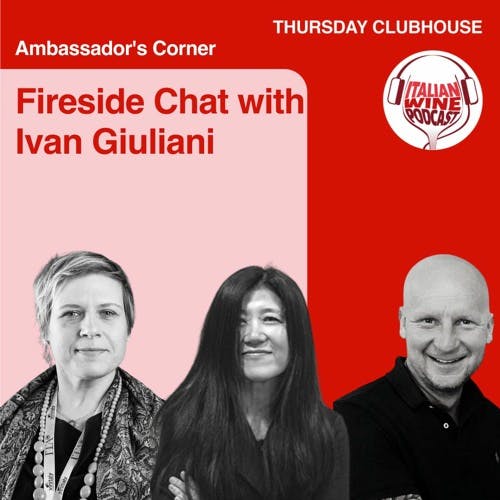
Ep. 882 Emilia Marinig Interviews Ivan Giuliani | Clubhouse Ambassador's Corner
Clubhouse Ambassadors’ Corner
Episode Summary
Content Analysis Key Themes and Main Ideas 1. The personal journey of winemaker Ivan and the family estate in Lunigiana. 2. The unique terroir and historical viticulture of the Lunigiana region (bordering Liguria and Tuscany). 3. The discovery, rescue, and cultivation of indigenous grape varieties. 4. The practice and challenges of ""heroic viticulture"" on steep, terraced vineyards. 5. Commitment to sustainable, organic, and biodynamic winemaking. 6. The role of a ""guardian vigneron"" in preserving land, heritage, and tradition. 7. The impact of climate change and land abandonment on traditional wine regions. Summary This episode of the Italian Wine Podcast features an interview with Ivan, a winemaker from the Lunigiana region, located on the border of Liguria and Tuscany. Ivan shares his personal story, from returning to his family's small plot of land in 1993, abandoning a career in economics, to dedicating himself to winemaking. He describes the challenging but unique terroir of Lunigiana, characterized by diverse soils and proximity to both the Tyrrhenian Sea and the Alpi Apuane. A central theme is Ivan's commitment to rescuing and cultivating indigenous grape varieties from extinction, a project he undertakes with the University of Pisa, having identified 256 native grapes. He delves into Vermentino Nero, a rare local grape, sharing findings that its DNA is unique in Europe and not a mutation of white Vermentino. Ivan highlights the demands of ""heroic viticulture"" in areas like Candia (near marble quarries) and Cinque Terre, where extremely steep, terraced vineyards necessitate manual labor and high planting densities. He firmly believes in organic and biodynamic practices, viewing the vine as a ""subject"" to be nurtured. Ivan also discusses the broader implications of land abandonment and climate change, emphasizing his role as a ""guardian"" of this historical landscape and its traditions. The conversation briefly touches on the ancient, oxidized wine style known as ""Shaquetra."
About This Episode
The Italian wine club is hosting a wine club edition and a coach edition. They discuss their love for wine and their focus on indigenous varieties. They also talk about their experiences working in London and their plans to start a new show. They discuss their success in the Italian Wine podcast and their plans to start a new show. They also talk about the importance of learning about the region and the use of the word Lexigiana in culinary culture. They emphasize the need to avoid bad things from happening and emphasize the importance of protecting against chemicals and risks. They briefly touch on the Italian wine industry and its importance in helping people.
Transcript
Welcome to the Italian wine podcast. This episode is brought to you by Vinitally international wine and spirits exhibition. The fifty fourth edition of Vinitally was held from ten to the thirteenth of April. If you missed it, don't worry. Go to Vineethly plus dot com for on demand recordings of all the sessions from the exhibition. And remember to save the date, the next edition of Vineethly will be held from the second to the fifth of April two thousand and twenty three. Welcome to this special Italian wine podcast broadcast. This episode is a recording off Clubhouse, the popular drop in audio chat. This clubhouse session was taken from the wine business club and Italian wine club. Listen in as wine lovers and experts alike engage in some great conversation on a range of topics in wine. If you enjoy listening, please consider donating through a Italianeline podcast dot com. Any amount helps cover equipment, production, and publication costs, and remember to subscribe and rate our show wherever you tune in. Hello, everybody. My name is Stevie Kim, and this is the Italian wine club on this clubhouse. It's been some time. We've started kind of as a fun thing to do some time ago. And now we have this Ambassador which is on it's a fireside chat, but it's really on fire because it's one of our most popular episodes, which we get to replay on Italian wine podcast. By the way, I want to thank everyone. I see Pablo there, one of her one of our fans. Thank you so much for joining us today. You know, we went from two twenty three thousand. I love to say this because it is a significant milestone for us. We went from twenty three thousand. Listen in two thousand seventeen. So, Wayne, I see you, Wayne. Don't get, discouraged. You have to be persistent and just put out great content every day. And we've been doing that especially since the pandemic. And now we are up to more than two million listens. Just last year, we did a million lessons. So and one of the more popular episodes are exactly the ambassadors corner. So thank you so much for that. I have I have all my phones ringing all over the place. So and it it is we are very grateful and This will be our actually last episode, before last call, before the Vinetalee marathon, because today is actually the first day of the Vinetalee marathon because we are starting with five Starwise, which is the competition. We'll start today where I'm at Villa Coranta in Verona waiting for the judges to get here. So we'll have our dinner. And then it will proceed to it will proceed the, the three days of wine competition, five star wines, and then we have four days of Vineituary international academy, then we have opera wine, and then four additional days of Vinituary. So we will be off air for a couple of weeks. I I hope you guys understand that. But we do have, we have a special space. If you guys are coming to Vine Italy, please pop by, not just at our office, wanting to digital where there'll be so many events and exciting workshops, but also in the hall. Hall six eight seven. I think it's completely, there's nothing there right now. I've sent my people. It's completely unconstructed, but hopefully we'll have a couple of tables and you guys can pop by, for a chat and meet some of our staff and just have a glass of wine, whatever. So that's, again, hole six, that's pavilion, six, and the designated area is a as in Apple seven. So please pop by and hope to see all of you very, very soon. So let's start today's show, which is are hosted by Emilia Amelia. Chamelea. Charles, TV, hello, everybody. So listen, Emilia, what are you up to now? Because are you still working, for Coacheabella? I very much do. Yes. I'm still at Cortabella's direct marketing and business development, which is a long title that basically covers everything. Yeah. It means like your one woman show. Yeah. Yeah. Even yeah. Exactly. No. No. No. That's not true. Actually, I have a great team at Cortabella. But, recently I relocated from London back to Italy, which is the best life achievement so far, I think. I survived, a move across. Across the channel. And, that's the very exciting But why did you why did you move back? Was it of your choice or the company's request? No. No. No. Actually, Cortibel has always been very cool about having me in London. But it was very much a personal choice. After many years, I just wish to return to Italy, you know, there's a little thing called Brexit that I didn't really like. Right. Yeah. And all the consequences that came with it. Also generally It's actually kind of a mess because it's easier to ship wines to New Zealand than the UK right now. Absolutely. It is. And, there's just one side of things and I'm also quite I mean, I'm getting to that age in which, you know, I favor things like a good bottle of wine and a good meal over for longer next to offer to be honest with you. So, you know, life choice, let's say. So So you're based in, where are you living at near the state? Where are you living? So it's actually pretty complicated at the moment. So I'm actually, I'm, right now, I'm in Calabrio. Mhmm. Calabria. Yes. That's not very near Cortabella. It's not. I just fly in this morning from from Tuscany. Right. I'm gonna spend some some time here in Calabria this year. Are you Calabrian? Why are you in Calabrio? My other alphys. Oh. It's family reasons. Yeah. Oh, okay. You know that I'm originally from friuli. And I like so it's like because I managed to slip it in the conversation as I usually do. Yes. I know. I know you were I I thought you were from Frulli. Yeah. I'm a proud frijullian. Yeah. I have actually the, the dinner tonight is being hosted by burda, so which is pretty Yes. So we have, I think fourteen or sixteen producers from Verda tonight. Who yeah. There's they're hosting, the dinner for us tonight for the judges. Great. That sounds great. Yeah. So, yeah. Of course, you're very close to that. Listen, I will let you, take over very soon. Tell us why you've chosen Yvonne. So, well, first of all, Ivan is, while I consider I can call him a friend. I believe so. Let's ask him later. Well, I've met him because he's, of course, part of Opera wine. Yeah. Exactly. So you already by by saying that we already know that we start with a very high quality standard. Because everything even does, it does it with extreme care and precision. And the reason why I choose him for the podcast, first of all, I couldn't bring Kota by last because that would be a little bit of a comfort of interest believe now, I'm kidding. I've always been impressed by even winemaking skills, to be honest with you. I think that is one of the best white winemakers of the oil of Italy. And the second reason is because of the amazing work that is done through the years rescuing, indigenous grape varieties from extinction, which is something that we all treasure very much, I think, yeah, but not only grape varieties, even the is doing an amazing job is actually rescuing vineer sites. And this is something that we're gonna explore later on during the during our chat. But when did you when did you meet Yvonne for the first time? I believe the first time we met was in a black cab in London. Mhmm. At the time, I was working for any, sorry, an English importer, and I managed Gaia as a winery. So I had the pleasure to bring, Gaia's son. Giovanni. Giovanni. You mean the baby? Yeah. But the baby now is accepted probably. I don't know. So I was Austin him in London and, you know, you're organizing some events for them and so on and so forth. And, just by chance, even was sitting at the back of the car, but we start chatting and Mhmm. I didn't really make well, it didn't probably have much time back then to, you know, to chat because of I can imagine me being quite stressed and acting at the moment for a guy event. So that was actually the first time we met. Did I, as I said, just by chance? And then later on, I was doing some consultancy work for Italian wineries And, I was cooperating with the PR agency based in Tuscany, and even was one of the wineries in the portfolio, and I had the chance to, obviously, to meet him and to talk to him and visit most of most of all visit the vineyards. And, that's how we all started. I was kinda very impressed by his work. You know, speaking of, black caps, I was just in London last week, and I was pretty surprise. I mean, pleasantly surprised because now they're spanking new. They're all like minted in minted condition, and they accept credit cards. I was just amazed. It's a lot for for England. Oh, yeah. So, getting back to us. So what what are do you think we will be learning from this call today, especially for the Via community? So, we're gonna cover some of Evan's work about, as I said, indigenous grape varieties of liguria and Tuscany. Things that I eve even myself, I haven't heard about, you know, before talking to even. So we cover a little bit, the grape varieties that he work with and that he has rescued from extension, but also, I would like to to explore a concept, the concept of heroic Viticulture. Mhmm. Not just in terms of, the efforts and the extreme conditions that, it needs to cope with. To make wise, but also this concept again about someone being almost the guardian, the guardian vigneron, if you like. Someone, as I said, that, protects and promotes. So which grapes will be the focus of your call today. What types of questions is? One of my favorite is Vermentino. Mhmm. Which, I'm sure Ivan is gonna is gonna tell us everything about, which has has been for me my favorite summer red for a couple of years. It's very interesting. I think, if you've ever tasted it, I think, you can find it quite enjoyable. You know, is it going grape? But something even more rare, like, rare, like, Massaneta, I think that's the name. Few Vermentinos here and there are different clones of Vermentinos. So even has actually a huge variety of, of grapes that he works with. Yeah. So Okay. Fantastic. Thank you. So listen, before I hand you over the mic, I just want to ask everybody's, not just today, but for the listeners at on the Italian Wine podcast, You know, we had a small snafu. Joy doesn't like me to talk about this, but we had a small snafu, and we got delisted on Spotify, especially. So we had to reset the whole account and start over. So we lost our fifteen hundred followers. So you you if I have the small ask, if you can just go on Spotify and subscribe once once more, that would really be grand. And instead on SoundCloud, I think we're almost up to success and scrubbers now. So we're very, very happy about that. And don't forget to follow our video channel, which is called mama jumbo shrimp. That's it. That's all the publicity for now. Over to you at media. Thank you so much. Okay. Let's start. I think that Ivan can unmute himself. We can get cracking on. Cha, even. Cha, our two team. Hi. Yeah. Welcome to Italian one Ambassador corner. I'm very happy and very excited to have you on board. So am I right? Can we can we can we say that we are friends now after many years of of knowing each other and working with each other? Am I allowed to call your friend? Yes. But not today because, you, you, decided to involve me in this, very, very important discussion. And so I'm I'm really shy today. I don't But but I really thank you. I really thank you, for this because, we we could speak about, a very, very impressive territory, a very difficult authority that was great two thousand years ago. And now, and now in the last years, could restart with, some very, very cool estate. Absolutely. As I said, I'm, I mean, it's a pleasure that I'm really open to give you, to give you justice for all the work that you do. So I would like to start actually from the beginning how you got started and, we're looking back looking back at the origiance of the Reswala. If you can tell us a little bit about that. Okay. We could start with my grandfather. Because at the end of eighteenth century, the, the, the days of the history wasn't so nice here in Italy. And so my, my granddad was one of the person that decided to take the ship and finish, as lot of a person in family, Giuliani, in New York. And then, he, he, he stay there. For example, another uncle was the first president in Colorado during, that period. And so the the the Giuliani family has, has very, very known in United States because, he he was the only that, decided, after the cries of twenty nine to come back Okay. And know the other person remained there. And, he has, always, in his mind to catch and buy a very, very, little plot for make a family estate. Okay. So And, your family sorry to interrupt, but your family is from Lunajana. Yes. From this area, just, board the line between Liquudy and Tuscany. In eighteenth century, they move, from, Emilia on the north of Tuscany. Just in this, Lunigiana area because Lunigiana was, was, as we will say after a a very single region, and, they moved, moved a year as I said, at the end of eighteenth century. Okay. And it was already, like, a wine estate or it was more like a agricultural? Yes. Absolutely. Yes. And so after he he he came back in thirty eight, He decided to buy, respect the interior of Ike Lunigiana or Ike Tuscany. This, wonderful place, in, ten kilometers by the sea, just in front of the sea. Name, Tevinsuela. I deal, mad you my deal, in the meaning of the three hundred and four hundred meters by the sea. So the perfect condition in, almost three actor at the time for grow, for grow vegetables, for grow olive trees, for grow a little bit of vine yard. And then, as that time, self made, family business, also just a little cause, just a little bit of bees for, homemade, honey. Exactly. And this was, the beginning. This was the beginning, then, with a lot of sons as that time. And so means, Last family. Yeah. Yeah. Yeah. Yeah. And so all these ankles, decide, with the words to move, and they move, all around, all around, the word in the meeting that, for example, one was, a very, very important engineer during the the launch of, for example, Apollo Redicci. Oh my god. Oh my god. Oh my god. Yeah. Yeah. Yeah. In Mesa and other things. And, I decided only in, ninety years in ninety three to come back to this family because I was born in in Piedmont in Nevada, And, I was practice, economy, restarting economy, but with, the idea of a single nephew and a single son and, about all my holidays that I usually spend, in a Christmas time. And in summer, with this angle, was very, very special family because I I I wrote the single one. And so all So we're dealing with the family estate, you know, what? Yes. All the the the attention were were on me. And so giving Boy, that. No. Giving them an help, was was, absolutely need when in ninety three, he had a heart attack to give an eye out. And, so my first harvest in ninety three was, knowing, absolutely, nothing. Nothing. For sure, the quantity was, was modest because at the time, the the the tradition was that, people, as the the vet for the white and a vet for the for the red in the classic style of a multivariate grapes that they usually grow. Like all times. Is also strange because now a lot of people speak about orange wines. And, at that time, just for a smile, they seem so the same, because, because, the the the yellow, the white was, oxidate, in orange. And, the red one without, pump over and, punching down was at the same, oxidating a sort of pink, half, orange, red, that, with very difficult, was able to arrive at the end of summer. And so all the wine, product in ninety two remains in a room with, with, Vinaigrette with, a very, very aesthetic, acidity. Yes. And so the start, as well, I can imagine. And Yeah. That's not very pleasant to drink. It wasn't so so simple because I really started out, from zero, but, under zero. But I say now with, with, with the smile on my teeth, absolutely. Yeah. Yeah. Because also, so you were studying economics, you said, at university, and, then obviously, This thing happened with your family. You decided time to to go back and and help. But what was really the inspiration back then for you to start doing wise the way you do? In nineteen ninety. Where were you in nineteen ninety five? No. The problem, the problems was, was that, my family decide for me, the the the the the way of medicine, but I want to study medicine. I want to study architect. And so the idea of economy is, is a an idea to say, okay. You don't want that I will study architect, and I will not, be proud of I study medicine, in your opinion. I'm great. And so, yes, I put in the middle, my, my decision, and I started studying, because of my my cousin, was, people that was involved in economy. And so I decided to study. Economy in the meaning of give him an help, the end of the university. Mhmm. But we without an idea. Nineteen ninety five answer this question. Where were you in nineteen ninety five? In nineteen ninety five, I was probably near your home. Yes. Because, fun fact of the chat. I managed to put the free only Yes. Back in the message. Because because, there was, there was the needing about, two exam, four year for don't be requests in the military service. And so when I decided ninety five to follow my ankles, in this, adventure. Yes. In single adventure, I I live, in part, the university. And so, immediately, I arrive, arrive a card with a convocation, to this new address for one year in, Freewley. There we go. Now Just just on the board online with, Slovakia, wonderful place, very, very shield place. Absolutely. But, but a very wonderful person, wonderful person. Thank you. I met, at that time, Malvaro Pequarati, very, very special person. And, at the end of that year, I come back. I come back, and, I've decided that, the Viticulture, the Wangrover, the one maker, all the time that you want to choice, as to be, my life. And, so I started to plant my first, alpha vector And, at the time, it was yet a little revolution because, people planned the three, four thousand vines, for Hector. But looking, the unseen vineyard that and looking at the the the the placing fuel in Slovenia, with, five, six, seven thousand vineyard. I really start, to look, what was happened, into one, in two thousand years, sir, in Lunejana. So I So you started let me get this straight. So you started in Lunejana with a few actors of land that you inherited with your family. I see this. Few thousand meters. Three thousand meters, less than alpha vector. Alpha vector. Yeah. Yeah. And so, of course, the we're already there. We're already on-site. Yes. Well, they were planted, in the opinion of three meters, on, one point five meters. And so one time, the problem was, high call was, density was ripen as because, also with the global changing at the time, I was very, very difficult to have ripe grapes because the quantity on the wines are a lot for the first time. Yeah. You mean, like, in terms of planting character, numbers of plants. Yeah. Yeah. Twelve twelfth was, was really an an El Dorado. And so I decided that yield, yield has to be my first, focus, and I glance at two meters on eighty centimeters. And so more than six thousand vines. And immediately, the idea of, finance, of structure, of density, and, starting from, the following years, I continue my my philosophy in the meaning of, high density plantation, and so looking, the vineyard, the vineyard lost, in thirty years, I restarted, as two thousand years of history to replant one point seventy on seventy. And so means more than, eighty, eighty point five thousand binds for Hector. That means less than one kilo. Okay. So we we are can we can we say can we talk a little bit about Lunigiana and, the type of, while over here that we are talking about. Maybe we describe it to to our audience, and as well as what type of grape varieties you actually found there when you start Yes. Yes. We have to start with, the Lunigiana keyword because we spoke yet two times about, Romans because we have to say that, the Roman Empire arrive, here in Lunigiana with this very, very important gate in the one hundred and forty four before Christ. And, they want absolutely to conquist, France, Galia. Mhmm. But, they didn't because, there was a very, very fighter tribe named Lee with Apwani. That, that, defense, this, very interesting area with the the UpOne Alps, that was, probably the the the the place in which these lucrative funds, are able were able to defense, this, this way that in the future will be the marble way the figram's way, the the the salt way, so very, very interesting. So we are basically squeezed between the tyranian sea and the alpia poa. Am I right? Yeah. Kind of like leading up Yeah. Getting up to to the to the al sorry. What about the soil types? What type of soil do we find in, colony? So in this area, first of all, we have to say that the Romans, catch catch with them all the indigenous, variety that's where in the Mediterranean Sea. And, this was for for us now a, a real, real puzzle, like, in company area. So we have, read, and in part multiply with the University of Pisa, two hundred and fifty six indigenous raves. Wow. And this is, this is interesting, also cause of the soil, as you said, and, as you know, because of the ligurian area, in the meaning of, she's, and in the meaning of Sande, fight against the the clay of Tuscany area, creating the eponalps, in the classic and historical magical white, marble, in the cave of Karada, in which starting from the the the Roman Empire, for example, in Egypt until michelangelo until, all the most artists now contemporary, choose the best block. Okay. This is a very peculiar type of, Yes. Landscape. You are talking here. Because it's a carbonate one hundred percent. Carbonate. And, and the name helps, it is not because it seems that snow, but helps is, is a name the geologists give them, because probably in a part, they were created, before a lot of the classic helping alps. Sorry for the joke. Okay. But, was a very, very historical warning. And, and the formation you mean, the formation of the Alpia Puana was actually proceeding the. Absolutely. A lot of the the classic ones. A lot. No. Yes. Okay. And so when you started, getting serious with, with the Viticulture, you were talking about this amazing puzzle or combination or mosaic of different grape varieties. Yes. And so I would like to really focus about this. So can you tell us something more about this? What was your discovery journey? Let's say. So you were mentioning something like a project that you run with the the University of Pisa and something something like that about Yes. Indigenous. First of all, first of all, I I found, because the problem was, as I said, that, I didn't study for this, job. And so in my, my trips, in my period, in, in, in, in, in, my successful, trips in, France and Germany. Now, sir, I decided to learn immediately what, was, in my opinion, the idea of quality, of style, of, energy in the wine, etcetera. So the first thing, in which I started was, an analogy about the best soil in my and was very, very special because we start, for example, at seventy meters by the sea and five kilometers. Seventy? Okay. Yes. Yes. Really, really near to the sea. With, an ancient, bed of rumsstones, that was covered with clay's and, and lime from the top of a. In in a French mode of, Pierre de la Munagne in the meaning that, there is, all the rich, contents of the top and the medium meal. Then we pass, in the medium hill and so many What you call calling Adimadzo. So Exactly. Up up up up the hill, let's say. Yes. In my in my case, is gray gray clay full of rocks. And in this case, I have eight point six of pH, completely different. I respect the bottom part. And I finish, incredibly at four hundred and twenty meters with, pure sheast, acid, and sebastage soil with four point eight, four point seven, like, like in IPMmont, like in Baltellina, and so one of the most acid soil, in Italy. As far as starting in all the puzzle of these, indigent grapes to choose for example, the more fine, so that the stones, they run stones, and the sheets for the white, and the clay, and lime for the red ones. Absolutely. Because we have a very, very fresh and acid, wines, and so I had to give a little more smoothness to the red ones. Okay. And so what type of grapes do you grow there? So now we grow about, forty, fourteen digit grapes, I probably Just in Coli Deloney, or that's your overall overall overall. Okay. Yes. Okay. The the bad moment, was in ninety years because in in a moment in which, all the people probably in all the world are planting, cabernet, chardonnay, Merlo, Yeah. It's the story that we often hear Yes. Hear it. Speak about. I I involve a very, very important, agronomist, and winemakers, and all the people that, finish here, say, yes, we have absolutely to plant, dead varieties. And, like, like a Dodge, I I decided to change, change the way. And, I decided to plant, canayola, about reds, for example. Yep. But Monteo at the beginning of the twenty seventh. It's absolutely one of my favorite, red groups. And then, and then, for example, Trebiano Rosa, the think Trebiano was another amazing variety. And, again, a super rare one. Absolutely. In Permano label, I pray. One of the best person that I never met in my life. And, it was the owner probably of, lot of parts of, the best place in, the West Legudia. Sorry, the East Legudia. And, he was, like, a land owner. So I presume, like, a rich family rich guy. I own a lot of land. He was, account. Yeah. And he was, he was, the safer of a variety named. And, yes, and it was amazing because the in seventy nine, in, this, sort of, callie de Loonie, in, colleague Louni wines, in Lounigiana Wines, spoke spoke about, pick up on, he never spoke about, Vermontino. Okay. Usually, we talk about sorry to interrupt, but do you see the government, you know, change it to? Okay. And what was the year? Yeah. And so we have, ever, we start with the Roman Empire because, starting from the the Greece, for example, the columns, take with them also from Kreta Island in the gate of Kenya. And then, if you wanna, we will explain the idea. Yeah. We will need we will need to, to, to patrolled on because I wanna talk about Chiquatara and Kanan as well, unfortunately. Exactly. Okay. As I knew, time is running short for us because we love chatting, but we need to keep it on point. So, yeah, You were saying Vermetino kind of came at a later stage almost in Luvs. Yes. Vermetino Vermetino arrives here with, the the the classic white, Vermetino arrives here, from from Greece as Malvasia, semi aromatic Malvasia, and then, started this sort of Jasper, and, it became, Faboitte and Piedmont. It became, Pigat. In the west side, it became, Raula and provence, in Hungary. And so the decision at the beginning of ninety years, it's was to to start keeping the best, colonial selection that the university were studying, you know, the Mediterranean Sea, founding my idea of classic, Valentino, in Mediterranean, and started the label of, Vineivas. But so Vermentinoneiro, very intrigued about this grape. I said it already. Vermentinoneiro. Is that related to Vermentin? Like a mutation like it happens with pinot noir and pinot Blanc or some sort of So just for starters, because I am, the the the the third, the third phase, that is starting, the maintaino, we we add, for respect, to name, Pierre Paulo, that, study in eighty nine, first first, where the University of arezzo, these, topology, then in the middle of ninety years, I would add your Chima. Ninety? Chima? Yes. In ninety five, ninety seven. I would let your team, restart this wonderful project. At the beginning, at the beginning of twentieth century, cause of, is, very, very premium price because Vermont start his life historically on the hill between Karara and Masa because it remained there for two thousand years. I decided to, cut some bots to multiply and to move these, vines of vermantino needle on Luna area in which the vehicle tour is, just a little bit more simple. And, I decided to made, sort of popular, as we said a lot of times, Valentino. A premium price, Vermontino. And so was because, because in the last fifteen years, sir, we moved to one thousand bottles until, thirty five thousand bottles was absolutely more simple to grow on learning respect on terraces of two thousand years. Yeah. And we are studying the G and A on, Mac Foundation in Samikala Adi. Yes. That is, that is with, Gazanime, one of two best, genetic university in all the Europe. And for now, we have a two wonderful, news. The first news is that, there isn't, a similar DNA in all the Europe. So there is So Yes. And so we can say is one hundred percent, indigenous. Wow. The second, the second, yes, because a lot of time, you you think to found something of special, and, it is unique, and it is not Yes. He is another thing with another name. Mhmm. And, the second thing is, that, didn't happen, the same history between, pinot noir, pinot gris, and pinot blanc. So the white, Vermentino, isn't a a genetic modification of the black one. But probably could be the opposite. In the meaning of, the white Vermont probably cross with a sort of pinot noir, a sort of gamay. Gamay. I believe. Yeah. Yes. Thousand of years ago creating the single variety of vermantino nero. That's At least from a tasting point of view would make a lot of sense because vermantino nero can remind us Yes. Without a lot of acidity, low color. Primary, primary. Absolutely. Absolutely. Very much primary for me. And, it's interesting. It's interesting because, probably the the only the only single, value that we had with the the global changing, the climate changing is that this area start to rip. And, we're maintaining an airlock. You're talking about the the upper, apparel. Yeah. Replanting, like, direct grapes. Now it's thanks to climate change. The the problem was the But conditions are better. Yeah. The problem starts with the the rootstock, the American rootstock, because with a very, very thin skin, start to add problem with, the ripeness, and also the sanity of, yes, of the skin in the meaning of botrytis. Though, for example, my uncle, my my my grand dad, Also, well, some of the people that decided in thirty, forty years to get off, the the large part. In fact, I retook the odds in, a very, very old vineyard. They did the a team in twenty seven. So probably one of the last prefy locks that are vineyard. Talking about the marble quality. The the vineyard that you find close to a marble cavadimar. Yes. Exactly. Yeah. Because now we need to talk about that because that's one of the most interesting thing that you ever told me and as you can as as our listeners can say you're praying to him of, of good, good things to share. So this is in Kandia, right? Am I right? Below the Yes. This was, as we said, single region, like a sort of, Valdosta, and this was, for five thousand, years. Then, after the buying Congress was divided between the Leguglia Tuscany and Emilia. But, for example, like, like in Calderon, we have a continuous UC that, with the board online, starting with, for example, Vermentino, BOSco, Alberto, and now Ruceze, passing the interregional, you see Coli de Louni? Louni? Yes. In which I am the single common, not because I am on the side, but because I am in the highest yield, and so means, just on the top of this, analytic form, And then we finish in the Equin alps with the the surname, Candja Yep. Of, Kalia Pwani. And, we yet spoke about, the name of Kanya. Definitely because you need to tell me about the the marble query. Yeah. And the the interesting of Kantya, is that we have, for example, in this parcel in which we re found the development in ninety meters, of sloping. And so the the we were very lucky because, people, weren't able to finish, with a mechanical, pieces, on the top of the hill because with a very, very thin, terraces, they were able to move on these terraces only by foot. Only with the main one. Mechanization wasn't an option. So they they kept on doing things manually and actually climbing up and down the field. Where the one thousand hours for Hector, like Patelina, like, East Island, Yeah. Yeah. I mean, if, people will go on your website and see the picture that I'm looking at at the moment, it it really gives you a perception of how steep it is. But also you were saying like very, some extremely small terraces as well. So I can imagine working there could be quite demanding. Yeah. Yes. We arrive at two twelve a thousand vines for Hector. And working by and by Dynamics is, is very, very tremendous in the meaning that we are in sixty person on twenty fourth actor. So it's a very it's a very big job. But, but is our job. And, as we said, always together, I want to be a guardian. Yep. And and be a guardian means, means save these amazing, place because, The medium major of people that is growing in this area is about, eighty two, eighty five. Okay. There isn't, changing, the middle of So there's nothing that's generation coming up? No. No. No. No. No. Absolutely. Not. So you you are the superhero hero? No. I I I love this area. As I said, I came here one time for holidays. And so, I really look at what happens, in the down part of the hill in the meaning of, and tropization, because now from, from Las Petia, there is, a single city. And all the people as happens, in mountain, long time ago decided to leave the hills. So about on the hillside and just Yes. I'm finishing in the in the bottom part because it's more simple, everything. Which is something that I am sorry. Yeah. Go ahead. No. No. No. I I was only saying that the problem, of beer garden is, is against the the the global changing is against fire against, hill, against a wild boar, a water bomb. So what is happening is not a single problem, ma'am. It's a commission, it is a multi problem. It's a combination of, a lot of different factors that are influenced by the climate, but also I understand commercial reasons. Like, people are abandoning more difficult places to live and to work in. And that's a story that, there would know well in Italy, unfortunately. But, So And then another thing that that I want to say is that, for for two thousand, probably, and more years, this was a a multi variate, variateal. Yes. Yes. Viticulture. So the idea of single, variety start only in eighty nine with a a single, Vermentino de Gallauda respect, Vermentino, this idea of, catch, the most interesting, aromatic, varietal, grapes, and multiply, to be to be just a little bit more interesting in a sort of national or international. And let's say to make it also more commercially viable. Yeah. Yeah. Because of because it's very difficult to respect, historical places, speak about, field land because people want to know what is drinking. Absolutely. And so if you speak about the, with a five million, of tourists, is simple. But, if you could speak, about Kenya of, other places, in which people never understand, thirty or one hundred variety inside, respect, Chatea Nep DuPont, or I don't know. Okay. So it is very difficult to have also an help in the meaning of, commercial appeal. Absolutely. But so do you just mentioned cinque terre, which is actually the, well, so far, the the third place where, where are you making wines? So you find the this is what I was saying at the beginning of our conversation. You not only rescue grape varieties from extinction. You also go and look for very peculiar places where to grow your wines. I would say very challenging. I mean, that's your one of your of your light motive of Quachabala is where you what why are you doing next? You're always putting yourself through these difficult situation. So, the problem was, also, in this case, the mid because, at the beginning of nineteenth century, people grow one thousand, and eight hundred hectares. Every, every single ten years, the entire vineyard arrived to the middle. So now now in thirty two growners, Viticulture. Good olives. Okay. Yes. We, are able to grow only forty eight hectares. Wow. And so Every one of you has actually Yes. One point five. One, four point seven meters, yes. And what this was, my opinion, a tragedy because, monks, one thousand, years ago, build the five thousand kilometers of stone walls. That are crashing down. Also, in this case, for fire, water bomb, and, wild boar. But the reason that that just gonna say one thing. Water bombs are in a very Italian expression. Boom badakwa, that means. Yes. Because some of the rain. Yes. In in Bernaza in twenty ten, twenty eleven, died. There's so many people, because of this, because rain, one hundred and eighty millimeters, in, into hours. And so if people if people leave, leave, the terraces, at the end, also the the city is absolutely in a very dangerous place. And so the idea of Guardian is ever and ever important. Absolutely. Totally agree with you. It's not only safeguarding, let's say the numerous grape varieties also about the heritage, the traditions, but also the landscape because you are ninety percent organic. You do biodynamic with the culture as well. Take from some practice from from all the sustainable practices. Let's say. Yes. It's in my opinion that is we need we need. So if you read the the word in pesticide, pesticide or beside the the late in suffix side means, death means, cut, cut off, bio bio is the opposite. Organic organic means that you have a partnership with, lives, organives. And so we we had we absolutely add to work, in bio or by dynamic, in the meaning, in the meaning of, start to think that, that the vine is a subject, and not, an object. You have you have to save, and not to be care after a problem. Yeah. And So you need to prevent from the Uh-uh. Absolutely. Prevent the bad things from happening by working with nature and not not. You have you have to change you have to change your visual. You're not in the meaning of, of my friend Amelia, but in the meaning of, all the people because, copper is dangerous because, chemicals, is dangerous because, for work against against the the climate changing, the only way is that, the the vine, the nature will be reapproached is on, area. Here's a rule. Oh, yeah. Totally agree. Last question, and then, I think we well, we close to the end. I have just the last question for you. Quick one. Do you still make Shaketra. Shaquetra. We we could say about, maybe we could start with the name in the meaning that, Shaq, Shaq, could be Scia, that Italian is, like, push or bring, and, entra is tira in the meaning of pull. So was, a very, very, ancient, just in the letting sense, offense and people that, leave, until the Christmas time on the rooftop. And every single evening, they report at home, these, gold grapes, drying? Left the left them outside during the day and then pulling inside pull the grapes inside the night time and then the morning after bring the grapes outside again. Is that what you mean? Yeah. Yeah. And, and, and, usually, in Christmas time, they, they clean, they clean to the stem. These, we say golden, golden berry. And they ferment, And, the amazing is that, Shaquetrai is completely against sulfur. So I I taste seventy one, and he's, he's, a wonderful, dried one. In the meaning of, tokay in the meaning of, Costaania in South Africa. The problem is that, people, bottle the Shaquetrai in a two liter big, bottled because, one time, was exclusively a gift because it was for, Marietta was for, a born of a new child that was for a very, very big event. But so do you make it or not? Because you are trying to be elusive here, but I need them. Oh, yes. But the The problem the problem is that the the music unit is the Demi Jones, also because in my in my opinion, is very interesting, is the only wine that I produce in oxidation style I'm looking a bit, a sort of, Priorat, or, been used, in white. Mhmm. And, so in Demid Jones, one time, really, on the top of the roof without problem, without sulfur and without wood, because the problem, the problem of that, the this kind of dried, wine is that, respect all the dried wine in the world. You haven't, a botrytis, a new event, an aromatic variety. And so the the sensation that you want to, follow is the idea of, see, the idea of salt, the idea of, drying, really in, the idea of a dried fruit. Yeah. Yeah. So, unfortunately, we have to call it, call it a day. And, I really hope that, we've been entertained. People, I I I love that you started, this conversation even by saying that you were shy because we went way too long. Think? Yes. We spoke about probably the amount of things that he want to respond about. Exactly. But we need to do, the fallback to our host of Stevie. Okay. You guys. I can't believe I I bet you guys can go for another hour easily. Two, three, four. Yeah. Thank you so much for this. This was a great way to end our, start, rather start our marathon. And thank you, Yvonne. I'll see you very soon at Opera one, Emilia. You're coming up to Vineetale as well, already. Absolutely. Okay. So we will be back, everyone, and I'm very much looking forward to seeing everyone at Vineetalee. So that that is out. That's a wrap and signing off for a couple of weeks time. Alright, you guys. Goodbye. Bye. Very soon. Thanks for listening to this episode of the Italian wine podcast. Brought to you by Vinitally International Wine and spirits exhibition, the biggest drinks trade fair in the world. Save the date. The next edition of Vinitally will be held the second through the fifth of April two thousand and twenty three. Remember to subscribe to Italian wine podcast and catch us on SoundCloud, Spotify, and wherever you get your pods. You can also find us at Italian wine podcast dot com. Hi, guys. I'm Joy Livingston, and I am the producer of the Italian wine podcast. Thank you for listening. We are the only wine podcast that has been doing a daily show since the pandemic began. This is a labor of love and we are committed to bringing you free content every day. Of course, this takes time and effort not to mention the cost of equipment, production, and editing. We would be grateful for your donations, suggestions, requests, and ideas. For more information on how to get in touch, go to Italian wine podcast dot com.
Episode Details
Related Episodes

Ep. 2789 ColleMassari: a long-term vision rooted in Montecucco with Giuseppe Di Gioia | On The Road With Stevie Kim
Episode 2789

Ep. 2788 Ep. 14: Austria and Hungary | Study Smart for your WSET Level 3
Episode 2788

Ep. 2785 From Volunteer to Speaker at TEXSOM with Samantha Cole Johnson | TEXSOM 2026
Episode 2785
Ep. 2766 Inside the U.S. Non-Alcoholic Wine Market: What Wineries Need to Know with Jill Sites | Masterclass US Wine Market
Episode 2766
Ep. 2761 Winemaking and Consulting Across Sicily with Alessandro Serughetti | Wine, Food & Travel with Marc Millon
Episode 2761

Ep. 2759 Part 2 – The VIA Educational Program & Italian Wine | Heart-to-Heart Conversation with Sarah Looper
Episode 2759