
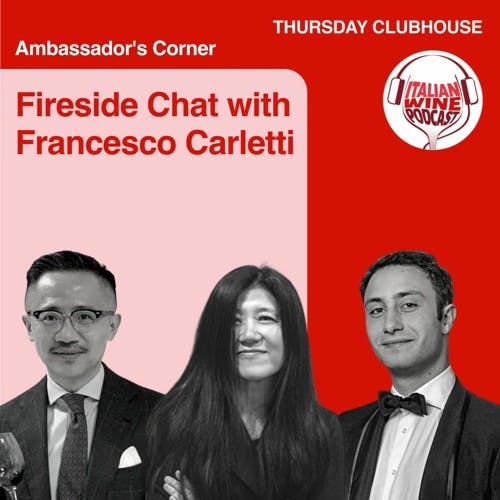
Ep. 892 Justin Chen Interviews Francesco Carletti | Clubhouse Ambassadors Corner
Clubhouse Ambassadors Corner
Episode Summary
Content Analysis Key Themes and Main Ideas 1. The Italian Wine Podcast and ""Ambassador's Corner"": The podcast series focuses on in-depth conversations with wine experts and producers, often featuring Italian Wine Ambassadors. 2. Poliziano Winery: A Legacy of Innovation: The discussion highlights Poliziano's foundational role in modernizing Vino Nobile di Montepulciano production, spanning three generations (Dino, Federico, and Francesco). 3. Vino Nobile di Montepulciano Terroir and Style Evolution: An exploration of the region's diverse soils, microclimates, and Sangiovese's phenotypic nature, exemplified by Poliziano's wines. 4. Single Vineyard Expression: Asinone vs. La Caggiole: A detailed comparison of two distinct single vineyards, showcasing how subtle terroir differences (clay vs. sand) result in vastly different Sangiovese expressions. 5. Challenges and Future of Italian Wine: Discussion of COVID-19's impact on exports, climate change, and innovative regional projects like Alliance Vinum and the ""Pieve"" (MGA) system for Vino Nobile. 6. Generational Transition in Family Wineries: Francesco Ricasoli's personal journey from engineering to joining the family wine business and his current role as export manager. Summary This episode of the Italian Wine Podcast's ""Ambassador's Corner"" features a recording from a Clubhouse session, hosted by Justin Chen, the Italian Wine Ambassador from Hong Kong. Justin interviews Francesco Ricasoli from Poliziano, a renowned winery in Montepulciano. Francesco shares his unconventional path from engineering to joining the family business, started by his grandfather Dino in 1961 and significantly modernized by his father Federico. The conversation delves into Poliziano's approach to Vino Nobile di Montepulciano, detailing their consistent production of a high-quality, mid-to-full-bodied Sangiovese blend that is increasingly leaning towards 100% Sangiovese. A significant portion of the discussion is dedicated to Poliziano's two flagship single-vineyard wines: Asinone and La Caggiole. Both planted in the 1960s, these wines illustrate the profound impact of terroir, despite being only 800 meters apart. Asinone, from clay-rich soil, produces a powerful, tannic, ""masculine"" wine, while La Caggiole, from sandy soil, yields an elegant, fresh, ""feminine"" wine with notable acidity. Francesco also discusses the ""Alliance Vinum"" project, a collaboration of six Montepulciano wineries aimed at revitalizing the region's image and re-establishing a clear identity for Vino Nobile, particularly addressing the confusion with Montepulciano d'Abruzzo. This initiative has evolved into the broader ""Pieve"" project, which will categorize Montepulciano into 12 micro-areas, similar to Chianti Classico's MGAs. The episode concludes with a brief reflection on the recent Vinitaly trade fair and the ongoing challenges posed by the pandemic. Takeaways * The ""Ambassador's Corner"" is a popular deep-dive series on the Italian Wine Podcast. * Poliziano winery has a long history of pioneering modernization in Vino Nobile di Montepulciano, focusing on quality over quantity. * Francesco Ricasoli brings a fresh, international perspective to the family business as the third generation. * Vino Nobile di Montepulciano wines, particularly Poliziano's, are increasingly becoming 100% Sangiovese, emphasizing purity and terroir expression. * The comparison of Poliziano's single vineyards, Asinone (clay, masculine) and La Caggiole (sand, feminine), perfectly demonstrates the diversity of Montepulciano's terroir. * The ""Alliance Vinum"" and ""Pieve"" initiatives are crucial for improving the communication and quality perception of Vino Nobile di Montepulciano. * Climate change is a significant factor influencing vineyard management and wine style evolution in Tuscany. * Connectivity challenges (like pre-Clubhouse recordings) and the impact of the pandemic on global travel and wine markets are ongoing concerns. Notable Quotes * ""This is the thirty seventh episode of the ambassadors corner. Wow. So that means for thirty seven weeks consecutively, we have been hosting the ambassadors Kona."
About This Episode
The Italian Line Club on Clubhouse is hosting a virtual tasting class and promoting their virtual tasting program. They are also exploring their virtual tasting program and their efforts to boost privacy and social distancing rules in Hong Kong. They discuss their interest in the wine industry and their plans to introduce them to their audience. They also discuss the importance of regular engagement with the podcast and the potential for a new wine called La Cajale. They also mention their plans for future taste and discuss the importance of regular engagement with the podcast.
Transcript
Welcome to the Italian wine podcast. This episode is brought to you by Vinitally international wine and spirits exhibition. The fifty fourth edition of Vinitally was held from ten to the thirteenth of April. If you missed it, don't worry. Go to Vineethly plus dot com for on demand recordings of all the sessions from the exhibition. And remember to save the date, the next edition of Vineethly will be held from the second to the fifth of April two thousand and twenty three. Welcome to this special Italian wine podcast broadcast. This episode is a recording off Clubhouse, the popular drop in audio chat. This clubhouse session was taken from the wine business club and Italian wine club. Listen in as wine lovers and experts alike engage in some great conversation on a range of topics in wine. If you enjoy listening, please consider donating through Italian wine podcast dot com. Any amount helps cover equipment, production, and publication costs, and remember to subscribe and rate our show wherever you tune in. Miss David Kim. This is the Italian Line Club on Clubhouse. And, like, I'm going to kill you because I thought we were supposed to have a break. For VINiktli, but in fact, we only had one week break because you put this on Friday. So Sorry about that. You know, we usually do it on Thursday. So we said, let's take a break for Vinichley because everyone's been working really, really hard. And then I just saw that, you know, we had to do the clubhouse to that. But I'm I'm glad that you were able to organize this. So let me just welcome everybody. I I don't even know if this is a little bit earlier than we usually do. So let's do this. This, like, a what what number episode is this? Is this Actually, this is the thirty seventh episode of the ambassadors corner. Wow. So that means for thirty seven weeks consecutively, we have been hosting the ambassadors Kona, which is basically we ask one of our ambassadors to invite their favorite wine producer, and they do this kind of like a fireside chat deep dive into this winery with the winemaker or producer or wine, per personality of that company. So today, we have Justin with us from Hong Kong. Justin. Hi. Yes. So, of course, our Italian ambassador from Hong Kong. When did you do the course? I can't remember. You mean the, the the the course. Yeah. It's it's the via. It's in the Hong Kong version. I think it's in the November of two thousand nineteen. Right. You did the the two thousand nineteen. So, actually, that was the last year, the very last year before the pandemic. Yes. Yes. I'm quite lucky actually. And I haven't seen you since, actually. Yeah. Because we travel stopped. We don't have the chance to actually see each other since then. So, Justin, what what is going on now in Hong Kong? What is what is the are you you guys are not locked down. Right? Oh, yeah. Not locked down, but we have social distance rules. Mhmm. So our all of our course so far, has been, online. So I hosted I still host the class and also various different tasting workshops. So we managed to send the samples to the participants. But So you're back so you're back to virtual tasting again? Yeah. We because of the fifth wave, it's quite. Chase. Yeah. But, we are we are improving now. So actually seeing, starting from the twenty first of April, the social distance rule will be relaxed. So we will actually hopefully, we will, resume the face to face class in May, I think. Oh, it's so crazy. You know, I see, of course, Kevin and Cheetos Lubbock, We've seen our in the audience, and we just saw them because they were here for five star ones and, Vinetree. We've just just concluded Vinetree, the day before yesterday, since, like, ages ago, So we ran, of course, five star one lines, and then we did Vineetoyne international academy, and then we did opera wine, and four days of Vinetoy. So it's literally been a Vitetoy marathon, And we have just concluded, and I was crossing my fingers every day just so that, you know, the COVID was under control. So but, yeah, it's so difficult. It's so crazy. The fifth wave, and definitely we are the COVID pandemic is not over yet. Anyways, let's go back to the show. Justin is, of course, an wine educator, and he works with, I believe Deborah Maiburg m w m wine school. Is that Deborah school? Yes. Yes. Okay. So you work with Deborah in Hong Kong. And, of course, you are also our educator. You're running our Italian Wine Meister program there. You are, diploma, w set, and also a certified educator for them. And you have you are the wine scholar, Gil, Italian wine scholar, and you're just one smart fellow. I think you are the best in our class from our graduating classified on your call. So and you are very keen about Italian wine as well. So, Justin, you have today with us Francesco from, Pauliziano. Yeah. Why did you choose Franchesco as your Francesco as your favorite producer to be interviewed today? So, actually, first of all, is the the diving, long, wine lover of their wine, particularly their flagship wine, the Acinone, actually is one of my favorite, Vignon Oakley, the multiple channel. And, So I drink I have been drinking their wine for quite a long time. But, actually, I think the chances that, later on, I got to know, their importer in Hong Kong. Which is Cheta and, run by Kathy Massey. So I think, Cathy introduced me to, Franchesco, and, I hosted several, like, Mastercard and the tasting workshops. With policy analysts. So I think I get more and more, get to know this winery and appreciate their efforts to actually in the reviving of the the the fame of, you know, nobody, and, I even wrote wrote an article in the local Y magazine about their winery. So that's the reason why I choose their winery for today's interview. Excellent. Is Kathy still in Hong Kong? Yes. Yes. Oh, so she's still living in Hong Kong. Yeah. Because I I I I I think that, she said to me that, probably, she will, join today's interview as well. But so far, I haven't seen her. Yeah. You know, I mean, everyone is I almost feel like everyone is a fleeing Hong Kong. Of course, JC has moved to Verona. Mhmm. Sarah, who topped the course here, last week, She has moved to Seattle in America. Mhmm. From Cheska, of course, Italian one expert. He did the course with you. Right? Yeah. Yeah. He did. Right? Yeah. Exactly. Yeah. And he, was living in Italy for just a brief period. In fact, he also translated Professor Tiyoshenza, Lyle's June for the Via flagship edition, and then he's now living in Argentina. Oh, really? So, yeah. So he couldn't come, and join us this year. But I feel like everyone is just, you know, fleeing Hong Kong at the moment. Let's hope that, you know, we are very, very, we have a very close relationship with Hong Kong, because we've been doing going to Hong Kong and have invested so much of our resources and energy and created a community, Avia, in Hong Kong. So we hope we can come back, go back very soon and to see UNR via community members. So, Justin, as you know, we look for some learning objectives that we would like to anticipate to our audience. By the way, as everybody knows, this, recording will be replayed on Italian wine podcast, and I have to tell you that it is one of our most popular series In the beginning, I was a little bit hesitant because we used to record for about fifteen minutes for our podcast. And then I said, like, who the hell is going to listen to an hour, talking chatting about, you know, why? But it turns out that everyone is very much interested in the deep dive version. So very, very popular indeed. So tell us about the learning objectives. Yeah. Actually, I think, basically, would like to introduce you guys to this great winery to understand their history and the latest development. And also, I would like to talk a little bit in-depth about their, two top, single vineyard with, completely different tower, which actually give it a chance to understand the diversity, of the tower in Reno Nobody so that they can make into two single vineyard wide, with San Jose, but completely different characteristics. And, and finally, I would like to actually talk also a little bit about this project. The Alliance VIN, VINum, which is actually the project, policy. I know, is one of the members and to actually try, try their efforts to actually really to, achieve the renaissance of Vino Nobley. So I think these are the basic, I think, learning points that I would like to achieve for today. Okay. Great. So over to you, Justin, I'll come back towards the end and close-up the room. And if there are any questions, we'll take a few questions, etcetera. Okay? So on those rare occasions, I will shut up now, believe it or not, and let you take over. Okay. Thank you, Stevy. And then, Let's welcome, Franchesco Caletti and Charles Franchesco. And, so I think, probably my first question is about, your background and, actually, I understand that that you studied engineering in the university. So, actually, I think the audience and also myself, will be a little bit curious about, why you choose to actually, still work with your dad for the wineries matters. So what's your original plan? And, since when you started to really, seriously involved in your winery matter. So I, when I was around, fifteen, fifteen years old, actually, even earlier, thirteen, fourteen, you know, winery wise, my my father and, and and all the people who work in the winery have always told me that, what is truly essential for for our businesses to speak English. So so I've always been forced, let's say, to, to learn it, through private lessons, summer camps, and and things like this. And ever since I was around ten, eleven. And, but I do remember that one summer, I was in a room with five, people, five guys, of around the same age as me who were all from London. And throughout those three weeks, I literally did not understand, much about what they were talking about. So So I said to myself, I really need to learn it. And if, and in order to do that, I am, I am willing to, leave my hometown, montauchina, and move abroad. And, for various reasons, I I I decided to choose and move to Scotland. Great. Where I lived or, yeah, where I lived for around six years. For very I'm not gonna go in too much details. There's no any there there's nothing, wind related over there. And, and my plans due to the fact that I had, several friends from there. I sort of you know, fund my my position in there. I decided to remain in Scotland and, you know, since I was very good at physics and mathematics, I decided to do engineering. But, as soon as I finished I wasn't really I I did enjoy the course, but not as much as I I I expected. So when I return home in two thousand nineteen, I was, my plan was just to, you know, spend the summer over there and start planning my future. And, you know, my father sort of, sort of said, why why don't you follow me, come to the vineyards, follow the harvest and, you know, day after day week after week. Month after month, I just convinced myself that, my my place was to be in the winery. So so I've let's say I've officially joined the winery somewhere around the end of two thousand nineteen, early twenty twenty. Yep. And I became, actually, the, that's sort of funny. I became the, expert manager for the winery first February twenty twenty. So right before COVID, started. Okay. So, so how about your export businesses? Is the business actually affected by the COVID? Of course, it should be. But, I think the things are getting better right now. So probably you will become more and more busy. Yeah. Actually, the well, the the very, a challenging year was twenty twenty, especially for not really the, the, for specifically for the Italian market. That was, we we had a lot of challenge, in the in those in that market specifically. But, twenty twenty one has been really successful year, we we sort of, we're we're turned back to our usual, sales, standards. So so, no, we we everything is doing better now. Obviously, as you probably as probably everybody knows, we we have all various new challenges to to face, and, you know, we we started thinking about transitioning a little bit more towards, digital forms of, communications, of sales, and, and other things. But so far, the the the, you know, everything is is doing well. I'm only missing and really looking forward to to start traveling again, which is, you know, that's that's what I was signing for right at the beginning. And, and I haven't had the chance to to do such, especially because I'm majorly focusing myself on markets which are outside of Europe. So, pretty challenging to to reach there. In the last two years. Okay. Fantastic. We are also really, look forward to seeing you in Hong Kong, once you got a chance to travel to here. So, my second question is about little bit about your history and the the latest development because, we all know that the policy I know is one of the leading wineries in, multiple channel. And, actually, this is the winery that really, is one of the pioneer to start at the modernization of the agriculture and, and the winemaking for winoguri. So could you give us a little bit about the the the backgrounds and also your latest developments? Yeah. So, the winery was founded in, in nineteen sixty one by my, my grandfather. He, my, my grandfather specifically wasn't a really, It it wasn't a person who was involved in agriculture in general because at the time when he elevated the estate, the estate wasn't, majorly focusing on on great production. And therefore wine. So some my my my grandfather started, to to reorient the winery or rather the estate towards, you know, vines, cultivations and, and producing wine. But as you as as you said, everything started off sort of, later on when when my father really started. My father, graduated in agriculture engineering. So he he was really, He knew a lot more things than my grandfather on, on on cultivating, in general. And, and, you know, everything from nineteen eighty, practically, because my father graduated in nineteen seventy eight, He did some working experience around, Italy in Verona, specifically, and, and also in Montalcino. Mhmm. And, in nineteen eighty, he decided to fully took over the business for which my my my grandfather was sort of quite happy about it. And, and ever since he started. He made, the first bottles. Actually, not the first bottles have been an obvious. The one those ones were made by by my my grandfather, but he changed the labels, and he was the one who, started the Asinori, which, by the way, is, one of the first, single vineyards, not only in Montapochana, but also in in Tuscany. Mhmm. Ever since then, he, obviously, as you were saying, we started with, modernizing the, the approach of cultivation so sort of changing what it was the tradition of the time. He, he was greatly influenced by international approaches, especially in terms of aging. And, And we kept on building the the company. Initially, we had only around twenty, twenty two hectares, whereas now we have about one hundred and thirty, one hundred and forty hectares in the Monteputiano area. We also have, three other two two and a half other states. One of them, which is the the the last in terms of time, which was acquired in two thousand seventeen is, you know, sort of in the middle between the territory of Monteputiana and the the close, Torita area or Monte Volonico in in with with more, details. Mhmm. And then we also have an around twenty five twenty twenty, twenty five actors in the the marima in marima. Mhmm. And another seven actors in Cortona, which is just up north, Monteciano. Yeah. Yeah. Fantastic. So, so basically, let the audience to get familiar with your, your different generations. So I think your grandfather is Dino. Right? And, your father is federico. Right? So Exactly. Exactly. Yeah. I think I think probably, Federico, is the the figure that, has been, a widely reported, about for your winery. Think, Portiano, I think he because he is really the pioneer in terms of modernization. So he is the guy that, trying to, produce the wine at the low yield and also involve a modern, equipment and also the French Exactly. Barrick agent for the wines. So really, really actually may more modernize the the style of, of, the VINenobally that you are put you have, you was you were producing. But, actually nowadays, I have learned from you previously. Actually, there's a, a gradually as a as a kind of, like, a style, switching back to a little bit more, like, traditional stack. Could you elaborate a little bit on this process? Yes. What what you said is, absolutely right, but, I would like also to make a point. Although my grandfather was, What was not a winemaker, and, he nonetheless, he was the one who started everything, you know. So, as an example, other than relevacing the initial twenty two actors, and building the first the really first agent seller. He was also the one who elevated the the Asinona vineyard. So so, you know, and he did it in a in not a, he didn't have any economical, idea. You know, it was it was truly just for, for passion, very romantic idea because, My my grandfather was working in the construction business in in Italy. And, he was forced since he was working in a very big company, which wasn't set locally. He he was forced to to move around Italy, as an example, my father lived, for seven years in Sardinia. Mhmm. And and the the decision to elevate the estate, was also to sort of, fundamentally, move back to his hometown. And, and, and, and I think this is, you know, it is very important in in light of what my father eventually did. Coming to my father, yes, you know, he was very, in the eighties, I think, wine producers were not as many as there are today, especially in in Tuscany. So, very in in a very short period of time, he managed to get to know many of them and and started sharing thoughts. And, and, and, you know, that that was the decade when or even the decade before, the seventies when, you know, old new approaches, new modern approaches, where we're starting to be developed. And my father has, he his primary goal was to, stop making, carboy wine and and start bottling, start making wine, which was growing in the quality Mhmm. Rather than the quantity. So Mhmm. So he he he basically started experimenting. He started experimenting. He sooner or later realized that He required a certain certain level of, technical, more modern, equipment. And so he built a winery. He built a cellar. He renovated the aging cellar. So so he has experimental a lot. Around the end of the nineties, early two thousands, year after year, he started realizing that, and and nowadays is very clear to everybody, but, the weather, you know, the temperature has started rising. Mhmm. And, and and with the type of density, the type of, vineyard treatments that he has been carrying from the eighties until the early two thousands, He realized that the vineyards were suffering. Climate change was was playing a huge role, and and that's why ever since the early two thousand, he, changed the focus. So he started focusing more, first of all, and, a little bit higher elevated places. Mhmm. So we we stopped acquiring or planting in very low altitude, the places of the Montebuchano territory, and he started going a little bit higher up. And as well, he started, you know, adjusting the density. He moved from five thousand eight hundred, six thousand plants per hectare more back to the five thousand, five thousand two hundred then he raised the the the the the height of the of the plants. And then, obviously, a huge, a huge study, internal study of the best clones of Sanjay, the best rootstocks, which we're adapting in the and, in in the various territories, the various terroir that we that we have, because, our estate is not, placed in only one specific position of Montapushanha, but it's displaced all across the, the, the town, the, the territory. Mhmm. Mhmm. Great. So I think, yeah, I think we will also talk a little bit about the the style switching when we Yep. Discuss your two, single vineer wise. I think, talking about your why, I would like to first discuss about your basic video, nobody, the multiple channel. I think this one is, for me, is a really, really, lovely wine and very consistent wine and also with, excellent value. So this is the wine actually produced it in a fairly large, quantity. But, yeah, in, yeah, out, you can still maintain a very good quality and consistency. Could you share us a little bit about, the basic style of your VINo nobody in multiple channel that you as a as a as a producer that you wanna achieve and also the efforts that you have been that have been done, in the vineyard and also in the seller that you you guys, trying to keep the consistency and equality of this basic, vino nobody? Well, the the the yeah. You first of all, yeah, you'd you didn't mention something relatively important. About the the numbers of bottles that we make of this wine. On average, we make about a hundred and fifty, a hundred and eighty thousand bottles of, our regular vina n obula. Well, I would say it's style, you know, Sungeviz is really is greatly influenced, and maybe we will, talk it, talk talk about it in with greater details when we touch the the the cruise. Mhmm. But, Sangeviz have as a variety, we we call it is a phenotypic variety. So it's greatly and hugely, impacted by the the terroir. The microclimate, the soils, where where it is grown. And, and and so so this brings me to, the type of terroir that we have in in Montalciano. Montealciano is situated a little bit up north than Montalcino. Mhmm. And, and and relatively south or than than the county classical area. So we're sort of right in the middle. The type of weather that we have is quite continental, and, and the characteristics of our soils is all although we have, some in some cases, we have some more, some more, sandy soils. The the tendency is to find is to always find clay clay soils. And and clay soils usually produce, very, usually sort of, highlights the the tannic side of of Sanjay. So so, style wise, I would say that our VINenobulate, which is, at the end of the day, a blend of the various parcels that we have all across the the Montapuchan territory. Is a is quite of a powerful, medium to full structured type of wine, and and is sort of as always being like this, for ever since my father started producing it. Over the years, as I was mentioning earlier, we have started to go a little bit higher in in elevation. And we have also acquired, especially towards the Valiano area. Which is a, like, a, like, a, like, a fraction of, of Montapuchano territory. Some a lot of, a lot of, vineyards, a lot of soils, which have a strong base of sand, which inevitably has, has allowed us to make some more, lightweight, more acidity based type of, Sanjay, which are, pretty much every year in the last, say, five to six years, been blended in the in the in the immunoglobulin, the regular veinobulin. Mhmm. So I would say that, although the the primarily structure, so this medium to almost full bodied depending on the vintage, vino nobilaire is slowly in the last ten, fifty years starting to be, to to grow in acidity, grow in freshness, and and and and we're starting to contain it a little bit more in, in in in in powerfulness. In terms of, say, you know, in terms of taste, the wine is, There's no doubt about it. It's becoming more typical, every day, every year more. As you know, in Montapochino, we have, we're a little bit different than Montalchino. We have, a seventy percent minimum of San Jose. Mhmm. My father, as always, worked within, seventy to eighty, eighty five percent of sangiovese, whereas the the remaining was, was always canajol and Colorino, which are local varieties of, our territory. But I would we we can also say Tuscany in general, and, and a little bit of Merlo as well. In the last, I would say two, three, four years we have started to consistently grow the percentage of sangiovese. And now we are almost reaching ninety five percent of sangiovese. It's around ninety two, nineteen, ninety two percent. The the Nobula two thousand eighteen, which is the one that we are currently having in the market. It's around, ninety two. And I think two thousand nineteen is even a little bit more. So nearly ninety five. So so, you know, the wine is very typical. It's it's, the our approach is to to make it more balanced and more, and more, a very, in a wide which express itself in, in equilibrium between the tonic and the structure and the freshness and the and the fruitiness. Okay. So, this wine, so, no, the traditionally speaking that they, the wine always involve a little bit of merlot. So I would the last of you that, you still believe that that recipe will actually, as you you would still keep that recipe to involve a little bit more low in in the future, vintage for for this regular window normally. Or you will consider maybe eventually you you will actually, use, only the local gift varieties? I I'm I think that, well, this is more of, a question to me. I would say. I I think, our our approach is to to, to probably reach the a hundred percent San Jevese in in the in the close future. Obviously, this also has a huge I mean, as I was saying earlier, San Joyce is fanocipic and and and when you have a very favorable vintage, you has two thousand eighteen or two thousand nineteen. We We we managed to make a lot of really, really, really good Sanjay. Mhmm. So I I believe that when this vintages occur, we we will always try to push for the, a hundred percent, the purity of Sanjay. Okay. Probably in a little bit more difficult vintages, we, we might be still be blending and concerning the merlot question for sure, in the next years, we're gonna we're gonna erase that, that component as well. Okay. Okay. Good. So, I think because of the the the weather and global warming, I think also because of your your, as you're choosing the right colons of San Diego, I think your your your winery is is now I I think it's, I got a feeling that you become more more and more confidence in using, a higher percentage of sangiovese or even a hundred percent sangiovese for the regular, Vino nobody. So I think, yeah, this is the, probably I will look forward to taste the more new vintages and, I think to get an, a more updated feeling about, your regular, we know, nobody. And, in terms of the two, cruise and the single vineyard wines. I think, Asenone is probably the most famous one. And, this is the one that, actually, use the remote one of my favorite and the and because of this wine that I I got to know, Portiziano. But, through our previous mask class and also tasting workshops, I also got to know Another, actually, very elegant vineyard, which is, la Caggiole. So I think, could you just, introduce a little bit about this two these two vineyards and, the, terawatt components and the, the different style, of the resulting wines. Oh, yep. So But both of them are, as you said, single vineyards. So they're both coming from, one specific, vineyard. Mhmm. And, a a funny aspect, I would say, or a curious aspect, more curious than funny. Is that, both of the two vineyards have been planted in the sixties. So they, fully, to to some extent, fully represent the, the traditional approach on on planting. But both of them are cultivated not in curdenspiron, which is, which was the, let's say, the typical approach that we would had in the eighties and the nineties, but it's And and the ten the the density is a little bit higher than the real tradition. We are in the four thousand five hundred, plans per actor, but, But, obviously, it's nothing compared to what it was in in the eighties. And and, actually, another very particular aspect, specifically of the astronaut. The astronaut is not, So it it is to some extent representing the tradition, but it is also not because, you know, in Tuscany, we would always plant our vineyards in a we we we call it ritoquino. So So all the vines, all the rows are going from the top to the bottom. Mhmm. Straight. Whereas, yes, you know, in it, for its peculiar shape. It's peculiar, Yeah. It's peculiar shape, is actually planted from left to right as they would most likely, as they would do in in in, the Barolo area as an example. Okay. Okay. And specifically about the the the two wines, the the two wines are approached and they are, managed exactly in the same way in terms of, treatment throughout the years. But also in terms of selection of the berries and the grapes. Mhmm. We we initially make a first selection prior harvest. Then there is, and then once all the grapes are collected, had brought down to the seller. We undergo, another additional secondary, selection made by hand. So, you know, the the really traditional and and popular rolling table where you have, several people at each side of the table and handpicking specifically every single berry, you know, taking out the leaves and and other things. Concerning the the the file, Asinone is a, almost forty to forty five percent of, clay soil. Mhmm. Whereas, like, a job is, around, four to five and some places even seven percent of clay, but the vast majority is just sand. I think the the richest point, it has around seventy two, seventy three percent of sand. So two completely different soils, Another curious aspect is that these two vineyards are only around eight hundred meters apart. So so, you know, that that sort of shows you the the the the the differences that you can you can have in in our territory, not specifically of both Santa but of Montabuchan in general. But what we have discovered, actually, a very recent period of time, is that both of these two soils are coming are coming from one of the most ancient, geological area, off, of, locally, which is the POC. So we're talking about Yeah. Five to six million years ago? Yep. And and, you know, these soils have been they they came out from from the seaside, from the water, again, several millions years of years ago. And this means that the soils are really poor. So so they do not produce massive quantities of grapes, but it they produce a lot less. And therefore, the vines are capable, to concentrate more, in those grapes. So, Louisel, And and and, you know, due to the this aspect and the aspects of, you know, their soil composition, you have two different types of of grapes. The asinony grape tend to be extremely small with very, very thick skin. And therefore, you know, here you have a lot of tannins, a lot of structure, a lot of color. And and my father has always worked, to in this in this idea. Therefore, you know, whenever I whenever I go around them in the market, I I've all I'm always being told that yes, you know, it is the perfect wine to have with, with a Bistika as an example. So variant, very fat, very, powerful type of food. Yep. Whereas leakage is almost the opposite. Yeah. You tend to have relatively bigger barriers with with a little bit thinner skin. So the major differences in in the making of the two wines is is during the fermentation and maturation. Since you have greater skin in the astronaut, you tend to maturate it a little bit longer. We're talking about, three, four, maybe five days more. And, and in terms of aging, the the two wines, pretty much follow the same approach, with the only difference that the Asinone tends to go a little bit more in New York, rather than La Cajale, simply because, La Cajale needs to be more typical. Okay. We have stopped, ever since the, I would say, ten, fifteen years ago to use Primarly Barriques. We're now introducing more larger, larger barrels. We have a preference four hours of such a visit with a tow nose. So those are the, types of barrels that we use for this two crews. Mhmm. And, whereas, for the Venaenobula, we we actually mixed the tow nose with the big barrels and and so on. What is the major difference between this two, Asinone and Lica Jolie, which are, by the way? I I didn't mention a hundred percent sangiovese at both of them. If you taste them, you you sooner or later realize that these are two completely different wines. And and this is truly, based on what I was just explaining earlier. It's the terroir, it's the it's the soil, and it's alternatively what you get as a great. As you know, it is a full structured, very powerful, very, very large, to some extent. Why? But as Lekajal is completely the opposite, right the opposite. It's a very, very light. You have a very medium to to lightweight type of structure, but you have this length this great acidity, which which makes this one, you know, extremely pleasant, extremely fresh and and very, very long and and and vertical. And again, as I was saying, both of them are a hundred percent sensitive. The approach is pretty much identical, but here, the territory, the soil is really making, a huge difference. And I always like to finish off by saying that the is the feminine side of Montebuchano San Jose Yeah. Whereas, as you know, is the masculine side of, multiple channels, San Jose. Yeah. These two lines are actually, I think, is a fantastic examples that if you wanna do, comparative tasting and to show the diversity of the Teoa in VINobre. I think these two wines, the perfect choices. So, I, I think that we, in our previous, tasting workshops, we compare these two lines side by side. It's really actually showed the showed the difference. And I think that the participants are are are all were all actually amazed by the the the the difference between the two wine. The asinone is, a little bit muscular and powerful. And, the, like, majority is more feminine and elegance. And showing more, like, asinone, it's showing more, like, a darker fruit, black fruits, and the the literature is showing more red fruit characters. And I also actually, know that probably you can also, introduce a little bit about the the the the the the the names of the two wives. Actually, there's a story behind it. The both names are actually is quite interesting. Well, the, the the the Asinone is, well, asinone in Italian for those who don't, Don't speak italian, mean speak donkey. Mhmm. And this is primarily due to the the shape of the, of the vineyard. If by any chances, you might, you know, find yourself in front of a Nasion on a bottle, you just turn the bottles, look at the back label, and you have a rough configuration of the vineyards. And it looks like the back of the donkey. And that's why it is called the big donkey. Whereas, is, the name is not specifically related to the, to the vineyard, but it's related to the area in which, the the vineyard is grown, is situated. And I if I do not go wrong, like, we used to be a type of flower, which was, incredibly present in the in in that specific area. Okay. From my understanding, this type of flowers have you know, they're much more rare nowadays, probably the the the climate has changed and therefore, they are not capable of, of appearing, that often as they used to. Okay. So, I think just one point technically about probably, I think the exposure of both vineyard also, has something to do with the different styles. And, the vineyard for Asinone is south and southwest. And, the vineyard for La Cajore is, east, facing the east. And so I think the, the, the, the It is actually Yeah. It it is actually facing. La Cajore is facing north. Oh, no. The hill okay. The the the hill is facing north. Yes. And, and, actually, another thing, you know, the on on a on a regular basis, you would think that, you know, clay soil tends to be a little bit more arid And that is actually the case. You don't have a lot of, high vegetation, around the Assinone. So that that is actually a really, really war, place. Whereas, like, also because of sand, but, but also because there has this, little, Mediterranean, forest, at the back of the vineyard. It tends to be a little bit fresher. Okay. And and funny enough, this is something that, my father and my sister have started realizing in in the last few years that that that area is also relatively warmer during the night. So when when it should be colder, it's actually warmer. And during the day, it's actually a little bit, fresher than than than, you know, similar positions of the same type of altitude. Both of the two vineyards, are in between the four hundred to five hundred meters level on the k. On the on the seaside level. K. So, I understand that Lecaturi, is the wine that, you produced the four for this, alliance VINum project. So, so probably also take this opportunity that, for you to, introduce a little bit about this, project and the the concept of, a renaissance of, you know, nobody? So let, let let me add this. La Cajoling actually used to be produced, around the, at the end of the eighties until the mid nineties. But then my father, if you ask him, he would, he would, almost scream at you saying, ironically, he he he did the wrong choice to to to stop the production of La Cajole. Mhmm. And then we restarted again in two thousand fifteen, in in in accordance with, with these other producers. The alliance premium is composed of, at its foundation of six wineries, from Montembuchano, Avinci, Salceto, labracisca, day Poliziano and and Pocarelli. Mhmm. So, you know, six minors, which and I'm not saying those are the only minors, but, six minors, which, have been recognized in the market in the last, ten, twenty years, thirty years, to to produce high quality wines. And, it's it's a long story, but let's say that, you know, throughout the last ten, fifteen years, our, has been has had many problems in terms of communication. The the first thing, which I I believe everybody have thought about at least once is the confusion between Montaluchano, the town placed in Tuscany and Montaluchano, Deborah, so the grape. Yeah. So we, yeah, so all over the the the last ten, fifteen years. I worked on Sortio and all the producers have started, thinking about solving this communication problem. But we never really came with a, solid conclusion. So the Alliance minimum So the six producers decided around two thousand seventeen, if I do not go wrong to, you know, to gather, to gather themselves and and start, like, like, a more inter conversation between the the six of us. And, and and we agreed that the best way to tackle this type of problem is to, sort of rename our wines not, but rather just, you know, that was the time when when we wanted to shorter the, the name, because, you know, at the end of the day, it's barolo. It's a county. It's, brunello. It's, Moreno. So, you know, one word, very easy, very easy to, pronunciate. You you cannot really, imagine how how difficult for some people, and you know, I I truly understand them when they try to to pronounce the the full word, the full sentence, and that, you know, either in the States or in China or or or elsewhere. So Obviously, you know, it it wasn't only just a matter of changing the work, but it was also a matter of, you know, thinking about, reconstructing the, the, the wine itself. Because, you know, I were, the the Divina Nobula was, initially thought, in the sixties, into sixties, then rebranded in the eighties. So that that type of approach in terms of, blendings, in terms of aging, in terms of, you know, period that it has to be in the bottle and and so on was, relatively old. For for for the time, you know, two thousand seventeen. So, they also gathered in order to think about, what what what type of new wine monte Puciano could have made after this, almost sixty plus years of, of winemaking experience. Mhmm. And we, and we came to conclude that the best approach, is to have a a hundred percent Sanjay. A crew coming from old vines, which, you know, as, as a minimum aging of around, twelve, but most of the cases of the wineries is a little bit more in wood. Not the use of, new oak, in particular, and neither of the Baricks, but try to use a little bit larger barrels and and give the wide some more time in the bottle. In fact, the Asinona tends to come up come out in the market a little bit earlier, the La Cajale tends to stay a little bit more time and and the and the bottle before it goes in the market. What else is there to say, No. Nothing much. So so this is still an ongoing project. So you will continue that that concept and it's trying to, explore more on that? Well, the you know, in in two thousand seventeen, we gathered, and, we started thinking and proposing. I actually did not mention one thing. My father was already, at that time, since in since two thousand and six and seven. He replanted a lot of vineyards, which, because we don't only have that, what, one vineyard in Lica Joliero, but we have several more. So he started replanting them, and, and in the process of replanting, he he paid much more attention to the wine. And, you know, the the the major characteristics of, Lica John. So it's this very this freshness, this great affinity, this, this, you know, almost, no existence of tenants. He he re he sort of rediscovered it. So Polisetta was already, planning on on coming back out with the, but around, again, two thousand seventeen, all these other producers, started talking, started thinking about you know, gathering and and discussing. So, so eventually later on in two thousand eighteen, nineteen slash, they all came out with, with their crew two thousand fifteen vintage. But we we were already planning on on coming out whether the alliance was existing or not. Eventually, this discussion extended, towards, the entire denomination And I think there was also another, similar association, which, was founded around the same period of time. And and that allowed us, actually, Steve knows about it because she she was one of the, She she actually had a, let's say, a master class where she, her and a TV of Shenza had some really nice thoughts about how a new one should be communicated and made. So we with an internal discussing within the consortium, and, we are nowadays, planning. It is not yet sure which from which vintage, but we're gonna be, coming out all the the entire denomination is going to be coming out with a new wine. Which is going to be called Lipie. Lipie, it's gonna be it it's basically a we we basically have overviewed the, the denomination and outlined twelve very high, sort of, terroir related, at micro areas within the denomination. And, and, you know, curious enough one of these areas is going to be called La Cajale. Okay. Okay. Fantastic. So, Paul, I really look forward to that, maybe we can have a chance in the future to taste these, these, twelve, really represent a different terawatts in, it's, more like, is a is a kind of a concept of, like, MGA or, twelve area. Right? Yeah. Absolutely. Absolutely. It is. Great. Fantastic. Fantastic. Because, the reason the development in county classical is also that they have, actually launched the the the the the the at least in their consortium has already approved on the on the Yeah. It is literally the the same thing. The the only difference is that, we, we group the micro areas based on also, historical bounds, because Lip Yevi, are churches. Okay. Yep. Yep. You have a more, like, unique names. Yeah. You have a more unique name, belong to, multiple channel. I think that's a good idea because you have a slightly different name, more reflect the local culture to refer to your actually MGA concept. That that that's a fantastic, I think, idea. So I think, we still have a couple of minutes I think I would like to, get back to, Stevie and to see, and also see whether, there's any questions about our session. So first of all, can you guys hear me? Yep. Yep. Okay. First of all, you guys have been so thorough. Let's give it up for Justin Chen and Franchesco. Thank you. Franchesco, I am so impressed first of all, you have a clearly, a great command of not only English, but also your wine stuff. And I think we were enthralled all of us just listening to you. I I don't recall meeting you, Franchesca, but I would love to have a chat with you next time. I see you. And congratulations. Franchesca, did you come up to Vin Italy? I did. I actually did. You've been How was how was it? How was Vin Italy for you? Well, yeah, it's, you know You can tell me the truth. We're only going to, you know, only if five thousand other people will be listening in your podcast. You know, I I I lived abroad. So, I I was never I never had the chance to go there has, you know, simply has the the son of Right. So so that was actually my That was your first. You were a ventically urgent? Yes. Oh my goodness. I I loved it. I I I really enjoyed it. Although most of my colleagues were saying that, you know, there were a lot less people, than than the usual. But but it was, it was it was really good. You know, I I managed to to get to these with some really, really good wines and, and and get to know some really, really nice people. And and, obviously, you know, after Ven Italy, that's where the the social starts. And and I I really enjoy that one. I'll say you partied in Vottega. Not as much, but, no, I was in, in the in the square. Right. Very nice. Okay. Excellent. So listen, this episode will, as soon, Joy. May the fifth. That seems to be the date I have on my calendar for this episode. Okay. So this will this recording will on the fifth of May, but I want to, I have a small ask for everybody. And please bear the word. We got the listed on Spotify, and we have some issues. So please go back and follow us and listen to us on Spotify so we can rebuild. Bigger and better. But we have been getting a lot of lot of listings. So thank you all for following us. It as you know, it's a it's a labor of love. So please send in those comments and spread the good word and gospel about Italian. Thank you very much, Justin, and Francesco. See you very soon. Here or there are chat I got saved. Yeah. I hope so. Yeah. Thank you. Thanks for listening to this episode of the Italian wine podcast, brought to you by Vineethally international wine and spirits exhibition, the biggest drinks trade fair in the world. Save the date, the next edition of Vineet Lee will be held the second through the fifth of April two thousand and twenty three. Remember to subscribe to Italian wine podcast and catch us on SoundCloud, Spotify, and wherever you get your pods. You can also find us at Italian wine podcast dot com. Jean chain. Hi, guys. I'm Joy Lemings Denon. I am the producer of the Italian wine podcast. Thank you for listening. We are the only wine podcast that has been doing a daily show since the pandemic began. This is a labor of love and we are committed to bringing you free content every day. Of course, this takes time and effort not to mention the cost of equipment, production, and editing. We would be grateful for your donations, suggestions, requests, and ideas. For more information on how to get in touch, go to Italian wine podcast dot com.
Episode Details
Related Episodes

Ep. 2789 ColleMassari: a long-term vision rooted in Montecucco with Giuseppe Di Gioia | On The Road With Stevie Kim
Episode 2789

Ep. 2788 Ep. 14: Austria and Hungary | Study Smart for your WSET Level 3
Episode 2788

Ep. 2785 From Volunteer to Speaker at TEXSOM with Samantha Cole Johnson | TEXSOM 2026
Episode 2785
Ep. 2766 Inside the U.S. Non-Alcoholic Wine Market: What Wineries Need to Know with Jill Sites | Masterclass US Wine Market
Episode 2766
Ep. 2761 Winemaking and Consulting Across Sicily with Alessandro Serughetti | Wine, Food & Travel with Marc Millon
Episode 2761

Ep. 2759 Part 2 – The VIA Educational Program & Italian Wine | Heart-to-Heart Conversation with Sarah Looper
Episode 2759