
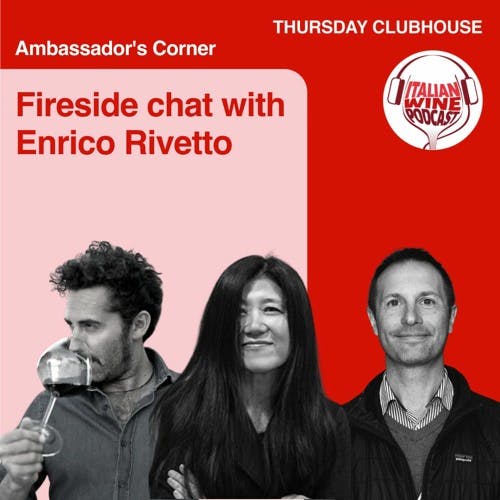
Ep. 937 Scott Thomas Interviews Enrico Rivetto | Clubhouse Ambassador's Corner
Clubhouse Ambassadors’ Corner
Episode Summary
Content Analysis Key Themes and Main Ideas 1. The format and aims of the Italian Wine Podcast, featuring a Clubhouse session. 2. Scott Thomas's journey from wine sales to wine education and his new venture, Grapalo Wine School. 3. Enrico Rivetto's family winery in Piedmont, its history, and his innovative approach to winemaking. 4. The deep dive into biodynamic farming and the pursuit of Demeter certification at Rivetto winery, emphasizing biodiversity. 5. Challenges of implementing biodynamics in a monoculture region like Barolo and the philosophy behind it. 6. Specific experimental winemaking projects at Rivetto, including Nascetta, sparkling Nebbiolo, and Amphora-aged Nebbiolo. 7. The importance of a holistic ecosystem (including animals, diverse crops, and team effort) for winery health. 8. A critical discussion on the lack of ingredient transparency in wine labeling. 9. The unexpected positive impact of the global pandemic on sales for Barolo producers. Summary This episode of the Italian Wine Podcast, originating from a Clubhouse audio chat, features a discussion between host Stevie Kim, moderator Scott Thomas, and winemaker Enrico Rivetto. Scott Thomas, a recent graduate of the Slow Food University, shares his pivot from wine sales to launching his own wine education business, Grapalo Wine School. He then introduces Enrico Rivetto, a fourth-generation winemaker from Piedmont, known for his commitment to biodynamic practices. Enrico details his extensive efforts to transform his winery into a biodiverse ecosystem, including planting various trees and herbs, and incorporating animals, ultimately achieving Demeter certification—a unique feat in the monoculture-dominated Barolo region. He explains how this approach contributes to healthier vines and more balanced wines. The conversation also highlights Rivetto's innovative wine projects, such as a Nascetta with skin maceration, a sparkling Nebbiolo made from specific parts of the grape bunch, and a Nebbiolo aged in amphora. Enrico passionately argues for greater transparency in wine labeling, questioning why wine is exempt from listing ingredients. The episode concludes with Enrico sharing how the pandemic surprisingly led to increased demand and sales for Barolo wines. Takeaways * The Italian Wine Podcast explores various formats, including live Clubhouse sessions, to engage with wine professionals and enthusiasts. * Scott Thomas, an Italian Wine Ambassador, is launching Grapalo Wine School, a new wine education venture. * Enrico Rivetto's winery, established in 1902, is a pioneer in biodynamic winemaking in Piedmont. * Rivetto is the only Demeter-certified biodynamic winery in the Langhe, a difficult achievement in a monoculture region. * Biodiversity is key to Rivetto's philosophy, involving planting diverse flora, maintaining seven hectares of woods, and integrating animals like donkeys and bees. * Enrico believes biodynamics strengthens vines, makes soil more alive, and helps mitigate extreme weather impacts, leading to balanced wines. * Unique wine projects at Rivetto include a Nascetta with extended skin maceration, a sparkling Nebbiolo from the lower grape clusters (harvested early for acidity), and Nebbiolo aged in amphora. * Enrico advocates strongly for ingredient transparency in wine, highlighting the current lack of mandatory labeling. * The pandemic period saw an increase in demand for Barolo wines, benefiting producers in the region due to consumers turning to known, quality wines. Notable Quotes * ""The love of wine was somewhat fading. And so we made a decision. Let's just immerse ourselves in a place that we'll be enriching, and at the same time be, completely life transforming, which it was."" - Scott Thomas * ""Working biodynamic, thinking biodiverse in Barolo region and the Langhe Hills is extremely difficult because the monoculture is really strong."" - Enrico Rivetto * ""I always say that what I was building outside is what I try to build inside."" - Enrico Rivetto * ""Biodynamic is the only one, the practice that helped me to have more, microorganisms and more live in the soil."" - Enrico Rivetto * ""I strongly believe... that if you start to think in a different way, somewhere in the world, some somebody is influenced by it and start also to change a little bit."" - Enrico Rivetto * ""Why is the only one beverage and food that is not allowed to put ingredients on the back label?"" - Enrico Rivetto Related Topics or Follow-up Questions 1. What are the specific challenges and benefits of applying biodynamic principles to different grape varieties grown in Piedmont? 2. How does Enrico Rivetto integrate animal husbandry (donkeys, bees) directly into the vineyard management system? 3. Can Enrico provide more sensory details on the Nascetta with skin maceration and the Amphora-aged Nebbiolo? 4. Beyond Demeter, what other certifications or movements are gaining traction in sustainable Italian winemaking? 5. What impact does the ""no-tractor"" philosophy in certain vineyards have on labor and overall vineyard health? 6. How might the discussion around wine ingredient labeling evolve in the coming years, and what role could producers play? 7. What strategies are employed by Rivetto winery to educate international consumers about the value of biodynamic wines?
About This Episode
A group of speakers discuss the Gratopart wine club and Grapalo Wine School, a virtual wine club. They discuss their backgrounds and experiences in wine, including their current business and plans to launch their own wine school. They also talk about their desire to stay in a small small winery and their satisfaction with organic farming practices. They emphasize the importance of working in a team and being mindful of the environment. They also discuss their experience with working with growers and the impact of the pandemic on their business. They mention their plans to create free content every day and their commitment to bringing free content every day.
Transcript
Welcome to the Italian wine podcast. This episode is brought to you by Vinitally International Academy, announcing the twenty fourth of our Italian wine Ambassador courses to be held in London, Austria, and Hong Kong, from the twenty seventh to the twenty ninth of July. Are you up for the challenge of this demanding course? Do you want to be the next Italian wine Ambassador? Learn more and apply now at viniti international dot com. Welcome to this special Italian wine broadcast broadcast. This episode is a recording off Clubhouse, the popular drop in audio chat. This clubhouse session was taken from the wine business club and Italian wine club. Listen in as wine lovers and experts alike engage in some great conversation on a range of topics in wine. If you enjoy listening, please consider donating through Italian wine podcast dot com. Any amount helps cover equipment, production, and publication cost. And remember to subscribe and rate our show wherever you tune in. It's six PM in Italy time here. And my name's Stevie Kim. Hello, everybody. Chada Gatsy. Welcome to tie in wine club, on Clubhouse. Josh TV, how are you? How are you? You've decided to open the room. Bravo bravo bravo bravo bravo. I'm good. Thanks. Can you hear me? Can you hear me? Can you hear me well? Yeah. I can hear you now. I'm just going to ask you to mute when you're not Yes. Of course. Okay. Okay. Of course. So this is, of course, the ambassadors' corner. Today, it's it is the fireside chat with Enrique Rivekto, and our moderator is Scott Thomas. Charles Scott. How are you? I'm super great. How are you doing? Listen, Scott. Are where are you based? I'm a little confused. Are you in Piamonte or are you in Denver? Or what where are you? I am in Deborah. I spent two years in Piamonte. Uh-huh. October of eighteen through essentially December of twenty. I am in Colorado. Oh, okay. Okay. I was a little bit confused. What were you doing in Piamonte? I was studying at the slow food university of gastronomic Sciences in Palenzo. They have a master's program in wine culture and communication. My wife and I essentially sold all of our belongings and both moved there, and we were in parallel programs at the same time. So she was she's in food side of things. What were you doing before? I've with, working for a wine distributor in Colorado. Okay. So I was managing on premise teams. So we were call on restaurants. A great portfolio. How did that come about? Both of you just quit your jobs and moved to. It sounds like eat pray and love kind of couple things. I I think it it's somewhat was. Of course, I think For me, the longer I was in wine sales, the further I got from why I got into wine in the first place, you're just thinking about sales all the time. The love of wine was somewhat fading. And so we made a decision. Let's just immerse ourselves in a place that we'll be enriching, and at the same time be, completely life transforming, which it was. So it's a wonderful experience. Well, good for you. But you, Indian, you went back to Colorado. What are you doing now? I'm a freelance and independent educator and consultants. I'm about to launch my own business. It'll be called Grapalo Wine School. It's kinda Yeah. Wine School. Good name. Thank you. And, yeah, I I went to school at home or at your business in office, and I'm working also with Cynthia and, becoming an Italianoan educator. So Oh, excellent. So you'll be teaching the Maestro program for Sure. So, of course, Scott and I met this year in in April, and he taught me how to relax that kind of like yoga pose. I'm still working on that, by the way. I think of you every morning. That sounds weird, not in a very perverted way, just because when you taught me that, actually, that really helps me stretch. It's an amazing pose. So Yeah. I I couldn't believe it. See, it's so easy, but So, Scott, you're gonna have to, like, you know, Instagram it so that everyone else has the privilege Okay. Our access to that. And, Scott, congratulations. He is now our certified Via Italian wine Ambassador at first try. Thank you. Did you think it was difficult? The program? Well, yes. And I had a lot of expectations on myself. I thought the information was profound, and especially the videos, and I really tackled it, in a way that was quite enriching for my education. I mean, it was I I was accepted in the program twenty twenty, but, of course, with COVID, I backed out, and this is it's been a long time goal for me. And, I'm very, very pleased with the outcome. But the whole experience was absolutely amazing from the videos being in verona surrounded by the community and being part of the community now. And, of course, the tasting portion with the level of depth and precision, I think of the tasting was was fantastic. And just being able to, you know, emerge myself. It's been quite special. So thank you, and thank you for your whole team. Thank you to your whole team. There was Well, thank you for participating, and I'm glad. You came. You passed exam, and hope to see you real soon, because, you know, we're organizing the Chuka around wine two wine. Hopefully, you can come back. We're going to Francacorta and lugana. Of course, that was those were our supporters. And after wine two wine, this is in November, We are organizing the Chistascolastica in Sicilia doc and Montefaca also are, via supporter program. So tell us why, Scott, you've chosen Erica Riveto as your favorite producer to be on the all to that? I was fortunate to visit in Rico in June of twenty twenty, and I had tasted his wines previously. And I think upon visiting him and afterwards, His philosophies on biodiversity and wine production, and, of course, his wines are absolutely full of life and and purity, but his biodiversity philosophies, and his stance in the longue really stood out to me so because of that, he became top of my list. One of my favorites today, of course. Okay. Great. And what, you know, you know, we're obsessed. You've done the BVR program now, and you know we're obsessed about the learning objectives. What what what can you say the learning objectives today from today's call? Which it goes back from you? As I've just stated, so really to maybe get deeper and understand Enrique's philosophy of biodiversity and why it's important in general, but also to him, to learn a bit about biodynamics, what it takes to become Demitor certified and his motivations behind that. And to really gain insight on the riveto terroir's and how he reflects place each wire. So, you know, I don't know if you caught, not yesterday. The day before, we had a call from your classmate, Michael Markarion. He interviewed, get a call with Sebastiano, Castiglione from Quachabella, of course, plant based biodiversity and and, you know, biodynamics. So it will be interesting also to have this conversation back to back. By the way, absolutely, your guest is Riveto, but he's also Sebastiano's call was riveting. It was absolutely masterful. I hope you guys get a chance to also catch that. Later on replay on Italian wine podcast. As you know, all of these calls are replayed on the Italian wine podcast. By the way, Joy, I see Joy as our producer from the Italian wine podcast. Congratulations to her, to like, and the entire team, because if you went on my incest story from this morning, we've had ninety nine thousand, nearly one hundred thousand listens just the past seven days. I know maybe I you if you to contextualize, we had twenty three thousand listens, the entire year of two thousand seventeen. So we've come a very long way, and it's also thanks to Joyed, like, and the entire entire entire one podcast team. So thank you very much. I'm going to hand over the mic to you now, Scott, and we'll come back if there, I mean, if there's any time for q and a Indian. Great. Thanks, Stevie. Chow. How are you? I'm very good. How are you doing? Great. Excellent. Well, welcome, and thank you for joining us today. We're very Thanks to you. And have you. Of course, it's my pleasure. Well, Erica, can you let's just start off and paint the picture as so can you tell us a little bit about yourself and about your family winery where you're located? Okay. So I'm located in in Piamonte, in, between, mcerolanga, and senior to small villages in the longer hills. I'm the four generations of, winemaker of, my family because, we started in the nineteen o two. The winery. But, you know, in the recent years starting from two thousand nine, I started my, I don't know. I don't know if you can call a path, you know, a walk, who I completely changed my my vision, and I started to destroy some, as, you know, way of thinking and creating a new one. As Stevie said before, you had, you had some guest daily previews, the, you know, programs, of whom they are, biodynamic, say, in other region of Italy, but, you know, you have to I don't know how many of you have been in Bairoa region, but, you know, working biodynamic, thinking, biodiverse in Barlou region and the longer hills is extremely difficult because the monocultures is really strong. But maybe we can talk later about that. I'm forty four years old, so, I was born as I can say, in the in the in the winery and my seller, I was doing a little bit of everything, but in the last fifteen year, I just felt, you know, the requirements to stay in the winery and to improve the quality, especially, if we are talking about the outside. So the vineyards and, the way how, how I deal with my you know, with my fields, with my vineyards, and, etcetera. Before I was traveling a little bit all around the world, promoting the wine, and, working of course in the cellar because my wine that is making small medium, small size, and that's what I really would like to keep, which is not so easy, try to be, in a balance where I can, control, when I can, all the phases of the working of my laundry. So to take part to all the phases of the working. So we are producing around a hundred thousand bottles per year. So as, as I said, we are medium small. In comparison to the average of the producers in this region. And, and I would like not to grow too much because, because that's something important for me you know, we have, like, eight people working, every day in the winery, and I think it's the the team of working, and it's some another subject in portal that probably nobody, speak about but for me is very important. And I learned a lot from my, from the United States when I was traveling is the team, the building of the team in a winery because it's, more and more difficult to find people qualified and specialized in the in the winery. So there are a lot of, subject, a lot of issue we can, we can discuss, and we can, and we can talk if somebody of you has questions, of course, Scott, you have some questions. I know. But if other people who listen to us wants to to to send some some questions, I will be more than happy to interact with them. Great. Absolutely. Thank you. Well, So you would be considered at a historic winery. Is that correct? Yes. The inception of nineteen o two. And I guess with that, your your location is in Seennial, So you're just east of Serelanga. That's correct. Yes. Exactly. I'm on a top of the hill called Lirano, and is a hill at the border between Serelanga and senior. The seller is geographically under Seenio and, part of the winery. And, and the other part of the winery is under the, village of Sarlunga. First, because Seenio is not in the Barolo region, and Sarunga is in Baru region. So I was always on the border of this two world because I can say two world because there is a a huge difference in terms of price. Of land and so also mentality of the people. So and let's say I think it was, very helpful for me to understand all the way of thinking of the people of my place and also myself, And you've also produced a barbaresco. Do you have a dumpster? No. Barbara is a very small production. I have a a organic supplier who supply me a very small quantity of the umbrella from barbaresco. But it's really represent like seven percent of the production. I was thinking in the past to, to, to enlarge in Barparesco, but the problem is that it, you know, also there, the price are also increasing, and it's very difficult to find organic supplier and especially biodynamic, because as as you said, we are the only one, demeter certified biodynamic in the region, and, we are very happy to reach this, this, this level of certification, even if I'm not a great fan of face certification. But it was very useful for me to attest to one, you know, tax on, one walk to, is that action? Yes. And I I would love to touch on the the certification and certification process maybe, in a little bit. And Okay. So describe to me then, the Lorano Hill. And you look you're looking up to Saralanga from where you are. Would would you describe the terroir as a continuation of, Saralanga dalba in in that sense? With sea soil formation, sort of allium of origin. And Yeah. Leerano Hill is always been considered under a part of Saralinga, but for some strange reason of the past, I, you know, it was half of them under under the other village because at that time, I'm talking about during the wars. There's one there was not a big difference in in in in price of the land between Long Village and the other village. So I heard some old people that my my grandfather was changing the changing the the the city hall property or city hall, because they were paying the less taxes under senior, but, I mean, that's something that I heard from all people. Maybe it's true. But under the point of view of ge, geological point of view is exactly the same, like, so we have a soylver rich of clay, calcium carbonate, and is a part of Barolo considered one of the climatically colder part. The southeast part of Barolo region, especially this, this part of Sirlunga. It was always considered the the counterpart. And with this change of climate, I have to tell you the truth, we were gaining something. You know, we had a good benefits in terms of a motivation of ripening of of the grapes. But if I can, describe you the hill, I always say that this, magic healer is a magnetic hill because, it's, it's, fusion between vines and other alternative crops like cereals, like aromatic herbs, we have a small pond, you know, on the top of the hill at four hundred meters above the sea level. We have seven hectares of woods that for the majority of you doesn't make, so surprising, but believe me, he's lying, he's having still having woods. It's quite rare. We have bees. We were in usually in, in our ecosystem, also the the bees we have six hives. We have, an area where we make our own compost. So you have to imagine, like, kilometers in the middle of the fields of lavender, Sage, rosemary, mixed bushes. We were planting more than thousand trees in the last, seven years. We have fruit trees. We have oak trees. We have, big trees in general ash trees. So this is, the idea to rebalance a winery, rebalance one hill and, trying to, build one, system where the main element are vineyards, but they are not the only one element. So I try to give you an idea to try to describe, how it looks my my my winery. And today, there is a bluing everywhere. If you, take a look at my Instagram, page, I try to process more pictures as possible of the beauty of of this period of the year because it's really, really exciting. And I have to tell you the truth. When when you are working and that's coming back, I mean, I'm sorry if we go on another subject, but for this, very important. When somebody is working, in my winery, like the everyday worker that everyday they are going to work in the vineyards, it's different if I go to work every day in a normal vineyard and every day in one vineyard when you have butterflies crossing you You have bees everywhere. You have collars. You have perfumes. So it's it's an experience every time you walk into the vineyards and you and you go to work. And believe me, you work in a different way. It is a beautiful place that, because I was fortunate to visit. I I think it strikes me of how much biodiversity you actually have on your property. I think fifteen hectares of hazelnuts. You mentioned the woods. All of the herbs and flowers and bees. And I mean, you were known for even ripping up vines to plant these, you know, the system of biodiversity and work on the ecology, and and it's living there myself, it's evidence that the the production of wine in the area is very monoculture. And you said something to me that was quite powerful in the sense that when we were up on your, your viewpoints, you have a on top of your winery, And you said when you look around here, this this is a common place in, let's say, tuscany, with the amount of biodiversity with the woods and the flowers and fruits and And yet in Pimonte, so the southern Piedmont, especially it seems to be less common. And so that really stuck with me in the sense that you were working towards, this goal to, to achieve something greater. It's beyond wine at this point. It's really taking care of the land. So bravo is what I would have to say. I I try to take care of myself, first of all, because because I always say that what I was, building outside is what I try to build inside. So, first, I have to ask myself many questions and change my way of thinking. And in this way, I can, I can change also what is outside? So that's, I think, was the main, main issue. So you're now the only demeter certified biodynamic producer in the long game. And when did you begin that conversion and, when did you receive it? And were you organic prior to that, or was it just a one one massive switch in your mind and movement towards the certification? I don't I mean, the certification, you have to be organic to be certified damage anyway. So you need to have the certification organic first and after you can apply for the debit certification. At the beginning, I was not very happy to to start, with this certification process because there are a lot of bureaucracy. And in Italy, there is a lot of bureaucracy every every day, and so I would have liked to have less but at the same time, I realized that everything what we were doing, we were really doing a lot of things, and and there's no way to test another way than make this a very difficult and certification, which is, I think, one of the most complicated also to obtain, because I've seen many, many winery who are working biodynamic, in a very serious way, and they are not certified. At the same time, there are many people who are make a confusion between organic and biodynamic. Everybody say I'm biodynamic because it's trendy. So I was a little bit upset, and also, the fact that, we I mean, a very conservative reason region, sorry, a conservative region in classic, have to show papers if I want to be have a credibility also, in, in, with with my competitors. So I started, first organic and after step by step to to biodynamic. But it was something quite, spontaneous, and natural. I I was not starting in two thousand nine to say I would like to become biodynamic. I just said, I would like to change the way of thinking in my winery. And I started to to meet people, meet growers, which are not are not in the wine business, potato growers, tomato growers, wheat producers, and I realized that I had a privilege, a privilege of make Barolo, a privilege of poor, a liquid, a magic liquid in a glass, and the people listen to you. And I and I've I met people who they were working ten times more than what I what I, work, and they are not considered, biodynamic wheat producer. They they are marmarbleous, but nobody talk about them producing hot potatoes. Nobody talk about them. So I was really, impressed about the, how they are humble and that, and how they believe in what they do, and they really, stop to, there's some job who are they earning a lot of money to change their life. To to grow some vegetables. So I was I was having some influence by them. And I always remember a guy who gave me, like, Diamond in their hands to me. They offered to me after one by the Army course and said, Hey, take with you this seeds of old variety of Italian wheat. So in your in your in your winery, and I said, yes. Of course. I didn't know where where to to grow because because I had all my surface occupied by vineyards. So but he gave me in such a sincere and pure way that I couldn't say no. And so I started to to to be influenced by people who are not in the wine business. And I try to make a fusion of this, two world and rebuilding one system, rebuilding one ecosystem that hundred years ago was normal here. And I used the privilege of making Barolo and have the chance to talk to you today that each element is like you are in the team. It's important to have a defense, the goalkeeper, they're in attack, It's important also the guy who is, who is, who is in the bench. And he's, he's entering at five minutes at the end, and he scored the the right goal. So the winery is a team, and we need all all the elements. But, of course, Divina is the most important because it generates incomes. Of course. Well, it's that's an inspiring story. And I I remember you have I mean, you you have donkeys on your property. I mean, you're the full on commitment. And you and you said something to me that was, again, very powerful in the sense that once you achieve the certification, you don't have the luxury to take shortcuts. And you are held to a very high standard. Are you enjoying this podcast? Don't forget to visit our YouTube channel. Mama jumbo shrimp for fascinating videos covering stevie Kim and her travels across Italy and beyond, meeting winemakers, eating local foods, and taking in the scenery. Yes. I give you some example. For example, you mentioned animals. You need to have animals. You will like to be certified demeter. And at the beginning for me, it was like, I never had animals. I have dogs, you know, but it doesn't count, you know. So I need to have something, you know, like cows, like, horses, like, sheeps, etcetera. And that makes you need to have the space for them. And and in Barolla, in LAaga, his space it costs. So it's always a question of, each square centimeter is is is very expensive here. So I I started to change this mentality that I will, put a sacrifice of five percent of my land and reinvest and reinvest in my environment. I reinvest in my winery under another form because I can be rich today and make some money or a thousand euros for this vineyard, but can be rich because I produce my own flour for my own wheat, or I can have my sauce made from my tomatoes, or my jam that I produce from my where he process, that's that's an example. And the limit of demeter, it's really strict. For example, copper. The copper, I have the half of the limit of organic wineries, believe me, that's the element that most of the producer, they run away from the certification because stay below three kilo per hectares of copper. It's extremely difficult. But I said, I I took over my team and I said, and I guess I learned from United States mentality. We raised the bar. We had a bottle of pro producer. We are a leader, and we had to act like a leader. So the meaning we can do is to take this risk because we can take, we have the money to afford also, to calculate the risk. So it's the minimum we can do. And so we try it, we to know better our vineyard, to, divide one vineyard to another vineyard to giving less copper because we know that there it's more windy and so we have less problem of, of, of media. We started to use a propolis, starting to use, automatic herb, essential oils who comes from the aromatic herbs we have. For example, the aromatic, essential oils of orange is extremely it's working extremely well. So we are, decreasing the quantity of copper year after year, we are also had by the we have to be also had by the by the climate, of course. But there are more than four years that we are say always below the particular practice, two, two point five, two point seven, but we are below. And and and and that's something that, is a motivation also for the people who are working in my winery. Another thing of the of the dominant certification, you know, you you need to have a minimum of biodiversity in the winery, but this one is something that I already had. You need to have cereals. You you need to have, a minimum quantity of a wound, we have three dankies because we have fifteen hectares of vineyards. So we need to have all two cows or three dankies or one hundred and twenty chickens, but I, you know, it's not too much for me. So just just to give you an idea of the of the of the limits that's limited certification, it keeps. It doesn't mean that I love the certification also because there is a cost behind that, but I think it's, something that in this moment is helpful to, raise the bar. And another thing I would like to say is that biodynamic is something that's arrived after because I think the biodynamic is the best instrument, the best tools to have, to cultivate and to having an agriculture who put, the focus on the how your soil is alive. We need to have soil alive, and the biodynamic is the only one, the practice that helped me to have more, microorganisms and more live in the soil. So would you describe your your land now as as different? That energy is different than it was prior to you practicing biodynamics? Yes. I was different and and and automatically also the the winery is different and the soil is different. And every year I have the university of Torin, they come to visit me and say, we can, you know, come and, count the number of butterflies, the number of, worms, the number of, bees or, insects you have. You say, of course, you are welcome. And in the meantime, they are doing, I try to go with them and learn. And, of course, there is a change in it. There is a change that you feel, which is the most important thing. But we are living in one world that you have to, always, scientifically, show to the world that you were, following one scheme, and scheme, scheme. And that's something that we feel more safe on that. But it's enough that you feel good and you feel the change, man, I think. Well, then switching the conversation maybe to the land the hectorage that you own or you manage outside of the Larano Hills. So, Rick Molina, for instance, is an MGA, is a crew in the southern part of Sallunga, is also biodynamically farmed, but it's also, a space that is on fractional ownership where there are multiple producers in the same space. And, and so you're farming biodynamically, and perhaps your neighbor is not. Is that correct? Briculina, in fact, is a different than than Lirano, because Lirano, we we can say that we have, like, sixty, sixty five acres altogether surrounded by wood. So that's I mean, it's more easy to to to to have biodynamic, culture and philosophy because it's all isolated and somehow. Brickona is in the middle of everybody. So the way I started to do is, first of all, the Brekorina, I have a health factor, which is our most important crew. We work all by hand, so we are not going with tractors in in this vineyard. When we started to build, we call, like, biological corridors there are just lavender, mix of bushes that we put on the border of the of the vineyard. And the fact that we are not going with tractors, we have more space that we save for this, for these bushes, for example. Or we've started to plant in the middle of the year some trees. And of course, all around me, there are nobody is following, this mentality. I strongly believe, and as the quantistic physics says that if you start to think in a different way, somewhere in the world, some some somebody is, influenced by it and start also to change a little bit. Hey. What's Pena De Brekorina? One of my neighbor, the the the son of one of my a neighbor who was always giving the the the the the fruits to the to the big cooperative. He's, like, twenty five or twenty seven years old guy. And he started to look at my vineyard and say, Hey, but I would like to do something similar. I'm I'm not I'm not brave enough because there's my father who wants to be in different way, but I'm attracted about what you are doing. You say, great. So these seeds put in the middle, start to have a a role. And that started other two actors of bricolena will be in the short, terms with, a little more flowers, with more, let's say, biodynamic step by step, we is going to the Bodynamic horseau organic So I think he's a he's a contagious way to work. But somebody has to start. And you you and I I was never I have never had doubt on that. And with your work towards biden Amex here, especially how Have you seen this wine change? I mean, what are the effects, bruegeline, especially being the most important crew that you have? The change meant, I, or I can tell you, consider that, I forgot to answer to your previous question. I started all this change mint in two thousand nine, and I had the first, vintage certified Baldanomics in two thousand nineteen. Okay. So it takes quite a long time, even if I was quite fast. The changement, I can tell you the real changement will be in the next ten years. So it takes at least twenty years because the time of the nature and the time of the soil is not like our time. That we we wish to have. But what I've seen, first of all, are the, grass in the vineyards. So the the spontaneous grass are increasing. The soil is more soft. The the vineyards are more, stronger because if we put the vineyards in a condition of less stress, because we are producing our own compost. So every year, we are using the same, organic substances produced ninety percent of the same organic substances produced in the winery. And if my roots are feeling better and less stressed, I have a grape stronger, and I have a healthier grape. And when I put when a when I vinificate, I have more and a better quality on the skins, and they have a better fermentation. And even if they are going slower, but they never stop that's happened last year, because it was was a very difficult fermentation last year because they were very slow. I believe never stop. And that's very important. The change in the wine, I can tell you, okay, the digested of my wine, that's much more easier also because the sulfites are very low. We are below six newly vampire liters. Anyway, it's we'll talk later about the humidification and so on. But anyway, the change in the Vigna, in the in the wines, I can say they are wine more balanced. In, considering that in the last ten, fifteen years, we are we have different vintages, more extreme weather, more hot, more dry. And the bar dynamic, I slowly believe, and I can see every year it's getting smoother this change. It's like, is a is a kind of heavy softer, the extreme. I don't know if it's correct in English, this, sentence, but I hope you understand. So you're able to achieve more balance. And so during the hot vintages, you do not have huge spikes of sugar or or ripeness levels. You're able to maintain the acidity. It's more acidity. It's more acidity than sugar, sugar. Unfortunately, so he's very high in the last years. But not so much for the nebbiolo because the nebbiolo is a great variety who is a fantastic also for this reason because, when, when, he's too much, then he's regulating himself in, and stop to, to select sugar. The barbera is exactly the opposite. The barbera, has no limits can go out tons of, tons of, sensitization of sugar rates, and it's become a problem on more on the barbera than than beyond do you have any issues with, like, flabashins or Dorre? Yeah. Disaster. Yeah. For the baguette, of course, because the other another it's it's a it's a resistant, or I can say it's particularly zero attacked by the fellowship in Sedarata, but there are, like, Arnais, like chardonnay are, really, really affected. Is it biodynamics help with the treatment of that? Or is there not not so much. Not so much. But, with the biodynamic, studies, I can under I I try to to make some theory about this sickness. Then, scientists, they doesn't they cannot understand what's what's going on. And with Boulder, we could understand, but there are hypothesis, of course. Why only some vineyard, some grape variety than other, I think it's strictly connected with the sun. Although the grape variety affected, have a have a reactive, sensibility, to the sun. And the sun is changing, and some trees, and some varieties are more sensitive on that. And Barbara is one of these. The immunity system is going down, and the virus is getting stronger on this variety. But this is my theory. Of course, it's not supported by any scientific test. Well, it's interesting to understand there there is no treatment at this point, and some vineyards are being heavily affected, but, especially, Barbana, as you said. Now, asking a few more questions is specifically about your other borale. You produce, reserve, and another from, community, Suralunga Dalba. Which crews? What other crews are you working with in Saraluma? The crew are Nomachino, Sarah, and San Bernardo that they put together, and they mix the other two Marlus. One is the Marro de Cernardo, with exposure, most of the of the of the Veneers are there with exposure east. And the reservoir is, a part of, the Ceralounga that I x-ray, five years. And I do a small, selection. I have to tell you that I have a new, crew that I bought this last winter, is called San Rocko in, Saraluma. It's also West exposure. And I had to plant, next year. And I have, I can tell you for first. I'm happy to tell you I will do on experimental, vineyard, in Barolo, where we'll be totally fused in biodiversity and no tractors would be, working in this vineyard, and will be the yield will be, different, and I have some idea to really make a strong impact on this new crew in terms of biodiversity. I can't wait to try that. And it's, It's one time, but and to know, you're working on both both sides of the ridges on on on the west and east side of Setera. Yeah. It's a very unique aspect. Well, let me change then to a grape variety of the the longest only native white grape, and you you were an early adopter of Neshita. Yes. Can you elaborate a little bits on you're working with it. Why you like it? What made it special? And and and how did you get into the shift? Of course. Thanks, Scott for this question because, I'm a I'm a valuable producer, but I have to tell you that I like also to experiment, because usually the bottle producer is very conservative. I like to experiment things, and I have three projects, on experimenting new things. One of this one is the Nacheta. Which is indigenous great variety white, the only one indigenous great white, great variety from Langer Hills that after the World War two was completely disappeared, and the University of Trino was, re studying and, don't lose the last videos that they were located in Novello, and I started in, two thousand seven, the plantation of the first initiative. And I was attracted by the initiative because if you read in the old books, Nacheta was considered by by the French technologist who came in our region in the middle of, eighteenth century under the Kavur court, that Nacheta was, a noble Greek variety who can be aged very well. And in some vintage can have some typical sense of riesling. When I read that, I said, okay. I planned immediately, and I tried it, and I planned the initiative not and I'm the only one in on the fifty five per use of Nacheta today in the languages who planted the Nacheta facing north, and I released the Nacheta. Now I'm just releasing the I'm I'm selling out the two thousand nineteen because my idea is to is to age, work, Denashita in a different way. From two thousand seventeen now, I was changing ten times the the verification of Denashita because it was not easy for me to understand what was the sole of the initiative because I have no idea how we have the characteristic of the initiative. And finally, now, I decided in a company also to the, to the change be that we have on the, on the, with the biodynamic to have twenty five percent of maceration, in a in a terracotta. So is a mac maceration and a vocation in red. And the other part is, three days of skin maceration cold. In concrete tanks, and after I bring together. That is the idea of the Mosheka. So to preserve and keep the part of the maceration that I really like, and at the same time to preserve the city. And to preserve the freshness of the grape. And that's the first, and let's say different project that we have. The other project we have, I'm sorry. If you didn't ask me that I have to say the other two in the different project. One is a starting line made of Napiola called Casa that we use the down part of the grape to, to make, a sixty months and there is, part of the, sparkly, methanoblastico, and I have another project that we started in two thousand and fourteen is a nebbiolo, vilified hundred percent in Anphora, in terracol, point seven months of maturation, which is really, really interesting. And what is that called? Vigna Vigna Yirano? Well, I have a question here, about the sparkling wine, because it's truly one of my favorites. I was on a mission as living there, to taste as many sparkling nebbiolos as possible. And yours, to me speaks very true, to the method, of course, but also the great variety because you can really get the aromatics. I think have been nebbiolo. But what's interesting and I would love to expand on if you could is using the the lower part of the bunch. So, essentially, you're harvesting the same bunch twice. You're producing two different wines from the same bunch. And what does harvesting the the lowest part of the grape variety? And I mean, what type of acidity does that capture? And then I guess my other question is how long after do you harvest, for making red wine? Thereafter, the the top part of the boat. Thanks, Scott. These are a fantastic question because, you know, that's exactly the point. The the nebbiolo, if you the the down part of the nebbiolo, of the bunch of the nebula, of course, in one month before the regular harvest is where each of facility is more acid because they should not stay in the upper part. So beginning of September, I pick this down part of the of the bunch. And after usually a month, I pick the other part who stays on the on the vine for the red for the baroque and condiment. Also, the pressure, it's very soft. It's like we have a thirty eight percent thirty five, thirty eight percent of the of the juice. It's nothing. But you have really the the the best part of this, tip of the bunch. And it's also quite important to have the right people working in the fields because we have to pay attention how we cut this part. It doesn't have, I say, let's bleed the, the Jews from the other party stands in the line. Otherwise, I can't have problems with the fungus. Infection. So we have to to to pay attention on on on this. You know, we are producing, like, two thousand, two thousand five hundred buckets. It's really small production. And we started in two thousand ten, and, to to to make it we are, eight, nine winders who use this, method. And I can tell you that it's a fantastic, especially in the colder vintages because you have a much higher city. And you give a great benefits on the nebula. Also because I don't like I disagree totally with the green harvest on the nebula. It's more than, I can say, fourteen years that we are not, green harvesting in August, the numbeulo anymore because the numbeulo is, is a lazy, I say. It's the first one who blew and the last last one we picked. The vegetative cycle of the nebula is quite long. And so we have to if we follow the nature of the Naviano, we cannot traumatize the the the line. We cannot anticipate the the the harvest, even if there are less risk if I anticipate. So what I would like to do is to staying with the nebula, with the genetic of the nebula. So, taking how part small part of the grape in the end of the of the motivation, not too early, Otherwise, I'm going to produce a lot of color, a lot of sugar that I have not lived in. And all the professor of my winemaker school always said to me, you know, half through, half provocation that in the biola, you have to pick when there are no more leaves on the vine. And as I said, half through half provocation, and it gives you an idea of the, genetic. And another thing I would like to say is that you realize to have a talent in your hand when you are vilifying the biola because you can produce a agent in the biola. You can produce a sparkly, young biola. As sparkly, I mean, for example, you understand that you have in your hands something really talented and something which is another level. And I mean, I feel more and more the privilege that I have to make this kind of wine. I I personally really enjoy it. So please continue on, and I will keep drinking them. And so just a question maybe about your philosophy in the in the winery in the cantina. I I know you're using a various mix of of barrels, in various origins with Hungarian, even Swiss barrels and amphora. What what is what guides you in the wiring? First of all, you have to consider that that in the in the in the cellar, the change made with the bidonomic was less mathematic than in the vineyards because we were already, quite unexpectedly in the in the cellar. But anyway, it was also a change meant because, we can't use, almost anything. Just a gel bentonite for clarification and, sulfites, we have to stay below eighty five milligram per liters of sulfites. But for all my wines, we are staying below sixty. We do our filtration, a very light filtration before bottling. So this is also something, and I'm my formation is white makers. So I was a technologist, hearing out. I was grady graduated over here. So it was really something that changed me a lot because, in the wine industry, and it's something that you can really, and I suggest you to open that is, another, you know, program on, on, on, on, on, on, club house about this, because nobody talk about that. How many ingredients we are allowed to put in the wine are unbelievable how many things we can add legally into the wine. And are all organic because, I think organic, it's not anymore or something, I think, serious because everything is organic now. From the chips, to the aerobic rubber, to the tannins added. There are a lot of things that the wine producers can add into the into the wine, which are really, really, I think, bad. And and you realize that, if you can't use all these things, you really understand who is a really good Ymaker. But that's, I don't want to be, political on the things, but just ask to yourself why is the only one beverage and food that is not allowed to put ingredients on the back label. You can ask yourself why the wine is the only one who is not forced to put ingredients on the back. Anyway, a part of this, we use, slavonian oak. We use, Hungarian oak. We have we use, fifteen hectoliters, thirty hectoliters, six sixty hectoliters. We have also some French oak barrel, but not a new for the Berbera. We have, a verification, vats made of, like, the form is like a pyramid of concrete. We have, of course, we still have steel because we we still have a lot of steel tanks, but I try to use less as possible because we realize also there is a lot of oxidore reduction, power on this, on this, container. So I think also in the seller meetings will change in the future using more natural, containers. We, of course, fermentation at all with Indigenous East. We are working also to to to to use, indigenous east for the sparkly, for the secondary fermentation in the bottle freezing the east of the barolo. That is another story. But generally speaking, we try to, you know, with the fact that we are working biodynamic and if the the vintage is normal, we have we have really, we start from a really high level when we have to work in the in the in the cellar. And as I said, also the filtration before the bottling is not so strong. Because we need to have a filtration because we sell wines, abroad, everywhere in the world. So I would like also to be sure that we don't have a piece of wood or piece of glasses going in the bottle. I don't want to be so extreme in that sense. Well, I think thank you for doing that. But I think the the conversation and I think it's a whole another program, it was a it was a big topic of conversation during our, the Italy Academy in Verona just in April was the topic of reduction, and, the use of stainless steel from enters and and aging in steel and how it's impervious, of course. And and maybe we see more of a push in the future towards more concretes or amphora that allows more oxygen during the fermentation and and aging period. So it allows wines to be less reductive, of course. So but I digress. I have one last question before we turn it back to Stevie, can people come visit your winery? Of course, they can. It's, you know, it's the the one of the most important parts because, you know, today I was, find to explain, and, hope, to give you some, some, some impression about my whining, but, of course, if you come and and visit and see with your eyes, it's all completely another another feeling, of course. Yeah. I can attest to that. When when I stepped foot on the property, you know, instantly that, you're working very hard to, promote biodiversity and and your, you and your family are were gracious hosts. So I encourage everybody. If you are in the long gate, just take a just take a tiny detour outside of the Barolo region, in five minutes away from Sarolanga, and and visit your your property. Well, Enrique, I wanna thank you personally for taking the time, to to inspire us again, about your philosophies. And, Stevie, I will turn it back over to you. If you have any questions or if there are any questions for the chat? Sure. I think, I think I'm gonna have to close-up the room because it's running late. But, Indigo, just one quick question. How you as a small it's a more market question, but you as a small, relatively small producer, how did you, cope with the pandemic period? And how has your business model changed? I guess, actually, that would need a lot more time, but Can you share us just No. I would be it's it's easy. During the pandemic, in general, for the wind of this region, there was an increasing of demand. Because, because, especially in the in the more, educated market with the collectors, with people who were at home drinking, they were choosing wine that they know. And Barolo and the winery for my region, they were, they had a great benefits of that. So we are short in wine. We still have a lot of demand thank god. And I can say the pandemic was, was good for us in the in the sense of sales. Of course, the restaurants not the restaurant, or not the importer or the market who are focused more on the restaurant. For example, New York was a disaster. But other markets, with the people, like, north of, Europe, like, Texas or other market where they have stores, etcetera, they were, they were booming. That's fantastic. I feel like you before you're, like, in Altorada, and now you're, like, I hear the birds chirping in the back ground? Yeah. No. No. Because everything is planned, you know, Stevy. I have a I have a microphone with fake birds for you. You're right. Right. I'm gonna bring up, Lika, our clubhouse manager. Lika, so who's out next? Okay. So next is on May twenty six. So we're gonna come we're going to come back with Anna of Skyya because, this has been postponed for a while. So he's she's going to interview, So Okay. Fantastic. So is that next Thursday? Yeah. That's gonna be for the next Thursday. Okay. I am not sure. I will be attending because I think it might be in Montevaca. We'll see. Alrighty. So thank you so much. Erica, hope to see you soon. And Scott, great modding. I mean, it's it's I love the ambassador's corner because we can do the deep dive and you got pretty geeky on me. It was fantastic. Good afternoon. Thanks for this opportunity, Steve. Glad to you. Thanks to everybody. Good afternoon, Rico. And remember to, re the replay is on Italian wine podcast and you know, if you like to to rate our podcast, you know, subscribe. That would be fantastic. See you soon, everybody. Yes. What's it again? Here we go. Thanks for listening to this episode of Italian wine podcast, brought to you by Vineetli Academy, home of the gold standard of Italian wine education. Do you want to be the next Ambassador? Apply online at benitely international dot com. For courses in London, Austria, and Hong Kong, the twenty seventh to the twenty ninth of July. Remember to subscribe and like Italian wine podcast and catch us on sound flat, Spotify, and wherever you get your pods. You can also find our entire back catalog of episodes at Italian wine podcast dot com. Hi, guys. I'm Joy Livingston, and I am the producer of the Italian wine podcast. Thank you for listening. We are the only wine podcast that has been doing a daily show since the pandemic began. This is a labor of love and we are committed to bringing you free content every day. Of course, this takes time and effort not to mention the cost of equipment, production, and editing. We would be grateful for your donations, suggestions, requests, and ideas. For more information on how to get in touch, go to italian wine podcast dot com.
Episode Details
Related Episodes

Ep. 2789 ColleMassari: a long-term vision rooted in Montecucco with Giuseppe Di Gioia | On The Road With Stevie Kim
Episode 2789

Ep. 2788 Ep. 14: Austria and Hungary | Study Smart for your WSET Level 3
Episode 2788

Ep. 2785 From Volunteer to Speaker at TEXSOM with Samantha Cole Johnson | TEXSOM 2026
Episode 2785
Ep. 2766 Inside the U.S. Non-Alcoholic Wine Market: What Wineries Need to Know with Jill Sites | Masterclass US Wine Market
Episode 2766
Ep. 2761 Winemaking and Consulting Across Sicily with Alessandro Serughetti | Wine, Food & Travel with Marc Millon
Episode 2761

Ep. 2759 Part 2 – The VIA Educational Program & Italian Wine | Heart-to-Heart Conversation with Sarah Looper
Episode 2759