
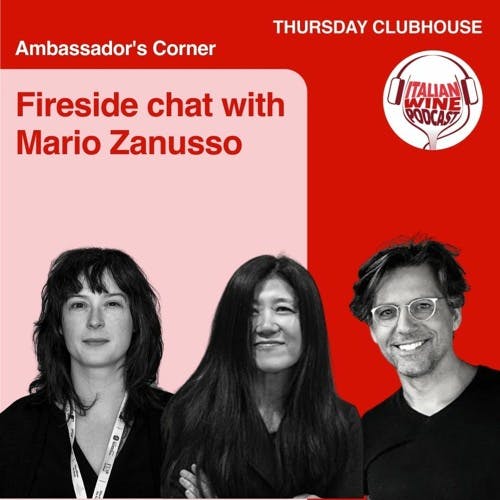
Ep. 974 Noell Dorsey Interviews Mario Zanusso | Clubhouse Ambassador's Corner
Clubhouse Ambassadors’ Corner
Episode Summary
Content Analysis Key Themes and Main Ideas 1. The founding and evolution of Eclivi Wines by Fernando and Mario Zunoso as a ""return home"" project in Friuli. 2. Eclivi's winemaking philosophy emphasizing minimal intervention, respect for terroir, and a ""classic"" approach over modern trends. 3. The critical role of Friuli's unique ""Ponca"" soil in shaping the character and salinity of Eclivi's wines. 4. Focus on indigenous Friulian grape varieties, particularly Friulano, Ribolla Gialla (RBL sparkling), and Verduzzo (dry style). 5. The business development of Eclivi, including production volume, export markets, and a new winemaking venture in Slovenia. Summary In this episode of the Italian Wine Podcast, host Stevie Kim and ambassador Noel Dorsey interview Mario Zunoso, winemaker at Eclivi Wines in Friuli-Venezia Giulia. Mario shares the unique history of Eclivi, founded by his father Fernando in 1995 as a return to his mother's ancestral land in Cormòns after years spent working in Africa. Lacking formal winemaking education, they adopted a ""less is more"" philosophy, focusing on the quality of their old vines and the distinctive ""Ponca"" soil. Mario explains how this geological formation, rich in ancient sea matter, imparts unique salinity and tension to their wines. He discusses Eclivi's signature wines, including the classic Friulano, their highly successful RBL sparkling Ribolla Gialla (made with a unique primary fermentation method), and their dry Verduzzo, a historical style. Mario also touches upon his experimental use of oak and cement, and his move towards returning to traditional Friulian field blends for white wines. Currently producing around 100,000 bottles annually, with half exported to the United States, Mario expresses his vision for ""cultural wine"" over ""natural wine"" and reveals plans for a new project in Slovenia, emphasizing collaborative, local winemaking. Takeaways * Eclivi Wines was founded by Fernando and Mario Zunoso as a passion project rooted in family history and a return to Friuli. * Their winemaking approach is non-interventionist, relying on the quality of the terroir and old vines. * The ""Ponca"" soil, a unique limestone-clay formation, is key to the saline and acidic tension in Friulian wines. * Eclivi produces a highly regarded sparkling Ribolla Gialla (RBL) using a single, direct fermentation method, and a distinctive dry Verduzzo. * Mario Zunoso is exploring a return to historical Friulian ""field blends"" for white wines and experimenting with different aging vessels (oak, cement). * Eclivi exports a significant portion of its production, with the United States being a major market. * Mario intends to expand his winemaking philosophy to Slovenia, focusing on cultural exchange and local traditions. Notable Quotes * ""If you work on a great soil, on a great terroir, that's ninety percent of the work."
About This Episode
The Italian wine podcast is hosting an episode on Italian wine payments. Speakers discuss the importance of being a member of the Italian wine community and the success of the Commonwealth Wine School and the Commonwealth Wine School. They also talk about their backgrounds and experiences with wines, including their love for wine and the importance of being mindful of the process. They discuss their plans to use their wines for their own style and meet their goals for their own brand. They also mention their success with a new wine club and their plans to involve local people in winemaking.
Transcript
Welcome to the Italian wine podcast. This episode is brought to you by Vinitally International Academy, announcing the twenty fourth of our Italian wine Ambassador courses to be held in London, Austria, and Hong Kong. From the twenty seventh to the twenty ninth of July. Are you up for the challenge of this demanding course? Do you want to be the next Italian wine Ambassador? Learn more and apply now at viniti international dot com. Welcome to this special Italian wine podcast broadcast. This episode is a recording off Clubhouse, the popular drop in audio chat. This clubhouse session was taken from the wine business club and Italian wine club. This in as wine lovers and experts alike engage in some great conversation on a range of topics in wine. If you enjoy listening, please consider donating through Italian wine podcast dot com. Any amount helps cover equipment, production, and publication costs. And remember to subscribe and rate our show wherever you tune in. Hello, everybody. And welcome to the Italian wine club on clubhouse. This is Stevie Kim here. And we are here today with our ambassador at Lodge Noel Dorsey, she was acclimated as officially as the Italian wine Ambassador from the flag edition, flagship edition in two thousand and twenty two. Just before Vinitally, but she's been part of the community for some time now. When when was when was the first time you you tried for the Via program? The first time was twenty seventeen with Ian. Oh my god. That seems like ages ago. Right? I know. That's how I met Ellen too. Yeah. Yeah. And you guys like, I always, like, in the beginning, I used to get you guys mixed up, not that you look alike. But you guys are, like, always together, you know. So I always thought you're one of the same, but, congratulations again. Where are all you now? I know you usually hang out in Nantucket You know, I'm in Boston now. I have been working in Boston at a skinner auctioneers as a seller manager over, in their fine wine and spirits department. So I left in a tuck it. My last season in tuck it was actually a while ago. It was, twenty nineteen. Oh my god. I should have come visit before. We can still plan a trip's TV. Yeah. Okay. Okay. Alright. And what is the skinner auctions? What what what kind of like I mean, is it just like another secondary market Correct. Auction house? Yes. Correct. So they do they mean, they they focus on, of course, fine art and jewelry, etcetera. They were on the largest in New England, but definitely one of the smaller auction houses And they actually just got bought by bottoms, in the UK. So we are now part of the bottoms team. It's called bottoms skinner. Oh, bottom skinner now. They just merged the name. Does that mean like you can kinda, vacillate between the UK and stateside? I hope so. We'll see. That is the one of the goals. Yeah. But they have offices all over the the world. Actually. Right. Yeah. We're doing you're also doing some teaching. Right? Are you doing any? Yep. I'm doing, at this wine school called the Commonwealth Wine School. It's in Cambridge, Massachusetts, and it kind of got started right before the pandemic. So our first year was pretty much only online, but they do, you know, great stuff. A lot of private tastings as well, trade, tastings. And, yeah, lots of classes for WS WST. And, I'm teaching a Rosay class next week, and I'm gonna teach a Sardinia class in July. So Oh, Sardinia. You're the expert now. Trying to me. Try. So, by the way, you guys, for those out there in the audience, check out our video. It's, I think, day two. No, day three. You're narrating day three. Yep. Our trip, we did a five day trip in Sardinia, Chikas Galastica with, with the Via community, and it was it was November of last year. And it was great fun. We had Oh, amazing. Yeah. It was it was great fun. We rented, like, two, vans one Yacopo drove and the other one, Andrea. I was always squeezed between Andrea and Shanesa. Yeah. I was right I was right behind you guys. Yeah. But it's we have we have great memory with so much fun. So check out the video. It's it's on the mama jumbo shrimp, our sister channel, YouTube's that we'd started about ten months ago. So check that out. And also subscribe you folks subscribe to Italian Podcast as well. Alright. Let's let's go on with the show and of today. Today's call is with Mario Januso, and I I believe I've not never met him. Why did you choose Mario and Uso? So I first got introduced to Mario's wines when I was a wine director at this restaurant in Boston called Island Creek oyster bar. And, the rep she's basically the importer for Massachusetts Her name is Gemma journal Nie, and she, brought in Fernando to taste the wines. It was the first time I'd ever heard of them. I guess this was probably twenty fifteen or so. And, you know, always looking for really pure crisp mineral driven whites. The list at the time was eighty percent white. And really fell in love, with the Friolanos she showed me. We put them on the list immediately, and they have a gorgeous, sparkling Rubola called RBL, and that was per went perfect for the food. So I I really fell in love with these wines. It was my first introduction. And their whole ethos of more natural, minimal intervention, winemaking. Yeah, and I then Furdy and Mario have come to Boston a few times, and then I was lucky enough to stay actually at a Cleveland for a week. In twenty seventeen fall, I was gonna work a small harvest, but that didn't work out so great because it rained every day. So, we decide, we they have a close relationship with, Rado Vineier in the burdock. And so luckily, I got to at least go and pick some grapes over in Alberta. But, the home is right in the vineyards, and I got to, get a tour of the winery and the property and eat beautiful for you in cuisine and go to La Subida, and it was a special time for sure. Yeah. You know, as you know, we had our, sponsor, Westverda, for the five star wines, judges this year. And that I went to that territory last I believe last August. I think it was in August. It's it's absolutely beautiful. It's it's you crossed the border without, like, noticing just with the flinch of an eye. Like, you you can be in Berta one moment and you can be in Frulli one moment. Right. Right. It's it's amazing. It's beautiful. I love the ones from that area as well. So listen, what are the learning objectives from today? So today, we're going to talk about The reasoning, I guess, behind the organic non interventionist methods, Mario talks a lot about Pankasoil and while some Italian ambassadors might know what Pankasoil is, and its effects on the grapes, a lot of listeners won't, and about that. And, also, why making methuded for the Freolano grape? Okay. That sounds interesting and exciting. So take it away, and I'm I'll pass the floor to you, Noel, But I will come back to see if there are any questions if we have any time. Okay? Sounds great. Alrighty. Chow. Chow. I'm going to just do a quick introduction about Mario and his wines. And then we will get into, the questions, the interview. But I just wanted to say, Mario Zunoso is a winemaker in, for you to leave inencia, Julia. He is the wine mechanic, the Clevi wines, and they're based in the Colio Coli orientale, districts. He specializes in indigenous frijulian varieties. So Rubula Jolla, Friolano, most recently, Espio Patino, as well as Malgazia, and they do a more natural non interventionist approach. So really pure beautiful wines. This history behind the winery is fascinating. His father, Fernando lived in Africa and worked for the UN before they started this project, in Frioli in nineteen ninety five. And, basically, I think it was after, and Mario can give us more background. But, Fernando's wife was from this region, the colonial area, and, they moved back and started this vineyard, and this winery with not much, winemaking experience. So I'm very, very excited, to talk to Mario about it. Ferdinand did pass away in twenty twenty right before the pandemic. So before it was just Fernando and Mario, And now Mario is the sole proprietor. So, yes, that's the background. And, Mario, I'm very excited to talk with you today. Could you tell us a little bit about the family history and the background of Ferdinand in, Africa, especially I'm curious, did you also grow up or did you also live there for a while with your mother and any siblings or How how did that go during that time of your life? Well. Hello, everybody. Hello, noelle. Hello, Stevy. Yes. I lived. I did live, for a while in Africa with my father. When it was two months or years old, two months old that was brought to Africa, then it was raised there. But let's say that the the the the story starts even, before that, when my grandfather who had my same name, Mario, was a doctor in Cormones, which is the capital of the cardio, DOC. And, he was, taken by the the not and brought to Germany in a concentration camp, and we never heard about him. My mother never met him. Actually, she was she still had to be born when he got taken away. And so let's say that the whole project is kind of, going back home to put roots in my mother's birth land, which is hormones. So after many, many decades of, traveling around, especially in Africa, mostly in Africa, because my father worked there. We had the chance to go back to Columbus in the mid nineties. So it was nice to to to to to to get home. The passion for wine has always been present in my family. My father worked for a French company. That's why he was in Africa because this logistic company had the headquarters in Paris, and these people trained my father, taught my father about good wines. These years, I'm talking about the sixties where the good years for the French wines, you could still afford them. They weren't so expensive such expensive as today. So my father who was a very deep and, let's say, intellectual man, like to, to to to study the wine, and to get into the the the aesthetics of wine. So he he always took me around wineries, the states, when since when I was a kid, I still have labels that I designed when I was four just for for play. So it was it was something that's always it was always around. It was always there. The wine as a form of culture. As a cultural expression. He was very he taught me to be very respectful about the work that was, behind every single wine, and, and I always appreciate that. So when, I finally graduated, in economics. In the mid nineties, my father retired at the very time. And so we started together this. I joined him, and we started together this, this entire journey. And it was, it was very exciting. It was, like, it was, like, not the natural destination. Was this something that you and Fernando had talked about quite often when you went to major in economics, or was this something No. Sort of okay. Not not at all. He was, following a different path. I had a different, we were kind of separated because he was in Africa. And when I started university, I was in Italy for a long time. So we we never we just spoke on the phone. We met really, just a few times, per year. So I I really needed to to have time with him. That's why I decided to to join him because I wanted to to be with my father as a person because I really respected him. I liked him. I liked the ideas he taught me. And I said, oh, this is a great opportunity to for my life, to to do something with my father, and something that I was raised to be passionate about. So it it happened really by chance, but it was a very naturally how it happened. That's amazing. Yeah. It sounds like it happened quite organically. Yeah. So but both of you did not have a background in winemaking or anything like that. So how did that come about? Did you you know, work with various analogists or interview a lot of your neighbors and colleagues or Both. How do you get started? Okay. We we started working with an analogist, as a consultant, but my father knew and he always taught me about this, basic principle, which is if you work on a great soil, on a great terroir, that's ninety percent of the work. I mean, in the salary, you can just ruin what Nature gave you. So we really never it was never, it never bothered us to not not having an education, also, it excited us to have, an approach which was, from, from, from from the outside, I would say, from people who were not trained. So it didn't have these schemes. These, prejudices, prejudices, or or or technical competence. And so we could really do it from scratch, using just our, sensitivity, our instincts. And that's why we started with these analogies because we we, tasted some wines that he he made from greater wars And with a really little interventionist, process as for the transformation of the of the grapes into the wine. So wild beasts, which kind of, was the easiest way to go because we didn't have choose from thousands of different strains of yeast that were available on the market. We just relied on what were the the naturalist of the grapes we were picking. And, we chose Steinless steel as a neutral vats to start with because we didn't have to deal with all the complication of other, other vats materials. So we which shows simplicity to start with because we knew that the first thing for us was to understand what sort of raw material we had in our hands. And we knew that these vineyards were great. We're greatly exposed. We're old vines. And so the quality we had in our hands were great. It was great. We just needed not to ruin that. That's fantastic. How did you find, some of these sites? Were they more well known or did you was it working out? It's a it was a matter of a a lot of work, going around, visiting, sightseeing. The truth is that especially at that time, but also nowadays, nobody wants to work on the hills in friuli because it's very it it has a lot of it's very labor intensive. The the yields are very low. So people prefer to go in full, mechanization of the vineyards on the plane. There's a lot of glare. That's the truth. So, working on the hills is more, requires a lot of passion and a lot of ingenuity, naivete, because you need to really believe in that strongly believe in that, and and putting that as the main goal quality, expression of the terwar instead of money making. So we were lucky enough to find these old vines that no nobody wanted to buy because of all these reasons. And but we we really did want to get our hands into the earth, into the soil, and, and do the physical work because we we came from different backgrounds compared to, well established producers, which were completely used to that, and they were looking for more technology. Instead of handworking. We were looking for the handworking. We were looking for the for the physical work to to reach and find a contact, and the symbiosis with the with the earth, with the soil. Now we're talking about the soil, and you write quite a bit about, what is what, Panca, about Panca soil. And would you be able to tell, the guests today what Ponka soil is? I mean, is it difficult to work with? You're talking about getting in the soil with your hands. I mean, how is this to work with? Ponka, it's it's a local name for for the soil of the hills. Of the free of friuli, which are a small ship, of land, on the Soviet border. Geological, it's a single island, that covers color, colored Italian burda. So Eclivir means hills and, comprehends, call you and call you in Tali, and, in the future, the new fridge is gonna comprehend also Berda. So we're gonna make Eclivir as a concept of, working on the hills. Which were a single uni, unique island in the past, and then for historical reasons has been separated. But, Pompeo, it's it's, essentially, it's, it's a soil that is emerged from the sea. It was covered by the sea, and the sea left a lot of interesting layers, layering of limestone clay and other organic matter, which is, then emerged because of the tectonic blocks that pushed up the hills. And this richness in, in, in in sea matter is very is key to to the salinity of the of the wines that are produced here. This is what I recall since when I was a kid that this specific tension, acidic, and, sir, and, and, and salinity. This is it's like electricity. That you have just on the punk. Punk is a local name that ex expresses this this type of soil. Do you find certain grapes thrive, better than others? Like, do you feel like for suits really well, or do you think generally a lot of the Frillian varietals express well in Ponca's oil? I think many, many different grapes can express the the the the essence of the soil. Frulano is challenging. It's very interesting, and it's traditional. So focusing on local native grapes is a way of simplifying the communication about the Pankaj soil. Unfortunately, we have, like, twenty three different variety, different grape varieties, allowed by the DOC rules, which makes a lot of confusion when you have speak about friuli. So that's why we focused on the local grape varieties. You can have many grape varieties having really good results on this soil. I we decided to get with my father to focus on the historical ones because we think that and we thought that, the the character is given by these native grapes more than by inter let's say, French or international grapes. So we focus on fluano and later on Ebola. Is what we started with, and then we introduced Ebola, and my father was really, smart in in understanding the potential of the Great Breola. So you also say you exclusively use stainless steel and cementing the cell there? Yes. We started with stainless steel because stainless steel is a neutral vaps that helps you learned. It's a perfect school to to learn about all, the verification issues that you can deal with. So it it it was like, It was great because it's neutral towards the raw material. So we had to learn what sort of character this raw material had. We weren't ready to to use other other containers. But now two two years ago, I started also adding some cement. And last year, this past spinach, I also added some oak. This is because it's, the natural evolution of a of a maturation, of a of a path, which, has to involve all sort of, material. Without I call it, a secular approach to winemaking, not focusing on, just taking one specific container and and and sticking to that for for the entire life, but trying and experimenting how to, express the same style towards different materials. Excellent. I'd love to try some of these at some point soon. So this is the first time you've ever used Oak, basically, in your past We did, in in ninety seven, we did use Oak. We did use Oak for both for whites. For Ferano and for the Merlo. But, we we immediately understood that it was, a longer, we needed to study more Surano. It's a complicated variety to treats with Oak because it's very low in a in acidity, and it's very concentrated. So going even further and concentrating that leads often to I I call it heavy Freeranos, which is what we try to avoid for a long time, and then I mature the different perspective. And now, that I started using Oak. I can see that I can pursue and express that style being consistent with what we did in the past, but being more projecting to the future as a professionally and technically as a winemaker. Thank you for listening to Italian wine podcast. We know there are many of you listening out there, so we just want to interrupt for a small ask. Italian wine podcast is in the running for an award. The best podcast listening platform through the podcast awards, the people's choice. Lister nominations is from July first to the thirty first, and we would really appreciate your vote. We are hoping our listeners will come through for us. So if you have a second and could do this small thing for us, just head to Italian wine podcast dot com from July first to the thirty first and click the link. We thank you and back to the show. One of the, prolific wine moments I've had was list, tasting. I think it was the ninety seven Galaea Freilano. Yes. It was incredible. And it was sort of this moment when I realized how well Rublak, excuse me, Freelano can really age. And it was it was really like a pristine, gorgeous moment, for me. Are you are any other producers working with the Brazanne and Galla vineyards, or can you tell us a little bit more about both of these sites? And Yes. That's nice and fast. Prasanne was the first vineyard we bought in the mid nineties. It it's, southwest exposed, which is the best exposure, especially for furano grape because it takes sun during the whole day until late in the afternoon. And, so the maturation is perfect for furano. So we started there. Then, we were looking it it was a two hectare hectares lineate. So it was a little bit small. We were looking for something bigger. To to to have a a an actual estate and to live after that. So we found the Galaea, which was in a different province and a different EOC, but was just three miles away. And, that was in ninety six. And so we got these two vineyards that had in common, the age of the vines, which were was very old for both of them. At the time, was sixty and seventy years old. So we had this common trait, the perfect exposure, the age of the vine, which has become the the main character of, of of the grapes and hands of the wines. So we we we we we started from this very simple thought. We said we are not trained. We're not educated as winemakers. But if we start with a great crop, we can really make terroir wines, very classic, very, let's say old fashioned for the time because in the mid nineties, Freule was really much, making international style wines, which I would say nowadays are completely out fashions, but, we were looking for something more pure and expressive of, of the classic history of the of of Rioli, which is, is, it's a culture of, German influence because, especially the colleague was under the Austrians and the Germans. And so when the pioneers of the quality when making I'm talking about bottle wine, when they started making good wines, they they they went to to Germany to understand. To learn how to make really interesting wine, Telbot Express. Wow. I wasn't sure. I just I didn't realize that close German, vineyard connection, but that makes sense with, like, the Steeper Hills pill size? Yes. And what? Yeah. It it's very far, in terms of, of type of grapes because the reasoning is all comparable in any way with any of the natural grapes we have. But, the style, the purity, the cleanest, the lightness, I would say, the neutral vat and the tension. That was the the the the the the values that we were focusing on, and and this is history. So we didn't want to invent anything. We didn't have to invent anything. We just had to rely on what was our, formation as wine drinkers, and which was towards this style of wines. So this is what we tried to reproduce when we started making wines. Going back to a classic style, which then was forgotten, and now slowly, maybe it's coming back. But for instance, I was tasting some wines today from the bats my wines. Two thousand twenty one vintage. So very young, we have to both of some of them in in a couple of months. We were making tastings. And, and I was shocked by the by the quality, by the tension, and and I was and the guy was tasting with, he works with me, and he was looking at me and saying, why are you shocked to me? This is how I should come in this soil. If you just don't screw it up, you just let the terroir speak, you make a very simple, but precise and accurate unification. This is the minimum. And I said, you're right, but still I am amazed about how can it Be so amplified the the the the terwar by by by this grape. I'm talking about firano, and it's still impressive. Every year, I'm still impressed. Yes. I mean, the Galaya vineyards, in particular, like I mentioned, everyone should try those wines. They're just spectacular, really gorgeous lush, rich, And it's very exciting to hear that, twenty twenty one is showing quite well. I mean, was the harvest a good harvest this year, or how would you describe the harvest this year? Twenty twenty one, I mean? The the harvest was was great. We had, a full September without any rain. Which is usually the the main issue with harvesting, frijuli, usually September the the weather breaks. And so we have to work in the small windows of sun we have to pick up the grapes. But with this past vintage, we had the whole month. So we could really fine tune the picking according to the perfect moderation state. And, also, there is this thing that every year you gain more experience, you gain more confidence. So, this shows into the wines because you You can really make the the right decisions effort, honestly. And this leads to, a very natural expressed wine. And it's it's difficult to explain, but, the less you do, but knowing what you're doing, and the better the one comes. Sometimes there is this bias given by the use of technology. We have so much technology, so we are gonna use it. But this is gonna break a balance that and you're gonna taste that into the wine. So let's say that here by every year, every vintage, we we learned, and we learned that we need stay on the background of the of the work, not being in the in the center of the stage. We just to to work behind the stage and and make everything, work right. The whole process, which is a very natural process. If you're just playing with it or dancing with it, if you wanna just put it like that. Very lightly, very casually even, but with perfect knowledge of what's happening. So in Boston, RBL, you're sparkling Rubola. Is a is a true favorite. You can find it on so many wine lists here in Boston. Can you tell us a bit about this wine, and was the plan to create a sparkling Ebola in the Austin mess method are always the final result? Or No. It it started from, from Ebola. We we really were excited starting working with Ribola. So we started with the Stibola, but then we had, we had an example of a great Ribola sparkling for the the the technologist we were working with at the very beginning. And, so we were tasting all the sparkly ribolas, and we said, but this is a great sparkling. So the the the type of grape is great for sparkling because of its low pH, low sugar contents, It's a a very, subtle automatically. And, a problem you have to deal with, when you're talking about sparkling wines, if you have plenty aromas, these are gonna be, amplified by by the CO two. That's gonna kind of make it even more automatic. So rebollet's perfect for the style of the spark that we were looking for, which was very elegant, very fine. And at the beginning, we tried the charmat we tried the the champagne was, but, then we very, immediately understood that the bullets so delicate. It can't bear a secondary fermentation. It's like cooking twice spaghetti, for instance. You have to nail it at the first, at the first, attempts. So the the the first fermentation is the one that keeps the the primary aromas, the varietal aromas, the delicacy of the grape, Ebola. So when we experimented that, we said, okay. This is the this is good. This is perfect. Because we are we're not adding any sugar or yeast for to, induce a secondary fermentation, and we had all we wanted from the grape, but amplified by the CO2. So it was pure pleasure. That was the idea. The it remind me I remember, one of the the the names I had in mind for that one was Snowneve because the purity, the clear the clear purity of the must reminded me of snow. So this is how it's touched. And yeah. And year by year, we, of course, fine tuned the winemaking. So now I'm picking late picking the grapes because you need to have all the sugars there. Since you have the no sugars nor yeast, you need to have all the maturity there. So it's a it's a sparkling wine designed, slightly differently from the the the common methods we know. It's also different from asti because asti leaves, high residual sugars. Whereas here, the goal is to, to go full dry. Of the sugars, because Sabola is not as aromatic as, Moscato. So any residual sugar would immediately turn it into a dull ordinary wine, which we don't need. It's fascinating to hear how you make it because it's it really is so successful and just very pure and just a gorgeous, gorgeous sparkler. That's what I I think it's my favorite, Sparkling Rubola, for sure, but one of my favorite sparkling wines across the board, honestly. It's quite great. Thankfully. Yes. The it's it's it's interesting. I mean, I like very much. The the idea came up and it was immediately We said it's a nice idea. When you have a nice idea, it works in its simplicity. Yeah. Definitely works. Congrats. I had a question, because you were mentioning You were mentioning Muscato and the the more speed style, but you also have you have a verduzo Yes. Which you make in a dry style, which is quite unique. Was the intention to always make a dry style, have some very experiments for sweet wine in the car? The the very first vintage, we the very first harvest we picked of Verduce was ninety seven, and we we actually did a sweet wine. But, Verduce lacks the the acidity to to make a truly outstanding sweet wine. So we weren't really satisfied with the outcome. And, historically, I remembered Vaduca, my father, taught me, taught me about Purdue. So being as demi sec or dry white wine, and he made me taste some wines made in that fashion in the past. I'm talking about the seventies. And I always remembered this class the class that these wines had. And so we just tried it. Try since, culturally, the the the Verduco, especially in the southern part of the colored in Talli where we are, was a dry wine. I even found some, historical records in the archives of wood in a, showing varduzzo dry succeeding in wine contests, in the, in the nineteenth century. So, there's definitely a background there for, for, for, for a dry wine, and the the the results, of a truly elegant, rich, powerful wine that's full expressive of the terroir of, of the ponca. So, it was natural to to to follow that path and and vilify that that way, because it's so much expressive. And even whenever I have a blind tasting, of all the range. Usually, Verduce is the one that everybody goes back to because it's so unique. That gains the interest immediately. For people tasting all over the world. Whenever I taste it, people say, oh, this is a great white wine full of structure, body, but at the same time, it's elegant. It's like a red light red wine. It has these red fruits in its aromas, which is very, very fascinating. We actually enjoyed a bottle of that this past April, at Pottego Delvino. It was a nice to to have that with some of the other fellow ambassadors. So it was great. And I noticed you are also now working with Cabony Frank, or maybe or maybe you have been, and I I wasn't aware. Have how long have you been working with Kepfron? Kevin and Frank, it's a it's a recent project. In fact, all the red wines were kind of left side for a while. We just did a little merlot, but we we spent almost ten years focusing on whites in developing our own style vision. Technically, we really need needed to go deep into that. So, the red wines were not on our radar for a while. But then through Cupertino, which is also known as Ribolinera, blackribola, Red wines came back into our, into our, perspective. So, then I was offered a a low, Ali's of a a vinea del cabernet Frank in Boutre, which is a great area of the color in Italian for reds. And I said, I wanna try it because, cabernet Frank has always been, interpreted as a herbal greenish vegetable, wine, and fruity, very, deep in color, very herbal on the nose. I really never liked it. So I said, I wanna I wanna try it. And I really liked the results. And so it's part of, of a path that's, that's towards finding terrible expressions, no matter the variety, using the variety as as a mean to express the soil, the subsoil, and the local culture. So I I really wanted to do something I never thought about doing, which was a company Frank. And this opened a whole, lots of other opportunities, which I'm experimenting right now, and, which I'm very happy about it because it's, it's a It's a personal growth you reach toward through making wine. That's very exciting too. Were you picking a little later with company Frank? Yes. Yes. Peaking a little bit later, macerating a little bit less. So the infusion of the skin is it's very it's very light, just twice for montages per day instead of the usual tree we did on the merlot, and it's, it's like painting with a very light touch. And it's it was the the twenty twenty twenty was the first vintage. Of Caba Nefrank. We released, and, now I'm taking you I'm I'm doing it also in twenty twenty one, and it's gonna be part of, of the range. So it's gonna be it's Cupertino's the main rate, right, great variety. Merlot because historically, we always been doing Merlot and adding a little bit cover like Frank. It's it was very, very interesting for me. Have you blended some of these grapes what's up on the time? Or no. Okay. No. I'm blending the whites. I'm going back to the original, blend of Galla and Brzan, which were born as and designed as field blends. So with all the grapes of the same vineyard, instead of focusing on single varietal, wines. But for the reds, no, because historical is cupertino, has always been verified as a single varietal wine. So it goes for Malot and cabernet. So it's, I'm not ready for that, and I'm not really much interested about that. I'm really focusing on blending the whites. In fact, the first bin the vineyard we bought, we were talking about ninety five. I just replanted it, last year in the past year, and we're finishing now to prepare the soil because, and the idea is to close the circle and to go back to the origin with the same composition, filled composition, which is Ribula, Frulana, Malazia, and a little bit of, picolet. So the focus for the future, not only by myself, but also by, let's say, the colleagues. We I'm I'm really exchanging experiences with his to go back to the blend of the grapes, white grapes, which is the, local culture was more about that, more about blending different grapes, inherited grapes instead of focusing on single varietal wines. And with that, it also feels like a full circle. When you talk about Mario, your grandfather Yeah. Actually doing the field blends and now you are coming back to make a style. Yeah. That was similar. Which is, which is, an old style. I think we lost, as a community of winemakers, we lost track of our history, which is there, and it's very simple what's this history offers us as inspiration. And we we are trying to go there back there. Being getting over all these technology that have we have been sold by a system that was also heavily subsidized. But, whenever we think, when I say we, Tom, talking about myself, another producer, we say, but in the seventies, people were making great wines with just very basic pumps, very simple technology, and that the virus sort of came up came out. But something that nowadays, it's much difficult to find because technology kind of evans everything. And we're going kind of even in the wind from the hills to the plane. So instead of having the plane, the wind is making in the plane. Looking up for quality to the to the hills, we are doing the the the Exactly the the reverse. And we need to be to lead the quality and to elevate the quality just going back to what the classic history is. Well, that's that's incredible. I'm looking forward to buying some of these blends soon. And I have not yet tried the company, Franco, so I'll have to ask Gemma. Yeah. Scupetino, I'm really particularly proud of because that's also, a project that was born many, many years ago. Always on, the impulse came, of course, from my father who studied all the local culture, and he always taught me about Scupitino, what was the original classic style of Scupitino, a light wine, really spicy, but very fine. And, and, of course, I have these blueprints in myself, and I can't help it. So as Cupertino, it's a kind of the synthesis of, many years of talking, traveling, discussing, tasting, and it's, So I'm really, really happy about. Well, thank you so much, Mario, for speaking with us today. It's been a real treat and treasure to be able to talk with you and revisit some of your wines again and hear your story. Thank you for having me. Very interesting. Thank you. And I some people might have some questions. We leave this part for potential Q and A, but Yeah. This is this is excellent. I'm gonna bring, Leica. Leica is our clubhouse manager. Chad Leica. Chaz, D. V. How are you? Where are you? I'm I'm I'm home. I'm all good. Because you're always like on a train or shopping or something. No. So like a tell us, a little bit about the program, the next, is there another, by any chance, another, call tomorrow? Yes. There's gonna be another call tomorrow I know you're gonna be interested. I'm not sure I can make it because I'll be in Tuscany. We'll we'll figure that out later offline. And, who's the guest tomorrow? So we're gonna have, Cedric, Isri, So he's also, from, the verona, via verona twenty twenty two, Italian ambassadors. Yeah. Noelle. It's your classmates. Mhmm. Yeah. That's a good question. So he's going to interview Frank Cornelison for tomorrow. And for next week, we're also gonna have, Bev Warden. She's gonna interview Kiara Condelo, and followed by Monica sup Saks. Okay. It's hard to pronounce her last name, but it's Zach Zuezka. She's gonna interview Sophia from Tinuteposco. So that's what we have confirmed in the lineup. Okay. Great. Fantastic. Like, did you have a question for Mario? Yeah, I'm actually very curious because, you started talking about, a winemaking philosophy, but I I wanted to hear from you, Mario, like, what really is your winemaking philosophy The winemaking philosophy that despise the the all all I do, it's the only one I I I can I can think about? I mean, it's going back to the roots. It's going doing something very respectful of the of the soil. So really using very simple but accurate techniques that I'm constantly studying and trying to handle as, as much better as I can. And, I'm I'm I'm I'm really inspired by this. So all it's about people I'm working with. It's about treating, the masks, you know, very respectful. It's very instinctual, I would say. It's not something fully irrational. I'm following an instinct when I when I when I'm in the cellar. It's I don't know. It's like playing an instrument. You can't really track it down to just notes. It's more than that. It's more complex than that. But at the same time, it's very simple when you do it, when you make it. I'm not following an idea of, let's say, natural value wines, which is an abused word, and as been emptied of its, meaning by so many years of using it without knowing what it was about. So I I would say that classic winemaking of Frayuli is, of course, natural. I would say that classic of, vine growing, vine tending. It's, of course, organic because this is how it was. It's always been. So It's just going back and adding a tiny little step in a very long path that was traced by our elders, in the centuries. And I think it's it's nice to think about, a long historical threat when you think about wine, it's I I like to talk about cultural wine more than natural wines. So, Mario, I have a question for you. I mean, for those who are less familiar with your wines and winery, can you kinda give us, kind of a big picture in terms of numbers, how many wines, how big your company is, where it's, how many bottles, where you export, just to kind of contextualize your size and the volume. Today, we produce around a hundred thousand bottles, divided into eight different labels, different varieties. And, we export half of it. Most of it, of course, in the United States, which is a very important market for us. Also, thanks to to Gemma, that works in, in Boston, and helped us a lot to bring our wines into the States. And, also, we have some side projects that bring the the the the the overall figure around a hundred fifty thousand bottles because we're also experimenting different wines, different labels, different styles, but with the same philosophy underneath. So and, of course, now we have this plan of this project of also starting a seller in, in Pennsylvania in Boulder. So it will be. What's the next question? Yeah. I think a lot of you have, vineyards and vines both in Alberta and also in in the in the very borderline of both countries? Yes. We don't, but, I've established very strong ties with a very good wine grow as on the border because, of course, as I consider us a single region, wine, wine making region. Yeah. I agree with you. So, it's interesting to to create a community working altogether instead of being myself, let's say, a landlord having people working for me. I like to work together with people on the same level. So, the the new projects I have, for Slovakia is to to involve people, local people, slovenian people that has to bring their own culture to the winemaking, and I wanna do something that's, really ground rooted to that specific culture and soil. And, and so Yes. I'm just, experimenting, as I was saying. And it's gonna be it's gonna be fun. First of all fun. Yeah. So in the grand scheme of things, will you also be producing slovenian wines? Yes. Romanian wines, meaning from Brenda, but I'm not I'm not thinking about, orange wines because they're too far from my, aesthetic health sensitivity although I I like them, I drink them. I'm I won't be able I would not be able to to get into them and making them because I I'm focusing on a different style, which can also be translated into slovenian style because there's a lot of, very good land. And the culture can be very much, of good influence to, to, to, to grow, to personal growth and professional growth. I like to say, One is I know it's a it's not a good word a nice word, but it's contamination. The must is being contaminated by yeast. So I like this idea of exchange, cultural exchange as con reciprocal consent contamination. So I'm gonna have to close-up the room, Mario, but how do people, find you? If they wanna come for a visit, for example, visit your winery. How how do they do that? Oh, they just can, write me an email through eclavic, at gmail dot com, and I'll be happy to, to make arrangements to, to receive visits. With what we do, especially in the summertime constantly, and I'm very happy to have people visiting us. Okay. Fantastic. And we look forward to seeing you. Are you coming to any of our, g Yes. I would love to. I would love to it. I'll sign up for you. Yeah. We're going to Lugan, Afrika Corta. Monte Fargo and Sicily very soon. And also Compania. Yes. In Compania, I saw that. Yeah. And Mario, if we get we get a chance to go to your area, you'll be, hearing from us. Please. Please do. I'll be very happy. Okay. That's it. Signing off. And it's a wrap. Have a good night, everyone, Chad, I got you. Thank you. Thanks for listening to this episode of Italian wine podcast brought to you by Vineetli Academy, home of the gold standard of Italian wine education. Do you want to be the next ambassador? Apply online at benitely international dot com for courses in London, Austria, and Hong Kong, the twenty seventh to the twenty ninth of July. Remember to subscribe and like Italian wine podcast, and catch us on sound flat, Spotify, and wherever you get your pods. You can also find our entire back catalog of episodes at Italian wine podcast dot com. Hi, guys. I'm Joy Livingston, and I am the producer of the Italian wine podcast. Thank you for listening. We are the only wine podcast that has been doing a daily show since the pandemic began. This is a labor of love and we are admitted to bringing you free content every day. Of course, this takes time and effort not to mention the cost of equipment, production, and editing. We would be grateful for your donations, suggestions, requests, and ideas. For more information on how to get in touch, go to Italian wine pot cast dot com.
Episode Details
Related Episodes

Ep. 2789 ColleMassari: a long-term vision rooted in Montecucco with Giuseppe Di Gioia | On The Road With Stevie Kim
Episode 2789

Ep. 2788 Ep. 14: Austria and Hungary | Study Smart for your WSET Level 3
Episode 2788

Ep. 2785 From Volunteer to Speaker at TEXSOM with Samantha Cole Johnson | TEXSOM 2026
Episode 2785
Ep. 2766 Inside the U.S. Non-Alcoholic Wine Market: What Wineries Need to Know with Jill Sites | Masterclass US Wine Market
Episode 2766
Ep. 2761 Winemaking and Consulting Across Sicily with Alessandro Serughetti | Wine, Food & Travel with Marc Millon
Episode 2761

Ep. 2759 Part 2 – The VIA Educational Program & Italian Wine | Heart-to-Heart Conversation with Sarah Looper
Episode 2759