
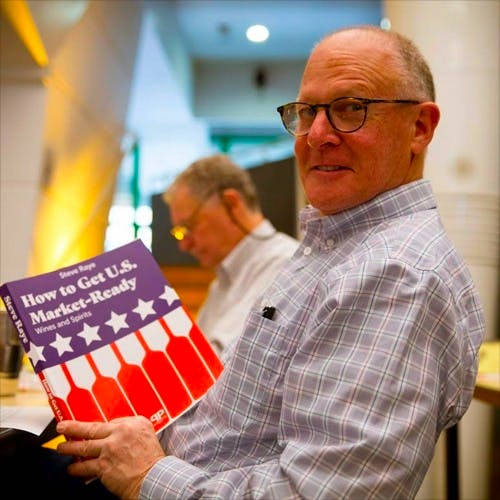
Ep. 499 Steve Raye How to Get U.S.Market Ready | Don't Make These Mistakes Again For The First Time
Don't Make These Mistakes Again For The First Time
Episode Summary
Content Analysis Key Themes and Main Ideas 1. Strategies and pitfalls for Italian wine and spirits brands entering the complex US market. 2. The importance of strategic planning, investment, and expert guidance over rapid, unfocused expansion. 3. Understanding the unique structure and regulations of the US three-tier distribution system. 4. The responsibilities of suppliers and importers in brand building and market development. 5. Common mistakes made by foreign brands and how to avoid them. Summary In this episode of the Italian Wine Podcast, Steve Ray, author of ""How To Get US Market Ready,"" discusses common mistakes foreign wine and spirits brands make when trying to enter the US market. Drawing from 30 years of experience, Ray outlines ten crucial guidelines. He explains that the US market is not monolithic but rather 52 distinct markets, each with its own nuances, and the three-tier system adds significant complexity. Ray emphasizes the need for brands to invest in experienced guides, focus on limited markets initially, and anticipate objections from distributors. He suggests considering service importers as a first step to build a success case before seeking a ""forever importer."" Furthermore, he stresses that brand building is primarily the supplier's and importer's responsibility, not the distributor's, and highlights the importance of understanding what motivates both trade partners (margin) and consumers (romance/value). Ray advises against launching before all elements (product, marketing, inventory, etc.) are ready and warns that growth must be funded ahead of profits. Finally, he underscores the necessity of understanding US regulations and having ""feet on the street"" (brand ambassadors/sales reps) to drive distribution and sales. The episode serves as the final chapter of his book's audio recording, with future podcasts transitioning to interviews with US-based Italian wine industry professionals. Takeaways - The US wine and spirits market is highly complex, comprising 52 distinct markets and a challenging three-tier system. - Seeking expert guidance is crucial for foreign brands to navigate US market entry successfully. - Strategic, focused market entry with limited scope is more effective than attempting broad, rapid expansion. - Proactive communication and demonstrating a clear value proposition are essential when dealing with US importers and distributors. - Service importers can provide a valuable initial pathway to establish a track record of success in the US. - Suppliers must understand that they, along with their importers, bear the primary responsibility for brand building and consumer pull, not solely the distributor. - Adequate financial investment must precede volume and profitability in the US market. - Thorough preparation (product, marketing, inventory) is paramount before engaging gatekeepers. - Understanding specific US regulations (e.g., state-level alcohol laws) is critical to avoid missteps. - Having on-the-ground support (""feet on the street"") is often necessary to drive distribution and sales. Notable Quotes - ""Experience is what you get when you don't get what you want."
About This Episode
The speaker introduces his new book on how to get US market ready, which will transition to a new concept and feature with a range of people. He emphasizes the importance of finding the right guide and building case history to navigate the wine and spirit industry. The speaker also advises against expanding too fast and against not launching while still in progress. He emphasizes the importance of investing in the brand's growth and not making the same mistakes others have made.
Transcript
Thanks for tuning in. I'm Steve Ray, author of How To Get US Market Ready. And in this podcast, I'm going to share with you some of the lessons I've learned from thirty years in the wine and spirits business, helping brands enter and grow in the US market. I've heard it said that experience is what you get when you don't get what you want. My goal with the book and this podcast is to share my experience and the lessons learned from it with you so you can apply those lessons and be successful in America. So let's get into it. Hi. This is Steve Ray, and welcome to this week's edition of the Italian wine podcast, the get US market ready version. As those of you who are listening know, I've been audio recording for my book how to get US market ready. Details on how to order it go to amazon dot com, or you can go to w w w dot usmarket ready dot com. But as I said, this is gonna be the last chapter in the book, but we are transitioning to a new concept, and we'll be talking with people who are engaged in the Italian wine business here in America. We're gonna be talking to a broad range of people, importers, distributors, independent, and chain on premise operators, retailers, national accounts, journalists, influencers, marketers, as I said, a broad range, And we're gonna be cherry picking those that I think not only have something really interesting and novel to say, but also an interesting and novel way to say it. And we're going to add another feature at the end of each of the new series of podcasts asking the person being interviewed For what's the one big takeaway listeners can walk away with them having listened to the podcast that they can put to use immediately. Then lastly, in terms of transitions, next week, which is February fifteenth, I'll be talking with Stevie Kim. Now I'm not quite sure if I'm gonna be interviewing her or she's gonna be interviewing me. We will find out. I'll let you know after. But we thought it would be a good way to kind of deconstruct what we did in the first series, which is about thirty podcasts transition to the new format. And we're gonna end this session with the chapter titled. Don't make these mistakes again for the first time. And, it's a bit of a wry, tongue in cheek way of stating that with the many dozens, maybe even hundreds of clients that I've worked with over the years. I find that many of them tend to make the same mistakes over and over and over again. Each one doesn't make the same mistake over again, but they repeat the ones that others before them have done. And one of the reasons for writing the book is to say, these are the things that you're probably going to think is the right thing to do, and it's not. So, hopefully, we can prevent people from doing that. So let's jump right into it, and we'll then say, wait to our next chapter in the series. I was in Verona at Van Italy one year, and I tasted a wine that really kind of blew my mind. And I said, wow. This wine from this producer at this price, it could be a winner in the US. And I asked him, have you thought about bringing it over? And his response was kind of enlightening. He said, To tell you the truth, I've thought about it, but I'm a bit hesitant. He went on to share a story about other producers he knows that never got paid for the goods that they had shipped, who had been promised distribution and sales that never happened, or who just lost time and money trying to figure out the three tier system only to be stymied and have none of it work. As I say, that's a story I've heard many, many times before, and the outcome could be very different if suppliers just followed the following guidelines, and that's why I'm sharing them with you. Number one, don't go it alone. Invest in a guide that has experience with the wine and spirit industry in the United States and particularly working with new to the world or new to the US brands. The US market and its three tier system can seem byzantine in complexity. And as many have found, the road is littered with potholes that will trip you up, set you back, and cost you money. One great way to avoid them is to find a guide that will help navigate the process, who is not only experienced in the market itself, but also has expertise launching brands here. The right guide can save a supplier from wasting money doing the wrong things, or even worse, doing the right things, but in the wrong order. Number two, don't launch too far or expand too fast. Many companies wanna launch in multiple states and expect to be present nationally in the first year. And that's often the recipe for disaster. As we've said before, the US is not one market. It's fifty two different markets, and each one has to be considered individually. So we recommend that our clients focus resources on a limited number of accounts and a limited number of markets and learn what works and then only expand when you can replicate that success on a broader scale. So pick the markets in which it's going to be easiest to develop your case history, and then volume will follow. Number three, anticipate objections and preempt them before they even get asked. Importers and distributors have an arsenal full of reasons why they won't take your brand. Starting with it won't sell in my market. It isn't any different from brand x. I'm not looking for another, whatever, vodka, Bruno, or whatever the category is that true. If I put it in, I have to take something out that I already know is selling. Or you don't have a brand ambassador or the one that everybody always uses. It's too expensive. Those aren't the real objections. Those are the objections they're putting up. And what they're really saying is they want some reassurance from you that the brand will sell, and it will sell better than whatever it is they have on the shelf already. That's filling that spot. So knowing that the objections will be raised, the most effective strategy is to preempt them so they never get asked in the first place. And the best way to do that is to build a case history and creatively tell the trade about your success. The end goal being to get them to call you rather than the other way around. And a good example is that we were working with a Spirit company, this new rum, and, we feel real strongly in in the value of trade PR. And we had some trade PR running, and we ended up having a distributor that senior person at the distributor, call us up and ask us to come in and make a presentation of the brand. I can tell you that that conversation was entirely different. A hundred and eighty degrees different from when we're calling and begging for an appointment. Number four, understand that finding an importer is not necessarily your first step. When I ask people what they're looking for, I often get that. Yeah. So, well, I'm looking for an importer. And I tell them, well, I think you're better off saying that you're looking for an importer solution. So often I'll recommend that you're better off starting with a service importer who basically is going to say yes to every brand. And those include MHW, Park Street, imports, Tim Ellen, and there are a couple of others as well. The reason for that is they work with everybody, and you're not limited or stuck with them for any long term contract. And what this will enable you to do is to focus on building your success case history so that you can go looking for your forever importer and once you've already started. The idea here is if you're able to pitch the success you've already had to the importers you want to work with in the long term, you'll end up with more meetings, more options if you can demonstrate success rather than simply promising. So give some serious thought to starting with a service importer. Number five, recognize that building the brand is the supplier and importer's responsibility more so than the distributor. The reality is very simple. The primary job of the distributor in the United States is to service the market for your brand. Meaning, where has the product and take and fulfill orders from on and off premise operating. While distributors certainly will elaborate with importers and producers to promote brands, ultimately, the responsibility for driving consumer pull is the supplier and importer's job. When people come to me and say I'm looking for an importer to take on my brand and be the ones responsible for marketing and selling it, it's usually where I put the brakes on because that's not the way it works in America. Sorry to say it, but that's that's kind of the way it is. Number six, ask w I I f m. By that, I mean, what's in it for me? Recognize that brands have two different audiences, and each requires a separate positioning, separate benefits statement, or point of difference, point of difference that makes the differences, I like to say. The trade wants margin and profits, while the consumer wants romance and glamour and high QPR value. If you can show the trade how your brand will make them money, margin, and market share, they're gonna be interested in a lot more than hearing about three of the brand or your grandfather bought the winery after World War two. On the other side, when you're talking to the consumer, you're gonna be telling a brand story to them that is authentic, unique, and motivated. And your story needs to be one that consumers will enjoy discovering and sharing with their peers, probably over social media. Here's a quick test. If it doesn't generate a smile or tears, your story, go back to the drawing board. Number seven, don't launch while you're still a work in progress. Bottle, liquid, label, marketing, brand ambassadors, if you're gonna use them inventory, All of that has to be complete and available in the US. Always be ready to leave a sample bottle when making a sales call and ensure that your website and point of sale materials are ready. Hard copies with you, electronic online. It's imperative that everything is ready and available by the time you have a meeting with your gate keeper. The worst mistake you can make is to get in front of our gatekeeper and say things like, well, our sales literature is being printed or we're just about to run the liquid. They wanna know you're ready to go the day that you're talking to them. Number eight, Don't think you can fund growth out of profits. This is a big one. Recognize that you must invest ahead of volume or profitability. Volume and profits will come, in fact, they can only come after a brand has established credibility and traction. Many brands, unfortunately, think that they can support their growth through cash flow generated from the brand in their intro markets. Not only is that unlikely to work, it's often the reason the importer or distributor won't take a brand in the first place or worse, won't take a meeting in the first place. Because it demonstrates your ignorance of the way the market works and what the needs and interests of importers and distributors are. So plan it advance, allocate the capital to support your brands. And then if you are successful and established and then moving on to other markets, don't stop funding the market that's successful in order to fund the new market. You have to feed both. Think about that. You can't just start a market and think it's going to continue at that rate on its own. It's gonna require continual marketing support. And whether that's advertising, whether that's PR, whether it's social media or any kind of creative brand promotion idea that you have, it's something that has to continue going on. Number nine, recognize that the US system is different. If you can demonstrate an understanding of the US system and that you have respect for the gatekeepers whose approval and support are needed to get off to a good start, you'll be ahead of the game. And and really, if you've read the book or listened to this podcast, you know that intuitive. So invest the time to learn things like margin structures, franchise state laws, and the regulations that have a direct impact on strategy. For example, supermarkets in New York do not sell wine, and retailers can only have one store. So when an importer or distributor, here's a supplier say they wanna focus on supermarket chains in New York, it's clear the very beginning the supplier doesn't understand the market. And gee, I shouldn't have taken this meeting in the first place. So the recommendation is, read the book, and there's other resources like this. But the more you understand about the US market, read the newsletters, and I provide a list of the newsletters in the industry on my website at, dot com. That's the first thing up on the blog. If you click on blog. And finally, number ten, put feed on the street. Now whether you call them brand ambassadors, market managers, or what they really are, sales reps, you need people whose primary jobs to get your brand into distribution on and off premise and then make sure it's selling through to consumers in each and every account. In many cases, local market support must be available before importers or distributors will even consider taking your brand or even taking the meeting. You might think, yeah, that's the distributor's job in some countries. However, in the US, the supplier is responsible for shouldering the initial development work, integrating distributor support when you can get it by demonstrating success. That's kind of the way it goes. And if you feel that doesn't apply to you for whatever reason, you may be, sponsored by some celebrity, it still is true. So something up for today, although these points may seem daunting, in the end, it comes down to a few solid principles. Do your research, understand the market, and build a strong measurable case for your brand to show that you have velocity at retail. Doing that will put your brand ahead of all the others who are still making those rookie mistakes. So again, don't make the same mistakes others have made for you again for the first time. Okay. That's the book. Thank you again for listening to the podcast, tune in next week. We're gonna be having a conversation with Stevie Kim. And in the weeks following, we're gonna be talking with a whole bunch of people in in the Italian wine and spirits industry, actually, in the United States, and I think you'll find both eye opening and enjoyable. Thank you very much for listening. I'm Steve Ray, and this is the Italian wine podcast. This is Steve Ray, saying thanks again for listening. On behalf of the Italian wine podcast. That's a funny one for laughs. My tire was thumping. I thought it was a flat. When I looked at the tire, I noticed your cat. Sorry.