
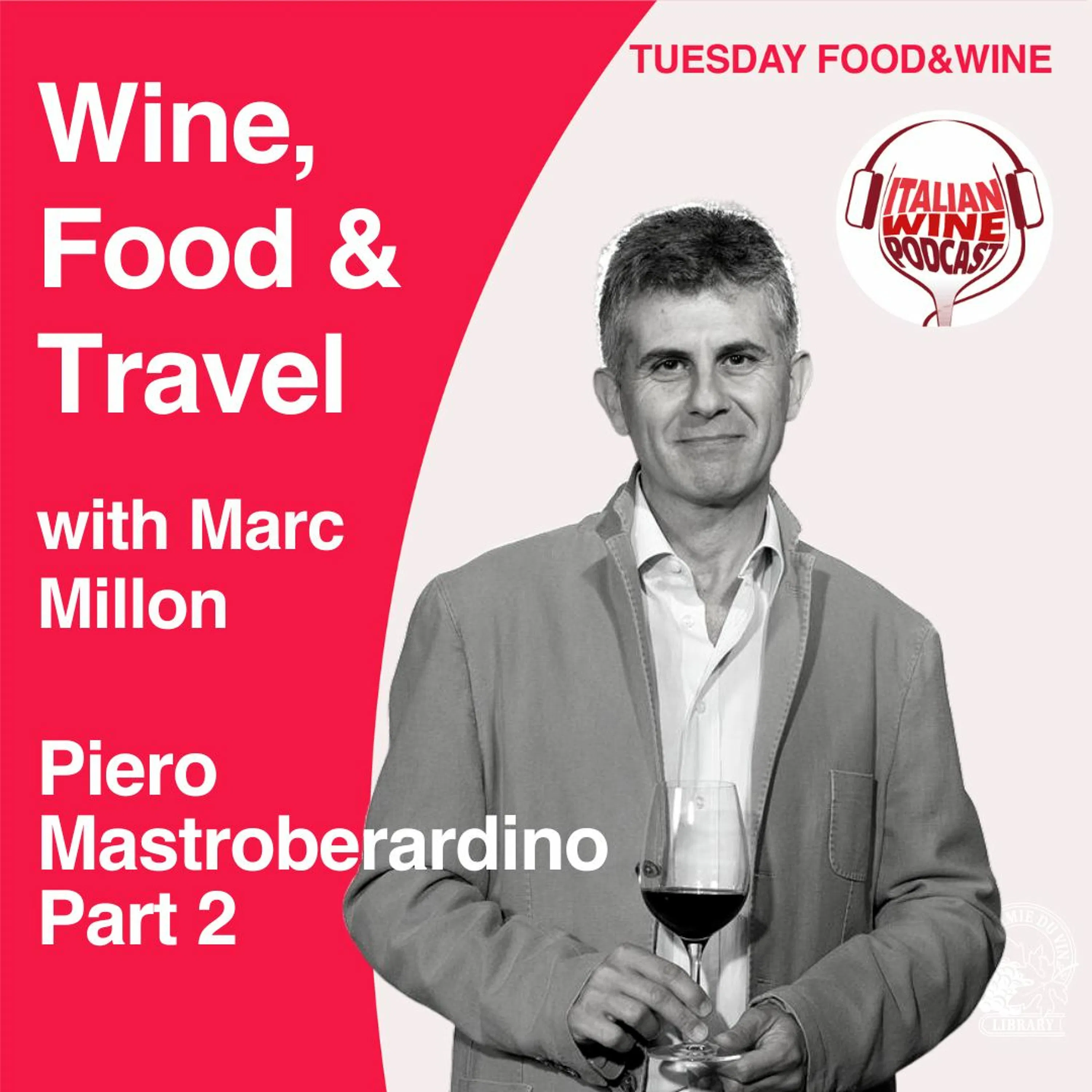
Ep. 1325 Piero Mastroberardino Pt. 2 | Wine Food & Travel With Marc Millon
Ep. 1325 Piero Mastroberardino Pt. 2 | Wine Food & Travel With Marc Millon
Episode Summary
Content Analysis Key Themes and Main Ideas 1. The multi-generational history and continuous innovation of the Master Vetardino winemaking family. 2. The legacy of Piero Master Vetardino, dubbed the ""archaeologist of wine,"" and his dedication to ancient grape varieties and viticulture. 3. The Pompeii (Villamestricia) project: re-establishing ancient Roman viticulture within the archaeological site. 4. The Stella project: a tribute to the father, focusing on long-aged white wines (Fiano, Greco) and a traditional yet innovative style of Taurasi. 5. The unique characteristics and potential of Irpinia as a wine region, particularly for its native grape varieties. 6. The growing importance of wine hospitality and tourism in Irpinia. Summary In this episode of the Italian Wine Podcast, host Mark Millen interviews Pietro Master Vetardino, who delves into the rich history and ongoing innovation of his family's winemaking estate. Pietro highlights the family's entrepreneurial spirit and global reach dating back to the 1700s, emphasizing how his father, Piero, pioneered the re-discovery and promotion of ancient Southern Italian grape varieties, earning him the moniker ""archaeologist of wine."" The conversation covers the fascinating Villamestricia project in Pompeii, where ancient Roman viticulture techniques were recreated, offering insights into historical agricultural practices. Pietro then introduces the Stella project, a homage to his father, which focuses on producing long-aged white wines (Fiano and Greco) and a refined, less concentrated Taurasi that harks back to earlier styles. The interview concludes with a discussion on the evolving wine hospitality sector in Irpinia, inviting listeners to experience the region's unique charm and the Master Vetardino resort. Takeaways - The Master Vetardino family boasts a long and innovative history in Italian winemaking, dating back to the 18th century, with early global market reach. - Piero Master Vetardino (the father) was crucial in reviving ancient grape varieties and viticultural practices, acting as a ""wine archaeologist."
About This Episode
The speakers discuss the importance of local and regional foods and specialities in Italy's wine culture, including the early involvement of the wine industry in the age of war and the importance of learning from family members. They also discuss the passion of Speaker 3's father for Italian wines and his involvement in the development of wines and grapes. They discuss the history of their wine tasting, including a vintage from the first year of the first vintage, and the use of vineyards to reposition wine plants. They also discuss their experience with traditional wines and their partnership with a wine company to reposition wine plants. They mention their experience with Stella projects, which are a collection of wines that are made from a single culture, and their success with a 12-year-old wine from the heart of Campania. They also discuss the importance of wine hospitality and the potential of their wine resort to develop wine tourism and hospitality.
Transcript
By now, you've all heard of Italian wine Unplugged two point o. The latest book published by Mamma jumbo shrimp. It's more than just another wine book. Fully updated second edition was inspired by students of the Vin Italy International Academy and painstakingly reviewed and revised by an expert panel of certified Italian wine ambassadors from across the globe. The book also includes an addition by professor Atilio Shenza. Italy's leading vine geneticist. The benchmark producers feature is a particularly important aspect of this revised edition. The selection makes it easier for our readers to get their hands on a bottle of wine that truly represents a particular grape or region to pick up a copy, just head to Amazon dot com, or visit us at mama jumbo shrimp dot com. Welcome to wine food and travel with me, Mark Binon on Italian wine pod us. Listen in as we journey to some of Italy's most beautiful places in the company of those who know them best. The families who grow grapes and make fabulous wines. Through their stories, we all learn not just about their wines, but also about their ways of life. The local and regional foods and specialities that pair naturally with their wines and the most beautiful places to visit. We have a wonderful journey of discovery ahead of us, and I hope you will join me. Welcome to wine food and travel with me, Mark Millen, on Italian wine podcast. Today, it's my great pleasure to actually travel to the heart of Irpinga to Attripalda, to be with doctor Pietro and Astro Veradino at one of Italy's most iconic wine estates. Continuing a conversation. We started a couple of weeks ago, a fascinating story of the Master Baradino family, and I'm delighted that we can actually have a part two interview focusing on topics we didn't really get a chance to to cover last week. So thank you very much for for, being my guest today, Pierre. How are you? Thank you very much. I appreciate it. It's my great pleasure, Mark. And, I really hope to have a a chance to show a little more about what we call master bedroom experience. So we have different aspects of, our contribution to the world a while. Yes. And it is a it is a very significant contribution. We just spent, a good hour walking through the fascinating family museum that you curated. It goes back to the start of the family's history here in the seventeen hundreds. And and the different generations and the contributions they made. And what I'm really struck by is how across the generations, it's been such a story of innovative entrepreneurship, really exciting, bold traveling around to find new markets to to share the wine that the family has produced. Yes. What is, really impressive for me is on one side the continuity of of this story that it's really something that hits the visitor because you have the idea of the approach to wine business and to wine family business. So the relevance of the traditional family inside the territory. And then also the, capability of the organization of giving a structure to a small company, even two centuries ago, that, you know, sometimes people don't realize that you can have, a coverage of all the risks, through insurance policies, on everything, even one hundred and fifty years ago. And, you cannot imagine that, you have a a structure that covers your internal services and process with people, you know, taking care of many different continents, markets, and languages. So I think it's very interesting as an experience to go through this museum, not only to understand what is wiring business or what has been must have been a wine business, but also to understand what was the business in the past centuries. Yeah. It it it is a really fascinating story. And to see this story actually documented with handwritten letters, seeing the beautiful and detailed handwriting of your ancestors that tell the story through your documentation that is searching from new markets. I think what's also striking to me is I, we we consider the master bedroom, do you know family to have been pioneers in really bringing the wines of Southern Italy to the world. And I'm I I thought that story began post war with your father, who we'll be speaking about in a minute. But what's fascinating is how early the company was selling wines to markets, in the US, but across the world, very long time ago and and wine in autos. Yes. The story, on foreign markets start starts at the end of eighteen hundreds. They are really pioneers, and, I think that, it's correct to identify my father as, the new wave of Maso Delo, winery. But, in his mind, I mean, in his heart, there was this strong feeling of bringing back the name of the family to the success of fifty or seventy years before that he knew through the tales of his father and then that he, had been experiencing when he was a child in the late twenties at the beginning of the thirties. Yeah. That's that's that's so interesting. And, and, of course, you you recounted in our previous interview, the difficult time in the nineteen forty is a difficult time, when the allies had bombed the area when men were away at war, and your father took over the company at fifteen years old. Yes. He was, very strong as a character, and, he was, living in a very strong relationship with his father because, my grandfather, Mokele, got sick in forty three when he died in forty five. And so, as the older brother of my father, Andrew, was under the German army, my father became first of all, the, leader of the family business. And, on the other hand, it became the, I mean, the person who read the newspapers to my grandfather, the person who with whom my grandfather used to play chess in the times. So this meant that he got all the stories from his father and he got the possibility together as strong experience, that he put in his, next years in which his father passed away. And, then he was lucky also because his older brother, when when he came back from the war, said that you have to also to study. I know that you are managing the company, but you wanted to bring him through university. So my father studied technical subjects and became technologists and, and then he took over the technical side of the company with a perfect professional. He he also made some courses abroad to complete his specialization. So, he was in charge of almost everything and studies and the business in the late forties and fifties. And, in the fifties, he was really a leader for the company and was was recognized as the great innovator of Italian wines together with other four or five friends of whom that were, you know, have a at the at the similar story. Ironaries in other parts of it. Yeah. Exactly. That we're really taking this, taking Italian wine to the world and really celebrating this long tradition of Italian wine that goes back literally two thousand years. Now, The father has been called an archaeologist to the mind because of his his dedication to these ancient great varieties that go back to the Greeks and Romans, something that, of course, continues entirely here today. Now, how did your father have that passion for for the past? You said that he studied engineering. Did he did he do classical studies? Yes. He he he was coming from, the high school that were classical studies. And then he went through chemical biology and uh-uh inology. And, he was a lover of the old books. And, he used to study all these ancient books, talking about, coming from pliny, the natural history story about Columbia and so, he he used to mention parts of these books almost every day. And those were his readings every day. You you saw in his room every day on the on on his desk, some of his old books. And these were really his base of, knowledge. And so, he knew very well the rules of our video culture that as you mentioned are partly from the bricks and parley from the Romans. So we had these two main, trajectories of our, Viticulture platform. And the Greek one, Grego, Janico, and the lapping one, maybe Seattle, but also a great lot of are still the base of our work. At some point in the early seventies, he he wanted to start a research plan in order to bring back to life, the knowledge base of the Romans in Viticulture training systems. And so, he started working at a project that could allow him to understand more and more about these different training systems of the past. Then only in the nineties, we were able to bring something to an operative level, with the collaboration that started in nineteen ninety six, with the Italian government, with the minister of culture in Pompeii. Where inside the archaeological site, we were able to plant several small vineyards, each of them dedicated to different grapevitals, different training systems, and, there were fifteen small vineyards. And the project, started in ninety six and lasted up to the end of twenty one. In this project, we were able to reproduce all the ancient techniques and reproduce also the density implementation opposition of the wines and everything that was linked to the world of agriculture in the in Roman times. So this has been an interesting project for us. We understand more and more about, what was the, original approach of the agriculture how it was, evolved and advanced in some sense, even if the motivations for for some technical choices probably were different from the ones that we got in our current literature, but the, options were similar at the end. So it was extremely interesting. This is, something that has always, been at the top of the thoughts of my father. As he usually said, we have to bring our story of our wines and our grapes back to the roots. All the projects dedicated to these grapes aimed at, bringing back to life, the original flavors of these ones. And so many of the research said we are currently, running. Just sticking with the villa de Mestari project before we talk about some of the new projects. So your father also inspired in you this love of the ancient worlds, love of of classics, and of this connection with the past. For you personally? Yes. Because, at the end, I realized that, classical is something that, generates, a bridge link between the past and the future. You cannot have anything classic, if you're not an innovator. So you have to make changes. And, at the end, time in wine business, it's like a circle. You know, something that brings you back, you know, old things as new ones, time by time. And so I've seen in my my professional career many things that, seem to be twenty years ago, something a little older or dusty that, now are considered the the frontier of research and innovation. So it's very funny. I think that, we must keep, a strong, stronger link with our roots in order to be real innovator in our turtles. Okay. Now just a few more details about this Village Mesthetics project. You say that you you, actually planted, in the vineyards, actual vineyards that were you were able to find traces of posts Yeah. And able to utilize the Roman training systems. Exactly. To reposition the plants in the exact same position of the seventy nine eighty, eruption. And, this was made with the collaboration of the archaeologists. And so, you see that those vineyards were made with a density implantation that is about eighty eight hundred plants per hectare. That is something quite crazy. I mean, currently, after many years, experiments here in Milpina, we decided to stay on forty five hundred up to five thousand plants per hectare. It is a good density considering the the steep slopes that we have here on the mountains, but there is very plain and it was possible to work with a little higher density that was the original ones from the Romans and the reason for that was that they wanted to have a higher level of shades during the working in the vineyards. And so the approach is different today. We we we talk about density or condition because we we want to make a, you know, a balance between the biological individuals and the microenvironment. The reasons were different But the options were similar as I was saying before. Yeah. That's absolutely fascinating. And, were, you able to determine the great varieties that have been planted through DNA? Yeah. I want plenty of information on this, and we made a lot of studies, but, of course, torture is a a very strong support there because, from that time, we have so many documents, but also we made a lot of studies on the residuals that we were able to analyze, think the region in the area. So, you know, we got plenty of information about it. And then, Pompeii, as you know, was, so rich and the huge expression of of the culture of the time that you've got very dedicated and, you know, precise description of every part of social life. And wine was in right in the middle of that process. Of course. It was a city of wine. Yeah. Yeah. They were people were drinking it, but they were trading it. Yeah. And the amphitheatre there, and, you know, on the position of the of the denied. It's, another, you know, option that is not, not a case. It's something that was made for a precise reason and you see yellow bandana with the wine bars on the street and so on. I think it's, you know, as a reason for being there. Yes. Well, it must have been hugely exciting to actually plant the vineyards and and see the fruit come to fruition and and and make that first. What would there was the first vintage? Two thousand and one was the first one. But, again, the research plan was mainly dedicated to the training systems because, of course, the microenvironment in Pompeii is playing a new innovation is closer to the sea you don't have the the discussional temperature that we that you need today to have, high quality wine. So probably it's not a wine that, you can age like a Taurasi from European, but it's very interesting as well because, you are doing an experiment in a very peculiar environment with a very dark and sandy soil with the richness and murals, but uh-uh, but of course it's wines from the coast. They're not from from the mountainside. Even in classical times, the line of Pompeii wasn't considered a great wine. It wasn't the growing crew of the Romans, was it? Well, yes. Probably it was more for, consumption in the city. In in the way we mentioned before. So you've got the production, and then you've got, the the wine bar that gave the wine to, you know, to the people going to the show at the unfamiliar. Now, you were concentrating on training systems. Did you consider making the wine in Roman style? I know now, the Emperor is, you know, it's become quite important in Italy, but that was No. It doesn't make sense. I mean, the the technology was the same. The control of temperature was there with the Dolia system in the soils, but, the the process then, doesn't make sense at the end. You got, something that is not in the line of the expectation, a statistical expectation of the consumer of today. And, I mean, of course, you do experiment on on those processes. But at the end, you don't you don't battle a wine like that. Sure. What were the great varieties you decided on then for for this one? First of all, we decided to focus on Pierlosa that is the great bridal that is, the most adaptable to that environment, but it also doesn't love cold environment of the have in your opinion, but, has a very good expression on the slopes of Mount Resugio. So close to Pompeii. And, also, we used a little over the shashinosa in the blend that is another typical Roman grape, in the second part of the project we planted also, Samal yamiko, we did bush training system Alallianico, you know, gave us more troubles, because, Alianico wants a closer environment. So, at the end, what is really weird, is the fact that, in Pompeo, was harvested in late September while here in Pinia, we harvest in in the beginning of November. And Pierre also is harvested there in October more or less, you know, in the same period in which we harvest in the Brazil slopes. It's a little higher. So it's a completely different behavior of the grape variety of Avayanico in two different environments. This was another interesting scientific achievement that they brought. You know, the influence of the microenvironment can move you know, the the maturation period from from mid November back to mid September. That is a lot. Yeah. So it was a real learning process. Yeah, which, which has helped in, in further researches, which will speak a minute. But first of all, you've you've very kindly opened a bottle of Billity, mister. And I'm very, excited to try it. It's a wine I've read about. So salute. It's a twenty twelve twenty twelve from grapes grown within Pompe. I know how many bottles would you make a year? Italian wine podcast. If you think you love wine as much as we do, then give us a like and a follow anywhere you get your pods. One thousand per year. Okay. So Yeah. The current, you know, the last vintage release was the first thing. The fourteen is going to be released. And, then we also have up to the twenty one that was the last harvest made in the project. Up to the twenty one, we are still in the cellular refining. Uh-huh. Well, it is fascinating to taste. Now, when you first tasted the validity, mister, your first vintages, did you really feel that you were tasting the past that it was connecting to that time, nearly two thousand years ago from when life stopped on on the streets of Pompe. No. I think that, we must, honestly make the difference between the research project dedicated to agriculture and the wine that probably I wouldn't even produce them because, you know, the focus was on agriculture. But at the end, the government side said, okay, you will you will produce some fruit, some grapes. So why don't you use those grapes to freeze a wine and to give this wine to the government in order to have the possibility to use it to flow in public events. And so we produced this really necessary that uh-uh became a kind of event wine and it was used in Italian embassies in, you know, big moments of the made in Italy. Event. But, it's it's been a good experience. But at the end, as you can see, the wine is very pleasant as, the character, of a wine from Campania, it's very interesting. It's, round and delicate as a wine from the cross can be. So It was good fruit still in two thousand twelve. Yeah. Yeah. It's it's aging well. It probably will not have the aging potential of it already that, you know, after one century is still alive and vibrant, but, it has a good potential of aging as well. And it's, it's it's a very pleasant one. Yeah. Well, it's an absolutely fascinating project, and I know that you spent twenty five years on the project. And have carried on research into, wine in so many ways, you know, you do so many things, you know, you've curated the museum, you write novels, and you research. So this was a an important project think it's an absolutely fascinating one. Tell me tell us about your research now, and in particular, a Stella project that we have here. Oh, yes. Stella project is the most important thing I'm working at. And, it was started as an idea in in twenty fourteen right after my father passed away and I wanted to work on some of his ideas and, to also may leave a tribute to his professional career. So, Stella, the word, Stella, meaning the connection of styles of an artist. Stellama is a collection of styles of an artist that is the Viticulture, and it's made of three wines. Afiano Dio Cg, Reserma, a very good day too for the Cg, Reserma, and the Taurasi DOCGs, and, each of them representing the benchmark in terms of approach to why making process, the benchmark, during the evolution of my father's career. So the whites generally have a linen recognition for, reproduce, this style of the whites, aiming at a love very long refining. So wines that are released in the fifth year. After the harvest. So it's something very unusual, but, the wines from Lithuania, like Ciano and Greco really can make it. And I think that they deserve it and that, we must take the responsibility of presenting these wines to the consumers, the wine lovers in a way that, can give them a full idea of the potential of these wines. So, still, Maaffiyam and Greiko, currently, we have just released a twenty eighteen. They are so fresh. The color is, still the same of the white that is it comes from the last harvest. But, with the, maturity, the complexity of flavors that is outstanding, with, at very, you know, an expression of salinity that comes from the process, twenty four months on the lease means that you have a huge protection, but also you have the enhancement of this, soil character that is outstanding. And the piano goes a little more towards, the Fume and, the Greco probably a little more towards, the hydrocarbons. I mean, the the style of a Greco refined, different wines. Greco has more power, piano, more finesse, but, those are the two wines that I really love to drink currently. And demonstrating that these two great white wines do have a capacity for long aging. Yes. This was something that, we already used to present, vertical tastings, mainly on dating back forty years, were already something that we used to do. But it's different now because with Stella, you'll think of these wines in that perspective. While in the past, we used to show the potential of aging of that wine that was the current January, you know, with a longer refined, this means that the evolution in the bottle was faster while I'm really confident, looking at the first data because Fiano is already at the fourth experience started in twenty fifteen. The first harvest of Sierra Villina's dilemma. I see that, the evolution is very, very, very slow and, these wines are really outstanding. So I'm I'm really curious, but also very happy about this experiment talking about the whites. If we move to the reds, the approach is completely different. In that case, it's dilemma reserved. The current vintage just released this twenty sixteen, that wine is a revolution compared to the words of Taurasi that you can experience currently on the market. The the Stella Taurasi goes back to the styles of the Taurasis of the fifties and sixties. So in that case, we are, shortening and reducing the maturation. We lower temperatures, with less dancing and, with a huge freshness. Much more agility and, beautiful transparency less concentration of the food, complexity, a little more exotic, nose, and, with the with the, a touch of fruit that goes more towards the small red berries than the darker ones that we find in Arvishi or in or in store. Yeah. So it's a completely different tasting profile. A wine that has an agility in the glass, an agility that takes in a drinkability, being a big, an important wine. We don't have the idea of, too much, earthiness, too much I mean, concentration on the farm. This is something that I love in terms of style elegance and finesse, and this is exactly what my father used to do producing the Taurazis with which when I was a child, I first came in touch with a big red wine. One thing that is, most striking to me, is that wines under the name Tarazi Greco, is in Greco, the two of alfiano, were being sold by the family, well over a hundred years ago, under those names. It sounds like to me, like Mistyema, you're really going back to the roots of the family to really express the territory and those three historic great varieties in his fuller and an expression complex. Not looking for those nuances of crew, but really embodying what those great varieties represent. Yeah. Yeah. Correct. And, I think that, I've been very lucky having a father that paid a lot of attention to the family roots, sir, and allowed me to have a beautiful library of wines that are witnesses of the evolution of, the way of thinking about, prestigious high quality wines in irpania. And, I feel the responsibility to bring this message on to give next generation the same opportunity that I got from my father. And so Stella project is, a way to start creating something that I want to leave as a testimony for the future to them. And, it's very nice because, you know, sometimes you feel the heaviness of a process like this. In wine business, it's not. You know, everything is so pleasant and so fascinating that at the end, even if you're you're aware that you're doing something important is something that you can enjoy, you know, with your family, with your friends, knowing that, pleasantness is a good driver for research and development. I guess if that that that drive to create great wine, it's also enjoyable wine. Yeah. Definitely. Definitely. Final one I'd like to talk about, is his story, and you've mentioned it because that returns us to the, to the ancient world, to your father's vaccination with, the classical world. And in many ways, I've always thought of, Eastoria is, is that, that's the greatest expression of Compania, and is the wine that really links us to the Roman world. So that wine that you maybe would have liked to produce in Pompeii, but because it's a coastal vineyard, the wine wasn't Yes. Wasn't that one. Historia is wine. Yeah. Historia that the full name is Natoralis' story. It's a project started in the nineties. It's the second wine project that I personally took care of. The first was the Morimayorrum. It was a family member in New York. Started in ninety five. Historia, the first harvest was in ninety seven and, started as a project of, verification of grapes coming from very old vines. So the idea was to, experiment the potential of quality of vines that are older. That means different density of foundation, but also different yield per plan. And so a completely different perspective. The one came out in ninety seven, was, extremely successful at the beginning. And, in the first years, it was an experiment. It was classified as an elite agent. Then in two thousand and three, became a ERCG Taurasi, because in the first years, it was verified in blending with a little percentage of heroes in the blend. But in two thousand and three, he also came out of the blend because the contribution was was not relevant. And so I decided to reclassify it, since, two thousand and three in the BRCGital class. And the wine is extremely interesting because, coming from a different site, it's a single vineyard located in the state of Mirabella, different from the character of the radishi Taurazil itself, whether this is from Montemarano, that is the coldest part of the operation area. Mirabella is a little lower in altitude, the motivation comes a little earlier one week earlier, but the temperature is a little higher. So at the end, you've got a little more delicacy talking about the Tawasi, of course, but a little more roundness compared to the radishi. And the the flavors, you you have this coffee, dark chocolate. A lot of beautiful spices. I mean, the wine has fruit and the spices with a beautiful integration. So elegance and and the kids. And, it's producing very few bottles about three thousand a year or two thousand per year. So it's it's it's a small production, but uh-uh it's a very interesting example of the fact that Tallazi is not just one wine. Tallazi is an opposition area that can express so many different things and we are obliged to allow people to experience all of them. So we want to give this wide representation of the potential of a beautiful operation, like, that's a good suggestion. Okay. It it it is a beautiful one. And of course, it's paying homage to any of the old there for his great work. Yeah. Natural, his story. Now, the funny thing I'd like us to touch on is wine hospitality. I drove over, from the coast today, over the mountains, into another world. European is very different Yes. From Coastal Campania. Very, very beautiful. It's a long time since I was been here. I was, it's more than thirty years. I was here in nineteen eighty nine, I believe, which was actually when the area was still recovering from a terrible earthquake of nineteen eighty. And I know so much has changed and and I know that wine hospitality, you know, in nineteen eighty nine, people weren't really traveling to to find wines and and and and to try to find the stories of wines, but now that's a very important activity for wine lovers. And I hope that that our listeners will find their way to atripada. So tell us about wine hospitality here. Yes. Just ten years after your first visit here. So in nineteen ninety nine, I decided to start a new project of, wine tourism and hospitality. And so in one of our, largest states, the one that I mentioned in Mira Bellicano, I established the, wine resource where we have, it's called the Pradeshi Resoft. And, there we established two different restaurants. So one is a fine dining and the other is like more in Austria with the with the Minnesota typical of the region. And, we also have, of course, the hotel, the town's hotel with the twelve suites dedicated to the guests. And, there's a spa, of course, there's a heated swimming pool, tracking. I mean, it's a very, very nice way to present our territory. In in a in a sixty five vectors, a property, that you really find the heart and soul of European. And this is another contribution that I want to leave to my land, to my homeland, because I think that the potential of the seals it's a huge, and, this wine resort has been classified among the eight most important luxury resorts are dedicated to wine and food culture immediately currently. So it's, for me, huge satisfaction to have had the possibility to open a new chance of development for college people. Yes. And I think that's important for the area as well because I think people at the love wine, you know, we love being in wine countries. It's nice to be where vines are or wine is produced. And then to also have other activities, that one can come and really hang out and live in an area is is a great opportunity. So I hope that, our listeners will find the wonderful Master Betardino range of wines wherever you are in the world. And even more, I hope that some, will make their way to Campania and to to neutropenia to to discover them here at the source. You know, it's been a real great pleasure meeting you here returning to to entry Paul after such a long time and to, sharing this story of the master burner, you know, family. My great pleasure. Thank you much. We hope you enjoyed today's episode of wine, food, and travel. With me, Mark Miller, on Italian wine podcast. Please remember to like, share, and subscribe right here, or wherever you get your pods. Likewise, you can visit us at Italianwine podcast dot com. Until next time.
Episode Details
Related Episodes

Ep. 2822 Ep. 20: California | Study Smart for your WSET Level 3
Episode 2822

Ep. 2789 ColleMassari: a long-term vision rooted in Montecucco with Giuseppe Di Gioia | On The Road With Stevie Kim
Episode 2789

Ep. 2788 Ep. 14: Austria and Hungary | Study Smart for your WSET Level 3
Episode 2788

Ep. 2785 From Volunteer to Speaker at TEXSOM with Samantha Cole Johnson | TEXSOM 2026
Episode 2785

Ep. 2766 Inside the U.S. Non-Alcoholic Wine Market: What Wineries Need to Know with Jill Sites | Masterclass US Wine Market
Episode 2766

Ep. 2761 Winemaking and Consulting Across Sicily with Alessandro Serughetti | Wine, Food & Travel with Marc Millon
Episode 2761