
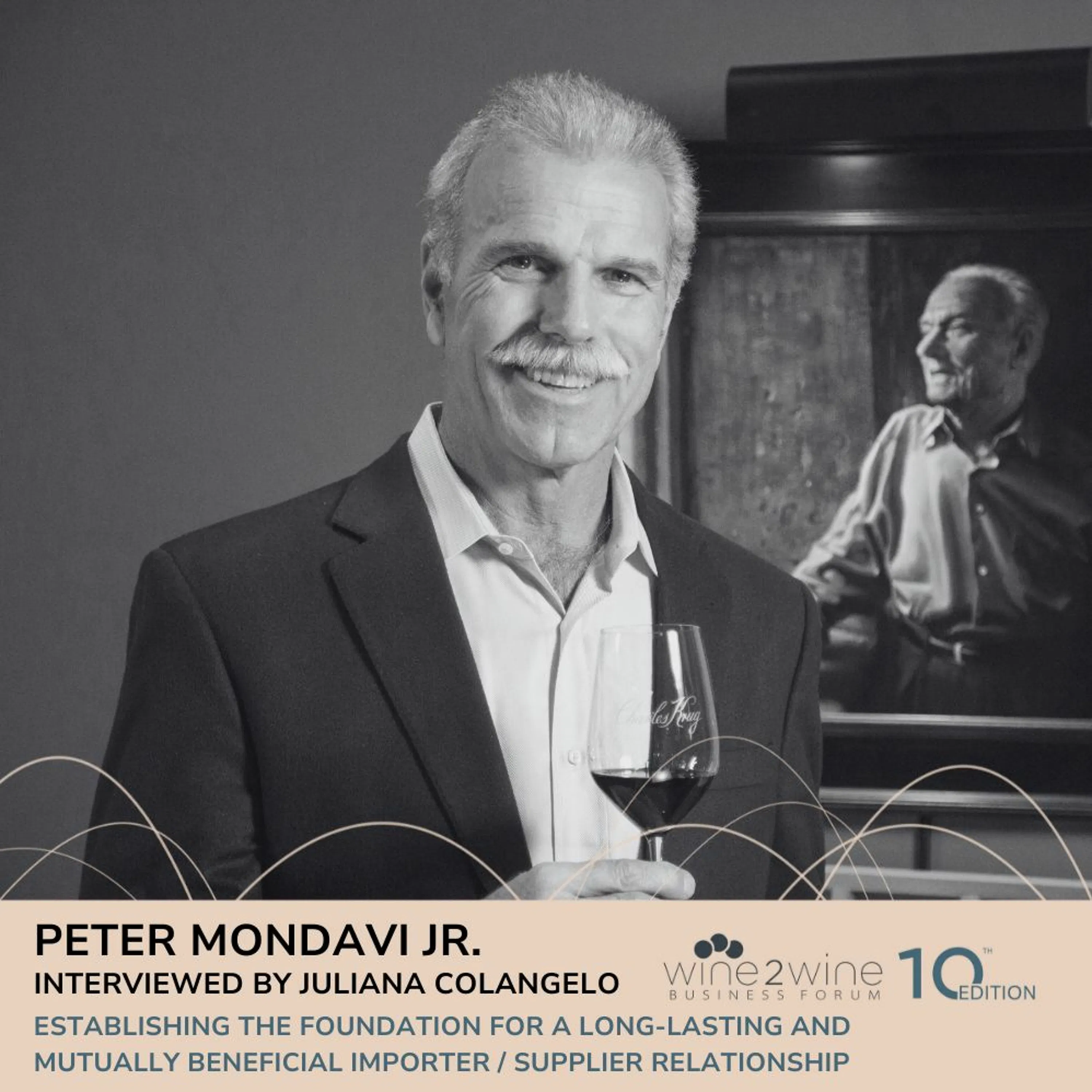
Ep. 1554 Peter Mondavi Jr. | wine2wine Business Forum 2023 Series
Ep. 1554 Peter Mondavi Jr. | wine2wine Business Forum 2023 Series
Episode Summary
Content Analysis Key Themes and Main Ideas 1. The enduring legacy and evolution of the Mondavi family's Charles Krug Winery in Napa Valley. 2. The strategic diversification of the Mondavi family business into wine importation. 3. The rationale behind entering the import market, including consumer trends, climate change, and distribution dynamics. 4. Key prerequisites and challenges in establishing a US wine import business. 5. The significance of family-owned business partnerships in the global wine industry, exemplified by the Mondavi-Bolla collaboration. 6. The strategic focus on Italian wines for their diversity, quality, and market appetite in the US. Summary In this episode of the Masterclass US Market, host Juliana Colangelo interviews Peter Mondavi Jr., co-proprietor of Charles Krug Winery, about his family's rich history in Napa Valley and their recent strategic move into the wine import business. Peter recounts his grandparents' journey from Italy to establishing Charles Krug in 1943, highlighting their unique entry into winemaking through fresh grape shipping. He explains the rationale behind diversifying their portfolio into imports, citing changing consumer demands, the impact of climate change, and the consolidation of distribution networks. Peter details the prerequisites for starting an import business, emphasizing the need for family alignment, experienced management, and a supportive distribution network, while also acknowledging the logistical challenges involved. The discussion then focuses on their partnership with the Italian Bolla family for Prosecco, underscoring the importance of shared generational passion, open communication, and mutual respect in family-owned business collaborations. Peter articulates their vision for expanding the import portfolio with diverse, complementary Italian wines and growing their strategic importance with US distributors. Takeaways - The Mondavi family's winemaking legacy began in the US through unique circumstances, not Italian winemaking heritage. - Diversifying a wine business into imports can be driven by evolving consumer markets, climate change impacts, and strengthening distributor relationships. - Successful wine import businesses require alignment from leadership, experienced teams, and strong distribution partnerships. - The Italian wine market offers significant growth opportunities in the US due to its diversity, quality, and consumer appetite. - Family-owned winery partnerships thrive on shared generational passion, trust, open communication, and a long-term vision. - Logistical complexities, including inventory and pricing structures, are significant challenges when transitioning to an import model. - Authenticity and compelling stories are crucial differentiators for wine brands in the US market. Notable Quotes - ""If it weren't for prohibition, we probably wouldn't be here talking about wine."
About This Episode
The Italian wine podcast has reached six million listeners and has had a significant impact on the Italian wine industry. The hosts discuss their family's legacy and the success of their wine business, including forming a multi generational legacy. They emphasize the importance of starting an import business and diversifying their portfolio, as well as the need for a larger national distribution network. They are excited about the potential opportunities in the US market for Italian wine and emphasize the importance of communication and sharing ideas beyond the same page. They are looking for a new business for the next generation of import business and are looking for a shared family history and a generational vision.
Transcript
Since two thousand and seventeen, the Italian wine podcast has exploded. Recently hitting six million listens support us by buying a copy of Italian wine unplugged two point o or making a small donation. In return, we'll give you the chance to nominate a guest and even win lunch with Steve Kim and Professor Atilio Shenza. Find out more at Italian One podcast dot com. Welcome to Mastercost US Market with me, Juliana Colangelo. This show has been designed to demystify the US market for Italian wineries through interviews of experts in sales and distribution, social media, communications, and so much more. We will quiz each of our esteemed guests at the end of each episode to solidify the lessons that we've learned to sharpen your principles, get out your notebooks, and join us each week to learn more about the US market. Hello. Welcome to Masterclass US wine market. Today, I'm thrilled to welcome Peter Mendavidavi junior to the Italian wine podcast. Peter is the second son of Peter and Blanche Mendavi and the grandson of Cesare and Rosa Mendavi, the NapPA Valley pioneers who purchased the historic Charles Group winery in nineteen forty three. As co proprietor with his brother, Mark, Peter is immersed in the stewardship of the historic Charles crew of winery and Vineyards in Napa Valley and steadfast in succession planning for the future of the family's legacy. Peter's passion is working to reinforce Charles Group Wineery as one of Napa Valley's premier estates centering on the family's tradition of innovation and quality. Welcome to the show, Peter. It's so great to have you here today. Oh, Juliana, thank you for the invitation. Of course. Of course. Well, we're so excited to have you on the show today, and we're really excited to talk not actually about Napa, but about Italy, and your family's recent forays into the Italian wine business. But before we dive into today's discussion, Peter, tell us a little bit more about your family's legacy in Napa Valley. Sure. Actually, let me start with, where it starts in Italy. My grandparents got married in nineteen o eight in December. My grandma was about eighteen years old, grandfather, a few years older. Of parents who were sharecroppers, so very modest means. They had about a third grade education, but two weeks after their, wedding, nineteen o eight, they crossed the pond, landed in Ellis Island, And, then immediately made their way up to Northern Minnesota where they already had people from their community and family had already established themselves up there. So it's important to note that our family has no winemaking background in Italy. So my grandfather twelve away in the iron mines briefly, didn't like that. Started a saloon. Of course, prohibition shut that down. It went into a grocery store business. And because he was dealing in fresh produce, fruits vegetables, the Italian community rallied around him to ship, fresh wine grapes from California back to the community so that the local families could produce homemade wine. So that's really our introduction into winemaking. Right. And from there, my grandparents moved to California to to further that grape shipping business became very successful. And also, got him the ability to understand, you know, wine making and the wine business here in the United States. And in nineteen forty three, my grandparents purchased Charles crude winery. So it's been in my family, ever since And my dad, Peter and Michael Robert ran it together. And in nineteen sixty five, Michael Roberts split off and started his operation the following year in nineteen sixty six, of course, Robert Mendabe Weinre, And shortly after that, my father bought out Robert's ownership of Charles Krug. So now Charles Krug remains a hundred percent family owned on my dad's side. We're starting to integrate and pass things on to the fourth generation. Both Mark and my kids. And there is a member of the fifth generation, two years old, but nevertheless, hopefully, someone to to carry on this multi generational legacy. So that's kind of a a snapshot of our family has Yeah. That's a really interesting timeline and really a true American success story of your grandparents coming across the pond. And I I love the way they got into the industry too, so interesting through through grocery. I mean, that's kind of a roundabout way, but it totally makes sense. Yeah. And if it weren't for prohibition, we probably wouldn't be here talking about wine. Exactly. Exactly. Well, Peter, thank you for that timeline and history to set the stage for today's conversation where we're gonna talk more specifically about your family's recent foray into the import business, which started in Bordeaux in twenty twenty with the label French Blue, and more recently just last year expanded into Italy with the Bola family So we're gonna discuss how to form successful supplier importer relationships specifically between family owned businesses. You can touch a little bit more on the recent news with Ebola Family Partnership. So our three key takeaways for today's master class and what we're really excited to dive into with you are. Number one, how do you start an import business in the US? Your family's obviously been working in the wine industry for many years, but this is the first time working in the imports, which is exciting. Number two, what are US importers looking for in suppliers? And finally, our third key takeaway is gonna be what are the unique aspects of two family owned businesses working together across continents? So Let's just dive right in. Peter, for my first question, I really wanna start about talking about how you decided to go into the import business after making wine in Napa Valley for eighty years. As you mentioned, we've been add it for eighty years here and the and the wine business in California in the United States. We know the market very, very well. It's very well established, our brands throughout really all fifty states through the distribution network. And things have been very dynamic in recent years, recent decades throughout the industry. And we felt that it was important to diversify our portfolio. And diversification for a couple of reasons. One is the changing wine environment out there with respect to demand. Now the consumer has numerous options for adult beverages today far more than we had twenty, thirty years ago. So it's very complex from that side. So I think it's important to have a more diversified portfolio Right. From a wine offering standpoint. So that's one of three driving reasons. Another one is more on the supply side of things. Now with climate change, kinda wrecking havoc, you know, throughout the world and growing in sometimes in growing regions, it's nice not to have all your eggs in in one basket. For instance, the twenty twenty vintage here in Napa Valley was probably about half of what is normal, perhaps even less. There's no real good numbers on it. All from the smoke taint from the fires that that devastated many parts of Napa Valley. So diversification from, you know, we're partnering with wineries, you know, away from, you know, different areas. Right. And also wines that complement our existing portfolio and work well with our distributor partners and and complement Mhmm. Our offerings within their portfolios. Right. So what I'm hearing is there is rationale to start this side of the business from market forces and changing consumer demands around what consumers are drinking, consumers drinking across categories, across regions, But also the reality of climate change that is diversifying where your products are coming from as well seem to be the the driving factors for going into the import business. Yeah. Very important. And also to then maybe we'll get this little later as well, but the distribution network is consolidating. The distributors are getting bigger. So we need to have a bigger footprint, a bigger presence in our distribution network. Mhmm. Absolutely. To be become a more impactful partner. That makes a lot of sense. So, Peter, talk to us a little bit more tactically how you go about starting an import business in the US. What was that process like for your family. Well, I think it kinda three key prerequisites for our family. First of all, starts at the top. The family, the board, the management team really need to be aligned in this import vision there to really drive it to the rest of the company. And we also need to have the appropriate experience, and some of our key managers in our operation. That's very important. So we're not starting from scratch. Per se. There is an embedded experience from where people have worked before. Also, it's very important to have an established capable and eager national distribution network. So our distributor partners are supporting us on this endeavor, embracing it because it adds more to their portfolio and obviously adds to our presence within their portfolio. And also, and it goes I mentioned this before, but a sales and marketing team with experience, with a diverse portfolio. We had a modest diversity in our portfolio up to this point, but we have people that have come from other wine companies that are far more diverse in their port full year. So, having that some of that experience in house is important. Right. So it sounds like it was a confluence of the experience that your team had, the interest of you and your family, and also the interest of your distributor partners all really coming together to to make this decision. Yeah. And, yeah, they're fully aligned on it and embracing it. Amazing. So so far, your focus in terms of imports has been on the old world, Bordeaux, and Italy, So talk to us a little bit more. This is the Italian wine podcast, of course. So talk to us a little bit more about the focus specifically on Italy for the import side of the business. Well, Italy, you know, we're looking at Italy for a couple of reasons. One, those are our roots I, as I mentioned earlier, grandparents immigrated from the market region, you know, over a little over a hundred years ago. We love Italy all things, Italian, love visiting there. But really, more importantly, I think, is the diversity and quality of wines coming from Italy are spectacular here for the US market. And I think they're a great complement to our portfolio. Wine to wine business forum. Everything you need to get ahead in the world of wine, supersize your business network. Share business ideas with the biggest voices in the industry. Join us in Verona on November thirteen to fourteen twenty twenty three. Tickets available now at point blind dot net. Right. Yeah. That makes a lot of sense. And also, I think, especially, we've seen the the Italian American love affairs existed for many years, but especially recently, I think culturally this summer alone, you've seen so many Americans in Italy, and they come home from those experiences wanting to drink Italian wine. Right? So there's such an appetite for the category, not to mention the rise of category like prosseco and other regions as well. So I think the market opportunities in the US for Italian wine are tremendous. I might be a little biased with that, but, I think the numbers have shown us that as well. Yep. Yeah. The numbers have and I agree with you. And and that really is our first endeavor into the Italian imports as prosaico with Valder. Right. Yeah. And and the Bola family. Yeah. Exactly. So tell us a little bit more about that part ship with the Boa family? Well, it it started well, boy, three, four years ago. Conversation started. And really, what happened was David Brown, our CEO and president prior to that, he was in charge of all of our say national sales. So he's been with us for about six years. But he had worked at, Pasternak, which, has a big diverse portfolio. And there, he developed a relationship with Pierluigi Ebola and the Valdo brand. And he got the idea of, you know, reaching out to pure Luigi and starting a conversation. And it was kind of fortunate my son was living and working in Italy for about four years during this time period, actually working unrelated to the wine business, but he was in Northern Italy. And so he was our kinda boots on the ground so to speak, visiting the Bola family and their operations because when we embark on these partnerships, these relationships, wineries, we really wanna understand that the families behind them, make sure there's the connection, the passion, So face to face meetings are very important. And this is, you know, partly during the COVID situation, so it was much more challenging for anyone from the US to fly over. But since he was their local that gave him accessibility. Yeah. That was fortunate to have Lucia in in Italy at the time when you were looking to embark upon this initial partnership and tell us, you know, about how it's been going since you started working with Ebola family. Oh, it's been going fantastic. I mean, it's great to have a per se go the portfolio. And they are a well established family in Italy as we are well established here in the United States, and they are introducing us to other potential partners throughout Italy. And so it's a great relationship there. Amazing. And look forward to developing these relationships and perhaps even developing, new brands as well originate from Italy. Yeah. Incredible. And think it's so great that it's two historic, iconic, family owned businesses coming together in this venture. And what do you think is unique about two historic family businesses working together in this supplier importer capacity? Well, it's interesting with these two families, the bolas and the Mandabis. We have a very rich, you know, as I say, complicated family history, ours in the United States, bolas, of course, in Italy. All around the the wine business. But through through our history, through our generations, we've been absolutely unshakable passion for the wine business. You know, we continue with it. You know, over all these years where at least here in California and Napa Valley, there's so many family wineries that have come and gone. They develop a brand. They sell it off. The gen next generation is not interested, things like that. That is not the case with Ebola's and the Madavi. We're in it for a generational perspective. And that with this shared background of a some of a common parallel background, who understand each other, and where we're coming from, and we really have a shared, mutual vision here, which I think is very, very important. And, you know, with the bowl is firmly rooted in Italy and our origins in Italy as well, it just further cements this enduring passion over multiple generations. Right. Yeah. I think that is really unique, especially in today's day and age that that family ownership, at least a longer term vision as well for the future of the business. I'd imagine. Yeah. And I think that that to a certain degree sets us apart here in the United States, it's a little more common in Europe, the old world, in Italy, to have, you know, these long multigenerational families, much less common here in the United States. Of course. Yeah. And Peter, you mentioned the bolas have been instrumental making some introductions to other potential suppliers. So talk to us a little bit about that. What are you looking for in other supplier partnerships for the import business with your family's company? Well, kinda going back to the theme of diversification. So we're looking for, you know, different wine suppliers, different regions in Italy, different styles of wines, These are wines that will will complement each other in the portfolio, not not really overlap or or directly compete in style and varietals. So looking up and down from, you know, Sicily all the way up to the north and in between, because, there are some fascinating beautiful wines throughout Italy. Absolutely. Okay. So a really a diverse portfolio winds from different region. And in terms of the supplier importer relationship, what do you think is key to have a successful relationship? I think first and foremost, as I mentioned before, common theme here, shared passion and vision, which has spanned preferably generations. And, really, the view to carry this on for generations to come. And a mutual respect when it comes to sustainability. We think sustainability is critical when you have the viewpoint of a multigenerational winery because you have to sustain the environment the economy, so on and so forth to continue this operation into the next generations. Open communications are absolutely critical. You really can't hide anything there, but that's absolutely critical. And as I mentioned before, a complimentary portfolio. So it doesn't, you know, we don't have brands directly competing with each other. They complement each other. They have different offerings for the buyers. And, of course, you know, an experienced an authentic and a skilled winemaking team there. And authenticity is critical. Stories tell so much here in the business and differentiate brands so much. So the authenticity is where the stories derive from. Right. And it also is what's aligned with your vision and and the vision and story of Charles Crew as well. Yes. Yes. Because we have a pretty fascinating depth, in-depth history here. It's a winery. Three stores you. Peter, how about on the other end, is there any red flags for for you and your team as you're evaluating potential supplier partners for import business? Yeah. I think really it boils down to one. I mean, we've shared attributes of what we're looking for, vision, sustainability, things like that. The lack of communication and or misunderstanding is that's a big red flag. If we can't properly communicate share ideas beyond the same page, that just brings about misaligned expectations, and then it just goes downhill from there. Prior to this, that's why we want face to face meetings, with the key players, the owners, the family members, not only the business setting, but a casual setting as well to really develop the trust that's needed for robust communications. Yeah. Communications is key. That's important. And so many aspects of business, but I think it's a really valuable reminder for our listeners as well. Peter, I know that import business is relatively new for your family, but tell us a little bit about, you know, your vision for this side of the business for the future. Well, we wanna continue to develop a diverse portfolio for the reasons mentioned before and ones that are complimentary with our distributor partners because we have a very well established distributor network throughout the United States, mainly with the principal players in all the key markets throughout the United States. So we wanna make sure that we're complimentary in our offerings there and also grow in importance with our distributors. We're still important to them today, but we wanna increase that importance as well. Yeah. I think that is very strategic of you to be thinking in that way, right, to how do we remain strategically focused for our distributor partners. Is that just key to the US market as we know? So I really respect you and the family for having that forward looking vision and thinking beyond, you know, your own backyard in order for ways to make your portfolio more resilient and more strategic. So, Peter, now at the end of every every episode, we do a rapid fire quiz where we will review the key takeaways from today's episode. You shared so many valuable insights and interesting tidbits, and we wanna make sure our listeners walk away with. So if you can do your best to answer these questions in just a couple of sentences, that would be fantastic. So question number one, what is the biggest feat or challenge when starting an import business in the US? Once we make the decision to jump into that and we have the prerequisites, the the people on the family and the board and management are on board, one thing that we found just boils down to logistics. When if you have an existing brand, in the United States and the distribution system, it's understanding the existing inventory position, the pricing structure that has been in place. There's a lot of work to be done to understand that. And often, you know, correct it or clean it up. And so there's a, you know, that could be, you know, a number of months, if not longer to get through that. That's one thing that can be frustrating at the point of transition. Yeah. Absolutely. And we know with, you know, international shipping. We saw a lot of those those issues come to the forefront in the last few years of course. Of course, it's right in the middle of COVID and all the logistic issues associated with that. So that probably comp compounded that problem. And, hopefully, it's a little bit less now. Fingers crossed. Question number two, what are US importers in your opinion at least looking for in supplier partners? Okay. Just rehashing some of the thoughts from before. Open communications is very important to trust there is is essential, a shared passion for the business, a generational vision. So we're not looking at just to make a quick buck and move on. We wanna develop something for the next generation. And, of course, quality throughout quality of execution, quality of the wines that we're working with, all very critical. Okay. And finally question number three, what are the unique aspects of two family owned businesses working together in this supplier importer relationship. Well, we have a shared family history in the sense that the Bulls and Italy and the Madavies in California, have been in the industry for really, literally, generations. We both share the same passion for wine. And then, actually, the next generation is sharing that same passion as well. So we see this going on for, you know, extended period of time and and generations into the future. I think that's what makes this partnership very unique versus other partnerships, import partnerships. Absolutely. It's all in the family. We love to hear that. So congratulations again, Peter. The new business venture and the recent partnerships with Ebola family and others, and we're so looking forward to seeing how your import business grows and seeing you more in Italy as well. Yeah. Thank you very much, Diana. Well, thanks again for joining us today on the Master Class US wine market, Peter. It was so great to have you. Yeah. Thank you very much. Thank you for joining me today. Stay tuned each week for new episodes of Mass or class US wine market with me, Juliana Colangelo. I remember if you enjoyed today's show, hit the like and follow buttons wherever you get your podcasts.
Episode Details
Related Episodes

Ep. 2822 Ep. 20: California | Study Smart for your WSET Level 3
Episode 2822

Ep. 2789 ColleMassari: a long-term vision rooted in Montecucco with Giuseppe Di Gioia | On The Road With Stevie Kim
Episode 2789

Ep. 2788 Ep. 14: Austria and Hungary | Study Smart for your WSET Level 3
Episode 2788

Ep. 2785 From Volunteer to Speaker at TEXSOM with Samantha Cole Johnson | TEXSOM 2026
Episode 2785
Ep. 2766 Inside the U.S. Non-Alcoholic Wine Market: What Wineries Need to Know with Jill Sites | Masterclass US Wine Market
Episode 2766
Ep. 2761 Winemaking and Consulting Across Sicily with Alessandro Serughetti | Wine, Food & Travel with Marc Millon
Episode 2761