
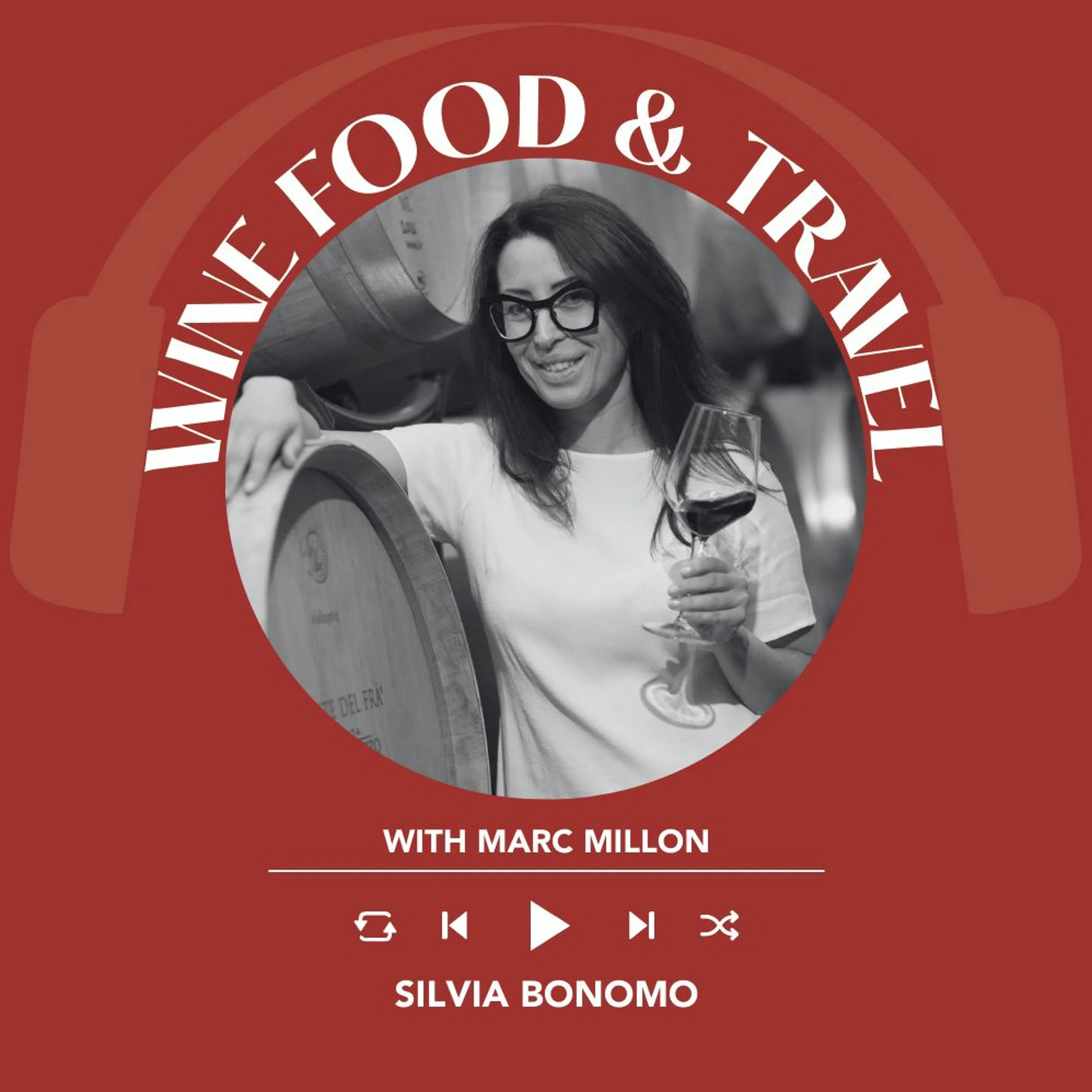
Ep. 1645 Silvia Bonomo | Wine, Food & Travel With Marc Millon
Ep. 1645 Silvia Bonomo | Wine, Food & Travel with Marc Millon
Episode Summary
Content Analysis Key Themes and Main Ideas 1. The historical evolution and family legacy of Monte del Frà winery. 2. The unique terroir and significant grape varieties of the Lake Garda region. 3. The characteristics and distinctiveness of Custoza DOC and Bardolino DOC wines. 4. The blend of tradition and innovation in wine hospitality and visitor experiences at the winery. 5. The integral role of local gastronomy and food pairing in Italian wine culture. Summary The episode features an interview with Sylvia Bonomo of Monte del Frà, an historic family winery near Lake Garda. Sylvia recounts the winery's journey from humble agricultural beginnings in 1958 to its current status as an award-winning estate. She details the unique glacial terroir of their region and discusses key wines like the complex Custoza (notably Cademagro, a blend benefiting from Incrocio Manzoni) and the evolving Bardolino Soma Campania DOC, aiming for a richer style. Bonomo also highlights Monte del Frà's innovative wine hospitality, which includes popular blind tastings designed to educate and entertain. The conversation delves into local Veronese gastronomy, offering insights into traditional food pairings, such as Carbonara with Corvina-based wines, emphasizing the connection between wine, food, and cultural experience. Takeaways * Monte del Frà winery, established in 1958, has grown from a mixed agricultural venture to a leading wine estate in the Lake Garda region. * The Lake Garda area benefits from unique glacial soils, contributing distinct minerality to its wines. * Custoza DOC, particularly Monte del Frà's Cademagro, is a complex, long-aging white wine, often a blend of indigenous varieties including the significant Incrocio Manzoni. * The Bardolino DOC is seeing evolution with sub-denominations like Soma Campania aiming for richer, more structured red wines. * Monte del Frà embraces both traditional and innovative approaches to wine hospitality, with blind tastings being a key educational and engaging experience. * Food pairing is central to their philosophy, connecting wines with local Veronese specialties like risotto and pasta dishes (e.g., Corvina-based wines with Carbonara). * The history of Italian wine production has seen a significant shift from simple, local consumption to a globally recognized, prestigious industry. Notable Quotes * ""where there is a monk history, there are several cultivation usually."
About This Episode
The Italian wine industry is evolving due to success of wines like grapes and peach, and the importance of traditional wine hospitality and tasting. The success of Cadel Margro, a complex, and adaptable white wine, is a challenge for many people. The importance of tasting and being inspired by local farmers is emphasized, and the importance of learning from tasting and finding the right wine is discussed. Speaker 2 thanks Speaker 1 for their visit and offers a tour of the Gentle Marine wine hills of Lake G conservatne.
Transcript
The Italian wine podcast is the community driven platform for Italian winegeeks around the world. Support the show by donating at Italian wine podcast dot com. Donate five or more Euros and we'll send you a copy of our latest book. My Italian Grapeke journal. Absolutely free. To get your free copy of my Italian Greatke journal, click support us at Italianpodcast dot com or wherever you get your pods. Welcome to wine food and travel. With me, Mark Billen, on Italian wine podcast. Listen in as we journey to some of Italy's most beautiful places in the company of those who know them best. The families who grow grapes and make fabulous wines. Through their stories, we will learn not just about their wines, but also about their ways of life, the local and regional foods and specialties that pair naturally with their wines, and the most beautiful places to visit. We have a wonderful journey of discovery ahead of us, and I hope you will join me. Welcome to wine food and travel with me, Mark Millen, on Italian wine podcast. Today, it's my great pleasure to travel to the Gentle Marine wine hills of Lake Garda, to Soma Campania, just to the west of Verona, to meet my guest, Sylvia Bonomo. To learn the story of her family winery, Monte del Frasse. Welcome Sylvia. Thank you so much for being my guest. How are you today? Hi, everybody. I'm fine. I'm great. Thank you. Is it a lovely day in the wine hills where you are? Fresh winds today. So I think winter just started very late in this year. But I think those winds have come from England. We've had some terrible storms from the last two days, and I know that storm has been moving probably in your direction. It's a beautiful day here now, but it is quite wintery. Yeah. For a week. I guess you're all able to relax a little bit now that the grapes are safely in. Yeah. The harvest's complete. It's been a challenging year, hasn't it? It has been. Yes. Not easy. The weather has been, unpredictable as it is coming in the last years. And and this summer, it has been difficult for some wild regions in the north of Italy. Yes. Yes. We've heard of, lots of problems with downy mildew, with hail, with nature throwing a lot of difficulties. So I'm sure it's a relief now to have the grapes in the cellar and, the wines being made. Sylvia Montedelfra is an historic wine estate. Can you tell us a little bit about the history of the estate and also the story of your family in this beautiful spot? Of course. So this is actually a winery, that is settled as you say in in the province of Corona. And, when we started here, it was nineteen fifty eight. When we arrived, we arrived in a court where several families were living, and my grandfather rented a few rooms to start his agriculture job. So, he started with few cows and peach and Kiwis, every every farmer starts with a little bit, you know, when that's that's the way we started. We are settled on the on the feet at the feet of a gentle hill. That is called actually Montemonte Montera, has a very, as a much older origin. Because here, we have documents explaining fourteen ninety two, the Ware Monastery, and the story of this Friars is explained and also in the document as the fryers were exchanging the goods with a farmer nearby. So it's a very interesting story, and we didn't want to forget it. And so that's why we gave this name to our seller because Monte, actually, everybody think to Mountain when they hear the word Monte. Actually, here is a is a hill, but in the past, for the old farmers, was appearing, like, Monte. And so that's Montee of the fryers, Montee Desrae, that wants to remind all this history. Actually, we don't have physical rests nowadays of this monastery, but we have a hilltop where there stays a cross, a big cross. That was a gift in the seventeenth century from a community of prayers, nearby to this community. And so That's the only symbolic thing that we have all our history that still is physical presence over here and protect us. So we always, say that it protect us our job and our vineyards it protects everything and god to check on us. That's that's what you say. And and Sylvia, I guess the monks then, as everywhere in Italy would have been, growing grapes and making wine from these same vineyards that your family are now making wines from? We guess so. We don't have, actually anything written about this, but, many times, the people comes here to visit us. They ask me why your wines has so many grapes inside. Why there is blend? Because when people travels, they are used to hear single. Right? Like, Shirley, you know, they don't know a lot about, blended wines, And over here, we have a lot of varieties, and it always explains that where there is a monk history, there are several cultivation usually. So, we really think that the fact that here, when started the ablation of kostoza, they put in so many varieties into that, it's because this was already existing, and and they might have been cultivated then. And so that's the reason There are so many varieties here. Oh, that's really, really interesting. Yeah. It is. Now, Sylvia, so your your grandfather was it your grandfather who came in nineteen fifty eight and started from very simple beginnings in renting the rooms doing mixed agriculture. So specialized agriculture, monoculture, as we see now when we go around wine areas, really wasn't in place yet. It was a very different countryside. It would have looked very different and agricultural life was not specialized. Exactly. Yes. It was like that. And, the vineyards in that moment was like a hobby for us when it started. We we were doing wine still, as you imagine, in the past, pressing the grapes with the feet. And and the wine was made for a restaurant nearby. And my uncle says in nineteen fifty eight, Sylvia, we had no money to buy the bottle glasses. So we ask it to return to the restaurant back to us when they finished drinking because we could not, afford to buy others. So, yeah, the landscape was very different. It changed pretty much, thanks to the canals, the irrigation system that is provided here, and also, thanks to probably a long view that my family was able to have and and, to predict what was the good future for this country, you know, for this area. And so they started focusing more and more on grapes, At that time, my uncle was more focused on peach. He was, he was also mentioned and as a big, master of the peach quotations because our pitches were famous to be so big and so good. So tasty. And my father in that moment was working for an editor, printing books by night. And when he was thirty years old, he says, well, I'm gonna I'm gonna stay in the agriculture with all my family. So the time that it was working in agriculture in, in industry, it could earn a lot of money enough to build his house and invest in in vineyards, that that moment was not so expensive. And and he he he had the view. Simply, he he he had the vision to say, we had to focus on this. It will be the future, and he was right. Because now nowadays, you can see everybody lofts, the whys, everybody would love to have a vineyard, the vineyard, the world, and now, and the wine word is is considered prestigious, and people really an inspiration of this. Well, that's that's a beautiful story, Sylvia, and it's also a reminder reminder to our listeners, a reminder to all of us that the story of Italian wine is one that's really evolving and quite new that just a few generations ago wines that we now enjoy. You know, they're not they weren't so well available. They weren't always in bottle. And now, the story has evolved in a really beautiful way. The the family winery now, you have vineyards in Castoza, which you've mentioned, and we'll talk about in a minute, but you also have vineyards in all of the classic zones of lake Garden, Verona, Vardolino, valpolicella, and Swave. So it's it's an impressive range. And out of those very simple humble beginnings, you the family now has a a large and extensive estate, which which also produces wines that win many awards. But I'd like to talk first of all about Castoza. You mentioned Castoza. You're in the heart of the Castoza doc, but it's not a wine that's so well known abroad perhaps, but I I know it's extremely popular in Verona. I know that when many people go into a bar in Verona, they'll simply ask for a costoza. Tell us about costoza. Castoza is, one of the first, appelations of Italy because the law of appelations of please started in the end of sixties, and we are here starting in nineteen seventy one. It is a white wine recognized as to be, busy drinking wine, very expressive, and with also a touch of very good minerality because of the soil, the characteristic of the soils that surround Lake Garda are very specific because we are on a glacial origin area. So over here, basically, The soils are very poor. A lot of stones. At the same time, you know, we had the ocean here in the past. So when the ocean dries, he left a lot of minerals, a lot of richness deep in the soil. And and our wines, depending from the altitude, you can have very daily, is it drinking wines or full body and and also wines that can stay long in time. It's an incredible adaptable wine, costosa. It's adaptable due to the fact that has several grapes. The main ones are free. You have Karganaga, Trebiano, and Cortese. These ones are fundamental to make the denomination. More than this, you can use another four that are allowed from the design. And very important is the encroacho mazzoni, and then you have tokay, raising, and share the name. The encroacho mazzoni is a great variety that is extraordinary and made change really the history of this wine because it's able to bring your wine from one, two years' life to ten, fifteen years' life. And, unfortunately, we just discovered this right ten years ago in the area. So it could have been introduced because it was already planted here. But, it has it has been changing so much the history of this wine And that would be also the reason. Might be the reason that this wine is now, spreading all over, and it's really appreciated all over the world and recognized. It's one of the best wines of Italy. Italian wine podcast. If you think you love wine as much as we do, then give us a like and a follow anywhere you get your pods. Well, I actually had a chance to taste your Cadel Margro, at opera wine this year. And I was really, really impressed. As you say, it's it's not a simple white wine. It's a complex concentrated wine that does have this acidity and this, minerality that, as you say, when in tasting it even young, you think, well, this is a wine that will be even better if you just tuck it away and leave it for a few years or even several years. Yeah. Yeah. Cadumagro is actually very special and is, the wine that I would say represents our family all over the world. There's now the winery is working in sixty five countries. And I have to say there is no country that doesn't want to buy Cadenmagro because, it's an extraordinary, complex, and, adaptable white wine that fits for a lot of meal, a lot of varieties on of food. And and it is a wine that, is really a challenge for us because, when people drink it, it doesn't know that this wine comes from such a poor soil My father is, has been the winemaker till two years ago, and they say, Sylvia, nothing than vineyards can grown up in that soil. It's so poor that only vineyards are able to go so deep with their roof to survive that only only that can be there. And the vineyards are old over there, forty, fifty years old. And this landscape with, with a special sun position makes this wine, so so great. It's not this wine, the greatness of Katumagro is not because we do so much in the cellar, but really is given by the job of the plans of the vineyards Okay. Well, that's a really good description and also emphasizing as you've said as well, the different varieties. And especially this in which is a fascinating variety. I think developed in Coniliano in the early nineteen hundreds, and I've tasted some wines made within Crocha, mancini, and it does bring a lot to wines when it's used in a blend. Let's talk about a couple of more of your wines before we move on to wine hospitality. I'm thinking perhaps of your, which is proudly bearing your family name. Tell us why this wine is special. Is a denomination very, very young. It started in two thousand twenty, because the consortium wanted to give value to the forest destinations of the Pardolino. Actually, we are not in the superior area. We are in the DOC, and we could not afford to make, we could not make superior denomination here. So they say, you can make your own denomination, Soma Campania. And the idea was to, to give richness to this Bardolino that's many times, it's considered that easy drinking summer red wine. You use that for barbecues. You use that for, fish meals or meats meals, but anyways, consider something easy. And we wanted to to give, space also to invoice to to Bardellino, because Bardellino can be a big wine, even if it comes from light soils. That's the same story, a little bit like Calumabrio. So, basically, Bardino, is a Corvina, Rondinella, and Molinara grapes that are coming from a a little bit of altitude. We are it's not that much over here. And when we speak about altitude, it's not the valpolicella. We are in the maximum two hundred meters. But this soil where it comes from is very rich. Actually holds a little bit of our dilla. And, it spends some time in oak, barrels, in French, oak, it's interesting because you have this, still spicy and fresh fruity nose. But at the same time, you have a, body and, this vanilla and, dried fruit touch that you get on the pallet. A palate. It's very, very interesting combination with the freshness. So personally, it's a wine that still I consider fresh, but I would get a stick or something a little bit more important because I can I can feel that there is body and richness in it? Now that's really interesting because as you say, Bartolino, we think of is that lighter style, the same same, the same blend of grapes or similar to alpoli cella, but generally lighter. But I guess you're on the southern flank of Lake Gard as well at Soma Campania, and you're getting this richer style of Bartolino. That's interesting too. The sub zone now that Soma Campania Bartolino doc, I wasn't aware that that had come into place. So that's interesting that again, it's a way to distinguish wines for visitors to the area. One more wine, let's talk about what about one of your passita wine, Sylvia? The passita, it's an interesting story. That the cert wines are, and they say the oldest wines existing in Italy. And it's something that, nowadays, not everyone make our focus because, you know, it's, it's pretty expensive to produce nowadays of the cert wines for a winery. It's always a limited edition wines because, well, I think that, there is a less usage of this wine. There is less knowledge and effect of many diets with the sugar restrictions are confusing people about what is really calories, or if it's good, or if it's bad, glass of dessert wine. But, the family produced a pacito called monastery monastero to remind again the history of the monte de Fra. And, it is a wine that is not produced every year because we want to focus just on the best of the interviews. It's made again with the stores of varieties. So we have, again, Garganaga, Travian Toscano Cortese and Champshafternoon. And it is a wine that has, one year in Oak barrels after the the drapes are drying till April. It is a rich wine, but as a monster for a style, we don't like to make the wines, let's say, boring in the drinkability because we love to work really on the easy drinking way. And so it's still dessert wine, but fresh. You catch good acidity when you drink it. It's like, I would say a lot of citrus aromas and, a lot of dry fruit also. You catch the pea, should agriculture, but even the citrus fresh aromas. And it holds sweetness, but it's not the kind of sweet dessert wine that you just drink, you know, a little bit and you say, okay. Thank you. I've tasted. It's I think it's a kind of wine that if you are into a dinner or a Christmas celebration and you have a cake or an ice cream in front of you. You can drink the old glass for sure. And maybe if you're if you like so much, you can have also the second you you throw. Oh, you you made me want to taste that, Sylvia. That sounds exquisite, and, and I love, like, that balance between, the richness, but also that acidity keeping it fresh. So it never is overly sweet. Mhmm. So if you let's turn to wine hospitality at Monte delfra. You offer a wide range of wine hospitality experiences, and wine and culture is very important to to your identity, wine and art, and also wine and food. So let's just talk a little bit about about this at Monte Delfra. Do specialty is something we started developing in two thousand eight. When we started, I was just finishing my master, in events organizing, and there was a lack of of this end of salary. And so I say, okay. We need to make more because people now we are visible all around the world. People wants to visit us, and we need to provide the right space. We need to provide the right welcome. So let's let's set something deeper. Let's let's do it better. And so, I started focusing on a regular regular experience is like, you know, classic tastings, where you provide, some calcare, some cold cuts and, and some and four wines or two, three wines. And then I saw that You know, we are well known for being innovative, but also traditional. This is something this is a philosophy. We we follows all all the winery in every sector. I would say my father loves technology, but it says if technology can support us without touching, without changing the products, we have to use it because it helps people, it helps us. At the same time, also in the innovation of the products that we do. It's a constant constant research. Every month, we do a a blind tasting in the family, with international products also to see how innovative, how good, how competitive is our wine. And the same for me is in hospitality. So over here is a collection of the world experiences that provides to make the costanza and the winery experience the best. And so I like to have traditional experiences, but also to have something innovative. Every year, there is something new because I think that, you must do a new stack every year. To be different, to be original, but to preserve your, your soul with the traditional ones. So the traditional always stays and I like to change and give more to tourists that wants to see the wine in a futuristic way. Give us some examples, Sylvia, of how you do that. Yeah. Like, for example, we do a blind tasting the blind testing experience is something that I could put in place because, basically, we do it monthly with journalists, with experts. And, that for me, after years doing that, it was coming easy. So people can choose between six white wines or six red wines experience, and, the fact that they can taste the original wines made all by the family, but learn through the tasting. So bring back home a background and learn how to taste the territory, how to recognize if a wine has been wood or not, how to recognize, if a wine can be, can can be, can can be with meat or can be with fish. So the food pairings also are stimulated during this tasting, And and this is very interesting because many times, for example, people come here and they have an idea of wine. And I ask, what's your favorite wine? And and they say, I'm Maroney. They say, so you drink a Maroney every day. And they say, oh, no. Of course. Not. So I said, your favorite wine. It should be what you drink every day because you want. You can't miss somebody on your table. And so tasting this wine, sometimes they discover that they like more repastle than marrone or maybe they like more custosadhy and Uganda, you know, and, I I think this is, interesting because people can interact. They have fun, and they learn. And this is what I focus on every tasting. It's very important. Even on the traditional one, people can learn. Yes. I think having fun and learning is the the real key to enjoyable wine hospitality experiences. Now going back to the traditional then to wine matched with food, You've mentioned as well the, the cold cuts and cheeses of the area. But tell us about some of the Piate TPG of your area and how they pair particularly well with your wines. A couple of examples of of really traditional foods from where you are. The area is very nearby to the rice cultivation in the south of Corona. So the risotto in Verona is a must. I have to say. And one particular is risotto a la marrone that is a rice that they make with the a marrone wine. This is something we pair very easy with the body red wines, not necessary in a marrone. You can pair even with Repaso. As, we have a lot of cheese in the area. It's this is a region that produce a lot of cheeses due to the mountains. And so, I like to promote local farmers during our tasting, we have, for sure, a selection of cheese. And and cheese, I like to buy something that you don't find in the supermarket. You know, it has to be exclusive for me because, that's that's a nice part to be in, in a winery and the local select the locals. The same is for the cold cuts because there are plenty of, people in the mountains that also has their own preparation, their own cold cuts. And and then we have some pasta, like carbonara is something that that in my family is weekly prepared. Carbonara pass and the well, here, then we have some birds. Berts, is something typical of the local kitchen. It's not something that you can find very easy to eat, because it's so old now in this dish, and, people is not used anymore. But the birds, and, also, this, Esargo. Oh, the snails? So, Esargo. Yes. It's something my mother makes during the year. That's not very easy to do. I personally don't cook that at all. Sylvia, what what wine would you pair with carbonara? With carbonara. It is not so difficult in the area. You know what, carbonara is a rich flavor dish that's a request of pepper. And so the key word here is pepper because the corvina grape that makes the but also the Bartolino, release a lot of pepper flavors. So I always tell people when you buy a product that holds Corvina grape, it's not so difficult to pair on the table remember that anything requests pepper is perfect with the wine. So for sure, the red of the region are any red, it would be perfect carbonara. And then, also, I would say that the had a marker that we mentioned before that is so complex. It would stay very well with the carbonara because, it might give some fresh air wash better your mouth from the cheese. And also, clean very well from the egg and the pasta. So also Cademago. Yes. That sounds that sounds really, really good. I think that our listeners will be inspired to to come and find you when they're next in verona because, they can either have a traditional wine tasting, or I like the idea of a blind tasting of tasting wines, without preconceptions. Sometimes you look at a label or you see a bottle and you think you know what the wine is going to taste like before you've even tasted it, but that is a way to really understand wines just through the sensations. So I hope our visitors will find Monte delphra when they're next in the area. I've really enjoyed learning your story this morning, the something of the history of the area, but also your family story, how it developed from very simple origins now to an important and award winning wine estate producing a really impressive range of wines. Sylvio, thank you so much for being my guest today. And I hope the wines from twenty twenty three are excellent. The Apacimento period goes well. And I look forward to tasting the wines in the future. Thank you very much. Thanks to you. Thank you. Ciao. Bye. Ciao. Bye bye. We hope you enjoyed today's episode of wine, food, and travel with me, Mark Millen, on Italian wine podcast. Please remember to like, share, and subscribe right here or wherever you get your pods. Likewise, you can visit us at Italianwine podcast dot com. Until next time.
Episode Details
Related Episodes

Ep. 2822 Ep. 20: California | Study Smart for your WSET Level 3
Episode 2822

Ep. 2789 ColleMassari: a long-term vision rooted in Montecucco with Giuseppe Di Gioia | On The Road With Stevie Kim
Episode 2789

Ep. 2788 Ep. 14: Austria and Hungary | Study Smart for your WSET Level 3
Episode 2788

Ep. 2785 From Volunteer to Speaker at TEXSOM with Samantha Cole Johnson | TEXSOM 2026
Episode 2785

Ep. 2766 Inside the U.S. Non-Alcoholic Wine Market: What Wineries Need to Know with Jill Sites | Masterclass US Wine Market
Episode 2766

Ep. 2761 Winemaking and Consulting Across Sicily with Alessandro Serughetti | Wine, Food & Travel with Marc Millon
Episode 2761