
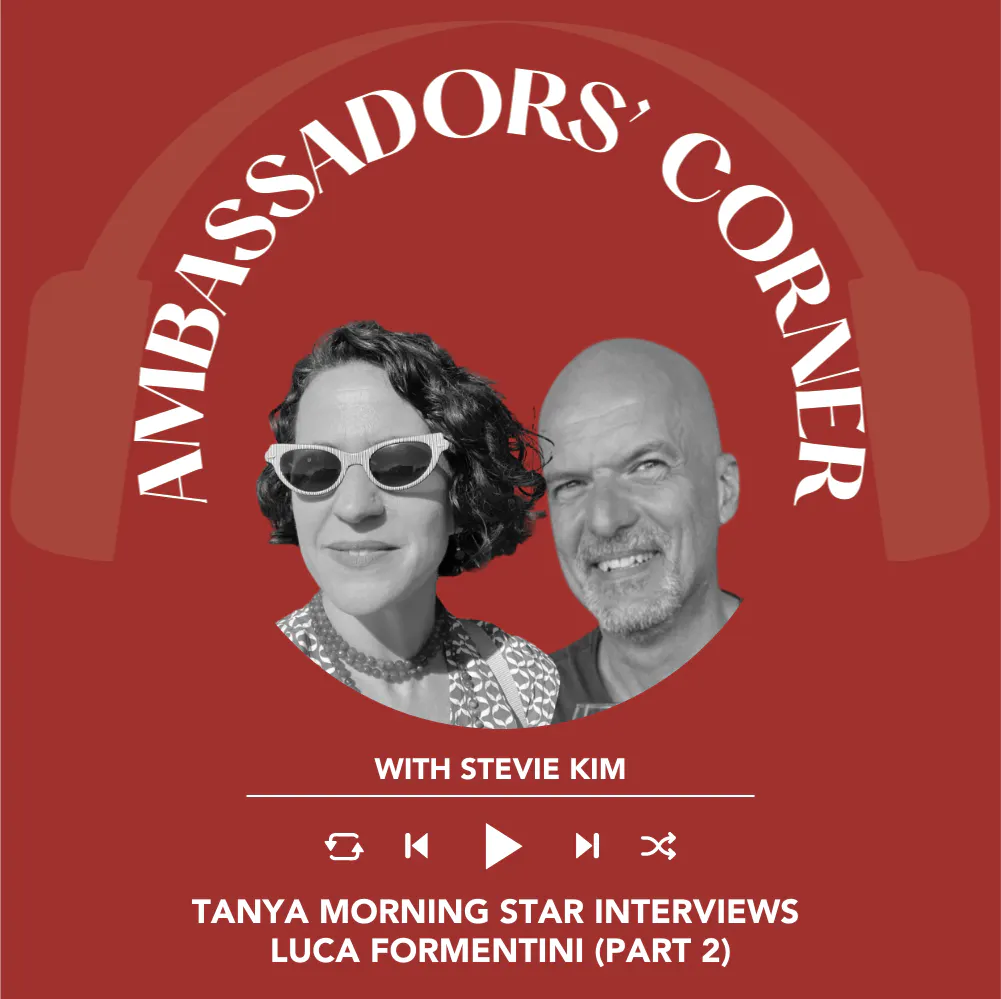
Ep. 1926 Tanya Morning Star interviews Luca Formentini part 2 | Clubhouse Ambassadors’ Corner
Ep. 1926 Tanya Morning Star interviews Luca Formentini part 2 | Clubhouse Ambassadors’ Corner
Episode Summary
Content Analysis Key Themes and Main Ideas 1. The Interdisciplinary Nature of Creativity: The central theme revolves around the intersection of winemaking and music composition as creative processes, highlighting similarities in spontaneity, improvisation, and minimalist approaches. 2. Luca Formantini's Unique Philosophy: Exploration of Luca Formantini's ""punk rock"" and rebellious stance in winemaking, contrasting with his scientist father's traditional methods, and his dedication to authenticity and non-dogmatic practices in both wine and music. 3. Minimal Intervention Winemaking (Nula Wines): A detailed discussion of Luca's experimental ""Nula"" wines, which embody principles of sustainability, minimal intervention (no added sulfites, no filtration, wild yeast), and allowing the grape to express its natural identity. 4. The Role of Unpredictability and Flow: Emphasis on embracing the unpredictable nature of both winemaking (e.g., harvest conditions) and music (improvisation) as sources of discovery and growth. 5. Sensory Experience and Unbiased Perception: The importance of approaching wine tasting and music listening with an unbiased, emotionally connected, and spontaneous mindset, akin to art appreciation. 6. ""Sleep Concerts"" and Immersive Music: A unique concept of ""sleep concerts"" where music creates an environment of safety and allows listeners to connect with their emotions without the pressure of conscious engagement. 7. Authenticity and Personal Growth: The benefits of bringing one's ""whole self"" to work and life, fostering deeper connections, reducing rigidity, and encouraging personal evolution. Summary This episode of the Italian Wine Podcast features a ""Clubhouse Ambassador Corner"" discussion between Tanya Morningstar and Luca Formantini, a unique individual who is both a winemaker and a music composer. The conversation delves into the profound interconnections between these two seemingly disparate fields, revealing Luca's innovative and philosophical approach to both. Luca shares how his musical background and embrace of spontaneity, improvisation, and minimalism have profoundly influenced his winemaking. He recounts his ""punk rock"" rebellion against his scientist father's analytical methods, opting for a more fluid and intuitive approach. A significant part of the discussion focuses on his experimental ""Nula"" wines, which are produced with minimal intervention, no added sulfites, and no filtration, allowing the natural expression of indigenous grape varieties like Turbiana and Tocai. These wines serve as a practical experiment to understand the grapes' inherent potential when allowed to ""do what they want."
About This Episode
Representatives from a wine club discuss the importance of creativity and the connection between music and wine. They emphasize the need for flexibility and finding the right balance between natural and organic wines, while also emphasizing the importance of finding the right balance between natural and organic wines. They also discuss the use of words and the emotional aspects of the experience of creating music and tasteing it. They stress the importance of balancing tension and release, avoiding bias, and limiting oneself in music. They also discuss the benefits of learning about sustainability and the importance of being aware of one's own environment.
Transcript
The Italian wine podcast is the community driven platform for Italian winegeeks around the world. Support the show by donating at italian wine podcast dot com. Donate five or more Euros, and we'll send you a copy of our latest book, my Italian Great Geek journal. Absolutely free. To get your free copy of my Italian GreatGeek journal, click support us at italian wine podcast dot com, or wherever you get your pots. Welcome to this special Italian wine podcast broadcast. This episode is a recording off Clubhouse, the popular drop in audio chat. This clubhouse session was taken from the wine business club and Italian wine club. Listen in as wine lovers and expert alike, engage in some great conversation on a range of topics in wine. If you enjoy listening, please consider donating through Italian wine podcast dot com. Any amount helps cover equipment, production, and publication cost and remember to subscribe and rate our show wherever you tune in. Hello, everyone. Welcome to another installment of clubhouse Ambassador Corner. So for today, by special request, we are doing a part two of Clubhouse Ambassador Corner with Tanya Morningstar interviewing Luca Formantini because the last time they were headed to a very interesting topic, but we ran out of time. So this is going to be a really nice podcast to look forward to. Since this is part two, I will go straight ahead and ask Tanya. Hi, Tanya. Hello. How are you? How are you doing? I'm good. Okay. So I will be asking you the questions. As you know, so now we have Luca Formantini. Why did you select him as your favorite producer once again? Well, as you mentioned, we got started on some interesting conversations last time that we wanted to bring back to you. And just kind of as a recap, I think in our last interview, it was really clear how, much I admire Luca's authenticity and dedication to crafting wines of meaning and participating in a commitment to community and local culture as well as the health of our planet through wine. But there's more. So I have some, I think some interesting questions for Luca today and hope that we can explore some of the intersectionality between creativity and wine. Okay. Okay. So how did you discover the wines of Salvakakaput Salvakana? Well, I think I mentioned last time, Luca and I met about eight years ago now, I think, or better part of a decade. I was teaching at a local college here in Seattle, and he came and taught a master class. And, I think during that time, he was the president of the Lugana consortio, and he was tirelessly traveling the world, teaching about Lugana wines. And so we kept running into each other at every conference. And, pretty soon it became a friendship and community and collaboration that that I think we both value. Right. Actually, I remember during the first conversation you guys had. I looked at Lucas profile and he is here on Clubhouse and he's a music and wine composer. That is something very interesting, and he's a one producer. And so now let's talk about the learning objectives that we should be expecting from this interview. Well, I really wanna focus on the correlation between creativity. Dynamic thinking, I guess, wine and music. And I think Luca's the perfect person to explore that with. Okay. So I am going now to mute myself so that you have more time to do the discussions. And then later on, if the audience would like ask some more questions for Luca. You can actually just type your questions at the room chat here. So yeah. So that's it. Awesome. Hi, Luca. Hello, Tanya. I love everybody. It seems like we just saw each other. Yeah. Enough a long time ago. Cycles and time and Yep. Vines. My my body is still on your time zone. Understand that feeling? Well, I'm really happy that we're back so soon to pick up this conversation again because I think it was just getting interesting the last time we left off. But I want to kind of refresh people that we were exploring what led us to the idea of, thinking about timing and creativity was through our conversation about innovation, preservation of traditions, going with the flow and the cycles of nature, indigenous grape varieties and and fun subjects like that just as we kind of arrive at looking at the intersections of culture, creativity in our relationship with the natural world through wine, it makes sense, I think, to be talking about other things that you create and bring into this world. So I guess I wanted to begin by pointing out one of the things that I love about your music, Luca, and your wines. And I think that's the fact that you are really committed to curiosity and not dogma. So I find you to have a kind of playful stance in both practices. And I think this gives you flexibility to respond in the present moment. So I'm hoping you can kind of address this approach. And if that approach applies to both of those activities, I'm curious. Well, yes. I I think that, you have noticed a very, very important connection between these two practices And, I think that, this kind of connection, saved my life as a winemaker, because I'm sung to an analogous, And so I've been growing up in a wine cellar with, a father who is a scientist of wine. So he knows everything, which is happening anytime in the wine, in the grape, and so on. And, and, and that has, a lot to do with measurements, with numbers, with physical reactions. And I remember that until the time I haven't found, another way of looking at wine, this kind of approach always looked like very limited to me. Because I was criticizing my father when, my father was, using the the term this one is good as, the way that he was giving this kind of, of judgment to the wine was basically because the wine was properly made. I mean, was not showing any trouble, any bad expression of, the aromas or the taste and so it was basically clean and in balance. And for me, who I am Well, I'm not, an analogist. I am not trained by that point of view. I have a very spontaneous approach to wine because basically, I think that wine is, is part of, of the food culture. I think that anything that we put in our mouth, which becomes a part of us has to be considered as, something very, very important because it is becoming apartulize. So numbers were not enough for me to justify what's quantity in wine. And so it was later on when I discovered that wine is, something which is very unstable. And, it's sort of the result of so many magic combinations and reactions which are not always predictable They're not always measurable. And, this helped me to to find my my way in the business. So finding that does this kind of, connection with the flow with with something which is happening and it's very difficult to predict was very, very, very important for me. And, this is exactly what I find in music. Or at least in the way I think about music, in the way I make my music, which is always a reaction to something which is unpredictable. And, by this, you are able to discover things that you wouldn't be able to, to plan, or to organize because you are always facing some something that you don't know. And I think that disconnection is, is finding the same, way of, finding the same elements in what you have to do when you are facing a new harvest with, new ripening, condition with a new temperature, with a different, humidity with so many different variables that we all know who are involved in Hawaiian Business can make dramatic differences in the final result. Well, Luca, you gave me so much to think about, but I I just wanted to kind of point out that you're kind of punk rock when it comes to both music and wine. A little rebellious against your father that inspired you maybe towards an opposite stance towards creation? Well, it's fun because because, well, my my father has honestly, it was, it was brave because it gave me a lot of room to change the direction of, our wine company a long time ago. And, so I don't know if it was crazy or confident or or probably it was adventurous, but at the same time, in a different way that I I feel myself adventurous. Yeah. Because I think that this kind of, connection, this reaction with my father's approach to to wine and to live. Well, for, for example, my father has had never had anything to do with music. I never saw my father dance or sing. Now let's and, well, while my mother on the other side was, a fantastic singer and, lovely dancer. I think it it is one of those cases where the limitation creates an impulse, which is taking, your, well, become aware of what's your position is in regarding this firm point. So it was actually very useful. I can say that. But I also think that, you know, if you look really far back into the history of science, you know, in early Greek scientists, really numbers and music and math and, you know, the cosmos, and we're all kind of woven together in a, you know, in a primitive or early, explorations of science. And so in some ways, I think that people who seek to understand through that lens are There is a creativity and an experimental nature to that in itself. And I think that's where your winemaking kind of meets in this playful spot, if you will. Because, last time we were talking about your question mark on the back back of the San Martina Delavatalia bottle to question what you'll have to listen to part one guys to figure that out. But, also Nula, because most of your wines are really they reflect actually your father's perspective. They're they're clean and and they really give a give way to terroir without obscuring it with a lot of fancy winemaking. And so I'm wondering about particularly the approach that you take for most of your wines and why you decided to do this experiment, particularly in what what those wines mean in context of each other? Well, yellow was, was another fun time because a few years ago, I think it was, like, seven, eight years ago. You know, the the concept of, natural wine was, getting more and more familiar and, exposed. And, and so few people ask me, okay, look, but look, you are so much into sustainability. Why you don't have any natural wine? And, okay, we know the subject is very, very complicated. We could talk about that for days, and I'm sure more than days. I'm very happy that European community forbid the use of this term on the, on a wine bottle. And, anyway, and I thought, okay, which is my position in relation with, with the idea of natural wine. First of all, which is my position as a winemaker, and which is, my feeling about what people could expect out of a natural wine. And so I started to do some experiments. I, talking I've been talking to Renato with, my main man in a wine cellar, and I've been talking with Sandra, who is our analogies. And with them, I shared my ideas about a few principles that in my mind should be at the base of a project like that. And, so the first principle was that the final results had to be enjoyable. If whatever we do, the final result is, something that we would not like to drink, then we're not going to to publish it. And I'm I'm using a very musical term. Bravo. It's good. Okay. Yes. We we should enjoy wine. That's very, very important. So if the music that we played is, not worth sharing, we're not going to release it. And there's no reason to drink about wine. So enters even less reason to produce a bad wine. And this was a first point because I've been tasting many so called, natural wines, which were very, very bad or at least not that my taste. And, and so the second thing was that we would use muscle fights. The third point was that we would use no yeast, no addition, no yeast. The third point was that we were not going to filter the wine before the bottling, and then I decided not to buy any new tank. To to do this wine. I decided to recover some old concrete tanks of my grandfather. So we restored them. We cleaned them. We painted them. Oh, yeah. And the packaging, had to use the fewer possible elements. So I decided not to put a capsule on top of that. I decided to print a very, very simple label. And, I use, well, behind every bottle of our lugana wines, you can find a circle. The circle is the element which becomes the union point between all our luganas because I think that the circle is the natural, representation of time in nature. Actually, when I decided to use the circle to represent lugana wise, I didn't realize how much power that's behind the circle in nature because at the beginning was just because of the circles of the ears in a tree. When you cut to tree, you see those circles that show how many years of tree But then I realized that the circles are actually the season, the orbits, the reincarnation, the resurrection, the most powerful shape and, in geometrical form, And so I was amazed about that because when you talk about Ligana, you have to think about two wine, which is made better by the time. And so this is the reason why I wanted to have, the symbol of time on the top of Ligana labels. So when it came about making a wine out of tourbillon grapes, which is the grape behind Ligana, I thought about making a hole in the shape of a circle because the principle of this wine was to take out was to be as minimal as possible. And so instead of, printing of the label, I took out paper, out of a label as a continuation of, the concept of the circles, but then, again, as a declaration behind the idea of this, which means nothing, which is a synonym of nothing in Italian. Same thing. And so we did the first test and, it was, same nineteen, sorry, twenty eighteen, I think. We were not happy with that. Than we did the second test, which was, you know, nineteen. And that was the first test to be released. And this was a very, very important time because began to be a very interesting point to start talking about this subject about sustainability, about what it means to make wines with, the least intervention, with delightest winemaking technique which could be used. Of course, we're talking about very small quantities. We're talking about eighteen hundred bottles, but that was the beginning, and it has been a very, very interesting, engaging, exciting, curious adventure, and it is like that. I have a question. We were just tasting your recent bottling of Nula at Selakapusa. And, that one is made from two key. Yeah. We we haven't released that yet. So you have tasted something which is not on the market yet. It's going to be on the market after May twenty third when we're going to do a vertical wine tasting, a very unique vertical wine tasting of San Matino de la Bartaya starting from two thousand and one. And there will be a sort price at the end of this vertical wine tasting in Milan, with this, new Nula, which is called alternula, so beyond Nula. Wow. And that's the one that I tasted. Yes. Exactly. That's what you're telling that one. Made by to figure. Yep. Yeah. And the but the previous experiments were with Turbiana. Is that true? Okay. Interesting. So I wanna ask you, you know, all of the things you're curious about. And one of those things that I think we talked a little bit about prior to this was about what you learn about the grapes when you let them kind of do what they wanna do. So I'm curious what you discovered new about these grape varieties that you've been working with for your whole career through the process. Yeah. These wines are very useful for us. So they are useful because they are teaching us what happens to those grape varieties. And, you know, we're totally focused on our indigenous varieties when the winemaking is so delicate, and, with, yeah, with no input almost. It's just output. And this is particularly interesting because the Nula ones, so both the tourbillonna and the two key, they're coming from the same venues where we are growing the grapes that will become the traditional version of this wine. So they will become the Lugana Silva or the Sanatino de la Bata camp for the sollio. The first is to, to Vienna. The second is to key. And so we are able to compare the same vintage of the same vineyard of the same grape picked the same day and made in two different ways. So one is the traditional making with, fermentation with the neutral yeast, and then, we have, we're cooling the tanks and, then we clean the mists and, and the henna's bottle with filtration and so on compared to the same grape, which goes into a small concrete tank. Stays there. We, leave the wine there. We do some and, and then we bottle from the tank, without using any filter. And without adding any sulfide during all the process. And, and this is allowing us to understand which is how far they go from each other. Are we still able to recognize the grape and the basic elements in, in these two different ways of making the wine? And, which is the reference, what do they still have in common and what they don't. And this is so, so useful to teach us, first of all, the potential of these grapes when they are left to do all the process by themselves. And, and second, which is the result of the yeast, of the control, on the temperatures, on the filtration, and so on. And, and this is very encouraging. This is encouraging us to to push more and more in the direction of allowing these grapes to breathe, to take their own shape to give them room to express their identity. So these wines are really very interesting for us first, and then they're very interesting for us to share with people like you and with other people who are curious enough to face these wines with a very clean mind. It's not a statement of what's better. It's not a judgment. It's not we're not saying, okay, this is the real wine while this is not. And we are totally against that because I think that this is a very sorile discussion, when it comes about, you know, deciding on which polarity to place yourself. I'm I'm in between, and, I, I like being in between because I think that's, does, something good on any of these two polarities. And I also like to choose where to go, what to drink, and when? So, Luca, do you like living in the polarities or do those experiences that exist on opposite ends of the continuum make you imagine that you'll be making wine differently more in the middle in the future. Possibly. Yeah. This this is, this is another good point, Tony, because, ideally, I think that that is the point. So to be able to combine The cultures of wine, which has, had, a very wild fermentation, and, and the solidity that can have a wine which has been produced taking in consideration what the technique allows us to do to preserve the character of the wine. And, and so, you know, there's a direction in, Let's call it, natural wine trend, which sometimes too, I would say, sometime too permissive in terms of, the weak points that natural wine can show. Because of oxidations, because of, aromatic elements that are not considered clean. And I think that sometimes we are to, we tend to to justify too much on that so that, wine has to be good. Otherwise, there's there's no reason to drink it. And so I think that my way of, probably the area in, well, in which I will be able to deliver something interesting in the future will be in the middle. And, I'm totally against well, consider Tanya that as you probably have noticed, we are very much doing a very light winemaking. So, we are not forcing, grapes to to to express the top of them using techniques which are, you know, shocking the grapes so that they are shouting, all of their voice. No. No. No. I I love wines which are progressive. Which are releasing their identity with time. I hate when wines are made so that they are explosive at the beginning, and then they become weak because they have spend all their energy at the beginning of their life. I think this is a this is a pity. This is, this is a waste. So it's I was just thinking about your all the different, you know, tried all of the wines that you make for a while now. And I find your, you know, your experimental wines also to be very clean, as I wanna say, an aromatic maybe a little bit more aromatic, which may have some a lot to do potentially with the ambient yeast and, you know, use of ambient yeast. But what I wanted to say is that I find your contemporary, more contemporary wines and your more experimental ones to be two different kinds of minimalism in a sense. Just different approaches to minimalism. And you said, actually, you often take a very minimalist approach in your music and composition as well. Yep. And you said two words that I wanna just throw out there and then let you kinda go on that idea, which we're addressing inputs and outputs. And so I'm wondering if you can think about those things. Minimalism inputs and outputs as it relates to your process with wine or music. You're right. It's, in my music, there's a lot of room to what's called improvisation. And, improvisation is, something which, allows me to connect with the mass spontaneity. It's what we're doing right now. So we are improvising anytime we're we're we are talking and we are not reading or we're not acting, we are improvising. And, we don't know, and this is, how I love talking to to other people. We never know where our talk will end and, what we are going to say next. And this is happening with, the way I I composement music and, sometimes these improvisations are are telling a story. Sometimes are they are creating an arc sometimes they're creating ways which go up and down. Sometimes they're very, flat, and they show details coming in and out. But usually the thing which is of the way that I decide when an improvisation has been successful in a way is How much have I been able to create a connection with, with a listener? First of all, of anything else with myself. How much do I find myself emotionally? In the music that I played. And when I say, which is my emotional connection to the music, it's not it doesn't have to be related to the moment. Okay. That music is important because I was living a specific time of my life. So it's important because of that. No. I'm talking about the emotional, the emotional content, which was able to be translated in music. Is there a transport? Is there an engagement? Is there a dynamic which is playing between tension and release? Is there something which is able to to to keep you connected. That is what I mean for, a successful improvisation, a successful, immediate or real time conversation. And, which is, again, very much connected to, to wine. And not just to the way you make wines, but also to the way you taste wines, I was just gonna say that actually. Exactly. I think there's a a stance. It's more of a a stance than a character trait being creative or improvisational. It's a a way of holding yourself in the moment. And, as you were describing your music and compositions, a lot of the same kind of poetic sensory type language that we use for win testing, you know, kind of comes up which made me think about how we approach tasting, often in the effort to learn how to understand the structural composition of wine technically we lose sight of our body as a tool as an as an instrument, really, for an experience, right, than the experience of making music or making anything, really. I've lately been kind of playing around as a taster against the backdrop of all the technical things that I know and switching up my approach. Like, you know, I think when we were teaching together, I was playing around with, don't smell it first, you know. Trying to confuse your brain by taking different patterns and turn to kind of primitive or emotional, response to our senses. And I think that's really the same kind of stance that we use when we're making art. Yeah. You make me think about about sleep concerts or with all those times when, we listen to music without watching to the musicians without looking at them because your invitation of, of, tasting without smelling first is clearly a super intelligent way to offer people to have an approach which is neutral, the most neutral and spontaneous as possible, but people are not always used to that because most of the times our perception is guided by something which is, in a way, coming before our perception. So we are already biased before using our senses to bring the information in and to connect with our personal story. And Also bias, Luca, with anxiety. Right? Sure. We already think that we know where we're supposed to be going with something. Exactly. Then that's very anxiety producing. And I think gives most people the idea that we're gonna not succeed. Right? Yeah. Exactly. If we we have an expectation of where we're supposed to arrive Sure. Before we take a journey. That's that's it. That's it. And another connection I find very important between music and wine is how you manage this inside of yourself. So how much do you allow yourself to be unbiased when you are facing a wine, music person, whatever. And this is the subject that I love because and this is one of the reasons which, keeping me connected with what I'm doing because I'm very curious to learn more about that. I'm curious to hear what other people think about these subjects because I feel that I have a lot to learn and I want to learn. I want to grow. And I need people, and I need subjects to to activate such kind of discussion. So one is subject. We need each other. We need to be doing it in community or we don't have the same discovery. Yeah. So the way I think about wine is is actually, a way to open a discussion, a debate. Let's talk about sustainability. Let's talk about your personal weather and, the way that you organize your principles and, you are able to protect your fragilities. And your weaknesses and, how much you waste of your energy to protect yourself and, which barriers are you creating to make yourself confident to face the unexpected. So how much are you limiting yourself? And, and so on. Yeah. Well, you mentioned I'm thinking about sleep concert and the things that you're saying because, you know, you've just said a lot about how much we limit ourselves with our expectations and preconceived notions of things, which is kind of what we're talking about. So for those of you that don't know what sleep concert or sleep concerts are, Luca, and I think some of Luca's friends do concerts, where people camp out in the vineyards when the weather is good, and music is played to them all night. And this is something really interesting for me because I found at a moment with art that I was so critically minded able to feel more. I wasn't enjoying enough. And, you know, after going to art school and, you know, always breaking things down, you know, and analyzing things. And so I started to play with purposefully falling asleep when I went out to concerts or movies and things like that to let myself rest actually, but still be in the experience. And I thought it's such a weird thing that I'm doing. You know, why am I doing this? I'm paying money to putting my head down and nodding off, but I would have these kind of dreams and perceive the the art, the music differently, really differently. And it restored me in a way, back to my a relationship with music and performance and art generally to let go entirely of even the idea that I needed to be conscious, be experiencing something, valuable. Well, first of all, I can't wait to attend one of your sleep concerts, but Do you wanna tell us anything else about that? Because I just love it. Thank you, Tanya. Yeah. Well, I think I'd I never told you about how I met Robert Treach, Robert Reach is, is the person who is, behind the idea of the sleep concert. Robert is, is now a dear friend, and he lives in Carmel in California, And, he did the first sleep concert while he was at a university. I think it was, like, nineteen, twenty years old. And he began to play concerts of very, How can you can we talk about that music? It's, it's, ambient music. First of all, this is, the big range of, as a genre, and, so it's music which is very sparse, very slow, and it allows you to to relax and, to connect with your breathe and, with your emotions. And, Robert, and I became friends because I discovered that he used to be a winemaker. And so I helped food him to taste some of my wines because I was curious to hear what a musician with this kind of approach to music could tell me about about the wines I was producing, and it was the beginning of a beautiful friendship and, I still have his notes. Those notes were really a beautiful gift for me because it was one of the first times when I was able to connect these words, music and wine, which for me, have been very, very distant from each other for many years. But I think I told you about that. The first time that we recorded this discussion. And with Robert, we released an album, two thousand twenty two, and making news we're going to release a new album in two, three months from now. And, so yeah, the sleep concert began to be, very common, not very common, but not so word, subject during the last years. And, we see that as a growing interest in in this kind of experience, which is a non frontal experience of music. So you're not going to a concert where you see, musicians playing on stage, you sometimes you don't even see the musicians because the subject is music, and actually the most important subject is you. Listen to the music. And what happens to you when you listen to the music? And, the idea of falling asleep when you listen to a musician playing live at the beginning could could sound a little bit weird, like saying, well, well, what? Sorry. Is does falling asleep, show a success of the music that I'm listening to? Yes. Yeah. Because if you're able to fall asleep when I play, it means that you feel safe. It means that you feel like you are in the right environment to let yourself go. And this is a beautiful gift for us musicians who are wanting to offer something which is not ourselves, which is not something like, okay, come here. I have a few things to tell you. No, it's okay. Please be here. I would like to, to create the right environment to make you comfortable and be at peace with yourself and be connected with your deep emotions. It's a different approach. I feel lucky when, people tell me that I've been able to find themselves by listening to the music I I play them. And, I think that this is the biggest gift that I can receive after having played my music. I I love that. I think that that's really the same goal in a way that we have as people who imbibe wine actually bodies and with something deeper in ourselves through our senses and our mind and our imagination obviously those things go hand in hand. But I think what I wanna do now, Luca, is actually do a little free associate play a little game. Can we do that in the last few minutes? Okay. Okay. Now that we're kind of open in our minds, I'm gonna throw a word or a phrase, and I want you to music, wine, both, or not. Okay. Okay? Alright. The first word is Creative mind. I would relate it first to music, but also to freedom. I love it. Okay. It doesn't see it doesn't have to be a long answer. The next one is learning pathways. Oh, this is life. This is life. Yes. All things. All things for sure. Yeah. Alright. The next one is uniqueness in wine, uniqueness in us. This is so deep. I think that this uniqueness is dynamic. It's not static. This is the subject that I I would very much like to to to underline because I think that uniqueness is not a goal. It's, it's not a, starting point is not fixed uniqueness as means to be connected with, with, the, the pulls with, with life inside of you. Okay. The next one speaking of pulse is timing rhythm. Renewal. It's always I I remember, I'm I'm sorry. I have such a bad memory, but as a very important composer, he is still alive and, and he is very much into repetitive music. I don't remember. It was Lamont Young or someone else in that area. And when someone told them, look, this music you're playing is always the same. But at a certain time, you have the feeling that something is changing. The music is changing and is answer was, yeah, because you can hear you changing. And this is one of the beautiful ideas behind the way we listen to things. Actually, sometimes we are able to listen to loops which are very static in theory, but we thought we start listening and filling differences, which because our hearing and our brain and our emotions are getting familiar with some parts of them, of what we're hearing. And, and so they begin to transform it And this is, something that I love because, I think that to have the perception of ourselves and, our the instability of ourselves is a beautiful thing. Alright. Cycles, Luca. Yeah. The same. The same. I would I would consider the same because the cycle as, something which goes back to the beginning, but, even if it's circle or I, I think it about it at something which is moving in more dimensions. So it's, it's not a cycle which is happening on a plane. It's a cycle which can morph in many different, many different donations. And, so it's not something which is closed. I mean, It is not which is completing itself. So the last word is restoration. Restoration in terms of, of having rest? So restoration, well, rest does restore us. You know, what Okay. Returns us to our wholeness or our wellness restoration. Okay. So it okay. Yeah, this is essential because I see that as a as a as an essential element for a true beginning, because it's, I see it as a neutral offering you the neutral starting point. I see it as, a way of cleaning things up around you inside of you, and it is essential for sure. That's how we should feel after we dine in a restaurant, a restored, right, cleaned of all the things that were bothering us before. Right? Yeah. Yes. Ideally through food and wine. So I guess we're just about out of time, but I wanna close with one little question, which is, sometimes it can be a challenge to bringing our whole selves into all the work that we do. Right? So if we have considered ourselves to be creative people or or historians or whatever interests our our loves, our passions, to not compartmentalize, ourselves. And that in the wine industry, sometimes I think both of us have felt challenged. But it's clear to me that when people make the choice to kind of authentically bring them their whole selves to any situation that exciting things happen, unique things, and good things. And so I wanna ask you in the years since you, you know, feel that you really in a special kind of way committed to bringing your whole self to all of your work. What kind of things have changed in your life since you made that commitment? Well, first of all, well, my life trees for the good, for sure. So it became much more, well, less rigid, and, my, relation with people improved in a very dramatic way. But I think that improved because I was, more able to recognize or I was more recognizable. By other people so that, it was easier to connect to the right people. And the right people are the people who are, sharing some of the important principles that you communicate with or without knowing and mostly from the actions that you're doing. And, so I became more more brave in a way or more confident to not be afraid of, of being criticized for not being, able to attract confirmations from others. And, I think that this paid me much more than what I paid for. And so this created a lot of, of positivity and, and more awareness, of my limits, and also of what I can offer to myself as, in good experience to grow. And to the people around me, for a clean connection with what I am, which is something that I'm very much interested in. And I always able to, to risk something to be able to deliver, a very clear and clean perception of myself. And, and this paid me with, with a very surprising and beautiful result. It's always so fun to talk to you, Luca. Thank you. Thank you so much. I look forward to our next installment. Yeah. Yeah. Anytime. Thank you everybody. Thank you so much. Thank you so much, Tanya, and Luca. I I really enjoyed it. It's actually it was kind of leading to a more philosophical and wine and music. So it it went deeper and I really like this conversation. So thank you for the time, and I am going to now close the room. And thank you so much for the listeners here, and we are going to let you know when it's up on Italian White Podcast. Thank you. And so, yeah, and Charlotte Ho actually said there's such a deep and beautiful and authentic interview. Thank you so much, Tanya and Luca. Alright. That's it for now. Bye bye. Step. Listen to the Italian wine podcast wherever you get your podcasts. We're on some cloud, Apple podcasts, Spotify, email ifm, and more. Don't forget to subscribe and rate the show. If you enjoy listening, please consider donating through Italian wine podcast dot com. Any amount helps cover equipment, and publication costs. Until next time.
Episode Details
Related Episodes

Ep. 2822 Ep. 20: California | Study Smart for your WSET Level 3
Episode 2822

Ep. 2789 ColleMassari: a long-term vision rooted in Montecucco with Giuseppe Di Gioia | On The Road With Stevie Kim
Episode 2789

Ep. 2788 Ep. 14: Austria and Hungary | Study Smart for your WSET Level 3
Episode 2788

Ep. 2785 From Volunteer to Speaker at TEXSOM with Samantha Cole Johnson | TEXSOM 2026
Episode 2785

Ep. 2766 Inside the U.S. Non-Alcoholic Wine Market: What Wineries Need to Know with Jill Sites | Masterclass US Wine Market
Episode 2766

Ep. 2761 Winemaking and Consulting Across Sicily with Alessandro Serughetti | Wine, Food & Travel with Marc Millon
Episode 2761