
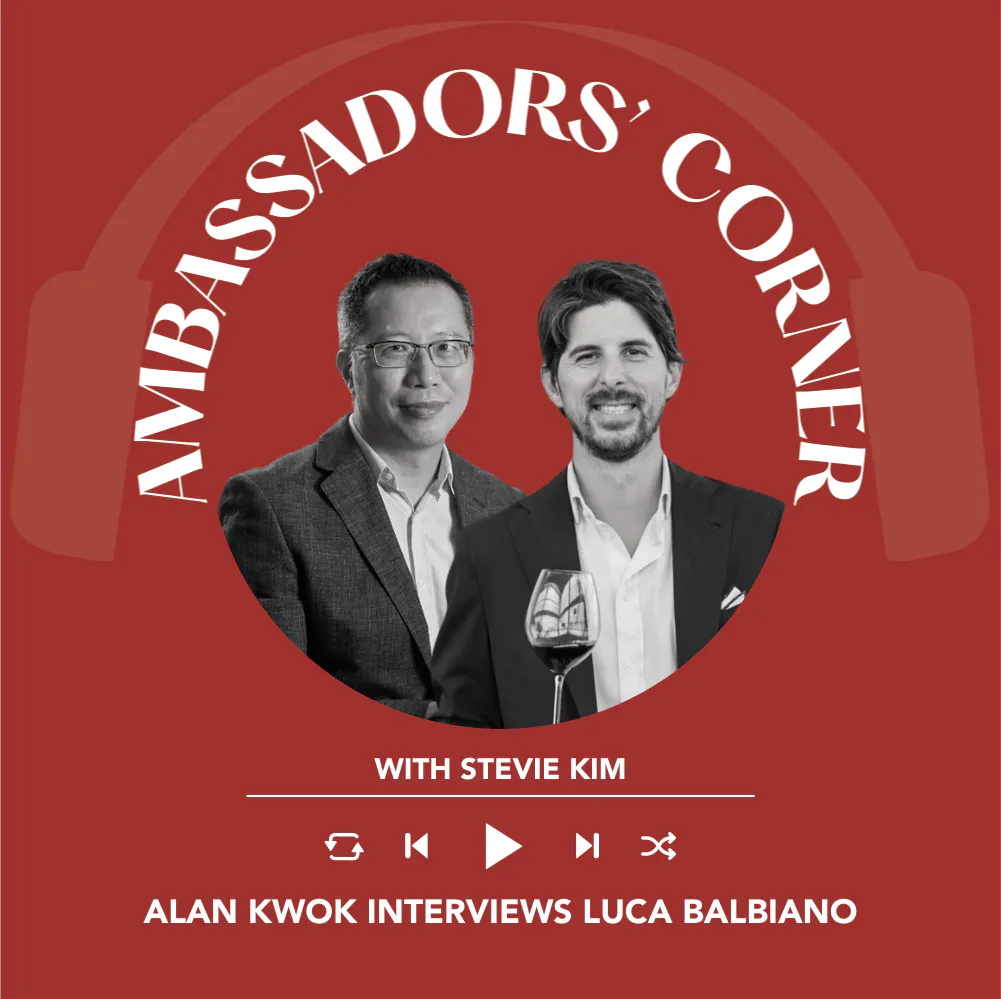
Ep. 1936 Alan Kwok interviews Luca Balbiano | Clubhouse Ambassadors’ Corner
Ep. 1936 Alan Kwok interviews Luca Balbiano | Clubhouse Ambassadors’ Corner
Episode Summary
Content Analysis Key Themes and Main Ideas 1. The history, characteristics, and evolution of the Frreza grape in Piedmont, Italy. 2. The role and contributions of Cantina Babiano (Luca Baliano's winery) in preserving and modernizing Frreza wines. 3. The significance and restoration of the Vigna Villa Della Regina, an historic urban vineyard in Turin. 4. The concept and global movement of urban vineyards and their cultural importance. 5. Winemaking techniques for managing challenging grape varieties like Frreza. Summary This episode of the Italian Wine Podcast features host Steven Spurrier interviewing Alan Kwok, a prominent Italian wine expert and importer from Hong Kong, who then interviews Luca Baliano, the third-generation owner of Cantina Babiano. Alan discusses the Hong Kong wine market and his role in promoting Italian wines, particularly in Piedmont. The core of the interview focuses on the Frreza grape, a historic Piedmontese variety. Luca explains Frreza’s long history, its resilience to climate change and disease, and its past dominance in Piedmontese vineyards before winemaking changes led to its decline. He delves into its unique genetic relationship with Nebbiolo (they are ""father and son"") and the distinct tannin composition that makes it challenging but rewarding to vinify. Luca describes the evolution of Frreza wines from traditional sweet/semi-dry (Amabile) styles, often consumed at brunches, to modern dry, age-worthy expressions. Cantina Babiano produces several Frreza labels, including a sparkling version, and still dry wines like ""Surpresa"" and ""Barbarossa,"" highlighting how winemaking techniques, such as separating grape seeds during fermentation, have improved quality. A significant portion of the discussion is dedicated to the Vigna Villa Della Regina, a royal vineyard in Turin bombed during WWII and restored by Cantina Babiano in collaboration with cultural institutions. Luca describes the emotional and technical challenges of replanting this historic urban vineyard and producing the ""Vigna Della Regina"" wine, which is noted for its elegance and unique spice profile. Finally, Luca, as president of the Urban Vineyard Association, discusses the global phenomenon of urban vineyards, citing examples in Milan (Leonardo's vineyard), Venice, Siena, Rome, Paris, Barcelona, and New York, emphasizing their cultural and historical importance. Takeaways - Frreza is an ancient and resilient Piedmontese grape, genetically related to Nebbiolo, though now representing only 2% of Piedmontese production. - Historically, Frreza was often made into sweet or semi-dry wines (""Amabile"") due to aggressive tannins and lack of modern winemaking techniques. - Modern Frreza wines can be dry, complex, and age-worthy, with producers like Cantina Babiano employing methods like separating grape seeds to manage tannins. - The Vigna Villa Della Regina is a unique, historically significant urban vineyard in Turin, restored by Cantina Babiano, producing an elegant, long-aging Frreza. - Urban vineyards are a growing global phenomenon, blending historical preservation, viticulture, and cultural tourism within city centers. - Cantina Babiano primarily focuses on Frreza, with 90% of their 80,000 bottles/year production dedicated to this grape. Notable Quotes - ""Frreza… It survived for so many centuries because it's a variety that had the chance and the ability to adapt to different climate changes."
About This Episode
The Italian wine club and wine entrepreneurs discuss the Italian wine market in Hong Kong, including the importance of language in the drink industry and the historic vineyard in Toreen. They also discuss the history and characteristics of the Calavaggio brand, including its use of various variiterals and its history of success. They also discuss the use of traditional techniques to separate seeds from wine and the importance of the fruit and vintage in the taste of the wine. They also discuss the importance of the river and its association with Italian vines. They offer to share a webpage of their association and provide an overview of their association.
Transcript
The Italian wine podcast is the community driven platform for Italian winegeeks around the world. Support the show by donating at italian wine podcast dot com. Donate five or more Euros, and we'll send you a copy of our latest book, my Italian Great Geek journal. Absolutely free. To get your free copy of my Italian GreatGeek journal, click support us at italian wine podcast dot com, or wherever you get your pots. Welcome to this special Italian wine podcast broadcast. This episode is a recording off Clubhouse, the popular drop in audio chat. This clubhouse session was taken from the wine business club and Italian wine club. Listen in as wine lovers and experts alike engage in some great conversation on a range of topics in wine. If you enjoy listening, please consider donating through Italian wine podcast dot com. Any amount helps cover equipment, production, and publication costs. And remember to subscribe and rate our show wherever you tune in. Hello, everybody. And welcome to the Italian wine club on Clubhouse. This has been going on for some time now. How long, Leica? I guess for about two years and more. Oh my goodness. Crazy. Right? Because this is the episode number. It's episode one hundred forty four. That's crazy. So it's been actually going on nearly three years now. So this is what we call the ambassadors corner. It's more over like a fartsight chat style, where one of our ambassadors get to interview their favorite Italian wine producer. And today we have Alan Kwok, who will be having this called with Luca Baliano. Charles Allen. Charles, Steven. How are you? Doing well. Where are you? There's a little bit of an echo. Where are you? I'm at home. You're at home. And what time is it now? Because, ten. Yeah. Ten PM. Yeah. You were in PMonte for some time. I saw, like, you were popping up my grid everywhere. So I spent, like, three weeks in Pemonte. So I first make such a few producers, and then I went to Vineitley, and, of course, passed the lines. And then afterwards, I led a tour of twenty one people for the nights of Albert. Run uh-uh just power and power. Twenty? Twenty one? Twenty one. Yeah. Oh my goodness. All from Hong Kong? All from Hong Kong. That's a big delegation, buddy. Yeah. It's too big. So we actually stay in the villa of, the Scapa and Montville. So we've booked the the whole villa, and we just go around. We said producers, and we actually have a really unforgettable, evening where we taste. The model from, eighteen producers. Most, we had twenty one, wines in total, and we invite four producers to speak with us. So that was really unforgettable. Yep. Oh, my goodness. I'm really jealous. One of my favorite producer is Murlotto Montelieto. Yes. We have free vintage of his, Montelio. Wow. That's exciting. Listen, so for those of you for our audience who are less familiar, Ellen Quad is a prominent member of our Italian wine community. He's not just an Italian wine expert. He is one of the most proactive members of our community with Alice Wong, and he is what we call an Italian expert, which means he is one of the top top experts from Vineet International Academy. There are just a handful of them. In total, we have about we're nearing about four hundred certified Italian wine ambassadors to date. About thirteen hundred have gone through the course. And I believe there are only thirteen Italian wine experts, and Alan Kwok from Hong Kong is one of them. So congratulations to that. Okay. That's for you, buddy. That's my special effect. Thank you. I'm sweating. Yeah. Alan, so tell tell everybody what you do in Hong Kong. Like, what is your day job except besides drinking and bringing a bunch of people to I'm actually a wine in portal. So I have a wine company called, deco wines Limited. We have started this business since two thousand and thirteen. And what are you importing mostly? So I would say half of my portfolio is, Italian, and I imports from eighteen regions of twenty of, Italy. The rest is, France and also the rest of the world. Okay. What is the current situation with the wine market in Hong Kong in general? A little bit slower at the moment, mainly because after COVID, a lot of the local people decide that that like we assume the traveling, there's not a lot of people in Hong Kong during the holidays or the weekend, and they are preferred to go to mainland China or Thailand or Japan or But then in May, of course, business is picking up, but in March and April is quite slow at more. Right. Okay. And you are also what they call the master of night of Alba from Caballerri del Taltuffo, a Davini, the Alba. What does that mean? It's an association started in Alba in nineteen sixty seven. I'm in charge of the day vision in Hong Kong. So we have around one hundred and twenty members, and we have, like, seven to eight events per year just to promote the wine and food, of commander. And, actually, Luca is one of the member in, Albert. It just got inducted, I think, last year. Well, congratulations. I'm actually a member. I think I'm a cover. Yes. Yes. But I saw your photo with professor Sushanza. I think you, however, are the most active delegation for the cavalierge because that's a lot, like, doing eight and nine events. Oh, yeah. Yeah. Yeah. We have our Which community members, did you say? Yeah. Yeah. Yeah. So our events are, like, just from thirty five people to our annual event, which is like three hundred people. Oh my goodness. That's amazing. Congratulations. Yeah. So listen. Yeah. I can chat forever with you. Now let's give a little bit of love to your interviewee today, Luca Baliano. So tell us why you've selected Luca as your producer on the call today. Yes. I think everyone who's got the via of the twenty twenty knows Luco Babiano, if they pass the investor the course, because he's one of our reference podiums, which, Sarah and Harry mentioned in all the videos. So coming from the piedmonti background, then, of course, like, I start off with the fraser. So by the way, Luca is, the most famous producer in Italy. So I start off with the language fraser. It was really a surprise in the video that my cell is talking about that the reference producer is actually from the region called Fraser, the, Tieri, which, at that time, I don't even know where is it or, like, how does it taste like? So I figured out that I have to get a bottle, which I couldn't until, last year. And what happened was that I was in Albert attending the Barolo and Babresco Academy. I met, Scott Thomas, which is also a fellow, ambassador. We mentioned the wines of Luca. So being a little bit competitive, we challenge each other who can get a photo of, Babiano Fraser. And, of course, I'm ultra competitive. Yeah. I'm really. So then, I just, call up Luca. It was a Sunday. I said, can we, like, on a Saturday? I asked, Luca, can we reset your winery and so on? He kinda said, yes. So, we reset the vineyard. And did the tasting on a Sunday afternoon. And I got free bottles of the signature wine, which was in the vehicles. It's called Vina, Villa Dela, Virginia. So I got one bottle for Scott, and I opened one bottle when I went back in Hong Kong with my study group. And the last bottle, I'm actually having it tonight. And after this trip, about the yeah. Yeah. Abiano became really one of my favorite for you. Yeah. You're so romantic. I didn't know that side about you. Okay. Yes. On the show. Okay. Alrighty. On to the show, what are the learning objectives that we should expect from you today? So an important observation I make is that the most popular and available region for Grip is not necessarily the best region. So in this case, we are talking about language Fraser. So I discovered that, even before I went to the winery of Babiano. So I opened a bottle of the bottom also, a fraser, which is, from that owner. And that is so much better than, like, all the frasers I try in language. And Luca's one is again special and maybe even more special than the Walter Master one. So I think, in this interview, I just want to point out that, but don't just ex you have to be open minded and I look into the history of the wine and so on. So in this interview, I really want to go into the history of Fraser, and the region of Fraceli, which is around the city code window. And along the way, we'll go to this historic arena from the Sephora Queen, which is Cristiana of France, and it is located on a beautiful hill which overlook the city of Toreen. Didn't realize it was so close to to win until I went to the ball in to win, where you can, see the vineyard on there. And this is one of the last and oldest urban vineyard in the world, and I'm really looking forward to look, to share more information. That sounds very exciting. You know, what we should do is actually like a blind tasting with Walter Masa and Luca next time. We'll do something like that. We'll think of something maybe at next minute to late. Okay? Alright. Listen. So, Alan, I will leave the mic over to you now, and I will shut up. As you know, that rarely happens, I will mute myself and then perhaps come back towards the end. Okay? Thank you, Steven. Alrighty. Okay. So a bit about Luca, Babiano. So Luca is the third generation owner of, Cantina Babiano. And like his father, Franchesco, he has the role of the presidents of Consortium, of DOC Friser, Vicky Airways. And Colina Cohenese. He's also, the founder and the honorary president of a worldwide association called Urban Vineyard Association. So more on that later, welcome, Luca, and very million friends, for being on this show. Thank you, Alan. Thank you, Steve. It's really a hunter being here today. Thank you for inviting me. So first of all, could you tell us where is your winery is located, and, you know, it's history? Yeah. Sure. We are in Andrezeno, which is a small village, twenty kilometers far from Torino. We are, in the cradle of Fraza because Fraser well, we're gonna talk about that later, but it's, really, historic variety talking about, but the the original land where, where Fraser was born, is is the key area. The company, as you, perfectly said, was funded by my grandfather, Melquiao in nineteen forty one. And from day one, we are totally devoted to to Fraser Crape, and I think it could be very interesting to to to have a blind tasting with phrases because it's, it's a very, let's say, plastic variety that can be made in many different versions depending also on, on terroars. So let's talk a little bit about the grip tracer. Like, we read in the test book that in the nineteenth century tracer was one of the most popular Pemon test grips. And close to half of the vineyard in ASTy and Alexandria. We're partnered with Fraser. Is that true? Yes. It is. Fraser. Well, the very first news that we have, very first document talking about Fraser are from fifteen seventeen. So more than five hundred years ago, and the that document was funded, here close to Kerri in Pankallieri, a very famous place worldwide for mint. But that was, well, very important, and permanent city, at the time. Frazer was, an is still, one of the very few real, indignant variety, of Pemonte because it's one of the few of them that never left Piamonte with a very few exceptions. But it was up to the, let's say, twenties of the last century was definitely the most diffused variety in in, more than barbera, more than the viola, more than Dolceto or whatever. For many reasons, first, it's a very resilient variety, grape variety. It survived for, so many centuries because it's a variety that had the chance and the ability to adapt to different climate changes. And that's the reason why it's a very interesting variety today as well nowadays as well. And second, it's a very resistant variety. It's still one of the most resistant to the main illnesses of the crepes. So it's very it's been a very popular variety because it was, very productive, very resistant. It was usually blended in lower heels. So where the other in humid environment humid environments, where other other different varietals used to struggle, Fraser was living there and producing. That's the reason why it was so famous up to the twenties. Then, once the, winemaking started changing, a little bit, and the wines moved from being easy, simple, semi, dry wines, samey sweet wines, to the the the actual, the modern version of of pigmentese wines. Fraser had some struggle to because it was really, tough, in the vineyard, but very complicated to be to be handled once in the winery. I don't know if it's the right moment to talk about that, but, well, there are some geeky things to say about this because Fraser is, a pretty much complicated, horse to be tamed, once in the winery. Now we know many things more about the the the varietal, but at the time, the choice of vintners for the majority of them was to replace, Frreza with easier varietals, to to be vintified just like Barbera, for example, and Preza, Barbera blend was one of the most famous one, because they used to balance, tenants, facilities, and so on. So nowadays, Fraza represents, more or less the two percent of the Piedmontese production. So a drop in the bucket of the Piedmontese wine world, but, is rising again, let's say, because it's a very interesting grape varietal that makes very interesting wines, especially, depending on how you, use the the craves, how you, where you plant the craves because it's very, dependent on terroir. So language phrases are very different from the from the kiwi ones and so on. I think that we will talk about this later, but this is the actual situation. Italian wine podcast brought to you by mama jumbo shrimp. It's been for many centuries, a blending varietal, that used to help many other, indigenous pyrenees varietals, like, like Nebula, for example, or or Barbara as I already said. So, super, interesting history, very long traditions, but at the same time, many big challenges in front of us. I think what you make, what you said, really ties things together, that it is easy to grow in the vineyard, but hot in the saddle. Like, it it is worth take, and you have to do a lot of things to, like, make elegant or, like, make a good one. But, could you tell us, like, why what does it add to the brand? If it's brand with Nipiolo and Babel? Yes. Well, Fraser stands on, two, big main pillars, big tenants, big assemblies. So Fraser usually was used to be blended with nebbiolo to help with color, for example. Phrase and nebbiolo are very similar, but, we will discuss about this, later maybe. Talking about Barbera, the phrase of Barbera blend was very famous, very fancy, and very typical because, Barbara usually has low a low amount of tenants and phrases very rich on that. Friza is a little bit poorer than Barbera talking about Antoscience and color. So Barbara used to help Friza with color and with some structure. So, well, that was really common. Nowadays, the, the old man, and and women producing their own wines here in sometimes still used to do that kind of blend. So the, the garages still do the phrase, a barbera blend. So if you look into your wheaton, which is a phrase that they carry, so I I look up the map and it's not overlaying with, the phrase of the artery, isn't it? And so it's, completely different. So you could not produce the phrase, the the astea in your vineyard. Yes. Well, the DOCs, trip to be told, we are really close to the Fraser DOC area. We are, one of the last villages of the, Torrance province, that ends with the Castel Novo Dombosco Village, very famous for its Malmosia, the Castel Novo Bosco DLC. But maybe not that that very famous, but still famous here. But the soils are very different. And this is something really interesting talking about Fraser, because well, would be with different soils using the very same, finification. The grapes picked up in vineyards in similar positions, cultivated more or less in the same way. Results are very different. The area, gives usually, a little bit more fruity versions of Fraser. The ASTy one is going a little bit more towards acidities, and that's why usually, phrase, Dusty are, made in this steel and sometimes, and pretty often, let's say, aged versions, because terawatts are very different, and the longer ones are, another time different from the previous two. And how would you describe the soil compared with austere and longer? Well, here we have in the kitty area. We have a pretty much, calcareous clay composition, but more oriented to the clay side, let's say, which is crate, and that's been great for many, many centuries because it's a, it's a humid environment talking about soils, and that, helped Fraser to produce in a very good way without too many struggles, even in very warm, seasons and vintages. The SD one is a little bit more calcareous. It's Fendi, a little bit more Fendi. Definitely different. And the wines tend to be a little bit more, austere, let's say, it's very funny to see how two wines, two fraser wines may be produced in ten kilometers far. Vineyards are so different. Because, well, the mix of terroars are are very, are very different. And, with the end of the turn heel, starts the calcarriers send decomposition, and it's even more funny because the the Terrence side, of the tornado heal, it's another time, Calcarrier's composition. In terms of employee geological e oil, are you having a younger or older soil, than, for example, the longer? I don't know if it's younger or not. I'm pretty sure that, the tier inside is a little bit, an older formation. So, the clay, here in the, Carrie's side of the tornado heel, it's, it's probably younger, and it's definitely more humid because we have many underground water. So and that's the reason why usually planting vineyards, recently became so complicated Recently, I had to plant an Hector of Fraser in a small village close to under Zena called Martinez. And we are we we definitely struggled because we had lots of, rainy, hot, rainy days, and a couple of how rainy days are enough to to have, a very humid terroir that stopped us from from planting with the with the planting machinery. So, it's complicated work here. So for someone who has never taste a freezer, how will you describe taste of freezer? And how does the taste compare with, maybe older? Oh, that that is interesting because it's really talking about young phrases, well, they they are very different from the biolo. Young phrases talking about the clearly ones, especially are definitely more oriented to tiny rat fruits. So you got the raspberry, tiny strawberries, sensation, very powerful. The first nose is very intense. Then you you got that beautiful acidity that makes you willing to having the second and third and fourth sip, with the modern soft tenants that now makes, even the young phrases very present in, so in terms of in terms of tenants. Nebula is definitely, has that that interesting elegant sensation even in young, wines. But it's, what is really geeky about that is that Fraser and Nebula are, relatives. Professor, demonstrated that. We with interesting datas and researches are very recently. They are father and son, their siblings, let let's say father and son. Funny thing is that we still don't know who's father and who's the son because we don't know the genetic mother, which is the very first time in history, probably. Usually mother is the only certain thing in life, but not with Fraser, and the violo. But they share the ninety five percent of their DNAs, and they they got something really similar. For example, talking about color, the Antoseans are pretty much the same. They are both based on on Peronin. So also the color, of Fraza and Nebula are very similar to the grape, the bunches are are totally, totally similar But, then also talking about tenants. The amount general amount of tenants is pretty much the same. The real big difference between father and son is the tenant composition. Because phrases, tannins are fifty fifty, crepe seeds and skins. With Nebiolo, the tenants are forty eighty percent, eighty five percent in the skins. So the technique approach is very different. So if the if in the young versions, Fraser, and Nebula could be similar, they are definitely more similar in the aged versions. And that's why usually doing some blind tastings, it's very funny because Fraser and the bureaus are so similar and sometimes we do some, some blind tastings with superezza, and some Barbarbecos, some maybe not so young, nebbiolo, and it's, it's really hard to guess. It's, really fascinating. But I think traditionally, fraser, the Kiawe is sweet, and sometimes like sparkling presente style of one, which, recently is evolved into more of the drywares style which you described. And I think today, you make it in both styles. Could you take us through, like, what is actually the traditional style of fraser in your area? And when did the dry style of fraser become popular? Yeah. Sure. Well, as I, started saying earlier, Fraser was really popular. It was the pigmentese people wine, for many, many centuries. And, the style was just one. It was called Amabil. And Amabil meant something in the middle between, dry and sweet. So a wine with a low alcohol percentage, let's say six to seven, percentage of alcohol, and lots of residual sugars, and the reason behind that choice was that, those residual sugars were the only way to to balance the aggressive tenants of praise that you you have to imagine, a completely different approach in the vineyard. At the time, the most important thing was the amount of the production So yields were crazy, and, if you if you leave, let's say, five, six, seven bunches per plant, it's pretty much impossible to to to to get the right ripeness. So you used to have, eleven, the dry versions of Fraser where eleven percentage of alcohol still something pretty much, that will be pretty much undrinkable today. So for many centuries, without the technology that we have now and without the, the right approach in the vineyard, the only way to to have a pleasant wine was to bottle it with many residual sugars. So stopping the fermentation once six to seven percentage of alcohol will reach and leaving all those eighty, ninety, one hundred grams of residual sugars into the wine. So bottle, that way, in springtime with rising temperatures, usually, fraser, tend to, to re ferment, in the bottle. So The result was the production of bubbles, and that kind of wine, that was very simple and easy has been one of the pillars of the Cadman tees dishes pairing because it was perfect with the Miranda signora, for example. I don't know if all in the audience know the Miranda signora, but it's one of the classic traditions of Pemonte. It's our It's our brunch. It's, like, more or less. So you had, sweet things, salty things. So, like, that, I'll be the phrase that was perfect for that because you could pair, in a good way sweet things, past trees and dry past trees and maybe, salami and cheeses at the same time. That was the perfect point. In other times, that kind of wine when food and wine pairing became something, let's say, serious. That kind of wine was wasn't definitely the right wine to to be, drunk during the meal because it was a what what we will describe today as a dessert wine. So, Fraser producers, us included starting started producing the dry versions of that wine, but well, without the knowledge that we have that we that we had, starting from, let's say, thirty years ago, and that knowledge is the result of many cooperation collaborations with universities, especially with, top players that we, you know, professors that we have here in Kimonte, like the Incenzo Jervi. We learned many things about Fraser we we we learned how to behave in the vineyard the right way, because we for example, what is working with other varietals, doesn't work with Fraser, considering concentration, concentrations, for example. It's definitely not a good idea to lower the yields talking about Fraser, because you concentrate, you you have big extractions, but you also extract tenants, and it's definitely something you don't want. So with no modern knowledge, we can produce many different versions of Fraser. The young and sparkling version is still one of the most loved, not only here in Piamonte, but also around the world because it's a very modern wine. It's very historical. It's very traditional, but at the same time it's very modern because it's a great wine to be paired with, many different kind of, cuisines, many different kind of food around the world. It's a very light wine, which is definitely something nowadays, with climate change All the wines tend to be more and more alcoholic, Fraser get the ripeness pretty early. So we can definitely choose when to pick up the grapes, when to harvest, And so we obtained a twelve point five slash thirteen degrees of alcohol wine, very fruity, very young, super chillable, which is really loved, not only here in Pimonte, but also in the US, or in the Northern Europe or UK or, in Hong Kong maybe. So this is a still a great thing here. Obviously, it's complicated because it's a wine, which is really loved by the traditional consumers of Fraser, and it's very loved by the young consumers. And that's definitely an interesting topic. But the, let's say, the middle age, is complicated with that kind of wine, and that's why we decided to produce a young fresh fruity, easy without any wooden aging kind of phrase, which is called, And it's, a very interesting one that we are pretty well selling around the world, even if our distribution is still very based on Italy. And then we have two super that we produce with an approach which is very similar to the nebbiolo one, especially the nebbiolo designated to be barolo or barbaresco with less food and aging but still with long macerations. We're talking about fifteen, twenty days of maceration, which is a big deal talking about Fraser. But we can do that because, we learn how to, for example, separate the grape seeds. During the fermentation. That's why we can extract the tenons only from the skins and the skin standings are definitely softer than the grape seeds ones, and then, with some six seven months only, of French to nose, not new used to nose, and then concrete, lots of concrete, amphora, and lot of bottle aging. We can obtain very interesting sometimes body, sometimes elegant, sometimes we hope both long aging kind of phrases. So it's a beautiful varietal for that reason. From exactly the same grape and the same area, you can obtain a very young and is it drinking wine or a very elegant and long aging wine? I think what you said is really interesting because as you know, Bauer used to be, like, with West juice sugar until, like, the middle of, the nineteenth century. But I think you the phrases style is probably similar, but it went into a, like, longer time. But, would you say that you are one of the first producer to produce a drive freezer? Oh, I think so. I think so. And the, cool thing is that on my grandfather's labels, it was written I think with thirty years of advantage before the DOCs, came out. So in the fifties, early fifties, the name was praise Adi Carey. So, and that says, how much my family pointed on on on the on our terroir on our lens, and the promotion of the carrier about this. And definitely, we have been one of the first. I don't know if the very first, but one of the first making dry phrases. And just a burning question is how you can separate, the seeds of the wine without separating, I think, the skins. Is it by gravity or how how how does it work? Yeah. By gravity, basically, that we have, special tanks that we used to for, for that, for that work. But on average, after forty eight to seventy two hours. The grape seeds, separates from the pulp and the skins, the the skins, which are lighter than than the must tend to go up creating the cap, and the grape seeds are heavier, than the liquid. So they they tend to go down. So when we do the verification process in order to maintain the cap, humid, so pumping up the most. We take it from the bottom of the tank, and so at the same time, we filter it from the grape seeds, and we keep the the cap humid. That way, we managed to separate, let's say, the sixty five to seventy percent of the grape seeds. That's very smart. And you make, four labels of freezer. So the first one is the sparkling and lightly residue sugar one, and then free dry ones. So as you mentioned, is, the soup Priessa, the pakoraso, and the vina with the de la Regina. So we will go over the winter, the the last. But could you tell us the difference between, the other two wines? Yeah. The trip to be told, the Frezzante is not that sweet anymore. It's a try wine. We we have five to six grams of residual sugars that we, leave them or leave their own purpose to to get a soft sensation, and not a bitter sensation at the end of the sip, but it's definitely a dry wine nowadays. Very fruity, and it's, beautiful because the promise when you taste it, so the promise of the nose is, of a sweet wine, but then when you taste it, it's a dry wine. So it's a beautiful wow effect, talking about. Talking about, which is a kedmanese dialect word that means surprise. And the reason behind that name is that talking with a very famous restaurant man in Torino that was asking us for a dry steel Friza for many years when we told him man with finally made your still young Fraser. He went, oh, okay. So what a surprise. So my father decided to to keep that name. It's funny because, nobody is pronouncing it the the right way in Italy because it's people pronunciate super phrasal or, sir Frasal, but never surprised the, let's say, anglophone ones are saying it the right way, usually, because it's similar to surprise. That's a very young and easy, still young Fraser, stainless steel only, just a few hours of maceration more than the than the classic for example one, in order to to get the same, fruity and easy, beautiful sensation, of the first nose, a very light body, but definitely a gastronomic wine because the tenants right there, come out very, very intense. So it's a wine that asks the calls for something to eat with And it goes greatly with many of our typical dishes, but not only, I'm thinking about, the Asian food, in general, that, some of the classical Asian dishes coast create, with Surpreza, in my opinion. And Barbarosa, the the first of our two, reservice is made with the crates of our oldest vineyards. So the ones that are forty years old or more, so with, slightly lower yields, but with, a great ripeness, very soft tenants. They are here in the k eighty side. The vineyard those vineyards are in the k eighty side of the Torino hills. So where where the soil is very rich, is super clay based. So the result is a pretty much muscled kind of fraser, but it not that much, still with a good acidity, but definitely the highest in body talking about our production. We name it by Barossa because Barbara was the name of a very famous emperor, German emperor that, almost destroyed Katie. That's definitely not a a good reason to dedicate a wine to him, but the thing is that during his campaign, he decided to to save the vineyards because probably, he thought to to stay here for a long time. So he knew, he and his armies knew that, in order to have a productive vineyard, you require many, many years. So they decided to save all the vineyards, and that's the reason why we decided to dedicate a wine to, to him. And also because this is a wine that, it's definitely, similar to a kind of soldier, an emperor. It's something very strong and powerful, compared to the definitely more, beautifully feminine wine, which is the villa La Regina one. Okay. So let's go to the villa de la Regina, and, so it is basically from the Royal vineyard of the Sephora family. And that's been in production since, four hundred years ago, but abandoned since the second world war. And in two thousand and three, in collaboration with the Italian ministry of culture, heritage and the and to win governments, you decide to restore and replant this vineyard. Could you tell us about this story and what you have learned from this experience? That has been a very crazy and, and beautiful journey for us because, well, you introduced the story, Villa de Gina is a beautiful place on the hill that overlooks the Turian City Center, and it was built on the Roman style villas because it was built for a, Saboy's prince that was a bishop before being a prince. And so he used to live in Transcat in near Rome. And right there, the royal villas are definitely smaller than the average Savoys once, but with a very big agricultural part. And Villa Regina was made, as an exact copy of his house in Pruscati up on the top of the hill that overlooks Dorino. And the identitory element of that villa was the vineyard. So for four hundred years, that place has given craves and wines to the royal family, and the court. Then it was bombed during the, allied bombing of the second world war. The villa was, hit and almost destroyed, and same for the vineyard that was abandoned. For for fifty years. As you correctly said, the ministry of of cultural heritage, which owns that land, starting the rebuilding of the Villa in two thousand, well, in the early nineties, they took ten years to to rebuild it all, and at the end or almost at the end of their work. They called us to have an opinion also about the replenting of the historic vineyard. It's a beautiful story because when we went there for the first time together with my father, we were invited by them, and so they welcomed us, welcomed us up where the vineyard was at the time. And they told us, well, thank you for coming. We definitely, are willing to replant the, historic vineyard. We said, well, that's cool. Where? And they went, okay, right there. And they showed us a forest, a a jungle grown in fifty years right in front of the turn city centers. So we said, okay, guys. Thank you so much for thinking on us, but well, no thanks. This is definitely something too complicated to to us. Yes. We are a very historic winery, but we are really tiny. So I don't know if we can if we can do that. I we don't know if anybody can do that. So we jumped into the car, and we are twenty kilometers far from, the company from the winery. Five minutes later, we started saying, well, we're not gonna do that. But just figure out how cool it would be having, a vineyard right in front of the city center of of Tarina, but well, too complicated. Five minutes later, we're not gonna do that. But, well, just imagine how important it could be. Also, not only analogically speaking, but also, theristically and culturally speaking, having a vineyard within the city center of the capital, one of the most influential wine regions of the world, like, well, but no. Well, it's too much bureaucracy. This is too complicated. So no. Then we arrived in the courtyard of the winery. We call back the architect and we say, okay. Let's do that. We we changed our mind in in half an hour, and it's been complicated, but, just like every great adventure, but beautiful because we managed to cut the trees, reshaping the hill and replanting the original grape variety that was planted right there by the savoys. So and it was Fraser. So together with the help of, professor, Anna Schneider and Vincent Gerby, we, also, managed to select the original clone planted by this voice at the time. So we we planted the two historic clones of Fraser right there and a couple of experimental ones to see how they could, behave right there. The end of two thousand and four, let's say, the the planting, the replanting in two thousand eight, the very first unofficial vintage. We picked up ten quintals of Fraser that we brought to, the University of Turin to make some micro modifications to understand how to, handle those grapes because we were used to produce that young phrases. We we were starting in the early two thousands experimenting on on aging, phrase aging, but nobody was aging phrase at the time, or let's say a very few people, very few wine producers were aging phrases at the time. So Professor Jabe made ten different micro humidifications, and at the end of the experiment, he strongly recommended to produce a long aging kind of fraser right there. So two thousand nine was the first official vintage. We produced something like four thousand bottles, the extension of that vineyard is, a little less than one hectare. So pretty low yields, but a very complicated environment to work with very very steep. And then the vineyard has been planted in the historic way. So the sixteenth century waste with the rows very close each other. So no machinery can go through the rows everything is handmade right there. Two thousand nine first vintage with the name, Vigna Delargina, table red wine, because Tolino wasn't included in any DOC disciplineer at the time. So, we said to ourselves, we've done the ninety five percent of the work. Let's try to do the the the final five percent. And we took a couple of years more to change the Fraser DOC disciplineer and, include the vineyard of Villa Regina, which is at the, borders, of the DOC area, into the Fraze dedicated EOC area. So, from two thousand eleven vintage, we can produce not only one of the few urban wines of the world, but also one of the very, very few also having a DOC ablation. It's a long aging tracer with completely different characteristics from Barbarossa, from the other reserva, because the soil is different because the exposition is different because the microclimate is slightly different. And the result is a very different wine, definitely more focused on elegance than body, definitely, pointed on spiced sensations. Tobacco leather, that kind of sensation black pepper. It's a beautiful kind of phrase, pretty much unique, and probably, that's the reason why we are here today. Yeah. It is always, an emotional wine for me. So I'm drinking it right now. And, having listened to your story, it make it even more emotional. So for me, It's, like, really in an insane amount of foul elements to it. Like, you have violet, you have rose, you have moss, and so on. But what stands out is that, besides the foreigners that is not rustic, is very vertical, and the tenant is reactive, but it's not reactive on the tongue. It's weighted on the gum. And then, a fan of how the one is that the favor just sits in your mouth, and then it refuses to move away. So you do not have a high concentration of favor, but it is very long and very persistent. And it's always the same, plateau. So, this is a very special one for me. And, really, thank you for your family to make, to revive this vineyard and make this one. Thank you. Really special because all the favor It's just staying in the mouth, like, at a constant level that, is very hard to imagine by other varieties or other ones can do this except, Chris. Thank you. Thank you. Well, does this that has been a great journey to us. And we discovered many things more about about Fraser, because, well, as I told you, we we know much more about the varietal, nowadays, but probably not everything. And that kind of phrase, helped us discovering a new facet of the of that beautiful grape varietal I can say that is a very emotional wine to me as well. It's probably, the very first project that I led from day one, once working in the winery because I I I I graduated in Lowe's. I started completely something else, and then, I started working in the company from the ride the day after of my of my graduation. So it was my destiny, but it's so emotional to me because it's we we so the renaissance of a place. We saw the renaissance of, a vineyard, which is always emotional, but that specific vineyards will which is so important for the Turants people. So we helped in transforming the city. And as we are so linked to Torino and to its lands, that has been for us the chance to to leave our mark, on on the city and on Cadman t's production. So we, we tried to to write a tiny page of the Cadenity's wine history. And it's something really beautiful because it's a place that you can go and visit. It's open to public. Everyone could can go right there and see that beautiful landscape on the Turian City Center from from a vineyard. Sometimes, when I sent, around the world, the the the pictures of the village in his vineyard, they they asked me if it's Photoshop. But it is not because it's a really, unique environment. So it's, a tiny, piece of the trans tourist transformation as well. That city that has been perceived, like an industrial city for, for many, many decades. And now, from the early two thousand, it's starting being perceived like a inaugustronomic city with beautiful restaurants, beautiful wines, and a great history that makes thirty nine so unique in the world. Yes. So Luca, besides But we know that Vina Vila Dela Regina is one of the most important urban vineyards. Being the president of the association of urban vineyards, is there other significant urban vineyards in Italy that we should discover? Oh, yes. We have lots of a few great places to visit talking about Urban Vineyards. The association was born in twenty nineteen because I, invited in twenty eighteen in Turin all the other urban interns that I that I found out on on Google and maybe from some recommendation of of France that that that have seen something like this around the world. So we had we created that group of crazy people, crazy urban vendors around the world, and we have many interesting other venues in Italy, but also, in Europe and and and out of Europe as well. Talking about Italy, we are we can talk about the Milan vineyard, the Leonardo's vineyard. So the vineyard that, Ludovico Elmo has given to Leonardo da vinci, has a payment for the realization of a tiny thing that he have created, has created, on the other side of the road. So the last supper, which is probably one of the most, beautiful and and important masterpieces of the Italian history, and that thing was created, what was paid with a vineyard. And that vineyard has seen his it's renaissance, during the exposition. So the two thousand and fifteen Milan expo, it was planted, with the original grape varietal that Leonardo LaVinci itself planted, in the mid sixteenth century. So the Mal Vasia Decandi, a beautiful place, very, famous recently because that's been it's been it has been bought by, mister are no. So now it's a private place, but it's still a beautiful vineyard that I hope it will stay, public for visits because it was visited by more than one hundred thousand people every year. Then we have Venice with two beautiful vineyards, one in the, lagoon of Venice run by an association called Laguna Nelbiquire, and another one in the, San Francisco Delavinia Ministry, really close. Well, in the right in the middle of of Venencia, Venice, close to the area to the, area, a stunning place run by monks for many centuries that now is in the hands, in the good hands of the Santa Margarita, company, right in the hands of Alessandro Marzotto, a great place to be. They started producing their own first wine, last year, and I can't wait to taste it because it's it's something very unique. Then going down, we have Sienna. We have, Rome. We have palermo. We have Catania. Vineyards. So Italy's, completely, covered by historical, urban vineyards that had their innocence recently or from a few, a few years. Talking about the the ones out of Italy, very quickly, Paris with the Monmarked vineyard, Barcelona that has, Kanalapa, up in the TV double area, run by, great people, with inclusion projects. So a great place to be, then places like New York that has It's urban vineyard in Brooklyn, in the Brooklyn Navy Yard, a crate, crate project, in my opinion. This is definitely not something not historical, but it's a carbon footprint zero place where people can hang out and, and have its strength with the landscape of, of the city behind, and so as many others more that are joining us. Well, so thank you very much, Luca. I think, you can share with us, like, the webpage of your association. I will share it with the group so that we can learn more about the vineyard. So it's really fantastic to help you here. And, I think We all appreciate, your work and, that you put it in such a, like, easy to understand manner that, I think every one of us would love to drink a bottle of freezer tomorrow. Thank you. Thank you. I really hope so. The website is, irving vignettes dot org, o r g. Okay. Fantastic. Yeah. I think I'm going to close-up the room, but because clearly, you guys can talk forever. A very geeky question on the pie. Hello to my skin. Just one quick question. Can you Luca give us an overview of, you know, in terms a little bit in terms of numbers like how many bottles do you produce? How many labels? Etcetera. Just the production volume and, so that we can kind of contextualize the the size of your wine Yeah. Sure. Thank you, Steve. It's a, family run business. It's a tiny winery. We produce more or less eighty thousand bottles per year, split in, ten labels. And six of them are a phrase based. So as I usually say, we are there are so many phrases producers. We are probably the the only ones that leave with phrase. So the ninety percent of our production is based on Fraser. The four that we mentioned, then we have a couple of Rose, Fraser, and also a white vinification, which is very interesting. That's very interesting, actually. I've never even heard about that. So Charlotte Ho agreed that Vigna Villa De La Regina Regina is a super emotional wine. I couldn't forget it. Thanks, Luca, for sharing your passion in Fraser and history of Kiheri today. So I think that's it. It's a wrap. We've been gone for, like, an on more than an hour. So I will close-up the room, but thank you so much to both of you. Alan, great guest. That was a great interview. And I hope we can get that out to many people as possible. So Thank you so much. Thank you. You're the best. Listen to the Italian wine podcast wherever you get your podcasts. We're on SoundCloud, Apple Podcasts, Spotify, HimalIFM, and more. Don't forget to subscribe and rate the show. If you enjoy listening, please consider donating through Italianline podcast dot com. Any amount helps cover equipment, production, and public costs. Until next time.
Episode Details
Related Episodes

Ep. 2822 Ep. 20: California | Study Smart for your WSET Level 3
Episode 2822

Ep. 2789 ColleMassari: a long-term vision rooted in Montecucco with Giuseppe Di Gioia | On The Road With Stevie Kim
Episode 2789

Ep. 2788 Ep. 14: Austria and Hungary | Study Smart for your WSET Level 3
Episode 2788

Ep. 2785 From Volunteer to Speaker at TEXSOM with Samantha Cole Johnson | TEXSOM 2026
Episode 2785
Ep. 2766 Inside the U.S. Non-Alcoholic Wine Market: What Wineries Need to Know with Jill Sites | Masterclass US Wine Market
Episode 2766
Ep. 2761 Winemaking and Consulting Across Sicily with Alessandro Serughetti | Wine, Food & Travel with Marc Millon
Episode 2761