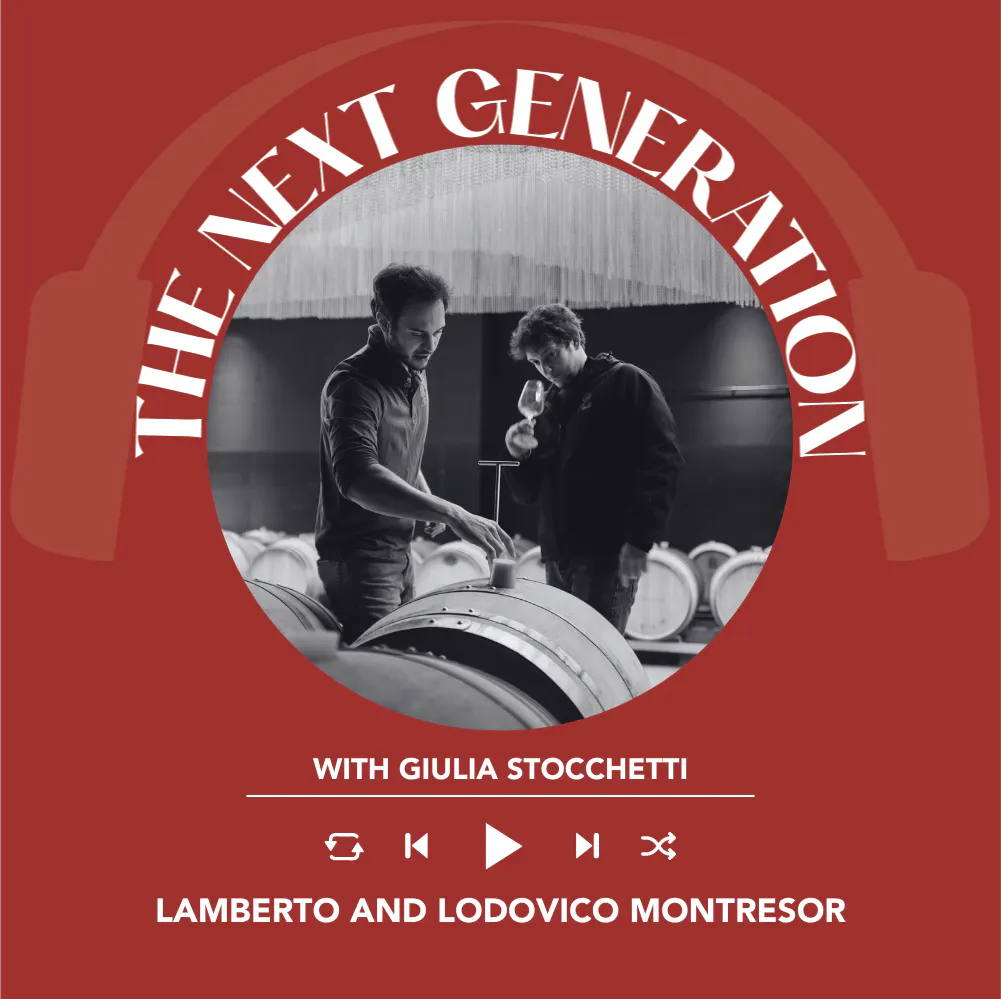
Ep. 1971 Giulia Stocchetti interviews Lamberto and Lodovico Montresor | The Next Generation
Ep. 1971 Giulia Stocchetti interviews Lamberto and Lodovico Montresor | The Next Generation
Episode Summary
Content Analysis Key Themes and Main Ideas 1. The generational transition and family dynamics at Ottella winery. 2. The unique characteristics and aging potential of the Turbiana grape in Lugana DOC. 3. Ottella's commitment to sustainability, biodiversity, and art in their winemaking and winery design. 4. Winemaking experimentation, including the use of concrete tanks and amphora for Turbiana. 5. Market insights and consumer trends, particularly regarding younger wine drinkers. Summary In this episode of the Italian Wine Podcast's ""Next Generation,"" host Julia Stockcetti interviews Lamberto and Lodovico Munozov, fifth-generation brothers from Ottella winery in Pescara del Garda. Lamberto, 28, manages commercial aspects, while Lodovico, 30, focuses on winemaking. They discuss growing up in the family business and their personal journeys into wine, including Lamberto's time as a chef abroad and Lodovico's formal enology education. The conversation highlights Ottella's dedication to the Turbiana grape, emphasizing its aging potential verified by scientific study. They detail their sustainable practices, use of modern art and architecture at the winery, and experimental winemaking techniques like fermenting in concrete tanks and amphora (for their ""back to silence"" orange wine). The brothers also share insights into their main markets (Italy and Germany) and their observations on younger generations, noting a shift towards more conscious, experimental, and quality-focused wine consumption. Takeaways * Ottella is a fifth-generation family winery located in the Lugana DOC, specializing in the Turbiana grape. * The Munozov brothers, Lamberto and Lodovico, combine commercial expertise with winemaking passion. * The Turbiana grape, especially from Lugana DOC, has excellent aging potential, evolving with elegant and flinty notes after several years. * Ottella integrates modern art, sustainable practices (no herbicides, pest control via sexual confusion, water purification, solar energy), and biodiversity into their operations. * They experiment with different fermentation vessels like concrete tanks and amphora to enhance specific wine characteristics. * Italy is Ottella's largest market, followed by Germany, benefiting from tourism to Lake Garda. * Younger generations are increasingly sophisticated wine consumers, seeking fresher, lower-alcohol wines, but also exploring natural and orange wines. Notable Quotes * ""The boss here is the weather, and this is the only truth."" - Lodovico Munozov * ""The main characteristics in Lugana is the soil. The soils of Lugana population are really, really rich in white clay."" - Lodovico Munozov * ""I truly think that, if the wine is fermented in, in concrete tanks and mature in the concrete tanks, this material works really well in the perception of the acidity... the salinity, the saltiness of the wine is, is highlighted."" - Lodovico Munozov * ""I believe that younger consumers, younger drinkers are definitely more conscious than those of twenty years ago."" - Lamberto Munozov * ""Personally, I think that the people is drinking less, but better."" - Lamberto Munozov Related Topics or Follow-up Questions 1. How do the specific soil compositions across Ottella's 90 hectares in Lugana DOC uniquely influence the various expressions of their Turbiana wines? 2. What are the biggest challenges and rewards of managing a fifth-generation family wine business in Italy today? 3. Can you elaborate on the long-term vision for Ottella regarding further sustainable practices or potential certifications? 4. How does Ottella actively engage with and educate the new generation of wine enthusiasts who visit the winery? 5. Beyond Turbiana, what are some of the other less common grape varieties Ottella is experimenting with, and what are their future prospects?
About This Episode
The speakers discuss their family and career in wine production, including their desire to pursue a family business and pursue a family business. They also talk about their experience working in London and their efforts to improve diversity in farming practices. They discuss their success in the Italian and German markets and their love for wine and fruit. They also talk about their success in Italian and German markets and their favorite fruit. They express their desire to pursue a family business and pursue a family business.
Transcript
The Italian wine podcast is the community driven platform for Italian wine Geeks around the world. Support the show by donating at italian wine podcast dot com. Donate five or more Euros, and we'll send you a copy of our latest book, my Italian GrapeGeek journal. Absolutely free. To get your free copy of my Italian GreatGeek journal, click support us at Italianpodcast dot com, or wherever you get your pods. Ben Venuti, welcome to the next generation with me, your host, Julia Stockcetti. Join me as I take you on a journey to discover young stars of Italian Food and wine world, Bronti andiamo. Hi, everyone, and welcome back to this brand new episode of the next generation on the Italian win podcast. This is your host, Julia. And today, I'm taking you to Pescara del garda in the province of verona, where two brothers are making wine together, believing in the aging potential of the Tourviana grape variety. Let me introduce to you, Lamberto, and from Ottella winery. Hi, guys. Jia. Hello, everyone. How are you doing? Jia, good. How are you? Oh, good there. Yeah. Shani, Sean. Oh, that's beautiful when the sun shines, everything is just fantastic. It's such a treat to have the both of you here today because, you know, it's always nice to have, like, more people in the interview. It makes everything, like, more fun and more interesting. So thanks for being here today with me. Thank you. Thank you. Yeah. To to all stars. Can you please introduce yourself? Like, how old are you? What do you do in your life? I'm Lamberto Munozov, and I'm almost, twenty eight years old. And together with, with my brother, Lodovico, we represent the fifth generation of, Otella and, Four years, I've been ending the commercials prospect both for the Italian market and the and the broader. Yeah. I'm Lodovico, and I recently turned the thirteenth. Currently, I'm trying to be a white maker at Jotella. By assisting by our father, Francesco, and our seller master of Dominican in the seller. So you're like an analogist? You studied the analogy or something else? Yes. I'm an analogist. I started with the cultural analogy in Milan. Where I did my bachelor. And, after it, I did a master degree in, outboard, where I spent one year in Montelia in France, and one in, guys, and I'm in Germany. You're both working at Hotel winery, and they're just the two of you, or you have also, like, some other brothers and sisters that I don't know. We have also, a sisters, but, right now in the winery, there are my, my father, my uncle, and me and of course, you know, the vehicle. We have also two cousins, but they are also younger and they are studying, at university. So they will be free to choose, what they would want to do. It's really a family run business. I mean, the whole family is involved in the wine production and in running the winery. Yeah. That's super cool. Yeah. So I guess you're never thirsty. You always have something to drink on the table. Right? Why have you decided to take on the family business? My opinion, I never be forced by our parents to work in the winery, but, you know, being born and raised in culture, the our winery. It came like a natural. It will follow in our father, full step. And, one thing that I realized during my my school years is that studying wasn't definitely for me. So right after high school, I just, left for Australia where I lived for a year and then worked as a chef in two restaurants. And that was my first step, in the in the world of food and wine. So later after a small trip in Indonesia and Thailand, I just went back home with a clear goal in my mind. Just traveled to promote our wines. So I just, enter the winery. Of course, the beginning in the field and the seller just to know everything about how it works, and then, started working, alongside my father, my uncle in the markets. Wow. That's super cool. Yeah. And, like, how was getting back home after being abroad for such a long time by yourself? Quite strange because, I was almost, nineteen. So when I went back home, it was just trying to figure out. Okay. Now what can I do? I don't wanna study, but I don't wanna I don't wanna go straight, you know, in the binary just to ask my father, please, give me give me the job. So I just try to you were out out to to manage the situations after that, I enter in really step by step in the winery, in the field, and then the introductions, and then when it was ready, just my father and my me why you don't wanna enjoy the rest of the markets. And that was my dream. So, like, the toughest part was your dream. That's cool. So from being a chef to be the sales manager and expert manager of your winery, wow. Congrats. What a life. Yeah. What about load of vehicle? I always, love the seller. And, I remember when I was a a child, that I was going secretly in the barrick room and put my fingers in the barrick. Just to drink wine. I always approach the wine word as a child with a deep curiosity. And, for this reason And still dipping your fingering barics. Right? Yeah. Yes. Absolutely. But, every day, I taste them. I check them. And, yes, after the high schooler, I decided to study more wine. And for this reason, I decided to go straight to university and then to travel a bit. And, yes, the most difficult part of coming back home is the fact that, when you travel, you taste a lot with different person, and you always share different, your opinion with others, and, sometimes I really miss, this part of staying, aboard, but, the most cool things of this job is that, as much you learn, you find out that you don't know nothing And I'm really lucky because, I work with, our master and my father, and, we share a lot of things, a lot of knowledge. They are sharing with me their experiences. And I think that with a different approach that I learned, outward, we will be able to create new things. It's going to be really exciting. You can also switch. Right? Like, sometimes, Lambert can take care of the winery, of the seller and Eulodovico can go abroad and sell and promote the wines just to travel a bit and taste more. Right? Exactly. Exactly. Yeah. But not that much, Yulay. You want to believe what just to tell you a story, a small story that we had in London, It was our first work trip together, fantastic. And, I was super serious still working at the tasting table after hours. And while I just look, a lot of eco, and it was practically tasted the entire, even He was drunk and I was mad. Lamberto, it was market research. You know, Ludovico was just trying to understand what was going on outside Otella. So he had to, you know, do that sacrifice to taste every. Exactly. I was not really good. Yeah. He was because, you know, he's learning to improve the winemaking and everything to make outstanding wines. So, Lamberto, you have to be patient and just accept that, you know. Thank you, Julia. Thank you. You went also to London together to promote the wines. That's super awesome. I mean, so in London, you can also find so many different kind of wines from all over the world. Are you enjoying this podcast? Don't forget to visit our YouTube channel, mama jumbo shrimp for fascinating videos covering Stevie Kim and her travels across Italy and beyond, meeting winemakers, eating local food, and taking in the scenery. Now, back to the show. I was taking a look at your website, basically, because I was curious to see the place, at least, you know, online. And I was noticing that you combine basically modern art, architecture, sustainability, biodiversity and nature. Yeah. Like, what's the vibe at your place and especially would it be possible to come to visit you? Yeah. That's an excellent question because, the the patient for art has, always been part of our family. So of our grandfather, lodovico, was a huge and interesting collector as, our father and our uncle, and, of course, our size two. Just to give you an idea, ever since we were a child, this in many paintings by famous artists coming going our house, like, Maros Kifano, Alguerboeti, Salvo, it made perfect sense for us to build a space that, reflect our passion. So we wanted to craft a space where visitors could, even if just for a while, become passionate, about art like us, what better way to do that than, while enjoying a glass of wine. Therefore, the new winery has been designed with, an artistic and contemporary approach using just simple materials such as wood, concrete, and Corten, for the layout, of the spaces, the architect was joined by Julia, Yulia Barfield. That is an artist of international level. Just to give you an idea, she's, right now, currently exhibiting the general idea. Yes. While, regarding the stability, we always put a lot of attention on a good diversity in the vineyard as much as we could. By choice, we don't use any herbicide in the vineyard. And, plus, we prefer to adopt a sexual confusion instead of using a pesticide for best control. We use, as much, careful as we can the water, and we have a installation just drip irrigation in our vignyard, and we use it just when it's strictly necessary. And, while I was in the winery, we can cover a significant part of our energy needs, thanks to a, for the voltaic system that we have, and, and finally, we installed the water purification system for the water that we use in the winery. And, in the future, we will, try to do better. That's really interesting because sustainability and biodiversity are actually something that the people do really care about nowadays. Yeah. And it seems like, although the vehicle, you're not just working in the seller as, like, winemaker, but also taking care of the vineyards. Or is there someone else doing that? Well, we have a team in the vineyard as well. We have a five person working in the vineyards. And I'm also helping them, not, everyday directed in Vineyard because I spent, definitely more time in the cellar, but, taking the cheese on and helping them, in working, I do it, every day. Oh, wow. That's really important. So you actually know what kind of grapes you're gonna take to the winery when it's time for harvest. But talking about, like, these days, it's been raining so much at least in our region. And how are your vines doing? How are they coping with this crazy weather? The wines, is not a problem when there is a water and then sun, they grow up really fast. And, indeed, just think that, in summer, our vines got thirty centimeters in, in one week. The main problem are best. Like a protonOSpora that was a really a real problem last year. Yeah. The milieu. So for this, the control in the field of this person going in the field directly and check if it's occurring or not. And, control, also, the weather forecast is really important. So far, we, did the minimum treatment, and, we were able to enter in the field at the perfect moment. So even after this month of rain, so far, we haven't seen any particular disease problem in our vania. The, of course, this is a work in which we can do our best, but at the end, the boss is not our father. The boss here is the weather, and this is the only truth. It's the only truth. But I'm happy to hear that, I mean, you're doing well and you don't have much problems with this weather because it's really important to have healthy grapes. How many hectares do you have? Actually, we are managing ninety hectares in a lugan population. Significant amount of hectares, but just things that, lugana DOC is a smaller operation based on five municipalities. And we have plots on, four of them. And, for us, this is a real richness because, it helped us to better interpret the diversity in, in soil, same microclimate, the ripeness of the grape and the age of the vines, to better represent the terroir and the vintage. So our lugana, for us, is a great interpretation of, the terroir and the and the vintage. Wow. So you got so many different expressions of Lugana, and you get to experiment, what are the differences and the similarities between all the wines you get from different plots, but Do they have, like, different soils, different aspects, different altitudes? Why are they so different? The main characteristics in lugana is the soil. The soils of lugana population are really, really rich in white clay that came from a big glacier that was located at the place of the Gard Lake. And these glaciers moving upward and, backward was releasing during the time, important concentration of this white clay. And this clay is not homogeneous in the appalachian. There are some plots, some parts of the appalachian in which this place is more concentrated. I'm speaking about more, the part of a Biscilla del garda, some Benadito de lugana, and, put Zolingo and the part, which is, directly on the gather lake. So the difference, the main difference is the the soil, then another difference is that going south and going closer to the moreenic hills there, the soils are more rich in, in rocks. And this has a lot about the the freshness and the minerality of the wines. When we've unified them, we try to separate our plots as much as we can. So in November, when our fermentation are ended, we have this big tasting, where we taste all the tanks directly from all the tanks. And, we try to understand the Vintouch, understand the wine. And, from this tasting, we then create the lugana, the vintage lugana. So, basically, it's an assemblage. Like, you blend the different plots? Exactly. Exactly. With exception of lecrate, which is our crew. This is the only to Ghana and Charlie, produce from a unique plot. But why? Because in this plot, historically is, was painted by our grandfather in nineteen sixty nine. So part of this plot is made up with the wood vines. And, because of it's really, really rich in white clay, and that's confirmed more salinity, more minerality to the wine that's came from that vineyard. Moreover, this vania, the plot that we harvest later in the vintage. And, it confers more intensity in favor to the wines. And that's it. So, basically, in the seller, what we want to do is just take a pictures, a real pictures of this plot and what happened in this plot during the vintage. So we prefer to verify it in just stainless steel tanks, to preserve this meteorite, this saltiness. And, from this year, from this being touched, we've unified just a bit in concrete tanks because, in this way, we were able to highlight the salinity of this terroir. And it's crazy how all these works, and this is our and what we do? So you think that concrete actually helps out the minerality and the salinity of the wine, like, to show off, like, to really feel it than in the glass? Absolutely. Absolutely. I truly think that, if, the one is fermented in, in concrete tanks and mature in the concrete tanks, this material works really well in the perception of the acidity. Comparing with the stainless steel tank, the wines that are the fighting concrete, the freshness is not that sharp as the one in stainless steel tanks, and, it's much more elegant, long, and the salinity, the saltiness of the wine is, is highlighted. So this is basically, a new project that is going on at your winery to vina in concrete, or is there also something else you're doing? This is one of the project, Julia. We have many, many projects. Like, Langarita, what's your favorite project going on? At this moment, we are focusing, of course, in the versatility of the tourbana. Different materials like Claude said. So at the moment, we are experimenting, and I want to spend some words about our back to silence. It is our white wine, obtain it only with tourbana grapes. Verified it entirely in Anfora. So, the long ski maceration. It's like a orange wine? Or Yeah. So it's like a long maceration. Can last from five to six months, depending, of course, the vintage. So it's made with the spontaneous fermentation without any addition of sulfur and surface. And, of course, there's more selection of bottles around ten thousand bottles per year. It's a project that, began in two thousand seventeen. Initially, it was produced all instantly still tank with a thirty day maceration, but later in two thousand twenty one, we experimented with the on front. And try to push in the maceration to the extreme to understand how far we could take the tourbillon. So the result was surprising. And, we decided to remove the stainless tank, and if I entirely in amphora. And this is our back to silence, wines. Wow. That sounds so interesting. So Thruviana is a really versatile variety. And how long do you think it can age? I mean, it's commonly know that Urgana can age really well. Also, Luigi Veronelli, the famous Italian journalist just claim the longevity of Ligana wines. And today, we can also experienced this scientifically, and indeed, my brother, just make, a study with a tabi de camoni of in a consulting and with a professor at Danila Fraca City in two thousand eighteen. Where he compared the seven different vintages of Lugana over a span of thirteen years with the youngest begin being from the seventeen and the oldest from the two thousand and five vintage. I don't know, though, you wanna say about your study? Yes. It was a fantastic of studies because we observed our lugana. Our automatic profiles changed during time. And, how it can easily preserve its freshness and the fruity and floral notes up to five years before it starts to evolve and reveal a great aging potential. That study was conducted of one of our crude, electric wine we were speaking about before. And, at that time, was made just in stainless steel tank. Was amazing to see the evolution of a wine produced with the tourbana grape. Study just showed Algana wines can age more than ten years. So we we also have empirical evidence of the age of Oregon every day. Last summer, for example, we had a bad gal. Uganda wine tasting was crazy to see how the the wine is evolves, and they're gonna get, elegant, indoor, flinty notes, like, gas and gunpowder after five years of aging. And, the same times, yeah, if the freshness minerality are still present even after ten years of aging. Finally, it's incredible the complexity and elegance that, Ghana wines get, but also the consorts of Uganda and many other producers are promoting these. You're making me thirsty. I feel like a glass of Ligana right now. It's almost a very table time. So, yeah, so this could be nice. And in it, Camo, we are plenty of Ligana. That's awesome. And So, like, do you only grow Turbiana or yours to grow other grape varieties? Like, how many different wines do you produce? We don't grow only lugana. We produce around nine hundred thousand bottles per year. So the seventy percent of that, production is represented by Ughana, but the others are, made by our Rossella. So we also planted the three acres of La Graine, in our, in our land, that is not a typical grapes from our regions. Actually, it's it's from Aldora Digger. Right? Yeah. But we just play it just for studying for experiment. And now, and because our father really love it. Yeah. And so Who doesn't love La Grange. Come on guys. Yeah. Yeah. That's and so we have done a a blend with La Grane and Corvina Veronese here in the Murani hills. So this is our Rosier Rosier wines. And I have to say that today is our third best seller wines, our Rosis wines. Wow. And what's the first? The first, of course, is the lugana classical, but we also planted the red grapes here. We also have a blend of, Corvino Vernese, Merloan Cabernet sauvignon. So and we also produced two sparkling wines, metallocassico, one chardonnay, and one pinot noir, of course, for the roses. What's your biggest market, La Merto? I had to say that our biggest market right now is, Italian market. This make us also happy as it is the result of a lot of daily hard work. This trend, started before COVID. And then we use significantly post covid as we we have put a lot of effort in the hospitality at the winery. So offering guided tours and wine shop space, but And we are well distribution, you know, Italy. But the other significant portion of our market, of course, is the the German market because, you know, the approximately to LeGarda greatly help us, as it's like, a second move for German people. Oh, yeah. They come on holiday and they enjoy the Bellavita, the Dolcevita with good food, good wines, beautiful places, nice weather, Yeah. I bet. Definitely. I'd do the same if I was in their shoes. So Me too. But I love the fact that your biggest market is Italy. I mean, it's not easy to be strong on the national markets on the whole market. So congratulations, guys. You're doing a great job. Thank you. Thank you, Julie. Just let me ask you something. Like, when you hang out together, because hopefully, you also hang out together or you just work together we do go out together occasionally. Okay. And what do you drink when you're together? After eight hours of wine, we like to change it to beer to beer and in town. If you go out for lunch or dinner, we enjoy experimenting, and often take also recommendation from the sommelier. So choosing something new that we're not familiar with. I'm more for the white wines. I think that chardonnier Dizzling for me on top on the list. But when it was younger, maybe it was more for their heads, pinotaro, or some also light, right, from Balicella sides, like the Balpantina Balicella rats. Interesting. And what about Loodovico? I would like to say that I drink champagne every day, but I can't. No. I will believe that only drinking bourgogne is like unachievable. Yes. But we don't need bourgogne. We got Lugana in Lake Garta. What the hell? I mean, would you compare the weather in bourgogne and the weather on the lake? We are plenty of a really nice wine in Italy. Maybe too much. Ever, this is difficult to choose. Awesome. But if I have to choose, I usually go for, for example, for a white wine. I really love albarrino from Galicia and riesling from Rosal. I totally understand. We are on the same page. It's a great page. It's a great page. I've been in Moz many times, sir, when I was studying in Germany and it's crazy, beautiful, the place and the wine are fantastic. That wines are great, but are super expensive. So, like, sometimes I move to Nafe to buy something similar to Mozil, but, like, cheaper, you know, but, yeah, that's amazing. And riesling, I think, is so underrated. It's such an underdog. But it has such a great potential. I mean, I could drink riesling from six in the morning until six in the morning of the day after. I just love it. As they used to say, it's Cap o'clock. You can always drink a good riesling, and I love the fact that, it has such a nice acidity that, it can balance also with the sugar it can have. So also a cabinet with, certain grams per liter of sugar, it's still, an easy drinking wine that you can drink at every time of the day. Every day. I know there are completely different grape varieties, but, like, when you were talking about your lugana before, like, that we aging, gained some petrol like aromas, some flinty notes, and it's a fresh and vibrant white wine. It could be like a brother of riesling in a sense. Maybe less aromatic. Yeah. From a dream to point of view, yes. It might be. They have many things in common in terms of, eligibility. They are not familiar. Of course, Turbiana is, more related to Verdicchio, of course, as we provide it. But for sure they share this great aging ability that, is not that common for white wines. I got the last question for you guys. Even if I just love sitting here and chatting with you, it's about, like, young generations what are the young people drinking? Do they actually enjoy wines in your opinion? Or are there more towards, I don't know, beers or drinks? What do you think in your experience? I believe that, younger consumers, younger drinkers are definitely more conscious than those of twenty years ago. They they are more aware about the environment and the I think that, nowadays, younger generation prefers to drink wines that are fresher, dry with lower alcohol content. We are more focused on the fruitiness than the complexity. There is a trend to go on the easier to understand wine. On the other end, there is a segment of young people who are becoming truly wine enthusiasts. And, we have experience of this also in our winery because, more and more young folks are coming for winters. Yep. And, this group of young drinkers is really highly educated. And the more open to experimentation, and they are easy to try new types of wine. So, and you can easily see with the natural wine orange wine, and that's it. I'm so happy to hear that because it seems like people are drinking less and less wine, but I'm not talking about us guys because for sure we always enjoy an as glass of wine and though the vehicle puts fingers in every single oak cask he finds on his way while Lambert is like, oh, stop drinking. Gotta work. And it's it's really nice to hear that. No. Definitely, Julia. But personally, I think that the people is drinking less, but better. Yeah. Okay. And that's fair enough. I mean, that's cool. Alright, guys. So is there anything else you wanna add before we wrap up the episode? Show and all of you. I definitely will. I'll call you guys, like, on a Saturday, and I'll tell you, hey, I'm coming to visit you, but get ready because usually I'm super hyper thirsty, and I'm always asking, like, a bunch of questions. So get ready. Okay. We are ready. We are ready. You are born already. We can click the exit from the tank and the tank are big. That's beautiful. I just love it. That's awesome. Thank you for being with me today, guys. And have a great day. Thank you very much, Julia. For being with me today and listening to the next generation on the Italian wine podcast, A la prosima. Chinch in.