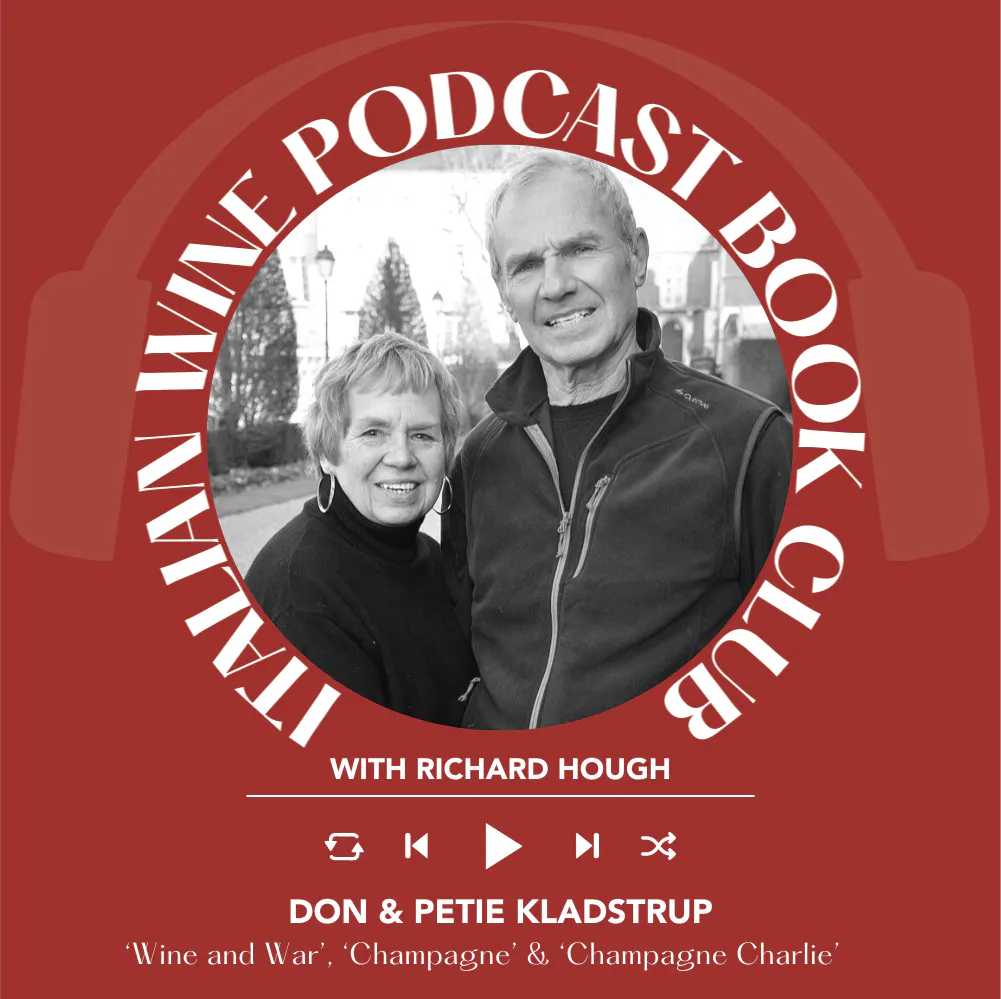
Ep. 2088 Don and Petie Kladsturp featuring Wine and War | IWP Book Club With Richard Hough
Ep. 2088 Don and Petie Kladsturp featuring Wine and War | IWP Book Club With Richard Hough
Episode Summary
Content Analysis Key Themes and Main Ideas 1. The interwoven history of wine and war, particularly in France. 2. The personal and professional journeys of American ex-pat journalists Dawn and PT Classrip. 3. The evolution and challenges of Champagne production and its global popularization. 4. The unique story of Champagne Charlie (Charles Heidsieck) and his impact on the American market. 5. Insights into the collaborative writing process and careers of co-authors. Summary In this episode of the Italian Wine Podcast Book Club, host Mark Millen interviews Dawn and PT Classrip, American husband-and-wife journalists and co-authors based in France. They discuss their fascinating lives, starting with their unexpected move to Paris in 1978 and their integration into the expatriate community and burgeoning wine scene. The conversation delves into their acclaimed book, ""Wine and War,"" sharing anecdotes of French winemakers' resistance tactics during WWII and the profound personal connection to wine, including Don's wine cellar saving his sanity in Afghanistan. They then explore their subsequent book, ""Champagne,"" highlighting the region's tumultuous history, especially during WWI, and the dangerous early methods of sparkling wine production. Finally, they recount the remarkable story of Charles Heidsieck, ""Champagne Charlie,"" and his pivotal but perilous role in introducing Champagne to America amidst the Civil War. The interview concludes with a discussion of their collaborative writing process, current reading interests, and upcoming projects, including a book on Empress Eugenie and one on baseball in France. Takeaways - French winemakers employed ingenious methods to protect and hide their wines from German occupation during WWII, often deceiving the occupiers with inferior products. - The Champagne region has historically been a battleground, suffering immense loss and devastation through numerous conflicts, yet it produced a global symbol of celebration. - Early Champagne production was fraught with danger, leading to explosions and the need for protective gear due to a lack of understanding of fermentation. - Charles Heidsieck, ""Champagne Charlie,"" was a pioneering figure who successfully introduced Champagne to the American market, enduring imprisonment as a spy during the American Civil War. - Co-authoring, as exemplified by Dawn and PT Classrip, can be a seamless and effective process when partners have a deep understanding of each other's working styles. - Historical context provides a unique and compelling angle for wine literature, moving beyond traditional tasting notes. - Wine, for some, serves not just as a beverage but as a source of comfort, sanity, and even physical recovery in dire circumstances. Notable Quotes - ""Wine and War has been a best seller in Germany."
About This Episode
The speakers discuss their experiences living in France and Hong Kong, their love for wine and learning languages, their love for learning languages, their love for learning languages, and their love for learning new languages. They also discuss their love for wine and their passion for wine, as well as their struggles with the world and the rise in cost of living and drinking. They also talk about their writing habits and their love for learning new languages. They mention their interest in learning about a book about the French language and their plans to write a book about baseball and a social event called " Almost Home playing Bas baseball in France."
Transcript
Good morning, Dawn. And, PT, how are you? Good morning to you too, and and we're fine. We'll try to be fascinating for you. Yeah. We are in good shape, and, thank you for having us. Great. No pressure. Welcome to the Italian wine podcast book club. Each one, we select the Great Wine Book to share. We chat to the author and get your opinions. Stay tuned as we read between the vines with the Italian wine podcast. Hello, and welcome to book club with the Italian wine podcast. This month, our guests are Dawn and PT Classrip, an American husband and wife team of distinguished former journalists now based between Paris and Normandy in France. Their first book combines two topics that are of great interest to me, wine, and war. So I was delighted when they agreed to come on the show to talk about their fascinating lives and careers. Their interest in wine, and their amazing trilogy of line related books. Good morning, Don, and PT. How are you? Good morning to you too, and we're fine. We'll try to be fascinating for you. Yeah. We are in good shape, and, thank you for having us. Great. No pressure guys. Before we talk about wine and war, as I mentioned, you you've both led these really fascinating lives and indeed both had distinguished careers in journalism as well. So I'd like to unpack some of that first if I may. Now you've been living in France in Paris. I believe since nineteen seventy eight. That's correct. What first drew you to France? And what were some of the challenges then and now for Americans living in Paris or France generally? We we got here almost by accident. I was working as a television news correspondent for CBS when my boss called and said, how would you like to move to Hong Kong? We were living in New York at the time. And, you know, we we both looked at each other. We thought, wow. Hong Kong. But this was just around, you know, the end of the the Vietnam war, but it was still exciting because PD and I had always dreamed of working in China as, American journalists. China was closed off to Americans at that time, and we thought this will be a true adventure to be able to get into that country and do what we've always dreamed of doing, and that is reporting. I should say we had just moved to Los Angeles. We've just bought a house. We haven't unpacked our bags our children are in school, and, you know, I've I've just gotta turn turn the offer down. As much as we would love to move to Hong Kong, I have to say no to which my boss said, oh, well, How about Paris? Yeah. And I almost fainted. I went home and I told Petie. I said, Petie, I think I've just agreed to move to Paris. That's how we got here. Yeah. Incredible. I got that in the late nineteen seventies. That's that's right. Uh-huh. I had just just gone to work for, network news, first in New York for two years, then Los Angeles where we were for only just a little more than six months when this offer came out of the blue. We couldn't believe it. No. But it turned out to be about the easiest move we ever made coming here. And, as you said, there were difficulties. I think primarily, one has to accept the fact that it is another country and another language, but The other things were really, an easy transition, and sometimes we both feel the the French get French get, a bad rap for being considered haughty or rude. When in truth, they can be extremely helpful, extremely friendly, and they certainly made our lives very, very comfortable, which, of course, is why we're still here. And and did you did you have any French before you moved, or did you have any experience even as as a guest or a visitor to France, or was it that complete dive into the the unknown? Well, we both had done what American school kids always do. We get a little bit of French enough, but never enough to, while we get enough to ask questions, like, where is the bathroom, but never enough to understand the answer. But PD, who, was here full time, having to raise our two daughters, you know, had to deal with, daily life experiences. And so her French became, very proficient. Mine, not so much. I worked I was I was working for American television, where English is the language. And as a result, My French is not so good. Yeah. I found also coming to Italy thirteen years ago that the the best help I got learning languages actually from my kids. I picked up the language as they began to go to school and read books and talk in the park and play with their friends. That was really, really the best mechanism for me for learning Italian, also because I felt less pressure speaking Italian to a three year old than I did with. I understand. So you you were part of this vibrant x hat community in in Paris at that time. It included, I think, the likes of Steven Sporia and Time magazine correspondent, George Tever. So give us a flavor of what that was like, what what was Paris like in in those years what was light being part of that community? Those were the days. I mean, really, the most exciting, the most pleasurable. We could go out. We we would go to Steven Spurier's little store. And he'd be sitting there and, talking about, oh, wines that he had just gone out into the countryside and discovered and are really fabulous. Oh, you have to taste some of this, you know, he would say to us. And it was always, an adventure to go there. We, got to know the men who worked in the store because it was primarily men working there at the time. And they were, an unbelievable group of young men who had all commented about the same time, but had this passionate interest in wine that they communicated to us very, very well. Yeah. You know, it was it was really personal. It was not commercial or at least it didn't feel that way. And so buying wine was really exciting and a whole lot of fun. And making it even more fun was that the wines were, much cheaper than they are now. PD talks about going down to what our little mom and pop grocery store. Right. Which was just down the street from our apartment and walking in and coming out with the bottle of, Chaval Blanc nineteen sixty one. It was, oh, it costs a little more than the average wine we bought, but it wasn't, a huge investment at that time as it would be now to find a wine that was, well, say seventeen years old. Yeah. Yeah. And I I would go down and pluck out, little bottle bottles of burgundy for twenty, twenty francs. I mean, it was unreal. They were from the nineteen forties and nineteen fifties. Which today would be no more than about in France to dollars. Today's dollars would be no more than about five dollars. Yeah. Yeah. Yeah. I mean, cost of living and cost of drinking certainly has increased in the intervening years. And another thing that that, we so much enjoyed then was going to auctions seeing the bottles that were being presented and put up for sale. Now everything is done online. Again, the personal connection is just, nowhere. Yes. That's true in it. In those days, before the, final sort of European union connections, the French auction houses were much smaller. They were all over the place in the countryside, and we would go to auctions out in little, little towns, really, where there would be a few bottles of wine for sale, maybe, from a restaurant that was going out of business or something. And those were real treasure shows and a lot of fun because it was both seeing the countryside, being at the auction with people from all over, and, then having the pleasure of drinking it later. Oh, for sure. Fantastic. Any any mishaps at those auction houses where you inadvertently, but for something you are looking for? Well, I'm I'm thinking more of a one big mistake that it wasn't ours, except that we went to get it. We drove a long way to bid on, a clos de Muche. Yes. And we got there, to go to the visitation beforehand. Shall we say where you can look over the bottles and talk to the, experts on the staff, etcetera. And we went to said, so so where is this, Clodemusch that you've advertised Yeah. It was Claude Amush from, the house, the burgundy house of Joseph drew Ann. Right. Right. And when we got there, he the auctioneer on duty sort of stammered and stumbled and looked around, and he said, well, actually, we made a mistake in the program or in the catalog. It it's not the Clodomouche we have. It what why is it they had? Cloda something else. It started with an m as well. Yeah. And and sounded like Moose, but it wasn't that at all. And so it was a, you know, three, four hour drive back from, the coast of Normandy to our house. Okay. These are really interesting anecdotes or insights into your to your life and your appreciation for wine in those early years. I wanted to ask you really, and I know this is a a win podcast that we generally try to steer clear of political controversy, but given your clear expertise and extensive experience in this area, I wanted really just to get a sense from you about the current geopolitical situation, so we'd be conflict in the Middle East war in Ukraine riots in the UK, and of course, a a divisive election in the United States. So my question is, are we living in a particularly troubled period or has has life and the world always been like this? Well, I can't speak to always, but almost, but it it definitely is, a period that concerns us a great deal. We see it as, a very, very troubled period. Yeah. It's very unsettling. Which way is our country? The United States going to go. We look at countries that are more in our neighborhood now that we're living in France. Look at what's happening in the in in Ukraine. Look at South Africa where we lived for a couple of years. You Ukraine, the Middle East, look at look at Gaza, look at Israel, you know, in a in a word, you know, how do we feel about the the general picture, the situation, we we think it's dreadful. We have a personal concern about it because our younger daughter, works for an humanitarian organization, and and she's in Haiti. Which is another country that seems never to find its way out of the quagmire that it's in. Yeah. Okay. Yeah. It's it's, I think we can all agree. It's it's a pretty, concerning and depressing situation. Whatever you look, So let's let's try to break in the mood slightly and return to the the topic of wine, and I got a sense from you that being part of this community in Paris was was where your your passion for wine really took off. But Is that the case where were you passionate or interested in wine before you came to France, or was it something that really began when you when you relocated here? Well, we our our interest actually began when we were still living in the United States. Long before we became journalists. We were still students in school, and suddenly, stores started to sell winemaking kits. And we bought one of them. Took it to the basement and immediately turned our our our cellar purple. You know, and the whole house was smelling of of, you know, fermented grapes, but I think that's kind of how it all started. How did you find it? Did we ever get to taste it or was it all exploded away? I can't even remember. Well, that was before we, sort of, you know, tasted other wines and, you know, knew what was good and and not so good. But it it it wasn't bad. Yeah. Okay. So you so you already had this appreciation for for wine when you when you came to France. Don, you've written about how your wine seller came to your rescue where you were under fire in Afghanistan to detail or something about that experience? You know, my wine cellar saved my sanity. I had been sent to Afghanistan to a company that muh-huh mujahadin, now now known as the Taliban, into a raid against the Russians. We were trying to escape. The Russians were in heart pursuit, and we had been, walking over this incredible terrain, the Hindu Kush, for more than twelve hours, we were, we were, you know, just dead tired. And I thought, you know, I don't know how how much further I can go. Day had turned to night. And, you know, it felt like I was walking across the far side of the moon. I may interrupt to point out this was December. So it was cold. So it was all also cold. But, you know, I, I I I started I don't know. I felt halfway delirious, but I began fantasizing and thinking about wine and my cellar and all the bottles that were in it. We must have had about fifteen hundred two thousand bottles, but I began counting And I began thinking, this wine is the here. This wine is over there. This fine burgundy is on is on the top shelf. And, You know, I I I just, you know, I went I went through the entire the entire calf pinpointing this wine and that. And, you know, I I I think it got us. It got us got me through. But it was, it was really, I don't know, an unreal moment. Yeah. A divine divine moment there when your Vine Shala comes to Yeah. So Tell us a bit more about your wine cellar, what what's in your wine cellar? You mentioned fifteen hundred, two thousand bottles. What kind of wines do you do you collect and and how do you go about choosing and selecting those wines? Well, our, we had we had all kinds. We had wines from the Laoha Valley, fine Bordeaux's, fine burgundy's, a lot of vintage port. We don't have as many bottles now as we used to, though. Right? Oh, no. And we don't I think at at one point, the seller had grown to around five thousand bottles or more. But we, decided to buy a house. Yeah. So we sold off a lot of the wine, and, but we still have a few gems there. We have a lot of the old port from, nineteen forty and nineteen fifties. We have, let's see. We have some from from nineteenth century wine, the Cafe Voiselle. That's right. Chateau Osone, eighteen ninety one. Yeah, from Cafe Voisanne, the very the very, restaurant that staged a famous, Christmas eighteen seventy dinner for the starving population. This was during the eighteen seventy Franco Prussian war. The city is, as I say, was was starving. And as a result, animals from the zoo, animals that have been brought into the city as a possible source of food prior to the, the siege by the Prussians were all slaughtered. And, the menu at Cafe Wazan was out of this world. You had elephant consume. Bear chops. Oh, yeah. And, I remember kangaroo, Kangaroo was there. Yeah. Uh-huh. And then the what was the the main course was, cat surrounded by wrap. Yeah. Tommy. But I know in the, the nearby gender they they are deformed of cat it's something in Corona that that we would have. But the wines were great. Yeah. The one thing that, the the people in Paris had plenty of was wine because the sellers were still intact. Yeah. And are you are you consuming any of this wine as well? Would you would you ever drink or open a bottle of of wine with that degree of historical significance or are these really collector's items for Post anything? Well, they we're never bought that way. They were always bought as wines that we were going to drink. Yeah. However, we have found well, we haven't found an occasion that feels right to drink in eighteen ninety one. Yeah. I mean, where where do you find the right moment? We never bought these wines as trophies. They were wines to to enjoy to share with other people. And yet, it's been so difficult to sometimes find the right moment to to open them. We did find one moment in which we opened some wines that all turned out to be absolutely out of this world, and that was after we wrote wine and more. We decided to give a dinner for some of the people who had helped us working on while we were working on that book. And for that dinner, we pulled out wines that we had written about. And I can't remember how many we had that night. But for every wine, we pulled out. Don had also pulled out at least one, maybe three backup bottles. And we did not need a single one of them. Everyone get selected was absolutely perfect. Yeah. Wines that o should have, at least, you know, begun going over the hill. Shall we say? They weren't. They were fresh. They were just you know, I couldn't believe how good they were. Not a failed bottle in the bunch. They had they dated back to, well, I guess, right, the beginning of the century because we had scheduled we'd planned the dinner to include the highlights of history leading to the war. So we had wines, for instance, from the year Hitler came to power, and, of course, it was nice to have wines to celebrate the end of the war. So we had a lot of wines from the forties, forty four and forty five. But one of the most special wines was a nineteen thirty seven Volene from the domain, Marquis Danjerville in in in burgundy. We, we visited him be shortly before his death, and we wanted to ask him about the war and how things went. And he said, you know, I have one real regret, and that is that I I never had a chance to taste the nineteen thirty seven vintage of our of our Vone. We had to sell all of our bottles, in order to, restart our business. Well, sometime later, PD and I were traveling through Champagne, and we passed by an auction house, which we couldn't resist going into. And there, much to our amazement, were boxes and boxes of the nineteen thirty seven wine. And we thought, man, we gotta come back here for for tomorrow's auction. But before before we did, I I I called the domain, and I I noted we notified, Don Asarreal. We said, you're not gonna believe this, but we told him, you know, all of this wine that you wanted to taste is here and gonna be sold tomorrow. Okay. Fine. Pety and I go back to our hotel. We show up the next day for the auction. And all the wine is gone. Donald Gil bought it all for himself. I know. Now there there's one saving grace to all of this, and that is we met his son, many years later. And we recounted the story. And we we said, you know, we're very happy for your father, but we're so sad for us, for ourselves. And, I asked, any chance we might be able to buy a bottle We explained we were doing this wine and more dinner. Yeah. And, Don Jerville's son said, you know, look, there is no price I can ever put on a bottle like this. So take this no charge and joy. Wow. That's what happened. Fantastic. But perhaps being, a guest on the Italian podcast is a is a good opportunity to to open that bottle of nineteen thirty seven. Uh-huh. Alright. Okay. Okay. So you mentioned your book, while and more, the French, the Nazis, and the Battle for Francis greatest treasure, published by Quador in in two thousand and one. This, I think, would be a good moment then to take a couple of meetings probably. Sounds good. Yeah. Let us talk about what how winemakers were engaged in the resistance. But but just preface that by saying that winemakers took all kinds of steps to protect their wines, you know, by building fake walls, burying their precious bottles in rubbish heaps, you know, wherever they could find it. After selling or after, you know, hiding their precious stocks, even in ponds, for instance, winemakers and others throughout the country were engaged in a special kind of resistance, not the resistance, but one Janet Flanner called hiding fibbing and fobbing off. Not only were enormous quantities of wine hidden from the Germans, but the French also patriotically lied about the quality of stuff they delivered to the enemy who ordered vintage burgundies and ignorantly accepted Pequette. Thin tart wine unfit for sale. They also fobbed off watered down wines to their conquerors, selling them diluted ground crews, watery champagne, and sixty proof o de v in place of the eighty proof cognac they'd paid for. Often, the Germans made it easy for the French to cheat. They were incredibly sloppy when they placed orders for wine, chuckled alsace's Johnny Hugel, We'd get a piece of paper saying send ten thousand bottles to such and such a place, but they never designated precisely which wine they wanted. So we would always send our worst. Like the nineteen thirty nine, which was absolute rubbish. If the Germans hadn't arrived, we would still have that vintage unsold in our sellers. I love that passage from you. I just love the thought of the French falling off the Germans with the inferior nineteen thirty? Yeah. Yeah. I mean, the germ the Germans would some the Germans would sometimes say, you know, send a x number of cases to, Hamburg and the AlSations would send it to Humber. Don read about the tricks, the the all of the ideas winemakers had for protecting their wines, but it was a dangerous game they were playing. As Claude Formon, a champagne official discovered when he was sent to Bergin Belson, a concentration camp. Each day was a test of survival. He told us. He would fix a date to live And then when that date passed, he'd pick another one. If I can just make it to January thirteenth, he would tell himself, then I can make it. When January thirteenth arrived, he picked another date. Those dates stretched on through the winter of nineteen forty three and forty four. The cold was unbearable. Formon said, I sang against the cold. I sang hymns, children's songs, any things. Songs seemed to be the only thing that helped. When he returned home, Farmon was barely alive. He'd been tortured, and he was no longer the a brilliant young man whom the Gestapo arrested in France two years earlier. I came home not young anymore. Formon said. He was thirty years old. Yeah. Very powerful. Thank you. You know, one of the most gratifying things about coming up with stories like this is, running into people who are related to some of the chief characters. We were at a luncheon in in Champagne when the nephew of Formon came up to the table. Right, PD? Right. And he's interrupted, the lunch and said, you know, I I just wanted to come over and thank you. My father was Claude's is Claude's twin brother. And although they had been so close their entire lives, when when he came home, Claude never again would talk about what had happened to him, about how he'd been treated during the war. No matter who asked, he would just clam up. Reading your book was the first time we ever found out how he had been treated during that war. Yeah. Very interesting. And it it seems to me that this concept of these these two themes of of wine and war with, they don't seem like natural bedfellows, but in fact, there's a long historical connection between the two, as you describe in your book going back at least as far as Side is the greater persia. You've ordered his trip to drink wine to avoid infection and illness. What what about this general link between wine and war via these topics? So well Well, as one of, general patents translators told us, a man named Drew Chuti, who ended up making wine and making champagne in champagne. Well, when we interviewed him, he said soldiers drink. But especially, you know, in in in Champagne, that part of France, that part of the world, has been drenched with, probably more blood than any other than any other place. So many wars have been fought about over it. Just consider it. The hundred years war the thirty years war, a series of religious wars, the Napoleonic wars, the wars of Spanish succession. It just goes on and on and on. Even before all that, you had a series of invasions from, wild tribes from the east, prompting one historian to say champagne has suffered from an overdose of invasions. It's truly ironic how champagne, you know, a place that has been drenched with so much blood is the birthplace of a wine that is the symbol of of good times and celebration. Yeah. That's the point very well made, and we'll come back to talk about champagne in particular when we discuss your subsequent education. But you asked about the connection between wine and more It reminded us of a, a review of, of the book, wine, and war that was done. I needless to say a review we weren't wildly thrilled with, but the author the critic wrote, I saw wine and war, and I saw it. At last, a book about the peloponnesian wars and thracian wine. This sadly is not that book. Well, you can't please everybody's afraid not. But, you know, you know, whom we can, please? The Germans. The bad guys in our book. Wine and War has been a best seller in Germany. It is just incredible. We have been called to Germany, on at least three occasions to do readings and and to talk about our book. So it's been very gratifying. To see how popular the book has been there. Pletcata is our is our publisher in Germany, and, even after twenty years of of the books being published there, they they just renewed the contract for, another I don't know what, five or ten years of publishing the book, but, haircut said the reason he asked to get the rights to our book was because his father had been a soldier in the, German army during World War two and had told him a story that he he questioned. He couldn't quite believe it had happened until he heard about our book. His father had been told to take a group of men and go to Burgundy and bring back a load of wine to headquarters to, to Berlin. And he did. And when he got back to Berlin with the wine and passed it on to the leadership of, the Nazis, He was given a case of of really fine burgundy as a reward for having made this trip. However, there was a a sort of kick in the tail of that reward, and they said, and now you go to the Russian front. So with his, aid to camp, they went into Russia where it was winter and miserable and everything bad you read about that campaign was happening. He managed to escape, but his aid to camp was wounded and very seriously wounded. He carried him back to a tent and saw the man gradually losing color, becoming weaker and weaker, and he couldn't figure out what to do. He tried to get a medic. It was so chaotic. No one came to help him. And he looked at the last bottle of that wine he'd been given, a bottle he had vowed to save to celebrate the end of the war no matter who won. And he realized he had to do something. So he opened the wine and began smoothing it or began spooning it into the mouth of his aid to camp. And gradually, the man regained some color, and finally, a medic arrived and said, if you hadn't given that man some wine, he would now be dead. It was a story that really impacted with hair clap, and as a result, with us and in our book. Yeah. He said, you know, if if I hadn't Well, that was the reason I published your book. So, you know, that made us very pleased. Yeah. Remarkable story. And I guess you when you've spoken already about how how one can can see you through the darkest mental challenges, but also physical challenges as well, which I guess is it comes back to your earlier point about soldiers drinking, and there's perhaps a very good reason for that. So I wouldn't want to focus our attention now on on Champagne you published in two thousand and six Champagne, how the world's most glamorous wine triumphed over war and hard times, once again, bringing together these themes of wine and war. The book tells the story of house Champagne, in particular, became a symbol for glamour good times and celebration, but what is less well known about champagne is that it was, as you you already mentioned, drenched in more blood than perhaps any other place on earth. You you obviously have this interest in in and conflict and given your your background is that's understandable. But what inspired you to take this rather bloody approach to telling the story of Champagne? When we were working on wine and war, people in Champagne regularly said to us. Yeah. World War two was really, really terrible, but it was nothing compared to World War one. That's when we really suffered. That's when Champagne suffered, not only the people and the land, but the wine, suffered as well. And we I don't know. It it caught our interest. We we couldn't quite process how champagne had survived all of that, and where it had come from originally, how it got to the glamorous point it's at today. So that's partly why we started looking backward at it to those Yeah. To that early battle and to the problems of champagne itself. Yeah. And to all the wars that had been fought, which which I mentioned before, is just a a never ending stream of them. The war is not over. Even today, they are still picking up shells, unexploded shells, full of poisonous chemicals from the land. Some of them are being unearthed by farmers who are plowing their fields. Others by, say, some woman who is tending her garden and digging through and discovering a shell. The and people in Champagne have formed a bomb squad to go out and retrieve all these unexploded shells wherever and whenever they are found. You ask about the other explosions, the ones that were shall we say close to home for champagne makers? Shall I read from, a book? Okay. We're in in the early days. Champagne makers shied away from sparkling champagne because it was dangerous and so unpredictable. The process of fermentation was unknown. No one had heard of yeasts or carbonic gas. Certainly, no one knew how to control them. All anyone knew was that their wine would begin to work just after bottling, then go into hibernation during the winter. After the March moon, when temperatures rose, the wine began to fret as it underwent what is now known as secondary fermentation. By summer, the wine could be, fury, bubbling like a witch's cauldron until bottles began exploding. Devil's wine, they called it, and no one dared enter a cellar without first donning an iron mask. These masks resembled a crude version of baseball's catchers mask and were constructed with a heavy layer of protective grillage. Even with the masks, lost eyes and scarred hands mark those who worked among the bottles. I started with six thousand bottles, said one champagne maker, by the end, only one hundred twenty were left. Another distraught producer, after seeing his hard work blow up in front of him, ran through his cellars with a club whacking the remaining bottles and screaming. Damn you then. Go ahead and break. I think another vivid illustration of the historic challenges involved in producing sparkling wine. Yeah. Yeah. Absolutely. I think I think the situation has calmed down a little bit. It's a little safer. It would be unsustainable if if for every six thousand bottles produced only one hundred and twenty survived, that wouldn't be much of a a business prime minister. Yeah. No. No. But we do have, you know, we have a picture of, these guys with their masks on and it it really does look pretty primitive and, you know, they weren't about to take any chances. Yeah. What what did you need to be talking about here? We're into the eighteenth century and into the early nineteenth century. Pastor began working with yeast and fermentation as a result that's slowly, probably around the eighteen sixties or seventies began to make, the production of champagne safer, but it was still a long battle. To be able to control it properly. So, even into the early twentieth century, right, Klad? They were still struggling with, the effects of that and understanding what was happening so that that could become a really, sustainable industry. That's really fascinating how, you know, you have this really volatile region with wars and conflicts taking place and this really volatile product and production process, and yet somehow champagne becomes the most refined and glamorous and revered product all over the world. It's interesting to consider how how that happened. And I know your your subsequent big champion Charlie, was in two thousand and twenty one, it tells a remarkable story of how Champagne conquered America. Thanks in part. I suppose to this colorful figure of Charles Heights. Is that how you pronounce that? That's right. Yeah. Charles Heights. It can yeah, thanks, largely to to Charles Heitzig. But as you said, the connection between wine and warren, gradually working backwards. So after World War one, we're now back in the middle of the the nineteenth century with the American Civil War and from eighteen sixty one to eighteen sixty five, which was, perhaps the key thing in the Charles Heydzic story. So who was this guy I I read his father was a a shantin merchant who was famous for riding into Moscow on a white island used to have the boy in advancing army. Who was this guy, champion Charlie, and what was his role in introducing champion? Well, Isaac was, this fellow's son, right, or grandson? Son. And he he wanted to emulate his father. But he looked around, you know, and he he looked around Europe, and he thought all the markets are saturated. You know, I've gotta do something different, something something spectacular in order to make a name for myself and for my champagne house. And so he decided to go off to America, you know, a country that, really, you know, was a whiskey drinking, beers, guzzling, country, champagne. Forget it. You know, we don't drink that kind of stuff. But Heidzic thought, you know, this is a place I can make my fortune. And so he decided to, you know, head off to America. Prompting everybody to, you know, around him to say you're a fool. Absolutely. But you and as Don said, you know, it was, not a country that was, at that point, interested in Champagne. Keep in mind, we're talking about the eighteen fifties. And when America was just moving west, they barely launched, any sort of life west of the Mississippi. In other words, half of America was still very, very uncivilized very, in western terms, very, wild the images that were presented to the country then were nothing but, wild Indians writing, around the country, gunfighters, mountain, man. This was not an image, of champagne. Hi. Heydrich's friends, you know, warned him. And they said, look, America is an unsophisticated country. It's full of wild Indians, and you'll go broke. Heidzic didn't listen and decided to go anyway. And he was wildly successful. I mean, wherever he went, people who tasted his champagne thought it was glorious. They couldn't get enough of it. And pretty soon Charles Heydzic was sending thousands of bottles across the ocean to the American market. But Unfortunately. The the times had moved on, and it was, a very contentious time in America. The question of slavery had become so important to the country that it, of course, led to the American Civil War and Heig was caught in it. Yeah. He, caught in it and nearly executed. We have a reading from our book that we can pass on to you. Do you wanna do honors, Pete? Or Okay. Sure. Charles Heidzic felt his knees buckle and the blood drained from his face as union soldiers hauled him away to prison. Snarls of the man in charge, general Benjamin Butler, a figure nicknamed The Beast, rang in his ear. You're a spy. You're nothing but a French dog and deserve to be hanged. For the better part of a year, the man known as Champagne Charlie had been roaming the south in an effort to collect money for champagne that had been shipped there, but money his sales agent had cheated him out of. But with the civil war intensifying and a union blockade of Southern ports tightening, Heitzig decided it would be better to leave the country in return to France. His plan, get to New Orleans and make his way to Mexico or Cuba where he tried to make connections to Europe. New Orleans, however, had fallen to union forces. Nevertheless, as a citizen of France, a country officially neutral, though sympathetic to the confederacy, Heitzig still thought he was safe, that his French passport would protect him. He was wrong. When soldiers discovered he was carrying a diplomatic pouch containing secret dispatches offering to help the confederates, he was arrested as a spy and thrown into prison. And he was barely saved. The Lincoln administration came to his rescue and ordered him released. The administration simply did not wanna get into a a big political row with with France at this time because the the war was still going on and actually much more important. So so Isaac was freed. He returned to France, and, life went on. If I understood correctly, he returned a broken and and bankrupt times. That's right. His champagne house had gone bankrupt. He was in a terrible shape of, physically, as well as financially. He was brought to court. And although he was he was fined for his business practices, one would say, They found him not guilty of doing something illegal, that it was because of the war and everything that had happened. However, he was still broke. His reputation was still in tatters because the court ruling didn't do anything to make people impressed with him, and he was struggling desperately to survive. He had only, some money for help from his family, trying to rebuild a business. And for us, the story that what happened is is sort of, like a a fairy tale or a Hollywood movie that out of this wild west that he had been attracted to and wanted to to see came the solution or the salvation for him, in the form of, the brother of that sales agent I mentioned. Yeah. The brother, came through. He was so ashamed of what the the agent had done, that he decided to sign sign over a whole bunch of land that he owned in the city of Denver, the fastest growing city in the west. And it was with this land, you know, that Heidzic suddenly discovered, you know, I own, you know, nearly half of the city of Denver. You know? He sold that off, used the money to to restore his house to, you know, its former former glory. But And to pay off the entire debt that had accumulated during his time in prison and, during the time the agent had withheld money from him and never paid the, suppliers. But Heidi's importance in history is that he was the first head of a major champagne house to go to America and introduce it to champagne. That's that's his crowning glory. What a legacy? And really it's the most fascinating. And as you mentioned, it's it's like a Hollywood the the story line, the ups and downs. Oh, it is. I mean, the the ups, you know, were, as I say, they occurred practically from from the day he first set foot in on in America, you know, wherever he went to restaurants, to stores, to whatever. The moment he appeared, people would say, oh, our Charlie is back. And pretty soon, they they began dubbing him. Champagne Charlie. Yeah. Fantastic story and that the book is highly highly recommended. So if you if you get the chance, anyone who's interested in the history of wine or the champion region, but wants to take a slightly different approach. Highly, either I can end it. There's also, I believe I am, huge rant, many series. Have you seen that as worth watching? We saw the movie. And by all accounts, it wasn't a very good movie. We didn't care for it. It took great license with certain things and, you know, distorted distorted a lot of the history. Okay. Okay. Let's turn now to your your writing habits. You're the first partnership on on this series. You work together as co authors, and I've noticed when you're when you're answering the the questions, you you do so seamlessly passing from one to the other, and I'm finishing off each other's story. So I I wonder, is it is it always like that? How do you work in practice as co authoring with your partner something that you would recommend? Well, you know, writing together is is pretty easy. It's the living together that's difficult. Yeah. You know, after being together for such a long time, we know what each other is thinking. We can fill in the gaps if somebody forgets a word or or or something, you know, the other person jumps in. You know, I would, you know, should should, couples work together like this. I wouldn't I wouldn't encourage it, but I wouldn't discourage it. I'd say just go with the flow, go with what works and feels comfortable. Yeah. Absolutely. And would you agree with that? Oh, yeah. It was almost, by accident that we did start working together even from, I guess, when we were even first married, there were times when we would well, we frequently ask each other. What do you think about this? Can you do you have any ideas on how to write that? Whatever came up in our, in our own lie, in our personal, or in our professional lives. And then there was a, an occasion where Don was working on a a rather long and detailed article for, a wine publication. And in the middle of it, he got called to go to, I don't know, the revolution in Iran or something, and he said, There's a deadline on this. Can you finish it? And so I finished it. And I guess And and I took credit for it. I'm ashamed. But I think that was maybe the first time we actually wrote one thing together, and we've just kept doing that. And did how do you divide the labor if you like? Is is one of your researcher together a writer, and head or is it best to Well, I can tell you that Don is the typist. Right. And he he's a much better typist than I am, much faster. And, also, I think he'd go mad if he had to wait for me to type it up. No. We you know, there's there there's no difference. We we both do the writing. We both do the knocking on doors, approaching people, asking questions. It's it's really fifty fifty, and it's all just, you know, mushed together. We seem to work together pretty seamlessly. Yeah. Absolutely. I think if you ask who wrote which, neither of us would know for sure. Maybe there are one or two things that I know for sure that Don wrote, because, of being there and knowing I I couldn't have done it. And maybe there are one or two things he knows that I wrote exclusively, but, in general, I for the books, I don't think either of us knows who wrote what, And I do remember that our agent one time said to us, then when he gets emails, he always tries to guess which of us it's from, and he's never sure. Yeah. Yeah. We're we're sometimes asked, what advice would we give to aspiring wrong wine writers And Yeah. You know, you know, I I I think taste. Do a lot of tasting. Get to know your subject. Really, and and and look for something different, something original. That's that's what we, tried to do with when we wrote wine and war, a book that's, you know, now been published in fifteen, twenty different countries with different languages. Been very successful, but, you know, when when we got out of the news business and decided to write books, we'd always dreamed of writing something about wine, but How many books about Chateau such and such, you know, can can you write? I mean, it seemed like so much of the literature was the same, you know, more pasting notes, more this, more that. You know, another profile of Chateau, whatever. And we really wanted to do something different, and it wasn't until we, did wine and war and met a really fine winemaker named Gaston Hewett in the Loire Valley that that we, got on our way and and found the the magic path. Yeah. It's a it's a niche, but it's it's one that is, for me, anyway, absolutely fascinating, and obviously Mhmm. Given the number of translations and the success of the book, it's one that many, many people have found an interesting and innovative access point and to the world of wine? Yeah. Yeah. Okay. Turning to, to reading for pleasure. What's on your best timetable? Well, I I read an awful lot of mysteries, and I think like, a lot of people right now, I've been reading, the deadlines series, but I also read a lot of historical things. I just finished one of the CJ Samsung books, which are fabulous accounts there are sixteenth century primarily sixteenth century England. However, in terms of non fiction, I I look at a lot of biographies. I look at, that sort of thing. One of my most recent ones was the lady from the Black lagoon, the story of a woman who created the creature from the Black lagoon. Right. Yeah. Me, I, I I can't compete with PD. I I read a lot of trash. My mysteries are my mysteries are trashed too. Yeah. I love I love novels of the old Western American West. Yeah. I like baseball books. I like sports. I am reading one book by CJ Sansom called Winter in Madrid. Yeah, and and also, books about World War two. There's a series, a books called Billy Boyle. They're written by a fellow named James Ben, very down earth and, you know, very, very interesting. That's a series we both like. Yeah. I I think the World War two interest when we lived in Normandy. That was, perhaps a natural thing, but it's continued. Yeah. And I I I imagine you recently had the eighties anniversary Right. Commemorations and, and, normally, so, yeah, I imagine that's a a topic of great interest. Yeah. Yeah. And, yes, day before yesterday was, the eightieth anniversary of the liberation of Paris. So, This is, an important time period in terms of anniversaries for that. And, maybe that's just rekindled our interest. Yeah. Absolutely. But then just currently my my big, that I'm currently reading is by Dominic and Brooke, English podcaster and historian. And it's called WhoDayers Winds. It tells the story of life in Britain between nineteen seventy nine and nineteen eighty two. So again, it's a pretty turbulent period in British history with the the thatcher government the Falklands war and and social unrest. And I was I was born in nineteen seventy seven, so from here, it's interesting to reflect on the political and social context of Yeah. Yeah. For sure. You can find details of all the books we've discussed today and the show notes for the show. In the meantime, tell us about your future plans. What what can we expect from you next, and I understand you working on a book about baseball and pitting your work in progress involved the last empress of France. So could you tell us a bit more about those projects? Yeah. With pleasure, I'm I'm working with a a friend of mine, a French historian on, the story of, Empress Eugenie, who was, the I think the only female ruler that France had. She actually wielded power. She was the regent for a long period of time and controlled the government, but more importantly, she was a feminist well in advance of her era. She was the woman responsible for getting French women the right to an education. She pretty much created haute couture on her own, and she was also a sports woman. So it's, it's fun to learn about her and has been fun to write about her, she also owned a lot of vineyards. So it's not as though we've left that I've left wine behind, but that it's just a different look at it from, a woman's standpoint. But she was the last empress of France and, she had to she had to go into exile after the Franco Prussian war, and live more than half her life, more than fifty years in, in the UK. After after the second empire, you know, fell. So As she lived to be ninety four, so she lived through, an incredible period, including World War one, and her her observations, her connections through all that time period were also really important because the material she had saved, she, was sent to Clement So who used it as part of the documentation that allowed France to regain control of Al Sace and Loren? Yeah. The the the book is, being published by Harper Collins, and we'll probably up here, sometime next year. Okay. Look forward to that. And and what are we doing? Best to stay out of the way. But I am I am toying or working on a a book about baseball, a sport that I've that I played ever since I was a a kid and which after a period of nearly forty, forty five years, I began playing again in France. Believe it or not, baseball does exist here. Yeah. Where tennis, bicycling, That sort of thing is is much more popular. You have us it it's a niche sport, and you have about fifteen thousand people playing it. And I decided, you know, at the ripe old age of sixty four to try to resume playing. This against people who were half my age and even younger. It was a real awakening, a real challenge, but, I managed and, haven't ended up enjoying several years of baseball here. So, yeah, that's what I'm writing about. It's called Almost Home playing Baseball in France. And do we have a a publication date? No. I I I don't even have a publisher. The first thing you've gotta do with a book is come up with a proposal that an agent likes who will then, you know, go on and and peddle it to a a publisher. It's a it's kind of a long and torturous process. But I, you know, that's that's where I'm at. Okay. Well, if you have any publishers interested, then baseball in France, who are looking a new book to publish, I'm sure, Yeah. No. Absolutely. Finally, how can our listeners follow you, and more importantly, where can they get a copy of Well, of course, Amazon is a surefire way of finding the books. We love independent bookstores, in English language bookstores. Yeah. And if you have one, you can get to. Go there and insist they stock it for us. Yeah. That's good advice. Okay. Fantastic. Thank you so much for being my guest today on book club and and being so generous with your time. If you're interested in history and or wine, Don and Patise Books are highly recommended and offer a really interesting historical perspective on some of the best known wine brands in the world. Next month, my guest will be Kelly White, who's latest book, win confident. There is no wrong way to enjoy wine is published in the UK on the first of October and in the US on the seventh of November. So I'm very much looking forward to having a conversation with Kelly. In the meantime, thanks, once again, for joining us on the Italian wine podcast book club. Thanks, Don. Thanks, Katie, for for your time this morning. You're very welcome. Thanks for inviting us. Pleasure to be here. Thank you very much. Chalau. Thanks for joining the Italian Mind Podcast Book Club. Tune again next month when we'll get between the vines with another great wine book. Remember, our show notes, including full details of all the books we've discussed today, are available at Italianline podcast dot com, or wherever you get your pods.
Episode Details
Related Episodes

Ep. 2822 Ep. 20: California | Study Smart for your WSET Level 3
Episode 2822

Ep. 2789 ColleMassari: a long-term vision rooted in Montecucco with Giuseppe Di Gioia | On The Road With Stevie Kim
Episode 2789

Ep. 2788 Ep. 14: Austria and Hungary | Study Smart for your WSET Level 3
Episode 2788

Ep. 2785 From Volunteer to Speaker at TEXSOM with Samantha Cole Johnson | TEXSOM 2026
Episode 2785
Ep. 2766 Inside the U.S. Non-Alcoholic Wine Market: What Wineries Need to Know with Jill Sites | Masterclass US Wine Market
Episode 2766
Ep. 2761 Winemaking and Consulting Across Sicily with Alessandro Serughetti | Wine, Food & Travel with Marc Millon
Episode 2761