
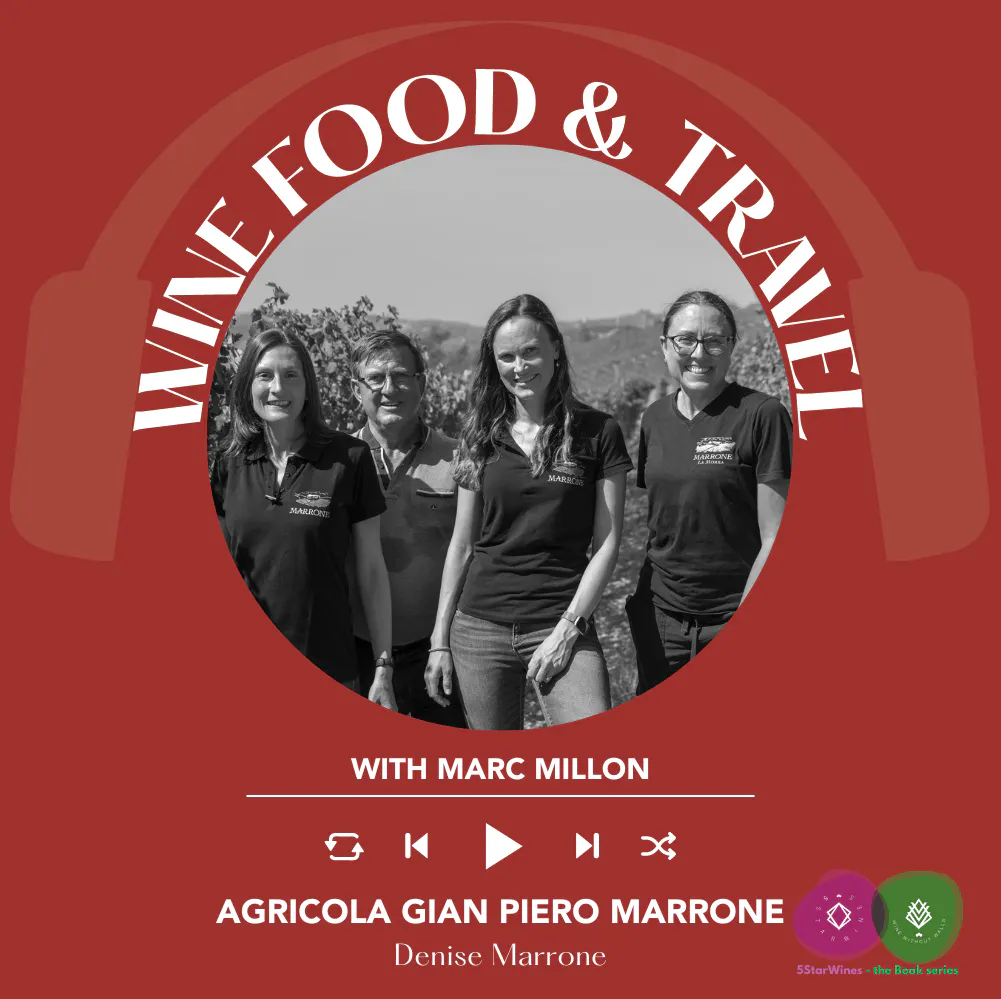
Ep. 2104 Denise Marrone of Agricola Gian Piero Marrone | Wine, Food & Travel With Marc Millon
Ep. 2104 Denise Marrone of Agricola Gian Piero Marrone | Wine, Food & Travel With Marc Millon
Episode Summary
Content Analysis Key Themes and Main Ideas 1. The historical evolution and global recognition of Barolo wine. 2. The Marrone family's legacy and pioneering role in Barolo winemaking through generations. 3. The unique terroir, climate, and landscape of Piedmont's Le Langhe region. 4. The diverse wine styles and grape varieties produced by the Marrone family, beyond just Barolo. 5. The integral role of traditional Piedmontese cuisine and hospitality in the wine experience at the Marrone winery. 6. The impact of climate change on viticulture and winemaking practices in Barolo. Summary The podcast features Mark Millen interviewing Denise Marrone of the Azienda Agricola Marrone in Piedmont's Barolo wine hills. Denise shares her family's deep-rooted history in winemaking, tracing their origins back to the 1950s in La Morra, and even earlier in Madonadigumo. She discusses the significant transformation of Barolo wine from a historically harsher style to the elegant, world-renowned wine it is today, attributing this evolution to both winemaking advancements and the effects of climate change. Denise highlights the Marrone family's dedication to quality, exemplified by their Busìa Barolo 2019 receiving a prestigious award. She also details the family's diverse wine production, including unique white wines and the cultivation of the rare Nebbiolo Rosay clone, which contributes to their Barolo's elegant style. A significant portion of the conversation focuses on traditional Piedmontese cuisine, emphasizing signature dishes like *tajarin* with truffles and *bunet*, and their perfect pairings with Marrone wines, showcasing the winery's integrated approach to food and wine hospitality. The interview concludes with a warm invitation to experience the authentic terroir and welcoming atmosphere of the Marrone family winery. Takeaways - Barolo's global recognition as a fine wine has evolved significantly over recent decades, driven by dedicated winemaking families. - Climate change has played a notable role in shaping Barolo's wine style, contributing to a more approachable and elegant profile. - Diversifying vineyard locations is a critical strategy for mitigating risks such as hail damage in the Piedmont region. - The Marrone winery is a family-run enterprise, primarily managed by three sisters, each contributing to different aspects of the business, from winemaking to hospitality. - The winery produces a diverse portfolio of wines beyond celebrated Barolos, including whites and distinct red varieties, emphasizing the rich varietal heritage of Piedmont. - Piedmontese gastronomy is deeply integrated with the wine experience, featuring traditional dishes meticulously paired with local wines, often with ingredients directly from the region (e.g., truffles). - The Marrone winery prioritizes wine tourism and hospitality, aiming to provide visitors with immersive and memorable experiences rather than just tastings. Notable Quotes - ""We haven't been always snob barrel of winemakers. We were in a poor land that just with our passion at first, the climate changes second, and together with the knowledge that came very fast year by year..."
About This Episode
The speakers discuss the evolution of Barolo's wine style, which is now more refinementate and up into the wonderful and loved wine that is so wonderful and loved around the world. They also talk about the challenges of finding quality wines in the current climate and the need for a change in mentality of winemakers. They discuss the importance of protecting against storm damage, the Boro Garcia, and the Italian wine industry. They also talk about the importance of taste in their culinary experience and the confidentiality of the MGA. They express their love for visiting the area and thank their listeners for their visit.
Transcript
I remember my grandmother when she was going to the market to sell rabbits and to buy clothes. So we haven't been always snob barrel of winemakers. We were in a poor land that just with our passion at first. The climate changes second, and together with the knowledge that came very fast year by year, following the nebula kind of a plant of grape together. We also change our mind. Blah blah blah blah. We arrived at what we have today. Welcome to wine food and travel. With me, Mark Billen, on Italian wine podcast. Listen in as we journey to some of Italy's most beautiful places in the company of those who know them best. The families who grow grapes and make fabulous wines. Through their stories, we will learn not just about their wines, but also about their ways of life. The local and regional foods and specialities that pair naturally with their wines. And the most beautiful places to visit. We have a wonderful journey of discovery ahead of us, and I hope you will join me. Welcome to wine, food, and travel with me, Mark Menin, on Italian wine podcast. Today, I'm delighted to continue a special subseries that highlights the winners of the prestigious five star wines and wines without walls competition that took place in April just prior to the Italy twenty twenty four. Those ones that scored more than ninety points were awarded certificates and have been included in the five star wines and wine without walls twenty twenty five book are the very best wines in each category were singled out for special awards. Today, we traveled to Piedmont's, Leilangue, to the heart of the Barolo wine hills. To meet my guest, Denise Marone, of the Azziento Greekone, which received a hugely impressive and special award for overall best Italian wine. This award supported by Banco BPM highlights the wine in any category that has received the very highest score. So it's a huge and important achievement. Many congratulations Denise to you and your family. And thank you for being my guest today. How are you? And is it a beautiful September day? Yeah. Not that beautiful because you have to see outside. It's the cloud in September that everybody knows, that is common in the Lanc region. And we were supposed to start the harvesting yesterday with the whites, but, we are a little bit delayed. We will need to wait until on Monday. Well, actually, that's really interesting when you say that That sort of is that the mist in the valleys sort of whether that autumn weather that often happens in the wine hills? Exactly. And the pictures of that normally are published on the magazines. It is exactly the landscape. Looking up from Lebelvedere. Looking down onto the ground. I'm imagining that now. But Denise, our listeners are located all around the world, and many may not have been to Barolla before. So you've begun to describe this beautiful and special landscape, but take us to Leilane. You take us to the Barolla else of La Mora. Describe this special time of year right now, this autumn in Le langue. Yeah, and really, it's a very beautiful place. Trust me. I travel the world all around for all my lifelong. And, with always the will to come back because even if I was born here, I can tell everybody how beautiful it is. It's this kind of soft hills, gentle hills that you can in ages are covered with the vineyards, and I'm in the heart of the Barolo wind production. I'm in La Mora. And our company, our family seller, is in Announciata. So a little bit downhill from our terrace, you can see all the eleven villages of the production overall. So just for fun, just as a touristy spot, it's a very beautiful touristic spot. Yeah. And especially this is a special and popular time to visit the autumn in Maynard. Isn't it? It is. It is because you can come all the year long, of course, MD May in June very green and very pleasant with this beautiful blue sky, but the September, October, November are the months, the months of the harvest and the months of the truffle. The months when everybody ages, oh, yes. It's time to talk about wine. And this is why from yesterday, from two days ago, we keep our seller open for the visitors seven days a week because of that because we love to welcome people coming here traveling the world to visit our landscapes. Okay. Great. Well, we'll talk about wine hospitality and also about those truffles that you mentioned a little bit later. But Denise, let's start with learning about the long family story of the Marrone family, wine making in Barolla. We're going back to the early years of modern Bureau to the start of the last century. Is that right? It is. It is because my grandfather arrived here in Barrovia in, in the village of Alamora, more or less in the fifties, having the idea that the baroque would start to be so special, so precious as it really is nowadays. Where family comes from a small hamlet close to Alba called Madonadigumo, So it was winemakers since ever. We can find the documents, written dating, last eighteen hundred, eighteen hundred and ninety, something like that. So, but then, step by step, a little bit of whites, and then a viola, and the barbera, to come here in Barolo in those years in the fifties. And always with the love and with the will of making better wines because Barolo at the beginning was harder to understand. The weather was not the weather that we get today and so the tenants were green. It was a long way to follow to arrive to the quality that we know and we love today. Denise, that's a really interesting story because I think it's very important. Wine lovers around the world know Barolo is one of the greatest red wines in the world, not just in Italy, but in the world. But it's very interesting that the story of modern Barolo really, is something that's been built by your father's generation and the generations that have carried on that word. But Bruno, the wines of Leilangi, these beautiful winehills. After world war two, were were you had been destroyed, there had been fighting in the vineyards. And and the wine itself was not yet known around the world. So it has been a long hard road for your family and for the families that have helped to put Barolo on the map, hasn't it? Yes. You are totally right. I'm not three thousand years old. I'm forty five in a month. But, on my skin, I could feel this story taking shape because I remember my grandmother when she was going to the market to sell rabbits and to buy clothes. So we haven't been always snob barrel winemakers. We were in a poor land that just with our passionate first, the climate change second, and together with the knowledge that came very fast year by year, following the nebula kind of of plant, of grape, together with what you were saying. So also change your mind, new barrels, new style, blah blah blah blah. We arrived at what we have today. And trust me, sometimes me and my sisters, we open up with curiosity, all the magnums, all the vintages, to say, oh, wow. Let me see what happens after twenty, twenty five or thirty years. And sometimes we are not that happy with what we find. Sometimes we are disappointed because with the taste of today, we did the the style of today Yes. There's the the idea that this wine lasted for the last thirty years, but it's not the taste that we expected. And so we also need to face what happened, what it what it has been this way. That's really interesting. Denise, this evolution of Barolo, this this refinement Yes. Into this wine that is so wonderful and loved around the world, but which began as a harder style of wine with those harsher tannins that you mentioned, but still the belief that your grandfather had that this land had the capacity to make truly great wine. Totally. And, yeah, consider, for example, something like that. But, the bussiah, the one that got the award and the beautiful award. So we are very proud of it, arrived in this style and in this way only through the years because at the beginning, our small part of the busier was a little bit shadowy and so there was too much water that it is what helps today to get these, kind of quality because with these, more water underground. Now we have healthy plants, what my dad loves to say happy plans that can give us, good grapes, beautiful grapes from where we can get the quality of the barolo that we bought, but only nature has changed to help us to follow this style and this line. Because if not, in the cellar, my younger sister, Valentina, she's the analog at home, but she is not making any magics. So if she doesn't harvest what we need, we can do nothing. Okay. So there's an evolution in the mentality of the winemakers, but also it's the change in climate as well has helped to evolve the wines. So many things bringing together. As always, to result in great wine. Now you've mentioned your sister is a Valentina who is the winemaker. Introduce us to the rest of your family who are working with you today. We are a special family in, while making because we are all sisters. Of course, dad will be here forever. I will be retired before him, but he's only making what he likes. So sometimes he go to the vineyards and he spend the full week in the vineyards. Sometimes he prefers to stay here in the center and he spends a week here. He has the luck and the proud of making what he likes. And we we need to work. And so my younger sister, she is the mommy of the wise. And so today, she's a little bit stressed because of the coming harvest day. And my second sister, where Sarah works in the office because someone has to do that. And, I take care of all the rest around. Let me say I'm the older, and so I'm the one that knows everything since the beginning. So I take care of the welcoming the seller of the hospitality I'm the only one speaking Germany, so I go up and down to Germany. I take care of the socials, the pictures, all the restaurant. Okay. Well, that's that sounds like an amazing family all working together. And, I'm sure you have your moments like any family does, but it sounds I wanted to tell you, we we urge you every day. Like, it doesn't matter tomorrow. We open the door and we are still love sisters. Yes. Of course. There's nothing as we have. Yes. Now, Denise, at Marona, you produce the classic wines of it's a large range, but I'd like you before we focus in on the Boro Garcia, the special award winning one. I'd like you to introduce us briefly to the main great varieties, that are most important in the beginning perhaps with the whites and then moving on into the other red varieties? Yes. There's a meaning of that because, what I told you, madonna de Cuomo is outside of the barolo region, is in between a barbaresque and Barrola. So the family farmers was there also together with the animals, some peaches, some fruit plants, and so on. And that has not been step by step. We decided to move away all it was not vines to make a space to vines. So the house at the farmhouse is on top of a hill. We have a north and a south exposition. On the south was already by there. Nebbiolo Moscado. That was the three main grape varieties that already my grandfather and the family planted. Along the years, we continued with Chardon it. With RNAs and Favolta that are all white. So to be what we said, the snob barrel of producers, we produced forty percent of whites, and complete the range a little bit of Dolcecto because it was the most popular of the, Kimonte wines, the one that was sold to Torino, for example, sold to the local market, and it was what it was, drank every day at home. So altogether, we have seven different kind of grapes. For not a big quantity altogether. But, because it was curious and it was interesting always to introduce something else and always to plant something that was not just local. To see what happened and putting together with the tradition and the mentality that we had. So this is a little bit the the reason why. Okay. So it goes back to the family roots to the original farm. But also that in melania, you know, I think everybody thinks in barolo. It's there's the barolo wine, but of course the importance of having this range of wines with vineyards from different areas as well. That's also useful to protect from things like hail, isn't it? Should be a real risk in the vineyards? I don't know if your readers can remember about the sixth of July last year. It was a disaster. A gigantic hail that took about thirty kilometers. So one of the biggest that my dad remembers. It happened eighty years ago. And so to have vineyards here and there, can help a lot. Last year, we were affected on the armies on the chardonnay and the part of the Dolceto, but the Nebula family, the Barbera family, all the part of the Nebula here in Barolo area, were safe. So, yes, and my grandfather was very scared about the hail. So this is also the reason why coming back in the history of the family, there's spots here and there and there. We have our vineyards around twenty kilometers more or less. Okay. Right? Well, that's that's, again, important to know when people are picturing Barolo that generally producers aren't of a single estate, perhaps like in in their vineyards often dotted around, and that's very important. It also gives you this wonderful variety and range of wine starting with the whites. And, of course, then the dolcetto, and they're barbera. Yes. But let's talk about this magnificent grape variety, nebbiolo. Tell us about your nebbiolo wines, your borola wines, and then finally, let's focus in on Nebula is really a beautiful, kind of, of grape, and it's one of my favorite together with pinot noir all around the world. Because it is so intriguing. It is so elegant with this transparency of color and a lot of potential. You're okay. It needs fresh air. It needs to be treated in a certain way, but the potential is huge because of that. So you can apply what you know, together with the traditional and innovation on something that can last, not forever, but a lot of years. And for example, in our spot in Lucia, We don't have just the clothes that everybody knows on PMique at, but we have about a twenty percent of Rosie. A very old style, a very old clone that freshness and elegance. So our barolo, it's, it it gives you the will to continue drinking because it is not too panic, too difficult. It has this gentle style that we always describe as our feminine patch that it comes again from from the soil, from the terroir, and from the the clothes that we planted. Oh my goodness. That's a beautiful description. Who wants to be the next Italian wine Ambassador. Join an exclusive network of four hundred Italian wine ambassadors across forty eight countries. Vine Italy International Academy is coming to Chicago on October nineteenth, twenty first. And Walmatikazakhstan from November sixteenth to eighteenth. Don't miss out. Register now at vinegary dot com. As we say, Barolo can can can be quite a big and powerful line and a tenic line. But this more elegant style in part through the skill of the the female skill of the team that you're assist to the winemaker. Yes. Who's who are attending the vineyards, but also this cone that isn't found widely. The Nebula Rosais. Is that the right name for it? It is. It is. Okay. Very, very old. Okay. Almost a no not to the ones that doesn't have a generation that it follow. Okay. Okay. And in fact, the award winning one, I think, was two thousand nineteen. Is that correct? It is. Yes. And this, it comes from these small part of Rosay that's in it. Okay. And that's still a very young vintage. Or barolo, but I know how rigorous the five star wine tasting competition is. I'm I've been a judge over the last years. And, first of all, the team of five will have judged and given every wine a point score. And the top lines, the very top lines get tasted again, and possibly again, certainly for an award, this important. So the head of the head judges that team will have tasted this. And and this one received ninety seven points. So it's a huge achievement and inoculating. You all must be very pleased with it. Oh, a lot. And you know, there's again another very nice story behind because we got to the same award for the same wine already being dated two thousand and thirteen. That was, the second year that we decided to to bottle the Busyel on only there in two thousand and twelve because of the climate change and what we already said that we started bottling a small part of Busia by itself. And so getting the same award. After years on the same wine, my sister was walking half a matter from the soil because one time, it can happen, but the second time is really that the confirmation of what you made was a good job. Yes. Certainly. Absolutely. Now, Denise, I'd like to turn to another treasure of late long game. That is the cuisine, the foods. This is I I think that it's one of the richest and most delicious of all of the many delicious cuisines in in Italy. There are a lot of very special plates. And as you say, we're coming to a special time of year. So can you perhaps highlight a few very typical foods of Lehlanga and how they pair with some of your wines? We need a couple of days of recording. But, We do. We do. To make a summary, Aloha, this year, me and my mom, we received the the award for thirty years in economy. So serving wine together with food. So again, it's quite a while that we are serving our good recipes together with our wines and what we always see today are start our inside restaurant is pretty big and the more than happy to welcome people coming from all around the world. But what we see and we can't change in our menus are at least four different dishes that everybody knows also without a translation. And it is a Tiring. So this is the traditional menu. And we tried many times at least in August, not to serve the bravo, but there's no way. And when we cook together with the guests that come from our cooking classes, and we put two bottles overall in a piece of meat they are astonished and they can't believe what we are doing. But without the pour in this good barolo into a good meter, there's no way to make a good recipe. Okay. Those are wonderful four dishes, classic dishes. And I'm imagining them in the beautiful setting that you serve them in this dining area overlooking the vineyards. Is that right? It is. This summer, we opened also outside. So we had only four tables, but who cares on a balcony. And so with the sunset and with the vineyards outside, and we had a beautiful weather in all August month. It was very, very nice. Trust me. Oh, that sounds wonderful. Now let's go into each of those dishes in a little more detail with the wine pairing. Starting with the we generally pair with two of our wines. A white end or a rose. Why this is a cerdhanate fermented an agent, you know, because the name is a cerdhanate Maemun, this, that comes from the soil where it is planted up in Madonadikomo, and the twenty four months of oak, but where the oak is a help and not covering the traditional style of the wine. So it's like, again, to go to the kitchen and to use a pen, a large panel to fry an egg, or a deep one to cook the pasta. This is the same. So we need the food to help the wine and not to cover it. And it is a very beautiful white. We made a vertical tasting going back till two thousand and fourteen. So ten years of a language, and we were very surprised and very happy. And the rosé is anabella rosé, of course, could you adopt it? And, we made it for the first time only four years ago because it's not the tradition, but we wanted to have it because we are all sisters. So we wanted to have a pink color wine. And, again, it's very powerful. We make the harvesting on the same time where we harvest the regular mediola. So at least a month later compared to what it's normally done to make a rose. And so we give it the the structure of a red, but in a pink color. So to be drunk, cool during the summer. It's a delicious wine. So together, we'll eat a little natto. They are both gorgeous and amazing. Wonderful. Now let's talk about the tayarine. Now tayarine could be these fine egg noodles hand rolled hand cuts. Now, in summer, I imagine you'll have a light thugo, but in as we move into autumn, and as we move into the season of the tartufo Bianco, what Do you be shaving those over to your tayarin? Definitely. Even but the tatufo menu is still out and what they are seeing at tayarin al tatufo. Of course. Of course. And what would be the one to pair with that? For the pairing, I can imagine, however, they are superior. So the eldest vineyards that we have, they are sixty five years old. The total yearly production is less than three thousand dollars. But it is a very special barrier because it doesn't bother your stomach as we did too much acidity is very fluid, a beautiful color. So it's also a charming glass that will handle it in your hands. And, it reminds what it has always been. A good glass of beer together with the pasta dish. Okay. And then, of course, with that wonderful two bottles of your beautiful wine used to cooking with it. You can only do this in a wine producers whole wedding to make the real buzz out to because you know the barolo is the really good barolo going into cooking. Yes. But then while cooking or while saving and enjoying, you can drink it as well. And so my all, for example, we have only. It's not just the meat of the drink. Oh, gosh. And the the barolo range, we have a free of them. The bussies, the most special and most precious because what we were saying is a single MGA and the very limited production. But the other two, the PMA and the classic, the regular barrel come from a combination of two territories. Again, MGA declared MGA, Busia, and the Chokini on the village of LaMara. And they are just more personal because when you mix, you can put in your hands and what you like. So bousia speaks about nature and terroir and PKMA and classical speak about the maroney family. Okay. That's really good to know. Because I think that's again the MGA is the single vineyard Borolos at such a level of interest to people that really love Barolos and want to find the unique personalities of terroir. But as you say wines that are that do combine grapes from may be different areas or different vineyards, speak of the personality of the family of the winemaker. Totally right. Now, the final dish, was it Monette Yes. That you mentioned? We must mention that it's something I love Explain what it is and what wine you like with that. It's very simple. It's a a milk chocolator, a spicy biscuit, a spoonfuler of a barolo kinato. Oven cooked like a flan, like a like a pudding, and it's delicious. Those are all the poor ingredients because they come from every single farmhouse, and it was the Sunday dessert for all the families here in the region. And, it is very good served with the most cattle. That's why my grandfather already planted most cattle because, again, is not that traditional in the region. Yes, more nasty part of our area. White making area. And so Moscow has only five percent of alcohol. So it was the first wine to sip the drink also by the kids because here four or five years old, you still start drinking something. There's not the the, forbidden wine. Okay. Let's start to put the finger in, and it is where everything starts. Okay. That's good to know. It's, I, you know, my, my daughter went We were writing books and traveling. Muscata was her favorite one from when she was very young too. Yes. But then she reached a certain age where she preferred Barbera. Fever then. Yes. While growing up, the line is that one, from Moscow to barbera to to baron. So always more expensive. Yes. That's right. Denise, it's been wonderful meeting you and talking to you this morning. You've taken us. You've taken me. You've taken our listeners. Directly into the heart of Le lang into that beautiful Barola wine house and into the Maroney family's cellars and heart. I feel like you've really given us a very personal and beautiful visit. So thank you very much. I know you've mentioned that you're always welcoming visitors and guests. I hope our listeners, I hope, and myself, I'm looking forward to visiting too. Will find their way to la and to visit the Marone sellers to taste your wonderful wines and to enjoy some of these delicious foods that you've described so beautifully. So thank you very much for being our guest today. It has been a pleasure, and it will be a pleasure. Really, anytime the doors are open, and you are all welcome because I can talk for days. But if you don't feel a deer, and the mood and what surrounds you is difficult to describe because there's so many sensations here. We are not waiting for visitors. We are waiting for experiences because you need to come back with a nice feeling and with the will to come back again. Absolutely. And you've given us an experience, but I will be better still when we're actually there. So I look forward to that, Denise. Thank you very much. Thanks, and have a nice day. We hope you enjoyed today's episode of wine, food, and travel with me, Mark Millen, on Italian wine podcast. Please remember to like, share, and subscribe right here, or wherever you get your pods. Likewise, you can visit us at Italianwine podcast dot com. Until next time.
Episode Details
Related Episodes

Ep. 2822 Ep. 20: California | Study Smart for your WSET Level 3
Episode 2822

Ep. 2789 ColleMassari: a long-term vision rooted in Montecucco with Giuseppe Di Gioia | On The Road With Stevie Kim
Episode 2789

Ep. 2788 Ep. 14: Austria and Hungary | Study Smart for your WSET Level 3
Episode 2788

Ep. 2785 From Volunteer to Speaker at TEXSOM with Samantha Cole Johnson | TEXSOM 2026
Episode 2785

Ep. 2766 Inside the U.S. Non-Alcoholic Wine Market: What Wineries Need to Know with Jill Sites | Masterclass US Wine Market
Episode 2766

Ep. 2761 Winemaking and Consulting Across Sicily with Alessandro Serughetti | Wine, Food & Travel with Marc Millon
Episode 2761