
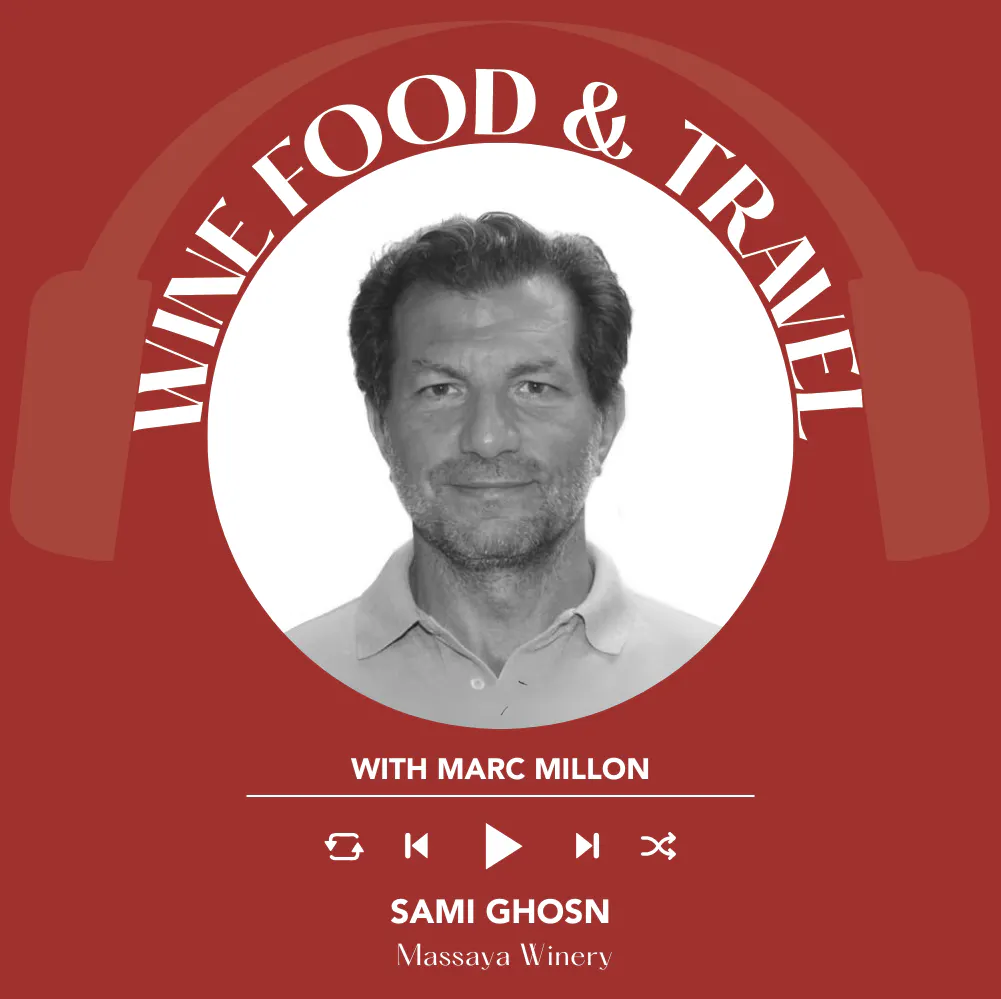
Ep. 2176 Sami Ghosn Of Massaya Winery | Wine, Food & Travel With Marc Millon
Ep. 2176 Sami Ghosn Of Massaya Winery | Wine, Food & Travel With Marc Millon
Episode Summary
Content Analysis Key Themes and Main Ideas 1. The ancient and profound history of winemaking in Lebanon, tracing back to the Phoenicians and biblical times. 2. Sammy Gosin's personal journey of resilience, reclaiming family land, and establishing Massaya winery amidst civil conflict. 3. The unique and advantageous terroir of Lebanon, characterized by high altitude, abundant sunshine, Mediterranean influence, and fertile soil. 4. The cultural significance of Arak as Lebanon's national drink and its role in preserving grape varieties. 5. The philosophy and characteristics of Massaya wines, focusing on minerality, indigenous varieties, and organic/biodynamic practices. 6. The rich, multicultural nature of Lebanese cuisine and its harmonious pairing with local wines. 7. The vision of wine as a tool for cultural exchange and peace, reflecting the Phoenician legacy. Summary In this episode of the Italian Wine Podcast, host Mark Millen interviews Sammy Gosin of Massaya Wines, located in Lebanon's historic Beeka Valley. Sammy delves into Lebanon's 8,000-year winemaking heritage, emphasizing the Phoenicians' role in spreading viticulture across the Mediterranean. He details the country's unique terroir, including its high-altitude vineyards (up to 1700 meters), abundant sun, and snowmelt, all contributing to exceptional grape quality. Gosin shares his personal story of displacement during the Lebanese civil war, his return to reclaim family land, and his unexpected entry into winemaking through the production of Arak, Lebanon's national spirit. He recounts how this led to the founding of Massaya winery with his brother Ramsey and renowned French partners. Massaya wines are highlighted for their minerality, minimal oak usage, and the revival of indigenous Lebanese grape varieties like Obeidy and Merweh. Sammy also explores the intricate relationship between Massaya wines and Lebanon's rich, multi-layered cuisine. Despite ongoing challenges in Lebanon, Gosin expresses a profound hope for peace and cultural exchange through wine, positioning Massaya as a global ambassador for Lebanese heritage and resilience. Takeaways - Lebanon boasts an ancient winemaking history, predating many European regions, with evidence of grape cultivation and winemaking dating back 8,000 years. - The Phoenicians were not just traders but ""cultures"" who actively planted vines and settled in regions they traded with, spreading viticulture across the Mediterranean. - Lebanon is the only wine region explicitly mentioned in the Bible, highlighting its deep historical and religious connection to wine. - The unique Lebanese terroir, especially its high-altitude vineyards (up to 1700m in the northern hemisphere), and specific climatic conditions (sun, snowmelt) are crucial for grape quality. - Sammy Gosin's journey into winemaking was deeply personal, rooted in reclaiming family land after civil war displacement and initially focused on producing Arak. - Arak is the national drink of Lebanon and played a significant role in preserving indigenous grape varieties due to high local consumption. - Massaya winery, co-founded by Sammy and Ramsey Gosin, benefited from partnerships with renowned French winemakers from Bordeaux and the Rhône Valley. - Massaya wines focus on minerality and minimal oak, making them ideal complements to the complex and refined Lebanese cuisine. - The winery practices biodynamic and organic methods, utilizing natural processes like snowmelt for wine settling and clarity. - Lebanese cuisine is a ""melting pot"" of diverse cultural influences, resulting in a rich and refined culinary tradition. - Despite ongoing regional instability, Massaya wines are distributed globally, with potential for further market expansion, particularly in Asia. - Sammy Gosin emphasizes wine as a medium for cultural exchange and a symbol of peace, reflecting the original Phoenician ethos. Notable Quotes - ""I came to discover all these huge heritage along the road into making wine. And this can be summed up in a nutshell with four factors. The altitude the sunshine, the Mediterranean, and the quality of the soil."
About This Episode
The speakers discuss the history and culture of Messiah wines, including their past travels to London and the historical vines they planted. They also discuss the cultural and cultural significance of Lebanon, including its success in war and trade, and its impact on family and personal lives. They express their passion for Lebanon and their desire to create their own wines, including their own wines and their brother's wines. They also discuss their love for organic ingredients and their interest in the natural ingredients of their wines. They express their desire to visit the region and visit the Becca Valley in the future.
Transcript
I came to discover all these huge heritage along the road into making wine. And this can be summed up in a nutshell with four factors. The altitude the sunshine, the Mediterranean, and the quality of the soil. So it's wonderful to grow grapes in Devon. Welcome wine food and travel. With me, Mark Villan, on Italian wine podcast, listen in as we journey to some of Italy's most beautiful places in the company of those who know them best. The families who grow grapes and make fabulous wines. Through their stories, we all learn not just about their wines, but also about their ways of life, the local and regional foods and specialties that pair naturally with their wines, and the most beautiful places to visit. We have a wonderful journey of discovery ahead of us. And I hope you will join me. Welcome to wine food and travel with me, Mark Millen, on Italian wine podcast. Today, we travel not to Italy, but to Lebanon's Becca Valley one of the oldest and most historic wine regions in the world to meet my guest, Sammy Gosin, of the Messiah wine wreath who will share his fascinating and courageous story with us. Good morning, Sammy. We met last month at DART Farm, Top when you hosted a quite fabulous and fascinating wine dinner. So I'm really delighted to be able to further our conversation and to share your story in the story of Messiah wines with our listeners who are located all around the world. How are you today? And where are you right now? Good morning, Mark. And thank you for hosting me. I am I just went to London from Washington DC last night. So I'm in London, not far from you, I guess. Okay. So this has been a a period of time outside of your country outside, the events that are happening, of course, but also meeting customers all around the world. You travel quite a lot. Don't you? Yes. Quite extensively. And, this is actually all was prescheduled to the current situation in our part of the world. So I don't like to change my schedule due to unforeseen circumstances we have no say about nor power about. Of course. Now, Sammy, many today might not immediately think of Lamadon as one of the most historic wine producing countries in the world. But there's a history and a tradition of winemaking and wine commerce that goes back thousands of years to the finishings, great seafaring, trading people who spread the culture of wine all across Europe and even beyond. Can you tell us about the finishings, please. It's something about this amazing civilization. Indeed, the finishings actually, were not on the traders, but they were the cultures. So whatever they set foot to trade, they planted vines, And when you plant vines, you settle, that's why they had all those, we call them around the Mediterranean Basin, and you say beyond Sicily, North Africa, all the way to Spain, Portugal. I was actually recently in Coleman in the southwest of the UK talking in front of customers and that gentleman farmer that on the land there said they were digging. They found Finnish out graph. They used to say it all the way to Cornwall for the ten. And it was always, a quality produced day book to to the world all the way from Asia from the caravan from the silk crowds. And, took it to the rest of the world. And certainly, wine, and I'm for, it was used to be named BIPleen. It came from, Biblos, North of Beirut. It was considered the ground twine at the time, and they were renowned for their quality of their, wine was definitions. You can say we're the first people to trade with wine. They brought in the wine to the pharaohs of Egypt, then to the Greeks and, it was always quality produced along those lines, the wines were the first. Recently, it was proven that the first crossing of what became the witness Unifera emanated from the levant, the heart of which is Lebanon and and Tunisia. So this is about eight thousand years ago. The two species that, came about around the same period, one in the levant, and the other one around Georgia, we thought originally it came down from just through mesopotamia towards, modern day Lebanon, but actually those species never crossed and DNA has proven that they were distinct. So you can say that Lebanon is pretty much where, grapes came about to life and, winemaking started there on. That's an amazing story. Actually, I didn't know that about the crossing of the wild vines with the VITis vinifera or this crossing to create the European grapevine, which is now planted all across all across the world. So that is a very important fact of Lebanon's long and lengthy tradition. The Romans were in your area too. You described this beautiful, really impressive temple Tabicus at Baldwin? Isn't this where your vineyards are situated? Yes. Indeed. The Romans came about later, but the Romans look at the time, the winemaking to an industrial scale. Whatever the Roman set foot, they produced wine all the way from Asia to Scotland. So they built not in Riohanort to in Norbor, though, but their temple for back is the god of grapes and wine in Balbak in the Becca valley, the city of the god bulb. And, Balbak is where there is stands the magnificent that it's the best reserved Roman temple in the world actually. And, it's quite impressive. I must have been visited. The Roman Temple of Bakers more than ten times. And and every time I'm there, it's it's It's just incredible, defeating. They give music concerts out there, and and the sound is immaculate despite the hugeness of the stone that are positioned and the Collins and It's quite impressive, and we discovered one thing. You know, the closer we got to this temple of values with our vines and vineyards as we developed Messiah, the better quality of the grapes and the wines. It's it's magic. Well, that's amazing. Again, this length, deep roots of Viticulture where you're growing grapes today. In the Bible, Jesus performed his first miracle at Kainau Gallale, transforming water into wine. That's in Southern Lebanon. Is that right? Indeed. Indeed. And, this is for the first miracle of Christ. And, actually, Lebanon is the only wine region mentioned in the Bible testament. There is no other wine region mentioned in the holy books, than Lebanon. The stealth suit, the magnitude, and the deep rooted heritage of wine it's part of our DNA in Lebanon. So honestly, I did not realize all that before, starting Masai, the venture and adventure of Masai came about, my accident almost by my, attachment to Lebanon and the of our ancestry. And, I came to discover all these, huge heritage and the signs of nature towards wine from our part the world and definitions and the levant and the mountains and along the road into making wine. And this can be summed up in a nutshell with four factors. The altitude, the sunshine, the Mediterranean, and the quality of the soil. So it's wonderful to grow grapes in Devon. You can see why these were wines that were considered the ground crew of the ancient world and producing great wines again today. Lebanon, of course, is going through troubled times now, but it's a country not just rich in the culture of wine, but such a rich and multi layered history over the centuries. And Beirut was, by all accounts, one of the most beautiful cities, a place of culture and sophistication. Is that how you remember it prior to the civil war? I still live it as such now. Mhmm. It might sound, you know, difficult to see what you see through the news, but Beirut is very vibrant. It's magnificent. Yeah. It has a soul. You know, the first time I landed, I remember in New York. I felt as if I'm in Beirut. It has this vibe that you cannot explain. It's, over a Beirut. It's overwhelming. It's not beautiful in design. It's beautiful by soul. It's one of those places you land and you see that it cannot leave you untouched. You might hate it, but you cannot be indifferent to to be rude. Now, Sammy, the civil war that lasted from nineteen seventy five to nineteen nine had a profound effect on your life. Tell us what happened. Actually, in seventy three, the trouble started with the Palestinians at the time that were, armed in Lebanon and were becoming, overpowering the state and, people are usually peaceful in Lebanon. And, we got remember Phoenicians never traded by wars or never had an army. It was always trade and exchange and numbers and culture So that took us off guard. My young man, the mother with my uncle and her car was shot dead by a Palestinian sniper. And, it was the first shock. My mom going to hospital to keep blood. And then in seventy five, we got, displaced from our town, and we were, rushed to the Deca Valley where my parents had a farmland thinking we would be it would be more peaceful there and, the war and the troubles with the Palestinians, caught up with us in Becca, and we got displaced again. We're Christian Marronites, and we had issues, you know, at the time with the Palestinians and the Muslims and Lebanon had, embraced the Palestinian cause, you know, the big struggle between the Palestinians is right. So we were caught in between the fires. And, that had definitely an impact on us. I remember the last, day leaving our property in De Becca, my brother, and I, rushed into my mom's white volvo at the time, we had our faces against the back shield of the car because our German shepherd was went through the barbed wire and was chasing the car and, unusually, because, you know, dogs, animals feed tension, and clearly their worst tension, which they our parents were trying to hide from us. And we realized, I said, mom, stop the car. Let's take she grow with us. We will take her with us. And then what she said, we'll be back next week and wasn't it seventeen years later that I came back to the property. Eventually, they shut the dog, took over our land, and occupied it for seventeen years. I came back in the early nineties, nineteen ninety two, after the growing up in France studying and then, working in the US to reclaim our land. I was really moved in the US when the Syrian at the time in nineteen ninety invaded what was left free of Lebanon looted and So it was very disturbing times, but Lebanon never really left me. I I studied in France and, worked in the US, but I was very much attached to our homeland as I am still because those memories did not, leave me. You know, the peacefulness of Lebanon in a way, the multicultural, the, how we go when the land, the sense of the land could not, could not dissipate from me. I might have left physically, but emotion there was still very much rooted in our memories in the mountains of Lebanon in Tabeca. And that is what I guess initiated my work and my passion for for Lebanon that unfortunately, has not seen much peacefulness, despite all our eagerness for this piece in the last, forty plus years. Thank you for sharing that personal story of what you and your family have had to go through, Sammy. You returned to the Baca valley. You reclaimed your land. You didn't begin immediately to make wine. Did you? You were actually doing something else with the grapes? There is, an older gentleman, that had transformed into a small piece of land into a piece of paradise next closer to Beirut. In the area, they call Nau dahi that is being bombarded every day, and he had planted, vines, not on divines, almond trees, pomegranates, cactus trees, he grew honey, and bees, and what have you. So it was radiated piece of paradise close to Beirut. And I said to him, I'd like to transform the land. I have to be in the beaker into this, and he would break couple of eggs. He had some poultry and sip on a white liquid, which I did not read. You know, I knew it was ara, but I did not know much more then. And he said, well, my son, why don't you make ara? I said, well, what's ara? He said, We have to source some grapes, which we did, make wine, which we did, and then, distill the wine into Arab. And, we rented the still. His wife would prepare for us, Reisine, the world now is familiar with Hamos and Babanos, and it was the first drop of rains on the recovery and the smell of the soil, and we were waiting while we were waiting still overnight. And it really came into my veins, and I realized this is where I am rooted, you know, finishing. I did my DNA. Ninety nine point ninety eight percent. Eleven time finishing. So I guess this was the calling, and I realized what Eric was. And, yes, I started making, a couple of produce from, gray policies and, a couple of reviews for our terriers, but Eric as well in handcrafted, with handcrafted labels in jars, and I started selling those at my parents pharmacy over on Mount Lebanon in a corner, organic with biodynamic practices. All those words, the word is now keen on because in Lebanon, we don't spray the grapes nor we irrigate that messiah. We're totally biodynamic, and and actually the weather helps you in that sense. Tremendously. We average about three hundred days of sunshine while we have snow capped mountains, and snow on the vines a couple of months of the year. So the grapes are, they don't need sanitization. They're beautifully, rich, and, and filled with sun and snow melt along the year. So the arac, I started selling at my parents pharmacy. People came for more. My dad said you must be doing something. Right? And this is where I So Iraq is something of the national drink of Lebanon. Yeah. Yes. Yes. It is. It is common to our area from the Mediterranean. You know, the French have pastis, the Greeks, the turks, habraki, the Italian Zambuka on the eastern coast, Lebanon, Israel, and this region, Iraq is the drink. And this is, what came about, and it was by default. You know, it's it's the same origins of all the any space flavors in our part of the world. And every region, made the alcohol from what it had as fruit and lebanon's is grapes, obviously, And even in Jordan, a Palestine, they have grapes as well. And this is how Iraq is recognized as the national drink, but certainly in Lebanon, at Massaya, we do it in a traditional way using old copper stilts. They're called more moreish led copper stilts. So the ancestors of the along big charante with which cognac is produced. Okay. Well, I've had a chance to taste your Iraq at the evening you hosted last month. And I, you know, I don't think I was aware of what an important element of Lebanese culture this drink represents to you. And as well, it's where you began your return to Lebanon through the production of Iraq. But you and your brother, Ramsey, made a bold decision to grow grapes not just for the production of Iraq, but to make table wines. Why did you make this decision? What led you to become a winemaker? Yes. It came organically, you know, as for the rest, we started, actually, I started making the Iraq and then thought of the blue bottle in remembrance of definitions. And, that was already on track. And, I get the call one day from, from a gentleman, French, you know, in Lebanon, we speak French. There is lots of, French influence. In Lebanon, and he says, my name is Jean Marie Frissex. Don't you laugh, and we speak French in Lebanon. Fresh sex. We could not not laugh. And that was before WhatsApp and Podcasts for sure. I said, yes. I said, my name is Frisex, and I provide corks to the wine industry in Lebanon. He said, well, I'm making arachnoid wine. He said, word is on the street. You're gonna be making wine. Because we had started Ramsey and I planting grapes at the time, at the time Ramsey had joined me and that was already nineteen ninety seven, nineteen ninety eight. And I said, well, introduce me to winemakers from France willing to invest me and winery in Lebanon. I'll bike, courts from you. He said, well, I will end a couple of weeks later. I get a call from the I kid you not Mark. I had no idea what Chival Blonde was. I knew both of us famous, but not more than that. And I get to visit Dominique in Santa Lyon. The first one that he visited was Chival Blonde. And, the rest is history. He loved the idea. Dominic says to me it's, it would be a dream come true to me to produce wine at the foothills of the temple of Vocus in the vocabulary. Obviously, it knew much more than I did at the time about the importance of Lebanon and definitions and the event in terms of wine and winemaking. And, this is how we came into a partnership. And then we were joined by the Virginia family from, geotrichrop in Chilton of Bob in France, and then my brother Ramsey became the winemaker out of fashion and, dedication and talent. And Masaya, as a winery, came about to life, and we have been partners for almost a generation. That's an amazing story. And, that French connection, of course, the French mandate, the French influence in in Lebanon, but extending into wine and these relationships with famous, well known producers in Bordeaux and and in the Roan Valley who are producing great wines themselves. So it was a a great partnership, I guess. But you were still you and your brother still were learning and doing pretty well everything you sells. And now you can celebrate twenty five years of Messiah. Is that right? It's, nineteen ninety eight. Yes. Twenty six. Right? Twenty six years. Wow. Incredible. Well, Sam, let's discuss your wines. Let's go through a range of wines. The wines that I tasted actually with you, last month because I think that, you know, the range is really interesting, both the grape varieties, classic French grape varieties, as well as lesser known native Lebanese varieties. I particularly enjoyed the reds, of course, but also in this beautiful white wine that we began with. So let's talk about your wines. In two thousand fourteen, we inaugurated an altitude Dwinery. You know, Lebanon is home to the highest attitude vineyards of the northern hemisphere. This is also an interesting, point because very few people associate Lebanon with altitude while altitude is, what compensates for the latitude of Lebanon, hence the association of sun, snow, and, cool weather that is instrumental to the quality of the grape. And when you're talking quality wine, you're talking quality grape, and this is a god gift to nature. I believe in Lebanon, particularly. And this is, god gift to nature in the levant. This is why you have so much history. How high are the vineyards, Sammy? We're up to seventeen hundred meters at Messiah with our Oh my goodness. That's incredible. That, literally at the foothills of the ski slopes of Mount Lebanon. So we literally ski, I actually, during the pandemic, I did snowball between the vines and send it to a few friends. So it's it's you really can't ski where we grow grapes. And we have in twenty fourteen, inaugurated an altitude winery over in on Mount Lebanon. And this is where we purchased the white. It has obeyed. It's a native varietal in it, and we have a second white that is only available at the winery made by another local grape indigenous to Lebanon is what I mean by local. It's called Merwe. And, it's a wine we vinify in amphora. So there are a couple of varieties that survived the Filoxera and for five hundred days of ultimate ruling. And those were white varietals. Predominantly. Thanks to the arak making. Arak, as we, you know, mentioned earlier is the national drink, I would say, of the levant. And in Lebanon, it was widely consumed and grapes, were widely planted. Thanks to those, the production of Iraq. We were able to those grapes survived if you wish. So this is pretty much what, salvage those varietals that we use in our white wines. And the Rosay we had, it's a hundred percent. So, you know, when we say Sansou in Lebanon, can always claim its French variety that it's true. But at the same time, remember, vines and grapes came from the east of the Mediterranean to the rest of the old world with the phoenicians. So Sansou is rooted back to us. It evolves with the wild crossing and the crossing of the different varietals along the roots of, evolution. But when you talk French varietals, you know, in Lebanon, you would say we have, you would say, but at the same time, those are Eastern Mediterranean variables, originally. So I relay them to the Mediterranean rather to a specific country. It's easier. So the SaaSau were mostly planted when the French after the second World War came back and Lebanon was under French mandate. So lots of the missionaries brought in the crafts, especially from Algeria. Algeria was the number one producing country at the time. They planted those, grapes. And the sun so we had at Masai, the rose is a hundred percent, and so And the reds, we dasted have predominantly, and we have in our Columbia, the first red we dasted finishings, planted, tempranillo in Spain, and Portugal, and we brought back fine cuts from there and tempranillo does superbly well in the back out. So it's predominantly Mediterranean varieties that we work with. We have very little oak involved in our production. So no oak casks. We have food, the larger oak vats at both wineries. So we did actually taste the Jose from Messiah, the white, the blonde, from altitude, and we did taste the terrace, the Balbak, and the cup s that are two single vineyards. We have closer to the temple of batteries. I was really, really impressed by the full range, Sammy. I was impressed, by the vibrancy and energy. These are wines that have real energy and vivacity to them in all styles. I'm really interested in what you're saying about varieties in the Mediterranean that originated from the finishings. The finishings carrying the vines with them And I know Professor Artilio Shenza, who is Italy's greatest authority on vine genetics has done a great deal of research into Italian native grape varieties and those that have come mainly on the Iranian side of Italy through the Phoenician traders. I guess coming up from the island of which was an important colony, and then around to Marce and eventually to Cadisse and around the vineyards of Perez de la Frontera. So these roots can be traced back now genetically by DNA proving the origins of grape varieties. So that's a fascinating connection. And you are now producing wines that do go back to those earliest roots. The phoenicians founded Marseille. I'm not sure if you're aware of that. The phoenicians founded Marseille as well as Sicily and, believe it or not, my French partner started making coaches and the best quotes you know, for that purpose because he has a property with a lot of very mountainous with a lot of oak and very hard to access. They would recommend it for him. Of, goats, in France, in southern France, certainly the shape of the finnish, the goats of Finisha. So, yeah, even goats were, transported, I guess, with the finishings to Marseille, and, Yeah. The connection is is huge. And, in Italy, the, at the shores, there are mountains of amphora broken, you know, they used to ship olive oil in wine, all in amphora. Spices and so forth. That was the bottle of the time of the recipient. So, there are shows, like, filled of amphoras, you know, breakage, residue whatever it did. Sure. Sure. Some of those m four, of course, are stained with the deep purple. The finish inside that expertise in extracting the purple dye from the Moracks, the Exactly. The sea snail. I know the island of Moxia, this small, small island opposite Marcella was a center for that production with the salt. The salt gathering in the Stagnos Bay dating back to the finishings as well. Hence, the the blue bottle Massiah in reference to the purple people, the purple blue bottle of Masai. Yes. Yes. Something else I'd like to touch on. And I know it's a complex subject, but it's a beautiful subject, which is Lebanese cuisine, and Lebanese cuisine in relation, you know, to the wines that you produce. I know we can't discuss this vast subject in great detail, but, just give us an idea of the richness of Lebanese. Food and and how well it goes with your wines. Yes. As I mentioned earlier, you know, Lebanon is a melting pot of different people influences all the persecuted minorities in the region found a safe haven in Lebanon, along the millennia. And, certainly, each brought in its own spices to what became Lebanese cuisine, you know, in Lebanon, we have Kurdish influence, Turkish influence. We have Christian, Jews, Jews, you name it, everyone. Armenians, so lots of influences from all the people that now we have a lot of Syrian refugees, a lot of people from Alepo. So Alepo is known for its spices. And, so that has brought in a very refined cuisine, the French influence between the two wars. So the cuisine in Lebanon is is very much as the wine is part of our DNA. So it's the multi layered influences have built in the best of those crossings, I would say, to name a few dishes that are uneasy to host with, full body threats. And, so we that's why our wines are more on the minerality. I'm talking about Masaya, you know, not the wines of Lebanon in general because every wine that he might defer in style, but we are more and more into the minerality less on the fruit, less on the oak. Minerality, compliment these cuisines. And Iraq is, you know, it's not by accident that, this drink is our national drink. As you mentioned earlier, and the predominant, national drink in the event, because it cleanses the palette between and every dish on a over a mesa, a mesa is like tapas, you know, small plates with hummus, which is, known now globally at how much in cloves, lemon juice, and garlic. And you have, you know, the aubergine, which is or it has grilled aubergine. Those are very difficult dates or let alone the which is a parsley, and there is a lot of coriander in our cuisine. There are a lot of acidic tastes, and the variety, especially in the mazes of flavors. And the air cleanses the palate between every little knob you grab, And then the wines, go nicer, I would say, with the dishes that have involved pork tree or meat and fish and so forth. So it's a I wouldn't say complex, but it's complex in its taste. It's very refined. Wisine and the Lebanese cuisine, and it is thanks to the process of, the the culture of people in our land. And, this is the signature of our land. It's the multi culture and embracement of so many cultures, over over the millennia that made it so, fermentably complex and refined. And the wines come along those lines. Certainly, is a wine I would recommend with this with the cuisine of the levant. Okay. Now, Sammy, I I know we're in deeply troubled times at the moment, but Lebanon is a country I would love to visit and I look forward to visiting one day. I'd like to talk about your wine resort that you've created. You've created a beautiful place on Mount Lebanon. Yes. At far yes. It's a small village. For the bien is a village, an altitude. My parents, bless them had acquired the land for us as well in that area that we developed. I was, you know, in two thousand six already traumatized the first time or the second time by the by an ongoing war that we're living again at the time. It was between also Hezbollah and Israel. There is a replay. Unfortunately, now sixteen years later, I, or eighteen years later. And, I did not want for my children to be displaced like we were in from the Because. So I decided to extend into this area, which is more mountainous and more in the heart of Mount Lebanon, and we were fortunate to fall on to sublime stones with which we have built the altitude winery and I was of course attracted by the cooler climate itself for the white wines. And it only happens that we overlook the highest altitude roman temple in the world. It's, just beneath in the horizon of our winery. And, another coincidence, which I did not know. As I mentioned to you, I came into this almost by accident and everything grew organically, the Romans used to wait and guard the Balba which was the main, town or main crossing region in their history and by having this temple in Farah to actually signal any invading, forces from the Mediterranean to Alberg. So they would have to wait for snow melt to cross, and this is exactly what we do. We have, I would say a temple for wine and hospitality in overlooking this Roman temple and our vines in around Balbak. And as the Romans did, we wait for the snow melt to cross, and we wait for the snow melt to bottle. And we really work closer to nature than any other winery, I believe. Because not only we work with the lunar calendar and we are, you know, biodynamic and organic practicing since the inception of Messiah also. This additional layer of respecting snow and, waiting for the snow to melt and the particles to settle in our wines, in our juices organically has brought a huge difference. And this is why you were mentioning the white that you have particularly enjoyed because At the Messiah, we wait for the snow to melt before bottling. So the wine's really no filtering really settled naturally, and this adds a layer to the natural approach of our winemaking. It sounds an amazing place that you're describing. A a corner of paradise that you've wanted to create and with wines that can then take that paradise around the world. Your wines are available now on global markets. Is that right? Where can our listeners find Messiah wines? Certainly in the UK, we're very well distributed by the main, merchants like, Tanner and wine society, and you saw them at that farm, we're we're pretty well distributed in Canada in Quebec, for sure, with the s r q and across the US in the Emirates. I'm in Dubai. Actually, I'm trying to by on Monday. We're available with MMA and, and Europe and Switzerland and Luxembourg in France and quite, broadly, broad markets. And in Australia. What about Asia? We have many listeners in Asia. We're available in Australia. I know we're in, Cambridge as well, and we there are a bit in Hong Kong Singapore, but main markets are Australia. We would quite, I might visit, actually, in the coming year. We are also available. I was in Mexico soon in Latin America, but our main markets or Canada US UK, UAD, you know, Asia is a bit, and shy, but because maybe I did not have an investment of time yet developing in HR. The outside of Australia. Uh-huh. Okay. Well, Sammy, thank you so much for sharing your story, for sharing the story of Messiah wines and for taking us to a historic wineland with deep roots in the very heart of western civilization. I've really enjoyed meeting you in person last month and meeting you again here. So thank you very much for being our guest today. Mark, this is a new Well, I have very much enjoyed meeting you as a person. And, thank you for the opportunity. And I only wish a peace, prevails in our very rich part of the world for, friends like you and your listeners, to visit without much worries because we are beyond all peace seekers. Remember the phoenicians never invaded by force of arm. They always invaded by culture and the exchange and the knowledge and the quality produced. Thank you very much. Thank you. Thank you, Sammy. And I very much look forward to meeting you again and to visiting you in the Becca Valley. Thank you, Sammy. Have a great day. You as well. Bye bye now. Thank you. Bye. We hope you enjoyed today's episode of wine, food, and travel with me, Mark Millen, on Italian wine podcast. Please remember to like, share, and subscribe right here, or wherever you get your pods. Likewise, you can visit us at italian wine podcast dot com. Until next time.
Episode Details
Related Episodes

Ep. 2822 Ep. 20: California | Study Smart for your WSET Level 3
Episode 2822

Ep. 2789 ColleMassari: a long-term vision rooted in Montecucco with Giuseppe Di Gioia | On The Road With Stevie Kim
Episode 2789

Ep. 2788 Ep. 14: Austria and Hungary | Study Smart for your WSET Level 3
Episode 2788

Ep. 2785 From Volunteer to Speaker at TEXSOM with Samantha Cole Johnson | TEXSOM 2026
Episode 2785

Ep. 2766 Inside the U.S. Non-Alcoholic Wine Market: What Wineries Need to Know with Jill Sites | Masterclass US Wine Market
Episode 2766

Ep. 2761 Winemaking and Consulting Across Sicily with Alessandro Serughetti | Wine, Food & Travel with Marc Millon
Episode 2761