
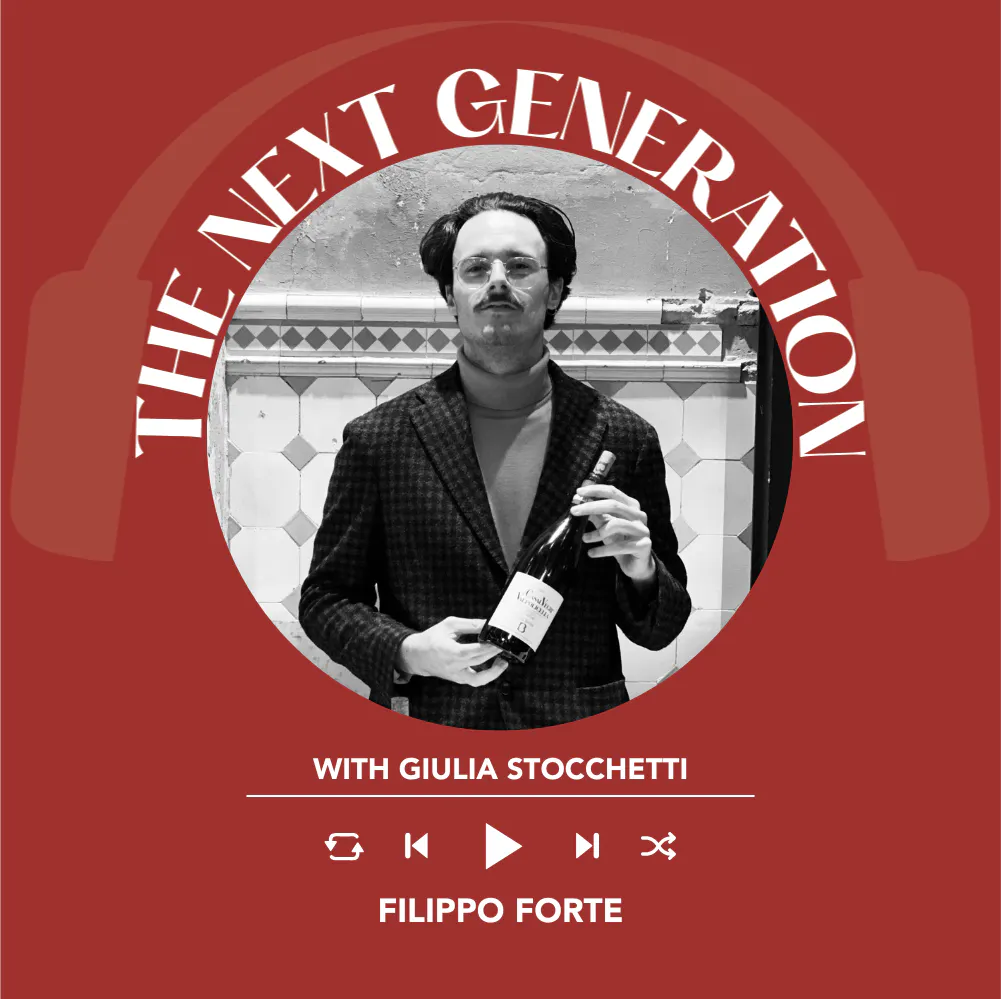
Ep. 2188 Giulia Stocchetti interviews Filippo Forte from Ca' La Bionda | The Next Generation
Ep. 2188 Giulia Stocchetti interviews Filippo Forte from Ca' La Bionda | The Next Generation
Episode Summary
Content Analysis Key Themes and Main Ideas 1. Filippo Managni's unconventional entry and growth in the wine industry, transitioning from cellar work to sales and export. 2. The operational model and philosophy of Calabionda, a family-run Valpolicella winery emphasizing freshness and drinkability. 3. The versatility and distinct expressions of Valpolicella wines, particularly the differences between fresh and dried grape approaches. 4. The significance of the FIIVI (Italian Federation of Independent Winegrowers) in supporting small to medium producers and ensuring traceability. 5. The evolving preferences of the younger wine consumer generation, focusing on authenticity, terroir, and local representation. 6. The importance of personal connection, honesty, and deep product knowledge in wine sales and promoting a winery. Summary In this episode of ""The Next Generation"" on the Italian Wine Podcast, host Julia Stochetti interviews Filippo Managni, a young professional from Calabionda winery. Filippo recounts his journey into the wine world, starting with a restaurant job in London and leading to his current dual role at Calabionda in Valpolicella. He explains how his hands-on experience in winemaking allows him to effectively represent and sell the wines, emphasizing the importance of honesty and deep product knowledge. Filippo describes Calabionda as a small, family-run winery producing around 120,000 bottles annually with a team of seven. He discusses the unique versatility of Valpolicella grapes, highlighting Calabionda's focus on fresh, drinkable wines as opposed to solely the more powerful Amarone. The conversation also delves into the value of being part of FIIVI (Italian Federation of Independent Winegrowers) for quality assurance and collective representation. Filippo touches on the growing curiosity among younger wine consumers for terroir-driven, authentic local wines and expresses the winery's open-door policy for visitors seeking to understand the story behind their wines. Takeaways * Filippo Managni's career exemplifies a new generation of wine professionals combining winemaking knowledge with sales and export. * Calabionda is a small, family-run Valpolicella winery that prioritizes freshness and drinkability in its wine production. * Valpolicella offers diverse wine styles, notably from fresh grapes (Valpolicella Classico, Superiore) and dried grapes (Amarone, Recioto). * The FIIVI (Italian Federation of Independent Winegrowers) label helps consumers identify wines from dedicated, independent growers. * Younger wine consumers are increasingly curious, informed, and seek wines that authentically represent their terroir and local culture. * Personal connection, transparency, and the ability to explain winemaking processes are crucial assets in modern wine sales. * Visiting wineries is encouraged as the best way to understand and appreciate the story and philosophy behind the wine. Notable Quotes * ""The people doesn't want just a normal sales because they are already full of that. They want someone that can answer to their question about winemaking."
About This Episode
Speaker 0, a chef and winemaker, discusses her love for the small cellar and family run winemaking business, as well as her desire to grow her family and share her learnings. She talks about the success of selling wines and the importance of finding the right wines for every day. She also discusses the success of Balipservice, a Italian wine from dried grapes, and the importance of being one thousand-plus producer and associate with a drink. They discuss the success of selling wines and the importance of being a good pairing partner. They also discuss the importance of being local and unique in the younger generation's desire to try local foods and wine. They suggest pairing with local typical dishes and being more representative of the area, and offer to organize a tasting appointment and a la tour. They also discuss their love for wines and want to share knowledge and passion for the wines and their desire to create their own wine.
Transcript
It's very interesting to for me to make both parts, so help when, they need, when making, help in every job in the cellar and also sometimes in the vineyard if the guys needs. It's important because when I go outside, when I go outside from Italy, the people doesn't want just a normal sales because they are already full of that. They want someone that can answer today or question about winemaking. The people is very curious about. And so I think that, my background of studies and also my background in the winery helped me to answer properly to all the people about, what we do, how we do. Welcome to the next generation. With me, your host, Julia Stochetti. Join me as I take you on a journey to discover young stars of the Italian food and wine world. Crandi and Yamu. Hello, and welcome back to a new episode on the next generation on the Italian win podcast. This is me, Julia. And today, I'm so excited to have here with me, from Calabio. I'm saying that because, literally, I've been chasing him for, like, one year now. So finally, we found the right moment to record this amazing interview. How are you today? Challenge Julia and hi to everybody. And, yeah, you're right. We need a lot of time to organize this interview, but, the time in the seller is always very busy. So we try to do our best. Today, I'm fine. Happy to be here. Nice. That's amazing because I know it. You're pretty busy with the winery with the seller. There's always something to do. So thank you so much for finding some times for us today. I would really love to get to know you a little better can you please introduce yourself and tell us a little bit about your background? Yes. So I'm quite new in the one word. We can say because I start my journey only in the two thousand sixteen after the high school because, I was, be confused on my my future work life. So I decided to take a flight to London, and I lived there for one year. And living there, I was looking for a job and I started working a restaurant in Notting Hill. The cool figure of that restaurant was The people working there, but most of all, they push me to know more about the wines we sell. We had more than two hundred labels. So I start to get involved into the wine in this way. I start to read about. I start to understand more about the label we sell. And then coming back to Italy, I decided for the university to join the one making curves in, the University of Verona in San Flora. And, I had an experience before of internship in Tuscany, and then I went, to Calabionda for my second internship in the harvest of nineteen. And in January twenty, I started my work with Calabionda. At the beginning, it was more in the seller, helping my colleague, Lulovico, and the owner, Alejandro, to make wise. But after we saw that we need someone that take more care of the commercial part, export in Italian, and so I'm doing from We can say three, four years. Mainly, this in the seller, obviously always helping the guys when they need in the winemaking because, our it's a small seller, and, this is what we need to. Everybody has to be able to do everything. When you say, like, small cellar, what do you mean? Like, how many bottles do you make a year and how many people actually work there? So, Calabioonda, the average production is about one hundred and twenty thousand bottles per year. We are just seven people there, the two owners, Alejandro and Nicolea, that are brothers, the Castellani. Nicolea has a a team of guys in vineyards that are Marco in Francisco and, some seasonal people that comes there to help them. And, Alessandro has, to work with him, me, my colleague, Luvico, and, his wife, Valentina, that takes care of the accountants. So formally, we are just seven people, three from the Castellani family, and for employee. And then, obviously, we have some seasonal people that help us for the harvest, and for some work outside individuals. So, basically, we can say that it's a family run business and working there, you actually become part of this family. Was wondering, but are you from Balpolicella or from where? Because how come you ended up at Calabianda? Formally, I am born in Verona, so I'm very near to Valpolicella. I'm from near the city center. I interned in Balicella. Studied there at the university. So, obviously, people from verona know very well the wives of the era, well, Priscilla because are pretty famous here. The fact is that in, eighteen, I made my first internship in Tuscany in, And in nineteen, I was writing my thesis for the university. I was just writing the lab proof were already made. So I had time. And, my colleague, my actual colleague, Blue Vico, that is also one of my best friend work there, and he told me, why don't you come here to make a a internship together so we can have some fun? And I said, why not? He was working there from six months. I said, I can do another internship just for my curiosity to see also different grapes because I work with San Jose in Montal Chilum, and we're we're curious to see our local grapes, how to work with those. So I said, okay. Let's join. We had two or three months together from September to November. With all the fun. And, also with, Elisandro Nikola, the homeowners, we create a very good relationship also outside the working hours. And, after they saw that they need one person more to increase the people working there, someone that, his focus like them, someone with patience. And I said, yes. Why not? We can start altogether. It can be a good journey. And after six years, because the first harvest was nineteen, and this is my sixth harvest that twenty four. We are still here altogether. So I think it's a good place to grow also for the work because I saw Nicole, I always say they have a deep passion in the wines and also they want to share what they learned in the time. With the a lot of our best altogether. So I think, they are a good teacher. We can save. And at the same time, we have a good relationship outside of the working hour. So I think this is the best way to go, I think, for a job for me. Yeah. That's awesome. When you enjoy what to do and you enjoy the people you're working with, I guess, it means basically almost like everything because we spend so much time every day at work. And better and it's nicer if you also enjoy. So I'm happy to hear that really, but I got two questions for you, or maybe actually three. Like, first of all, how old are you, Philip? Right now, I am twenty eight years old. And I'm going, twenty nine on the next table. So we can still push. Yeah. Always push. And second question, is it so different working with San Jose and with Corvina, London, the grape varieties native to Balpolicella? Yes. It's completely different because, we start from two very different, kind of grapes, by the level of ten inches, also of color. So the wine that comes from Montalcino, and the wines come from, Vailicella are very, very different. And, the most important thing is that, in Balpolicella, also the grapes, we see two different shades, the fresh grapes that are used for the Balicella wise, and the modern wines that are made from dried grapes. So the corvina, Corvino de la Molineara, change their expression between the fresh side on Balicella, and from the dry grapes for amoronendos or ricciotto because it's a sweet wine. So we start from different grapes Sangiovese and, Corvina, for example, but after Corvina has these two different expression, fresh and dry that, permits to the winemakers to have very different wines. This is the rich for me, the most important part of Alapulicello that from one single vineyard, you can make, Valpolice, El Paso, El Paso, Amarrone, and Rachoto. So a lot of different wines, and I think that our goal as well maker is has to be to make every wine different from the other to show to the people the difference of wines we can make, in this area that is something unique, I think, for the winemaking in Italy. Versatility is one of the things that come to my mind when I think about Balicella and it's grapes and it's wines because as you said, from just some varieties, you get so many different types of wines and So my question is, what's your favorite version? Like the fresh or the dried grapes? In my personal opinion, I prefer for daily use, the fresh side of the grapes because I think that developed martial law wise, still have a lot of, market available that they don't know because, us, Escalabjunga, Nicole and Alexander started this project in nineteen ninety eight, of working for the Balpolice, only with fresh grapes. And, when I was arrived in nineteen, I saw that all this work they made in the past is starting to giving right now in this moment good good good sellings because this fresh side of Balicella is something, quite new on the market. The people is more used to, when they think of Balicella, they think to the powerful side, even by the dried grapes, but we can say that the fresh grapes is still not so known to the people. About the dry side, what I like is that you can make, amarone and Racholletta to great wines, but obviously are two wines that you don't drink every day So if you think for wine for every day, I think the fresh grapes is something, very interesting for the one, pretty seldom. And then when you look for something special for some dinner, you know, for some particular menu, for wine pairing, you can go with the amarone that is, something very interesting because, with the sforzato, Baltellina, amarón Guachella are the two only, I think, the two only Italian wine from dried grapes, but dry. Not sweet. So this is something really interesting on the environment wise. Yeah. It's kind of unique. I was wondering how was moving from the seller to this sales. Well, I think it's really interesting, and also was a bit of challenging at the beginning because, I didn't study sales or commercial or marketing. I just made some course at university, but all the things that I know, I learned from Alessandro, my boss, and also from myself that I traveled a lot in my life. So I love to speak with people, and I think this is the base to make commercial mistakes because you have to be able to speak with everybody. It's very interesting to for me to make both parts, so help when, they need, when making, help in every job in the cellar and also sometimes in the vineyard if the guys needs. It's important because when I go outside, when I go outside from Italy, the people doesn't want just a normal sales because they are already full of that. They want someone that can answer to their question about winemaking. The people is very curious about, and so I think that, my background of studies and also my background in the winery helped me to answer properly to all the people about, what we do, how we do, because I know what the guys do. I know what I do in the seller, so it's very easy for me to answer to the people in, honestly, obviously, in this way. Yeah. Sounds about right. I mean, you've been lucky because you saw every single aspect of, wine world, I can say because you started from actually making wines. And then now you're on the other side, just selling wines and talking to people and spreading the Calabi on the words. So that's kind of a unique thing because most of the time, people start in the vineyard and they end up in the vineyard or on the sales side and they just do sales. But in your case, your experience is definitely much, much bigger. And, of course, helps you doing a great job day by day. That's it. Because you're on the sales side, let's say, I guess you take part into some events, right, to promote the wines and let people taste your wines. So I mean, Calabuna is among the Phoebe founders. Right? Yes. Alexander is one of the founder with other producer of the Phoebe. That is this, important Italian filtration of independent wing roller. Yeah. You just go back from Phoebe. Right? Yeah. Exactly. I was back from the market of Phoebe in Bolonia last weekend. Mhmm. That was a massive event, more than one thousand producer of wine we're there. And I think the Phoebe is a very good thing for the Italian wine market because permits, with a simple logo, the logo auto feed that you put on the bottle, you can put, on the cork in very different positions. But it's very important because the people who knows, fifi, they know that the wine they are going to buy is, made from one grower from in your home. That is the most important thing, to know because if you have to choose from three wines that you never heard about from a region. If you see the logo theory, you can think at least this is made from, one grower. After a taste, it's very personal because, all the wines are different, all the people are different, and my taste is different probably from your taste. So a wine that I like maybe you don't like, but this is taste and it's pure personal. But Phoebe, I think it's a good thing, because, permits for the people to recognize the Wengrover. And also it's very important for the Wengrover because you can associate altogether to make requests also in the parliament that is much more important to being one thousand producer than twenty. The thing I see in bologna is that all this producer that were nearby us, but also far from our both. You can create a link with the people. You can, associate, and also you can create friendship. That is the most important thing in our job because, when you need some tip, when you need something, you can always ask two other people that make your job, and you can trust them. So I think that TV has a lot of good things inside, and it's very important for the medium, small wine grower of Italy. Basically, what does the word Phoebe stand for? So Phoebe stand for Italian federation of independent wine grower. Okay. And how does the logo look like? Just for people that maybe haven't seen it before. So the logo of Phoebe, basically, has an a, mostly is a paint of, beer on that bring on his head, a basket full of, grapes. His shadow is a bottle of wine. It's simple, but, really impressive in the mind because, yeah, once you saw it, and you understand what does it mean, you always remember. I think it's, pretty easy to see this logo, and also all the producer that are associated have some, of this painting in the in the cellar like us also. I think all the wires that takes part to Vivia, some paintings in the cellar just to remind the people that this logo is very important. And that this logo means something. It's not just a logo, but it's a federation. So it's very important. So it's something that you really feel. I mean, if you're part of it, you're really believing what you're doing, and you're a really vigneron who actually works the land, delivering terroir wines with no makeup, I would say. Yeah. Exactly. It's a pure expression of terroir, but also the idea of the winemaker because they're out of winemaker in every federation. And, obviously, everyone has a different expression of wise, but I think that, yeah, you feel that you are part of something that, you are not alone in this work and also it's important for the people to understand that, the wine, that are still, artisan producer that, try to express something with their wines. Are there many wineries in Balpolicella that are part of Phoebe? Or it's just a few? A lot. I think, yeah, so, wineries that are part of Phoebe. The exact number, I don't know, but I think more than forty for sure. All the wineries that are Phoebe and the Nibal Preciate that are medium sports we can say. And, obviously, we know not everybody, but almost all the producer we know. Palpochelle is pretty small if you see it by the size, so you can easily know all the associate of Figio Pollichel. Except for Phoebe. What other kinds of events do you take part during the year to promote your wines? Do you sell most in Italy or abroad? We can say that, right now, Calabuyona, we sell around, sixty, seventy percent of our wines, in export market, and the rest, thirty, forty percent in Italy. Depends on the year. Obviously, every year is a bit different. In Italy, we take part, usually only to fear, the Phoebe and of in Italy. That is the most important, fair for us because it's where we can meet all our partner all around the world or our importance of wine and where we can taste the new vintage altogether, and then we make some little, portfolio tasting of our Italian distributor, and then, when we go outside of Italy, usually is, or me or or Alexander, the owner traveling, generally are two different kind of events or normal portfolio testing for, distributors, like, you know, all the winners go there for one or today to pour the wines to their customer and explain the wines. But also sometimes, we make, something more focused with, our partners outside, and maybe we can make, like, three, four, five days of, market visit, just us, Jessica Calabio, and, our agents in the different part, for example, this year, I made it in Sweden. The last year, in Belgium and Washington, DC. So we go there. We meet, all the agents. We go to meet their customer, to make testing with the customer. And I think, this is very important for the work because when the people, when the restaurant see you there, they see that you explain why is, you make, a very good work also for them to remember your wise after. Sounds like you really enjoy doing it. Right? I love this job because, it's a different shade, of, the one making, and, I like that Alessando gave me this opportunity also to travel for them to represent Calabi on the outside and also it gave me the opportunity to learn before how we do what we do, why we do these things. Wow. That's amazing, really. I mean, you're lucky because not everyone has a boss like Alessandro that actually helps you out. No. I always say that, Lisa Nikola are the lucky of Calabrio. Because, obviously, they are the boss, and we always follow them, but they also leave us free space to grow and to express our ideas. And this is why me and Ludovico, he's there from January nineteen, and they are from, officially from January twenty because before I was an internship, and also the guys outside, it's a lot of years. They are working with us. Be there all together. It's, a very good thing for us because, we are not just co worker, but we are also friends, and it's much better for the daily work to go in a place where you're happy at the end. Of course. And because we are on the next generation, I was wondering, is the younger generation of consumers part of your target, or are you still working on it or you think they're not really interested or they're crazy about your wines? I think that, our range of customer is, pretty wide and, obviously, the young people take part of that. We work mainly with restaurant, Wireshope, and also our partner outside of Italy. They make the same. So after at the restaurant, it's hard to know who drinks your wine, obviously. But, what I can see when I travel around is that there is a new generation of sommelier, young sommelier, that are really curious about wines, really curious about taste, new wise, new ideas, and I think that, Calabio, right now, is a really new idea in the world of the wine, because I suddenly call decided to point all on the freshness on the drinkability of the wine more than on the body that it's secondary for us. So I think that, yeah, Calabienda is, pretty popular between the young people, but because, these young people are curious about knowing us. So I think this is the most interesting things also at Phoebe. So a lot of young people come in there, tasting the wines because some producer tell them to try. Some some of you suggest them to try it's amazing to see that, a lot of people appreciate our work because, at the end, we work, to make the people happy because when you make wise, you're trying to make the best to make the people happy of enjoying your wines and to remember the situation where they drink your wines. Definitely, sir, you think basically the modern, younger consumer's expectations are all about, like, happiness of enjoying a good class of wine. Right? Yeah. And also to drink, we can say, why is that to represent a land? Because our wines, like, otherwise, obviously, but I talk about our wines because I know well, really representing the expression of the Maranovale in the class. And I think that, when someone with the young people travel a lot and when they go in a place. They want to eat local food, and they want to drink the local wines, the local beers, so they want to focus on what is local and unique in that era. And this is the lack here of Italy because every region you go, every city you go, probably you have a different wine from the other. So when the people travel to Italy as dyslucky, that they can taste, massive range of different wines. And I think that right now, the young want to try the wine that represent better that there are. So they read online. They ask maybe if they have friends that works in the wine business or their So I think that, the young people are really curious, but also informed about the wines. And I think that to be in that kind of market, you have to be also very representative of of your area. Because you were talking about food and wine. If you have to pick a wine of yours and pair it with a local typical dish. What would be your pairing? I think that, we can go on our classic gravazole. It is a single vineyard the marrone we produce. And, the quite easy pairing we can say is that, here in marona, it's pretty easy to find, bore, like, vennelong. This kind of a maroid that is completely dry without residual sugar, pairs very well with the vennison. So I think this could be one shade The other shade could be the Balpolicella superiore, our Casel bakery, the other crew that is completely opposite as the marrone because it's a wine made only from fresh grapes. And, in this case, it's a wine that goes out from thirteen to thirty five alco. So much more lighter by that alcohol taste. And so we can go with, very big range of plates, like in verona. It's pretty famous the result though because, we have this other Escada that is one of the biggest producer of rice. And so we can pair the Casa deli with a lot of local result, like, with Casa Salo, with, Radicchio, or Panklin also that are pretty famous in Marona. So two wise and two different, plates. Casa deli is more open to play also. To the pairing. When we go on the Amarangarab at all, I think we can stay more on the meat word, and, it would be very soon, but also it can be a good plate of me like, Brazarangarangarang. It is the easiest probably pairing, but always a good pairing. Alright. I guess that after your pairing recommendations, lots of people are, like, looking for flights or for trains or whatever to get to Verona to have a flight of all the delicious things we have here. So Yeah. Let's hope. Yeah. For sure. I was wondering if you have to pick a wine of yours that better fits the new generation palette What would it be and why? It could be too wise, that are different, but at the same time, they have the same idea. I like Philip because I ask for one, and he always has two. That's amazing. We can go, for example, on the Balicella classico. That is, probably the most, identity wise of our region because it's the PACE wine. And, from the PACE wine, a lot of people can understand how a winery works, and, all the young people starts usually to understand a seller from the baseline because this is the cheapest. So if you work properly and you express very well that there were. From a base wine, I think that after when you go up with the other wines, you just can increase your quality. I can talk for us. It's a wine that doesn't go in the food. So it just stays in stainless tank for five months. So it's the real expression of, the terroir and of the grapes, Corvina, Corvina, Romvina Molinaire. And to continue on this line, after Varcularicello, we can go on the Cazalevigri that I talked before, but because I think that two wines are in our idea really linked because the is a easy approach to our area. And after with the superior, we go with a wine that make an aging of eighteen months in Oak barrels. Big oak barrels only of three thousand liters and then the mousse six month in bottle. So you have also the evolution of the fresh grapes that is really important for me because, when you make a only from fresh grapes, but from a selected vineyard and without choosing any grapes to make maroona, but using only the best grapes to make this kind of wine, you have to fill the link between Balpulcella, the base, and Balpulcha Superivora. So this is why I think these two wise are very actual for the young people because they start from the Balpulicella classical and then they move on the Balpulicella class because they feel this link between the two eyes, And also, they see that, there is an idea of the war behind these two lines here. Yeah. And it sounds like there at Calabrio on the, you have basically all the shades of Valpolicella, let's say, because you start on the classical, like, the first wine. I don't like to call a wine, a base wine or entry level because I don't think it's a matter of quality, but as you said, it's a matter of winemaking and also, like, expressing, you know, the terrarium different ways. Yes. Exactly. So I think it's really worth it actually to come to visit you because you will still host people. Right? I mean, people can come to your winery for tasting. Yes. Yes. So we host, tasting every week, and we are always open to meats our customer and people that want to discover. Obviously, we are a few. So we have our way to make appointment, but, we never say no, I think, to someone, except on Sunday, because it's, the rest day also for us, we like to receive people because I think, the greatest experience, to understand the winery is to visit a winery. And, we also as a team, but also in the private. Life, all the team of Caribbean that we like to travel. We like to visit wineries. We like to understand more about wineries because, first of all, we love wines. And, if you love wines, you always discover something new every day, and you're always more curious. So, yeah, we know that we like to do this. So we like also to ask the people to try to answer to all their question and make a good tasting together. Yeah. To share knowledge and passion and, some Balpolicello, so with, people who are not really from the place and wanna know more. That's amazing. I wish I had time to come to visit YouTube. When you want, you can just, send me a message, and we can organize is very happy about. Sounds great. Thank you so much. Well, I have a bunch of questions actually to ask you, but we are running out of time. So the only thing I can say is, like, is there anything else you'd like to add before we wrap up the episode or any message you wanna send? I think that I talk a lot, so it's my problem. We can make like two hours of podcast and I won't suffer about because I talk a lot. I don't have any particular message just, that I think that the people that listen to your podcast and everybody, not only about carabionda, not only about but for each hell, but all around Italy. There are good ones everywhere. There are good people. Everywhere. And I think it's really interesting when you are into the wine business or wine patient also because we see also as a business, but a lot of people is only a patient, daily patient is to travel, to meet the people that makes the wise to understand why there are difference in the wise and not just, you know, judge the wise, but try to understand why something is made in the way he's made. Beautiful. So let's go behind the label. Yeah. Exactly. I think it's, always interesting the story of the people. The winemakers are all different, and, I can see from my boss of the sun they call the are very different in some things, but they have a lot of point on common about the quality of the products, and, this is what the like of the winemakers, different ideas, different places, but everybody has the goal to make a great wine, and the taste is very personalized as we said before. So maybe we drink ten bottles together, and, I like five and you are like the other five. So the taste is very personal. We can't judge a wine, what we can, but just in personal opinion. But we always, have to drink good wines that will I can because one is a pleasure. It's not in mandatory. So we have to be happy of spending our money and, be happy what we are drinking. I totally agree with you. That's awesome. Thank you so much, Filipo, and thank you so much everyone for listening, and don't miss the next episode next Sunday on the Italian Win podcast. Gracie for being with me today and listening to the next generation on the Italian Mind podcast. A la prosima changing.
Episode Details
Related Episodes

Ep. 2822 Ep. 20: California | Study Smart for your WSET Level 3
Episode 2822

Ep. 2789 ColleMassari: a long-term vision rooted in Montecucco with Giuseppe Di Gioia | On The Road With Stevie Kim
Episode 2789

Ep. 2788 Ep. 14: Austria and Hungary | Study Smart for your WSET Level 3
Episode 2788

Ep. 2785 From Volunteer to Speaker at TEXSOM with Samantha Cole Johnson | TEXSOM 2026
Episode 2785

Ep. 2766 Inside the U.S. Non-Alcoholic Wine Market: What Wineries Need to Know with Jill Sites | Masterclass US Wine Market
Episode 2766

Ep. 2761 Winemaking and Consulting Across Sicily with Alessandro Serughetti | Wine, Food & Travel with Marc Millon
Episode 2761