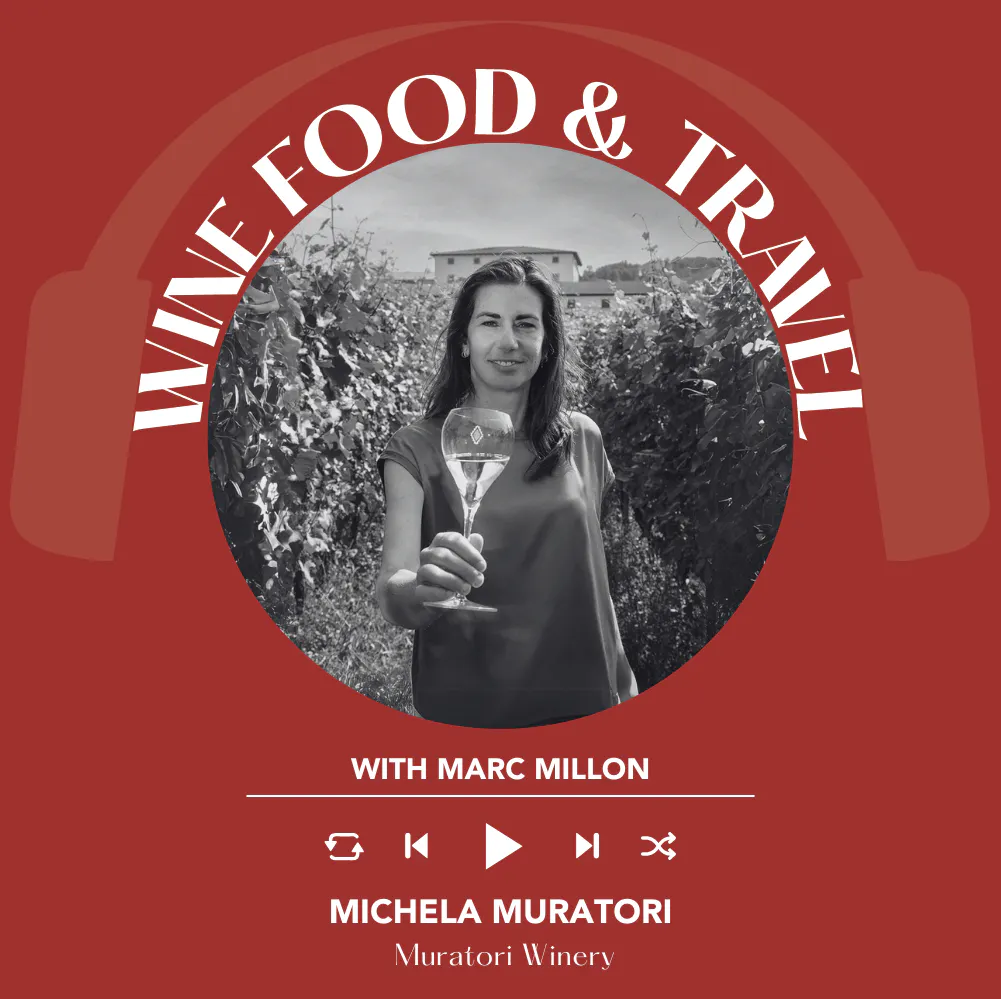
Ep. 2190 Michela Muratori of Muratori winery | Wine, Food & Travel with Marc Millon
Ep. 2190 Michela Muratori of Muratori winery | Wine, Food & Travel with Marc Millon
Episode Summary
Content Analysis Key Themes and Main Ideas 1. The unique identity and history of the Franciacorta wine region in Lombardy. 2. The Moratore Family Winery: its origins, philosophy, and commitment to Franciacorta. 3. The detailed process and specific characteristics of ""Metodo Franciacorta"" sparkling wine production. 4. The distinctive terroir of Franciacorta, particularly the *morenica* soil, and its influence on wine quality. 5. Exploration of different Franciacorta wine styles produced by Moratore (Brut, Satèn, Rosé, Pas Dosé, Riserva). 6. The gastronomic versatility of Franciacorta wines and their pairing with local cuisine. 7. Visitor experiences and tourism opportunities in the Franciacorta region and at Moratore Winery. Summary In this episode of the Italian Wine Podcast, host Mark Millen interviews Micaela Moratore of the Moratore Family Winery, located in the Franciacorta region of Lombardy. Micaela introduces Franciacorta as a leading area for high-quality classic method sparkling wines, emphasizing its relatively young but rapidly growing popularity since the 1960s. She shares the Moratore winery's unique history, established in 1999 by a family primarily involved in textile production, driven by a passion for wine. Micaela delves into the ""Metodo Franciacorta,"" highlighting its stringent disciplinary rules, such as the lengthy minimum aging periods on lees (e.g., 18 months for Brut), which are among the longest in the world. She explains how the region's distinctive *morenica* (glacial moraine) soil and varied microclimates across its six vocational units are crucial to the wines' character. The Moratore winery meticulous separates grapes based on vineyard location and pressing phases to craft their blends. The conversation explores various Moratore Franciacorta styles: their Brut, considered the winery's ""business card""; the unique Satèn (a Blanc de Blancs with lower pressure and finer bubbles, exclusive to Franciacorta); their complex Extra Brut Rosé; the transparent Pas Dosé (including their ""numero zero""); and the long-aged Riserva wines (60+ months on lees), which showcase the region's aging potential. Micaela stresses that Franciacorta wines, particularly theirs, embody balance, harmony, and a strong sense of place, making comparisons to other sparkling wines unnecessary. Lastly, Micaela discusses Franciacorta's role as a gastronomic sparkling wine, perfectly complementing the region's diverse cuisine, from freshwater lake fish like *sardina di Montisola* to traditional beef stews like *manzo all'olio*. She encourages listeners to visit the Moratore winery for tours of their impressive gravity-fed facility and tastings, emphasizing the importance of experiencing Franciacorta firsthand to understand its unique story and the dedication behind its celebrated wines. Takeaways * Franciacorta is a premier Italian region renowned for its high-quality classic method sparkling wines (""Metodo Franciacorta""). * The Moratore Family Winery, founded in 1999, transitioned from textiles to wine, focusing exclusively on Franciacorta production. * Franciacorta has a strict disciplinary code, with minimum aging periods on lees (e.g., 18 months for Brut) that are among the longest globally. * The region's unique *morenica* soil, a result of glacial activity, greatly influences the distinct character of Franciacorta wines. * Moratore cultivates 54 hectares across Franciacorta's six vocational units, carefully separating grapes and pressings to craft their blends. * Satèn is a distinctive Franciacorta style (Blanc de Blancs, lower effervescence) that is exclusive to the region. * Franciacorta wines are highly versatile, pairing excellently with a range of local gastronomic delights, from lake fish to traditional beef dishes. * Moratore produces a diverse portfolio including Brut, Satèn, Rosé (Extra Brut), Pas Dosé (including ""Numero Zero"" and ""Chisiolo""), and Riserva (aged 60+ months). * The Moratore winery offers guided tours of its 14,000 sq meter, gravity-fed facility, emphasizing the complex production process. * Franciacorta, despite its quality, produces a smaller volume compared to larger regions, making it a ""hidden gem"" often consumed domestically in Italy. Notable Quotes * ""Franciacorta is, of course, one of Italy's premier areas for the production of classic methods, sparkling wines."" - Mark Millen * ""We really believe that a strong personality of our grapes, of our wines, give us the chance to produce wines that are completely different from any other kind of sparkling in the world."" - Micaela Moratore * ""For a certain, you can just, find it in front of the top."" - Micaela Moratore (referring to Satèn) * ""Franciacorta has a very wide opportunity of our restaurants... they are very different, and they move from the lake fish to the traditional, cooker beef, of the area."" - Micaela Moratore * ""Franciacorta doesn't need to be compared to anywhere else. And the sparkling wines don't need to be compared against other wines. They're unique. The region is unique."" - Mark Millen Related Topics or Follow-up Questions 1. How has the Franciacorta consortium contributed to establishing and maintaining the region's strict quality standards? 2. What are the specific viticultural challenges posed by the *morenica* soil, and how do producers manage them? 3. Beyond the mentioned dishes, what are some lesser-known traditional Franciacorta recipes that pair surprisingly well with its sparkling wines? 4. What sustainable and environmental practices are being adopted by wineries in Franciacorta to address climate change impacts? 5. How do the different specific aging requirements for Brut, Satèn, Rosé, and Riserva impact the overall flavor profiles of Franciacorta wines? 6. Given the family's background in textiles, what lessons or business philosophies from that industry were applied to the winemaking venture?
About This Episode
The speakers discuss their interest in creating a more famous and globally recognized French wines in Francacorta, where they have 50]] of vineyards planted with the grapes, the permitted grapes for the consortium, chardonnay, pinot narrow, and pinot Bianco. They are focused on creating a wine area that is very popular in the area and separating different phases of the pressing to have a very, very different types of wines before and after. They are also interested in creating a unique and unique experience for their customers. They discuss their approach to the production of wine, including their experience with Saten, their desire to share their own story with listeners, and their unique approach to the French wine. They also discuss their history of collaborating with other winemakers and their unique approach to the French wine. They recommend visiting the winery and have a guided tour, and express their interest in visiting the region and visiting the winery.
Transcript
Tell us a little bit about Francacorta, your wines, and the gastronomy. Yeah. Francacorta has a very wide, opportunity of our restaurants, actually, as you were saying, they are very different, and they move from the lakefish to the traditional, cooker beef, of the area. Fascinating people with stories to share. Fabulous wines and the best local foods to accompany them and beautiful places to discover and visit. All of this and more on wine food and travel with me, Mark Millen, on the Italian wine podcast. Join me for a new episode every Tuesday. Welcome to wine food and travel with me, Mark Millen, on Italian wine podcast. Today, we travel to Lombardi to the beautiful wine region of Franca Corta to meet my guest Miquela Moratore of the Moratore Family winery in the Maureen wine hills near Erbousco. French Corta is, of course, one of Italy's premier areas for the production of classic methods, sparkling wines, and I'm looking forward to a sparkling conversation with Mikaela. Welcome, and thank you so much for being my guest today. How are you? And is it a beautiful day in Franca Court? Thank you, Mark, and thank you for this opportunity. Yes. Today is a now it's sunny. It's a sun that just appeared in the sky. It's very cold, but, the sun of the last year is very warm. So I think the day will be hotter. Okay. Well, I'm imagining that beautiful sun, but I think our listeners who are located all around the world. Some of them, perhaps many of them may not know the Franca Corta region, may not know this beautiful, this beautiful lake that Francha Corta is located below one of the great lakes of Italy. Can you describe your region? Describe your wine area. Describe Franca Corta so that our listeners can gain a vivid idea of a beautiful land. Yeah. Franacotta is actually, I don't wanna say we are a younger region, but, we manage to become, very popular in Italy, mainly. For the sparkling wine, we've, say, confirmational impactor. So this is called, made to the classical that we like to call made to the Francacorta. It means that this area, is, is very popular now. But, we didn't have a so long history up to nine. Now, French Corta is located in Lombardy, as you said, between Milan and Venice. And, we are close. Our vineyards are close to the Lake Isao. Lake Isao is very important for the climate of this area. And in the in the past seventy years, this area manager to become a very, synonym of high quality sparkling. We as a family, are a family winery that starts in nineteen ninety nine focusing on the production of just sparkling. My family winery brings the name of brings our family name. They we are called Muratore. And we are in Adro. Adro is, is considered to be the heart of Franca Corta close to the, what you made, the other village you mentioned, that is, Erpusco, that is the, the the site of the where the consortia of Francacorta is located. And, as a family, we have always believed in Francacorta. And, that means for us, the area and the name of the wine and the method of production. And I I really believe this area is very popular now because, all the area has always been focused on this specific wine, and, everybody focus on the specific production of this, of this wine. Continuing this story of your family. Muratore is about twenty five years old now. Is that right? Did you say nineteen ninety nine? What was the family doing before you went into wine? And I like that you say that every story starts with an idea. So what was the motoratory idea, or was it a dream when all of this began? Actually, as we are, I'm a deterioration of our, winery. And, what was my grandfather before and what are now still. We are textile producers. So we trade the cotton yarn. And, so we are at the same time, winemakers and in another business. The passion for wine has always been huge in my family, but, we concretize this project in nineteen ninety nine. We are with the idea of focusing of the of the French Accord production. This area is very this phenomena is very popular in this area. Because, to produce this wine, we need at least three years. So we need, investments from, a different sector. And it, this is what happened to us. Okay. That's interesting because I know, Lombardi as a region, and your area as well has has been very famous for textiles. A lot of very well known businesses and famous, names, come from textiles produced in Lombardi. But really this passion for wine is another element of the family activity. You have fifty four hectares of vineyards planted with the the grapes, the permitted grapes for Franca Corta, chardonnay, pinot narrow, and pinot Bianco. But I'm interested that, they're located in each of the six, and because Frenchicorta has such an incredible range of soils and terroir. I guess this land was scoured by the glacier as it retreated leaving behind this varied terrain. We talked briefly about the vineyards and about the grapes and what the maybe a little bit about how the terrain varies and how that contributes qualities to the wines when you're blending the couvet to make your sparkling wines. Yeah. One of our, particular, something that, make us different is exactly what you said. The the idea of have, of having vineyards in each one of the six vocational units that, unit that is this, environmental and ergonomic research carried out, by the consortium, in collaboration with the University of Milan. And, these six, micro landscape, as we call it them. Are very, very different. And we have the chance to have grades coming from these very, very different areas. And they are different because of the microclimate because of the soil, because of this position to the sun, the wind. And, if you are curious about this, on the website of the consortium from Chorus, these six microiaras are very well explained. And from this study, we we understood that, the different grapes growing up in different on different soils, give different sense. Not just on the grapes, but even in the glass. And so our idea has always been to keep separating the grapes coming from the six different landscapes. To have our, different wines to design our COVID. We are very much focused on the separation, to produce the kind of wine is fundamental to have very, very different wines before, they covet up that, bring to the Tirage to the battling. So the separation is multiple, and it's, different from the vineyards where the grape come from. We have, twenty three vineyards. The separation is from the vocational unit, but fundamental is the separation of the, pressing. We separate the different phases of the pressing to have a very, very different, juices before and then once. Okay. That's That's really interesting. I want to just clarify this for our listeners. The fact that Franca Corta, first of all, as you mentioned, Mikaela, is a relatively new, wine region. The the production of sparkling, classic method sparkling wines began, first in the nineteen sixties and then as intensified in the decades since since then. But we're talking about a historic land where grapes have been grown, but for the production of quality. And I'm talking of about quality wines, that reach the highest levels. It is a relatively new wine region, but like in Champagne, which we always compare great sparkling wines to champagne. Like in champagne, the great houses, the famous names, have vineyards located in the three different, of champagne. And exactly doing what you're talking about, Mikaela, having grapes with different qualities and characteristics to make wines that can be carefully vinified separately in order to then blend them together. Into the couve to get the house style. I guess that's how you create year after year, the Moratore style of Francacorta. Is that right? It's this importance of small vinnifications, and then a lot of tasting to get the blend right before you begin the process of secondary fermentation. Yeah. Correct. The the tasting are multiple. And, very, very important. And we end up we actually we produce nine French a quarter, but, by the end of the year, we end up to having the winery, one hundred wines. That that help us to do our multiple testing and to design our COVID. You're different couvets. Okay. Well, McKenna, now, we're talking about classic method sparkling wine. You actually called it the Matoro Franca Corta. Can you explain to our listeners, what this is? And also, let's consider as well what makes Franca Corta unique because classic methods sparkling wines are made elsewhere in Italy and elsewhere in the world, but Francacorta has a very strong personality. It's the one I really love. Yeah. So can you explain the method and also something about what makes Francacorta so special? Yeah. We the method has two fermentation. So it means that when the grapes arrive into the winery, we keep them separated and, we we bring them into the wine to make this the first alcoholic fermentation start. That is the one typical of each steel line. And, after the first alcoholic cementation, we, we do our, as was, we were saying, our Kuvet is designed, and we do the bottling that is called the Tirage. And the first bottling has, a cork is is not a cork. It's a cap that is isolated as a metal cap. And, we before the the first battling, we add select selected this, and we add more sugar in what is called Lushiro podidiraju. That is a kind of liquor that we add to make the second alcoholic fermentation start. After this battling, the bottle remain on the on the lease for a minimum of eighteen months for the brutal. They are twenty four for the Jose and the certain. Thirty six for the Melissa May and sixty for the reserva. And these are the minimum, months, that the consortium of Francacorta ask for these typology wines. And as a consortium, we we decided to give us the strictest, the disciplinary in the world as the eighteen months for the brutal is the longest time for a this kind of method, to have in the world. And, I like we like as a producer to call it, made to the French court as you were saying, because, actually, it is, we produce this kind of sparkling with our grapes, with the grapes of Franca Corta. And we really believe that a strong personality of our grapes, of our wines, give us the chance to produce wines that are completely different from any other kind of sparkling in the water. So there's no need of comparison. There's no need of something of proposing something different. We propose our, our landscape. They express a potential of our, of this land. We are French, of course, people. And do we like to talk about the front of hotel? Absolutely. And that's a very, very good description, saying that although the classic grape varieties, the principal grape variety, chardonnay, as well as Pino Nero, and Pino Bianco, But Chardonnay and pinot noir, pinot narrow are similar, to the principal grape varieties in Champagne and elsewhere grown on the marine soil. These grape varieties grown on the Marine soil of Franca Cortor gives a wine with its own personality completely and added to that is the lengthy aging discipline that the consortium of Franca Corta imposes on all producers to have this lengthy bottle aging on the knees to add character and personality to the wines. Yeah. Demorinica is very as you were saying, is this fundamental element of this, area of this land. You can really we have in our winery, different places where we we brought the soils from this six different areas. And then for people coming, in French, of course, having the chance to see the difference between the more any carrier with very strong huge stones very roundy, because they are, make it like that by the glass here, is very, very, is a huge perception of what, wherein it means, from the visual point of view, and then the idea of, understanding it in the glass. Yes. Absolutely. And and and as well, the the the proximity of this beautiful lake, a lake that's not so well known to foreign visitors perhaps in some of the great lakes of Italy, but one of the largest lakes in a in a very beautiful lake to visit and indeed to holiday around. I've been to, to your area and enjoyed it very much. Yeah. Lake is very much more, less tour touristic place compared to to add our more popular links closer. I wonder why that is because it's so beautiful. Is it that mainly people from Lombardi visit and maybe from Milan and They keep the secret to yourselves. If we are wider. Yes. So let's talk about some of them. You you produce nine wines, but I don't think we have time to talk about them all, but I'd still would like to give our listeners a clear idea of of some of your ones, perhaps a moreitory brute, the satin, which I think is a style of wine that many of our listeners would enjoy. And and and and then the rosier and the the vintage or perhaps, let's just talk about some of the styles of wine that you produce. Yeah. We are very focused on our route because we believe that, is something very that has to be extremely representative for us because, we are we it's the the wine that, our clients, people that drink our wines, drink most because it's the the bigger production. So we every year, we try to be put every we are much more attention on the conveyor of the brute. Because normally it's considered to be the simplest line of the of the winery. But for us, it is our business card because it has to be extremely representative, extremely us as a family. And, so we are, we are very, very proud of our group because, it's a very brute brute doesn't mean necessary just drinkability. But, the opportunity to, taste our land in a very fresh way. We are very focused on, one main feature in all our French culture that is, the balance. The balance and the harmony in all the components. So in the acidity, in the in the freshness, the bubbles, everything is to be very, in a balance that has to be perfect in every way. In the way, in a way that you drink being, it's a blunder blanco or a brand denmark that you, but you say, we produce. But for the brew, we we believe that, a person has to drink the winery when taste our brews. So we are very, very and much putting a lot of attention in the in the production in the in the in thinking about the COVID of our root. And actually, we are very happy. Something that's changed that they didn't say in our winery is that from ARvest two thousand twenty, we had starting the collaboration of a important winemaker that is Ricardo Cortrella. And he and his team help us in, thinking about, how, a wine has to be very, very focused on the soil on the on the landscape. Where it come from because it's something that give the difference to a wine. Yes. Of course. And Ricardo, brings great expertise from his experiences across Italy, one of the great winemakers, actually. And, for us, has been a very important, part of our history. We now we have, twenty four ARvest and, background. In our history, but, coming the the meeting with him and his team, help us in and not just in the technical way, but in the vision way, the humanity point of view, because, wine has to tell a lot about us. We are people as a lombardy people. We are normally very I mean, we are I don't wanna say we are called people, but we are very focused on our ideas on our, day by day work in the vineyards, in winery, in the other company we have. But, We try to be more, focused on telling about us because actually, we now in Muratore, Francacorta, we we want to tell our Francesorta because it's different courses that come from our vineyards that I have, twenty four years old, cultivated by us. We have our philosophy, we have our way of producing wine. So it's correct to tell about it, today. To the to people that drink our frontal culture. We like our frontal culture because we believe, represent us in a very specific and false way. And, we hope people that drink our friends of course are like them too. Yes. I'm you're you're absolutely right to focus on your personal story and what you bring to the wines and and so that people can really appreciate what is unique. About the wines. Tell us about Saten. Yes. Saten is a kind is, actually, is something unique for for Franca Corta because asking for a Satenis that you ask for a Franca Corta is, something is a trade marker by consortium Frances Corta. It has to be a blunder blanc. So mainly, white grapes and, this specific fetchure is that, it has a lower pressure in battle because we add less sugar for the second fermentation. So there is less pressure in battle. And so the main feature is that it has to be softener. Babola has to be thinner and more delicate. And this kind of specific types typology that, has to present over this element of, finesse and elegance. It's very good with specific pairing, determinedly, not with a stronger taste, but with, delicate taste, like fish, not so savory fish, but, or other peritiv, are very good. Compared to a brood has a for me, satin has to be more personality and has to tell, again, a lot more about frontal court, because, you can ask a brute, an extra brute, a, at every latitude of the word from, in UK to South Africa. But for a certain, you can just, find it in front of the top. That's a that's a very good, point to make, Meekannon. I'd like our listeners to to really be aware of that. When you come across a sat ten, It's a wine that is unique to Franca Corte. It's a wine that one should try. This more gentle, delicate, elegant, style of sparkling wine, not quite so much pressure. Blonde de blanc, really beautiful style that I think, must be a very successful wine because it is so unique to Francacorta and its story. What are the wines, should we discuss Mikala? Should we mention the, the Rosay, and then perhaps your, your reserve or the wine that undergoes sixty months of aging. Rose, for sure. Rose, I think it's, from the point from our from the winemaking point of view is one of the more complex, French of course, to produce because here, Jose, you have your our beloved pin on wire. And, to make a very well balanced, Rose, it's very important to give attention to all the phases. So the pressing. And, so our Jose is an extra brutal. So it was it's a rosette that mainly tell about pinot mark. Going it's a expression of, body and, complexity, but has also is also balanced by the savory taste and by the freshness. We are happy about our Jose because he's a very balanced extra brute frontal quarter. And we like the color. We like, on your skin color. So we don't, we are not in the in the mood. We are not in the the frontal quarter. Our French of Jose is is very delicate and we like it because, in this sense, we preserve the aromas of the pinot noir more in the in the mouth than in the, look. It's what we like to say. The extra brute. Now, extra brute, of course, has even less dosage than a brute. What are the sugar levels for extra brute and brute? In French quarter, you in a broo for a brutal, you can arrive. We can start from zero till twelve. Extra router has to be, not more than four ground liters. Not more than four. So we're talking about a very, very, dry, sparkling wine. And you also make, of course, the the padosage, the padosse. Yeah. And those engines, yeah, those engines did zero. For us. It means it's something that we start producing, since the beginning, because for us means the more, clearer way to tell about the grapes. Because in the the gorging phase, we add the the same wine. So we don't add the liquor at all. It's something that some it's normally called is in a sense that we don't use a liquor at all for the filling of the bottle. But, we are the same one. So it means that a very transparent way of tell about our, our soil in our grip. That's why we are very focused on the padauzi since the beginning. We produced two padauzi. One is called numero zero, and that means number zero because it's the four was the first Frenchacorta we produce in our first early on the market in two thousand two at Vin Italy. And the other padousa is a Chisiolo that is a Blonde Moire padousa. To, that, tell about our story that since the beginning has always been focused on the vineyards on telling about the soils and our differences. Okay. That's very, very interesting. Then let's finally, just touch on the reserve. Yeah. Reserve is, quite a, different products because if you think that, they are a minimum of a sixty months on this but we have two reserve, but one is a two thousand fourteen and one is a two thousand two thousand sixteen. So they are very, very more than sixty months on the on the lease. They are more on the, feature of, tell about a frontal quarter that is very in its, warm, feature. Because, here in this reserve, you perceive very much more the grape, the Jewish, together with the the flavor of the lease of the Easter. In a complexity that is a good, well balanced, we we believe, or with the acidity. Of the, of the activity. We produce two reserva. One is a blend and guar padousa, and one is a root. The blend and guar padousa is called the reservea de gelsso. And the blunder Black Brutbrute is reserve immediately. And, the this reserve hotel, how French Acura baseline give their best on the on the list. Because they get in, in a balance. Okay. That's very interesting as well. This capacity of French, Corta, to, have evolve over lengthy, lengthy periods. Sixty months, or beyond, as you say, well beyond on the leaves. So this is before, the de Gorgement, so the yeast cells that are a byproduct of secondary fermentation after the the the yeast eats the sugar, of the byproduct is the leaves that fall into the bottle. And aging on the leaves adds this tertiary flavors and aromas and complexity that you're talking about. So, again, I urge our listeners to look out for for French accorta wines, for motor tory reserva wines that can offer this this freshness combined with complexity. Me Mikaela, one of the interesting, things I find with Franca Corta. And then again, that makes it a unique sparkling wine is that it's very much a gastronomic sparkling wine. We sometimes think of sparkling wines as wines to have as an aperitivo as an aperitif wine. The French of Corta, has body and finesse and elegance that enables it to pair very well with foods. Can we talk about food in the region in Francacorta? I know you have, restaurants that range from simple Osterie to, a real, fine, temples of gastronomy serving beautiful foods. But tell us a little bit about French Acorta, your wines, and the gastronomy. Yeah. Francacorta has a very wide, opportunity for us around, actually, as you were saying, they are very different, and they move from the lakefish to the traditional, cooker beef, of the area. French Corta is a very challenging in a sense that, it's very, very hard to find a bearing that is it's a disaster. I mean, It's very, very thick. It's it's fresh and freshness. Allow it to be paired with a corregone alferno that is a typical lake fish, or, to a manzo loyo that is the beef cook in the in the wine for long hours of a roberto villager. So the difference of the opportunity for the for wine and food pairing in in this area are very huge. And as in this area, we are, used to drink a French a quarter from the start, from the very team moving to the first course to the second So we never change, for different wines. We are is it kind of perversion? A very nice nice perversion. Yes. What with the that's interesting. With, with the beef, the traditional beef of the area. Again, you would you would be drinking perhaps, a rose with that or a blonde de noir, or a more quinoa noir dominated just to have that bigger structure. I would say more, I would say, more, I mean, the blend and wire pinot noir. I love it to pair it with with, maybe we've grilled, beef. Okay. Yes, please. Not with the amount of loyalty. Is this a kind of, beef that has to be cooked for long hours? So it's very, a huge of flavor. So I would choose a reserve because of the complexity of the wine that could be at the same time with the food. Yes. In a in other wines and our French of Corta, there is more freshness compared to, the complex city of our very server. Okay. One one food that I remember was very unique to, to your area. It's a sardini de Montezola. There's very strongly flavored lake fish that is air dried. Is it salted or just air dried? Hang placed outside for the wind to help dry the fish. Very, very strong, many months. And I found that actually, a frontal Cort de brute is such a beautiful pairing with this strong flavor because it helps to sort of cut the flavor and, clean it. Yeah. Is that something you would eat occasionally? Yeah. With polenta. With polenta. Okay. Yeah. Because polenta is I mean, can be if you Sabinia is very strong in flavor because it's very salty, but it's normally not so big. And you have a big, slide of polenta that has a very neutral taste. And together, it can be paired with a fruit. Our sardinia, sardinia is very strong and flavorful, but this way of, presenting it, tell about this talk, the traditional way of, driving it on this net, left on the open air in the in this very typical of Montezula that is, the island, on the lake that we have on our lake. A really beautiful island. Again, somewhere I would recommend our visitors, our listeners, try to visit Now, you've given such a good picture, Francacorte, and you made a very important point at the beginning of our conversation that Francacorte doesn't need to be compared to anywhere else. And the sparkling wines don't need to be compared against other wines. They're unique. The region is unique, and you've given us a very good, imagined vision of what makes it unique from the marine soil to the the care and the vineyards to the styles of wine and now also to the cuisine, this unique cuisine that combines the fish from the lake, but also land traditions. So I think really for our visitors to really understand Francacorta because there isn't a huge amount produced, which is I think why the Italians drink most of it. You keep it to yourselves more, and we we don't see it as often as we should. I think the best way is to visit the region as always in Italy. What opportunities do you at Muratori have for our listeners to visit? Yeah. We we have, we are opened for the tour into the winery. And we normally we can visitors can book it on our website. And there is a guided tour into our winery. This is a that is a quite huge winery. The the winery is fourteen thousand meter square meters, and it goes in deep till, twelve meters. Because, it used gravity for removing the Jewish and and in the first phase. So it's very interesting to visit the winery because, it helped us to really understand this method of production. It is very complex way of producing a wine. You can arrive, have a quick tour, quick or not. It depends on you on the vineyards, and then have a tour in the winery. And by the end of the of the tour that it lasts normally, one hour, you we normally have a tasting of two different frontal courses. One is the root and one is our, padauzi. And therefore, understanding this area, this region, the visiting the winery is very, very important because, it help you to understand what producing this kind of wine means that the, the effort, the attention of every detail is, is given. I mean, this frontal Corta is quite small. You were talking about, the fact that we are not so known abroad. Actually, Francacotta is very small, compared to other bigger in the world. And, I travel is, it's many years. I work here for my family while winery. I mean, I'm the oldest of the third generation. So it's I travel a lot in US telling about, frontal Corta, but it's something that people love because they love the wines. But, they don't know. So the effort is to tell about this area more than before than telling about, the single binary. And as an area, we are very, very focused. On it because, we believe the importance of, telling all the, all the, all the group of wineries that are our, that make us as big in, in Italy, and, I'm sure in the world in many, not so many parts of the world, but in very, in the most, very curious and attentive restaurant by Sam Sommelier that are, very up, up to date with last tendencies and trends. And where, our friend, where you find frontal Corta, is a it's a good way to understand about it, even if it's very hard to find it. You're right? Yes. Absolutely. Well, you've certainly explained and taken us to Francacorta this morning, Mikaela. It's been a fabulous conversation with you. So thank you very much for being our guest. Thank you. And I hope our listeners will make their way to Franca Corta or and when they see a bottle of Muratore, wherever they may be, that they'll buy it and taste it. So Thank you very much. Thank you, and I'm waiting for you in France. Oh, I look forward to that too. We hope today's episode of wine, food, and travel with me, Mark Millen, on the Italian wine podcast, has transported you to somewhere special. Please remember to like, share, and subscribe wherever you get your pods. Likewise, you can visit us at italian wine podcast dot com. Until next time, Chincin.