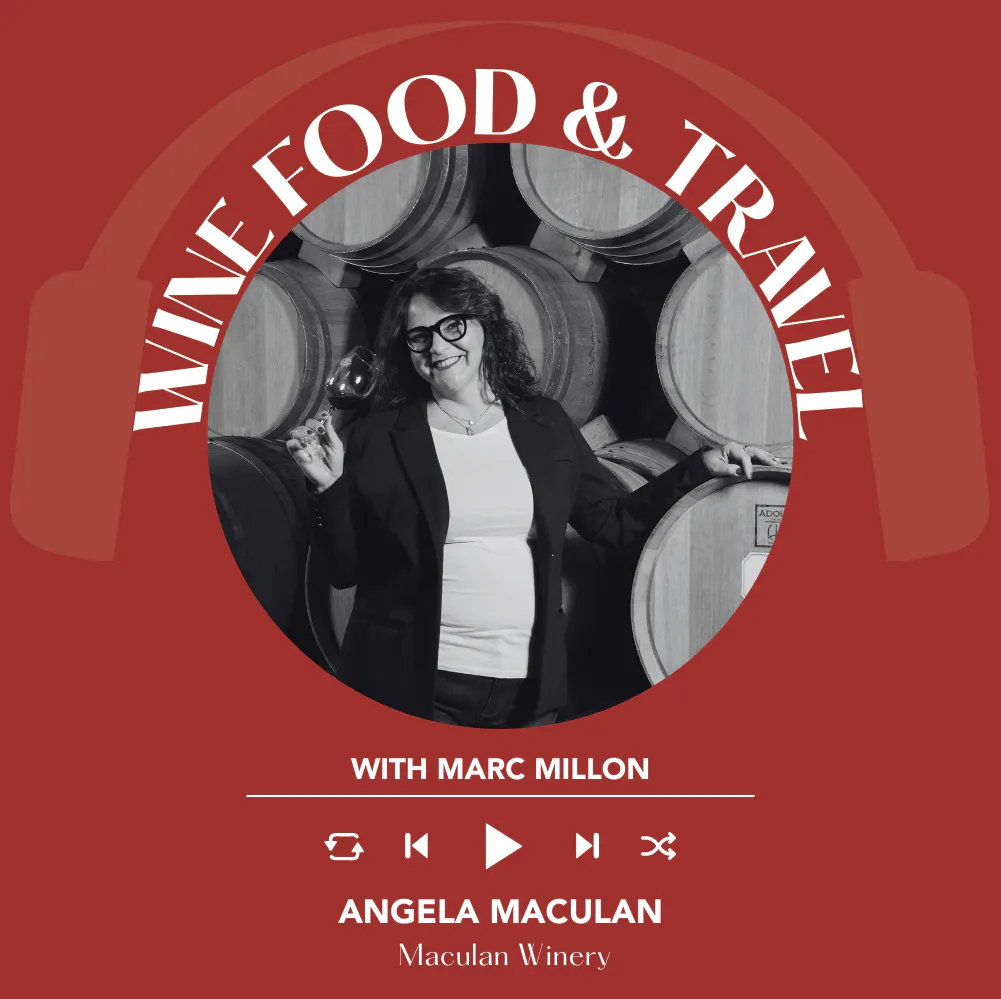
Ep. 2197 Angela Maculan of Maculan Winery | Wine, Food & Travel with Marc Millon
Ep. 2197 Angela Maculan of Maculan Winery | Wine, Food & Travel with Marc Millon
Episode Summary
Content Analysis Key Themes and Main Ideas 1. The multi-generational history and evolution of Maculan winery in Veneto, Italy. 2. The pioneering role of Fausto Maculan in the Italian wine renaissance, focusing on quality and innovation (e.g., high-density planting). 3. The unique terroir of Braganze, Vicenza, characterized by volcanic soils and protected climate. 4. The significance of indigenous grape varieties, particularly Vespayola, unique to the region. 5. The historical presence and stylistic approach to ""international"" grape varieties in Veneto. 6. The deep connection between Maculan wines and the rich local gastronomy of the Veneto region. 7. The iconic status and traditional production methods of Torcolato passito wine. Summary In this episode of the Italian Wine Podcast, host Mark Millen interviews Angela Maculan, a representative of the historic Maculan winery in Braganze, Vicenza, Veneto. Angela traces the winery's history from her great-grandfather's osteria and her grandfather Giovanni's bulk wine production, to her father Fausto's transformative vision in the 1970s. Fausto is highlighted as a pioneer of quality Italian wine, introducing high-density planting (10,000 vines/hectare) and advanced winemaking techniques. Angela describes the region's unique volcanic soils, its protection by mountains, and its historical ties to both indigenous grapes like Vespayola (used for dry wines and the famous Torcolato passito) and ""international"" varieties like Cabernet Sauvignon, Merlot, and Chardonnay, which have been present in Veneto since the Napoleonic era. She discusses specific wines such as the Valvolpara Vespayolo, Ferata Chardonnay, and the flagship red blend Frata, emphasizing their quality and connection to the terroir. The conversation also delves into the rich local gastronomy, with Angela sharing traditional pairings for their wines, including Baccalà alla Vicentina with Vespayola, Bassano white asparagus, and Torezani (local pigeon) with red blends. The episode concludes with an invitation for listeners to visit the historic Maculan winery. Takeaways * Maculan winery has a rich, multi-generational history, evolving from local bulk wine production to a focus on high-quality, terroir-driven wines. * Fausto Maculan, Angela's father, was a significant pioneer in the post-war Italian wine renaissance, championing quality standards and innovative viticultural practices like high-density planting in the 1970s and 80s. * The Braganze area in Veneto possesses a distinct terroir with volcanic soils, offering ideal conditions for viticulture. * Vespayola is a unique indigenous white grape variety found exclusively in Braganze, used for both dry wines and the renowned sweet passito, Torcolato. * ""International"" grape varieties like Cabernet Sauvignon, Merlot, and Chardonnay have a surprisingly long history in Veneto, dating back over 150 years (since Napoleon), making them almost ""native"" to the region's viticulture. * Torcolato is an iconic Italian dessert wine made from dried Vespayola grapes, with a traditional drying method involving ""braiding"" clusters of grapes on ropes. * The strong connection between wine and local cuisine is emphasized, with specific pairings for traditional Veneto dishes like Baccalà, white asparagus, and Torezani. * Maculan winery is open for visits by reservation, offering insights into their production and history. Notable Quotes * ""My dad's first harvest as a winemaker was nineteen seventy three."
About This Episode
The speakers discuss their experience visiting winery wines, including their grandfather's success as a winemaker and their current success as a wine-winery. They also discuss the history of Italian wine, including their success as a winemaker and the creation of a new wine industry. They also talk about their approach to growing grapes, their love for the fruit and their use of unique equipment for vineyards. They also discuss their love for the fruit and their favorite red wines, including the Baccola and Torcolato wines. They provide helpful information on their dishes and their historic and historical dish, including the Baccola and T o r e.
Transcript
The wine I recall tasting in the winery in a vertical tasting was the Frata. Frata, I'm always you just mentioned three wines that are all my favorite of our of our production. Cratha is again the name of the vineyard area. The first vintage of that wine was nineteen seventy seven. Fascinating people with stories to share. Fabulous wines and the best local foods to accompany them. And beautiful places to discover and visit. All of this and more on wine food and travel with me, Mark Millen, on the Italian wine podcast. Join me for a new episode every Tuesday. Welcome to wine food and travel with me, Mark Millen, on Italian wine podcast. Today, we traveled to the Veneto, to the province of Vicenza, to meet my guest, Angela Maculan, and to visit her well known and iconic family, Maculan winery, located in the historic center of Braganze, which is itself an ancient wine growing area. Buongiorno Angela, thanks so much for being my guest today. How are you? I'm great. Thank you. Thanks for having me. Thanks for being with us. It is a beautiful day in Braganze. It's a kind of a beautiful day. We are lucky we are on the hills. So we never really get fog, like, sometimes it can happen in the north of Italy. It's not super sunny, but it's, the winter has arrived. So this morning was everything was, frozen. It was white. It was quite impressive. Oh, okay. With the frost. Yes. Okay. Well, following on from that description, why don't you give our listeners who are located all around the world? A description of where you are, Braganssen of the beautiful wine hills where your vineyards are located. Take us to your world. Okay. So we are in the northeast of Italy as you were saying in Veneto. We are about one hour from Venice and one hour from Verona, right in the heart of the region of Veneto. In the province of Vicienza. We are twenty, twenty five kilometers north of Vicienza, right at the footstep of the mountains. The mountains are north of us, is the Altopiano, Deziago, where they produce the real aziago cheese, the the mountains are not super high. They're, about the Altopiano. The high plane is about a thousand meters above the sea level, but they're high enough to protect us from the cold wind that we could get from the north. And also they give us a beautiful, breeze during the summer. So it's, never really too hot. Bregance is on the hills. So we are at the very end of the Pianura Padana, the flat part of the north of Italy. In the beginning, we are the first and the second row of hills, so not super high between about one hundred to four hundred meters above the sea level with mostly volcanic soil. So that's perfect for the vines. We, as I was saying, we are close to Vicienza. We are close to Basano del grappa, which is famous because they produce the grappa. They they distill the promise of the of the grapes. Marustica, with a beautiful medieval castle, in Berghansa, this cute little town, where we make wine. Okay. That's a very good description. And it is a beautiful beautiful area, this ripple of hills leading up to quite a steep climb up to the alto piano. I remember driving up there. And then, surprisingly, you know, it it flattens out again at a thousand meters, or or more gently hilly before the big mountains rise up. So you're protected from the the harsher winds from the north. And, you're in this beautiful area of historic towns. I remember Marostica as well. I remember the cherries from Marostica. Beautiful cherries. Angela Mhmm. Your family, has been making wine for is it four generations now? Your father, of course, your father Fausto is one of the pioneers of quantity Italian wine, the renaissance of Italian wine, but your family story goes back even further. Share that with us. So the history the connection with, between my family and wine goes back more than a hundred years ago. Because my great grandfather used to have a little Osteria, a little, the local restaurants, here in Dragonza, and he was making wine for the Osteria, and we go back to the early nineteen hundreds. Then, during world war two, there was a law that was mandatory to provide anything you could to the army stationed in the area. So my grandfather Giovanni started making wine for the army with this. Father's achievements. And then after the war, he decided to try this new adventure and make wine the main business of the family. So in nineteen forty seven, he built the winery even if it didn't have vineyards at the time. So it was just purchasing the fruits and making the wine. This is why the winery and you've been here, the winery is right in the center of the town because we don't have a background as farmers. The wine that my grandfather Giovanni were was producing were very cheap and low quality, sold in the big bottle, one liter bottle with the crown cap, and the label was just saying Vino Bianco and Vino rosso, white wine and red wine. And then sold in the big jar in the Damijana, the fifty four liter jars, but that was the kind of wine that everybody was drinking in the fifties and sixties. You just mentioned my dad, Fausto. He was the only son. So it was literally sent to study when making in Conelliano. And after he graduated, he arrived at the winery and he was not happy with the quality of the wines that my grandfather was producing. So he decided to completely change everything he could. He started going around to see and to visit the other wineries to try to catch all the secrets and taking everything he could back to Breghanset, technology, equipment for the winery, the most state of the art, pressed machine, filters, and everything. Let's say he fixed the the phases of the production of wine in the, at the wine, during the winers of the VINification. And then he realized pretty soon that if you want to make a top quality wine, you should start from a top quality grape. And the best way would have been having his own vineyards. So he started leasing vineyards and then with a little more money buying land and planted more modern vineyards. And today, we have about a little less than fifty hectares of vineyards that we directly manage. We still purchased a little bit of grape from farmers of the area, and the total production is about six hundred thousand bottles a year. Today or not today, but two thousand seven, my sister, Maria Victoria, graduated as a winemaker. So since then, she's working side by side in the vineyard Managing, and winemaking. And I joined my dad, in the sales and marketing. I always say, I'm the smile in the face of the winery. Well, that's a really good family background, Angelo. And I think it's really interesting to note. The evolution of Italian wine, postwar, the recovery after, the fighting because your area had a lot of fighting in it. Lots of lots of fighting and casualties and destruction. So rebuilding your grandfather rebuilding producing bulk wines. I remember those wines, those wines in large bottles with the crown court and simply just Roso Bianco. So your father's decision after studying at this very important wine institute in Corneliana to begin that road towards quality. It was very much at the forefront of what we now all consider, you know, the renaissance of modern Italian wine recovering this great patrimony. So he was, he was a pioneer, wasn't he? Absolutely a pioneer because, my dad's first harvest as a winemaker was nineteen seventy three. Even if he started So the the very first wine and the oldest bottle we have here at the winery with our label with the name on it. It's from nineteen seventy. And that was the first unofficial, harvest as a winemaker from, my dad. But then in nineteen seventy three, he fired the previous winemaker. Even if he was only twenty three, but, I mean, it's, my dad is kind of a pretty stubborn person. And, he he decided to fire the previous one, making it start his own, path. So definitely a pioneer. I mean, that's the seventies. It was a completely different wine world, a completely different word. And so, yes, he definitely started with I mean, with many other producers of, his generations, of course. Yes. That you're right. This was a generation of of of pioneers that really were determined to bring Italian wine to the world's attention, not just in Italy. And, I've always, I've always really admired and enjoyed, the Macarland range of wines, wines that combined tradition and also innovation. And I've also been interested that you've always or I'm not sure how long, but you have combined, grapes that we consider international, Cabernet sauvignon Marlow. Chardonnay. Alongside great native varieties such as the unique variety I'd like to talk about, soon, Vespayolo, but also Thai. You have this blend of, of, more international style as well as very, very local. Would you say that's correct? Absolutely. We have to say that, the, what they are usually called international grape varieties or French, charging grape varieties like cabernet sauvignon merlot pinot noir, chardonnay sauvignon I've always been here in the area. I mean, always more than a hundred fifty years. They've been grown in Venice. Since Napoleon and when since the French passed through. Yes. This is what when probably Veneta got the French church and grapes, with Napoleon. And then after that, a lot of, the noble local noble families used to go to France for vacationy. So they wanted to have the same wine they had during, their holidays. So they just kept replanting the franchise and grapes. In eighteen fifty five, which ironically is the same years of, the burdo classification. In Vicienza, there was a kind of, farmers fair. So all the producers, all the farmers of the Arab brought their products to the exhibition, and they printed the catalog of this, fair. There were more than a hundred twenty different bread grapes grown in Vicienza in eighteen fifty five. Cabernet sauvignon, Merlo, and Pinonero are in that list. So that was before Filoxera before World War one before Bordeaux became trendy or the Supertuscan, so it's, something that has always been here. And after World War II, as you say, that we had a lot of fighting here in the area, there was a very big push towards this international grape variety. Okay. That's that's really, really important, for our listeners to understand because I think it is easy as you say to think that these French or international varieties have arrived recently And and in many parts of Italy, it is much more recent. The introduction of Cabernet or Merlo or or or Chardonnay, but in Veneto, the roots are very deep. And in a sense, the Having been there that long, they now can be considered and should be considered native varieties. Yes. We kind of consider them native varieties, but, I mean, at least, the everyday red wine in the area, but not only in Vichennes, in Vichennes, but if you look at the variety map, the grape variety map of the northeast of Italy, you will find those grapes all over Veneto and Frulli as well. In Verona de Verona, it's different. There's verbally challenged. So, by the way, they mainly have their own local and indigenous grape, but throughout the rest of Veneto and friuli, the main grapes are the international grapes. Of course, we have you know, the local. Here we have the Marzamino, the Guaio, and then you will find, I don't know, a bose or a fosco and all those grapes. But the everyday glass of bread wine will be a kebper name, a low blend. Now what about your approach then to growing grapes? Your dad realized that to make great wine, you needed to have the highest quality fruit. How what is your approach in the vineyards then? So my dad, as you said, it has always been pioneer, and we still are pioneers. He planted high density vineyards, in the eighties. And when I say high density, I'm talking about ten thousand vines per actor. So, because he went to France, because that that was the place where the great wines, were coming from in the seventies and eighties. And, he saw that they were planting ten thousand vines per actor. Henny came back to Braganza. He had nothing to lose. And he decided he said, okay, they do like that. I can do the same. I have nothing to lose, so I'm gonna try And he planted twelve actors of ten thousand vines per actor, vineyard in Bragance. So he went from, fifteen hundred, which was the traditional density here in the area to ten thousand. So Can you imagine we're talking about nineteen eighty six and on? That is amazing. Was the old the old, method of training pergola? No. It it has always been mainly, like, sput cortana or, double Guillo, doppia cappuccino, as we call it here, for the traditional grape, like the vespayola or the tie. But pergola has never been here as a traditional method. And then so he started doing that we and the things that we still do. We prune very short. We make a selection of the shoots, in May. We green harvest. We do the leaf pulling. Of course all the grapes are harvested by hands, and selected in the vineyards. But can you imagine when a, a young guy, I mean, in the late twenties, early thirties does something so innovative and so out of the tradition, like, planted high density vineyards, in a small town, of eight thousand people, live in place. Everybody was saying that my dad was crazy, but and the cutting half of the production, before the ripening. And then he said, and of course, the the vines were very, very short. And he's he used to say that, his vines were bonsai vines. That was the reason why they were so short and so close to the ground, to the soil. So quite low yields per plant, but lots and lots of plants. I guess he would have had to buy special machinery to work the venue and special tractors that would have been coming from France? Absolutely. This is what we did in the eighties. And of course, not only the machinery, the tractor, that goes over the vines, but a lot of, there's so many things that you have to do by hands. So a lot of labor for these kind of, of vineyards, really labor intense. Yes. But the quality, as you said, it's really high. Now the vines are thirty years old, almost forty years old. And, they produce less than a bottle of wine, in, per per plant, and the quality of the grape is really, really high. So very, very, absolutely amazing results. Well, let's just look at a few of your wines. A few of wines that I myself have enjoyed. Can we start with the, the Valvol para Vespayolo? And tell us about Vespayolo because this is a great You don't even find it elsewhere in Veneto. It really is very much linked in in the province of Echanza. Is that right? It's absolutely right. Not only it vespayola. It's a very unique grape variety that you will find only here in Braganza, not even outside the DOC of Braganza. It's, it's a white grape. It has, from a biological point of view has a very long cycle. It's the first one that buds and the last of the white grapes that we harvest. It's usually harvested in the second half of September. If it's a regular season, of course. When you harvest, it's still pretty green, even if it's fully ripe, but it's typical of the grape variety. And, it has always been here. It's mentioned for the first time in a book written in seventeen fifty four. The vespayola from Braganza. And it's used in different ways. One is to make a dry white, but, we also dry to make a dessert wine, the turquoise. The one you mentioned, the Valvol para vespayolo, it's, one of, we produced two different vespayolo, and we started in two thousand seventeen to make to produce the the Valvol para. Because we planted this, vineyard. We selected this, old clone of Espayola, and we decided to plant it on this hill with, mostly two foam as a soil. The vineyard is facing east, of course. And, it's a it's just a small parcel. We produce, probably fifteen hundred bottles of this wine, and the the name of the artist called Valvolpara. And volta is, of course, it's fox. So it's the valley of the fox. We harvest the grape, and then we dry the grapes, for a couple of weeks to have a little more concentration. So it's not a fully drying process. It's, more than I'm, I don't know, I could say probably overripe just to, lose a little bit of water and having a little more concentration. And then we cold macerate the the grape before the fermentation for five days. Then we separate the skin. So it's not a orange wine, but it's, just the regular fermentation in stainless steel tanks and then it's aged in in tanks for a few months. And then in bottle. It's our approach to, the vespayola, to the the vespayola, the wine, because we we really believe in this grape variety because it's so characteristic and so unique. And but the the regular one, it's not a big wine. It's not, a wine that made for long aging. It's a yeah, one that has to be drunk in maybe a couple of years, more or less. So the Valvolpara is our way of giving more importance or to produce a bigger vespayolo with more structure. Okay. To really express, really express that character of this unique Yes. Unique, great. That's my own love. Okay. Well, let's turn to one more white before we discuss Other minds, but the Farata chardonnay. As we say chardonnay, it's grown around the world. But it's been in Braganze now for for a very, very long time as we've discussed. Mhmm. And the characteristics of your chardonnay are unique to your vineyards. Tell us about this wine. So the the chardonnay Ferata comes from, the ten thousand vines corrector vineyard that we've just talked about because that would it's, it's one of, the vineyard, the variety that my dad planted with high density because he planted the chardonnay, cabernet sauvignon, and merlot. And the chardonnay is planted on, again, the is facing side of this hill where the soil is really red, like, the same the soil has the same color as a tennis court, because it's really rich in, in copper and in the irons of high minerality. Ten thousand vines per actor planted in nineteen eighty six. So almost four years old. And the style of our chardonnay, it's, I don't know, I I could say French oriented, maybe French inspired. I would say so from my recollection. Yes. It's a very, very elegant style of Chardonnay, not a not a big huge overblown Chardonnay in any way. But much more restrained and elegant. Yes. It's, it's barrel fermented and barrel aged, for five months in New York. And again, it's, it's a wine that can be saved in the cellar for ten, fifteen years with no problem at all. And Ferrata, this is a characteristic of our wines. We try always try to find a connection with the territory. Ferrata means railroad tracks. And this vineyard is on a street, where during world war one, there was the railroad tracks on. So Ferata means, recalls this, the name of the area as well. Okay. Well, let's turn now to one of your flagship red wines because you produce some outstanding red wines as well. But the wine I recall tasting in the winery in a vertical tasting was the frata. Frata. I'm always you just mentioned three wines that are all my favorite of our of our production. Frata is again the name of the vineyard area. The first vintage of that wine was nineteen seventy seven, which was a terrible VIN for wine, generally speaking. But my dad had as this, amazing cabernet and he wanted to, vinified myself, and he started and this is when he started using the name of the areas of the vineyards, to as as the name of the wine. Before that, as I said, we went from Vino Bianco and Vino rosso. Then to, in the seventies, we, my dad used the, the name of the grape varieties. So, Capernet, Pino Bianco Merlo. And then in nineteen seventy seven, he started using the name of the vineyard Darya to identify the name. So Frata's always been our top wine. It's a Cabernet sauvignon and Merlo blend. It always the percentages slightly change every year, but it's always mostly Cabernet sauvignon. We're always around the seventy percent Cabernet and thirty percent Merlo. The fermentation goes on in stainless steel tanks. We don't like doing long restoration only seven days because we don't want to extract the bitter ten ins, and then, Farate's age for eighteen months in predominantly new French oak. What we do is, as I said, we have about fifty actors. They're all in different areas of the DOC on the heels, every vineyard, every parcel is harvested and unified separate one from the other. So at the end of the harvest, we will have probably twenty five, thirty different lots of wine. We blind taste all of them every month, month and a half. And about a year after the beginning of the aging, we will do the final tasting. And pick the best cabernet and the best merlot, and we will use them to produce frata. And then we will go on with the other wines, of our, portfolio. It's really the top flagship of the maculan winery. Absolutely. Absolutely. So potentially all the grapes can become frata, but at the end of the day, the wine that we select for frata always come from the same vineyard. Well, that's a really good overview of not just the wines, but of the approach that you take to to crafting these beautiful wines that are so expressive of your terroir. Final line I'd like to talk about is one you've already mentioned. And possibly for many, listeners, the most famous of your wines, and I'm talking, of course, of which is this one of the greatest Italian dessert wines and has been in a iconic dessert wine for a very long time. Now, again, with this unique grape variety. So tell us the story of Torcolato. Tell us how you make it and what the wine is like. How much time do we have? There's so many things about Torcolato. Try to make it, short. So turco is the name of this, dessert wine, as you explained, made out of the vespayola grape, this unique grape variety that we have here. So it's, We harvest the vespayola, as I said, around the middle of September, and then we dry the grapes of the winery for four months. So from September to January, the grape was about seventy percent of the weight. So the yield is very low, just to give you an idea, to make a to produce a seven fifty bottle of white wine, you need one kilo of grape, to make the same quantities of seven fifty bottle of turco you need four kilos of fresh grape. So four times the the the grape because the the the loss of the losing of water is so high. The sugar goes up to thirty five percent. Then, we squeeze the grapes in January, fermentation in stainless steel tanks, and then our turquoise aged for about a year in, pardon you, per use, French choke. And the result is this amazing wine with a lot of aromas that goes from dry apricots, honey, all these notes as a little bit of spicy, from the sweet spices from, from the oak. And it's sweet, but not sweet. I mean, describe the sweet dolce, non dolce, so sweet not sweet because it's a sweet wine, of course. It's a dessert wine. It's meant to be sweet, but, and that's the main characteristic of this grape has a very bright acidity. The balance, the residual sugar that's in the turquoise, so it's sweet, but it's not glowing. It's not syrup. It's really pleasant. And also easy to be paired with many desserts, and many, many different food as well because we don't have to forget, cheese as well, paired with the turquoise. And it's a wine that has always been made When I said that the vespayola is mentioned in a book written in seventeen fifty four, it's mentioned as the. So the vespayola from Breganza is a liquor wine. So as well. Oh, that's fascinating then. It was a historical wine made with the passito. Grapes than going back very many centuries ago even? Yes. There's a very long and big history of, pastito of, dessert wines in Vaneto. I could talk for hours about sweet wine, but maybe next time. What does the name Tercolato mean? Does that have a meaning? Absolutely. Yes. So Tercolato, the word Tercolato will appear for the first time in eighteen forty eight, and that's the name of, of the wine. It refers to the traditional way of drying the grapes. Because, when you say passito, everybody thinks about the, you know, the straw mats that they use, in other areas, Here, the traditional way is different. The people in the past would use a rope, a string. They would put a a bunch of cluster of vespayola and then turn, at least a couple of times the string and then put another bunch and so on, and you create a kind of a braid, like you can do for dry tomatoes or dry red peppers or garlic, that kind of, drying method. And you would hang this grape from the ceiling. Okay. Hanging like a curtain then. Yes. Absolutely. Yes. And that was the traditional way the farmers used to because Dorco was made by every family here in the area. But using that way you optimize the space. Because you don't first of all, you don't have you don't need any storage space for the straw mats because you need to put them somewhere when you're not using during the summer. And if you have this braid, this curtain, you take the whole braid and you put it into the torko, you old wood press machine, and you throw away everything. Plus, in the past, people didn't have, refrigeration or preservatives. To to, so to have something sweet during the winter, they would dry everything. And if you hang the grapes from the ceiling, you can still put other stuff underneath, to dry, like, apple, pears, nuts, grain. So you definitely optimize the space. Okay. So it's really going back to the country traditions of your area of Bragansana, Vanito. Yes. Very long tradition. As I said, more than two hundred fifty years of history and tradition that we, when my dad took over from my grandfather, he wanted a unique wine, something to be known for. And, he wanted something unique and something traditional and historical and typical of the area. So two hundred fifty years of history, unique because it's made with, with the vespayola, and Burgante is the only place where you will find the vespayola. So he fixed all the different phases of the process, and he came out with this, I usually say modern version of the Turkorato, and that was nineteen seventy seven. And with that wine, it's the, turkorato nineteen seventy seven. It's the first wine that we exported in nineteen eighty one. To the US. Amazing. This is when our his this this quality history started. It is amazing. And it is a wine that has gone around the world and wine lovers who have been able to to enjoy it will will know this very special wine often found in a half bottle because it is such a special wine and such a concentrated dessert wine. Angela, we've got a little bit of time left to briefly turn to gastronomy, your wines, a mackerelin range of wines, like, I think most Italian wines, if not all Italian wines are wines that are made to be enjoyed with food. Can we talk a little bit about the gastronomy of where of your area. And some of the typical dishes that particularly pair well with your wines. Absolutely. So I always like to start with the not not typical of Braganza, but of of Vic chains, with the baccala, a la vicentina. Baccala is the stock fish, so it's cod. Typically, we use the air dried from, from Norway. So you basically rehydrate the fish for three days and then, you cut it in pieces and you prepare, you saute some, white onion. This is my family's recipe, of course, because all the traditional recipes in Italy, every family has own version. Right? Of course. So, I remember my great aunties used to prepare this, it's onions, white onion saute in olive oil, and then they were putting all the pieces of, the stockfish, and then you will cover it with, olive oil and milk half and half, and you will cook it slowly cook for four or five hours, until it almost fall apart. And you can imagine how rich and intense and, I also would say greasy is this, dish. And the typical pairing is with the vespayolo because as I said, it has a bright acidity that cleans the palate, and it's perfect, with some rich fishing. Oh, that sounds that sounds wonderful. And it is one of the great dishes of, of the Veneto, I think, the Baccala, vincentina. And I urge all our listeners to try and sample this and especially to sample it with a vespayola wine. What about the you mentioned the town early in our conversation of bassano del grappa. What about the famous white asparagus? Asparagus is very difficult usually to pair with wine. So the asparagus, the white asparagus, from bassano, they are the OPS Vargas. They are amazing. They're usually cooked a la bassanese. So it means they are boiled. Of course, they will be boiled tending with the top, not covered by water. And you prepare, kind of sauce with eggs. So you, not fully boiled. I don't know the English word. Sorry for that. But not fully boiled, not completely solid eggs, you squeeze it, use mesh it, and you put a little bit of olive oil, and, of course, salt and pepper, and you prepare this kind of sauce, and you will eat it with with the white asparagus. So another pairing for the vespayolo when it's in season. So in springtime will be with the white asparagus because, some of the note, the vegetable notes of the vespayola are the same as the asparagus. And at the same time, the acidity will balance the the egg. Okay. That's that that's a good description. And they are the big fat white spears of asparagus. Some of the best I've ever tasted. And I've had it exactly as you described, this almost a mash of of the soft boiled eggs with with the the olive oil also comes from the province of Echanza generally. Is that right? It's correct. We also make our own olive oil. So we are traditionally, and historical, this area because of the climate that we have here in Berghansa. It's the northern part of Italy. If you don't consider, of course, the Lake Garda. We're historic, historically olive trees, were grown. So we have, in a hundred years old, olive trees, and, we make our own olive oil as well. It's, delicate with a little hint of spiciness. It's really, really good. Okay. That's also important because we don't think of Venatou really, apart from the, perhaps, the Lake Garda oils as olive oil, extra virgin, quality extra virgin olive oil. Coming from Veneta because we don't see it very often. I think you must use it all yourselves and keep it, jealously. We don't have a very big production. But, you know, the being on the hill on the hillside area of the of the of the province, you cannot plant vines, all over the hills. So, typically, you will save the best and the smoothest area or side of the hill for the vines, and then you will plant the olive trees where you cannot go with the tractors or the machinery because, again, olive trees needs a lot of labor. Of course. Of course. Now what about the most typical, local dish to have with one of your great red wines. Are you referring to the Toresania Lospiedo maybe? Perhaps. So another traditional and historical dish, these are us on the hills. We used to have individually medieval times, a lot of towers, for protection. And after the, they were not used, for, with this purpose, they will close. The people would close the, the, the, the top floor and they create a special room where they were rising pigeons used not only for communication, but pigeon has always been a very rich dish food for for noble people. Here in the area, we call them Torezani, Torezmi, Tore means Tore. So there are pigeons that haven't left the nest yet. They're almost ready to to fly away. And we cook them on the speed for three, four hours. And we eat, of course, with Polenta because, what else? They're not like the French pigeon. It's, they're fully cooked. So they're not, rare. And they're amazing with, with the cabernet that we make here. I've only had that once, but it is just as you describe a really amazing, an amazing local food that you just don't find anywhere else cooked in this way. And as you say, polenta being the bread of Venta. Polenta being Mhmm. Staple. It's so loved by everybody, and eaten widely. Final wine then, what would be one special dessert to have with My suggestion would be the two years old asiago cheese, but the typical dessert of the area is the, we call it macafamme. It's, again, a very traditional dessert cake made with the the old bread. When it becomes too hard to be eaten, you will put it in, in milk, and then you will use apples, raisins, and pine nuts, and you create this, this cake and you bake, of course. Oh, wow. So it's, rich, it's the tradition. Pe people in Venator has always been, poor and farmers. So they would always have to, make the best out of everything they could. So using the leftovers, to make this, this this case. Oh, that sounds delicious. I've not had that. Angela final question then, can our listeners visit the Aquulan winery? Yes. The Maculan winery is open for visits. They need to make a reservation, from Monday to Friday and on Saturday mornings. We usually take our visitors and we throw the winery, and we describe the production of, of wine in every single step. And then they can taste the whatever they want. Okay. Well, that's, and I urge our listeners to to find this historic and pioneering winery when traveling through Veneta. As as you've said, you're about an hour from Venice or from verona situated in a beautiful beautiful area. So it's certainly a wine state that all lovers of Italian wine and of the story of Italian wine should make an effort to visit. Angela, it's been a real pleasure meeting you again here. I haven't been to your winery now in a good few years. I think it was two thousand seventeen when I last visited. So I look forward to seeing you again sometime soon. Please, Markie. We'll be more than welcome to come, and we will go for, some amazing local food that you haven't tried yet. I hope That sounds wonderful. I hope to host you here, very soon. That would be great. I look forward to it. Thank you very much. We hope today's episode of wine, food, and travel, with me, Mark Millen, on the Italian wine podcast, has transported you to somewhere special. Please remember to like, share, and subscribe wherever you get your pods. Likewise, you can visit us at italian wine podcast dot com. Until next time, Chinchin.