
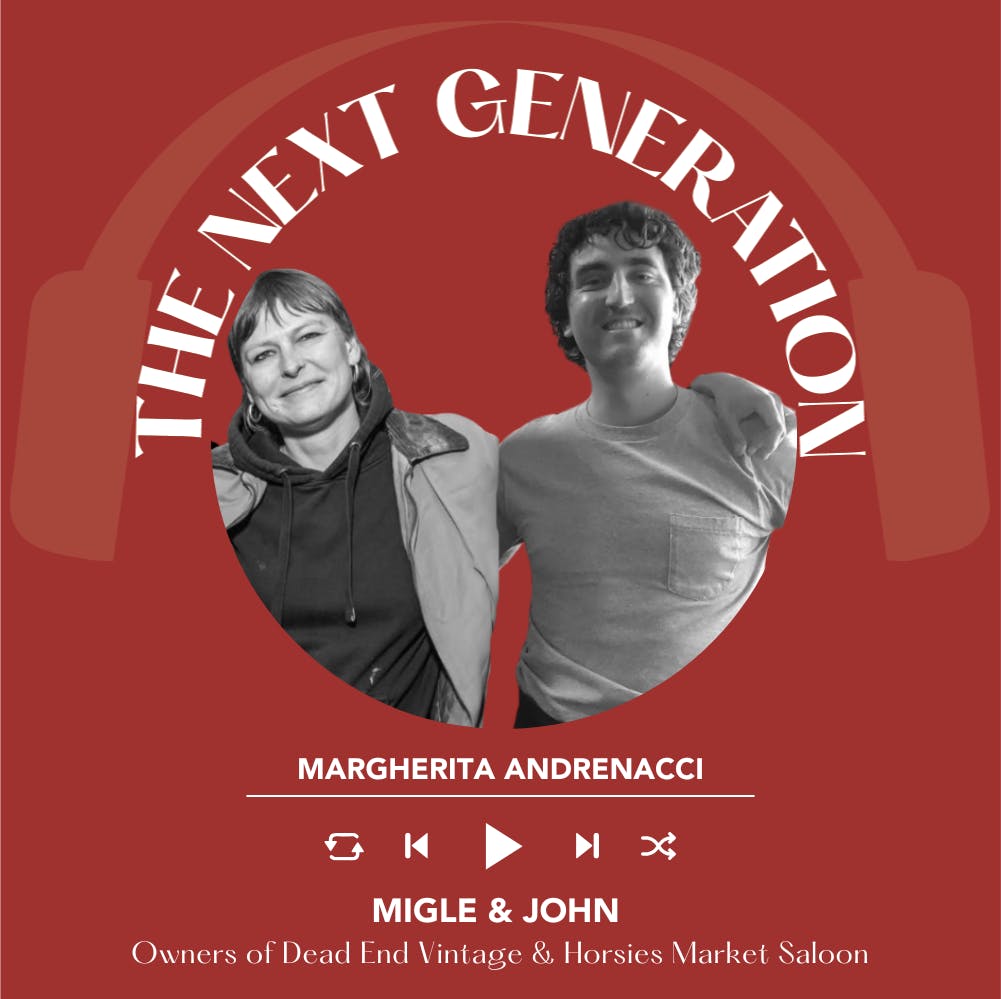
Ep 2328 Margherita Andrenacci interviews Migle of Dead and Vintage and John from Horsies Market & Saloon
Ep 2328 Margherita Andrenacci interviews Migle of Dead and Vintage and John from Horsies Market & Saloon
Episode Summary
Content Analysis Key Themes and Main Ideas 1. The collaborative relationship between adjacent small businesses (vintage shop and bar) in San Francisco. 2. The impact of personal backgrounds and cultural influences on entrepreneurial approaches. 3. Challenges faced by small business owners in urban environments, specifically San Francisco's issues with homelessness, theft, and city management. 4. The unique ""mom and pop"" ethos and community atmosphere fostered by independent businesses. 5. The natural synergy and shared values (sustainability, uniqueness, community support) between vintage fashion and natural/local wine and beer. 6. The potential for small businesses to create accessible, ""cool"" spaces and opportunities for younger community members. Summary This episode of the Italian Wine Podcast's ""Next Generation Series"" features host Margarita Andrenacci interviewing Migle, owner of Dylan Vintage, and John, owner of Horsey's Market, two distinct but adjacent small businesses in San Francisco's Mission District. The discussion explores their unique friendship, shared wall, and how they foster a collaborative environment. Migle, originally from Lithuania, and John, from Huntington Beach, discuss how their diverse backgrounds influence their ""low-key"" and ""mom and pop"" business approaches, emphasizing community and authenticity over mainstream commercialism. They delve into the challenges of operating in San Francisco, particularly the impact of homelessness, drug addiction, and theft on small businesses, criticizing the city's approach to these issues. Despite these hurdles, they express a deep passion for their work, highlighting the joy of creating unique spaces and employing younger community members. The conversation culminates in a discussion about the natural connection between thrifting/vintage clothing and natural/local wines and beers, suggesting that consumers drawn to one often appreciate the other due to shared values of sustainability, uniqueness, and community support. They even playfully pair specific wines with a thrifting session and share their favorite non-work aspects of San Francisco. Takeaways * Collaboration is Key: Neighboring small businesses can thrive by supporting each other and creating intertwined experiences, even without formal joint ventures. * Challenges of Urban Business: San Francisco's specific social and governmental issues (homelessness, theft, bureaucratic fines) pose significant difficulties for independent businesses. * Personal Touch Matters: The owners' individual personalities, backgrounds, and ""do-it-yourself"" ethos are central to creating a welcoming and unique atmosphere that attracts customers. * Shared Values Drive Consumer Choices: Consumers who appreciate vintage and thrifting often align with the values of natural, locally sourced wines and beers, emphasizing sustainability, uniqueness, and community. * Community Building: Small businesses can play a crucial role in fostering local community, providing unique cultural spaces, and offering employment opportunities to younger generations. * Finding Joy in Ownership: Despite the difficulties, the ability to create and manage one's own space and bring unique experiences to a city is a significant motivator for these entrepreneurs. Notable Quotes * ""We only have a secret door. So that separates us."" – Migle, on the unique physical connection between their shops. * ""I feel like I'm a little, like, building shop that that it has no sign. It's like, you can knock. Maybe she's dead or not."" – Migle, describing her intentionally low-key business style. * ""people come because they like the atmosphere that Julian and I kind of like put out as individuals."" – John, on the appeal of Horsey's Market. * ""This city does not take care of its people first of all, sometimes. And that shows on the streets..."" – Migle, on the socio-economic challenges in San Francisco. * ""It's just like, cool. Like, we're in charge of spaces where we can actually make, like, cool things happen and accessible to a city that's kind of been denied. Cool things for a while."" – John, expressing the passion behind their work. * ""I think that it's sustainable, definitely, but it's also it's important for, like, communities and subcultures to exist because when people get together, like, they're actually possessed, like, the agency and the infrastructure to, like, develop something that's unique and interesting to a space, you know, in a period of time."" – John, on the shared ethos of vintage and natural wine. Related Topics or Follow-up Questions 1. How do small business owners in San Francisco actively advocate for policy changes regarding urban challenges like homelessness and theft? 2. Beyond providing employment, what other community-focused initiatives or programs do Migle and John envision for their businesses? 3. What are the long-term impacts of such hyper-local, community-driven business models on urban gentrification or preservation of neighborhood character? 4. How do they leverage digital platforms (social media, online sales) while maintaining their ""low-key"" and ""mom and pop"" identity? 5. Are there similar models of collaborative small businesses in other major cities, and what lessons could be drawn from them? 6. How do they measure the success of their businesses beyond traditional financial metrics, considering their emphasis on ""vibe"" and community?
About This Episode
Speaker 1 and Speaker 2 discuss their past experiences and current business plans. They talk about their personal backgrounds, past experiences as a fashion designer and a construction business partner, and their desire to create a real scene in San Francisco. They also discuss challenges faced by small businesses due to the pandemic and the need for more safety measures. They express concern about the safety of their own sign and bring their own personal experiences and personal experiences to their business. They also discuss the benefits of living in San Francisco, including the love of sports and the romantic atmosphere. They express their love for sports and the surrounding architecture, and discuss the importance of thrifting and supporting local small winemakers in creating unique and interesting ways of living. They also talk about their plans to buy sustainable wine and the importance of bringing vintage wines and the potential for a thrifting session at Darren Vintage.
Transcript
But you're both friends, business owners, and you literally share a wall. What's the best part of a about it? Do you ever join forces to create something together? And do you feel that this can be an example on how small business owners can join forces and create two different experience that kinda intertwine. Totally. Yeah. I mean, anytime I see something who's wearing, like, a cool piece of vintage clothing, clothing I ask if they got it next door. And it's funny because sometimes they totally have. And then sometimes they're like, oh, what do you mean? I'm like, oh, dead end. You gotta check out next door. Mhmm. If you're wearing this, like, we'd really like that. Welcome to the Italian wine podcast, the next generation series. My name is Margarita Andrenacci, and I would love to take you on a journey with me to find out new ways to pair wine. Whether with music, and activity, and experience, or your feelings. Let's dive into it. Welcome to another episode of the Italian podcast. I am Margarita Duracci, and I will be your host for this episode of the next generation series directly from San Francisco to get beyond tradition and find more ways to pair wine. I am beyond excited today to have as my guest, Migle, and John, So let's jump right into it and tell me who are you, where are you from. And what exactly do you do, Migla? Do you wanna start? Hi. My name is Migla. I am an owner of Dylan Vintage, which is based on nineteen street and a mission district. And it is a small vintage shop specializing in forties to eighty clubbing unisex humans. And John tell us about you? Yeah. My name is John. Owner of, Horcy's Market. And, yep, it's a, natural wine beer and vermouth bar located right next door to dinner in vintage. Now we've been operating as Horcy's Market for about a year now. And how did did each of you find your way into your respective industry. So Miue for Vintage and Josh for the beverage industry. I started a long time ago, started a vintage just because I couldn't work in, didn't have a job because I was illegal, and I had to come up with something. So I started, buying and reselling vintage online. And then eventually, once I got my paperwork, I opened up the business next door to Hoses. And tell us how did you get into the beverage industry, John? Yeah. It was just kind of like a unique opportunity. I had been a fan of the bar through my friends, Hannah and Julian. Julian had been working for the previous owners of the bar for about six years when they gave him the opportunity to, buy the business because they were looking to part ways with it. And I had finished grad school in twenty twenty three and was kind of looking for work was visiting San Francisco, hanging out at the bar, and Julian approached me with the question as to whether or not I'd be willing to take over the bar with him and run it and, having, you know, no other real options, for employment on the table at the time. I just thought like why not give it a go? That's great. So you both kinda were looking into something new or something to jump right into, and you took the chance to do it. And it's great to have, you know, young business owners that are kinda finding their way into their respective industry streak, but I have a question. I mean, I know the answer already, but I want you to share it with the audience. How did you meet each other? And why are you here together? Well, as John put it, Julian, pop it in the position, but I am friends with Julian for a very long time and him being called a Lithuania, and I am, and me being for a Lithuania, and I guess that was the first connection that we had. And once we met, we kinda had a little dream together that we will have a business together one day. And, yeah, I don't know where it happened. And Although, isn't the business is not together, but it's next door. We only have a secret door. So that separates us, I don't know. And I yeah. And John was you know, this such an easy addition to this, you know, partnership. I remember I was living in Long Beach for a long time, and so I'd come up, like, every, like, couple months just to come hang out at the bar and just there was like this really bad scene happening here on nineteenth Street. And I remember one time. It was like my first visit up after I had met Julian hanging out here at the bar and meekly, you had, like, come into the bar. You're eating some tacos. The they were doing, like, the Dolores pillow balm. Oh, yeah. And it had just, like, coming from that. And you I was, like, you're, like, totally answered about that. Can can we just, for a second, can you tell us what is the, he'll bomb at Dolores because I feel like everyone should know. Yes. Absolutely. It happens once a year, and, all the skaters come together, a lot of places from California, go to Bam Hill, and a lot of fun, which is very dangerous. So it's feeling about it's really fun. Yeah. Yeah. So I just remember you, like, came with all this energy, and I was like, it was like my first time meeting you, but also, like, one of my first trips hanging out here at the bar and I was just like, to me you were like one of these characters of people that, like, hung out at this, in this space. And I was just like, oh, that's, like, that's so rad. I was super into the moonlight. I mean, do I I feel like it's a quick a couple trips before, I actually had the converse like, when we coming back and forth before I actually having a conversation with you. And then after I moved up, I was like, okay. Like, we're gonna be cool. Yeah. Yeah. What's natural? Yeah. But were you bombing the hill or just watching? I usually just watch, but I, I don't remember that. Probably this time, I did not. Hopefully, I did not. I did it probably twice in, like, last seven years, but I don't remember if that was the answer. I did it. Okay. Well, maybe next year. No. Oh, yes. They're getting older. Okay. So you both come from distinct backgrounds, Lithuania and Huntington Beach. So how have these different environments influenced your vision and approach to your businesses? I come from a background of clothing, making first of all, so to restyle fabric is not something that I, you know, just stumbled upon. I don't know. I just love the good quality of clothing and so did my parents and my grandparents and, you know, they were makers too. So that's, I guess, how it's And in socket union, they did a lot of, like, great uniform, sewing, you know, and the materials that they used, and I feel like it is the same. What I'm interested in is American Workware, and I think that's very relatable to where I come from. In terms of, like, white clothing and construction. For me, I grew up in Huntington Beach, which is in Orange County, and it is, like, as far as California goes, it is really a pretty conservative place and pretty boring. Like, it's it's definitely like the whole city is a grid of suburban tracks, and there's people who are interested in cool things there, but there's never like, there's not a whole lot of opportunities for any kind of real scene of people who are makers to, like, get together to have something really take off because like the culture there is like very homogeneous. And I feel like growing up there and like living a lot of my adult life there San Francisco has always been this place where it does have a rich cultural history, and it was always like far enough away from home to where I could take trips here and still feel like I'm totally leaving getting off from under the orange curtain as they say. But it was also, like, close enough to where it was accessible to me. I think the drive here, friends, and stuff. And, yeah, just getting to Julian, over the course of, like, these trips up here. He had expressed to me that he it was kind of his vision to, like, run his own business, like the Lithuania and Dumplin shop was kind of like his big family. He was, like, yeah, I know I've got Migle, like, we wanna do this thing. And so he was really, like, a big part of, like, the cultural vision of the states, you know, I wanted to create something that was true to his root. And for me, it was an opportunity to, like, immerse myself in something that felt like realer than anything that I kind of was able to be those two growing up and always having these like tendencies to want to enrich myself into a scene and San Francisco always being like this very romantic city for me. It was just great opportunity. So I feel like, yeah, carry a lot that into this. And so do you feel like your personal background are adding something to your business? Do you have your own take on dead advantage and horses? Are you bringing something of your personal life into it or your personal experience and background into into what you're doing? Oh, totally. Yeah. I tend to run a business kind of in a low key way. I would say. Why I don't have a sign on the front of the building. And, yeah, I don't know how to try to. I think that's a very European vibe with, like, where you're gonna stumble on to is also this not being the main street, you know, is being off treat, that really helps. To do that, I don't know. I feel like I'm a little, like, building shop that that it has no sign. It's like, you can knock. Maybe she's dead or not. Yeah. Oh, and also, like, adding, like, you know, noise shows in the evenings and feel like that also brings my best, you know, into the the to the present. Yeah. It really, for sure, has this this feeling. People, just right now, people came and asked Like, is this is is the shop open? And you were like, no, it's on Wednesday. Come back on Wednesday. No explanation. Yeah. That's it. But I feel like it's fine. I don't know. I I feel like there's nothing I don't know. I really don't think that that that kind of vibe exists, and I feel like That's why it works both for me. And then I feel like, yeah, it works because it's just like a mom and pop, you know, like, it's so small and they come and ask, like, they come and ask me, for example, when his horse is open. It'll happen hour late, you know, I was like, whatever. And then, you know, they come in to horses and us. When is that in the open? You know, so it's kinda like, I don't know what kind of brother and sister, I guess. I mean, it's it's really just kinda like three people making it happen. As far as, like, bringing it back on into it, like, as English said, I don't know, like, horseshoes is very mom and pop, like, it's doing it yourself. Like, all of the laborers apparent in here, like, people's, like, we don't have ice machine. We don't have like glass sanitation dishwashers. We do everything by hand still. It's only been two of us running like owning and operating the place for over a year now. So I come from a background of, like, my dad owned his, like, small business practice. And, yeah, my my mom was a teacher. Most of my work experience before this was an education. So I did a lot of one on one tutoring and worked as a music teacher. As well, which is a lot of, like, one on one instruction. And, like, I learned a lot, through that about just like interpersonal engagement. And I think from what I've heard a lot of customers and people talking to me about courses express is that like people come because they like the atmosphere that Julian and I kind of like put out as individuals. And this space was really kind of like quirky and eccentric because the previous owners were and Julian and I are both, like, kind of cut from the same cloth. Like, it's very, like, maximalist in the sense of, like, there was always something new to look at. And there's really interesting lighting, the Building itself is very narrow with tall ceilings, and so there's this sense of, like, I think it's a really warm environment and it's an environment that, like, people can come into and be taken out of their heads a little bit. And then the way that Joanne and I are able to engage with people kind of contributes to that atmosphere. So I'm having a mix of the space that we use. That definitely comes through. Yeah. I think I always say that I'm here because the vibe is just It's good. It feels like I'm stepping into my own house. And it's like, yeah. It's just It's just your grandma's house. Yeah. House feel with people that I don't know, but I can potentially. And I know they're up to getting to you know, know each other, just have a chat. And And, the spaces really compliment each other. Yeah. In terms of, like, they're both kind of do it yourself in a sense, like, not necessarily, like, outside influences, but there's spaces where interesting things are happening. And, like, midway, you totally have, like, this, like you said, like, European, like, five, like, like, like, the music that you get, the shows, kinds of projects, art projects that you put on are super gray, and like, totally. It's like this union meeting with the kind of, like, things that we're doing here. Now more of a personal question, what excites you the most about doing what you do? Probably the connections that I get from people and, like, I don't know. It's, you know, it's your own establishment, so you it's kinda, like, becomes kinda your baby, you know, and you love it, and then you wanna nurture it, and, like, and bring the best that you can in it, you know, and ups and downs, honestly, not gonna lie, you know, in the last two years, but, you know, not all the time, you feel that way. But in at the end of the day, it's, like, it's something that you you you prayed and then you have to be the part of it or even do it at all. You know, that's like the bottom line interview. Why why why the label? Yeah. Yeah. I agree with that. It's it's it's kind of exciting just to be doing it. Yeah. Yeah. Yeah. Yeah. Plus the end up, not not the end goal. Yeah. Exactly. It's just like, cool. Like, we're in charge of spaces where we can actually make, like, cool things happen and accessible to a city that's kind of been denied. Cool things for a while. And also I would wanna say, we do share an employee together. And I feel like what these guys, and I am doing is trying to employ someone a little younger in the community, you know, but that is also have the same kind of values and views for the future. So that's, you know, and I feel like a lot of people the chance in me, you know, when I was younger. So I feel like what we are doing now is getting a chance for someone else to do what we wanted for the future and for smaller community rather than being a bank doctor. Yeah. Totally. Krypto. Yeah. There's a lot of professionals who could, like, do the job. Right? But there's, like, I think about reading so far. I've tried to emphasize, like, personality and people can just kind of share a value system that we do. Yeah. I mean, that is totally noticeable in both of the business. I mean, that's why a lot of people keep coming back and it's very packed. And people just comment horses and then go check out Miglas or the other way around, and it's very clear. And I love it. What's one non work related thing that you love about living in San Francisco? Really city. That's skateboarding. I don't even skate anymore, but I just I think the skate couch here is awesome. I just love it always, all the big hills. And, like, I don't know. Yeah. It's just a babysitter, but the skate couch here is pretty, like, it's insane to me. Yeah. I have to say most of times, maybe people living around the area have seen Migler with her skateboard skating down the street to get her sign for her shop back to the shop because she has it on the main street. And so at the end of the day, when she wants to close-up, she just skates over the corner, grabs her sign, and and comes back, and that's also nice. That's very nice. It means the day is over. I feel like it's like a picture that everyone has, you know, or like a live video, like, if you have to, you know, everyday picture nineteen and admissions. That's totally part of it. So, John, what is it that you like about living in San Francisco? Yeah. I've always had the very romantic idea of San Francisco. Like, I studied creative writing and music and so much of, like, when when I was younger, so much of the culture that came out of San Francisco in the twentieth century, like, it was very formative for me, and it gave me something to be interested in that was cool when I was in high school, like listening the type of the fans that came out here, reading the authors that came out of the city and the Bay Area. So it's always kind of has this rose colored, like, tint to it, and now just like living here, like, I just kind of like love walking around the city. Like, I live in the inner Richmond right now and I, like, walk home from work and Oh, wow. And it's just like this it's like the hills are romantic to me. Like, the architecture of the city is romantic to me. I think that it's geographical location is one of a kind. You know, it is it's a major city, but it's very small, and it's also kind of it's located on the Pacific Ocean, like, with beautiful mountains and beautiful northern California trees, like surrounding it. And it just kind of trips me out sometimes just to, like, look at it and be like, it's so crazy how this city can be built in the way that it is. It looks the way that it does, and it just, I think I'm always gonna be fascinated with it in that way. Stephanie picture, perfect. Yeah. Think the beach. Maybe let's let's just go back from that skateboarding. I think the beach is maybe buoyancy. Like, I'd be like, no yeah. If there was no ocean, right, like, like, fifteen minutes away from me, I definitely, you know, like, gotta be like, oh, this is getting expensive. An associate meeting keeps me paying that price. I cannot move away. There is no way. Yeah. That's a very interesting way to put it. Yeah. I'll pay my rent because I know I have the ocean. You know, I can I can go to I can relate, but that's for another conversation? So since we're talking about San Francisco, what are the biggest challenges that this city has for business owners? Well, this city does not take care of its people first of all, sometimes. And that shows on the streets an update that reflects, have the government run it, and how, in general, the system runs it over this. Let's not get into too many details of that. But, for example, now I am dealing with a small business with a lot of theft. Because once again, the city pushed away the house less individuals from tenderloin because they are cleaning the streets and pushing away people from one area to another area is not cleaning the streets. Usually, you're not doing nothing. You've absolutely used this job. And now we're having a big influence of drug addicts and, you know, and it's very unfortunate because there is not enough programs and you know, and they what they're gonna do, they're gonna steal, you know, to get their next fix. And I understand that, but I am a small business. So for me, it gets harder. This is the now I'm paying for their drug use, basically. Mhmm. And the city is not doing anything at all because they don't they already been doing this for many, many years. They're not gonna change that. Their house list are not gonna they're not going home. They don't have a house. Yep. So pushing them away from one area to another area is not a consortium. I'm sorry for my language, but for now this is, like, it's getting effective very small businesses, and then I think it's not just me that, you know, can say that. And then they are very concerned about my son and that is k two every night to and trying to give me three hundred dollar fine because my sign is not safe and not clean on the sidewalk. You know, it's like, can we please concentrate on actual problems? I think we can yeah. Much stupid sign. We can all agree that there is more things I mean, that your sign is not the most dangerous thing on the sidewalk. Yeah. Yeah. And that's, yeah, that's where the I feel like the city is taking all the smoke detectors. Mhmm. Yeah. I mean, I think what you spoke to, like, definitely resonates with me. Having it's really hard to, like, maintain, like, a really welcoming place when you have people who are coming down off of drugs, like hanging out outside the space, and you know, coming in to, you know, try and use the restroom or something. And it's really your problem because you wanna, like, help out any helmet, but when you as as I've been learning, like, the more you do this, the more you're allowing it to happen an increase in volume. It's with how busy the barking is sometimes, it can be really hard to balance, having someone whose behavior might be a bit unpredictable, like, in the space. And it's like, cause me to have to, you know, learn how to draw firmer lines with people who obviously need help, and it's tough because it puts this pressure on business owners as individuals to be in that position of drawing those lines, and it's just tough to make the city, especially like the neighborhood feel welcoming when I don't know. You just walk around outside lately. Yes, since people have been pushed from the tenderloin into other parts of the city, and it is significantly and it's just so much more noticeable than it was last year. It's undeniably an ongoing issue. Yeah. But Let's go back to this amazing corner place that you are working in, and you're both friends, business owners, and you literally share a wall. So What's the best part of a about it? Do you ever join forces to create something together? And do you feel that this can be an example on how small business owners can join forces and create two different experience that kinda intertwine. And how does that work? And do you see people going from that advantage coming in and the other way around? Totally. Yeah. I mean, anytime I see something who's wearing like a cool piece of vintage clothing, clothing I ask if they got it next door. And it's funny because sometimes they totally have, and then sometimes they're like, oh, what do you mean? I'm like, oh, dead end You gotta check out next door. Okay. If you're wearing this, like, you'd really like that. Also, it's yeah. We share a wall. Like, we're in the same building, technically. And I think it's really cool. Like, an example that comes to mind in recent memory is, like, the movie that you guys showed. And we were able to, like, make it not just a dead end thing or a horse's thing, but it was, like, this unified front between Migua and Julian. If you wanna talk more about that, maybe. Yeah. That was the Petiness seven chronicles. Movie made in two thousand and twenty three, I believe in Lithuania in Jolene where I'm from, in the area, in the story, takes an area where I was born and where my parents grew up. Any they depict, nine nineteen nineties, Lithuania, the views of nineteen nineties, Lithuania, the the outfits, the the language, the music, and it was a really good story that we showed at dead end, but we both yet promoted it, between Morse's and and the vintage shop and it was really successful and people enjoyed it. And a lot of most of the people were not from Lithuania. Mhmm. And how was the best part about it? You know, and they all came out, like, appreciating it for me and Julian to show how little, I guess, a little bit part of us. And so people were coming here for hap to have a drink and then popping in to see the movie at your vintage show. Promoted it. Yeah. For, like, a week and then, yeah, you could buy tickets. And, yeah, it was, like, thirty seats only, very small, but thank you. And would you say does it happen often that people just pop in at horses, get something to drink and then check out your Yeah. Your shop Totally. Totally. And we did actually, when we we we opened, from the beginning, we did like, event called Sippen Shop. So that's, you know, maybe like Friday night and then, you know, sometimes we get a DJ or sometimes you know, John and Julian get a band, and so that's, like, totally, like, even though we're not maybe even throwing an band together, but that's, like, flows both ways for sure. So, John, what's me going to go order when she comes seen at horsies. Maybe, you know, it's about five. And she still has a couple of hours to work, and she feels like she needs, you know, just to hang out a little bit. So she pops in, what does she ask for? Yeah. It's a real, real easy answer that. We both do an under bird, typically, and then, she gets a puppet, which is a, a puppet sized glass of beer. And, that keeps you going for a while. You said, maybe that was, I I don't even have to sometimes say anything at this point. If it's super busy and I just see, like, Migoy's hand, in the dormer. Just like, coming around the pups. And then we get a do a quick Chefy underpe and help ourselves to Do a puppets. Yeah. A quick small glass of beer. Yeah. It's all about puppets. Yeah. Yeah. All the things that I drink is coming pups. That's fun. And, Migle, what is the last item of clothing if that you sold John? I believe it was the two t shirts They were very feminine, nice, and then, my jacket that I hunted down for him specifically. Migo does a really good job in making sure it's a bit cool. No. I get so many compliments on this jeans jacket that he's not made. It's like the warmest jacket I have today. It's lined perfectly. Like, it actually fits me. And, like, I'm an Excel in a vintage that's, like, kinda tough for her to come by. And so Yeah. When she sees it, I think she grabs them pretty specifically. Yeah. Yeah. I mean, they're thinking it is kinda hard. It takes time and it takes a lot of luck. You have to find what you like, and it has to be your size. So it is kinda hard. So what would you say, Migla, that Would you agree that the general consumer that is willing to comment thrift and cares about buying vintage clothes is the same consumer that then would go to a bar and choose to have sustainable wine or just, wine that is natural and just owned by small winemakers. Totally. And I feel like that would be also I feel like vintage is, you know, like, it's of rare pieces and very unique pieces. And I think not only is sustainability also from the variety of the drinks that they provide, and I think, you know, it's something different, you know, so it's like also very unique stuff that you can here, you know, and you're not gonna walk in in a wine bar or, you know, and find really good natural wines locally sourced, you know, and then plus a really great selection of beer, you know, and that is also from worldwide verbatim just locally, you know. It's just interesting drinks. I think and that's and the uniqueness between the, you know, one piece of clothing that you find, you know, from nineteen fifties that you know, not, you know, started to find. I feel like that relates to to, like, really cool, interesting, like, even the labels, chemistry, like, you know, it's just like, you know, it's so unique. Yeah. John, what's your take on that? Do you think that in a way, thrifting and just supporting local small winemakers make sense together. Totally. Yeah. I mean, these things go hand in hand. It's, comes from what's coming from the community, you know, like a lot of the vintage clothes, like, I know that you are, like, a super room in the morning to see what comes through the bins at the Salvation Army. And that's, like, stuff that's coming from people in the city. We've been here for years, and now they're closed. It ended up through one form or another, like, into Miegway's hands or checking out, like, the local flea markets all the time. For the wine at this moment, it's entirely California centered. We had a food partner working with us last year, Connor, and he's really someone who's an expert on wine and natural wine, and he kinda had this idea that horses could be this place that exclusively works with California natural wine. And that's something that I don't know has existed in California up until this point. And so, like, all all of the wine makers that we work with, we have a personal relationship with. I'm looking at a bottle right now. Miss Graham, winds. And the makers of this wine are two women who live like two blocks away. And, yeah, it's, so it's, it's really cool to see, like, this is what people in you are producing. This is what people in the Bay Area are making. This is what people on San Francisco are doing. And I think that it's sustainable, definitely, but it's also it's important for, like, communities and subcultures to exist because when people get together, like, they're actually possessed, like, the agency and the infrastructure to, like, develop something that's unique and interesting to a space, you know, in a period of time. So that's wrapped. Yeah. I mean, it really is like that. Because I feel like people that do care about the community, they're not necessarily looking for a big name or a big brand or to be part of anything. They just are looking now for each other, and that's exactly what is going on here between courses and that that vintage. John, what is the best wine to pair with a thrifting session at Darren Vintage? And I am gonna ask the same thing to you, Miguel. Probably something with a high alcohol to go push that in just for that way. You feel a little bit more inclined to purchase something. Love it. Very business focus. Business forward. We love it. Now we help each other on. Yeah. Also something super fun. One of the more fun wines that we have in. It's the Italian, the Remi, it's like this super bright orange lime, which every time I've given someone a taste, they're just like, wow. I've never tasted anything like that. The It's really unique. The label is super cool. It's black and white. Very monochromatic super dead end. Vibes. Yeah. So it's got like this weird. It's just like great label art and, just kinda like this little bit of risk on energy that I think would pair super well with anything that you find at seven. I'm just I could see that. Yeah. I would have to say probably yeah. I'd go with that one and then I do like the, I don't know if I can even date someone, but I do like the table because it's very vintage looking and it's peggy's suit. Yeah. That that's just, like, because it's, like, very seventies looking. I feel like I love the sofa. And a couple. It's kinda blurry. Great label. I think it will do well in in a vintage shop. It's it's a petite syrah, you know. So it's gonna it's gonna be like full bodied. It's like it's gonna give you what you need, but it's not gonna, like, shout them love it. Migle, what do you say? It's the best one to pair with a session of thrifting at dead end? I think that was the my my answer. Yeah. The peggy sue, yeah, definitely the the the so far that you got me, the stripes love this mattress. So I feel like, yeah, we're agreeing on that. Now to close it up. Uh-huh. Please, I want you to pair, and it's not necessarily going to be wine, but are an Italian wine podcast. So if you have a wine, I feel like you should go for it. If not, go for something different. But do you have a track album producer, songwriter, or someone that that you are obsessed with, and what would you pair it with? Like, what would you if you imagine you sitting on that right coach couch that we just sat for the label of this pagissue wine. If it was just, like, chilling there and you play the record, what wine or beverage would you pair with it? Well, my darling, you know, my answer, it is Definitely, the last glass of wine by Jim Jim Olsen. Yes. And I would pay them any wine. I would pay the cheapest wine, the most expensive wine, one last drop of whiskey bottle, because it's just the best song. But yeah, I don't know. Or, you know, on the burg, really, like, you know, I'm not maybe not necessarily big wine drinker, but I do like icebergs. Yeah. Yeah. It's a great answer. We're gonna check it out. We're gonna pair it and check it out. Okay. Our tapelines will go real well, you know, the most affordable bank for your buck. Absolutely. You know, saw I've been playing a lot at the bar. One of our customers always brings us these great vinyls, and he brought in one the other day, Little Bob and the lollipops in the song is called I got loaded. And it's this classic, like, just up tempo, like, r and b song about just drinking. And, I would choose probably the Fed's roby web to go with that. It is this kind of effervescent little bit so a little bit bubbly Cabernet merlot one. And so it's it's super full bodied. It's gonna get you drunk, but it's very light and easy to drink. You know, it's a great one. So That sounds great. Yeah. We're gonna, for sure, try both of this, you know, and maybe it's the plan for the rest of the day, but everyone should try the sparings. But Let's all get loaded. Yeah. That's loaded. Yeah. For sure. For sure. Monday. Yeah. But thank you both for being my guest, the next generation of the Italian podcast. We are going to keep up with everything you're doing. Please keep sharing the things that you're doing, and I really appreciate you being here. And I'm looking forward to just more of this collaboration with wine and thrifting. It sounds amazing. It has been amazing so far, and I'm sure the city, the whole city is just, you know, gaining something from from this extremely amazing collaboration. Thank you very much. Yeah. We really appreciate that. Alright. Thank you. Very good addition to also our our business and our community. So Thank you. It feels like, I mean, great minds think alike, so no wonder why we are all vibing here between horses and dead end vintage. So thank you again, and that's it from daytime wine podcast. Thank you for joining us today. Let us know your thoughts on our social media at Italian wine podcast and follow us to keep up with the next generation of Italian wine people. Make sure to check out my latest article where we dive into music and wine on the Italian wine podcast web side. Cheers.
Episode Details
Related Episodes

Ep. 2789 ColleMassari: a long-term vision rooted in Montecucco with Giuseppe Di Gioia | On The Road With Stevie Kim
Episode 2789

Ep. 2788 Ep. 14: Austria and Hungary | Study Smart for your WSET Level 3
Episode 2788

Ep. 2785 From Volunteer to Speaker at TEXSOM with Samantha Cole Johnson | TEXSOM 2026
Episode 2785
Ep. 2766 Inside the U.S. Non-Alcoholic Wine Market: What Wineries Need to Know with Jill Sites | Masterclass US Wine Market
Episode 2766
Ep. 2761 Winemaking and Consulting Across Sicily with Alessandro Serughetti | Wine, Food & Travel with Marc Millon
Episode 2761

Ep. 2759 Part 2 – The VIA Educational Program & Italian Wine | Heart-to-Heart Conversation with Sarah Looper
Episode 2759