
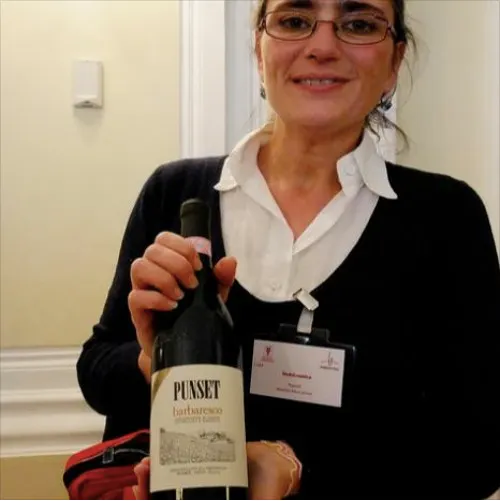
Ep. 550 Marina Marcarino | Monty Waldin
Ep. 550 Marina Marcarino | Monty Waldin
Episode Summary
Content Analysis Key Themes and Main Ideas 1. The history and evolution of organic wine production in Italy, particularly since the 1970s and 80s. 2. The formation and enduring success of Vintesa, a consortium of Italian organic wine producers. 3. The distinction between original motivations for organic farming (personal health) and current market perceptions. 4. The critical importance of certification for organic wines to ensure consumer trust and combat misconceptions. 5. The collaborative spirit and challenges faced by Vintesa members in promoting organic wines globally. Summary In this episode of the Italian Wine Podcast, host Mark Millen interviews Maria Marcarino, CEO of Vintesa and owner of Punset winery. Maria introduces Vintesa as a consortium of organic Italian wine producers formed in 2004, initially as a technical group for sharing organic farming experiences, many members being pioneers since before the 1980s. She explains that the decision to farm organically was initially driven by personal health concerns rather than marketing. Maria highlights Vintesa's unique longevity and success as a commercial consortium, aiming to produce outstanding organic wines for the mainstream market, not just niche organic shops. The discussion emphasizes the ongoing confusion surrounding organic wine, its distinction from natural or biodynamic wines, and the absolute necessity of third-party certification for consumer assurance. Maria asserts that certification is non-negotiable and essential for validating organic claims, dismissing excuses related to cost. She concludes by inviting listeners to explore Vintesa's portfolio and visit their wineries. Takeaways * Vintesa is a unique and long-standing (16-17 years) commercial consortium of Italian organic wine producers. * Many of Vintesa's founding members were pioneers in organic farming in Italy, starting as early as the 1970s and 80s. * The initial motivation for organic farming among these pioneers was primarily personal health and well-being, not market-driven. * The consortium aims to produce high-quality organic wines that compete in the general market, not exclusively in specialized organic shops. * Certification is presented as a crucial and non-negotiable guarantee for organic wine, ensuring consumer trust and rigorous controls. * Collaboration and mutual support among Vintesa members, stemming from shared beliefs and friendship, are vital to the consortium's continued success. * There is still significant consumer confusion regarding the definition and scope of ""organic"" in wine. Notable Quotes * ""Vintesa is a group of producers, of organic producers, which joined together in a consortium in a year two thousand four."
About This Episode
Vintesa, a group of organic wineries, created a consortium in 2004 to share their experience of organic growth in Italy. They emphasize the importance of communication and promotion between the winery and the consortium, and maintain a strong bond with the winery. The company prioritizes communication and promotion between the winery and the consortium, and the need for certification to ensure product is not misused. They emphasize the importance of certification for consumers and guarantee it provides, and emphasize the need for people to be certified to avoid confusion and misunderstandings.
Transcript
Italian wine podcast. Chinchin with Italian wine people. Hello. This is the Italian wine podcast. My guest today is Maria Mercarino. From Vintesa. She is the CEO, and she also has a family winery in Piamonte called Unset. Welcome. Thank you. Nice to see you, and nice to meet you. Could you tell us exactly what Vintesa is? Vintesa is a group of producers, of organic producers, which joined together in a consortium in a year two thousand four. Our main contact was the experience as we are pioneers over organic growing in Italy. As a matter of fact, many of us started before the eighties, and, our main goal was to create a group for sharing the experience of organic. So it was more a technical group at the beginning. And then we decided to put together our experience, also in terms of market and promotion, and we started this group, this consortium, with idea of starting to sell in Italy together and promoting the wines in Italy together. But then it became very interesting for the market. And little by little, we started to propose our portfolio to many different countries. And now we are working in the in the mostly, part of the regular markets. Let's say. So your initiative was very have on guard in two thousand and three, two thousand and four when organics was kind of still just taking off. And the fact that you created this organization, I think it's very, very significant. Your family winery, which is Punset, was one of the first organic wineries I heard of when I was working at the first English language organic wine guide. And in those days, it was very hard with organics. So why well, in terms of in terms of Vintesa, how easy was it for you to get the producers together to work as a group, to work as a team rather than as as individuals. It was, of course, not very easy, but, there was something that was pushing us and was the passion of, a a choice that was quite unusual for those times. You know, I have to tell you something that, I think is very important. In the early eighties, when we start and, a few of us started in seventy eight, eighty two, like me, eighty nine, no one was working organic. And, we were considered like a strange part of agriculture. There was a lot of confusion. Many people were thinking that, being organic should be bad, any cost. And those wineries that were sharing the experience, were all focusing on high quality and, and wanting to to be on the market considering organic as a plus. What is really tying us, as an experience, is that organic was, let's say, an egoistical choice, an egoistical decision because we then wanted to work in a poisoned place And, we all are farmers. So we don't see it behind a desk, but we are in the vineyard. We are in the winery, and, we breed the hair outside. And we were thinking that, the decision of working organic was something good for Howard personal health. So it was not a marketing decision. Now organic, as a different position on the market. So we were sharing the necessity of working at the best. We all decided not to focus on a special corner on the market, the strange corner of organic. As a matter of fact, still now, our our goal is not to to to set to specialized, organic shops, or resellers. But was, lady was to make outstanding wine that could stay on the shelf together with the other main brand, having this plus of being organic. So the the first experience of deferred certification was, of course, so difficult to because, many times, our wines with these strange labels saying organic was refused. And we had really to get together for proposing our products and the, in our philosophy. Some of us also work natural, work biodynamic. So we have so many different things to to communicate that, that was too important to have the strongness of working together. Now it is, of course, a different experience because, we are considered as, as I told you, the pioneers. It is quite normal, to consider our product in a certain position At this time, the the proposal, the the portfolio, which is ample, as well as, the difference, of wines that we offer can be a plus, you know, Vintesa has a great peculiarity anyhow because, it is the only consortium that is still alive after almost sixteen, seventeen years of life. Many of them in commercial, open and close in a couple of years, three years. So I should say that, it was quite an experience to reach together this winery and to maintain this structure in the time. So we are very proud of this. I mean, I wrote, one of the first books on organic wine in the late nineteen nineties, and, obviously, in days I wasn't alive then, but your winery, the name of your winery was already known in the UK by people who were interested in organics, and by a particular importer, a guy called Tony Mason, who had a company called the organic wine company. I contacted him. I said, I've gotta write this book for friends of the Earth on organic wine. Can you give me some names? Your name was one of the few that he could he was able to give me because and Punset is quite an interesting word. It's not kind of a word in English language. It has a very distinctive name, and it's always stuck in my brain. And to hear you speak now about the initiative that you created all those years ago and that is still holding strong is really, really, very, very remarkable do you think that's why do you think it's it's survived this, this this organization of cooperation between the organic growers in that particular part of the world? Why have you stuck together and not split apart? Because, you know, when you strongly believe in something, you do all you can for for, bring ahead your project. So I couldn't say that we had a problem. We had partners that came and went several times. There is a base, which is always there. And, and this is, formed by, of course, my winery, the loacker wine estates from Guzano, and they also own a winery in Montaccino and one in, Marima, La Luna de Rospo, which is a small winery in a yellow diamond. We were exactly the founder, and we were the ones that wanted to bring ahead this, project. And with the time, you know, there is not a border anymore between the winery and the consortium because the the consortium became really a branch of the winery. So all the logistic or the communication, the promotion, the interaction with the with the market is done by the consortium. So at this point, it would be too difficult to destroy it. And so, of course, we maintain this is a strong, let's say, bond that is putting us together. It is a commitment. And I think that, where we are now, we only can grow. We can go back to smaller situation. The the producer that joined Vintesa later on in the time, sometimes we're considering this, like, a distributor. And this is a big mistake because it is not a distributor. The idea of Vintesa is to propose the wines at the same condition in the same way, as at the winery is done. So, as a partner of I should be able to speak about my wines at the same as my partner, and we all are ambassadors of this group of wineries. And in my opinion, this is the plus because it is good to be a sales person, but it is much better to be a winemaker that knows what is behind the bottle and speaks about the motors. And, if you think that, the group is offering good wines and you believe in that wines, there is not a much difference to speak about a BarBaresco or speaking about a brunello or about an elderly Roya because you know what is the production, you know the vineyard, and you know how is intense, and, even heavy to make a wine. So all the history is not just a label. But it is, what is behind the label. It is the experience and, it is made by people. So we are a group of people. We are a group of producers, but, mainly, we are a group of friend. If you don't join the friendship, it is very difficult to work together because, always there are problems in, you know, everyone who's working can reach problems. And, and this is the life So we should be able to stand and go ahead facing and solving problems together. I think that this is the real key, that gave us the opportunity of growing and maintaining this this group. How many, I mean, how many events do you do a year? I mean, do you have tasting events with the public together? In in any in a normal life or in this life? No. In a work life. I mean, obviously, there are organic wine fairs, like, Melisine Bio in, in France, events that your group has. Yeah. Do you fight for sommeliers or for the public? Or Okay. We many, many years ago, we started with Mila Simvio. Mila Simvio was the first, exhibition that we decide decided to share. In the last years, we, focused only on two important first. One is Vineethally. And the other is providing. As I told you before, we decided not to to join the organic section of both these first because, of our idea that organic is a plus, and we wanted to offer the solution of organic to the word and to the the wine world. Even because we think we all think that, organic should be a little more considered and maybe become, obligatory. For getting a better health to our planet, but this is another discussion. And, so what we do more often is, to make smaller tastings aside of the big affairs, inviting a group of the consumers in case we face consumers or a group of restaurant, or retailers, or some, because we think that in that way, it's much better to to propose the wines, and at the same time, to have a conversation, to have the possibility of sharing opinions, to getting questions to answer because, sometimes, the tasting behind it has in a place crowded of different wineries that doesn't allow to to give the right message. So we consider the big first as important because of the kind of public that they bring in. And so for proposing the one to importers and to big buyers. But, for our communication, we prefer small groups. And, in that, we should say that, the big help is given by the ones that already are representing our portfolio. I am speaking by the Italian reps as well as the importers that are bringing in the wine. Organize the several tastings, focusing on our products or in particular seasonal tastings. So the the wines in spring and maybe the heavier wines in autumn or winter. So giving also a message which is not confused because, you know, in our portfolio, now we have about one hundred sixty wines. So it is quite a lot. What is a typical question that you get asked at a trade event or a professional event. Do you still get some strange questions about organics or are people much more informed now well informed about what organics means and what the what the differences are between organic and conventional? Yes. We still, receive many strange questions. The main one, for sure, still now, is, that people don't know exactly what organic means. So, to explain how, we different practice in agriculture. It is always the main answer because, people still think that, because the farmer make the wine, this is organic, or because the wine is outside, and it is a wine, it is organic. Actually, the the production side is always the question that, more often has to be answered. And, and there is, I should say in the last years, we got, for sure, more interest for organic. More curiosity, a lot of confusion. People are really confused and, they mix organic with natural, with, Vigna yol independent, and, with many different things that have not introduced with organic. Our opinion is that, organic now is tied to a low, which is European, which is the same for all Europe, and, you can't be organic without being certified. So this is our strong opinion. And we also really don't like this, sort of, strange corner of, people that say, okay, I refuse. This is the certification because it is expensive or because I don't want it to be tied in a rule. There is a rule. So as we follow rules for the appalachians, we should follow rules for the for the organic problem. And, and this is really what I mainly have to explain to to these people. What you're saying about certification, I completely agree with you, and the voice felt the same way. If you want to talk about being organic, you should definitely be certified and not say I'm organic, but I can't be bothered to be certified. I'm organic. I can't afford the fees or whatever. Any excuse I I totally agree that third party independent certification is very, very, very important. And it's good to hear that you're that you're on the same page that you believe that as well. And your and your member wineries also think the same way as very, very important for consumer reassurance that somebody independent has come and checked your winery in your vineyards and maybe taken some samples and say, nope, she is organic and she's not cheating. Totally agree with you. Thank you so much. And and this is really important to me because, you know, the certification and this is a message to the consumer is a guarantee. Is a guarantee because, we get through many controls not only in the field, not only in the winery, but on the market. People, sometimes don't don't understand or don't know that. And they be, and and there is, you know, this tricky idea that maybe something is not correct. Maybe some the scandal. Organic is really very, very well controlled. People that, are doing organic go through a lot of different things that don't happen in any other production. I am as a consumer, now I am speaking because I got the experience as a as a winemaker and as a farmer. Sometimes I avoid the farmer things. The farmer as, you know, made without any any official practice because that products, are not controlled in terms of chemical. And, in many case, the ignorance is dominant. So people that wanted to be a farmer, and they have to spray, and they go to the shop, and buy the product we're spraying, and they say, okay, this should be sprayed like one liter perractor. Okay. I will put one liter and a half because so I'm sure. And this is unusual. It is just poison that you put in the air. And many times, we don't care on what we are putting inside and what we are breathing. So this is the reason I I believe strongly in the certification because there are so many subjects that are controlling that is almost impossible to to to be And once someone refuses the certification because of the expenses, doesn't believe in organic. It is doing something in my opinion just for marketing because, if you believe that this is something helpful for all of us, you can spend that little amount of money for sure. Maybe you buy one pair of shoes less or two a year, but it's not such important, I think. Have we missed anything? Is there anything else you'd like to say today about, Vintesa? I just wanna say that, this is, a very nice experience, in our side, but, I I would like to invite people to know a little more about us to try to join our experience, in terms of, offer because really, Vintesa is very interesting, also in what is is able to do and, and give to to the to the buyers, to the market. So, our wineries are open for welcoming or the ones that, in a real life and not in the life that we are living now can be able to visit us. We're really happy. And the last thing, if you just tell us, you obviously, our guests have a website. If you can just give us the the website address for anybody listening, and then they can go in on your website and find out more about you. That would be very, very helpful. It is very easy because, the the website is Vintesa dot wine. And, inside the of that, sir, they find out the information. Okay. I'd just like to say thanks to my guest today, Maria Marcarino. Who's from the Unset winery, but today was talking about Vintesa. Very interesting, story that you have personally and also, with your group. It's a wonderful initiative And it's always nice to hear wine growers that have see that they have more in common with each other than things that they don't have in common, and they work together and promote, organic and, and and and biodynamic wine. So been a real privilege talking to you today. Thank you so much. Thank you for the time that you deserve to me. And, I really hope that people will enjoy organic wines and more and more in the life, and hope to see you at the winery anyhow. Thank you. Thank you so much. Bye. Listen to the Italian wine podcast wherever you get your podcasts. We're on SoundCloud, Apple Podcasts, HeimalIFM, and more. Don't forget to subscribe and rate the show. If you enjoy listening, please consider donating through Italian wine podcast dot com. Any amount helps cover equipment and publication costs. Until next time.
Episode Details
Related Episodes

Ep. 2822 Ep. 20: California | Study Smart for your WSET Level 3
Episode 2822

Ep. 2789 ColleMassari: a long-term vision rooted in Montecucco with Giuseppe Di Gioia | On The Road With Stevie Kim
Episode 2789

Ep. 2788 Ep. 14: Austria and Hungary | Study Smart for your WSET Level 3
Episode 2788

Ep. 2785 From Volunteer to Speaker at TEXSOM with Samantha Cole Johnson | TEXSOM 2026
Episode 2785
Ep. 2766 Inside the U.S. Non-Alcoholic Wine Market: What Wineries Need to Know with Jill Sites | Masterclass US Wine Market
Episode 2766
Ep. 2761 Winemaking and Consulting Across Sicily with Alessandro Serughetti | Wine, Food & Travel with Marc Millon
Episode 2761