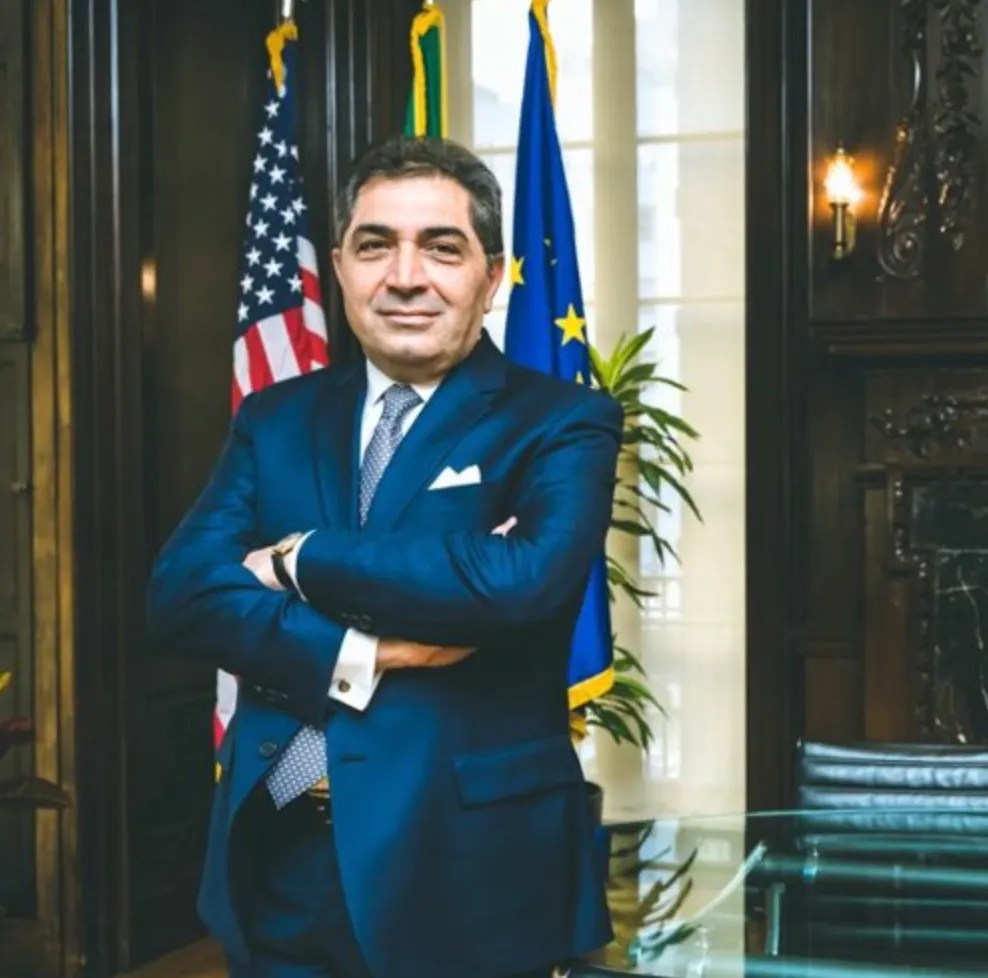
Ep. 554 Antonino Laspina | Get US Market Ready With Italian Wine People
Ep. 554 Antonino Laspina | Get US Market Ready With Italian Wine People
Episode Summary
Content Analysis Key Themes and Main Ideas 1. Strategic promotion of Italian wine and food in the US market. 2. Addressing the challenge of diverse Italian wine offerings and consumer familiarity. 3. The integral role of food-wine pairing in Italian cultural export and marketing. 4. The Italian Trade Agency's (ITA) multifaceted approach to market entry and growth for Italian products. 5. Leveraging digital tools and e-commerce alongside traditional trade promotion. 6. Emphasizing sustainability and authenticity as competitive advantages for Italian wine and food. 7. The evolving role and future of physical trade shows in a post-pandemic world. Summary Host Steve Ray interviews Antonio Laspina, the Italian Trade Commissioner of New York, about strategies for promoting Italian wine and food in the US market. Laspina addresses the challenge of educating US consumers about Italy's vast array of wines (over 600 varietals) and emphasizes the Italian Trade Agency's (ITA) strategy of combining wine promotion with Italian food, highlighting food-wine pairing as a cultural and marketing strength. He discusses balancing efforts between trade partners and consumer education, utilizing both traditional business-to-business events and modern digital communication, including e-commerce. Laspina also points to sustainability and authenticity as emerging values that Italian products inherently embody. He concludes by discussing the future of trade shows post-COVID, foreseeing a hybrid model that integrates digital pre-engagement and post-event follow-up with the crucial in-person tasting and relationship-building aspects. Takeaways * Antonio Laspina is the Italian Trade Commissioner of New York, focused on promoting Italian goods in the US. * A core strategy for Italian wine promotion in the US is its combination with authentic Italian food, leveraging Italy's cultural heritage. * The Italian Trade Agency (ITA) employs a dual approach, prioritizing engagement with trade partners while simultaneously driving consumer awareness through various media, including social media. * Sustainability and a ""green approach"" are seen as inherent strengths of Italian wine production, aligning with new consumer values. * Digital tools and e-commerce are becoming critical components of Italian product promotion, allowing for broader reach and multi-channel sales. * Trade shows are evolving into hybrid models that combine digital pre-engagement and post-event follow-up with essential physical interactions for tasting and building trust. * Despite challenges like the sheer number of varietals and American perceptions of Italian food, authentic Italian products are gaining traction in the US market. Notable Quotes * ""What is moving in this market is the combination of the Italian wine paired with a pairing with the Italian food."
About This Episode
The Italian wine industry is experiencing challenges due to the combination of Italian wine and food culture, but the success of the Tuchi program is due to the combination of these factors. The company is educating consumers on the benefits of this approach, including sharing information on the impact of the new values emerging from the market. They plan to use communication and social media to target the market and achieve their goals. The importance of trade and consumer education is also discussed, and the company is preparing for the pandemic by educating consumers and trade partners on the importance of authentic Italian foods and the importance of learning about the Italian culture. The company is working to educate consumers on the benefits of the approach and create a better business relationship between individuals and companies. The trade show is a good opportunity for promoting their brand and creating a trust between individuals and companies.
Transcript
Thanks for tuning into my new show. Get US Market Ready with Italian wine people. I'm Steve Ray, author of the book how to get US Market Ready. And in my previous podcast, I shared some of the lessons I've learned from thirty years in wine and spirits business helping brands enter and grow in the US market. This series will be dedicated to the personalities who have been working in the Italian wine sector in the US, their experiences, challenges, and personal stories. I'll uncover the roads that they walked shedding light on current trends, business strategies, and their unique brands. So thanks for listening in, and let's get to the interview. Hi. This is Steve Ray, and welcome to this week's edition of Get US Market Ready with Italian wine people on the Italian wine podcast. And this week, we're pleased to have as a guest Antonio Laspina, who is the Italian trade commissioner of New York. Thank you. Thank you. So let's jump right into it. One of the first questions I have One challenge for Italian wines is the sheer number of offerings. I understand there's over six hundred indigenous varietals plus all the innovative new styles and brands such as Supertuskets. In addition, consumer familiarity with Italian wine varies by market. How do you expose and expand consumer recognition of all that Italian wine has to offer? Some experience that we had during the twenty twenty, such as the promotion of, wines, with, some internal selected Italian restaurants has given us the chance to elaborate a strategy that is going to be developed in the future. And we are confident that, this is give us the chance to get in touch with the important players, as I mentioned, in the new areas, new cities, new metropolitan areas because we have seen that. What is moving in this market is the combination of the Italian wine paired with a pairing with the Italian food. After all, we can say that out of the almost five billion US dollars of export from Italy, we have almost two billion of US dollars of wine. So it's almost thirty four percent of our export, but either is leader in many other food products. And this is what is important if you want to send a message to the consumer, to the traders, to the restaurants. Because what is coming from Italy, as I told you, it's not just a a product, but this, a culture, the culture of wine, the culture of food, the culture of the Italian food where food and wine are combined, and they make a a very unique experience. And this is going to be in the future. A comment here. I got asked forget what the specific question was, but my answer was If it grows together, it goes together. And I think that's kind of a model for in, you know, what I drink when I'm in Italy. I'll drink something different in bologna than I would in even barona, right, or certainly Romer in the south. There's a new TV show that's airing in in the US. It's probably on the fourth out of fifth with Stanley Tuchi. Yes. I don't know if you've had a chance to watch it, but I think it's extraordinary. The only negative I have about it is he doesn't talk about wine at all. He goes waxes prolific about how wonderful Italian food is, which is true. You're making a point now about wine and food kinda go together. How can you guys or do you have plans to leverage you know, the media power of that being seen by millions and tens of millions of people. Yes. Of course. I I am aware of the success of the Tuchi's program, but as you know, it's different. The approach that as a Italian trade agency, we have when we have to deal with this kind of subject. That was a a kind of, of course, private initiative. So they were focusing on food. We have always been focusing on this combination of wine and food coming from Italy. If you want the experience of the success of Tuchi's program is giving us an additional strength to work more and more on the fact that we have to combine wine and food. Of course, we are not going to make every single activity, or action where we are combining food and wine. For instance, when we have to go for the training courses for wine specialist, wine connoisseurs, we know that we have to specialize on wine. And this is what we are going to do as well. We tried, during the twenty twenty to combine some events. We send wines to the specialist, and we had the lecturer that was positioned in some place that was different. But in the future, we are going to take advantage of the digital tool to have, for instance, the first cycle of lessons and lectures, digital, and then we can select in a specific place, a limited number of people that are going to have a more specific education. If you want, this gives us the chance to reach more people, but to educate a limited number of people that have been showing more interest for the issue of the Italian wine. Are you talking about the trade now or consumers? It can be trade and consumers. Of course, consumers, as you know, today is very difficult. It's impossible. Whatever you would like to do with the consumers, it's difficult to gather the people. But this is gonna be on two different level. On one side, I always mentioned the traders, but we are aware of the fact that could new consumers they should be reached with a social communication, of course, with the new tools of the communication, but also we have to take them, you know, in front of a glass of wine. And at the time that we are explaining why this wine is different from what the wine that they've been, you know, accustomed with. It's the time that they have to understand that what is coming from the other regions of Italy is equal in terms of quality to the other wines. In terms of values that are emerging from the market, we are understanding that, you know, the green approach, sustainability are becoming, important fact in terms of evaluation of the old consumers and the new consumers. Maybe for the new consumers, this is becoming more important. Let me say that, as a country, I think we are already there. In the sense that, you know, the great sense of respect that the, winemakers in Italy have been showing, you know, during the centuries for the Italian peninsula is proved by the fact that is, our scenario or panorama looks like it's depicted, you know, one. Because it's in some ways perfect. You see some areas of videos. Now they belong to the list of the heritage of the UNESCO. So this is, I think, is very much in line with the new expectations and the new values that are emerging from the market. Wine that is coming from Italy is very much in line with this new trends and these new values. This is, I think, another plus, another factor of competitiveness that we can add. Up to now has been always, you know, a competition on fantastic, the colors, the heritage, the story of the the history of the family that has made the wine, the the territory that has made the wine. I think in the future, it's gonna be how good is the wine in terms of, you know, respect of the nature, of the green approach, how sustainable is the production of this wine. What is the the the impact that making this wine for the American consumer, for the US consumer as generator on the nature, on the land, and so and so. Here, I think we are already there. We can say that we have a if you want a certain certification, you know, at the time that the people they come to visit early, they can see. It's an open country where you can see and visit any kind of winemakers. And you can see the way that this wine is made by the medium size, the large and historical winemakers, and the small winemakers that is now emerging with a new system of production of wine. So one of the questions on these programs is how do you balance between consumer and trade? Obviously, trade represents a gateway to consumers, but it has to go through them to get to consumers. And then there's the whole consumer education thing, which Some people can say is very complicated in Italy, and some people can say just the opposite. You know, we know that since we have a small and medium sized companies, we cannot count on big entities, our concern has been always that the first contact. The first touch is with the traders, with the business people. That's why as I mentioned, when we have events such as Vinitri or other events in Italy, and we have some kind of business trip organized to Italy, we always are aiming at selecting the buyers, the traders because we think that the the distribution network is the first approach that we have to conduct into this market. We have to offer the Italian companies the possibility to start, you know, some kind of, negotiation and relationship and partnership with the people that are going to make easier for them to introduce the wine to distribute the wine in this market. But, of course, there is a a parallel action that we have developed because at the same time that we are conducting our scouting for the, traders. We have to make people and consumers aware of the existence of some wine, of the peculiarities of some wine. And that will give the chance that the trader to understand that we are working also on the growth of the awareness among the consumers. The more we work among the consumers, the more we will see more traders to be interested in the Italian wines offer. The more we are going to conduct promotion in, what we call other cities, the more we will get in touch with the traders, and the more they will see that Well, it's time to have traders that are interested in Italian wines in areas where in the past there was none. So it is a parallel action. That's why I think we use also the communication people, the press people there or any kind of a tool for the communication that as partners because this is the those are the partners that we are you have used in the past and we are using probably more and more in the future, particularly the social media, because this is the way we can make people aware of what is happening in Italy. Yeah. I don't call it a revolution, but definitely there is a change in the past. There were only you know, possibilities for limited number of companies, limited numbers of wines. Today, we have a hundreds. We are now working for a partnership with a digital player, and we know that they have already dealing with more than one thousand of different labels, maybe six hundred companies. What we intend to do is to add more companies from Italy to this huge already huge offer that is coming from Italy. But I would like to say that there are different kind of projects that are intended for different kind of, targeting the market and also objectives in terms of sales and promotion. I just mentioned the projected suit that gives us the chance to, give the companies that are emerging from the southern part of Italy, not only for wines, but for other sectors, but the wine for wine is a very important program. Because we are going to facilitate, the contact between these emerging companies and, US traders. We are going to work in order to make for the traders in the US possible to know more about some of the wines that you mentioned and some other wines that are not even been able to be known by the not even by the specialist. So the future is in front of us, and we are going to work on different levels with a parallel lines. But I insist more and more. There will be information. There will be education. There will be promotion. There will be more partnership with, reorganize retail players important. And we are going to focus more on partnership with the companies that have developed the offline online business. Because we know that this is another of the strong point of the future. Oh, e commerce you're talking about. E commerce. Exactly. And there are there are companies that are specialized on in e commerce and digital trade, but also there are players that they play with the two different lines of business And this is this is okay for us because they will give us the chance to make demonstrations and win testing, the physical place. But at the same time, they can take care of the sales on the digital channel. So it's a multichannel, promotion system that is going to take advantage of, basically, of what, of this important growth of the digital trade in the US that, in the past, was limited only for some, small items of, consumption, you know, daily consumption. Today, the digital trade has been able, you know, to cover multiple sectors and food and wines are becoming very important sectors in the digital trade. So further to the point about leveraging assets, I think one of the most important ones is the Van Italy International Academy, which Stev Kim, who's the publisher of of this podcast, and also the publisher of my book has initiated. And they've got several hundred people thoroughly trained. And I've sat in a bunch of the classes, and I can tell you I would not pass. And I know a lot about it, tell you why. So these people are very, very educated. And throughout the world. Everything from Russia to China to the United States, East Coast, West Coast, all over the world. Are you guys integrating with, the Ven Italy International Academy? I know You work together. I know on the Italy and also on some of the other programs. What about Via? No. With with the academy, we have been conducting a joint activity in this, in the US market and the out of the US. So in the future, of course, we are going to continue this kind of activity. But as, I mentioned, we are there, you know, standing by position because we are not in our condition to make investment that are going to be affected, negatively affected by the fact that the people cannot travel, the people cannot move, the people that cannot gather together. But as soon as we are going to to to have the confirmation by the authorities that, we can go back to the physical activity. We have plenty of projects that are going to start. We are like the, Olympic athletes, you know, ready to start. And then if the Olympic is going to start, we are going to be ready. This is the kind of situation where we are now. Okay. Let's you're from the government. So I think an appropriate subject to talk about is taxes. And the US government has just relaxed taxes on European countries. Italy was not a target of this. It was related to the Airbus dispute, but it it hammered French producers and Spanish producers and and French exports to the US are declining. I think, is significantly and Italy has benefited from that. Do you have any comments on on the whole tariff issue? Well, you know, it's, I don't want to talk about, you know, reasons and, any kind of, this, political matter. What I can say that Italy was affected also for the spirits, sector will wine was not affected, but the spirits were affected. And this was, a sector that where we have been investing, you know, considerably in the in the past because, once again, it's a much of cultural. Our idea was to to promote spirits as, you know, linked to the moment of what we call the aperitivo, this relaxing moment in Italy that we think once again is going to offer the people the chance of not using simply a product, an industrial product, or whatsoever product, but the, absorbing some kind of culture. The cultural imperative is a relaxing moment that people have inserted in the afternoon or whatever is possible to do this kind of thing. So the spirits were affected, and we have, now tried to conduct some activity to push, the spirits again. I think one that has benefited most is April and the aperol spritz. I mean, one of the the pleasures in my life is sitting in Piazza bra in Verona having an aperol spritz looking at the Roman coliseum. I mean, doesn't get more Italian than that. Yeah. But there are many other variations. As you know, there are many other interpretations. So is what is important for us is the fact that it's not only a matter of spirits. It's what is coming with the spirit is this this moment. This is this fraction of the life, of the eternal lifestyle that the people now are up solving. So you see more and more even in Manhattan in many other cities that the people when they have to order something in the afternoon is just the spirits. Then it can be done with different kind of spirits. But this is very important. So this means that, we were not affected in terms of wine. We were affected in terms of spirits. We are confident that, it seems as as been already announced that, there will be a period of four months where this, kind of duty are going to be waived, are going to be stopped for a certain moment. But the idea is that, at the end, there will be maybe we hope in the elimination of this, measures And, once again, I think, combining the post COVID moment and the elimination of the duties, we are going to have, conditions where a lot of physical activities with partners. You just mentioned the academy of Venetri, but we have partners here, such as Gambert Ross. We have many of the partners in Italy and in the United States because all the professional people that we are going to engage every time that we have to conduct some any market research to know more. Those are we consider the partners because without the collaboration of this, skills of this competence, of these professionals, I think it's impossible even for a a national agency to have a better picture of the market to understand what is necessary for this market. And to if you want to transfer all this precious information, to the Italian companies. We are constantly informing even with the seminars, with the webinar now, the Italian companies about the changes, the difficulties of the market, the regulations of the market, telling the people that this market is a very attractive market. Of course, it's difficult, but it's not impossible because this market in the specific case of wine has been able to give, you know, if you want the the Laurel of the such says to the small and medium sized companies to the traditional companies, but everybody knows that there are now some small, really small companies. But because they have been able to do the right wine for the right consumer in the United States, they are now collecting in credible results and success that was unthinkable ten years or fifteen years ago. Okay. So I'm gonna challenge you on something here. I I was watching another Stanley Tucci movie called The Big Knight takes place in Italian restaurant. And one of the things that occurs there is a consumer is very upset. She served with risotto, wonderful risotto presented. Oh, you're beautifully all that. And then ask for a side order of spaghetti and meatballs. And and that's I know. Okay. But it's it's very I think it's less truth today, but still very significant that Americans think of Italian cuisine, the southern cuisine tomato dominated red sauce, gravy, as we call it here. Do you see more and more people accepting more or encountering real Italian foods even in the supermarket? And I think of Barilla, as an example of an authentic Italian pasta. Well, I see I see everything through the data of the export from Italy. Export, the twenty nineteen in sector of food has been growing was growing for four years in a row. And it was a constant growth of the Italian food from Italy. This means that, Americans now are switching if you want to new model of dietary habits, of course. But what they are doing also, I think among the Italian so called Italian products, also as a consequence of the activity, the aggressivity, if you want of Italian companies and the activity of the Italian trade agency, more and more Americans are now understanding what is the authentic, the real authentic Italian product and what is called the Italian food, the Italian product. We know that when we talk about Italian food, millions of consumers, they do not distinguish. Between the original food coming from Italy and the what is called or the so called or the I would say the Italian style food. But we have seen that, due to the fact that any single sectors, subsectors of the food that's been growing in the last years, we see that more and more consumers, they are paying attention to the fact that when they want to really enjoy the experience of the authentic Italian food, they go for the authentic. And this is can be, you know, for cheeses, can be for preserves, can be for any kind of of product coming from Italy. So we are confident that by combining the activity of wine with activity of food, we are going to continue to force, change and the growing awareness among the consumers that when we talk about real Italian food, we have to have in mind a totally different scenario from what the people that have been dealing with the American food or Italian food in America have been dealing for the past. The Italian food is, as because it's a cultural moment is always in a continuous evolution is changing. So we have to teach the people that in Italy, the rise is something that is part of the Italian tradition. Rice doesn't mean China. But in Europe, it is the largest producer of rice and is the largest consumer. This means that rice has been, of course, a secondary, you know, food. But has been present from, lombardia and, and, Piedmont, but also in Sicily because some some street food or specialties of Sicily that are dating back to the time of the Arabs. They are very, very popular. So Cecilians have been consuming rice in huge quantity, but also other areas in Italy. So it's a matter of information, of education, of communication. Italy is not only you know, what the people say spaghetti and meatball. Of course, this has been the tradition, but we think that, the great chefs are contributing to the change of the patterns of the idea that the people have of the Italian cuisine. More and more, we see that Italian restaurants are, you know, into the top ten, the list of the top ten, top twenty, and, and the food is becoming now more and more if you want sophisticated. We have more and more restaurants that, for instance, even in Manhattan, they have the so called Ricotta directly imported from Italy. So it's now there is a competition in the past certain products, they were only made. Although they were Italians, they were only made in US. Now a lot of, top quality restaurants and supermarkets, they are providing the consumers with the the real product made in Italy. So for us, this is a big change. Of course, this for us is what does it mean is is that lot of work for us. This means that there is space in the market, but what we have to do is to make more and more people in the US acquainted what with what is the real and authentic Italian product. That's why in the past, we have been using authentic Italian product and some campaigns were based on the real or we'll say real authentic Italian product. Understood. Yeah. So last question. Vin Italy, they've announced, is going to happen this year as we're recording this in in early March. What's your point of view on the role of trade shows going forward post COVID? Well, I think it's that, the people are, you know, becoming more and more aware people that are working in the promotion, in the fairs, in the exhibition, more and more aware that the post COVID area is going to give us the chance to combine some of the experience that we have developed during the COVID era, which means that platforms. There is a new jargon, you know, platforms, digital trade, connection, a B and B or virtual B2B, things like that, and the physical. When the physical is coming back, I think that, everybody is going to combine these two aspects. Even at the trade commission, we are at the trade agency. We are combining these two aspects. Well, in the future, at the time that we are going to participate, for instance, into a fair, we are going to take care of the Pavilion, of course, the Italian pavilion selecting the companies, everything will be physical, but the digital tools will give us, for instance, to open up kind of platform a window one month before the exhibition. So we can give the people the chance to introduce with the videos and, with other presentations to the potential traders. So the fair is going to be, one of the moment of the exhibition. If you want, there's an evolution of the exhibitions. So the the anything and and then, of course, the exhibitors and the organizers, they are going to keep the platform open for three months more compared to the physical, you know, shutoff of the of the fares. So the people, they could continue to get in touch even after the fares. And if you want between one edition and the other edition, there will be some kind of a digital bridge that is going to be able to connect the exhibitors because they can send messages. They can continue to talk with the exhibitors with the visitors. But at the same time, they will give the chance to the companies to develop, a better business relationship. It's not it's no more something that is occurring and is happening in three days over the exhibitions. It will start in advance. It will continue even after after the exhibition. I've I've stated, my point of view on that is that the real value of, I think, trade shows is you initiate it used to be that you would initiate the conversation. You would meet someone for the first time at Vineidalia, and then you would go home, right? Now I think the challenge or the opportunity with all the tools that we have is the conversation gets started, however, gets started, but the role of the trade show is to consummate the relationship because it's the only place where you can do the two things you can't do online, which is look someone physically in the eye and taste alongside with them. And I think that is absolutely critical. It is not just the wine alone. It's the person who makes it because brands are a lot more than just a bridal. Yeah. You know, it seems to go back to the, middle ages at the time that the fairs you know, where the m the moment where the business was finalized. The people were meeting and, most important cities in Europe. The people were traveling. They were visiting there, and they were forced to finalize the agreement, the deal, because there was no other chances. You know, they've been traveling for hundreds of miles. So, if it has certain way that the exhibition, the physical exhibition is going to be the final moment of a dialogue that has started maybe one month in advance. And at the time that the people are meeting, they will have the chance to to get together each other, to know each other, to finalize, to develop the if you want the trust that is indispensable for the business. And so once again, I think the first and the exhibitions are going to prove are going to show that they are indispensable. I think that business will need in any case for some specific business and for some specific sectors, the physical presence. And that's why I think the companies are going to offer a gain in the calendar important excavation, reorganized excavation, rationalized exhibitions that are indispensable, particularly for the one one sector. Okay. We're, we're gonna close right. For those of you who are not familiar with, Vin Italy. It's one of the the largest trade shows, certainly the largest trade show in the international wine business, but also of all trade shows. And if you ever get a chance to go take the opportunity, it is an experience of a lifetime. So I wanted to say a big thank you to Antonio Laspina, who is the director of the Italian Trade Commission, New York office for his time, sharing it with us and your thoughts. Thank you very much for joining us. Let me thank a lot for giving me this chance and opportunity to talk with your people, I would say, the people that have been following you. And I think that the where I remain available for any kind of additional information that, you know, your people is gonna need about the Italian wines and any kind of activity with Italy. Thank you very much. One more thing before we go. So a message to the listeners out there, we really don't know who you are, and we'd like to hear from you. You can reach me at steve at bevology inc dot com. We know that a large percentage of the people who are listening are Americans, smaller UK, and even smaller yet is Italian. I don't understand that. And I'd like to understand who's listening and why. So if you wanna reach out to me, I'd love it. Okay. Once again, signore La Espina and the Italian trade commission, some, people I've worked with for many years and, expect the great things from you in the coming year. Thank you. Thank you. Hariva Deerci. This is Steve Ray saying, thanks again for listening. On behalf of the Italian wine podcast.
Episode Details
Related Episodes

Ep. 2822 Ep. 20: California | Study Smart for your WSET Level 3
Episode 2822

Ep. 2789 ColleMassari: a long-term vision rooted in Montecucco with Giuseppe Di Gioia | On The Road With Stevie Kim
Episode 2789

Ep. 2788 Ep. 14: Austria and Hungary | Study Smart for your WSET Level 3
Episode 2788

Ep. 2785 From Volunteer to Speaker at TEXSOM with Samantha Cole Johnson | TEXSOM 2026
Episode 2785
Ep. 2766 Inside the U.S. Non-Alcoholic Wine Market: What Wineries Need to Know with Jill Sites | Masterclass US Wine Market
Episode 2766
Ep. 2761 Winemaking and Consulting Across Sicily with Alessandro Serughetti | Wine, Food & Travel with Marc Millon
Episode 2761