
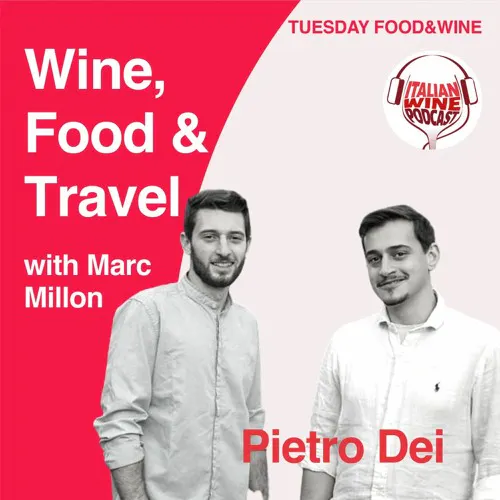
Ep. 880 Pietro Dei | Wine, Food & Travel With Marc Millon
Ep. 880 Pietro Dei | Wine, Food & Travel With Marc Millon
Episode Summary
Content Analysis Key Themes and Main Ideas 1. The journey and evolution of Podere La Maronaa, a family-run organic and biodynamic farm in San Gimignano, Tuscany. 2. The unique characteristics and historical significance of Vernaccia di San Gimignano as Tuscany's only white wine. 3. The principles and practices of organic and biodynamic farming and their impact on wine quality. 4. The integration of Tuscan gastronomy and traditional winemaking techniques (like amphora fermentation) into the wine tourism experience. 5. The importance of connecting wine, food, and local culture for visitors to San Gimignano. Summary In this episode of the Italian Wine Podcast, host Mark Millen speaks with Pietro Day of Podere La Maronaa, an organic and biodynamic farm near San Gimignano, Tuscany. Pietro shares his family's unique transition from scuba instructing to winemaking in 2000, driven by a desire for sustainability and health. He explains their philosophy of organic farming from the start, and their later adoption of biodynamic practices, detailing methods like using cow horns and following moon cycles. The discussion highlights San Gimignano's medieval history and its signature white wine, Vernaccia, which Pietro describes as an aggressive, structured wine best enjoyed with food. He elaborates on their amphora fermentation technique and their 100% Sangiovese red wine, ""Intensive."" Pietro also outlines their wine tourism offerings, emphasizing immersive experiences that combine wine tastings with handmade, seasonal Tuscan meals, traditional desserts, and cooking classes, all reflecting the rich local culture. Takeaways * Podere La Maronaa's founders made a significant career change from scuba diving to organic farming in 2000, prioritizing health and sustainability. * The farm transitioned to biodynamic practices in 2016, believing it yields richer wines with more mineral and fruity notes. * Biodynamic farming involves specific preparations (e.g., cow horns, crystal sprays) and adherence to lunar cycles to create a balanced ecosystem. * Vernaccia di San Gimignano is Tuscany's sole white wine, known for its strong, ""aggressive"" character that pairs well with food. * Amphora fermentation is used to create a micro-oxidized wine with enhanced structure and aroma, reflecting an ancient winemaking technique. * Podere La Maronaa offers comprehensive wine experiences, including multi-course meals featuring handmade pasta, fresh local ingredients, and traditional Tuscan dishes. * Tuscan bread is traditionally made without salt, complementing the region's salty cured meats and cheeses. * The winery produces unique dessert wines like Vin Santo and Profumo (a Sangiovese-based quinato). Notable Quotes * ""We were just three or four farms that made the organic... more than a hundred that we had."
About This Episode
The hosts of the Italian wine podcast discuss upcoming edition shows featuring wine and spirits dishes, family history, and sustainability. They also discuss the use of organic and Non-traditional farming, the importance of the moon and its impact on the wine's characteristics, and the importance of organic and Non-traditional farming in achieving different flavors and characteristics. They also discuss the use of yeast and the importance of the moon in the wine's taste and taste profile. The hosts explain their wine culture, including their approach to sustainability and their use of various products and networks. They also discuss the importance of organic and Non-traditional farming in achieving different flavors and characteristics, and their recipes and traditional recipes for creating drink and dessert. They invite guests to visit their show and thank the producing members for their time.
Transcript
Welcome to the Italian wine podcast. This episode is brought to you by Vinitally international wine and spirits exhibition. The fifty fourth edition of Vinitally was held from ten to the thirteenth of April. If you missed it, don't worry. Go to Vineethly plus dot com for on demand recordings of all the sessions from the exhibition. And remember to save the date, the next edition of Vineethly will be held from the second to the fifth of April two thousand and twenty three. Welcome to wine food and travel. With me, Mark Billen, on Italian wine podcast. Listen in as we journey to some of Italy's most beautiful places in the company of those who know them best. The families who grow grapes and make fabulous wines. Through their stories, we all learn not just about their wines, but also about their ways of life, the local and regional foods and specialties that pair naturally with their wines and the most beautiful places to visit. We have a wonderful journey of discovery ahead of us, and I hope you will join me. Welcome to wine food and travel with me, Mark Millen, on Italian wine podcast. Today, we head to Tuscany, to an organic and biodynamic farm just outside of one of Italy's most beautiful small towns. San Jimignano. To meet my guest, Pedro Day, who manages the family estate, Podare La Maronaa, together with his brother Corado. Ciao Pietro. How are you today? Tomma. Good. And you? Yeah. I'm really well. I'm just imagining the beautiful view you have from your farm. Can you see the towers of San Jimignano? Yes. I had this hour just in front of me. Oh, my. It's a a beautiful site, and it's one of the most popular places in Tuscany for visitors to to come in and discover this extraordinary medieval city with It's almost like their medieval skyscrapers, isn't it? Yes. Yes. We we have a lot of towers. We have a lot of things to see. To visit Olsen Jimiano, we should spend like a day because there is a lot of, like, attraction all around the the town inside and outside the walls. I I think maybe a day and a night because for me, San Jimignano is always best when the big coachloads of tourists have left in the town actually becomes quite quiet in the evening. Yes. Yes. Consider that the local go there just, later in the afternoon or later at the after dinner to the ice cream. That's nice. That's nice to just, nip out for a gelato in San Diego. You're very lucky living there. Pea, Peter, what were the towers for? These hours, they have different use. Mostly, they are used as storage. They, so inside, they have different layers and their storage food and treasure of the family. Okay. And they the most powerful family had the tallest tower? Yes. Yes. Officially, it depends about the how a family are. So if they are healthier, if they are have a lot of power. They have a lot of money. They make a bigger and taller tower. Okay. Size matters. Yes. Yes. But there was a, like a law that that allow the the nature of the town to make the taller tower. Oh, of course. So that's why the twin tower were born because it's a Gucci family, create the twin towers, has storage, but the legend say that you should put one in the top of the other one to create a tower that is taller than the big one. Now, you're you're in the countryside looking over, to this wonderful medieval skyline. But the countryside itself is probably not changed that much over the centuries. Is that right? Can you describe it for us? Describe where you are in the countryside itself? Yes. Yes. So, we are nine hundred meters far from the, seeding from the walls. And, now here, probably, it's not changing a lot because we still have vineyards. We still have a lot of woods. A lot of olive trees that are the most important production of San Jimiano. It's the and with the zaffron, since the middle ages, the two products that is very, very important. The Bernaza and the software. It's considered as gold, and then you need to make, exchange to pay, like, the rent of the house, or if you have some, you have to pay somebody. You can use the We're not sour, but it's offering to do it. And it's still producing here today. That's really interesting. So, Pietro, tell us a little bit about your family story, how you came to the Pildren Amada, This one is like a funny story because we start in two thousand. And before two thousand, both of my parents were Scuba instructor, and they have a diving. They always live here. My mom is born, where I was born in town, the inside the walls. And, my father is born half half an hour to here close to Florence. And, but they always live in San Jimignano. In two thousand, they decided to go to a farm and to start to make wine and olive oil. So a big family, a big, big change of career from from being in the sea and diving to, to working the land. Yes. It's totally different. And a big change for you and your brother as well. I was five, and my brother was three when we start officially. So I remember mostly working in the farms. I never make scuba diving. Right. Okay. So you you grew up here, Madania is really your life and and what do you know? Yes. Yes. I I I see the the farm boarding because when we take it, the house, the main house was a Old Watching Tower of the the new EVA age, and it was all destroyed. So we have restored it. And in my brother, we we we see everything. We have saw everything from the, restoring to the to the working officially. Okay. So the, the house needed to be restored. What about the vineyards? Were they already there and the olive trees? Were they there and needed? A fireTS and apart, no, we have in fact some new grape. For the olive trees, we use on a mostly old olive trees. But for the vineyard, we have a party with you and a party that it's old. Okay. Continue that we have one of the oldest vineyard of Vernacha. Is that right? Cause Vernacha is a very ancient grape. Yes. And we have one that begins from nineteen seventy, and it's the one of the oldest in San Jimmyana. Now when your family came to Marania, they wanted to farm in a particular way. It was important right from the start. To farm organically. Why was that? Why was their desire so strong to do things in this way? It wasn't actually that common in two thousand. Was it? No. It wasn't, in fact, it's not not so common. Consider that here in town, we are we were just three or four farms that made the organic. It's that the more than a hundred that we had. So, you know. And they they they just wanted to farm organically because I believe this was, very important for, for sustainability for, for the goodness of the wine. This, of course, but mostly because, me and my brother, we were very young, and we played around the vineyards, around the olive trees, and they don't want that we see in contact with chemical products. So, they did one for the sustainability, but also for me and my brother. So me and my brother, we were doing output, with the organic culture. And in fact, when my brother started in twenty sixteen, we he proposed to us to switch to the another kind of farming that's the biodynamic. Well, let's discuss, both organic and biodynamic, and some of the differences because it is a very particular way of farming, and, there are certain things that need to be followed. Yes. The organic head mission to don't use chemical for derivatives, don't use chemical fertilizers, know how jam, not pesticides. The biodynamic, it's it's different because it's based on an header. It's based on an ecosystem. So we wanna recreate it. In fact, we don't have try to create a collaboration between sky, soil, and plants. To do that, we use two network products. One is called Con five hundred, and another one, it's called Con five hundred one. The first one is a corn of a cow full with manure, and this one had inside more than two thousand different bacteriigos. Then transform all the natural ways that we live there into rooting for the plants. And the second one is a crystal, and we spray this one in a wooden part to permit to the, the sunlight to be reflected. So in that way, the plants can produce more energy. Considering, if we have a cloudy day before the harvest, we just at the last spring, the last kick to make a good harvest. We can distribute these products. In that way, defense are allowed to, to produce more good grip. And you're following the the cycle of the moon and of the planets as well? Yes. We we check it the moon phases because the moon phases are so important. Obviously, when you work, it's not possible to respect everything. Because, for example, if we have, like, a hard, the hardest time, and we know that, something we have, like, ten days of sun and after all water. And the moon phases is not correct. We should make the harvest in that timing because otherwise we cannot do it. Okay. So we had to find a balance between the natural side and the productive side. But mostly we try to respect all the roots of the biodynamic, especially the moon phases because they are so important. Yeah. I I think, you know, it it it makes sense because the moon is such a strong gravitational force, and it can you know, effect when you rack the wines, for example, to have the wines, less cloudy and and and so many different factors. It's such a powerful force. Biodynamics, I think used to be, you know, people were really curious about learning about this system with the cow horn filled with the manure and the phases of the mood. But it the the results that that good producers are getting really, justifies all of these different processes, and it reflects itself in the purity of the wine. Is that is that what you have found with your wine? You're getting a different flavors coming through now that you're biodynamic. Yes. Yes. We have we can really see the difference between the winemaker with the organic method and the ones made with the biodynamic method. The color, the flavors, the aroma, and also the structure. It's totally different. The wine, it's richer. It's much better. So you take more mineral notes, more fruity notes. Mostly because the soil, it's richer. So into the soil, we have more substance. We have more, nutrients. And the vines can absorb it and they can experiment into the grape. Yes. Right. And so that's reflected in the wine itself. Let's talk about two of your wines. And, let's talk about Verinaccia. This important grape. It's it's interesting that the Verinaccia grape is only found around San Jimignano. I know there are other Venacha, for example, in Sardinia or Nemarcke, but they're different great varieties. The Venace in Tuscany is only found around San Jimignano. That's curious that it it doesn't seem to have traveled and yet it's such a distinctive grape variety. Yes. Yes. The Villanache is one of the most important wine in Tuscany. It's the only white wine of, tuscany. It's very important because it's a medieval grape. And this kind of wine, it's, it's very strange. Consider that in town, we see that's a red wine with a white color. Because when you drink a white wine, mostly you respect, like, very fruity wine, like, a chardonnay, or, just from in there, very, very soft and light. In the natural, it's more butter. It's very, very strong. Very aggressive. So, it's it's a very strange wine. It's a big wine then to enjoy with food. Yes. We should definitely we should you use in combination with food. Because during by itself, it's, it's too hard. Oh, yeah. Yeah. You make a, version of Vernacha in amphora. Tell us about this and why you are fermenting or in in terracotta. SO, the TeddACOTA IS THE OLDEST MATH TO MAKE DIFFERMENTATION AND TO MAKE THE WIN MAKING. SO WE'RE GOING BACK TO THE ORGINES OF WHY AND THOUSANDS OF YEARS AGO. YES. Came from Armenia, from Georgia, Armenia, and, after we're imported here also. And we try to rediscover back these old techniques. Now we try to ferment in Amphora, we have, the first one, we have a two thousand eighteen Vernacha, but now we have also some red and some rosé that we try to ferment there. And to see what's coming out They offer I have a very good characteristic that I personally love it. They have, an exchange of c o two and oxygen. So the wine inside had a micro oxidation. In that way, he lost a little bit of his acidity of his freshness, but he developed more aromas, more structure. He become a wonder. He's a little bit delicate and rounder. By the same time, he take out the body the real body of the wine. So the wine would be more structured and deeper, especially the color. It's deeper. Is there skin contact? No. No. No. We don't have skin contact in the hand for us. We just press the grape. And we it goes straight into the embryo. Okay. With the natural yeast that's present only that had been from the skin? For for all our wines, we make fermentation without added yeast. So we make natural fermentation. This one allow us to have wine a little bit more structured, but also richer at the notes. Because if you're not sure they don't have a lot of, flavors has the, has I told you has the bistrami or the chardonnay. It's intense, it's rich, but not has the other one. So with that kind of winemaking, we can take out a little bit more. Now, San Jimiano is famous, of course, for Verlacha, less well known for its red wines, but you've been making your first red wine is pure san gervese. Is that right? Yes. The intensive, it's it's the wine that we had dedicated to my dad. Because all our wine have, have the connection with us. In general, it's dedicated to a member of our family. And this one is the ones that we dedicated to my dad because he had a very intense character and a very intense personality. And this wine is one of my favorite. It's made with a hundred percent of sangiovese. That's my favorite grape. It's a full body wine. Very aggressive, very, very tiny. In fact, the first things that you feel is the dry of the tenants. Adenose, it's a bunch of flavors. It's so rich, had a lot of flavors, a lot of aromas. And this one, it's not age or better. It's age just in the bottle. So you gotta make the finishing. It's fermented in a cement and have to make the finishing in the bottle. Okay. Just to keep that more aggressive character and let it just develop and evolve, you you're, making me really want to taste these wines. I love the sound of them with you know, the the Venacho with this real intense character, even a little bit of aggression, this white wine for people that love red wines, and then the intensive with this strong character of Sangiovese coming through in a in that with the acidity and and that slight bit of tannin or or more tannin than, you know, needs to be softened in the bottle. I love those ones, and I love them with the foods of the of your area too. Now, I noticed that you offer wine tastings with meals. That seems to me with this style of wine, the very best way to discover and taste wines. Can you tell us a little bit about how those wine tastings with meals work and what are some of the most typical foods that you think that people should sample when they're coming to San Jimignano when they're coming to Tuscany and want to really enjoy the local foods and the local wines. Of course. So mostly we have, different kind of wine tasting. The wine tasting with meal is composed by five different course. We have the bruschetta as appetizer after we have two first dish. Would that bruschetta be simply with your own tuscan extra virgin olive oil? No. It's like, it's make with fresh vegetables and, like, creamy cheese and everything. Okay. So a range of different butterscotch then. Yeah. Yes. It depends about the the day because it's make everything it's made fresh. We made it by hand also the pasta and all the sauces, all the sauces. What would be the typical pastas that you would have? We make, mostly, made three kind of pasta, make, p g, and yolky. Also, that we made by hand and we take all organic products to do it. Wow. You make all the pasta by hand. Yes. Well, fabulous. And what about, what sauce would be with that? Also, for the sauce, it depends about the season because we try to make everything with fresh ingredients. So it depends about the season. We have pasta, like, with, cabbage, or with, fresh tomatoes, we change it really often because the season is very different and not every day we can have the same ingredients. Yeah. That's great. You're really, reflecting the seasons and what's growing. What, what, what, what's in the markets, what's Do you grow some of the vegetables yourselves? We didn't grow inside the farm. We have, some friends that had the heritage, and then we take it directly from their and I imagine as well with that intensive wine that would be fabulous with a Yes. This one is perfect. It's the perfect, blend. The perfect combination. Yeah. So you would be cooking the the meats over a wood fire then. Officially, we don't make the tip on stick. We have colmids and cheeses. To, sample the wines as well with the salumi of of Tuscany, the saltier, prosciutto toscana, saltier than a daniele or the parma, but very, very good when tasting wines. And of course, the bread in Tuscany is unusual. Yes. The bread is without salt. Yeah. That that takes some getting used to. We lived in Tuscany, one year, and it took us a little while to get used to that. But once you're used to it, it's, you know, it's so good with the the salty salumi, with the pecorinos, the local cheeses. Now, you also offer cooking classes. Yes. We have different kind of cooking classes. We have the the ones of the pasta. We have the ones of truffle. Would that be the truffles from San Miniato? No. It don't come from San Minneapolis. It come from, or here San Jimiano or another village that's close to us. It's calling. It depends also that about the season because During the season of the white, we make with white truffle. During the season of the black, we make with black truffle. People tend to think of alba for the truffles and Piamonte, but it's important to remember that Tuscany has some wonderful truffles as well. Yes. Yes. We make less production than in the bmont, but we still have some good truffles. And what about a typical dessert? We so the typical dessert is the Cantuchini and Vincent. K. And you make your own Vincanto? We have our own Vincanto, and we we have the Cantucini, but also we make some, very particular cake, and we we change it also this one more or less every day. In combination with our profumo. The profumo is another dessert wine that we made. It's, it's a quinato. So it's infused with with flavorings, like in the way that Barolo quinato is. Exactly. Exactly. Instead, the guarola grape, we use the santa basic grape. So you've got the traditional vin santo made from the dried grapes, aged in the Caratelli, aged in the in the heat of the summer, the cold of the winter? Yes. Yes. Made with the this one is made with the tragiano grape, hundred percent. And you lay the grapes out, or you hang them up? No. We hang up. You hang them up. Okay. So it's a very labor intensive to to arrive at this exquisite dessert line, the Vincent. Okay. Well, Pedro, you've given us a wonderful overview of not just Lamaranaya, but also of San Jimignano, of the countryside, and of wine hospitality. Of I think to me, what I'm most interested in what I like best is discovering wines in the way that you've described being able to come to a farm to meet the people that make the wines, to taste the wines with the local foods. So I hope that some of our listeners and our listeners are located all over the world will be inspired to visit you and to discover your wines and your farm and your family for themselves. Thank you so much for being my guest today. It's a big pleasure. Pleasure to to talk with you and all of your listeners. To present my farm. Right. Well, I hope to meet you soon. Yes. Me too. Me too. I will invite you to bring the glass of wine with us. Oh, that'll be, that'll be with great pleasure. Thank you very much. Appressed off. Thanks. Bye. Appressed. Thanks for listening to this episode of the Italian wine podcast, brought to you by Vinitally International Wine and Spirits exhibition. The biggest drinks trade fair in the world. Save the date. The next edition of Vineet League will be held the second through the fifth of April two thousand and twenty three. Remember to subscribe to Italian wine podcast and catch us on SoundCloud, Spotify, and wherever you get your pods. You can also find us at Italian wine podcast dot com. Chinching. Hi, guys. I'm Joy Livingston, and I am the producer of the Italian wine podcast. Thank you for listening. We are the only wine podcast that has been doing a daily show since the pandemic began. This is a labor of love and we are committed to bringing you free content every day. Of course, this takes time and effort not to mention the cost of equipment, production, and editing. We would be grateful for your donations, suggestions quests and ideas. For more information on how to get in touch, go to Italian wine podcast dot com.
Episode Details
Related Episodes

Ep. 2822 Ep. 20: California | Study Smart for your WSET Level 3
Episode 2822

Ep. 2789 ColleMassari: a long-term vision rooted in Montecucco with Giuseppe Di Gioia | On The Road With Stevie Kim
Episode 2789

Ep. 2788 Ep. 14: Austria and Hungary | Study Smart for your WSET Level 3
Episode 2788

Ep. 2785 From Volunteer to Speaker at TEXSOM with Samantha Cole Johnson | TEXSOM 2026
Episode 2785

Ep. 2766 Inside the U.S. Non-Alcoholic Wine Market: What Wineries Need to Know with Jill Sites | Masterclass US Wine Market
Episode 2766

Ep. 2761 Winemaking and Consulting Across Sicily with Alessandro Serughetti | Wine, Food & Travel with Marc Millon
Episode 2761