
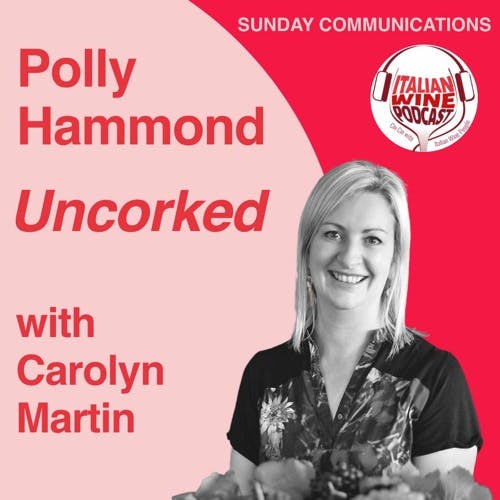
Ep. 1052 Carolyn Martin | Uncorked
About This Episode
The speakers discuss the challenges of creating a profitable business in the current pandemic and the importance of traceability and authenticity in fine wine. They emphasize the need for a more assertive approach to advertising and communication, creating a healthier environment for guest, and creating a diverse and sustainable approach to wine production. They also discuss the challenges of marketing and communication, the importance of innovation and upfacing the industry, and the importance of word-of-mouth in building a brand. They emphasize the need for continuous innovation and daily updates for consumers and customers.
Transcript
Welcome to the Italian wine podcast. This episode has been brought to you by the wine to wine business forum twenty twenty two. This year will mark the ninth edition of the forum to be held on November 2022 in Verona, Italy. This year will be an exclusively in person edition. The main theme of the event will be all round wine communication, and tickets are on sale now. The first early bird discount will be available until August 22. For more information, please visit us at winetowine.net. Hello, everybody. My name is Polly Hammond, and you are listening to Uncorked, the Italian wine podcast series about all things marketing and communication. Join me each week for candid conversations with experts from within and beyond the wine world as we explore what it takes to build a profitable business in today's constantly shifting environment. Today, we welcome Carolyn Martin, co owner of South Africa's multi award winning Creation Wines. As a third generation wine estate owner, Carolyn has wine business running through her veins, having served her first customer at the early age of five. In this episode, we talk about how a customer first approach has created an unparalleled experience, what fine wine means to Carolyn, and how collaboration has been key to their DNA from day one. Let's get into it. Good morning, Carolyn Martin. How are you? Excellent. Yes. Wonderful. Thank you for asking. I'm so glad to have you here with me. You were in the middle of winter in South Africa where I am broiling here in Barcelona right now. And you were you've just come off the heels of quite a big event there, in Stellenbosch. For anyone who doesn't know what we're talking about, we're talking about the Irani, annual event, the think tank gathering, where you've had a big focus on what is fine wine and what are the, challenges and, in fact, the opportunities that we're facing going forward. So now please proceed. So one of the things you have to do, Pauline, Vikal, has you worked together collectively on defining fine wine? Yes. I think, you know, for me, it was just wonderful to be part of this summit on fine wine. And it's really one of the things that we had to discuss was, you know, what is the definition of fine wine? And I think this is something that's really difficult to put out there. I had to write up mine. And for me, the ethos is really it's about culture and provenance. And it's really all about, character and personality. And I really want people to enjoy authentic wines that have traceability and, you know, that have exclusivity, wines which offer elegance, finesse, and really great quality. And, I mean, this has been the ethos of creation wines from day one. Like, this is not a a pivot or a change for you or how you've built the brand. What what does all of that you know, they're they're great words that we use in trade, but when I'm sitting in the customer space, when I'm standing in a shop trying to buy or I'm I'm trying to recommend something to my friend, what does that mean from a a consumer perspective to have traceability and authenticity and integrity in in what we do? I think, really, it's about traceability. And I think that's one of the great things about South African wines is that we have this amazing ability through the wine of origin scheme to actually, you know, have site specific registration to know that, you know, what we say is 100% authentic really is. And we've set benchmarks on, on on global sustainability from that point of view. I, I, one thing that has always intrigued me about the South, the South African wine market, and I will admit I'm not an expert on it by any means, is that it feels like it has really gained cache externally at very rapid pace over the past sort of five to seven years. Was this part of a concerted effort? I mean, you know, did you come together as a region and say, we must cooperate to build our our national and our regional brand in our export markets, or was it serendipitously a a series of producers and it just came together? So it's quite interesting. I think, you know, one of the things that, we need to understand is that, you know, there is a diaspora of South Africans living around the world. And so I'm kind of going to look at this from a consumer point of view and really just say that what we find is, you know, these are, incredibly, you know, there are amazing South Africans around the world when you think about some of the inventions and some of the people that are out there. But there is this real feeling of nostalgia, in a way, for our country of birth. I mean, I think we all have that. And I think, you know, they love sharing. These discerning wine buyers, who are interested in discovering the world of fine wines are also, wanting to share their discoveries, with friends and family and with colleagues. And so this diaspora of South Africans, I think, through this feeling of nostalgia, they want to connect with the country of birth. And one of the ways that they do it is through the wonderful fine wines that we produce in South Africa. I spent twenty five years in New Zealand, where, of course, we've got exactly that population that you're talking about, where that feeling of home, the the proliferation of South African food stores, of of South African cuisine. So I think that's really interesting to to identify the diaspora as, like, your early network. How do you then translate that or transfer that into those drinkers being brand advocates? So someone in New Zealand, has a premium bottle, has a bottle of creation wine, and now they're gonna go out and talk about how fabulous you and your culture is. What have you had to put in place for that? So various things. I mean, during lockdown, we obviously did a lot of virtual and hybrid tastings when we couldn't connect with people, directly, you know, and actually see them face to face. And I think that gave us a chance to make sure that, you know, we kept our relationships with our customers and with our guests that would normally visit the farm. And I think the other thing that is just wonderful is our tasting room. So our tasting room creates this amazing opportunity. So when people do visit, we create these curated experiences. And the most important thing for us is actively listening to our guests that visit and co creating with them and actually developing new experiences, getting feedback from them. And so that's such an important part of who creation is in terms of our innovation. Do you have a big staff in the tasting room? We do have quite, quite a big staff and, you know, it was really hard during lockdown. We have, 50 people that work in wine tourism between our kitchen and, yeah, between our culinary team and the tasting room. And I think, you know, what we really had to think about during lockdown, because we were totally sort of annihilated, if you like, by the lockdowns, Absolutely. From a government point of view. And so we had to think about how do we, you know, how do we manage, sort of people's mental and, well-being during lockdowns, you know, the toll that it took COVID on all of us. And so one of the things that we did was we focused on leadership training and, you know, tried to create a more resilient team and actually did a lot of, skills transfer. And we worked together with nutritionists and psychiatrists and psychologists. And Really? Yeah. It was pretty incredible, really. But what this did was it really pulled the team together and it created a much happier, healthier environment. So that's fascinating because, one of the things I wanted to ask is, you know, how do you train your team to be an active listener, you know, to actually hear the the obvious, but kind of understand the non spoken messages that you're getting from the consumer. And I guess this goes back for to me, to what you're saying about culture, that if if you're supporting them and they fully understand what the brand is, then the likelihood that they
Episode Details
Related Episodes

Ep. 2795 Ep. 15: Spain | Study Smart for your WSET Level 3
Episode 2795

Ep. 2789 ColleMassari: a long-term vision rooted in Montecucco with Giuseppe Di Gioia | On The Road With Stevie Kim
Episode 2789

Ep. 2788 Ep. 14: Austria and Hungary | Study Smart for your WSET Level 3
Episode 2788

Ep. 2785 From Volunteer to Speaker at TEXSOM with Samantha Cole Johnson | TEXSOM 2026
Episode 2785
Ep. 2766 Inside the U.S. Non-Alcoholic Wine Market: What Wineries Need to Know with Jill Sites | Masterclass US Wine Market
Episode 2766
Ep. 2761 Winemaking and Consulting Across Sicily with Alessandro Serughetti | Wine, Food & Travel with Marc Millon
Episode 2761