
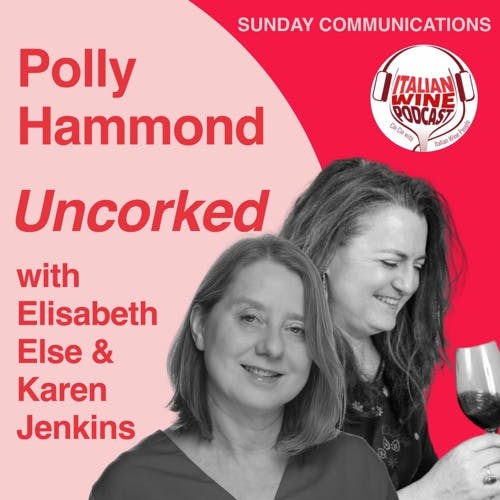
Ep. 1084 Elisabeth Else & Karen Jenkins | Uncorked
About This Episode
The hosts of the Italian wine to wine business forum discuss the challenges faced by producers and the importance of educating consumers on trade relationships, using social media, and upskilling crafts and clients. They emphasize the use of language, communication, and community involvement in promoting tourism. Speakers emphasize the importance of being a professional and being a creative person, while also acknowledging the challenges of promoting the industry and promoting their brand. They also discuss the use of social media and the importance of wine with all, while highlighting their brand and efforts to promote their brand.
Transcript
Welcome to the Italian wine podcast. This episode has been brought to you by the wine to wine business forum twenty twenty two. This year will mark the ninth edition of the forum to be held on November 2022 in Verona, Italy. This year will be an exclusively in person edition. The main theme of the event will be all round wine communication, and tickets are on sale now. The second early bird discount will be available until September 18. For more information, please visit us at winetowine.net. Hello, everybody. My name is Polly Hammond, and you are listening to Uncorked, the Italian wine podcast series about all things marketing and communication. Join me each week for candid conversations with experts from within and beyond the wine world as we explore what it takes to build a profitable business in today's constantly shifting environment. Today, we're recording live from the YNB annual trade tasting where we're joined by Karen Jenkins and Elizabeth Els. Together, they're working with some of The UK's finest producers to improve business models, drive brand building tourism, and grow successful digital. Join us as we settle in for a conversation about the new and old challenges for producers and solutions to thrive amidst today's uncertainty. Let's get into it. We are hiding out in a backroom at the Wine GB annual trade tasting. I'm here with Karen Jenkins and Elizabeth Els, who I have known or communicated with in the wine world at this point for years, And we're gonna talk about UK wine marketing, about trade communications, about the new WineDB report, and let's get into it. So, it's nice because I can see faces, but the audience can't see us. So I'm gonna quickly ask each of you to introduce yourself and just tell us a little bit about your expertise in wine and where you are rocking change for our industry. So, Karen, you have a fabulous producer's toolkit that we're gonna talk about. If you're shy to introduce yourself, do you wanna start with that? Okay. Well, the producer toolkit, is about helping producers to how they communicate in terms of getting their basic information right. And all of that comes from my background as working for an import as an importer for the last twenty something years and what the requirements were in the trade to know about producers and their wines to be able to basically support the sales of those wines. So when I decided to work for myself a few years ago, I wanted to pick an area that was of interest to me and get back to my roots and force myself to do some more academic study and be able to put all that information into context for people. Because people in the trade are really, really busy and everybody pretends they don't pretend, but they have to get on with the next thing. So they gloss over stuff, and sometimes you need to spell out some of the basics to them to really understand who you are and what you do. So So along with the producer's toolkit, you do a lot of consulting as well, with in house teams, and then you do a lot of collaborative work with With Elizabeth. With Elizabeth as well. Yeah. So different opportunities come up. It comes from working in the trade for many years, working with really good producers, importing, representing them, background in retail before that. So I just love all the different things. And I quite like being independent now because I can look at the trade from lots of different angles. And although I've been doing it a long time, I love all the new developments. I love having met people like yourself from social media and things like that because I never would have had these opportunities fifteen, twenty years ago because the trade didn't didn't work like that. Awesome. Well, we're gonna come back to that and talk about some of the channels that trade is using. But first, Elizabeth. So, I'm gonna fangirl for a moment because there are so many people who do the thing that you and I do, Elizabeth, and they don't necessarily do it well, and it's not necessarily in wine. And I've always enjoyed communicating with you and working with you because you're so talented at the work that you do with wine brands around digital. So can you tell us a little bit about that, with the cellar door and how that has evolved into consulting? It all started because I was doing, ecommerce for quite big brands, nothing to do with wine, and I was embedded with a client for twelve months or so, typically, doing quite big stress for launches. And then I was thinking I need something to do in between. So I'd take a gap between those projects and, started visiting vineyards and just doing a block just for my own sake. And then he realized after a while that it's very easy to find who grows so many hectares of Chardonnay. But if you want to know which vineyards open on a Tuesday, it's almost impossible. So I thought, well, I could do that because to me, a website where you can say a dress that's red with short sleeves is exactly the same as a vineyard in Surrey. That's open on a Tuesday. So that's just the way my brain works. And so I built that website just, just for fun. And that's gone through a few iterations. And then I started doing, a bit of e commerce in wine and now mainly I'm doing consultancy because I can see where producers can improve in their direct to consumer offering, you know, mainly sort of, you know, tourism and e commerce is sort of the way I've come at DTC. And those are the main routes to market really for people selling direct direct to consumer. So what I think is really interesting about this is that both of you are working in wine education. But so often when we talk about wine education, what we're talking about is, advising the consumers, is educating the consumers. But, really, there's a lot of growth that we're seeing happening in terms of the knowledge base or the desire to learn amongst producers and their in house teams. So, Karen, you were working on the educational side of their trade relationships and their trade representation and their communications, are there patterns that you just, you know, every time you take a look at a prospective new client, you look at what you're doing and you're like, yep, a, b, c. I see this time and time again. What are those most common pitfalls? The most common pitfall, I think, specifically talking about English and Welsh producers is is the understanding between their their own DTC sales, their online sales, and retail pricing in the trade. Oh, talk about that. You mentioned the p word, pricing. Pricing. Yeah. Yeah. That's my Yeah. Having worked as an importer, you know, working at sellers, working in The UK, you know what the margins are gonna be. At an event like this, people have to give a an indication of their resale pricing. It's it's where people assess you, what bracket they put into, and often people struggle to have that accurately. But the big issue with, English producers when they start out, they're gonna they're all about their website and their sell at all, and they've gotta think about the bigger picture to what that where they pitch themselves as to where that pricing will put them if they had trade clients later on. So which direction does that go? Chicken or the egg? Is it that they've started out with retail pricing and they've decided they want to adopt some sort of digital strategy? And then they're saying, okay. I've got channel conflict, and how do I price this in such a way that I don't piss off all of my trade relationships? Or is it, you know, people who are just starting out as the example that you gave who aren't thinking, oh, at some point, I need to be able to move beyond d to c. Think about that thing then. It sounds over the top when they've got 300 balls to sell, swing the first you know, but it is where you're gonna put your pricing. And then if you have to sell that to a trade person, could you still make that price? And if you're gonna put it on your website, will that be the same price
Episode Details
Related Episodes

Ep. 2795 Ep. 15: Spain | Study Smart for your WSET Level 3
Episode 2795

Ep. 2789 ColleMassari: a long-term vision rooted in Montecucco with Giuseppe Di Gioia | On The Road With Stevie Kim
Episode 2789

Ep. 2788 Ep. 14: Austria and Hungary | Study Smart for your WSET Level 3
Episode 2788

Ep. 2785 From Volunteer to Speaker at TEXSOM with Samantha Cole Johnson | TEXSOM 2026
Episode 2785
Ep. 2766 Inside the U.S. Non-Alcoholic Wine Market: What Wineries Need to Know with Jill Sites | Masterclass US Wine Market
Episode 2766
Ep. 2761 Winemaking and Consulting Across Sicily with Alessandro Serughetti | Wine, Food & Travel with Marc Millon
Episode 2761