
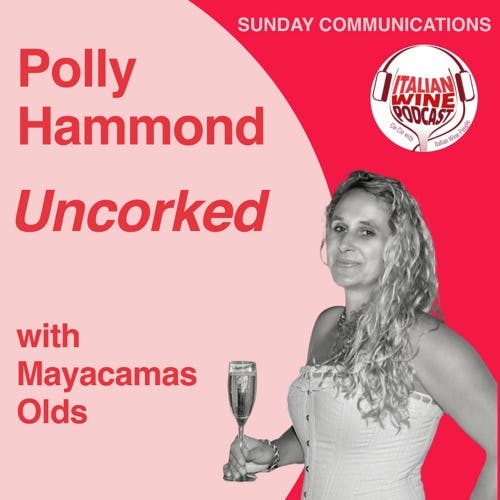
Ep. 1108 Mayacamas Olds | Uncorked
About This Episode
Representatives from Uncorked wine podcast discuss their efforts to build regenerative models across all facets of wine, their work as a chemist, and their onboarding process. They also discuss the challenges of sustainability and the need for people to understand the meaning of words like "ma'am," and "hasn't." They express concern about the negative impact of the pandemic on their family, and the importance of protecting the environment and creating a world-class, sustainable, and long term brand. They also discuss the importance of sustainability and its impact on the industry and the need for more discussion about it.
Transcript
Welcome to the Italian wine podcast. This episode has been brought to you by the wine to wine business forum twenty twenty two. This year will mark the ninth edition of the forum to be held on November 2022 in Verona, Italy. This year will be an exclusively in person edition. The main theme of the event will be all round wine communication. Tickets are on sale now. So for more information, please visit us at winetowine.net. Hello, everybody. My name is Polly Hammond, and you are listening to Uncorked, the Italian wine podcast series about all things marketing and communication. Join me each week for candid conversations with experts from within and beyond the wine world as we explore what it takes to build a profitable business in today's constantly shifting environment. This week, we welcome Maya Kamas Olds. Born and raised amidst the vines, Maya Kamas has spent her entire life in the wine world. Over ten years ago, before sustainability was an everyday buzzword, Maya Kamas earned her master's in corporate sustainability and has made it her mission to build regenerative models across all facets of wine, not just in the vineyards. In this no holds barred interview, we discuss everything from the need to vote and prioritizing mental health to the great resignation and caring for our ag workers. Let's get into it. Good morning, Maya Kamas. It's very early where you are there in California. Good morning, Polly. I'm happy to be here early this morning. It's foggy and nice and cool here, luckily, for a change. Nice. Nice. So, I I've known you on and off for a couple years. We do work with some of the same organizations, and I when I was doing the research for this interview, I actually found out something that was just sort of like, oh, light bulb for me, which is you're really well known as GM and as a viticulturalist, but you actually have a master's degree in corporate sustainability, which and you've had it for a long time. It wasn't like you went off, you know, three years ago. You're like, oh, sustainability is important. I mean, like, this this dates back ten years or so. So I would love it if today, we can talk about some of your work and your efforts with sustainability. But first but first, I wanna talk about your fabulous name and your history in wine for all the people who don't know you, who are like, Mayakamas. That sounds familiar. Why do I know that name? Where does it come from? So Mayakamas is the name of the mountains that separate Napa and Sonoma County. They are named there's a little bit of controversy. It's a native American word, but, fundamentally, it means howl of the mountain lion. There's some different spellings to the north that have a slightly different meaning, but I'm not gonna talk about that because it's not my expertise. I am named up in the mountains in which I was born and raised. My dad was also the winemaker at my Akamas winery for most of my childhood and when I was born. So, I love that. So when we talk about, you know, we talk about all these different ways that we have multicultural or, excuse me, multi generational wine families. I think that yours seems to be almost like the lowest key version of the multi generational wine family because you've grown up in this. Your family has Sky, which stands out because it is an off the grid vineyard. Is that correct? Yep. Everything is off the grid. We have never had electricity on the property. My parents bought it in the early seventies. The winery is run off a generator when we have to do some major projects, but the rest of the time, it's solar. The house is solar. The vineyards the only thing that right now is my current focus is trying to get our well on solar, so it pumps water to our tanks automatically to feed the vineyard and do everything else. My comments, are you a hippie? Like, it's the family sort of old California hippies. My parents definitely are. I'm a little I'm on the edge of being a hippie and not because I truly I mean, I went and got my master's in sustainability when it wasn't the cool thing to do. But also I like technology in the future, and I'm not really a back to the Earth or back to the lander. So I hate patchouli. I don't like You're not wearing hair and pants and and dancing like Jesus at Wilmette. That's really just not no. No. No. I'm gonna get belayed for saying that probably. You actually tell this story that at 16, you were like, fuck it. I'm out. I'm running away from home. And that didn't maybe take you as far from one as you'd hoped. No. It drove me straight into Spain, into Jerez De La Frontera where I ended up getting a job and working because that was my skill set. So my plan to run away was a complete failure. I learned about doing my research about where I want to go and how to get there. The good thing is I learned Spanish in a way that most people don't get to as, you know, a white American girl. And I learned to be independent. How did you as in, like, you learned it in the in the vineyard or you learned, like, proper immersive Spanish? Like, what was did you learn all the good naughty words? What was different? I learned all the good naughty words. I was in the cellar just working with whoever was there. Nobody spoke any English, you know, in 1992, I wanna say, 1991, something like that is when I was there. Like, nobody there spoke any English. Americans were vastly hated because it was near the Rota American military base. So I had to really defend my position and be a good representative of a California girl, and I think I was successful. How long did you stay in school? I was there for just about a year. And then I came home to back to wine in California? No. I came home to study politics and chemistry. And how long did that stick? Three years, I studied that. And then my math skills were not up to the major that I wanted in microbiology. And so I ended up in fermentation science instead. So really as a chemist, but we can just all much more appreciate the work that you're doing than, you know, if if you were a lab chemist doing something else. So high five for that change as a wine lover. I I will say I'm okay with that. So corporate sustainability. You have been a pretty vocal, you know, advocate for as long as I've read anything that you've written or as long as I've heard you speak around issues. First, it was organics, then organics, it seems like over the years, really took on a much more regenerative approach. But it's not just in the vineyard. Is that correct? Your your approach is much more about that beyond the vineyard. Yeah. When I was in the Presidio graduate school, we learned a lot about at that time, regenerative agriculture was only just, starting. It was this gentleman in Texas was kind of starting to do it. But in our program, we talked a lot about bringing that piece of kind of using regenerative economies and regenerative systems to help the ecosystem services, people, economies, like everything. And so everywhere that I've gone, I've kind of melded that into my leadership, whether it was at Diageo after I graduated or really at Newton is where I really was kind of given free rein to kind of wrap it into the whole business. So we were really doing that was really how we were rebuilding Newton to come back. And at Gloria, I had even more leeway to do what I needed. It was COVID, and it was an amazing time and a place to get to show that it works. Like and I really I mean, you saw little bits and pieces of it. I really kind of tried to ingrain it into every piece of the business, making sure everything we did gave back in some way. Every decision we made, like, we thought out, like, where it was going and where it would take us. It didn't always work, but it really made us think through every decision we made. But so what does that mean in, like, the day to day context? And and this is not particular to any one position or another position, but I'm just thinking about all of the jobs that we alread
Episode Details
Related Episodes

Ep. 2795 Ep. 15: Spain | Study Smart for your WSET Level 3
Episode 2795

Ep. 2789 ColleMassari: a long-term vision rooted in Montecucco with Giuseppe Di Gioia | On The Road With Stevie Kim
Episode 2789

Ep. 2788 Ep. 14: Austria and Hungary | Study Smart for your WSET Level 3
Episode 2788

Ep. 2785 From Volunteer to Speaker at TEXSOM with Samantha Cole Johnson | TEXSOM 2026
Episode 2785
Ep. 2766 Inside the U.S. Non-Alcoholic Wine Market: What Wineries Need to Know with Jill Sites | Masterclass US Wine Market
Episode 2766
Ep. 2761 Winemaking and Consulting Across Sicily with Alessandro Serughetti | Wine, Food & Travel with Marc Millon
Episode 2761