
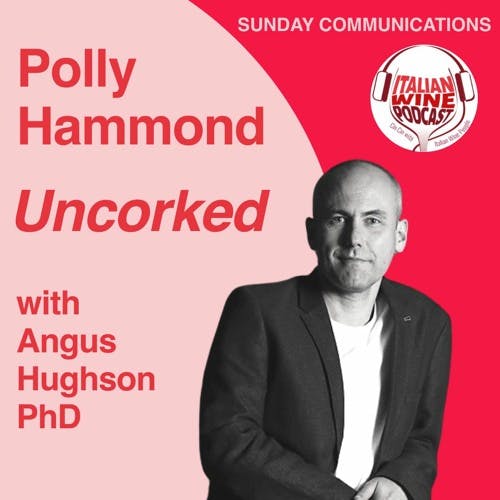
Ep. 1124 Angus Hughson PhD | Uncorked
About This Episode
The Uncorked wine podcast series discusses the challenges faced by the Australian wine industry, including lack of quality and privacy issues, and the success of Nolo brand due to mixed experiences and historic pictures. The speakers emphasize the importance of creating historic pictures and anecdotes, as well as the history and influence of the wine industry, including the German wine industry and "Grange dinner" where they were at the restaurant. They also touch on "Grange dinner" where they were at the restaurant and "Grange dinner" where they were talking about the "Grange dinner" where they were at the restaurant.
Transcript
Welcome to the Italian wine podcast. This episode has been brought to you by the wine to wine business forum twenty twenty two. This year will mark the ninth edition of the forum to be held on November 2022 in Verona, Italy. This year will be an exclusively in person edition. The main theme of the event will be all round wine communication. Tickets are on sale now. So for more information, please visit us at winetowine.net. Hello, everybody. My name is Polly Hammond, and you are listening to Uncorked, the Italian wine podcast series about all things marketing and communication. Join me each week for candid conversations with experts from within and beyond the wine world as we explore what it takes to build a profitable business in today's constantly shifting environment. This week, we're coming to you live from the wine industry impact conference in a very rainy Bendigo, Australia. My guest is the clever and witty Angus Hewson, a fellow who wears many hats in the wine industry, including writer, critic, publisher, and digital media specialist. Today, we dive into the challenges facing Australian wine and what it's going to take to excel and what we need to know about the coming wine consumer. Let's get into it. Gonna hit record, and I'm gonna say this is the first time I've ever gotten to drink while I'm recording a podcast. So that is very lovely. Welcome, Angus. Well, thank you very much for having me. I hear, I actually I recognize on the slides that you're doctor Angus. I am doctor Angus. I did a PhD on wine tasting at the University of Sydney. I completed that in 2003, and I pretty much invented the degree. Was there anything that you learned that we didn't already know? Like all psychology, no. Really, what I found was pretty obvious. Essentially, what I was looking at, I was looking at whether wine expertise was perceptual or cognitive. So wine expertise, is it based on being a, you know, having amazing, perceptual skills and being better than everyone else, or is it a cognitive information processing skill base? And that's what I found. But, basically, guess what? Wine experts have more information than novices. Wow. That's some that's some deep and meaningful research you did there. Four years. Your brain is big. This and the Australian government paid me for four years, you know, to study, you know, study this, give wine to first year students. And and, you know, the first year students were happy, and so was I. And and where has that taken you? Alright. For the the benefit of our listeners, what do you do in your, you know, day to day life? Look. In my in my day to day life, I am a wine writer, publisher, you know, general man about town in terms of Sydney and wine. I, you know, I I write for the Australian newspaper, the national newspaper. I've been a wine correspondent for fifteen years, which I can hardly believe myself, really. Thank you, Rupert. Does that make you one of the few staff writers for wine left? I I'm not staff. I'm still casual. But but within but within the Australian, there are basically three of us. So there's James Halliday, there's Max Allen, and myself, and and the three of us have been right. I mean, James obviously been writing for a lot longer than me, but, yes, fifteen years as a columnist for The Australian and the newspaper and a broadsheet, who can believe these animals still exist in this world? I want I wanna come back to this, but you but you write for basically everyone. So you write for the Australian? Yep. You write for Venice? I do. Yes. I do. So I I'm I'm recently been appointed the new Australian editor for Venice, which is, extraordinarily exciting, really, in a number of ways. Firstly, Australian wine hasn't been that well covered in the global wine media. I mean, it's definitely I mean, Josh Reynolds did a great job at Binnis previously, but I think there's when you're in the when you're in the country and you speak to the people and and you you know, every day, I just think that that gives it, I guess, a different a kind of a different view on it. So it's look. It's exciting for me in terms of it's a, you know, it's a great platform. It's a platform I've been a fan of for many years, and I think they the way that Venus goes into wine in-depth and regions in-depth, I think, you know what? It's actually exactly as you as the conference we're at right now, Bolly, you know Yeah. Where the hell are we? Yeah. We're recording live. Yeah. I don't get to do this that often. No. No. So what we know we know, you know, we've been at this conference for two days, and we've basically been saying Australian wine has some challenges. And in the export market, there's actually not that much knowledge about Australian wine, and, you know, I'm really looking forward to, you know, essentially, you know, using that Venus platform to tell all these amazing stories for this. You know, our wine industry started in the eighteen hundreds. It's been going for two hundred years, really, and in and out, phylloxera wasn't ideal, but it wasn't ideal for everybody. But we have this amazing wine history in this country. You know, Penfolds and Torbrick and all those guys, they do great things, but there's so much more going on, and I am so looking forward to using Venice to spreading the biblical words of Australian wine. That's really interesting because, of course, you know, and I do wanna come back to some of the other things that you're working on on publishing and writing, but understanding that we're speaking to so many different audiences and having to tailor what we're saying to our different audiences. Is that just a natural skill of someone who's a writer or is that something that you had to learn to be like, okay, who is my audience in this space? How am I going to convey it to them? What sort of language and presentation do I use between, you know, say, Venice and the Australian or moving forward to wine pilot with what they're doing with that? Look. I I think I'm I'm, you know, I'm I'm incredibly lucky in that, you know, I'd learned wine right well, I learned to write as a doctoral discipline there. And that and, you know, my first wine writing was the most horrendous wine writing you've ever seen because it sounded like I was an academic, and at the time, I was. But, writing for four years every day teaches you to be a better writer, and then over time, I've morphed that into really different places. I've also I've had a I've had a history of start up ecommerce retailers. I've I've been involved in that kind of thing. I've probably written more spam in Australia than any other man. So I've I've I've I've Everyone's turning off. Don't say that. Don't say that. Don't say that. Don't say that. No. No. But I've I've I've I have been involved in the retail industry as well for a long time at at various parts at a premium level, at a, you know, at an everyday level. So I've written that I've written a hell of a lot of words for for for different audiences and, you know, my PhD is actually in psychology. So it's in the school of psychology. So my I have psych training and I I think I bring that to what I do in terms of writing is is an understanding that we're all different species and we're all in different places and, and people respond to different nuances of language and I think over time, fifteen years writing for the Australian and monthly column too, you you learn to, you know, look after your audience and and I've always really tried so hard to because I think sometimes in wine writing we talk about terroir too much and hills and slopes and mellow and blah blah blah. We talk with all that stuff, but when I write, I really am out looking to, you know, tell the truth and be honest, but also how can I make this wine or this place sound as sexy as possible? How can I entertain whoever it may be, whether it's for the Australian newspaper, which is an old male white guy in Sydney or around the world potentially who's
Episode Details
Related Episodes

Ep. 2795 Ep. 15: Spain | Study Smart for your WSET Level 3
Episode 2795

Ep. 2789 ColleMassari: a long-term vision rooted in Montecucco with Giuseppe Di Gioia | On The Road With Stevie Kim
Episode 2789

Ep. 2788 Ep. 14: Austria and Hungary | Study Smart for your WSET Level 3
Episode 2788

Ep. 2785 From Volunteer to Speaker at TEXSOM with Samantha Cole Johnson | TEXSOM 2026
Episode 2785
Ep. 2766 Inside the U.S. Non-Alcoholic Wine Market: What Wineries Need to Know with Jill Sites | Masterclass US Wine Market
Episode 2766
Ep. 2761 Winemaking and Consulting Across Sicily with Alessandro Serughetti | Wine, Food & Travel with Marc Millon
Episode 2761