
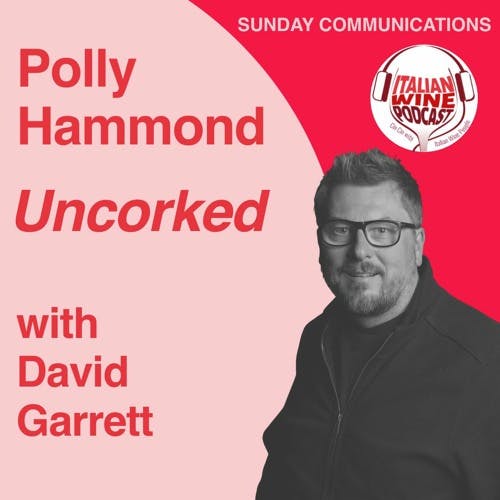
Ep. 888 David Garrett | Uncorked
About This Episode
The speakers discuss the benefits of NFTs in the world of wine, including accessing art, updating images, and creating new NFTs. They also mention the use of NFTs in virtual wine cellar and the potential for community building. The use of NFTs in the wine store and for events like club and global club shows is emphasized, along with the importance of the wine podcast being the only wine podcast with a daily show since the pandemic. The speakers thank everyone for listening and acknowledge their role as the only wine podcast with a daily show since the pandemic.
Transcript
Welcome to the Italian wine podcast. This episode is brought to you by Vinitili International Wine and Spirits Exhibition. The fifty fourth edition of Vinitili was held from ten to the April 13. If you missed it, don't worry. Go to vinietli+.com for on demand recordings of all the sessions from the exhibition. And remember to save the date. The next edition of vinietli will be held from the April 2023. Hello, everybody. My name is Polly Hammond, and you are listening to Uncorked, the Italian wine podcast series about all things marketing and communication. Join me each week for candid conversations with experts from within and beyond the wine world as we explore what it takes to build a profitable business in today's constantly shifting environment. We are joined today by David Garrett, cofounder of Club Divin, the fastest growing NFT community in wine. He has graciously agreed to help me and hopefully some of you understand exactly what are NFTs, how they've been used in the non wine world, and what are their implications for today and the future of wine. Let's get into it. David Garrett, I'm really excited to have you here today. You are one of the cofounders of one of the fastest growing NFT and wine platforms. Club Divin has a very specific direction that it's going with NFTs that is a little bit different, I think, than what a lot of us maybe in our low level of understanding, think of when we think of NFTs. And so I am I'm super excited to kind of pick your brain today and help you help me and the audience understand, as I put in the title for this, NFTs, what the fuck. So welcome. Well, thank you very much. I appreciate, the opportunity to to chat with you today. And I, for a very long time, said Apaches what the fuck myself, and didn't, you know, people had been bringing me Y and blockchain projects for a long time, to look at, to help out with, to invest in. And, for the longest time, I would learn a little bit and look at it and say, yeah. I don't I don't really get it. And then I would learn a little bit more and say, I don't really get it. And then a light bulb went off about, I guess, about nine months ago. Somewhere between a year and nine months ago. And that's, that really caused, what you see in Hub2Vin and how how So it was so light on ground crew. What was what was the thing that took you from where we are right now, which is, you know, what the fuck, to now having an an NFT that you're really in the process of launching? So, the the the light bulb for me was in looking at instead of looking at NFTs as a as a piece of art or even looking at at an which which they are, and and that's, that's an important piece of it. The art or the design, the, you know, the storytelling of an entity is really important, the visual aspect. But that that wasn't quite enough. I thought it was interesting, but it wasn't quite enough. Mostly because it it existed in places where, where it's not not super easy to find, not super easy to see. There wasn't there wasn't enough there. And then, you know, you started looking at at NFTs as a as a deed of ownership, which also interesting, but, but not really, you know, most people we we've gone for a very long time, four thousand years without a deed of ownership for our for our bottles of wine. I don't know why we necessarily need one right now. It's interesting, but again and and there are I can see some some ways that that's that's important. I'm sure we'll talk about that later, but it wasn't enough. It wasn't until we saw the utility, the ability for that NFT to be functional, to provide a to provide a way to identify individuals or to identify holders of the NFT and provide those holders with some sort of utility community connection. And Okay. And that's really where the where the label went off. I I wanna jump in on this because I I feel like, at least for me and my research, I wanna sort of go back to some basics. So NFT, non fungible token, which basically, according to my understanding, means that it is a it is not a commodity where you can have a one for one interchange of a good. Is that kind of correct? Sure. I mean, it's like, it's a it's a store of value that is non non fungible, non exchangeable for another one. So for example, your, and this is actually the the the really the easiest way to say it. If you've got $200 bills, they're exchangeable for one another. If I've got a 100 and I give it to you and you give me your $100 bill, then it's the same. We're in the same place. But if I've got a deed of ownership to my house and you've got a deed of ownership to your house, those are not exchangeable. Right? I can't give you mine and you give me yours, and then we both just have the same thing. So so that's the that's really the difference between, a fungible token, which is a total you know, one one for one. Mhmm. And then nonfungible, which is they're two different things. Right? They're they're two they're both assets, but they're different things. It's a unique thing. A fungible token is a unique thing like your house. So in in the language that I think in my head made a good segue, An original piece of art, is that considered basically like an old school NFT? I have one piece. It only exists as this one piece. I can never trade it for another one piece that's exactly the same. Is that, like, is that kind of an NFT? Kind of. Actually but and when you think about it this way, it's actually not the art itself. It's the ownership of that art. Right? Like, the token that represents the ownership of that art, that's the that's the thing that's the NFT. So if you have if I've got a piece of art and you've got a piece of art, then we can't just exchange them for one another because they're unique. Right? We can't exchange ownership of those for one another with art. There's there's a problem. And it's Not just problems, but they're different. Right? Like, you're you might have a Monet and I might have a Matisse. Those two things are not but they're they're different. Right? They have different This is what we all want. I'm not a Monet. You have the Matisse. Yes. So then because, again, I'm, you know, coming from more of a creative background, I'm just really trying to make certain I understand this. So what I've understood from some of the early NFTs that happened in art is that because there's a direct line, because, a, it's a digital product and there's a connection between the artist and the purchaser that there is updatability, which Picasso cannot come back into my house five years later and decide that he wants to add another Dachshund to the picture. I can't have a moment in life and say, hey. I have three Dachshunds. Can you add more Dachshunds? Because somehow I've engaged with you and you've met my Dachshund. Like, is it is is part of the value that there is an interchange or an adaptability or a growthability? So that's not always the case. So some some NFTs, some art NFTs, are, so this is and this is we're getting a little bit technical here. But Okay. Some sometimes it's on chain and sometimes it's off chain. So let me let me let me kind of explain what that means. When I say that an NFT is a deed of ownership, that's really true. The thing that is the NFT is, you know, it's a wallet address, and it's some information about a about the ownership of a specific thing. Now for most art, and if you have an art entity, part of the metadata of that thing that you own is a link to the file. Right? It's a link to a JPEG or it's a link to a video file or it's a link to an animation. That's that's a piece of the metadata. It's not all of it, but a piece of it. So there are two ways that you can do that. One way is on chain, which means that you're storing the image on the, IPFS, and that's that's actually a funny thing. They call it the IPFS. That stands for the interplanetary file system. IPFS, interplanetary I'm just gonna sing beastie voice, but that's Yeah. Yeah. It's just crazy. But so th
Episode Details
Related Episodes

Ep. 2795 Ep. 15: Spain | Study Smart for your WSET Level 3
Episode 2795

Ep. 2789 ColleMassari: a long-term vision rooted in Montecucco with Giuseppe Di Gioia | On The Road With Stevie Kim
Episode 2789

Ep. 2788 Ep. 14: Austria and Hungary | Study Smart for your WSET Level 3
Episode 2788

Ep. 2785 From Volunteer to Speaker at TEXSOM with Samantha Cole Johnson | TEXSOM 2026
Episode 2785
Ep. 2766 Inside the U.S. Non-Alcoholic Wine Market: What Wineries Need to Know with Jill Sites | Masterclass US Wine Market
Episode 2766
Ep. 2761 Winemaking and Consulting Across Sicily with Alessandro Serughetti | Wine, Food & Travel with Marc Millon
Episode 2761