
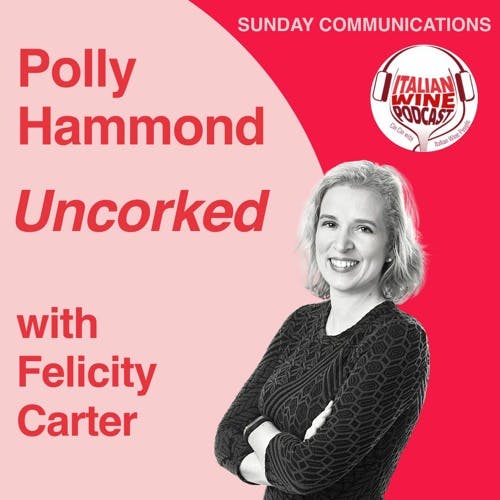
Ep. 924 Felicity Carter | Uncorked
About This Episode
The representatives fromPARI International Academy emphasize the importance of creating "good stories" and transformation in writing, with a focus on creating a "good story." They also stress the need for research and data on the alcohol industry to improve the value of wine in shaping people's views. The speakers acknowledge the need for long-term research but note the complexity of the market, with the need for long-term research and data on the wine industry.
Transcript
Welcome to the Italian Wine Podcast. This episode is brought to you by Vinitili International Academy announcing the twenty fourth of our Italian wine ambassador courses to be held in London, Austria, and Hong Kong from the twenty seventh to the July 29. Are you up for the challenge of this demanding course? Do you wanna be the next Italian wine ambassador? Learn more and apply now at vinitiliinternational.com. Hello, everybody. My name is Polly Hammond, and you are listening to Uncorked, the Italian wine podcast series about all things marketing and communication. Join me each week for candid conversations with experts from within and beyond the wine world as we explore what it takes to build a profitable business in today's constantly shifting environment. Today, we're joined by the multi talented miss Felicity Carter, a respected journalist, editor, and all around answer seeker. Felicity chats with me today about the ins and outs of publishing, why the editing process is crucial to proper journalism, and how wineries can use tried and tested writing techniques to improve following, loyalty, and sales. From feedback to Freytag, we're talking good stories and good writing. Let's get into it. Good morning, Felicity Carter, one of my very favorite people in war in the world, not just in wine. One of my very favorite people. Thank you for joining me today. Good morning, Polly. It's always a pleasure to talk to you because you're one of my favorite people. Well, we, Antipodeans, have to stick together. That's really what it is, especially in wine. I was thinking when I was writing the intro for this that, like, everyone knows you. I feel like everyone knows flisty and what you do and what you've done. But, actually, you have you have done a lot of shit that is not sort of wine trade related, and that is going to tie into some of the things that I wanna talk about today. So I wanna start with this big question. Tell me a little bit about what you did in the writing and journalism world, in advertising and marketing before you got sucked into wine. Oh, well, so I tried very hard to be a, to be a performer. I trained originally as a classical singer, but the fly in the ointment, the the click in the plan was that I wasn't good enough. And so, I I found myself I found myself in my late twenties with a day job, which was writing brochures for a wine company, and I suddenly realized it was my real job. It wasn't my day job at all. So, I went into advertising as a copywriter. I went and worked in a blue chip agency. We had really big clients, Mastercard, Qantas, people like that. And I learned I learned the dark arts of persuasion through through copywriting, but I didn't really enjoy people telling me how to use my creativity. And, you know, what happens is everything is done by committee. So you write something and then a whole bunch of lawyers and account people come along and completely rewrite it into nothing. So I went back to university, I did postgraduate work in journalism, particularly after September 11, I was really interested in foreign affairs, And then I graduated and discovered that there were, to my horror, that there were no jobs being offered to mature age students who couldn't speak Chinese, Russian or Arabic, that the, foreign correspondence was just, not gonna happen. So, I basically did lots of things. I worked I I worked as a freelancer, so I worked for newspapers. I worked for magazines. I did general feature writing. I did a lot of science and medical reporting, because I'd done some science at university. And, and then I I did some wine writing as well. So and, and in that period, I also wrote a couple of books, and, I ended up doing book editing too. So I've had quite a lot of experience across a range of media. Book editing. Yes. We had a, when I worked at Mininger's, we had a absolutely, sensationally talented sub editor who, was in town because his wife was teaching at the international school here. I've never worked such a absolutely top class professional. I used to get emails from him at 03:00 in the morning thinking, you know, saying, here's why I've rendered this Russian name in English like this. Here's my reasoning, and he would write me a long email. But he went back to The States with his wife and, became the CEO of a major romance book house. So a few years ago, he wrote to me. He said, we're we're just overwhelmed with work. Can you can you edit some of our books? So for a while, I did. I used to edit romance books while I was in airports. You edited romance novels. I did. I I mean, I can't help but think about we laughingly call the back of late or, you know, back of wine bottle labels romance, and a lot of the content that we write for websites, we describe as the romance language on it. I mean, is there anything when you look at the writing that we do in in our wine world that reminds you of your romance novels and editing? Absolutely nothing. They can Absolutely nothing. That means we're failing because holy shit, romance novels sell like hotcakes. Maybe we need to. They do. Well, the the so like most people, I, you know, I I don't actually read many romance novels myself, and so I wasn't sure how I would approach it. But when you when you do it, it's it's like any other writing. Is there clarity? Do you understand what's going on? Is there some sort of, you know, passion, you know, written into it? Is it do you get sucked into the characters and so on? And that's true whether you're editing crime or romance or thriller or or literary books. And so what you often see in line writing is you see, you see two sort of problems. One is that often it's didactic. Somebody is writing to educate the reader. Most readers don't actually want to be educated. Most people are not sitting around thinking, today I would really like to know about the soil in a random area of Spain. Where can I get an article about that? And most people actually get really pissed off at the notion that we're trying to educate them. Like, they may not this is what we notice in in our user feedback that they may not express it as I'm pissed off because you're trying to educate me, but there's sort of this tacit abrasion that they're like, you know, if you're trying to educate me, the implication is I am stupid or do not know enough. And that that that's just very uncomfortable for a lot of people. Yeah. And most of us yeah. Most of us, when we in our own spare time, are not reading to, you know, so that we can study up for an exam. And a lot of a lot of wine writing is written as though, you know, you're you're gonna study it at the end and take a test. Lots of information that's completely unnecessary or information that's given and then the the reason that you're telling somebody isn't there. So I get a lot of wine articles sent to me, and somewhere in the wine notes, some people say, and this is on, you know, slate soil. And I always go, so what does that mean? What does that mean for the final wine? What does that mean for the taste of the final wine? Why does somebody need to know that this has gone on a slate soil? And quite often, they can't tell me, in which case, I just strike it out. It means it's it's not necessary. So is there a big difference between the marketing copywriting that you did when you were, you know, like, early out of postgrad compared to the would it be considered creative writing that that you work in now? Yeah. There's a big difference. So the big difference is is what are you writing it for and, who is your audience? So when you're doing marketing copywriting of any sort or advertising copywriting, your your goal is very simple. It's to sell. You are there to persuade somebody to buy something, and that's the game. I've got something to sell. You've got money in your pocket. I want the money. And nobody reads advertising copy for entertainment or for, for educational purposes. They don't wanna read it. Right? They wann
Episode Details
Related Episodes

Ep. 2795 Ep. 15: Spain | Study Smart for your WSET Level 3
Episode 2795

Ep. 2789 ColleMassari: a long-term vision rooted in Montecucco with Giuseppe Di Gioia | On The Road With Stevie Kim
Episode 2789

Ep. 2788 Ep. 14: Austria and Hungary | Study Smart for your WSET Level 3
Episode 2788

Ep. 2785 From Volunteer to Speaker at TEXSOM with Samantha Cole Johnson | TEXSOM 2026
Episode 2785
Ep. 2766 Inside the U.S. Non-Alcoholic Wine Market: What Wineries Need to Know with Jill Sites | Masterclass US Wine Market
Episode 2766
Ep. 2761 Winemaking and Consulting Across Sicily with Alessandro Serughetti | Wine, Food & Travel with Marc Millon
Episode 2761