
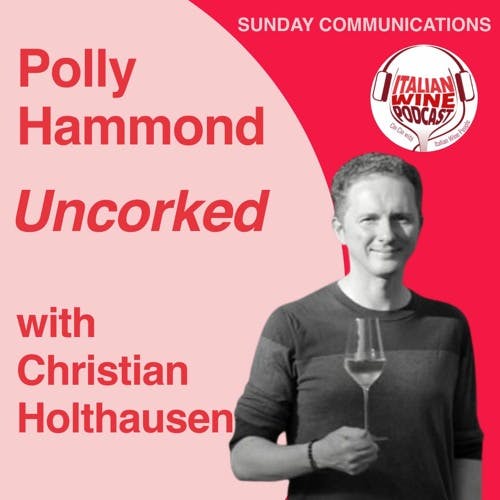
Ep. 960 Christian Holthausen | Uncorked
About This Episode
The Italian wine podcast Uncorked discusses the loss of personal connections and the importance of finding the right person for a job. They emphasize the importance of building a brand profile in the industry and finding the right person to represent the client. They also discuss the challenges of finding the right person for a job and the importance of finding the right person to represent the client. They stress the importance of finding a clear message to attract customers and creating a brand profile in the industry. They also discuss the importance of understanding demographics and finding the best producers for their work. They emphasize the need for a more collaborative approach to communication and the importance of working with luxury brands.
Transcript
Welcome to the Italian wine podcast. This episode is brought to you by Vinitili International Academy, announcing the twenty fourth of our Italian wine ambassador courses to be held in London, Austria, and Hong Kong from the twenty seventh to the July 29. Are you up for the challenge of this demanding course? Do you want to be the next Italian wine ambassador? Learn more and apply now at vinitiallyinternational.com. Hello, everybody. My name is Polly Hammond, and you are listening to Uncorked, the Italian wine podcast series about all things marketing and communication. Join me each week for candid conversations with experts from within and beyond the wine world as we explore what it takes to build a profitable business in today's constantly shifting environment. This week, we welcome Christian Holthausen, an absolute rock star of public and press relations in wine. We'll talk relationship building, budgets, influencers, and how good old fashioned bar stories can help us be better communicators. Let's get into it. Good morning, Christian Holthausen. How are you? Good morning, Polly. I'm great. Thank you. You're in Paris today. Is that right? I'm in Paris every day, which is quite cool. Well, you're sort of in Paris every day, but you've got clients all over Europe and The UK. So, you know, you bebop around. Yeah. I do. I do bebop around, but, my home is Paris. I'm very lucky to be French and American. And I spent, most of my childhood in New York. And I've spent most of my adult life in Paris, and I feel very lucky to be able to do so. So God forbid you ever end up in, like, Cincinnati. Cincinnati is a cool city. It's a really cool city. Alright. I'll let that one go. So, so I I've asked you to join us today because I have done in the past interviews with publicist and public relations, execs, and this is your bailiwick. I mean, everyone that you talk to, knows you know, EnWyme knows you. You've got a great reputation as a talented communicator, and I'm really curious to talk with you about some of the differences we see between, you know, sort of old world and new world communications, some of the trends that you're seeing, but also just some of the the misconceptions around what PR is and what you can and can't make happen. So maybe let's start with that. PR today, what what does your job include anymore in an era of digital and social media and, you know, podcast and YouTube and everything else? Like, what do you spend your day doing? I mean, I think that one of the things that's really interesting about, being the age that I am, which is 48 years old, is, we're young enough to adapt, but also old enough to know, like, how things were. And I think it's really interesting because when I first started, my career in 1998, we literally had a Rolodex. We literally had, like, you know, personal, phone numbers. We didn't even have mobile phones. We had personal phone numbers. And, basically, your card was basically, like, who you knew. Whereas today, you can get in contact with anyone on LinkedIn or on Instagram. Like, if I wanna find out, who x writer is for, you know, x magazine, like, you can find that very easily. And if the story is compelling enough, you can completely get in contact with them. So that's definitely, then a change for sure. But I Can I jump in on that, though? So I remember the days of being hired for your Rolodex. I mean, I I was in Los Angeles. I worked in politics, and very much it was who who you had access to was, you know, set your pay scale and decided whether or not you were going to get that job. Do you feel like that the loss of the personal connection that is implied by having someone Rolodex. I mean, that was an assumption that we knew somebody, and we had a direct dial line. Do you think that the loss of that personal connection, is outweighed by the access to basically everyone in the world. You might be cold calling or cold messaging someone nowadays. So even though we can get to them, we don't necessarily know them. I think that I agree with you a 100%. I think that the thing that I'm really proud of is that I do have very, very close personal, relationships with a lot of the people that I'm reaching out to. They could be, you know, sommeliers. They could be journalists. They could be whoever. And I think that keeping that direct communication and, also, I'm not just contacting these people when I'm pitching them something. I'm contacting them just to check-in because a lot of these people become real friends, and and you actually get to know them and know what they need and know what they don't need. And you also know what they might be interested in communicating about or not. There's a whole list of people that you're like, okay. They will like this, and then there's a whole list of people like they will not like this. So I think that having that personal relationship is cool. I see that the the cold contacting stuff, which now everyone does, I don't really like because, for me, I always like to be introduced to someone by someone. Like, if you said, hey, Christian. You need to meet this person. I'd be like, okay. Well, we have poly like in common. So therefore, if I respect her and trust her, then clearly, I will probably respect and trust the person she's introducing me to. So I still think that's really important. You see the way that people contact the rest of the world now, and it's so cold. It's very cold and and impersonal. And the thing that I hate more than anything is, you know, when you get these emails from people that say, hey, Polly. Hope you're well. And you're like, we've never even met before. You don't hope I'm anything. And what I love about those are the unsubscribe button in that email as well, where I'm like, oh, thank you. I don't know you. You scraped my data. You added my name to a list. And guess what? I don't care what you're pitching. You're out the door because there's that you know, that's not how I do business. I I think that one of the things that I'm kind of remarking upon as you're talking is this notion of empathetic, you know, communication. And and sitting in that middle space between the clients and what I'm gonna describe as the broadcasters, you know, the publishers, the people who are actually gonna get that word out. I always tell the story about George Clooney. The brief version is George Clooney's career changed when he realized that he was the solution to casting director's problems. You know, he he wasn't it wasn't his problem. It was theirs, which is a very empathetic approach to what kind of problem am I trying to solve. You know, this is the thing is that you're looking at it and you're saying, okay. What's the problem that I'm trying to solve on both sides here? And and how do I actually make my work of value to both of them? And and the the reason that I'm kind of harping on this is I think a lot of what I see in PR, and and we have the opportunity with Five Forest to read a lot of people's, you know, PR pitches. They're so I'm just gonna tell you everything that I want you to know about me, and I don't give a rat's ass what how this matters to you and your life. And I'm not gonna structure this to apply to you at all, and now go forward and, you know, be my voice. Like, it it's just so abrasive and poorly written, actually. We can separate that separately. You know, so so in that context, like, let's just say if I'm out there and I'm looking for someone to do the job that you do, what should I be looking for? Should I be looking at tenure? Should I be looking at breadth of relationships? Should I be looking at sweetness and personality? Like, how do I find the right person for that job? It's it's a tough one. I mean, I I I like your focus on the word empathy because I think empathy is very important. I think that being a high level empath means that you actually know what people need. You actually know what people don't need. That's, an easy skill to assess for
Episode Details
Related Episodes

Ep. 2795 Ep. 15: Spain | Study Smart for your WSET Level 3
Episode 2795

Ep. 2789 ColleMassari: a long-term vision rooted in Montecucco with Giuseppe Di Gioia | On The Road With Stevie Kim
Episode 2789

Ep. 2788 Ep. 14: Austria and Hungary | Study Smart for your WSET Level 3
Episode 2788

Ep. 2785 From Volunteer to Speaker at TEXSOM with Samantha Cole Johnson | TEXSOM 2026
Episode 2785
Ep. 2766 Inside the U.S. Non-Alcoholic Wine Market: What Wineries Need to Know with Jill Sites | Masterclass US Wine Market
Episode 2766
Ep. 2761 Winemaking and Consulting Across Sicily with Alessandro Serughetti | Wine, Food & Travel with Marc Millon
Episode 2761