
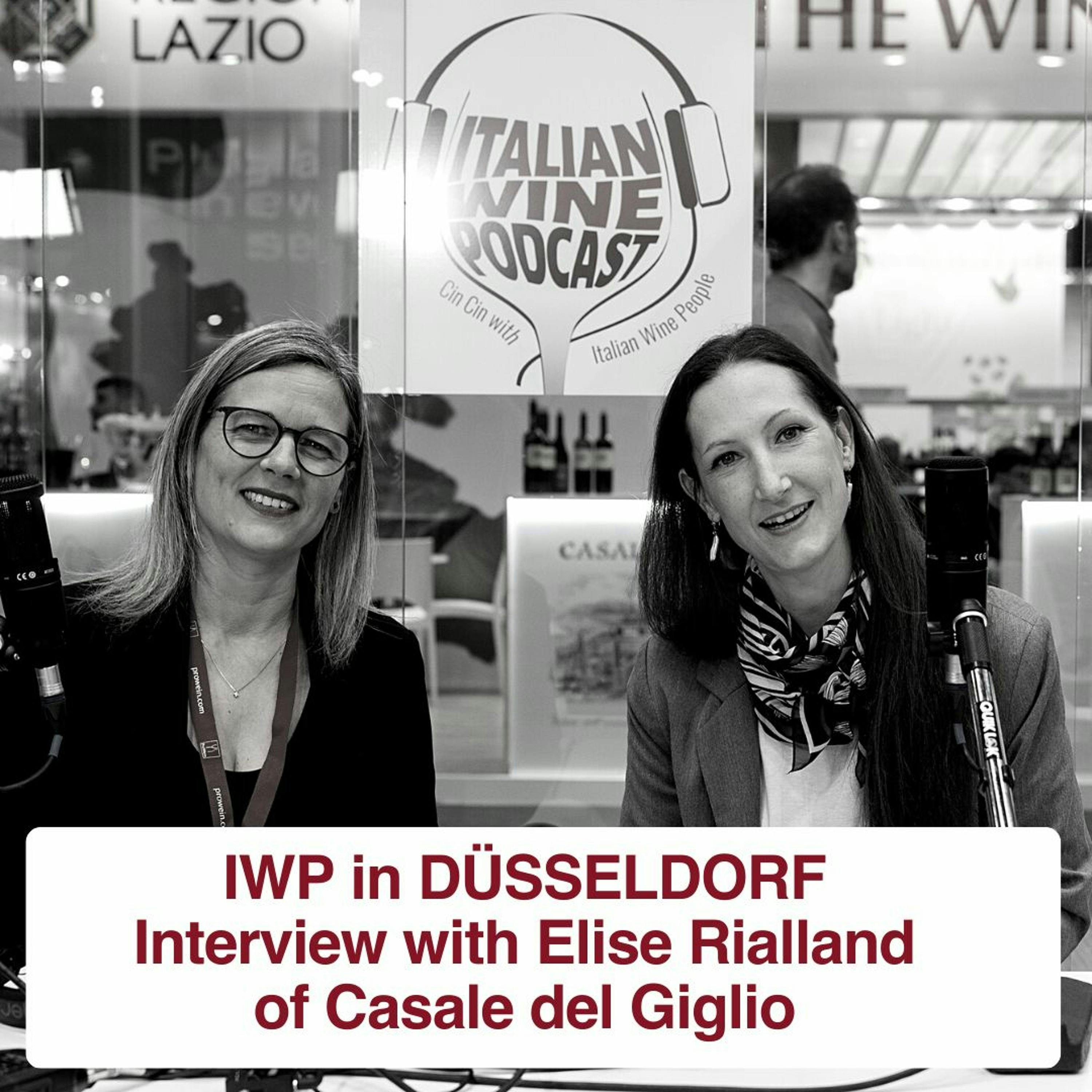
Ep. 1364 Elise Rialland | Italian Trade Agency Masterclass Wineries In Germany
Italian Trade Agency Masterclass Wineries In Germany
Episode Summary
Content Analysis Key Themes and Main Ideas 1. Promotion of ""Italian Wine Unplugged 2.0"" and a new podcast mini-series featuring Italian wine producers. 2. In-depth interview with Elise Realon from Casale del Giglio, a winery in the Lazio region. 3. Casale del Giglio's unique experimental approach to viticulture, testing 57 grape varieties in the 1980s. 4. The challenges and opportunities of promoting wines from the less-known Lazio region. 5. The successful integration of both international (e.g., French, Spanish) and indigenous Italian grape varieties at Casale del Giglio. 6. Export strategies and market development for wineries outside of Italy's most famous wine regions. 7. The personal journey of a non-Italian individual working in the Italian wine industry. Summary This segment from the Italian Wine Podcast begins by promoting ""Italian Wine Unplugged 2.0,"" a newly revised book on Italian wine, and introduces a new mini-series focusing on Italian wine producers attending a trade event in Düsseldorf, Germany. The main content is an interview with Elise Realon of Casale del Giglio, a winery located in the Lazio area, approximately thirty miles south of Rome, near the coast. Elise, a French native who has lived and worked in Italy for nineteen and fifteen years respectively, discusses the winery's unique history. In the mid-1980s, Casale del Giglio embarked on an ambitious project to plant 57 different grape varieties—both Italian and international—across their 180 hectares, featuring three distinct soil types and under the influence of the constant sea breeze. This extensive experimentation aimed to identify which grapes best adapted to the region's specific terroir, an area not traditionally known for vine growing. The results showed a surprising success for many international grapes, particularly French ones, alongside a commitment to rediscovering and utilizing local indigenous varieties like Biancolella, Bellone, and Cesanese. Elise candidly addresses the challenge of marketing Lazio wines abroad due to their lack of recognition but emphasizes the winery's dedication to quality. She details Casale del Giglio's current export markets (Germany, US, Canada, Switzerland) and their ambitious plans to expand into Australia and South America, where indigenous grapes are gaining attention. She highlights key wines like Madresilva, their flagship Mater Matuta (Syrah/Petit Verdot blend), and her personal favorites, the white Bellone and their pioneering 100% Petit Verdot, which was the first in Italy to receive IGT appellation in Lazio. Takeaways * ""Italian Wine Unplugged 2.0"" is a comprehensive, updated book on Italian wine. * The podcast mini-series focuses on presenting Italian wine producers at international trade shows. * Casale del Giglio is a pioneering winery in Lazio, located close to the coast, south of Rome. * In the 1980s, Casale del Giglio conducted a large-scale experiment, planting 57 different grape varieties to assess their suitability for the local terroir. * The winery successfully cultivates a diverse range of grapes, including international varieties (e.g., Syrah, Petit Verdot, Viognier) and rediscovered indigenous ones (e.g., Bellone, Cesanese, Biancolella). * Marketing wines from lesser-known Italian regions like Lazio presents significant challenges abroad due to lack of awareness. * Casale del Giglio is actively expanding its export markets, targeting regions like Australia and South America, where indigenous grapes are helping them gain traction. * Notable wines include Mater Matuta (flagship Syrah/Petit Verdot), Madresilva (Bordeaux blend), and a unique 100% Petit Verdot, which was the first of its kind to achieve IGT status in Lazio. * Elise Realon's personal story exemplifies dedication to promoting Italian wines from less famous regions. Notable Quotes * ""The fully updated second edition was inspired by students of the Vin Italy International Academy and painstakingly reviewed and revised by an expert panel of certified Italian wine ambassadors from across the globe."" (Referring to Italian Wine Unplugged 2.0) * ""Casale del Giglio is a winery located in the lazio area. Exactly, it would be like thirty miles south of Rome, just just by the coast."
About This Episode
The Italian wine podcast, led by Speaker 0, features a new mini series on Italian wine and a welcome from Stevie and her just do the work team to discuss their wines. They have selected a portion of their international and French grapes, including local indigenous ones that may not be popular. They are working to export their wines from the Latu area and expanding their market in the Latto region. They are also trying to export their wines from the Italian wine industry and plan to expand in other markets. They are working to export their wines from the Latu area and have seen success in Germany, Canada, and South America. They are also promoting their podcast and showcase their success in Germany and South America.
Transcript
By now, you've all heard of Italian wine Unplugged two point o. The latest book published by Mamma jumbo shrimp. It's more than just another wine book. The fully updated second edition was inspired by students of the Vin Italy International Academy and painstakingly reviewed and revised by an expert panel of certified Italian wine ambassadors from across the globe. The book also includes an addition by professor Atilio Shenza. Italy's leading vine geneticist. The benchmark producers feature is a particularly important aspect of this revised edition. The selection makes it easier for our readers to get their hands on a bottle of wine that truly represents a particular grape or region to pick up a copy, just head to Amazon dot com, or visit us at mama jumbo shrimp dot com. Welcome to this new mini series on Italian wine podcast. Join Stevie and her just do the work team. As they travel to Dusseldorf, German, to interview some great Italian wine producers. Each producer had submitted one of their wines towards the special Italian trade agency's master classes. Each were run by master Somalier, Eros Teboni, join us to get the inside scoop on these fantastic wineries. Okay. So I am here with Elise Realon. Yeah. Got it. Okay. And, from Casalle del gio. Yes. So, yes, we are enjoying a fantastic afternoon here in Dusseldorf. In Germany, I would like you to, tell me who you are and tell me a little bit about your winery. Okay. So it's very nice to be here and to be relaxed with you here today. Okay. So I'm Elise. I'm French, but I've been living in Italy for nineteen years and working for Casa del gio for fifteen years now. So, Casa L'adenjillo is a winery located in the lazio area. Exactly, it would be like thirty miles south of Rome, just just by the coast. So, actually, Casa delilio is in an area called Agro Pontino, which is not that famous for, vine growing. Okay. It was really not a a tradition for vine growing. But we, for so, there was a great potential there. So we decided in the mid eighties to plant it fifty seven different kind of grapes. Wow. Both Italian and international just to see which were the grapes that had left the best to that area. So the winery is launched a hundred and eighty hectares. So we have three different kind of soils. So the idea was also to test those grapes, those varieties in the different soils with the climate that we have, obviously. And we have to see that we have, like, ten minutes from the sea. So with the constant savories. Right? So that was very interesting. And, actually, it turned out that, a lot of international and French grapes demonstrated to that very well in our area. So that's why we have, for example, the sovignon, the vignonier, the petite man saying for the whites, but also the Sierra, a petite verdeau for the gray for the reds, and also the Spanish and Pranilio, for example. Oh, okay. So that was very interesting. So out of those fifty seven, we've selected one third of them that have been replanted, and that are now part of the range, Casaille del silio. So both international, mainly French, and also the Italian grapes because we also wanted to rediscover some local indigenous grapes that maybe sometimes were a little bit underestimated in our area. So we've started, on the island of Ponsa, which is just in front of the Roman coast, just in front of, Rome, and with the Biancolella, which is a indigenous grape that was used to, grow on the Eastka island, but is have been brought also on the Poons Island, but very small island, so small production. And then with the balloon in the area of Anseo, and other indigenous local grapes, in the Vocadian area, those ungrafted vines, actually, and with the Chisanesi, Morinda Hitezeland, the Hilli area. So all those local indigenous grapes have joined the international grapes to enlarge our range so that we have really, another view in our range of the potential of the territory, the expression of the grapes, and of the territory. Yes. We're saying that you had gone there in the mid eighties. What brings a French lady to the south of Rome in the mid eighties? How did that happen? No. In the mid eighties, no. Actually, the mid eighties was the project. Project. Yes. So I yeah. No. Because I I graduated in languages, so I wanted to have an experience, abroad. So I had first an experience in the States and then in Italy. It was supposed to be six months. And it turned out that nineteen years. Yeah. Something like that. The the settings happened. Yeah. So that's why I haven't actually. Yeah. Yeah. And, but I wasn't in the in the wine business, actually. But then I met, so my husband, And, his family, they work in the wine business. So they, that's how they introduced me to the wine business. And, that's how I met my first time with Casa del Gileo. And then, yes, I really fall in love with the you know, this adventure with the winery, with the wines. And it's really a challenge for us because the lazio wines, you know, abroad are not easy to to to be sold, you know, they are not, you know, when you are in the parts of the world. They don't know about Latu wines. So that's really a challenge for us to tell the people that there are great potential for quality wines in the Latu area. And that Casa del gio really definitely believe in this challenge and quality wines. Okay. Are you enjoying this podcast? Don't forget to visit our YouTube channel, mama jumbo shrimp for fascinating videos covering Stevie Kim and her travels across Italy and beyond. Meeting winemakers, eating local food, and taking in the scenery. Now back to the show. We were I was just talking about Master classes before we started talking at the beginning. Which which wine are So the one was Madresilva. Madresilva. Yes. So Madresilva is a blend of, a border blend of merlo, Petiverdo, and Cabernet Savignon. Okay. And, it's the board delayed lens you need to make that. That's Yes. Exactly. Yes. Is that your signature wine? It's not actually it's not exact the signature wine, which one of the reserve wines. The sinestro one will be mater Matouda, which is the flagship of the wine. It is eighty five percent Sierra and fifteen petiver dough. So this is the a wine that was thought by the winemaker to really express the excellence of this territory and would be mater Matuta. Yes. Yes. Okay. And, another question. You were just saying that it's difficult to have the wines from this area known outside. Do do you export here, and if is there an area or, sorry, a market where you would like to start export? So we we are present in Germany. We work with an agency. Yeah. Yes. I was with Tarantino. Uh-huh. I guess, Tarantino. They are our urgency for Germany. And, we are trying, yes, to work. So we are already present in the States, present in Canada. In Europe, we have some, you know, mainland It's like Switzerland, Germany, or but we would like now to focus on also more difficult market, which is even more difficult for us being from Latto, but we, like, for example, Australia, we are trying to work there in South America. Oh, wow. So those are Yeah. Two markets on which we are trying to, you know, penetrate them and have them, you know, discover and taste our wines. Yeah. And on those markets, the indigenous grapes have helped us a lot. Yeah. Yeah. So below in Chezonese, those are two wines that really abroad are getting more known, and people are getting curbs about those grapes. So that's, yeah, helping us. Out of all the wine, because It's a lot of a lot of wines. Yes. A lot of wines. Which one do you think you drink most? When you take home at the end of that, you had a hard day. Yeah. You go home, and you're like, I'm gonna choose something to drink Yeah. What what is it? So I would have, like, my two favorites. Right? Yeah. Yeah. Exactly. So I would say that, the Anthem Belone is one of my favorite for the whites. Yeah. Because it's really, the baloney is really the anthem is like a glass of sunshine. Right? It's a seaside grape. So it's really it's very you get the perfume, you get the aromaticity, you get the grapefruit, you get the sunshine. It's very nice, very nice. And, I would say that for the reds, we have a very special red, which is a petriver dough. So it's a French grape. Usually used in very small percentages in the border blends, but we managed to have a pure, hundred percent petriver dough, And this one is really a tricky grape, and we are very proud to have a pure we were the first one to get make it pure in Italy and to get the IGT appolation in Latcio for the for that grape. And we are very proud of having, like, a hundred percent PDivado, and I think it's one of, yeah, very good. Yes. That's pretty cool. Yeah. Yeah. A little bit of friends, anything. Yes. Don't have friends. Thank me. Exactly. Well, thank you so much for taking this question. I know you're so busy. Like, seriously. Thank you so much. Thank you. It's been a pleasure really. Okay. So here we are with Eliza Realon. Thank you. You too. Bye bye. Listen to the Italian wine podcast. Wherever you get your podcasts. We're on SoundCloud, Apple Podcasts, Spotify, email ifm, and more. Don't forget to subscribe and rate the show. If you enjoy listening, please consider donating through online podcast dot com. Any amount helps cover equipment, production, and publication costs. Until next time. Chichi.
Episode Details
Related Episodes

Ep. 2789 ColleMassari: a long-term vision rooted in Montecucco with Giuseppe Di Gioia | On The Road With Stevie Kim
Episode 2789

Ep. 2788 Ep. 14: Austria and Hungary | Study Smart for your WSET Level 3
Episode 2788

Ep. 2785 From Volunteer to Speaker at TEXSOM with Samantha Cole Johnson | TEXSOM 2026
Episode 2785

Ep. 2766 Inside the U.S. Non-Alcoholic Wine Market: What Wineries Need to Know with Jill Sites | Masterclass US Wine Market
Episode 2766
Ep. 2761 Winemaking and Consulting Across Sicily with Alessandro Serughetti | Wine, Food & Travel with Marc Millon
Episode 2761

Ep. 2759 Part 2 – The VIA Educational Program & Italian Wine | Heart-to-Heart Conversation with Sarah Looper
Episode 2759