
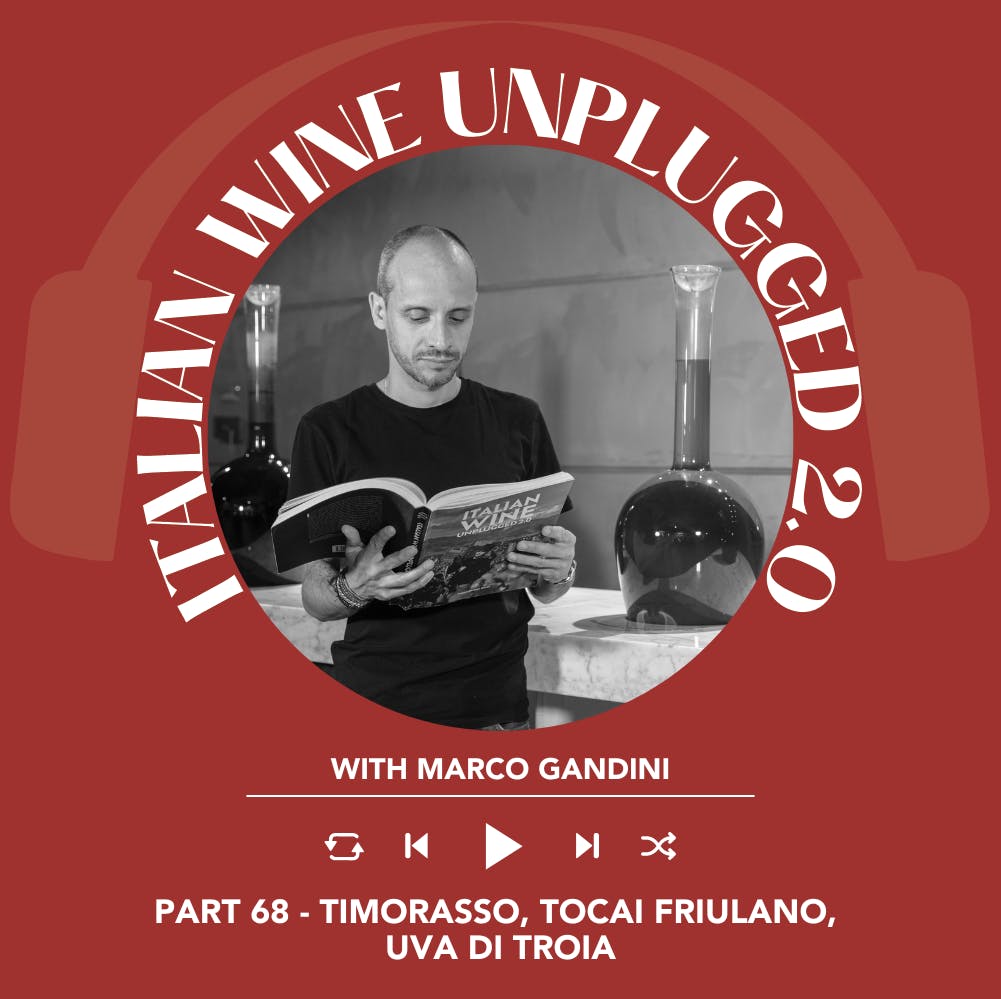
Ep. 1920 Marco Gandini Narrates Pt. 68 | Italian Wine Unplugged 2.0
Italian Wine Unplugged 2.0
Episode Summary
Content Analysis Key Themes and Main Ideas 1. In-depth profiles of specific, significant Italian indigenous grape varietals: Timorasso, Friulano, and Uva di Troia. 2. The historical context, origins, and evolution of these grape varieties, including name changes and near-extinction events. 3. Detailed examination of the viticultural challenges and unique characteristics associated with growing each grape. 4. Sensory descriptions (color, aroma, palate) and stylistic variations of the wines produced from these varietals. 5. Recommended food pairings that highlight the versatility and regional affinity of each wine. 6. The role of pioneering producers in the resurgence and recognition of these indigenous grapes. Summary This segment of the Italian Wine Podcast provides comprehensive descriptions of three distinct Italian grape varietals: Timorasso, Friulano, and Uva di Troia. It begins with Timorasso, a white grape from Piedmont that was nearly abandoned but was single-handedly rescued by Walter Massa. Known for its remarkable aging potential and complexity, Timorasso produces a full-bodied wine with intense fruit, honey, and floral notes, evolving into minerality and petrol hints with age, pairing well with light appetizers to richer seafood. Next, the text details Friulano, a prominent white grape from Friuli-Venezia Giulia, formerly known as Tokai. It explains the successful Hungarian claim to the ""Tokai"" name, forcing Friulian winemakers to adopt ""Friulano,"" which unexpectedly boosted its regional identity. Friulano wines range from crisp and youthful to rich and full-bodied, often displaying citrus, pear, and tropical fruit aromas complemented by meadow flowers and a characteristic bitter almond finish, famously paired with local prosciutto and cheeses. Finally, the analysis covers Uva di Troia, an important red grape from Apulia, characterized by its high polyphenol content, yielding intensely colored, tannic wines. It discusses the grape's Adriatic origins and the historical practice of blending it, contrasting with modern efforts to produce high-quality monovarietals. Despite viticultural challenges like asynchronous ripening, Uva di Troia offers a bouquet of violets, dark fruits, and spice, with refined tannins, making it an excellent match for roasted meats, ragu, and semi-hard cheeses. Takeaways * Timorasso: A white grape from Piedmont rescued from near extinction by Walter Massa, known for its exceptional aging ability and complex aromatic evolution (fruit, honey, mineral, petrol notes). * Friulano: A white grape from Friuli-Venezia Giulia that underwent a forced name change from ""Tokai"" due to Hungarian exclusivity, ultimately strengthening its regional identity; characterized by a pleasant bitter almond finish. * Uva di Troia: A red grape from Apulia with high tannin and color concentration, historically blended but increasingly produced as an elegant monovarietal, despite challenges in its viticulture. * Indigenous Grape Importance: The podcast highlights the distinct character and historical significance of Italy's native grape varieties, many of which face unique viticultural challenges. * Producer Impact: Individual producers (e.g., Walter Massa) play a critical role in preserving and promoting lesser-known or challenging indigenous grapes. * Regional Identity: Grape varieties are deeply intertwined with their regional terroirs and traditional food pairings, contributing to a unique cultural experience. Notable Quotes * ""Timorazo is highly regarded for its ability to age and achieve complexity."
About This Episode
The Italian wine podcast and series called "unsure wine" are a must read for wine lovers, with a new series called "ugly wine" made from hybrid hybrid drink. The region is known for its diverse vines, including fruit peach, fruit peach, and fruit peach, and has a large number of wines, including a record of a specific wine called Fairfield. The fruit and vegetable industry is discussed, including the use of conspicuous herbs and flinty mineral character, the importance of skin contact, and the use of fr married couples. The regions and regions, such as in Italian wine, are also discussed, along with traditional pairing and regions, such as in Italian wine, and the use of barge and wines. The podcast is promoted, and viewers are encouraged to subscribe and rate the show.
Transcript
The Italian wine podcast is the community driven platform for Italian winegeeks around the world. Support the show by donating at italian wine podcast dot com. Donate five or more Euros, and we'll send you a copy of our latest book, my Italian Great Geek journal. Absolutely free. To get your free copy of my Italian GreatGeek journal, click support us at italian wine podcast dot com, or wherever you get your pots. For all the super wine geeks out there, we have a special new series dedicated to you. We are reading excerpts from our new addition of Italian wine Unplugged two point o. Wine lovers tune in for your weekly fix. Only on Italian wine podcast. If you want to own a copy of this new must read Italian wine textbook, just go to amazon dot com or visit us at mama jumbo shrimp dot com. Timorazo. Description found in the wine region in southeastern p mines. Timorazo is highly regarded for its ability to age and achieve complexity. However, it was almost abandoned due to Viticulture challenges and its irregular yield. As a grape, it has been present in the province of Alexandria for centuries with the first written records confirming its existence, coming from an agricultural treatise written in the fourteenth century. The di Ervazenda family's and demographic bulletin, eighteen eighty five, declare that in the late nineteenth century, timorazo was the most widely cultivated varietal in the area around Dertona, formerly known as Dertona. In modern times, Waimekur Valter Masa has been acknowledged for single handedly rescuing the grape from extinction and initiating a crusade for its resurgence. He produced the first vintage of the one hundred percent timorazo in nineteen eighty seven from less than five hundred vines rescued on his estate. He proposed that extended lease contact could help the wine develop complexity as it does not benefit from Oak aging. From a few actors in the late nineteen eighties, to the current two hundred and fifty under cultivation, timorazos meteoric rise, has called for the introduction of the Coli Thortonese Dertona sub zone. End the vineyard, usually relatively compact medium large, pyramidal, and often three inch bunches with large berries with thick waxes skin of yellowish green color. Synchronous moderation is one of the challenges that growers face as are timorasa's challenging flowering and fruit set issues, especially in the cooler local climate of the growing zone. Alarmingly, to berries also fall off easily in windy conditions. The choice of the vineyard sites protected with good ventilation and exposure and skillful management throughout the ripening process are essential. In the glass, deep lemon color intense fruity sands of pear Africa, and peach jump from the glass often with a hint of tropical fruits. Honey nodes are typical and so are the flora aromas of Acacia and Hothorn. After two, three years of aging, the minerality becomes more noticeable accompanied by tertiary notes that refine the wine. Specific styles, dry still white wine, when young timorazo is already intense full bodied and peeling. Consider a wonderful combination of acidity and depth with tangy fruitiness, savoriness, and splinted limestone minerality. With more time in the bottle, complexity balance, power, and finesse, come together in the mouth filling character. Aging brings out the aromatic nodes, the petrol and the hydrocarbons, which are a remarkable feature of this varietal. At the table, The most straightforward bottles are excellent with fresh goat cheese and light appetizers such as vitello tonnato, veal with tuna sauce, as well as stir fried dishes of chicken, tofu, and vegetables. More complex expressions call for creamy dishes such as vegetable curry with coconut milk, seafood spaghetti, or risotto. H timorazo is complimentary with saffron risotto with truffles and a decadent pairing with oysters and juicy prawn recipes. Also consider an excellent meditation wine associated regions and DOPs. Panchmark producers, Walter Masra, Claudio Marieto, Claudio Marieto, vigna yoli, but to continue. Description primarily found in friuli Veneza, Julia, where it is a prominent varietal in almost all DOP periods. Also formerly known as Tokai, it might have originated in Veneto, but it has been cultivated in Fruliva, Vanessa, since the seventeenth century. A counter theory is that Frulano had started its journey in southwestern France as souvenists or sovignon Wach, both names still considered to be synonyms for this grape. Even though there is no proven connection with sovignon blanc, the two grapes share more than one common empalaography trait a coincidence that led to Friolano cuttings being mistakenly exported and planted in faraway Chile. The first official record of a tokai Frulano wine made from sovignon Vergh Frulano seems to be in nineteen thirty two. At the same time in Hungary, other wines were made by the name Tokai. Upon joining the European Union in two thousand four, Hungary successfully obtained exclusive use of the name Tokai for their wines. With great disappointment, pre aluminum winemakers had to come up with an alternative. They decided to refer to their white grape and it's resulting wine simply as which has served very well as an unexpected marketing bonus locating the wine firmly in its terrace. End of vineyard. Friolano but late, but ripens early. Figor is high and yield must be controlled to maintain quality. Bunches are medium size and well filled with small to medium berries golden with orange tints when ripe. Its thin grape skins make it susceptible to various forms of rad and mildew. Therefore, drier vineyard sites are more successful for this varietal. In Fuele's hillless vineyards, the typical Marley, Pongka soils provide good drainage to create wines with weight, and distinctive minerality and better potential for aging. The flatter southern part of the region has scenty and clay soils and a climate regulated by sea breezes, which influence the character of the wines as lighter fruitier, youthful, and easy to drink. Two primary clones are available to growers. The more common green clone, sovignon berg, leans toward a crispier lighter character. In contrast, the rarer, yellow clone, sovign units has smaller berries and leans toward its spicer, delivery, and body. They are often blended and even co planning to achieve balance and complexity. In the glass, bright lemon to golden color, the nose is always intense with fruity aromas and citrus, pear, peach, and tropical fruits, along with notes of meadow flowers and aromatic herbs like mint, thyme and sage. Are you enjoying this podcast? There's so much more high quality wine content available from mama jumbo shrimp. Check out our new wine study maps. Our books on Italian wine, including Italian wine unplugged, the jumbo shrimp guide to Italian wine, Sanjay, Lambrusco, and other stories, and much much more. On our website, mama jumbo shrimp dot com. Now back to the show. This are complimented to a varying degree by intriguing notes of balsamic herbs and a flinty mineral character. Acidity is generally sustained, milder if the wine undergoes melatic fermentation. Typically well balanced, the wine is medium to full bodied and elegant closing on a pleasant mouth fill with a characteristic, pleasant bitter almond f taste and a long finish. Specific styles, dry still white wine, stylistically, it ranges from light and crisp youthful wines to richer and full bodied examples matured in oak. Skin contact also intensifies the grapes character and aging ability, and there's potential for very high alcohol levels, fourteen point five percent volume, not being uncommon. At the table, In friuli, a glass often accompanies the region's Hallmark prosciutto's of which Sandanele and Salis are the most renowned. Another traditional pairing is with Montezio cheeses often used to make frico, one of the best local dishes. It has an affinity with seasonal asparagus and eggs, frittata with herbs, minestrone or barley risottos, and it's also a suitable match for white fish dishes and roasted or grilled chicken. Associated regions and DOPs. Frulli, grown everywhere in the region. The best examples come from, and DOC. Venedo Pave DOC. Lizzo Prava DOC. Outside of Italy, the grape is known in slovenia as the word tokay backwards and is found in the Vipava valley and British Caberda. Benchmark producers, ikliva, canosa, livio Feluga, Marko Feluga, Venica, and Venica, Ronkodel Niemits, Polentech, Gigante, Taurus, Storm Doro Princic, Levin, description found in Apulia. Also commonly referred to as in terms of vineyard area, approximately one thousand eight hundred hectares, it is now the third most planted native red grape after negromaro and primitivo. The in the name refers to high polyphenolic content contained in the grape skins that give the wine an intense ruby red color which at times may seem black. It is also known as troyano, Uva de la marina, Barletana, or Uva de Barleta. As ascertained by recent DNA testing, the vine originated somewhere in the Adriatic basin, and it's believed to have arrived in Apulia with ancient Greek colonists. Its name also could refer to the Albania town of Kruja. The name translates as Troy which is across the Adriatic sea from Apulia or even to the nearby town of Traya in northern Apulia. Ova Ditrya is also naturally high in tannen. In the past, This was offset by blending it with other varieties, mainly Montepucha. Thanks to the modern verification technology and a global thirst for indigenous grapes, giant steps have been made to produce high quality elegant monoviritals. End of vineyard, good vigor and medium productivity, it adapts easily to all forms of training and pruning and has no special land requirements. The barge is medium compact, large, pyramidal, simple, or winched. The berry is also black medium spheroid with thick skin, almost violet covered with blue. Late ripening, but its skins are susceptible to somburn. Light sensitivity to powder and mildew, and the Favonia winds typical of the area. A synchronous ripeness also means that the grapes require several passes at harvest and some might rot on the vine before full phenolic maturation is achieved. For this reason, many choose to pick early and make Rosados, even though it is a low asset culture. Some of the very cultural issues have been improved thanks to clonal selection. There it says two main yet very different biotypes, the barletta or ruevo and the canosa. The first exhibits large sized clusters and loose berries that deliver fragrant perfumes and freshness while the second develops smaller cylindrical clusters and berries. The canosa expresses itself with gray color and structure. Still due to its restrained harvest and challenging nature, the canosa has almost been abandoned by growers looking to secure more consistent yields. Planded they make the perfect style. In the class, intense ruby red color tending to purple The typical bouquet of violets, red and black fruits such as cherry and black currant is exquisite with black pepper, tobacco, and licorice notes. The same aroma of violets and fruit mingles with notes of vanilla star anise, herbs, and spice on the palate leading to a persistent finish. The taste is dry, tenic, fresh for acidity, and with a good body, and refined tenants, and sustained alcohol. Best enjoyed with a few years of vintage, but the best wines improve for up to ten years. Specific styles, primarily dry, still in the last twelve to fourteen years, there has been a move toward producing monovarietal wines expressed the elegant varietal characteristics fully. In a blend, this variety confers considerable finesse and freshness on wines containing primitivo Nigramaro and Ayanyiko. Other reason developments and verification include vinify rosato or even white wines. At the table, pairs well with the savory taste of roasted, stuffed and stewed poultry. Also semi hard cheeses and cooked vegetables such as various cabbages. It is a great match with pasta dishes such as tayatela with rabbit ragu and a homer or a with chimedirapa. Other traditional regional pairings include sweet and sour lamb or goose, guinea fowl, with sage, Fava bean puree with wild chicory associated regions and DOPs. Ova D'Traya is best agricultural specimen in the province of Fogyak and the upper side of the province of Bali. The most important ablation is the Castel Monte d o p and it's two sub zones, Castel d o c g and Castel also blended into other GOP wines. Benchmark producers. Cantina for a rare example of Nero Ditroya, VINified wipes. Listen to the Italian wine podcast wherever you get your podcasts. We're on SoundCloud, Apple Podcasts, Spotify, email ifm, and more. Don't forget to subscribe and rate the show. If you enjoy listening, please consider donating through italian wine podcast dot com. Any amount helps cover equipment, production, and publication costs. Until next time. Chichi.
Episode Details
Keywords
Related Episodes

Ep. 2787 Prosecco Superiore by Dr Susan H. Gordon | Book Club with Richard Hough
Episode 2787

Ep. 2784 The Other Side of Valpolicella: Volcanic Soils & Sparkling Wines with Francesca Marcato of Talestri Winery | Wine, Food & Travel with Marc Millon
Episode 2784

Ep. 2780 The Bridge between the Past and the Future of Wine with Serena Costanzo from Palmento Costanzo on Etna | Clubhouse Ambassadors' Corner
Episode 2780

Ep. 2773 Trento DOC: one of Italy’s finest sparkling wines with Alessandra Caroni of Maso Martis | Wine, Food & Travel with Marc Millon
Episode 2773

Ep. 2749 The Many Faces of Etna: Climate, Contrade and the Art of Volcano Winemaking with Federico Graziani | Wine, Food & Travel with Marc Millon
Episode 2749

Ep. 2744 Ep 25: Pantelleria, Salina e il fascino del vino insulare | Pellegrinaggio Enoico con Attilio Scienza
Episode 2744