
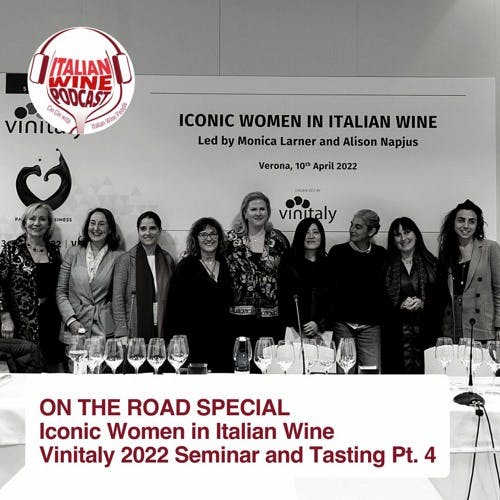
Ep. 905 Iconic Women In Italian Wine Pt. 4 | On The Road Vinitaly Edition
On The Road Vinitaly Edition
Episode Summary
Content Analysis Key Themes and Main Ideas 1. The multifaceted concept of sustainability in Italian wine production. 2. Challenges and opportunities in communicating sustainability and unique identities of Italian wineries. 3. The growing importance of storytelling and cultural context in wine marketing. 4. The role and experiences of ""iconic women"" in the Italian wine sector. 5. The need for collective action and collaboration in driving industry changes. Summary This segment from the Italian Wine Podcast, recorded at Vinitaly 2022, features a panel discussion with ""iconic women in Italian wine,"" including wine producers and journalists. The discussion primarily revolves around two key themes: sustainability and communication. Panelists emphasize that sustainability is a complex term encompassing environmental, economic, and social aspects, and there's a significant challenge in clearly defining and communicating it, especially given the lack of unified certification. They highlight the agricultural responsibility of winemakers to soil fertility and future generations. The second major theme is the critical role of storytelling in a changing world, particularly post-COVID. Panelists argue that moving beyond numerical scores, producers must communicate the full narrative behind their wines, connecting them to the unique terroir, local culture, and history. The conversation also touches on the distinct challenges and successes encountered by these women in the industry, advocating for collaboration and a shift towards authentic, localized narratives that resonate with consumers and differentiate Italian wine in the global market. Takeaways * Sustainability in Italian wine is a holistic concept that goes beyond organic/biodynamic practices, including economic viability and social responsibility. * The lack of a unified, cross-border certification for sustainability creates communication challenges for both producers and journalists. * Storytelling, which connects wine to its territory, culture, and the people behind it, is becoming increasingly vital for Italian wine's competitiveness. * Producers are encouraged to find and communicate their unique, original story rather than adopting generic marketing approaches. * Collaboration among producers (e.g., co-ops for sustainability) is seen as a powerful way to drive industry-wide change. * Italian wine communication to foreign markets needs to contextualize wine within Italy's broader cultural heritage (art, history, cities). Notable Quotes * ""The world's sustainability is a complicated word to use. This is very much very open... It is a puzzle made of many things."
About This Episode
The importance of sustainability in the Italian wine industry is discussed, along with the need for certification and creative and responsible practices. The challenges of communicating about their work and finding the original story of each winery require attention, and the industry needs to create a new story. The importance of communication and sustainability is emphasized, and a donation to help other wineries is offered.
Transcript
Welcome to iconic women in Italian wine on the Italian wine podcast. This recording was taken from a seminar that took place during Vin Italy twenty twenty two. Listen in to this unprecedented unique session that included two competing wine writers and seven renowned wine producers sharing a stage to tell their stories. This was a meeting of hearts, minds, and wines, a showcase of the communication skills of women who were able to pool their resources and put aside differences to come together for the greater good of the entire Italian wine sector. So I would really open it up to all of our, producers, all of our panelists here to mention if there's something special they would like to say, in the winery that they're focusing on, how you're facing climate change. We have wineries from north to south in Italy, and we know that it's a difficulty everywhere. So, please, sustainability is the topic. Alviera, I see, maybe? I think the world's sustainability is a complicated word to use. This is very much very open. In the sense that if to somebody can mean biodynamical, biological, for what I see in the perspective, I see. It is a puzzle made of many things. Obviously, with the final objective of leaving something better to the next generation. And this goes not only in the field, also in, in, in in the winery, but also across the workers across the sales, across lots of parameters. And that I wish that, we are we we should have in Italy one certification that says sustainable because if not, it becomes really difficult to set a space and go and go along. I literally admire, for who manages, to do biological or biodynamical in some area. It is difficult. So some wineries should have the option of, how you say, compensate with other things, you know, that you have something at the end that is really, on a hundred percent sustainable. Not only as Priscilla said. It has to be economically also sustainable. Great. And, Ellen? L is on a try. Okay. Because I try. And, for me, I mean, we work, in the logic in, outside inside in Sala. And, our new seller is, all in by your kid. The first seller in, in basilicata is the first seller in basilicata. We use all in the recycle material for the construction. We recycle the raining water. We are energetics in part zero because every energy we consume, we produce, and that the solar panel help us in this. But, the building is energetics in part zero. It's a you know, in in Italy. And, for me, this is the first step for the new generation for the new. This is my my work and we are theologic and we are before for us because we live and we work with the whole family in the vineyard and, in the, our, our town and after for all you and for all the work. And, for me, this is, the first step because I'm a very small, very, very, very small seller. And, this is my contributor for, for the for the new generation. And and is it better? Yes. This is a very, very complex, item. But the first thing that I think we are farmer because we are farmer. We are also be medical authority, but we are found. We are responsible for the fertility of the soil, which is our richness. It's not only for making wine, for making what we have to eat. And this is not very difficult to do. I mean, father my experience in the last thirty year working, you know, everybody choose with way, but, to be, self produce all the fertility for your soil, which is the main item for the biodynamic method is a very important thing because the new, I mean, the new the human being forgot how important these agriculture And perhaps in these days, which are very dramatic, which the cost of the fertilizing is, I don't know how much is going up. Everybody say, oh, what's going on? We will die because we don't have enough wheat or but this is a perverse, cycle of the human being who who push in one direction, but in fact it's irresponsible for this, for the next generation. And this is for us the first, step because we choose to do in another way. And I I say you is really not difficult. It's just to see things with other prospection, and, to be farmer who are creative and responsible for the for the future or the soil. And then whatever is grave is, me is So, yes, but I I know it's a complex item. So we were just my contribution to that. Thank you. I mean, I think that, as he ends your show, when you talk about sustainability. It it goes everywhere from developing more biological material in their soil all the way to the solar panels on top of the winery and shipping your line. So there's so many different layers to it. But, you know, this idea of doing more for the future of the next generation is, I think, an important one to everybody who's here on this panel. Before I open questions to the audience, Monica, do you have anything you want to ask or any other comments? Do. I do. I definitely wanna get two questions from the audience. But before I do, I have a question that kind of throws, the responsibility back on us as wine journalist, Allison and I. We work, with giving points to wines. We give we think about a lot of these wines in a numerical sense, which can be limiting, but it's also very effective, and it communicates the quality of a wine. And I wanted to open up to the panel this question. Now that we're going through what we've been through with COVID and the world is changing. I think we all agree that storytelling or telling the whole story behind a wine is becoming increasingly important. Can we improve that? How can the producers communicate differently their wines and how can journalists also get some of the story across. It seems that as we go forward, this is the real way to help Italian wine be more competitive is to have the down down to the, you know, soil down to the producer, down to the winery, down to the vineyard, down to the last walk, story told behind the wines. I'm just wondering if there's any thoughts on that. And then I think we should definitely take questions from the audience. Thank you. I would like to add something about today, Susanna Bummer time. And, I think that, in in the three minors that, I am a living many projects are in support of me. In all the binary we achieved the sustainable certification, but this is something that is difficult to communicate to consumers because in term of uh-uh institution, we don't have this friend and we don't have the possibility. I know that the organic is recognized, but the sustainable certification is something that is going on. And, I think that, we have to be to develop more sensitivity on the consumer about this thing. And definitely, sustainable organic is a trend, but we definitely go on because we want to respect an environment is our main task and we also want to respect the the people that work in the vineyard. So, we change completely our approach to the beauty culture in the last any of. Yeah. I could I'm sorry. I'm not going to get to Monica's question. I could just reply to that, but, you know, at once back to you there, we have talked many times over many years about wanting to write about sustainability, about organic, about biodynamic, But as you said, it's just so there's no clear definition. It becomes very hard to write about it in a way that consumers will understand. So it's, you know, it's a it's a real challenge, and I agree that needs to be more regulations that cross borders also. Because in the United States versus Europe, there's different categories and different certifications. Kiara, you wanted to add something? Yeah. I would say I'm doesn't matter the certification or the law, whatever. I'm glad that is we are almost delayed. The change of the environment, the change of the weather is here to stay. So I don't know if we're still in time, but we have to move They have to act. They don't even talk about just everybody does have to do their own part. I think we'll do it this table. I know a lot of organic, moldonomic. Okay. Which is important to see what we know respect by the environment to be on the way. And it's important that, that normal development, we cannot expect that the big boss of the world would kill him all day. There are taken us into a role. They're attacking us into the disaster. So I think we have to do us is one of the most now, I think. Yes. Definitely. And, Monica, do you have a little bit address your question to send it on a specific one? Because you have a picture and call on them. Basically, I just wanted to ask, how can we improve communication of wine, especially since we're dealing with iconic women, how do we tell the stories better? Maybe yeah. And then maybe to extrapolate all of you are communicating about your minds right now and have done a great job. And this is why your iconic women have been some of your challenges and successes perhaps. And and how should we, help you with that storytelling? No. I think that the way to communicate better is, not just to speak about our production, but to speak about the territory where we live and the value that we have. In Italy, we have beautiful arts. So we have beautiful cities. We have, beautiful monuments. So we have cities that, like verona, for example. It has a Roman, medieval, and Renaissance city. So we have to put the product, the agricultural product, and not just wine in a cultural context. And this is for me is the future of the Italian wine production. I may take it to the other end. And Ariana asked you to speak. You know, as I mentioned, I think that your your name became well known, but I think you have to talk about Spectato and talk about Victoria and talk about Victoria in a larger context and not just your binary. So can you can you maybe talk a little bit about your early experiences, communicating what you were doing? How we want to communicate to the one in our future because after two years of COVID, I think, every change for me. For example, I'm in a moment of, a lot of thoughts about this. I'm trying to to have a break from, some events because I need to reflect it. And, I think I have to come back, to the truth. The real part of our life. In my long life, a lot once and is done. We talk about everything. We now is the moment of sustainable this, so we are talking about this. And, in aside, I'm very happy because, everybody's trying to do the best they can in, their farm. So it's it's very good. I'm also part of a new group in Sicily that is called sustained is a foundation. We are trying because sustainability is a personal journey, but this also something that's unique to do in group. So in this moment of my life, I am trying to twelfth also other producer in Sicily to transform their idea to make wine and, to manage their farm, also in cooperative. Because if we change two thousand vineyards in a cooperative, we are changing a lot of the actors of vineyards. So I'm trying to work in this, but, I had no idea what is the future of the world now about communication. I think we have to to do what we feel. I feel myself more in the production. So I will, be in the place where I'd be comfortable. I with myself. And, the most important thing is to concentrate our work in our place to work really in, in the agriculture that we choose to to have and, trying to to bring our, our method to our to other people and to transform a step by step because it's not very easy to I CC. It's really easy to make a sustainable in the culture. But, I hope that's is not is not very fast inside because it's a personal journey. So we we must do because everybody's making. But, I think a real change will be when everybody start to feel every day in a in their life, in their choice. Even when we buy from the supermarket, Even that when we do every every action in our life, this is the real change. So, the communication on the of the wine water is, difficult things for me at the moment. So maybe you will help us to to find an answer better. I mean, I think that, it's important. As you said, you're taking a moment to sit back and pause and think on it. And I think that, we all in whatever work you're doing, you need to always take time to periodically check-in and see what the next steps are, what the new direction is, and and this is how we all really move forward and even your personal life. So Do I wanted to see, do we have any questions from the audience on the cards? Let me kick it off. I'll I'll pretend I'm from the audience. So I'm going to say something very unpopular as I always do. I think a communication of wine is something very dear to me. And I think, frankly, the communication that goes on Italian wine, especially is the fault of Antinori family because They have such a wonderful, beautiful, twenty sixth generation of story to recount, and everybody everybody wants to be La Quintanore. That's what I face as an agency. Right? When I'm doing agency work, I want my, home page to be, like, anti no worries. But, okay. Hold on. I must say, I really appreciate Avrieta, because you did only charge your first generation and work us all the way throughout twenty six. You know, we're on topic and concise about telling your history. So, yes, you're the good cop. So, the point is I think, we have to all of the wineries have to find an original story, right, because we throw the word sustainability in a very, very casual way. Right? And and as I get him mentioned, it has to be also economically sustainable. That is an issue that we don't really address because we like the romantic story of the generation and the terror and everybody. If you took an advertising page, even spectator or advocate, you take a page, and all the families in their barrels and their cellar and you cut out their face and replace it with anybody else, it will be exactly the same. So in terms of the communication, I think we are struggling because we have to find the uniqueness and original story of each winery. And I think that is something that we have to ask ourselves. I think you are all up here because you all have an original story to tell. And that's what I think everyone else has to do. And that's I know I'm not very popular, but so I just had to get that off my chest. Anybody? We have, I think, Cynthia with a mic? Yes. I I haven't really understood what you meant by, it's all until he's found. But some of this, I think here, the point is we need to get our wines always better and better. And journalists need to find the stories and tell them the better it is. So let's not mix them too much to do. Yeah. Actually, the owner of Ryan Spectator always says that he he wants to hire a fresh journalist because you can teach people about wine, but to find the story is a lot harder. So I agree. This is the important thing. But, you know, I will also say I think Marissa made a very good point, in terms of talking to foreign markets, you need to also consider that people don't always understand where you're talking about. I mean, to most Americans, Italy is Florence Roman Venice, and and maybe they've heard of Milan, you know, so you have to start somewhere that and equate it and make it understandable. And I think that all of these women and do that while telling their own personal stories and their own original story. If we don't have any quest do we have questions from the audience? I I do have one kind of one geeky question if we can dive in a little bit. We have a number of people here who have officially made wine. Oh, okay. Sorry. Kathy. Kathy, you have a question? Oh, sorry? No. Yes. Yeah. Go for it. Sorry. I feel like the the bigger question where you were going is far more interesting. But I wrote a I wrote a question down. It's actually for Kiara, about the single crew. When you were talking about the single crew, what has it taught you to do the single crew that will inform how you work with the awesome blush with your other wines? Yes. I was telling you the story. This is a nice story. Of the middle of the way is young. So what's happened is that, many years ago at the end of the eighties, we were a bunch of young way makers, and we were trying to, to to taste as much wine as we could. Because we are all small winery. It was more winemakers. We were doing, of course, the unification in, Charlie. So we were comparing the one from Barolo, Kanuvi, the Barolo from from other villages, and now we're really astonished by this diversity. But if you stay on your own little relation, you don't make it, you don't make this experience. So only with this, help of this group, but naturally there was a a very revolutionary thing because in the past, but there was always work work alone. So for the first time, we got it together, and then we kind of, yeah, we met this solution first inside mentally speaking that's, was the the idea was to help each other to learn more and to, and to grow. And those things that cannot, enter our eyes as well as the uniqueness and the incredible beauty of this diversity. So for us, was immediately in the direction to go. We started to develop this, dynamic, choice of unification in priority. And and all in all, in fact, finding in two thousand and ten. We also the recognition of the enjoying that the fire wasn't existing. So, you know, the regression that I never decided the barber of the of the single renewed But I also noticed that I started also to appreciate it as a nurse that has a traditional air or metal one. So, again, it's really, you know, to have merchants, more options. So, like, the lancia woman said, No one has to write that. Listen to the Italian wine podcast wherever you get your podcasts. We're on SoundCloud Apple podcasts, Spotify, email ifm, and more. Don't forget to subscribe and rate the show. If you enjoy listening, please consider donating through Italianwine podcast dot com. Any amount helps cover equipment, production, publication costs. Until next time. Hi guys. I'm Joy Living Denon. I am the producer of the Italian wine podcast. Thank you for listening. We are the only wine podcast that has been doing a daily show since the pandemic began. This is a labor of love and we are committed to bringing you free content every day. Of course, this takes time and effort not to mention the cost of equipment, production, and editing. We would be grateful for your donations, suggestions, requests, and ideas. For more information on how to get in touch, go to Italian wine podcast dot com.
Episode Details
Keywords
Related Episodes

Ep. 2787 Prosecco Superiore by Dr Susan H. Gordon | Book Club with Richard Hough
Episode 2787

Ep. 2784 The Other Side of Valpolicella: Volcanic Soils & Sparkling Wines with Francesca Marcato of Talestri Winery | Wine, Food & Travel with Marc Millon
Episode 2784

Ep. 2780 The Bridge between the Past and the Future of Wine with Serena Costanzo from Palmento Costanzo on Etna | Clubhouse Ambassadors' Corner
Episode 2780

Ep. 2773 Trento DOC: one of Italy’s finest sparkling wines with Alessandra Caroni of Maso Martis | Wine, Food & Travel with Marc Millon
Episode 2773

Ep. 2749 The Many Faces of Etna: Climate, Contrade and the Art of Volcano Winemaking with Federico Graziani | Wine, Food & Travel with Marc Millon
Episode 2749

Ep. 2744 Ep 25: Pantelleria, Salina e il fascino del vino insulare | Pellegrinaggio Enoico con Attilio Scienza
Episode 2744