
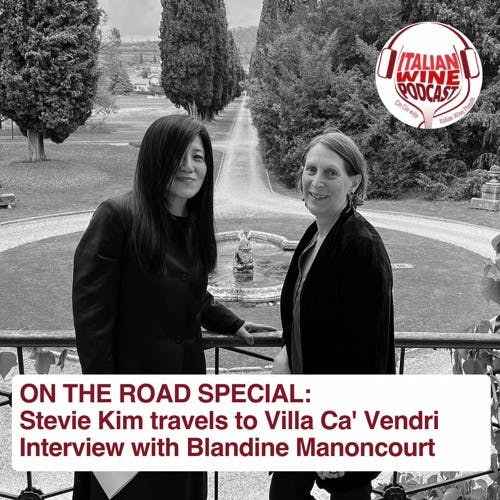
Ep. 1032 Blandine De Brier Manoncourt | On The Road Edition With Stevie Kim
On the Road with Stevie Kim
Episode Summary
Content Analysis Key Themes and Main Ideas 1. The legacy and unique identity of Château Figeac in Saint-Émilion, Bordeaux. 2. The family ownership and multi-generational involvement in running a prestigious wine estate. 3. The significance of terroir and specific grape blends in defining a wine's character. 4. Adaptation and resilience in the face of challenges like the COVID-19 pandemic and climate change (frost). 5. The Bordeaux wine classification system, particularly the Premier Grand Cru Classé A status. Summary In this ""On The Road Edition"" of the Italian Wine Podcast, host Stevie Kim interviews Blandine de Riqueur de Manoncourt, a co-owner of Château Figeac. Blandine discusses the history of the esteemed Bordeaux estate, family-owned since 1892, and its home in Saint-Émilion. She highlights Figeac's unique Premier Grand Cru Classé A status and its distinctive grape blend of equal parts Merlot, Cabernet Franc, and Cabernet Sauvignon, unusual for the region. The conversation delves into the estate's special terroir, characterized by gravelly soil over blue clay, which contributes to the wine's distinctive character. Blandine also shares how the family, including four sisters and their active mother, manages the estate alongside a professional team. The discussion touches upon the challenges faced during the COVID-19 pandemic, including building a new cellar and adapting to En Primeur sales by carefully distributing samples to critics. She also mentions the impact of frost, noting Figeac's resilience due to their deep understanding of their specific plots. The episode concludes with a mention of an upcoming masterclass focused on Figeac's terroir and a tasting of three different vintages. Takeaways * Château Figeac is a historic, family-owned estate in Saint-Émilion, Bordeaux, renowned for its Premier Grand Cru Classé A status. * Its distinctive character comes from a unique 1/3 Merlot, 1/3 Cabernet Franc, 1/3 Cabernet Sauvignon blend and gravelly soil over blue clay. * The estate is actively managed by the Manoncourt family (four sisters and their mother) in collaboration with a professional team. * Château Figeac innovated during the COVID-19 pandemic by continuing construction and carefully distributing En Primeur samples. * In-depth knowledge of terroir is crucial for mitigating risks like frost. * The Bordeaux wine classification system (especially Saint-Émilion's ten-year renewal) serves as a booster for quality. Notable Quotes * ""We are in Chateaufizac. We've been there since eighteen, eighteen ninety two. So eighteen ninety two are a family. And, now it's still a family hundred percent family owned business. And it's not only a business. It's also a place to live."
About This Episode
The hosts of the Italian wine to wine business forum discuss various edition of their show, including an upcoming edition on Nostona in Japan and a tour of a property in London. They also mention their own winery and the classification of their wines. They discuss their roles and personal lives during the COVID-19 crisis, including managing their own sales and working on their ideas with children. They also mention their involvement in estate management and safety, as well as their approach to the mix of their wines and master class. The speakers emphasize their unique roles and personal lives during the pandemic and their efforts to improve their knowledge of the terroir and use it for their master class.
Transcript
Welcome to the Italian wine podcast. This episode has been brought to you by the wine to wine business forum twenty twenty two. This year, we'll mark the ninth edition of the forum to be held on November seventh and eighth of twenty twenty two in Verona Italy. This year will be an exclusively in person edition. The main theme of the event will be all around wine communication. And tickets are on sale now. The first early bird discount will be available until August twenty second. For more information, please visit us at wine to wine dot net. Welcome to another episode of On The Road Edition, hosted by Stevie Kim. Each week, she travels to incredible wine destinations, interviewing some of the Italian wine scene's most interesting personalities, talking about wines, the foods, as well as the incredible travel destinations. Okay. This is kind of an impromptu, mama jumbo shrimp on the road edition because I'm actually here in Verona, and we're a car vendor. Just just kind of outside of Verona. This is a very beautiful villa. I actually got married here many, many years ago. Oh, great. So I was coming here. Emotional. Yeah. I'm still married, but I was like, you know, I didn't I I didn't know. It's still the quite the same. So today we're here with I'm going to try to pronounce her name. Blandine de Rier manon Court. Yeah. Is that correct? That's correct. Absolutely. London the beginning. Of course. Of Chateau Fijac. So, blending, first of all, thank you. And can you tell us a little bit about yourself and your winery for our audience. We don't usually get a chance to speak to, French wine producers. We're very Italian wine centric. So tell us a little bit about yourself and Chatek Yes. I'm a member of the family owners of Chateaufizac. We are in Chateaufizac. We've been there since eighteen, eighteen ninety two. So eighteen ninety two are a family. And, now it's still a family hundred percent family owned business. And it's not only a business. It's also a place to live. Oh, you have in this state. We live in this state. In India state. Yes. Yes. Yes. And this is maybe why we really love it. Okay. It's much more than a business. Where are you located? It's a big a great border wine, winery. And it's located in Saint Emilion. So, Santemillion, about about thirty kilometers away from Bordeaux. And we have it's a very special territory is fifty four hectares of, estate in which you have forty one hectares of vineyard dedicated to vines. It means Nearly at all. No. It means the rest of it is not with vine, and it's dedicated to a sort of biodiversity. Okay. No. We have not only vines, but also the rest. Okay. And So it's a premier grand Cricholaset in San Antonio. One of the major, states in Sanimiliano. So what does that mean? Just for the audience, you are not aware what that means? Premier gone crew class eight. What does that mean in terms of the class? First growth. It's it's equivalent to first growth in this Yes. Because they have a special, classification. Yes. They have a special classification. Every ten years, they renew it. Yeah. I know there's a kind of a big discussion. Right? Yes. But the topic is it's San Dimino has this classification and every ten years, people dare renew it. And, this is quite interesting. It's a booster for quality. It's a booster for everybody in Santimin, you know, to to try to improve quality, improve the way they work, actually. How many labels does it? You have two. It has a little bit of numbers. You have two. You have Chateaufizac, which is the great wine. Mhmm. Okay. And we have a second wine. We have second label, petit Fizac. Okay. We produce approximately hundred thousand to hundred twenty thousand bottles of Chateaufijac and between thirty thousand and fifty thousand bottles of second wine. What is specific to Chateaufijac is the balance between the three great varieties. We have only one third of Merlo, one third, cabernet Horn, and one third cabernet sauvignon. It's very special, actual is Unick and Bordeaux. Yeah. Because when you think about, Santameon, you're thinking, of course, very low. Yes. Right? We have only thirty percent, but has it been the tradition that you've always had in three equal parts. Marlowe Capronk and It's a sort of tradition. It's a sort of tradition. Yes. Due to my my father in the fifties, he had to replant all the the estate, you know, more or less. And he's been thinking, okay, what do I do? Is it does it have sense to go on with the tradition as it is now and no change, or could we do something better? And he has been looking at the ground, the soil, subsoil conditions, and he realized we have these gravels that you don't have in San Diego. The gravel, you share it, you have six Santa Millia is what? Five thousand five hundred hectares. Mhmm. And you have sixty hectares of this gravely soil shared between us and the neighbors. Famous thing, but Right. Right. Okay. Great. And you have forty. So we have, yeah, we have most of them and three hills of gravelly soil. And under the gravel, gravel means quartz, selects, You're not pebbles. Yes. Coming from the river. Okay? And under it, you have under six meters deep. You have blue clay, the famous blue clay that gives to the vines the nutrients. Yes. So it's quite important for us. So would you say this is kind of the uniqueness about Fishac? Yes. That differentiates you in a way from even other Right. Unfamiliar pieces. Yes. It makes a difference. And it explains why people recognize Chateaufizhek's wine. When they know it, they have it again, and they recognize it because it's specific, special. Are you enjoying this podcast? There is so much more high quality wine content available for mama jumbo shrimp. Check out our new wine study maps or books on Italian wine. Including Italian wine unplugged and much much more. Just visit our website, mama jumbo shrimp dot com. Now, back to the show. So can I ask you something National? Do you have children? Yes. We do have children. We are four sisters. Right. We have children. Some of them, the eldest one, maybe thirty two, I think. Yeah. Thirty two. And the youngest is twenty. And the four siblings. Yes. Your old sisters? Yes. We are sisters. Four women. Only women. Yes. And we work with our mother. Oh, okay. Yes. Your mom's still working. Yes. She's still very active because, you know, she's been living in Fiji for sixty six years since she got married to my father, and it's her passion, you know. When you live in Fuzac, it's a passion. So how are your roles divided? So you were saying the two siblings yourself and your sister, once Yes. One sister are more in full. Yeah. In in the in Fuzac. So how are your roles divided. What do you do? Is one person an inologist, one person communication? No. We have a great team in on the estate run by a manager who is not from the family. Uh-huh. And this works very well. We are much involved in the everyday life and in the strategy, big decisions, okay, we are much involved protection, family, presence, you know, with the the workers, with people who work for us. Okay. But we have a team, and this team, the with in our in our log, Inologists. Inologists, professional engineers, in agronomy, agriculture, really we choose the best people, you know. And I just ask you a question about COVID, how how you have lived through COVID in terms of if your life changed or you did the same thing. Ah, Fizac. Yes. In Fizac. So we've been building a new seller, brand new during COVID. Yes. So How did that work out? The workers and the Yes. We spend yeah. We decided very quickly to establish rules, adapted rules for all the firms who were working during these big works, construction work. The suppliers and everybody who was working there had to sign a contract, a special contract saying here are the new rules, sanitary, sanitary rules, and only the people who agree with that can go and work. But did your personal life, your your daily life changed in any way? Of course. I mean, we all traveled less. Yes. Yes. Of course. It's my family's in New York, and I hadn't seen them in a very long time. And of course, visitors. Right? Yes. I'm imagining you had a lot of visitors Yes. To this day. Before we But, you know, when the COVID crisis came, we were already closed to visitors because we were we had started our construction works. So this was no change due to COVID. It was due to closing for works. So It's not working but actually And also Yeah. COVID by preventing us from going to see going abroad flying, okay, traveling. Obliged us to stay at Fiji and to be more to be there every day for the big works, and it was useful in, in this way. It was not so bad for us. Just the thing that was very difficult was at the beginning, we didn't know how we would sell our wines. Yes. Because we we understood we wouldn't have the on prima week on prima time. Yeah. And we said we had no idea at the beginning. Right. Right. And that was the big train. So how did you manage the the sales? We, you know, we have this special system in Bordeaux with the plus the border, the border of wine merchants. We, Afisac, sell only to them directly, and they sell it to the whole word. And it's not that. Last year, we we had our we've sent or we've, sold our twenty twenty Right. To more than hundred countries in a few weeks, you know. Right. Right. So it's not bad. It works. So how did we manage? We sent a bottle, a sample of the on primo wine to very few people, wine critics big wine critics, but we sent it under the best conditions possible that is individually. We didn't send it with a group of other estates. Right. Right. We sent it individually with with another estate, some friends, in a special box with a special traceability for temperature control. Okay. And so the critics who got the bottles the samples could check if the temperature was, Consistent. So, yeah, it worked, but then we thought, okay, we would really not like to do it. A third time. Right. And we were happy that this year, we didn't have to do it because you need the contact. Yeah. You need to be able to talk with people as long as as possible. I mean, as they want to. Okay. Nothing's better than meeting people. Yes. I absolutely agree. So one last question, were you afflicted by the frost? This year? How do you mean two thousand twenty two? Yeah. Till now? Yeah. No. Oh, okay. So you're one of the lucky ones. Yes. Yeah. Until now, no. Because maybe one of the reasons things that helped is that in these last ten years, we've been trying to progress in the knowledge of what we have. What is Fishak? How does it work? How each parcel, each plot works, all that. And we've been studying with this University of Burgundy studying our terroir. Mhmm. And we know it much better now. We know about the temperature of our IEAations, variations. We know about certain things like that, and it helps. And at the time of frost, we knew which plots are more sensitive, you know, to frost. Which ones you don't need to protect or, okay, we knew that maybe more than in seventeen. Listen, just one last last last question, I promise. So today, you're doing the master class with, Gabriela. So you're doing here, I see three three wines, three vintages. What will you be doing today? What will we what is your purpose today of your master class? Well, it's been asked to do these years. Yes. I'll present Fiji how it is and how we, you know, the family and how we consider it, and then we'll taste three vintages that are very different, but show, you know, speak about the place. The the the aim for us is to put the place, the terroir in bottle in a pure with purity. So thank you so much. Lindine, it was so, so nice to meet you. Was it okay? I'm looking forward to testing your wines. Yes. And come to Fijac. Okay. Yes. And that's a wrap with Landine. Let me do it again. Yes. Okay. Yes. We hope you enjoy today's episode brought to you by the wine to wine business forum twenty twenty two. This year, we'll mark the ninth edition of the forum to be held on November seventh and eighth twenty twenty two in verona Italy. Remember, the first early bird discount on tickets will be available until August twenty second. For more information, please visit us at y to y dot net. Hi, guys. I'm Joy Livingston, and I am the producer of the Italian wine podcast. Thank you for listening. We are the only wine podcast that has been doing a daily show since the pandemic began. This is a labor of love and we are committed to bringing you free content every day. Of course, this takes time and effort not to mention the cost of equipment, production, and editing. We would be grateful for your donations, suggestions, requests, and ideas. For more information on how to get in touch, go to Italian wine pot cast dot com.
Episode Details
Keywords
Related Episodes

Ep. 2597 Wine in Transition: Declining Demand, De-Alcoholised Wine & New Alternatives with Robert Joseph | On the Road with Stevie Kim
Episode 2597

Ep. 2595 Where Wine Won In 2025 with Erica Duecy | On the Road with Stevie Kim
Episode 2595

Ep. 2583 Women For WineSense and the Houston Rodeo Wine Competition with Amy Gross | On the Road with Stevie Kim
Episode 2583

Ep. 2564 Understanding the Albanian market with Erjola Braha - CEO of Alehandro Group | On the Road with Stevie Kim
Episode 2564

Ep. 2554 In conversation with Marco Alberti, the Italian Ambassador in Tirana | On the Road with Stevie Kim
Episode 2554

Ep. 2463 Lamberto Frescobaldi | On the Road with Stevie Kim
Episode 2463